TL;DRFive headlines
- The damage rides on the child's inner life, not the household structure. Mutually adjusted, the Sad Loner axis (childhood depression, bullying-adjacent isolation, "at war with yourself") predicts adult flourishing at β = −0.47; Broken Home lands at exactly 0.00 and Purity Culture at −0.01. Divorce, absent fathers, and church mostly mark where the misery lives, not what does the damage.
- The hypothesis going in was half right. Sad Loner survives spectacularly, and Aggro Family survives — but barely (β −0.37 alone → −0.07 adjusted, an 81% shrink). Broken Home collapses entirely, as predicted. The surprise: parental warmth (Idyllic Family) also mostly collapses (+0.37 → +0.09); Adventure (+0.10) ties it as the strongest positive.
- Honesty check: childhood is a third of the story at most. All seven axes together explain 30.6% of flourishing variance (beyond sex+age); 57% of the total variance is explained by nothing in this model. And the crowd-weighted single heaven↔hell score captures only ~70% of what the seven axes do — because the crowd weights family chaos heavily while the predictive power lives in the sad-loner axis.
- Damage is linear all the way down. No safe threshold, no saturation: each 10 points worse on the childhood score costs a steady ~0.2 SD of adult flourishing, in both sexes.
- The resilient had a differently-composed hell. Thriving survivors of bottom-decile childhoods had just as much household aggression, abandonment, and (nearly) as much sexual abuse — but far less childhood depression/isolation (d = −0.85) and more adventure (d = +0.24). They are also older, more often male, and 4× more securely attached today.
THE 7 AXESWhat the survey extracted from childhood
Each respondent rated ~100 statements about their childhood (each asked twice: ages 0–12 and 13–18, −3 = strongly disagree to +3 = strongly agree). The survey groups them into seven named axes — each axis is simply the mean of its battery. High scores mean: Idyllic Family = felt unconditionally loved, respected, parents honest and physically affectionate; Purity Culture = abstinence teaching, required religion, porn blocking, obedience-as-virtue; Broken Home = abandonment, divorce, absent father, neglect, no nuclear family; Sad Loner = "you were depressed," at war with yourself, false rumors, struggled with school, life wasted, very online; Adventure Time = played outside, risk, drugs, drinking, sex, romance; Privilege = educated connected parents, vacations, camps, no food scarcity; Aggro Family = yelling, verbal/emotional abuse, parents at war with each other, unpredictable physical discipline.
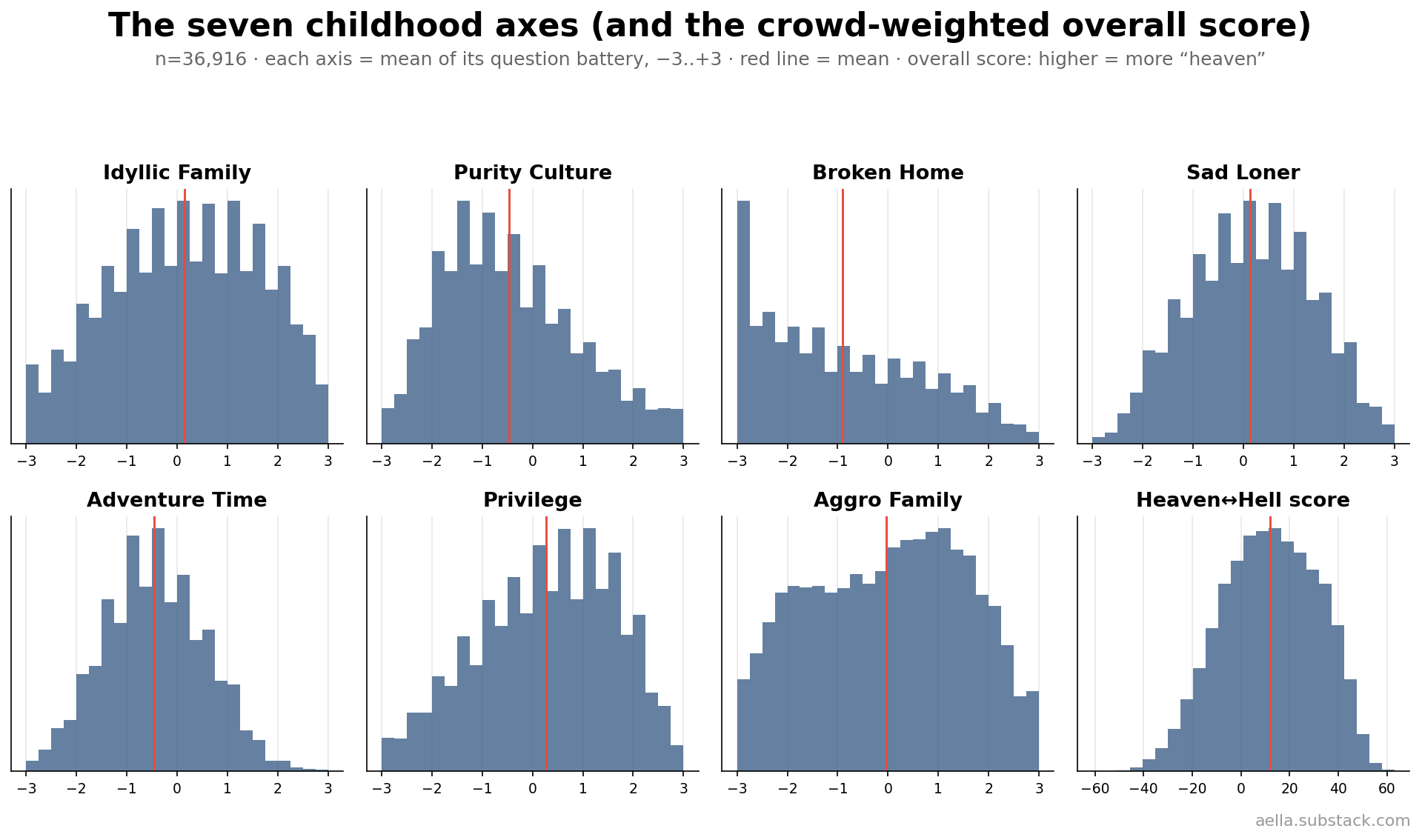
There's also badscorefinal, the survey's overall "heaven↔hell" score: every childhood item (plus the eight sexual-abuse items) weighted by crowd-sourced badness ratings. Higher = closer to heaven. It's roughly normal — most childhoods are mildly good, and both tails are well populated.
How much do the axes overlap?
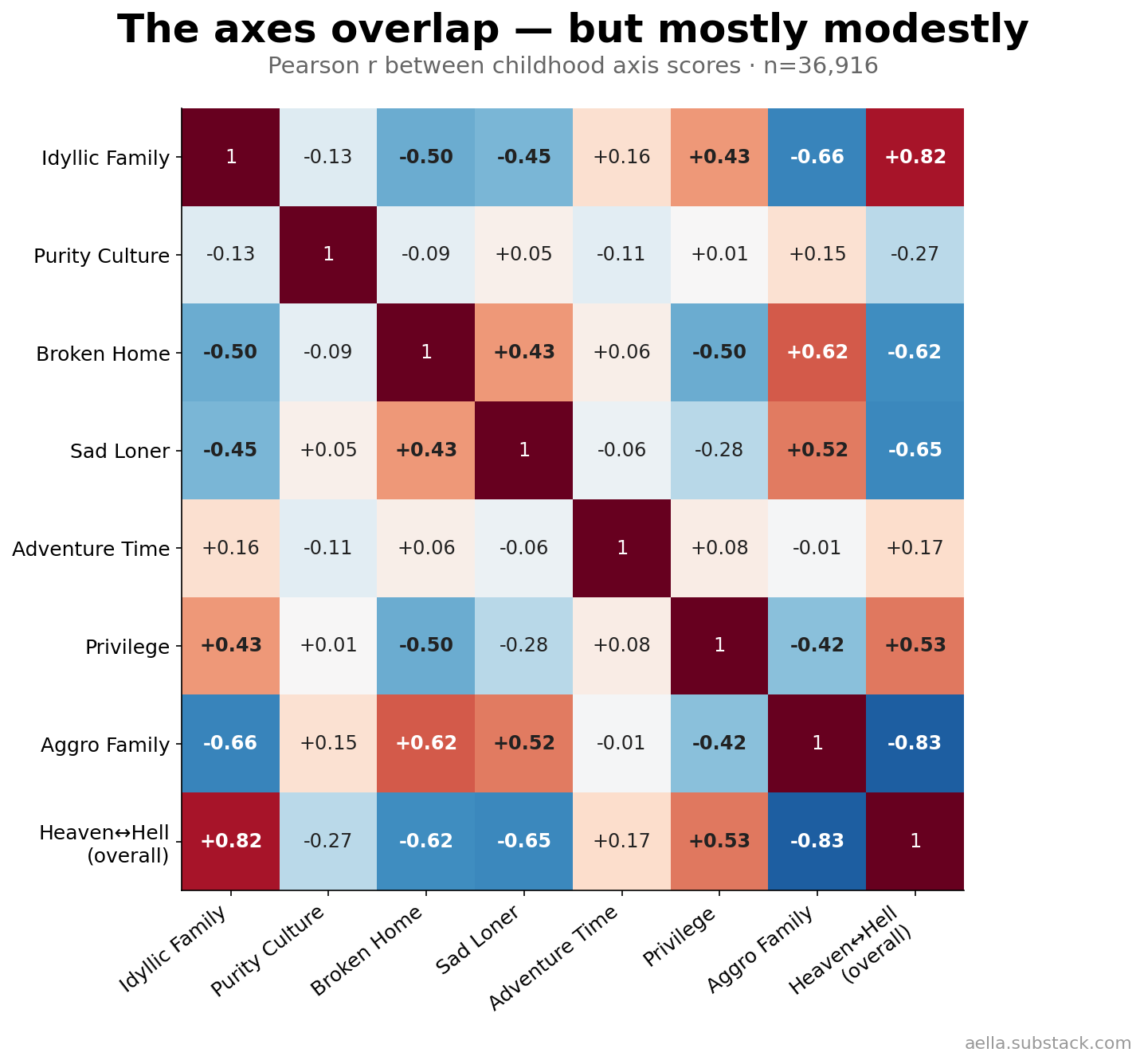
Plenty, but not fatally. The big tangle is the family triangle: Aggro Family vs Idyllic Family r = −.66, Aggro vs Broken Home +.62, Idyllic vs Broken −.50. Sad Loner sits halfway out (−.45 with Idyllic), and Purity Culture and Adventure are nearly orthogonal to everything. The crowd-weighted overall score is dominated by the family axes (±.82 with Idyllic/Aggro). Variance-inflation factors in the joint model top out at 2.4 — collinear enough to matter, nowhere near enough to break the regression. Which is the whole point of the next section: these axes co-occur, so the raw correlations double-count, and only a joint model can say which one actually carries the damage.
MEASURING FLOURISHINGThe outcome: a six-item adult flourishing composite
The survey has no single life-satisfaction scale, so flourishing is built as the mean of six z-scored adult items (then re-standardized; mean inter-item r = .45). Verbatim, with direction:
| Item (exact survey text) | Direction in composite |
|---|---|
| "I tend to suffer from depression" | reversed |
| "I tend to suffer from anxiety" | reversed |
| "If I could take all of the possibility of pain out of suicide I would commit suicide immediately" | reversed |
| "I am not happy" | reversed |
| "In the past 4 weeks, you've had difficulty accomplishing things in work or social activities due to emotional issues (such as depression, anxiety, etc)" | reversed |
| "In the past 4 weeks, you've had difficulty accomplishing things in work or social activities due to physical pain" | reversed |
Two planned items couldn't be used: the "at war with yourself" question exists only in childhood form (it's literally inside the Sad Loner axis — including it would be circular), and no adult life-satisfaction item exists; "I am not happy" carries that load. For profile contrasts further down, three separate domain composites are also kept: mental health (depression, anxiety, suicide item, unhappy — all reversed), relationships ("I am satisfied with my romantic relationships", "people in my current social circles tend to treat me really well", "my friendships often end due to fights or disagreements" reversed), and self-concept ("I love myself", "I'm happy with my appearance", "if life is a game, I'm losing" reversed).
THE VERDICTPut all seven in one regression and see who survives
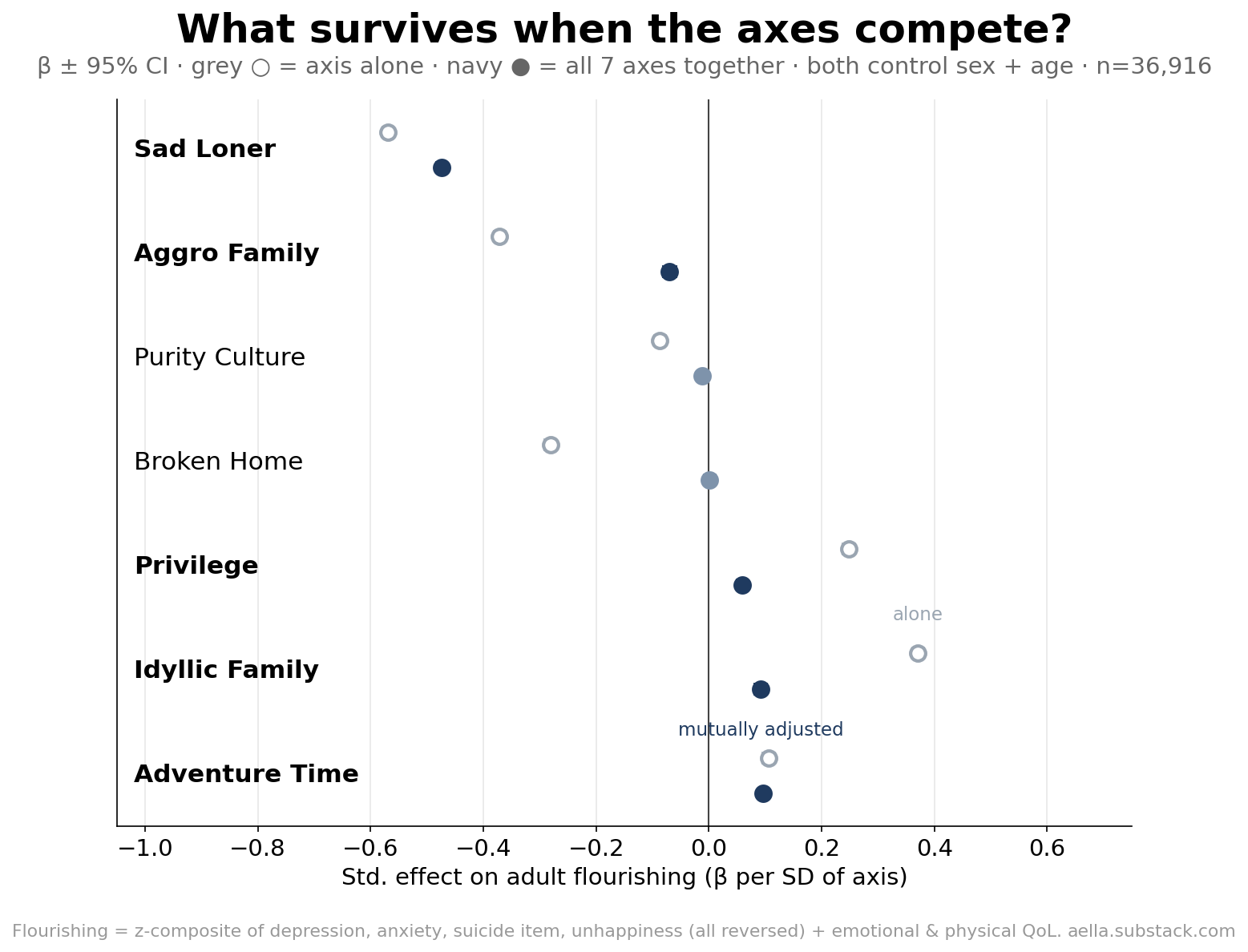
For each axis, two numbers: its effect on flourishing alone (controlling only sex and age), and its effect with all seven axes entered together (+ sex + age, n=36,916; 21,388 male / 15,528 female). Both in SD units. If an axis only predicted bad adulthoods because it travels with another axis, the joint model strips that away.
| Axis | Alone β | Adjusted β | Survives? |
|---|---|---|---|
| Sad Loner | −0.57 | −0.47 [−0.48, −0.46] | massively — keeps 83% of its raw effect |
| Adventure Time | +0.11 | +0.10 [+0.09, +0.10] | yes — barely shrinks at all |
| Idyllic Family | +0.37 | +0.09 [+0.08, +0.10] | only a quarter of it |
| Aggro Family | −0.37 | −0.07 [−0.08, −0.06] | yes, but 81% shrunk |
| Privilege | +0.25 | +0.06 [+0.05, +0.07] | a sliver |
| Purity Culture | −0.09 | −0.01 [−0.02, −0.00] | effectively no |
| Broken Home | −0.28 | +0.00 [−0.01, +0.01] | no — dead zero |
The pre-registered-in-spirit hypothesis was: aggro/loud and sad-loner survive; broken-home mostly collapses. Verdict: two-and-a-half for three. Sad Loner doesn't just survive, it eats the model — five times the size of anything else. Broken Home doesn't "mostly" collapse, it collapses to 0.00 exactly: growing up with divorce, an absent father, or parental abandonment predicts nothing about adult flourishing once you account for the misery, yelling, and poverty that tend to come with it. Aggro Family survives, but as a shadow of its raw self. The same pattern holds within each sex separately (male Sad Loner β −0.47, female −0.47; male Aggro −0.06, female −0.08; Broken Home null in both).
Read Sad Loner's coefficient with suspicion before quoting it. Its items ("you were depressed," "you felt at war with yourself") are the childhood versions of the outcome. Part of that −0.47 is genuine continuity — depressed kids become depressed adults — but part is the same stable trait (or the same genes) measured twice, and part is recall bias: currently-miserable people remember miserable childhoods. What the model can say cleanly is comparative: whatever a bad childhood transmits to adulthood, it travels through the child's internal state, not through family structure. (This worry is now tested directly: Inside the scores splits the axis into feeling-reports vs circumstance-reports and lets them compete.)
THREE DOMAINSDoes broken-home matter for relationships, even if not for mood?
Maybe family structure doesn't wreck your mood but quietly wrecks your attachments? The same joint model, re-run on each outcome domain:
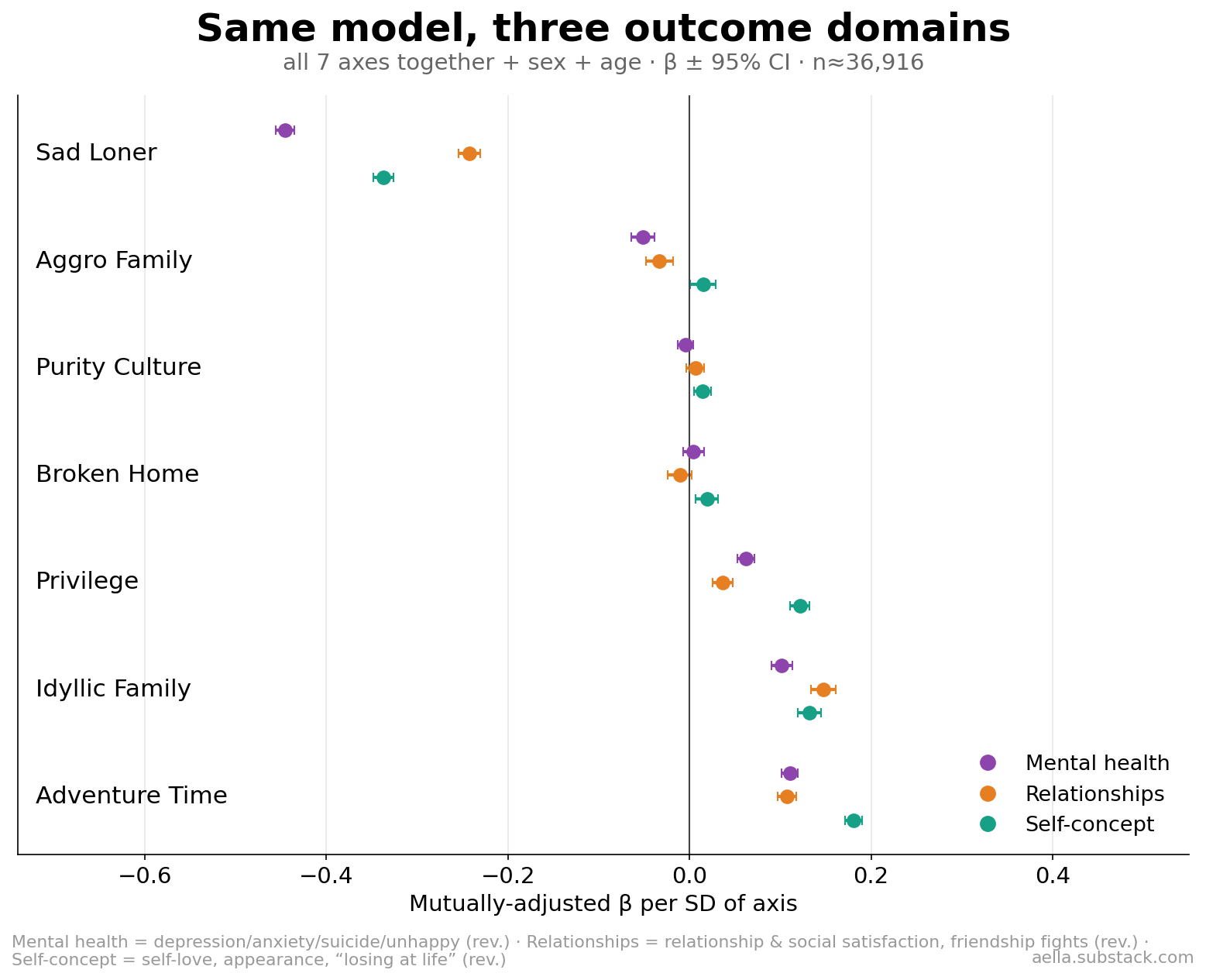
No. Broken Home is null for relationship outcomes too (β −0.01, ns) — and weakly positive for self-concept (+0.02). The interesting domain texture is elsewhere: Idyllic Family matters most for relationships (+0.15, its largest coefficient — warm parents predict liking the people around you more than they predict mood), Adventure Time matters most for self-concept (+0.18 — the kids who climbed trees, took risks, and had romances like themselves as adults), and Aggro Family's small surviving effect is mood-and-relationships only, vanishing for self-concept. Sad Loner is the top predictor of all three domains (−0.45 / −0.24 / −0.34). The axes explain 28% of mental health, 21% of self-concept, but only 14% of relationship outcomes — your current relationships are the part of adulthood childhood predicts least.
R² HONESTYHow much of adult flourishing does childhood explain at all?
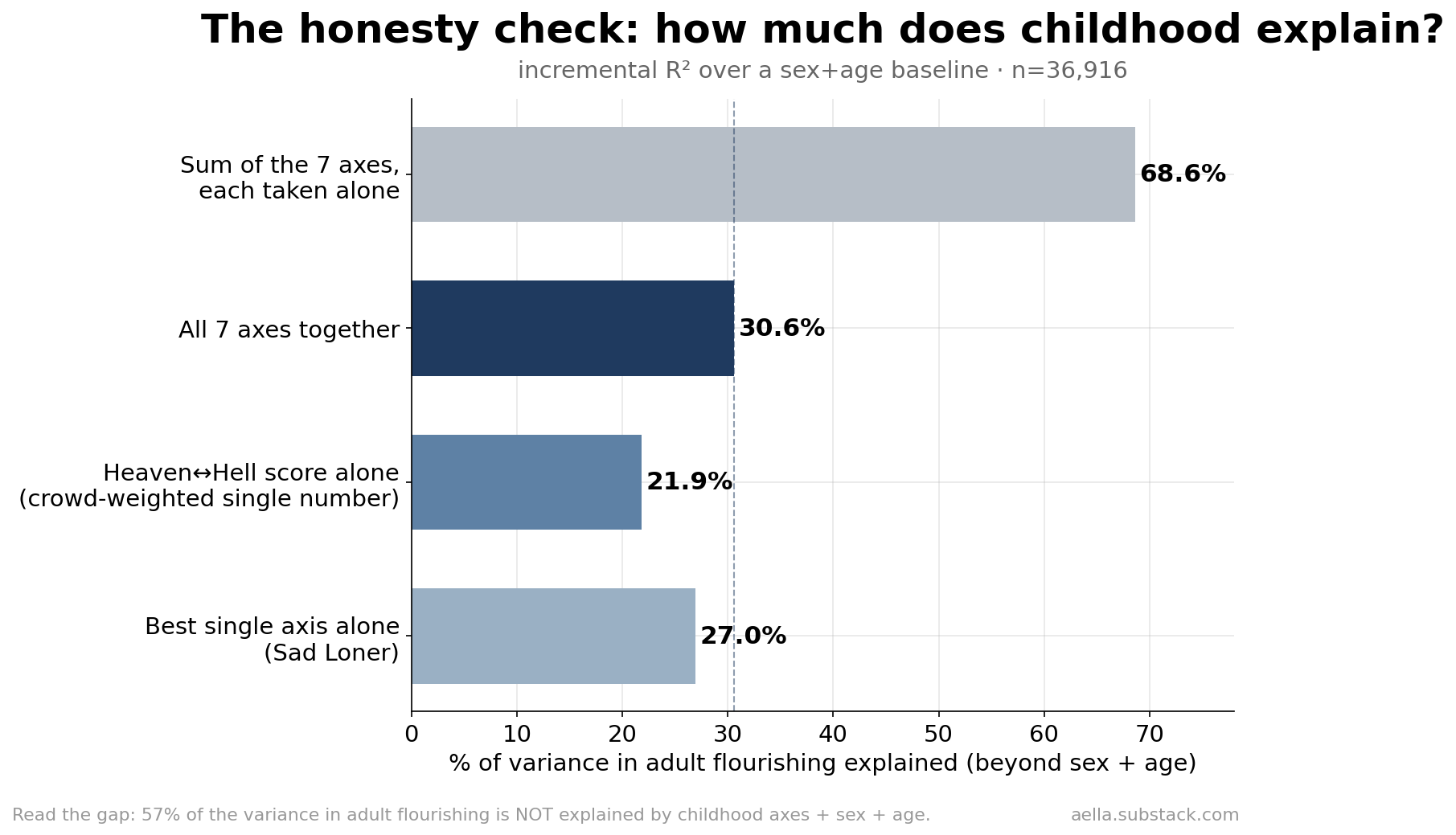
Three honest numbers:
- 30.6%. That's all seven axes together, beyond a sex+age baseline (the full model reaches R² = 43%, but 12.6 points of that is just sex and age — this sample's flourishing rises steadily with age). So: childhood, measured this thoroughly, leaves ~57% of adult flourishing variance completely unexplained — and the explained share is an upper bound, since recall bias and shared genes are working for the model. If you naively summed each axis's solo performance you'd get 68.6% — more than double the truth. The axes overlap; most of their individual "effects" are the same variance counted seven times.
- 21.9% vs 30.6%. The crowd-weighted single heaven↔hell score captures about 70% of what the seven axes capture. Good for one number — but it leaves real signal behind, because the crowd weighted family chaos and abuse heavily (r = ±.82 with the family axes) while the predictive juice is in the sad-loner axis (r = −.65 with the score). The crowd's intuition about what should damage kids and the regression's verdict about what tracks damage genuinely differ.
- 27.0%. The Sad Loner axis alone gets within 3.6 points of all seven combined. If you can ask a person only one battery about their childhood, ask whether they were a depressed, isolated kid.
DOSE–RESPONSEIs the damage linear, threshold, or saturating?
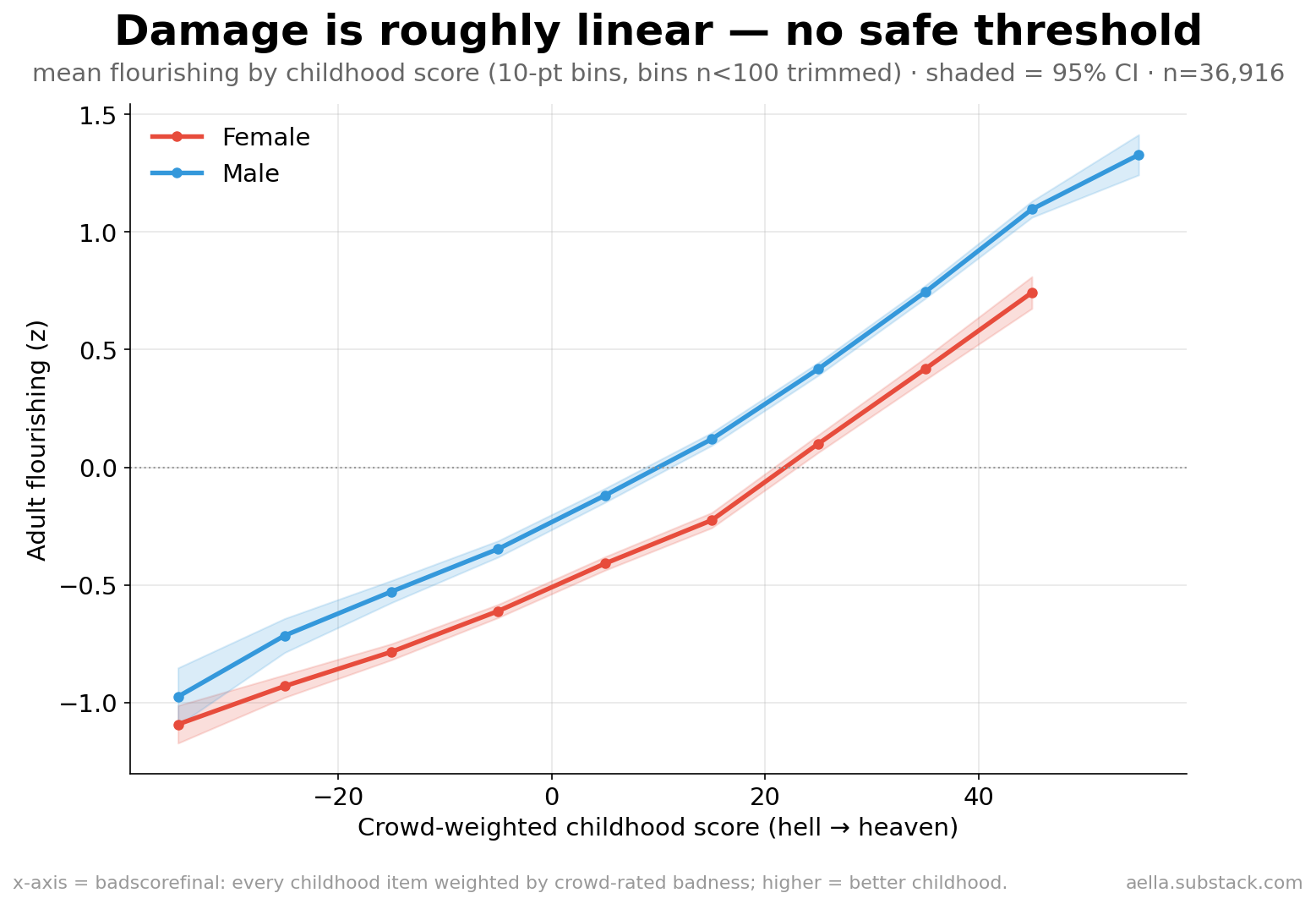
Linear, basically all the way. From hell (−35) to heaven (+50), each 10 points of childhood score buys a steady ~0.2 SD of adult flourishing, with if anything a slight steepening at the very best childhoods (the heaven tail keeps paying off; there is no satiation point). There is no threshold below which childhood stops mattering and no plateau where "good enough" parenting maxes out the benefit. The sex curves run nearly parallel: females sit below males at every level of childhood quality (mostly the anxiety/depression items) — a gap of ~0.3 SD across most of the range that narrows to ~0.1 SD in the deepest hell bins, where everyone is doing badly.
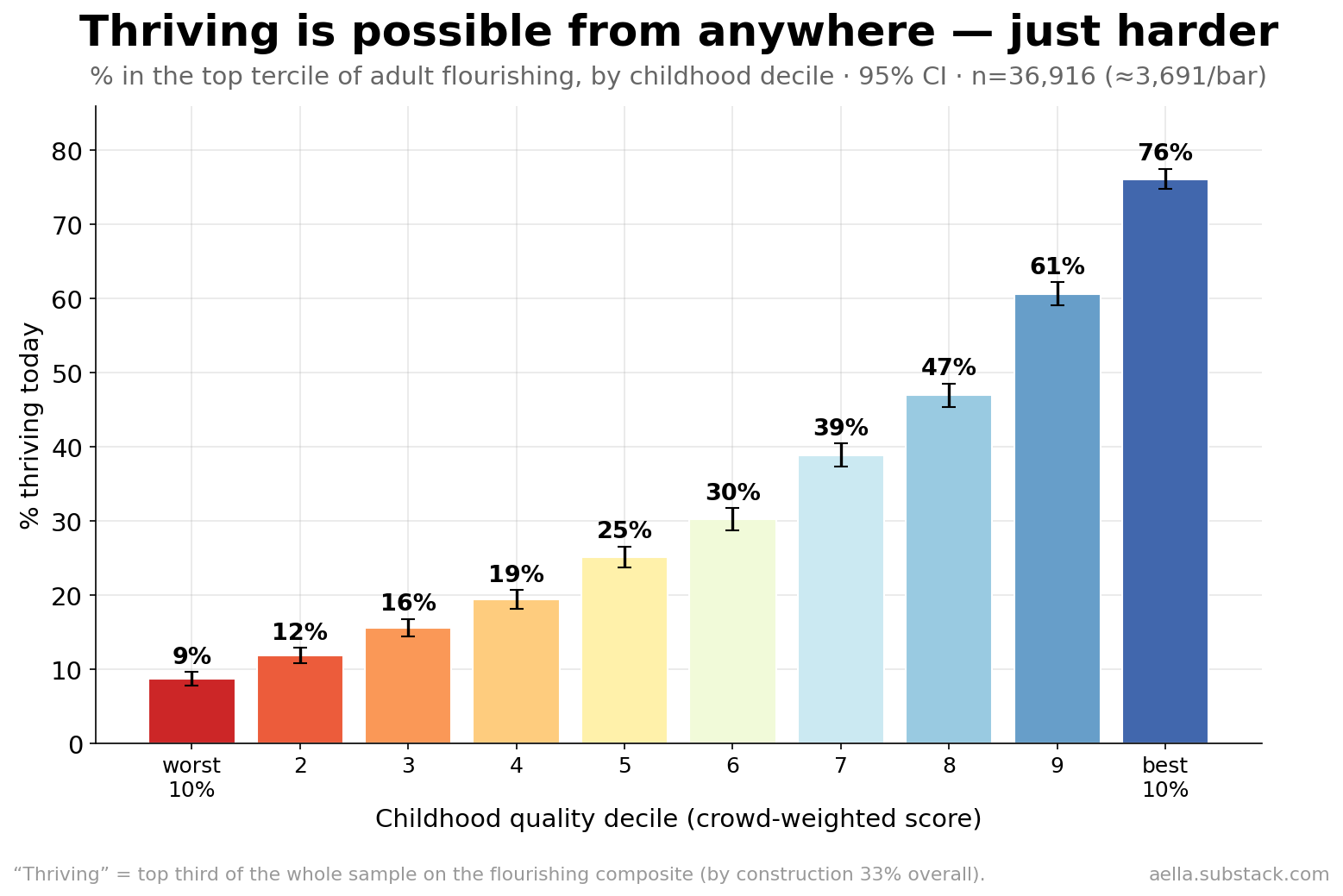
The same fact in plain percentages: the odds of being in the top third of adult flourishing climb from 9% (worst-decile childhood) to 76% (best-decile) — a smooth ninefold gradient with no jumps.
INSIDE THE SCORESInside the scores: which individual questions carry the weight?
The seven axes were built for public-facing display, not for analysis — each is just the unweighted mean of its ~7 statements (each asked twice, for ages 0–12 and 13–18; here the two reports are averaged into one value per item). An axis coefficient is therefore an average over questions that may have nothing in common causally. So: open the boxes. Same outcome, same sex+age controls, same n=36,916 as everything above.
Within the three axes that matter
Each panel below is one regression — all seven items of that axis entered together, so siblings compete with siblings:
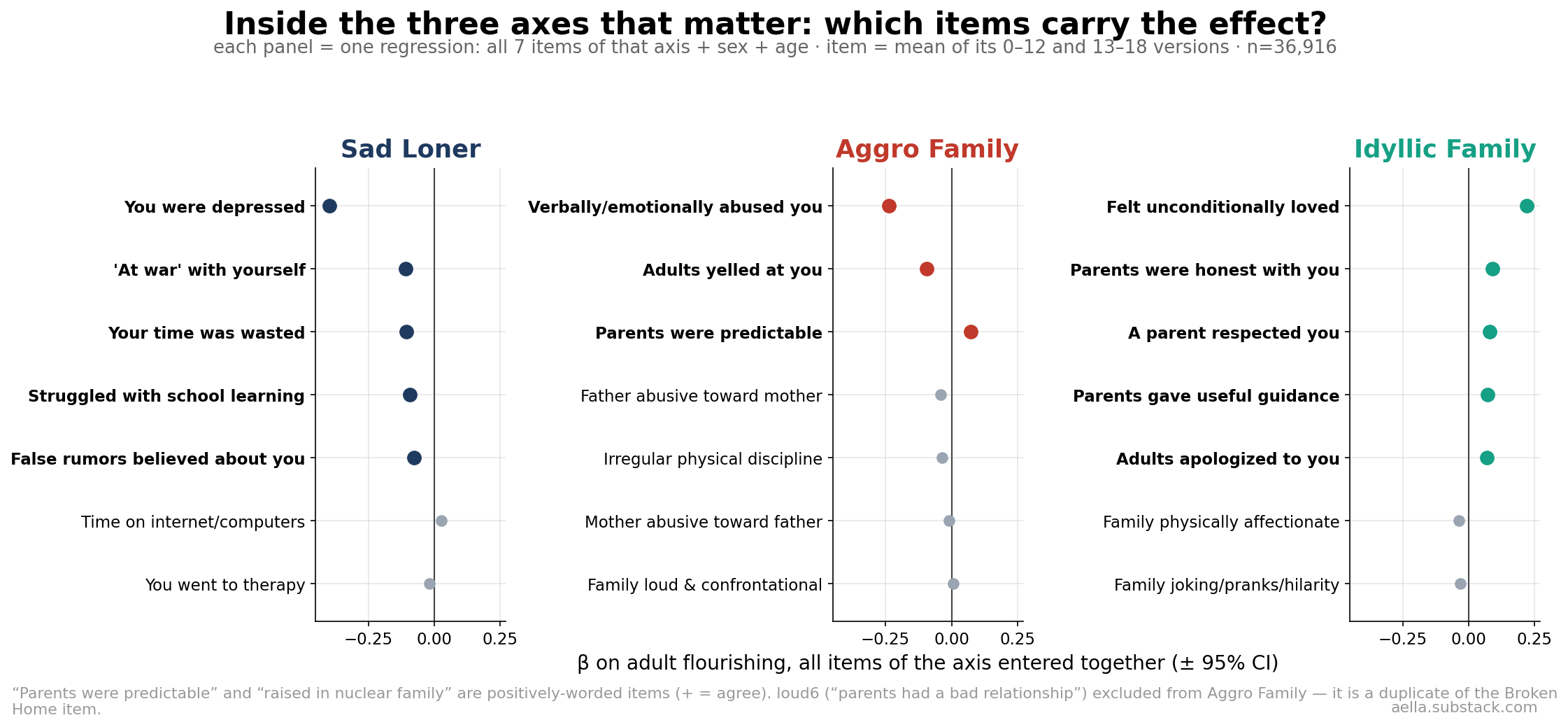
- Sad Loner is mostly one question. "You were depressed" carries β = −0.40 — nearly four times any sibling item ("at war with yourself" −0.11, "your time was wasted" −0.11, struggled with school −0.09, false rumors −0.08). "Time on the internet/computers" — the very-online flavor of the axis — actually flips slightly positive (+0.03) and going to therapy is ~0 once childhood depression is held. The axis is, to first order, a childhood-depression scale with decoration.
- Aggro Family is the abuse, not the noise. "Your parents verbally or emotionally abused you" dominates (−0.24); being yelled at adds a little (−0.09); but "family culture was loud and confrontational" is a flat 0.01 — loudness per se predicts nothing once abusive content is separated from volume. Parents abusing each other contributes almost nothing beyond abuse of you (father→mother −0.04, mother→father −0.01), and having predictable parents helps (+0.07).
- Idyllic Family is "you felt unconditionally loved." +0.22, vs +0.07–0.09 for guidance, respect, honesty, and apologizing — and the fun stuff goes slightly negative with the rest held (joking/pranks −0.03, physical affection −0.04). Warmth as felt security, not warmth as activity.
The recall-bias test: feelings vs facts
The standing objection to Sad Loner's dominance is that its items are mood reports about your child-self, remembered through your adult mood. But the axis isn't all mood reports. Split it: a feeling sub-composite ("you were depressed," "at war with yourself," "your time was wasted") vs a behavioral/circumstantial sub-composite (false rumors believed about you, went to therapy, struggled with school learning, time on internet). If the axis's power were pure recall bias, the circumstantial half should collapse the way Broken Home did.
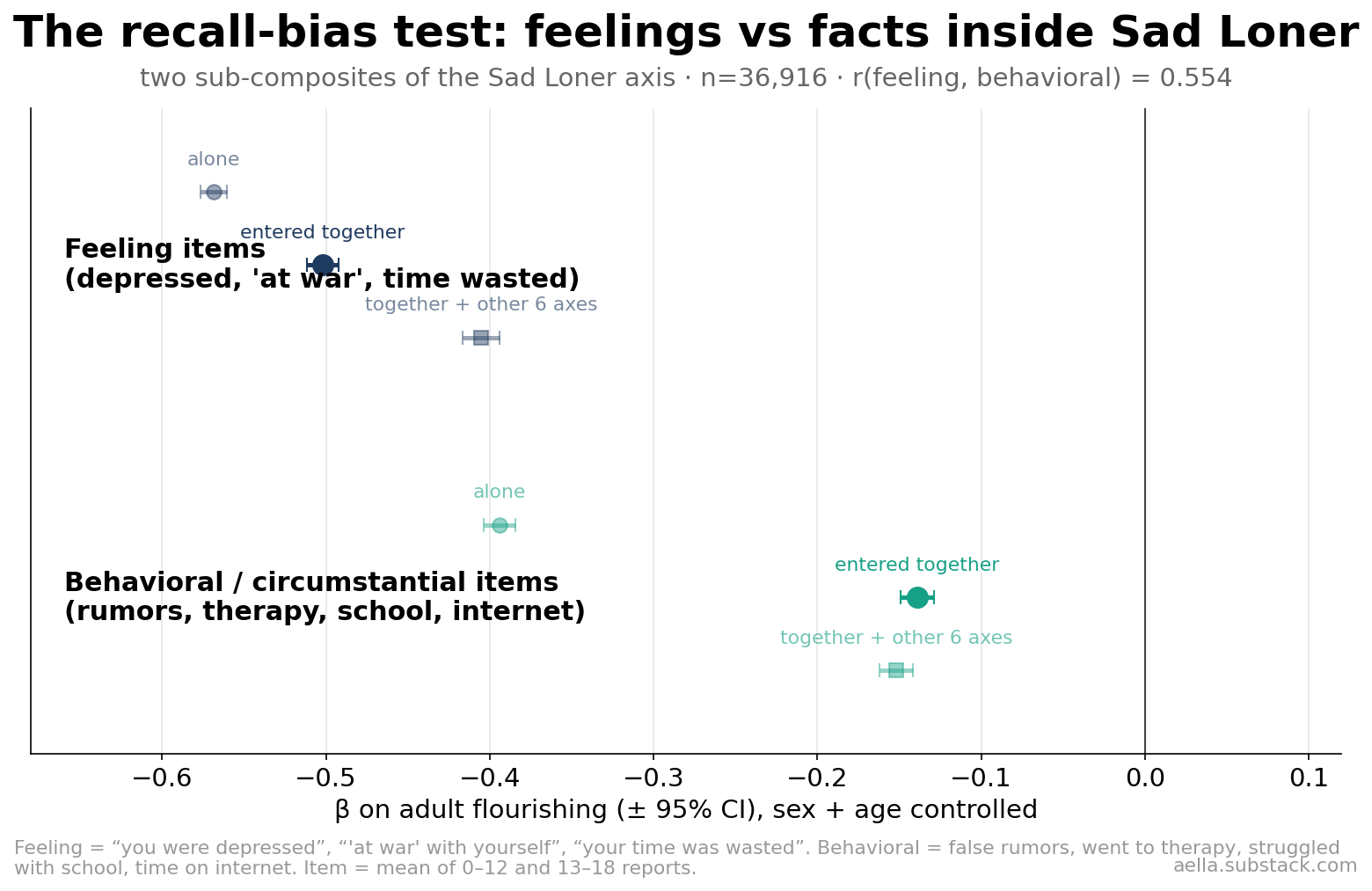
| Model (all + sex + age) | Feeling items β | Behavioral items β |
|---|---|---|
| Each sub-composite alone | −0.57 | −0.39 |
| Both entered together | −0.50 [−0.51, −0.49] | −0.14 [−0.15, −0.13] |
| Both + the other six axes | −0.41 | −0.15 |
Verdict: mostly feelings, not entirely. Entered together (they correlate r = .55), the feeling half keeps β = −0.50 while the behavioral half drops to −0.14 — so roughly three-quarters of the axis's punch rides on the recall-bias-prone mood items. But the circumstantial residue does not collapse: −0.14 (−0.15 with all other axes controlled) is still about twice the entire surviving Aggro Family axis, and the feeling sub-composite alone out-predicts the full 7-item axis score (incremental R² 28.4% vs 27.0%; behavioral alone manages 12.9%). Adding "you were bullied by other children" — a question the survey asked but never put into any axis — lands at β = −0.10 alongside both halves. So the honest reading: Sad Loner's size is inflated by same-construct measurement and recall bias, but a real, fact-shaped childhood-misery signal survives that can't be explained away as mood-tinted memory.
The grand league table: every question competes at once
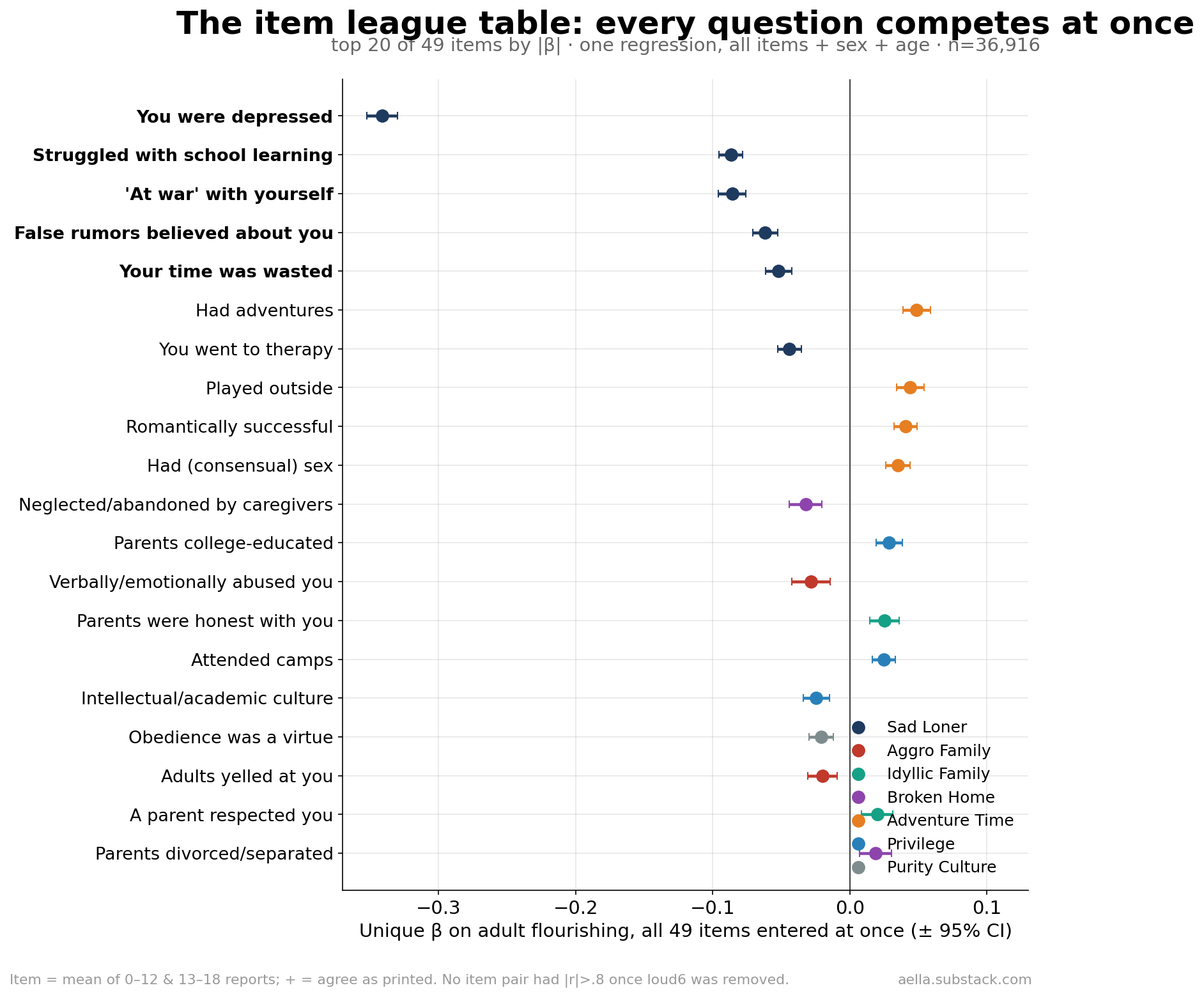
All 49 items (the eighth Aggro item is a duplicate of "parents had a bad relationship" and was dropped; no remaining pair correlates above r = .8) in one regression. The top five unique predictors are all five meaningful Sad Loner items: depressed (−0.34), struggled with school (−0.09), at war with yourself (−0.09), false rumors (−0.06), time wasted (−0.05). The first item from any other axis is "you had adventures" (+0.05) at #6, with played outside, romantically successful, and consensual sex close behind — the Adventure axis is the only one whose items nearly all show up positive. The best warmth item ("parents were honest with you," +0.03) ranks 14th; "verbally/emotionally abused you" keeps −0.03 of unique effect; and the Broken Home items go out the way their axis did — neglect (−0.03) is the only structural item with any unique signal, while divorce itself ekes out a slightly positive +0.02. Notably, the items the crowd rated most damaging when building the heaven↔hell weights (neglect −45, abandonment −37) sit far down a table headed by a quiet "you were depressed."
Do the items beat the axes? Modestly: all 49 items reach incremental R² = 35.1% vs 30.6% for the seven composite scores on the identical sample — about 4.5 points, most of it from letting "you were depressed" carry its own weight instead of being diluted seven-to-one inside its axis. The display composites cost surprisingly little information; they just hide where the information lives.
THE RESILIENTBottom-decile childhood, thriving anyway: who are they?
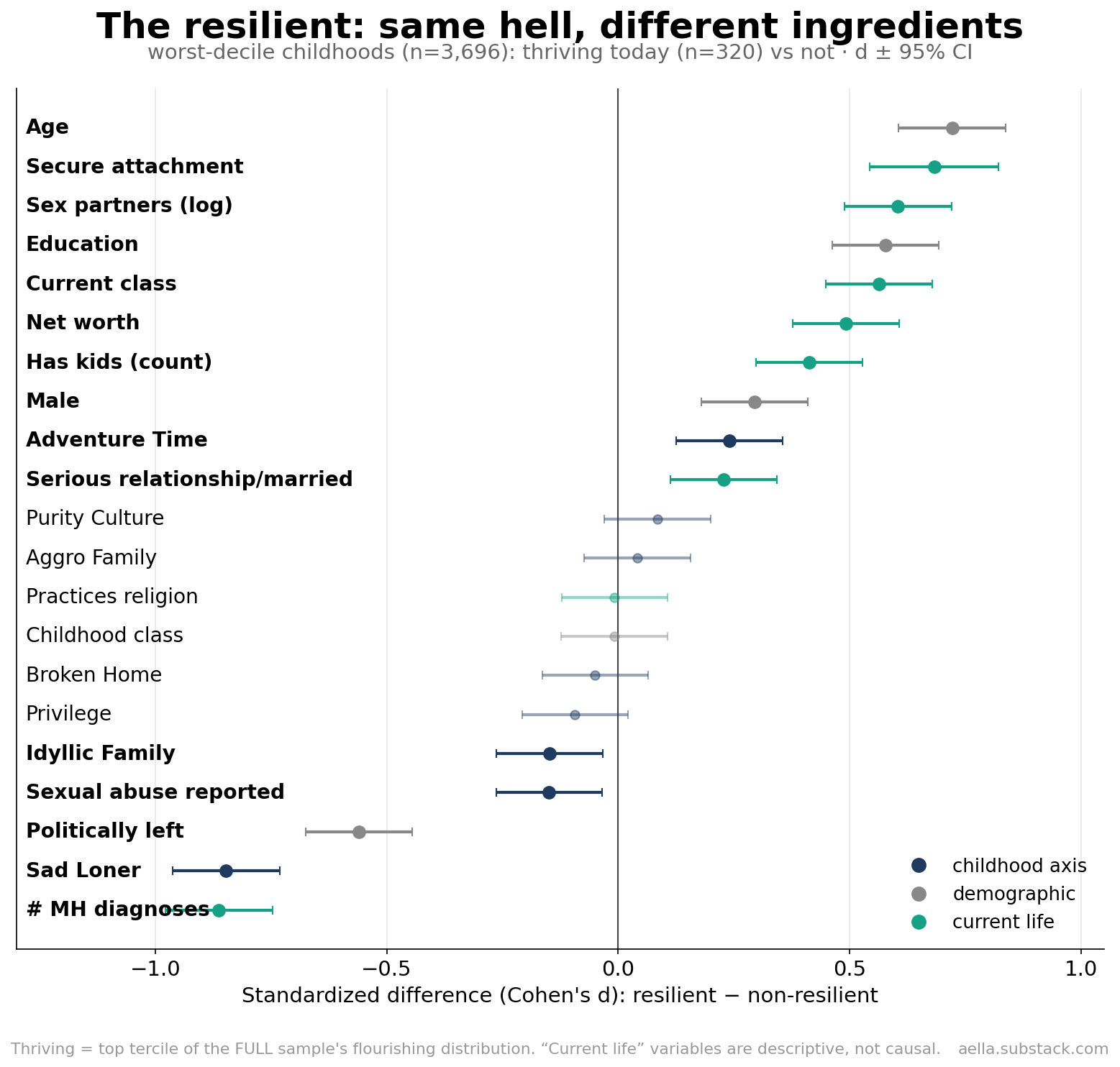
Take the worst 10% of childhoods by crowd-weighted score (n=3,696; score ≤ −14.2 — these are childhoods with serious abuse, chaos, or both). 320 of them (8.7%) are nonetheless in the top third of the whole sample's adult flourishing today (11.8% of bottom-decile men, 7.0% of women). What's different about them?
Three layers of answer:
- Their hell had a different recipe. Same total badness score, but the resilient were dramatically less sad-loner as kids (d = −0.85; axis mean +0.76 vs +1.46) and had more adventure (d = +0.24). Reported sexual abuse was only slightly less common (77% vs 83%, d = −0.15). Household aggression, broken-home structure, and childhood class were identical. Strikingly, their parents were no warmer — Idyllic Family runs slightly lower among the resilient (d = −0.15), a composition artifact worth being honest about: to land in the worst decile while being a non-depressed, adventurous kid, the badness has to be concentrated in the family axes. "Warmth somewhere" is not what saved them; not internalizing it is the thing that distinguishes them (with the recall-bias caveat in full force — thriving adults also remember their child-self more kindly).
- Demographics. They're older (31.7 vs 24.8 years, d = +0.72 — some "resilience" is just recovery that hasn't happened yet for the 22-year-olds), more male (48% vs 34%), more educated (d = +0.58), and markedly less far-left politically (d = −0.56; mean +0.9 vs +1.8 on the −3..+3 scale).
- Their present life. Secure attachment 23% vs 6% (d = +0.68), 2.3 vs 5.2 mental-illness diagnoses (d = −0.86), higher current class and net worth (d ≈ +0.5), more likely partnered and with kids, and more sexual partners (d = +0.61). All descriptive, not causal — being securely attached and solvent partly is thriving.
THE FRAGILEThe reverse: golden childhood, struggling anyway
The mirror group: top-decile childhoods (n=3,694) who are in the bottom third of adult flourishing — only 158 people (4.3%), half the resilience rate, which is itself a finding: a heaven childhood protects better than a hell childhood condemns. Their childhood profile is nearly indistinguishable from their thriving top-decile peers on family axes (Idyllic d = +0.03, Aggro d = +0.01, Broken d = +0.10, SA d = −0.06) — with one glaring exception: Sad Loner, d = +1.03, plus less adventure (d = −0.30). Today they carry 2.8 vs 0.8 psychiatric diagnoses, are more often female, younger, less partnered, and further left. Same story from both ends: once the seven axes face each other, the child's inner weather — not the household around it — is what follows you into adulthood. Whether that inner weather is itself caused by treatment, genes, or both, this survey cannot say.
ITEM RANKINGForget the axes: which single questions predict adult flourishing best?
The seven axes are composites, and composites can hide their best parts. So here's the same question asked at the raw-item level: take every childhood-content question in the entire survey — all ~100 axis battery items (each asked for ages 0–12 and 13–18), the sexual-abuse module, spanking and physical discipline, religion and purity culture, family structure (siblings, birth order, parents' ages), childhood social class, even age-you-learned-to-read — and run each one alone against the same adult-flourishing composite used throughout this report, controlling sex and age. That's 153 items (Likert items z-scored; categories like childhood religion turned into yes/no dummies; the survey's "answered No at the SA gate" sentinel recoded to "didn't happen"; the duplicated loud6 item and all derived scores excluded; per-item n from 5.1k to 42.1k). The top 25:
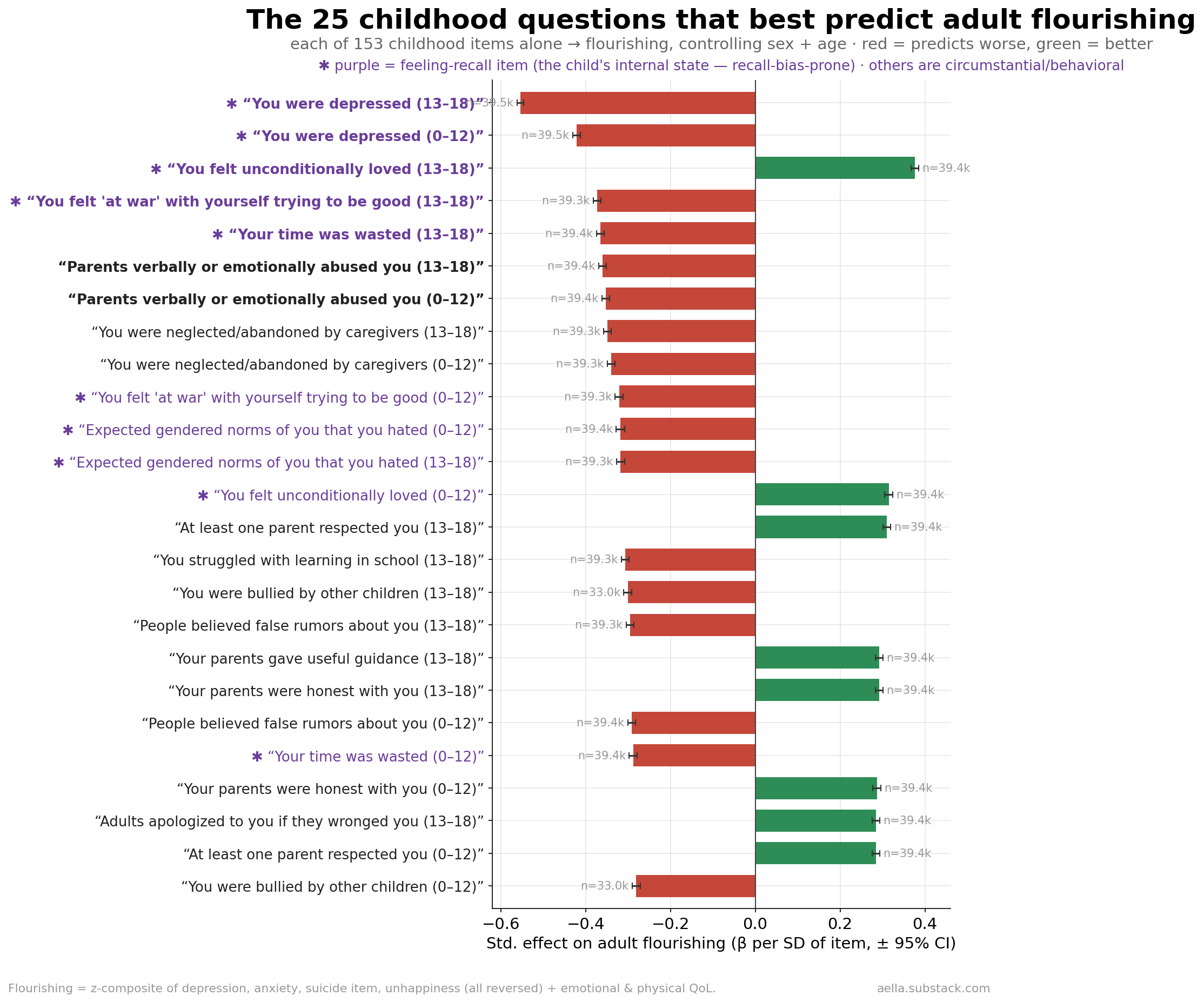
The top of the list is a clean sweep for the child's inner life and direct emotional maltreatment — and almost nothing else. The single best question in the survey is "during ages 13–18: you were depressed" (β = −0.55), which alone predicts adult flourishing nearly as well as all seven axes combined. But note the purple ✱ items: half of the top twelve are feeling-recall questions — reports of the child's internal state, exactly the kind of memory current mood repaints. The honest headline is the best circumstantial items, which land right behind them: "your parents verbally or emotionally abused you" (−0.36), "you were neglected/abandoned by caregivers" (−0.35), "at least one parent respected you" (+0.31), "you were bullied by other children" (−0.30). Words, neglect, and peer cruelty — reportable behaviors, not feelings — carry nearly the same signal.
- The famous villains rank surprisingly low. Reporting any childhood sexual abuse: β = −0.19 (rank 50 of 153). Parents divorcing: −0.13 (rank ~80). Angry/unpredictable spankings: −0.23 — while calm, predictable spankings are a flat +0.01, rank 145: the anger, not the spank, carries all the information. Purity culture, required church attendance, homeschooling, and childhood religion are all |β| ≤ 0.08; family structure (siblings, birth order, parental age) and early development (reading age, potty training) are ≈ 0.
- The teen years dominate. For nearly every item pair at the top of the ranking, the 13–18 version outpredicts the 0–12 version of the same question ("you were depressed": −0.55 vs −0.42; bullying: −0.30 vs −0.28). Adolescence is closer in time (memory is fresher) and plausibly closer to the adult outcome.
- Within the abuse module, context matters more than category. Among SA victims, acute distress during the abuse (−0.18) and coercion (−0.13) predict worse outcomes, while growing up in a household culture that took sexual assault seriously predicts better ones (+0.15) — bigger gradients than the household/penetrative distinctions between abuse types themselves (victims-only items, n ≈ 5–9k).
Solo rankings double-count, of course — "you were depressed" and "your time was wasted" travel together. So: the top 30 solo items entered into one regression (three near-duplicates dropped at r > .8, leaving 27 items; victims-only SA items excluded so the sample stays general; n = 31,434):
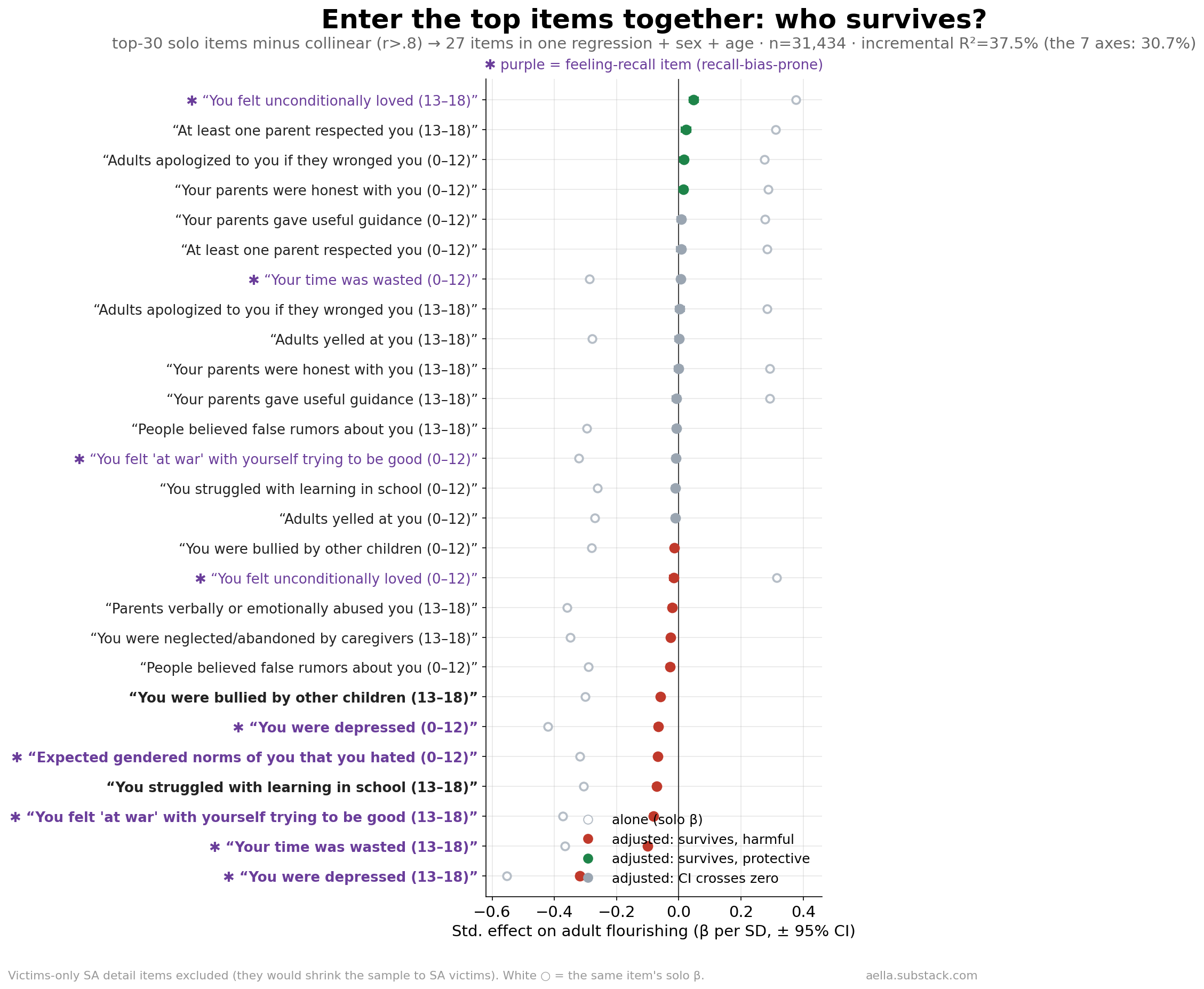
Teen depression survives mutual adjustment essentially intact (β = −0.32, five times anything else) — the item-level rerun of the Sad Loner story, with the same suspect crown. The circumstantial survivors are the interesting part: "you struggled with learning in school" (−0.07), being bullied 13–18 (−0.06), "people expected gendered norms of you that you hated" (−0.07), and on the protective side "you felt unconditionally loved (13–18)" (+0.05) plus small but real effects for parents who respected you, apologized, and were honest. Meanwhile the whole aggro/neglect block (−0.35-ish alone) shrinks to −0.02…−0.03 — it predicts damage mostly via the misery it co-occurs with. And the R² honesty check: these 27 raw questions explain 37.6% of flourishing variance beyond sex+age, versus 30.7% for the seven axes on the same sample — the axes are a good compression of the survey, but a single page of well-chosen questions beats them, and ~62% of adult flourishing still isn't childhood (as measured here) at all.
Read the purple items with one eyebrow up. Every ✱-flagged question asks what the child felt, and currently-depressed adults remember sadder children — some of that −0.55/−0.32 is the same person describing the same mood twice, plus shared genes. The circumstantial items (abuse witnessed in behavior, bullying, neglect, school struggle) are recall-prone too, but less mood-colored, and they tell a consistent story. None of this is causal; it's a ranking of which memories travel with which adulthoods.
CAVEATSHow to read this
Genetic confounding. Aggro parents share genes with their kids; so do depressed parents with sad-loner kids. A heritable temperament can produce both the "bad childhood" report and the bad adulthood with no causal arrow between them. Nothing here is an effect of childhood in the causal sense; twin or adoption designs would be needed for that.
Self-selected, very-online sample. Young (median 25), left-leaning, disproportionately internet-native — the kind of sample where "spent childhood online" is near-universal context rather than deviance. Absolute levels (e.g. 68% with ≥1 psychiatric diagnosis) don't generalize; the comparative structure is the defensible part.
Cross-sectional. Childhood and adulthood reported in the same sitting by the same person. The age gradient in "resilience" is a warning: some of who-recovers is just who-has-had-time.
Composite choices matter at the margins. Flourishing here is mood-heavy (4 of 6 items). The domain models show the conclusions hold for relationships and self-concept, but an income- or meaning-centered definition could shuffle the smaller coefficients (Privilege in particular).