TL;DRFive findings
- The abuse-specific details mostly don't carry the damage. Entered together, penetration (β=−0.03, n.s.), household-vs-outside perpetrator (β=0.00), and frequency (β=+0.01) all collapse to nothing. What survives: whether it happened in the 0–12 window (+0.17 SD), the 13–18 window (+0.09), how much fear/pain it still causes now (+0.21 per SD), coercion (small, +0.03), and the social environment around it.
- The social response matters about as much as the act's mechanics. Victims whose abuse was known and met with upset/concern do better than victims nobody knew about (−0.07 SD adjusted); known-but-dismissed ("didn't care/no big deal") is the worst position (dismissed vs taken-seriously p<0.001). Each step of household and adult culture taking sexual assault seriously is independently protective (−0.05 and −0.06 SD).
- Reward-based ("grooming") abuse without coercion looks strikingly less damaging than coerced abuse — adjusted damage +0.40 vs +0.57 SD (p<0.0001), with rewards-only victims reporting the lowest distress at the time of any group. But it is not a free pass: it leaves a distinct signature of elevated BDSM arousal, and abuse involving both coercion and rewards is the worst combination on nearly every outcome.
- Dose–response runs through frequency, not penetration. Among female victims the penetrative and non-penetrative lines lie on top of each other; "regularly" vs "rarely" adds ~0.3 SD in both sexes.
- Honesty check: SA is real but smaller than the whole childhood. All abuse dimensions combined explain 19.1% of adult-damage variance among victims; the single general childhood-quality score explains 25.6% in the same people, and 33.5% in the full sample. Sexual abuse is one heavy ingredient in a larger recipe.
THE DATAThe survey, the module, the outcome
The "Was Your Childhood Heaven or Hell?" survey ran April 2024 – June 2026 and, after quality filtering (no repeats, ≥4 minutes, age ≥14, honesty self-check), leaves 43,872 respondents: 25,512 male and 18,360 female at birth, mean age 27.5. It is a self-selected, very-online sample recruited largely through Twitter — keep that in mind throughout.
The gate question is verbatim: "Did you experience any sexual abuse during your childhood?" 29.1% answered Yes; 23.1% additionally endorsed at least one concrete abuse item, and that stricter group (n=8,339; 34.0% of women, 15.1% of men) is the "victims" sample used here. Everyone who said Yes was then asked, for ages 0–12 and 13–18 separately:
| Dimension | Question (verbatim fragments) | Scale |
|---|---|---|
| Perpetrator × severity | "a household member sexually abused you in a way [that] included genital penetration or envelopment" — and the non-household and non-penetrative variants (4 items × 2 age windows) | didn't happen / rarely / occasionally / regularly |
| Distress at the time | "did you experience acute fear or pain while the sexual abuse was happening, at the time that it happened?" | 0 not really – 4 extreme |
| Distress later | "did the sexual abuse result in fear or pain later in life, some time after it happened?" | 0–4 |
| Coercion | "did the sexual assault involve coercion? This means the use of bad outcomes if you didn't participate (e.g., physical force, blackmailing, threats)" | 0 none – 4 extreme |
| Rewards | "did the sexual assault involve rewards? This means the use of positive outcomes if you did participate (e.g., candy, gifts, compliments)" | 0 none – 4 extreme |
| Who knew, at the time | "At the time of your sexual assault, what was your impression of the attitudes of people around you about the incident?" | nobody knew / treated positively / didn't care / slightly → extremely upset |
| Culture seriousness | "how much did your household culture take sexual assault seriously, whether they knew about your experience or not?" (and the same for adult culture, ages 19+) | 0 normalized – 4 extremely |
The outcome is a z-scored "adult damage" composite (higher = worse) of seven adult items: depression, anxiety, the suicide item ("If I could take all of the possibility of pain out of suicide I would commit suicide immediately"), emotional QoL, physical-pain QoL, relationship satisfaction (reversed), and self-love (reversed). Cronbach's α = 0.79, n=42,191 (≥5 of 7 items required). Sign-flipped items per the codebook were verified before use.
WHAT HAPPENEDThe shape of reported abuse, by sex
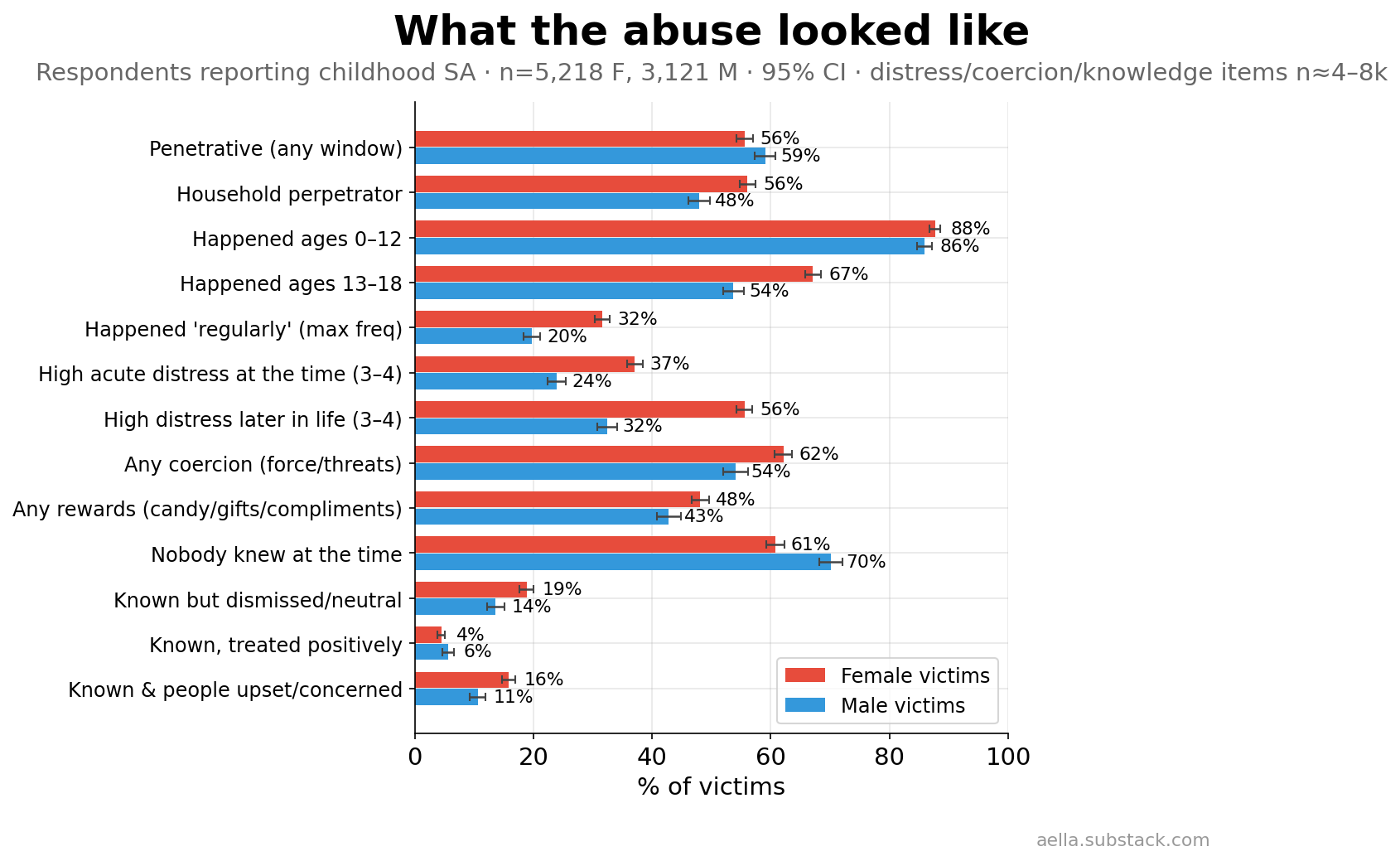
Most reported abuse is non-penetrative and from outside the household, but the overlap is heavy: 56% of female and 59% of male victims report at least one penetrative item, and roughly half report a household perpetrator. The age windows are nearly identical by sex (0–12: 88% F / 86% M), but male victims report less teen-window abuse (54% vs 67%), much less coercion (43% vs 62% any), and more often that nobody knew (70% vs 61%).
Two descriptive numbers worth sitting with: 64% of victims say nobody knew at the time (it falls to 32% "still nobody knows" for the later-in-life version of the question), and 31% report no acute fear or pain at the time it happened — while only 20% report none later in life. Mean distress rises from 1.7 (at the time) to 2.2 (later) on the 0–4 scale: for a large share of victims, the damage is reported as arriving after the fact, not during.
RAW GAPSBefore any adjustment
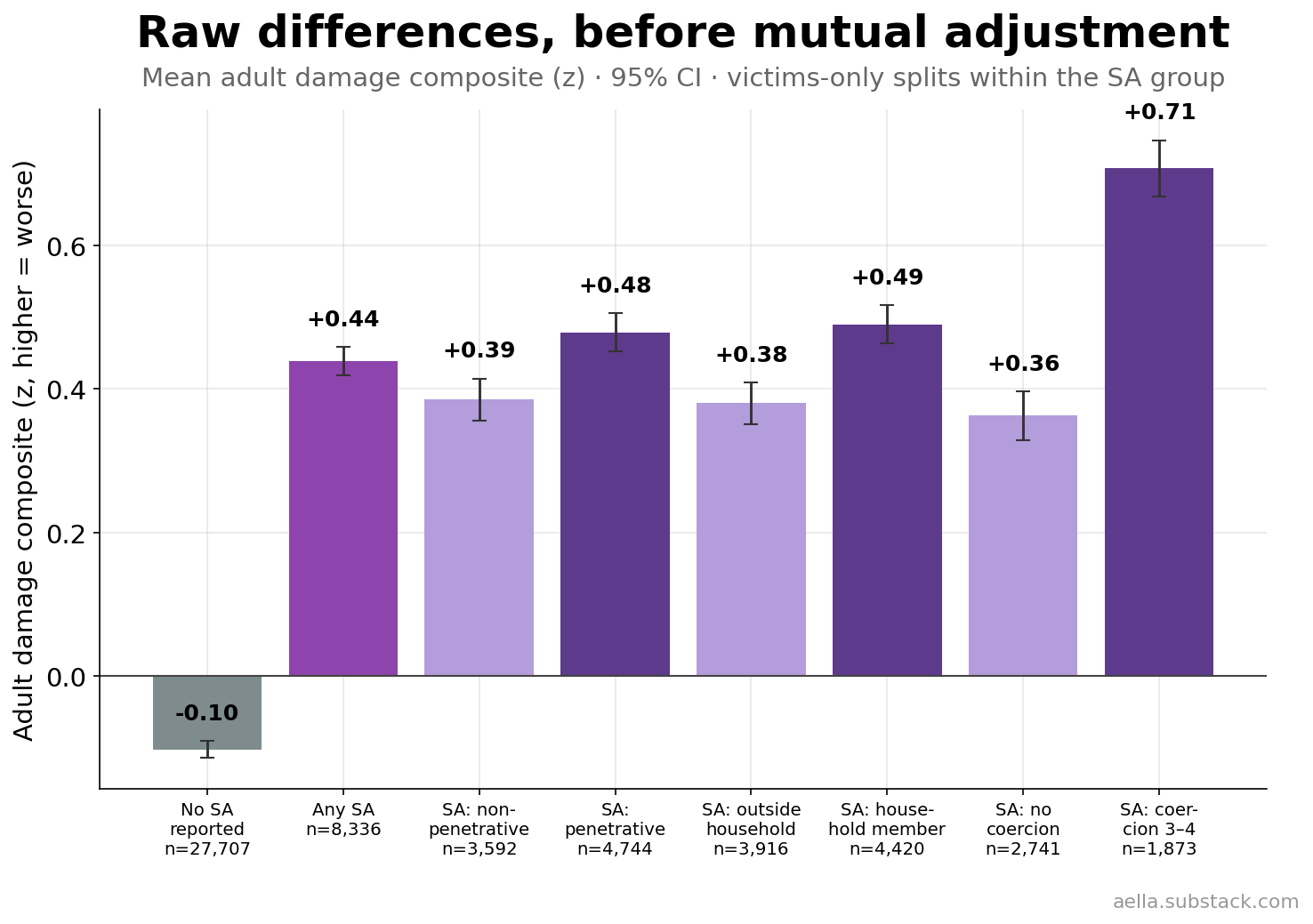
Raw, victims sit +0.54 SD above non-victims on the damage composite (+0.44 vs −0.10). Within victims, every "worse abuse" split looks worse: penetrative +0.48 vs non-penetrative +0.39, household +0.49 vs outside +0.38, heavy coercion +0.71 vs none +0.36. The bivariate correlations (victims only) line up the same way: distress-later r=.33, distress-then r=.21, frequency r=.19, coercion r=.17, household-culture seriousness r=−.11 — and penetration and household perpetrator are already weak here (r=.05 and .06).
Split by sex (always worth doing — SA is female-skewed and bad outcomes are female-skewed, a classic artifact generator): female victims +0.57 vs +0.20 for female non-victims; male victims +0.22 vs −0.28. The victim/non-victim gap is, if anything, larger for men (0.50 vs 0.37 SD). Every model below controls sex and age.
THE CENTERPIECEAll dimensions, mutually adjusted
The question this report exists for: when you put perpetrator, severity, frequency, age window, distress then, distress now, coercion, rewards, who-knew, and culture-seriousness into one regression on adult damage (OLS, victims only, complete case n=6,157, controlling sex and age), which dimensions keep their effect?
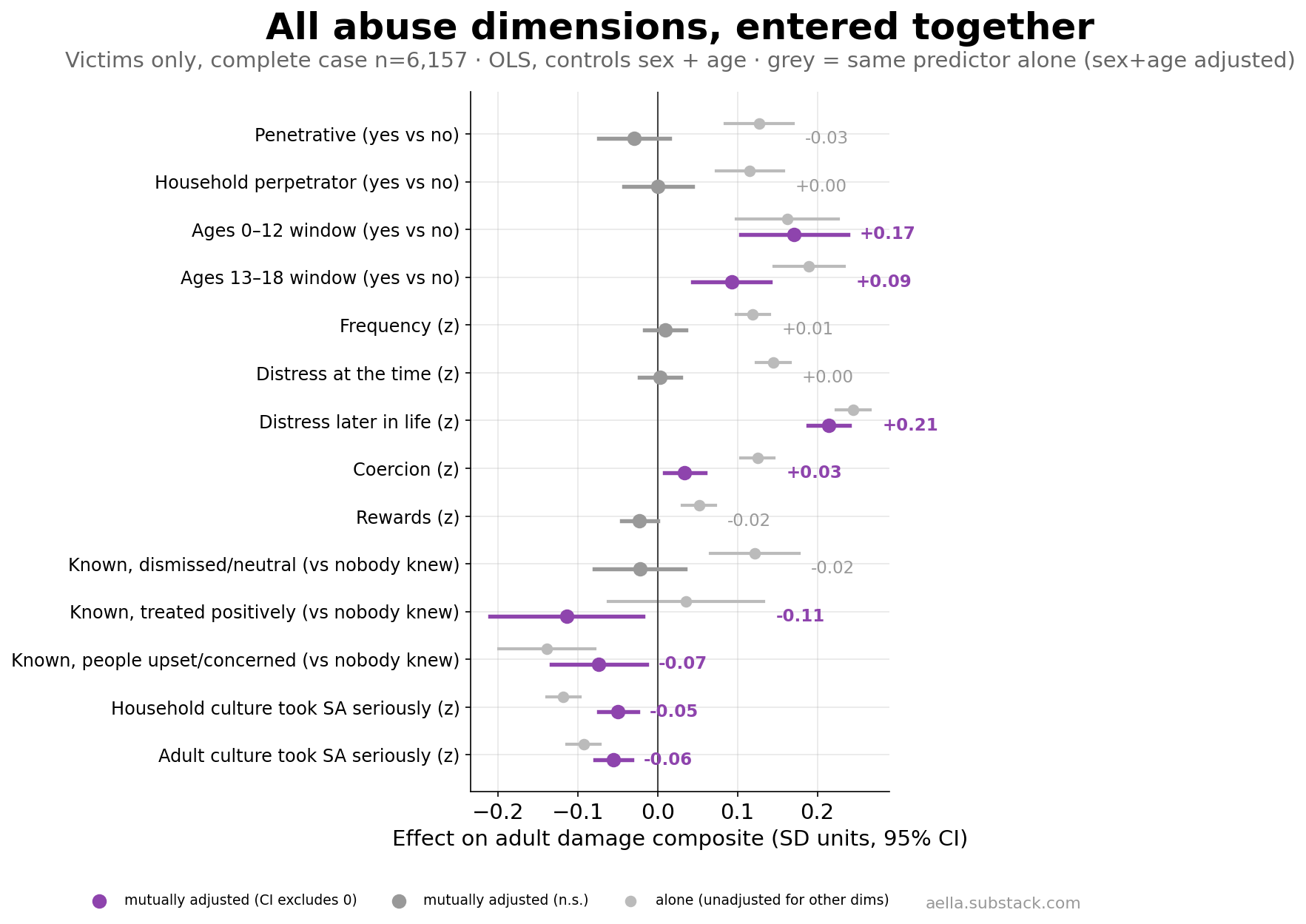
What survives:
- Distress later in life (+0.21 SD per SD) — by far the strongest term, though partly outcome-adjacent (see § In context).
- The 0–12 window (+0.17) and the 13–18 window (+0.09): abuse in either age window adds damage independently, with the childhood window carrying nearly twice the weight of the teen window.
- Coercion (+0.03 per SD, p=.010) — small but real beyond everything else.
- Culture taking sexual assault seriously — household (−0.05, p<.001) and adult culture (−0.06, p<.001) are each independently protective.
- Being known and met with concern (−0.07 vs nobody knew, p=.016).
What dies: penetration (−0.03, n.s. — note the sign even flips negative), household-vs-outside perpetrator (0.00), frequency (+0.01), distress at the time (+0.00), and rewards (−0.02, p=.052, trending protective once coercion is held constant). The grey markers show the same predictors entered alone (sex+age adjusted, same sample): penetration alone is +0.13, household alone +0.12, frequency alone +0.12. Their apparent damage is carried entirely by their correlation with the surviving dimensions.
Sex itself is a null among victims in the full model (β=−0.01): male and female victims with the same abuse profile look equally damaged. Age is the largest control (−0.25 per SD: younger respondents report much worse wellbeing across the board, abuse or not).
WHO KNEWNobody knew vs dismissed vs taken seriously vs "treated positively"
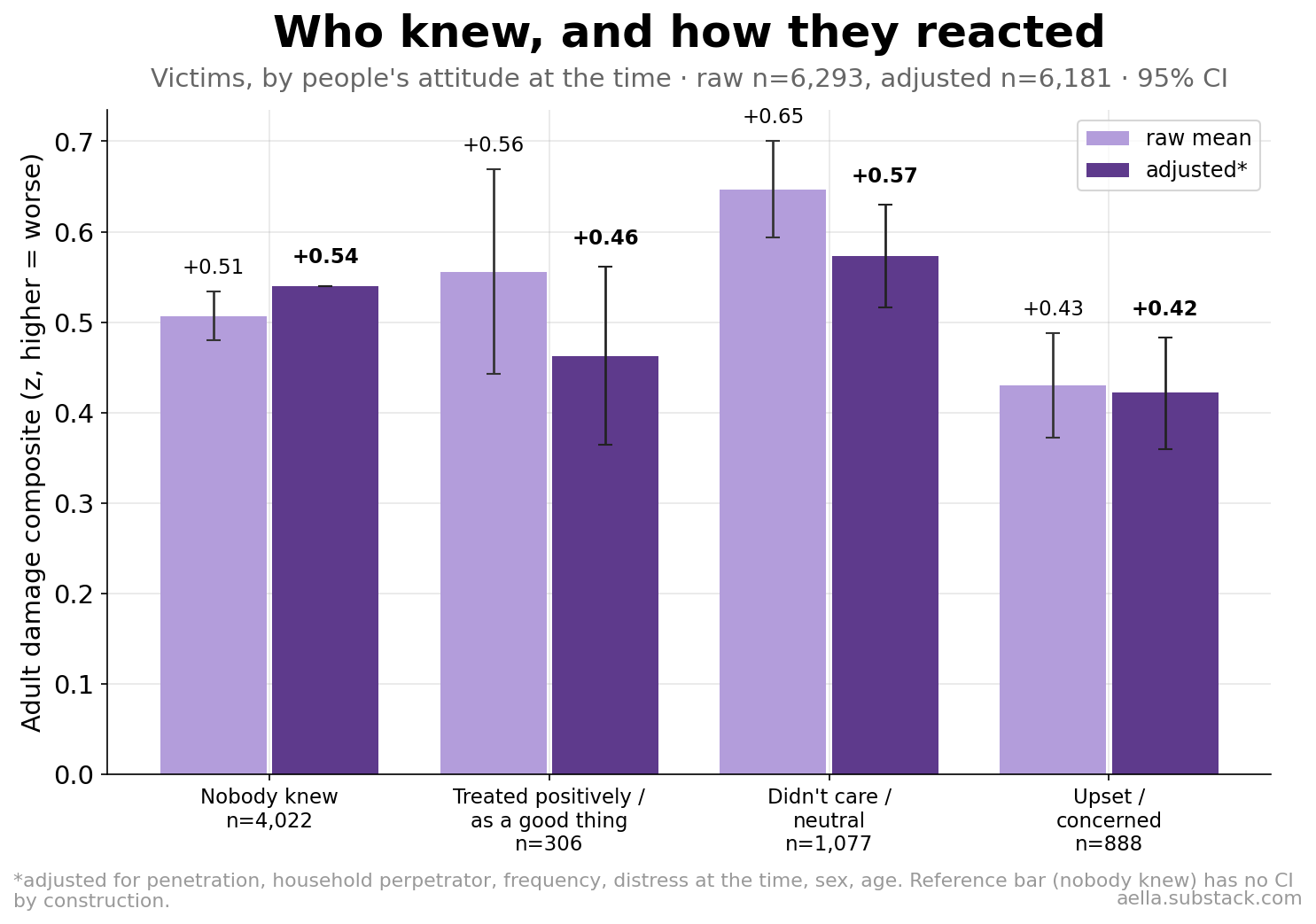
Ordering the four social responses by adjusted adult damage (controls: penetration, household perpetrator, frequency, distress at the time, sex, age):
| People around you, at the time | n | raw | adjusted |
|---|---|---|---|
| Known & upset/concerned | 888 | +0.43 | +0.42 |
| Known, "treated positively/as a good thing" | 306 | +0.56 | +0.46 |
| Nobody knew | 4,022 | +0.51 | +0.54 (ref.) |
| Known, "didn't care/neutral/no big deal" | 1,077 | +0.65 | +0.57 |
The clean answer to the headline contrast: known-and-taken-seriously beats nobody-knew (−0.12 SD adjusted), and known-but-dismissed is the worst position — dismissed vs taken-seriously differ at p<0.001. Disclosure per se isn't protective; disclosure that lands with concern is, and disclosure that lands with a shrug is associated with the worst adult outcomes of all.
The "treated positively" group is the strangest cell: raw, they look bad (+0.56); adjusted for how severe and frequent the abuse was, they land between the concerned and dismissed groups (+0.46, CI 0.37–0.56). At n=306 and with obvious unmeasured selection (environments that celebrate child sexual contact differ in many ways), treat this as descriptive only.
The later-in-life version of the question shows the same shape: those whose disclosure as adults met indifference do worst (+0.69), those met with concern +0.50, nobody-ever-knew +0.49.
COERCION VS REWARDSDoes grooming have its own signature?
The survey asks separately whether the abuse involved coercion (force, blackmail, threats) and rewards (candy, gifts, compliments). Crossing any-coercion × any-rewards gives four groups: neither (n=1,956), coercion only (1,666), rewards only (786), both (2,336).
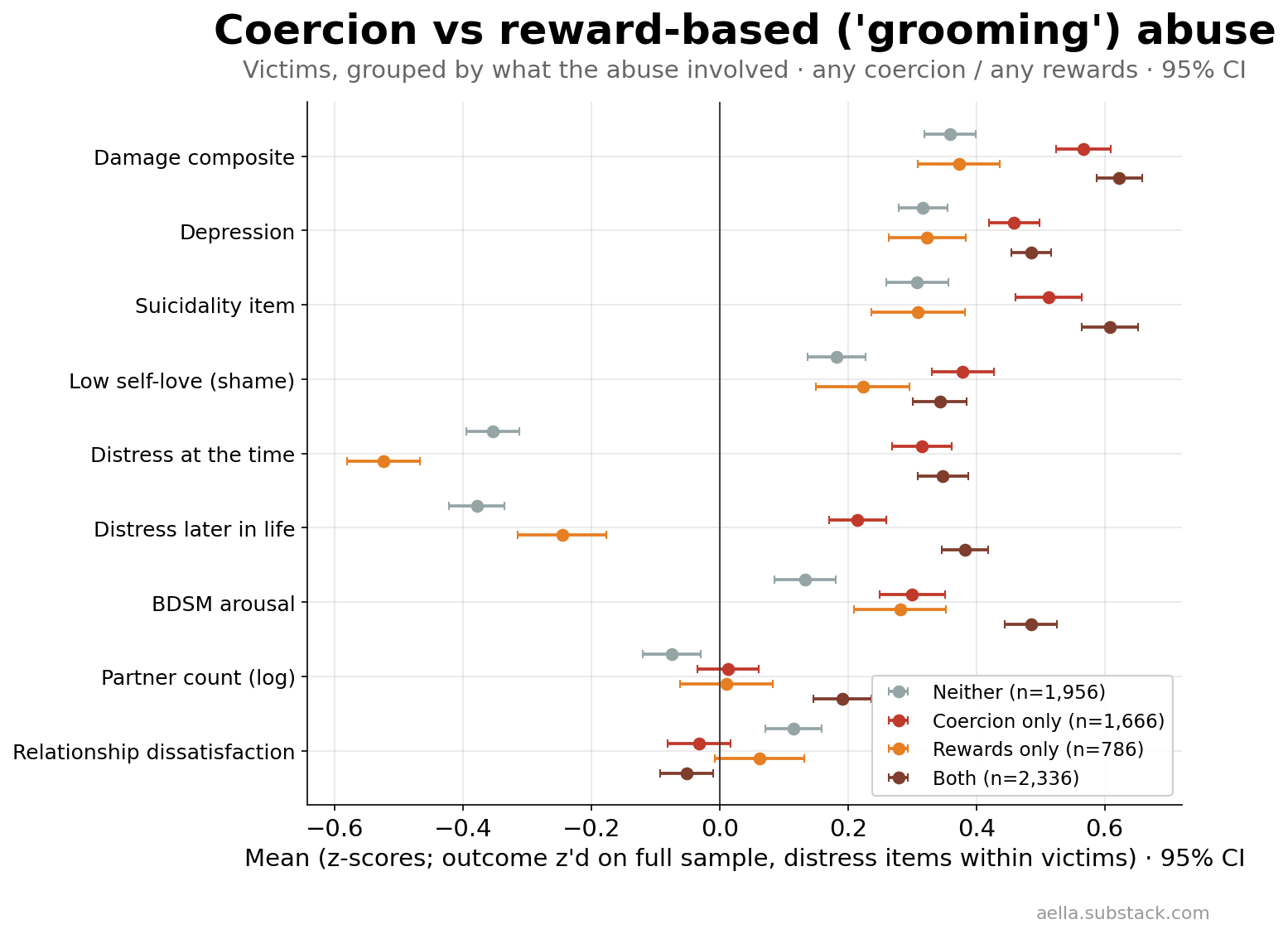
Coercion carries the damage; rewards mostly don't. Sex-and-age-adjusted damage: neither +0.38, rewards-only +0.40, coercion-only +0.57, both +0.59 (rewards-only vs coercion-only p<0.0001). Rewards-only victims report the lowest distress at the time of any group (−0.52 z, below even the "neither" group), low distress later, and depression/suicidality/shame levels indistinguishable from the neither group.
But the signature is real. Where rewards-only victims do diverge from the neither group: elevated BDSM arousal (+0.28 vs +0.13; as high as the coercion group's +0.30) and directionally more lifetime sexual partners (+0.01 vs −0.08 on log partners; CIs overlap). The both group — coerced and rewarded — is worst on nearly everything: highest suicidality (+0.61), highest BDSM arousal (+0.49, 62% moderately+ aroused vs 51% of the neither group), most partners (median 3 vs 2), highest distress then and now. Reward-based grooming on top of coercion appears to compound rather than soften it.
DOSE–RESPONSESeverity × frequency
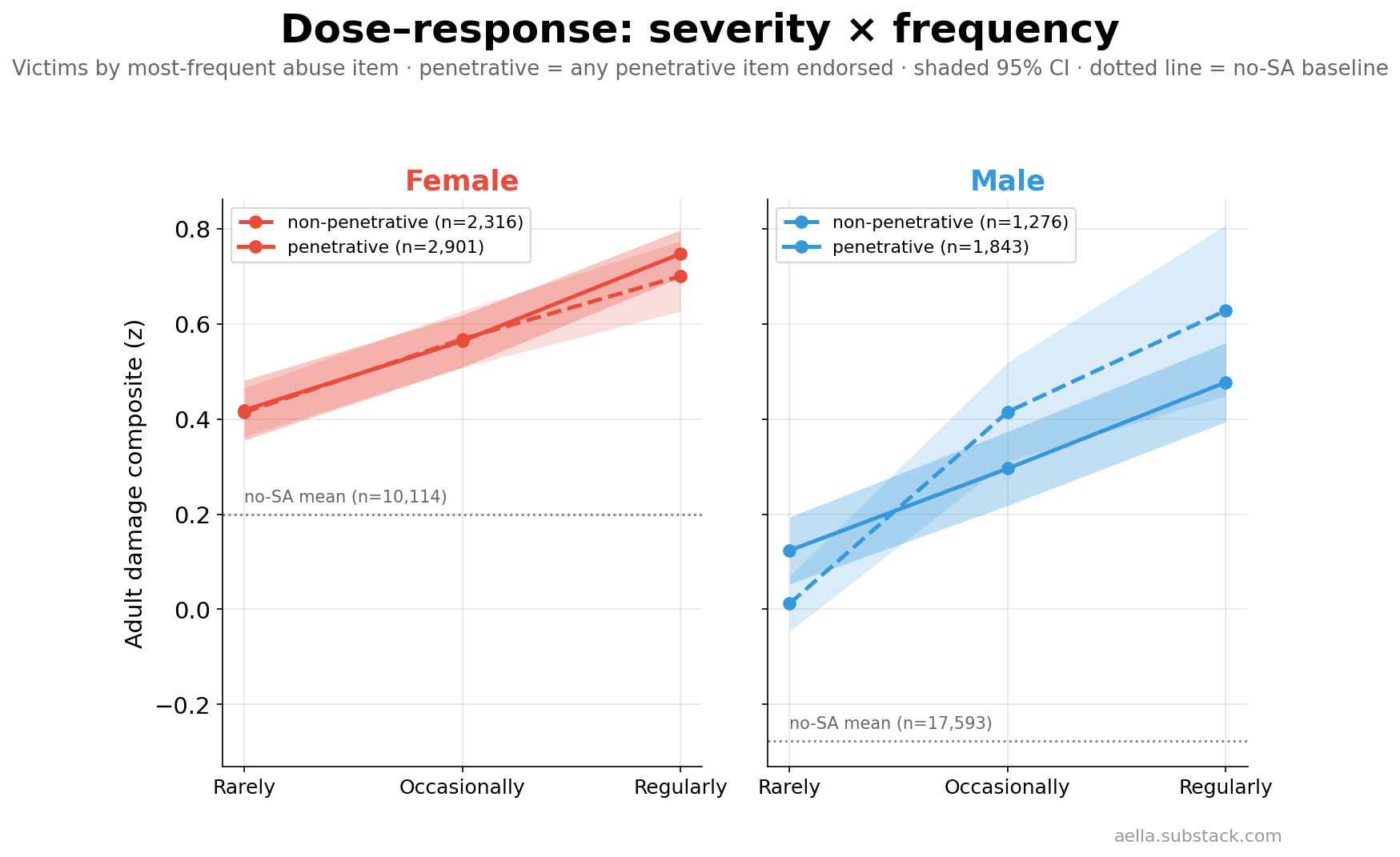
Frequency shows a clean monotone gradient in both sexes: from "rarely" to "regularly," damage rises ~0.33 SD in women (+0.42 → +0.75 for penetrative abuse) and ~0.35–0.6 SD in men. Penetration adds almost nothing at a given frequency — among women the two lines are statistically indistinguishable at every point; among men they cross (the non-penetrative line is noisier, n=95 at "regularly"). This is the picture behind the forest plot's verdict: regularity looks like a severity dimension; penetration mostly doesn't — and even the frequency gradient itself thins out once distress and social context are held constant.
Note both male lines sit ~0.3–0.9 SD above the male no-SA baseline (−0.28), and the female lines ~0.2–0.55 SD above the female baseline (+0.20): every victim group, in both sexes, is worse off than its same-sex non-victim baseline.
IN CONTEXTHonesty checks
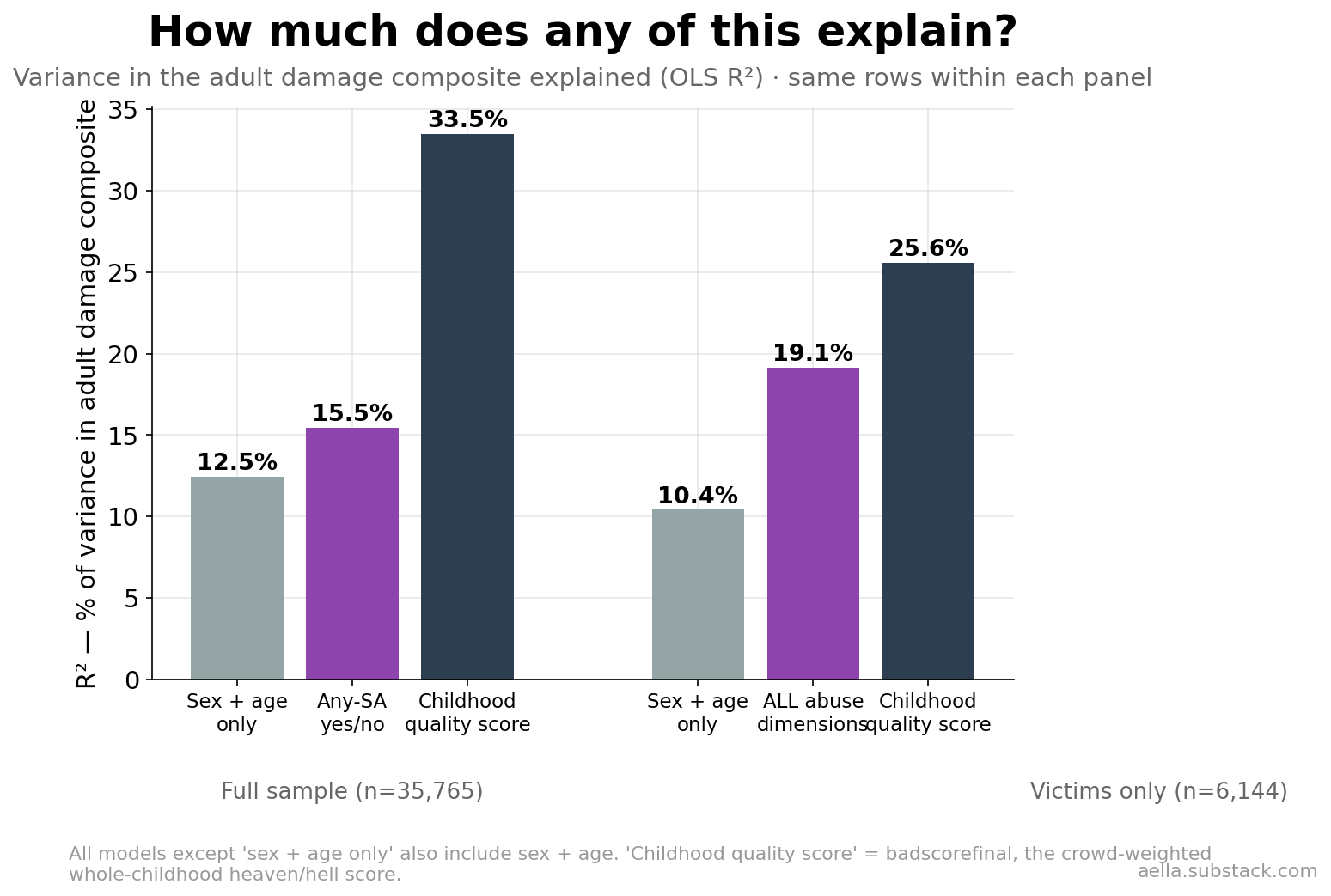
How much do these effects matter overall? In the full sample, sex+age alone explain 12.5% of damage-composite variance; adding the any-SA flag brings it to 15.5% (Δ ≈ 3 points); the survey's general crowd-weighted childhood-quality score brings it to 33.5%. Among victims, every abuse dimension combined reaches 19.1% — while the single childhood-quality number reaches 25.6% in the same people (29.3% combined). Childhood sexual abuse predicts adult damage, clearly and dose-responsively — and is still outpredicted by the overall quality of the childhood it happened inside. Abuse rarely happens in otherwise-idyllic childhoods, and the rest of the childhood matters enormously.
Distress then → distress now: a mediation-shaped pattern. Distress at the time predicts damage alone (+0.14 per SD), drops to +0.09 with the other dimensions, and to ~0.00 once distress-later-in-life enters (the two correlate r=.57). Read descriptively: acute distress at the time predicts adult damage through whether the abuse goes on hurting, not directly. The same is true of frequency and most of coercion's raw effect. We flag, without resolving, that "fear or pain later in life" is itself close to the outcome — a person currently doing badly may both rate their abuse as still hurting and score worse on wellbeing. That is why the forest plot's strongest bar should be read as where the signal concentrates, not as a causal pathway.
CAVEATSHow to read all of this
Self-selected, very-online sample. Recruited largely via Twitter; young (mean 27.5), left-leaning, kink-survey-adjacent. Prevalence numbers (the 23%) should not be quoted as population estimates, and survivors willing to answer a detailed internet survey about their abuse are not all survivors — the most severely harmed may be least represented.
Cross-sectional, no causal claims. "Predicts" throughout means statistical association with controls, not mechanism. The mutual-adjustment model says where the signal concentrates among correlated descriptions of the same events; it cannot say what intervening on any dimension would do.
Victim-only conditioning. Distress, coercion, knowledge, and culture-seriousness questions were asked only inside the SA-Yes branch; all within-victim results are conditional on identifying one's experience as sexual abuse. People groomed gently enough to never label it abuse are absent from the victim sample by construction.
Small strange cells. "Treated positively" n=306; male "regularly, non-penetrative" n=95. CIs are drawn everywhere; believe them.
Data notes. The later-distress variable for ages 13–18 was rebuilt from raw answer text after a survey-software bug overwrote it; the culture-seriousness items were added mid-survey (~2025) and exist only for later respondents, which sets the complete-case n of the joint model (6,157).