The Drug Report Card
3,430 people rated 17 drugs they'd taken: how each affected their life, by their own account, how many of their uses they'd take back, and what changed afterwards. Ayahuasca, psilocybin, LSD and MDMA get the best reviews. Alcohol is the only drug where clearly more users say it hurt their life than helped.
The Drug Experiences survey asked people which drugs they'd ever taken, then asked the same 31 questions about each one: how it affected their life, empathy, creativity, motivation, thinking and sexuality; what fraction of their uses they'd undo if they could; what happened during their trips; and what changed afterwards.
Most people rated more than one drug, so drugs can be compared within the same person: the same person rating psilocybin and LSD, or alcohol and marijuana. That sets aside differences between people, such as how kindly they rate things, though not differences in how much they used each drug.
Short version
- These are users' own ratings, not measured effects, and for most drugs they rise steeply with use. They come from people who chose these drugs, mostly experienced users who found the survey through Aella. People who'd used a drug more rate it much higher for most drugs (alcohol and nitrous are the exceptions), which may reflect people sticking with what worked for them, benefits building up, or both.
- Ayahuasca, psilocybin, LSD and MDMA get the best reviews, and most of the lower-rated drugs get "no big effect" more than "bad". 72–76% of ayahuasca, psilocybin and LSD users rate the drug's impact on their life as positive, and 3–6% as negative. For MDMA it's 66% and 5%. Those count slightly positive answers; counting only moderately or strongly positive, it's 44–50% for ayahuasca, psilocybin and LSD and 37% for MDMA. Nitrous, DXM, salvia and GHB are mostly rated neutral or mixed (65–74%), with 12–16% saying they hurt.
- Alcohol is the one drug where clearly more users say it hurt their life than helped. 40% say it hurt and 22% that it helped; nitrous (15% hurt, 12% helped) and DXM (16% and 18%) are about even, and marijuana is more positive than negative (40% vs 23.5%) but has the second-highest share saying it hurt. The gap is concentrated among people who rated many drugs: among the 80 who rated only alcohol it's even (26% hurt vs 25% helped). On the average score alcohol is lowest (−0.40 on a −3 to +3 scale), but only about 0.3 below nitrous (−0.09). Drinkers would take back about a third of their drinking occasions, 26% say it damaged their physical health (moderately or strongly), and 39% say people around them have expressed concern about changes it caused.
- Regret splits the drugs in two. People would take back 7–16% of their uses of the psychedelics, MDMA, ecstasy and ketamine, but 24–37% of their uses of nitrous, GHB, marijuana, salvia, alcohol and DXM. Alcohol and marijuana are used far more often (typically 301–500 and 201–300 times, against 6–8 for psilocybin), but the split holds at similar use counts: among people with 4–50 uses, they'd take back 25% of alcohol and 28% of marijuana occasions, against 8% for psilocybin and 9% for LSD.
- Each drug has its own profile. Users rate marijuana as helping creativity, empathy and sexuality but hurting motivation and thinking (40% say it helped their life, 23.5% that it hurt). They rate alcohol as hurting motivation and thinking most. Psilocybin and LSD are rated positive in all six areas asked about (so are ayahuasca, DMT and 5-MeO-DMT, though 5-MeO-DMT's thinking score is only just above zero), but 2C-B and MDA come out at about zero for motivation and thinking.
- Head to head, in the same people's ratings: ketamine beats nitrous by 0.7 points, LSD and psilocybin are close to a tie, and salvia and DXM lose badly to the drugs they're compared with. MDMA edges ecstasy by 0.3, but that gap goes with how much more people had used MDMA: +0.7 where they'd used it at least twice as often, +0.2 where use was similar, and no clear gap where they'd used ecstasy much more.
- A quarter to a third of ayahuasca, DMT, 5-MeO-DMT, LSD and psilocybin users agree, moderately or strongly, that it permanently changed concrete, testable beliefs about the physical world. That's 24–33%, and 44–58% counting slight agreement. It depends strongly on use: 12–13% of LSD and psilocybin users with three or fewer uses, about 45% of those with 36 or more. Ayahuasca, DMT and 5-MeO-DMT raters typically had used them 2 or 3 times, against 6 to 8 for LSD and psilocybin. Between 37% and 47% of DMT, 5-MeO-DMT and ayahuasca users say it raised their belief in spirits or aliens.
- Who answered
- The report card
- Where users say each drug helps and hurts
- During the experience
- What lasts
- Head to head
- The more you use it
- Who regrets more
- Could it be something else?
- Methods and limits
1. Who answered
The survey ran from October 2024 to January 2025. After removing implausibly fast and straight-lined answers (people who stopped partway still count for the drugs they rated), 3,430 people rated at least one of the 17 drugs with 100 or more raters (rarer drugs aren't shown). They include 39 people aged 14 to 17, 1% of the sample, who rated 80 drugs between them, 26 of them marijuana and 25 alcohol. People rated 3.3 drugs on average, and 2,449 rated two or more.
They're 71% cis men, 17% cis women and 12% trans or nonbinary, aged 14 to 81 with a median of 31; 68% lean left politically, and 71% came to the survey from Twitter. They're experienced: the median user had taken psilocybin 6 to 8 times, MDMA 6 to 8 times, and marijuana 201 to 300 times (people answered in ranges like these).
2. The report card
Two questions give the headline verdict. The first: "Overall, doing [drug] has had a ___ impact on your life - your sense of wellbeing, purpose, fulfillment, etc.", answered from strongly negative to strongly positive. The second asks about regret: "Imagine you had the power to go back in time and stop yourself from doing [drug]. What percentage of total times you've done [drug], would you stop yourself?"
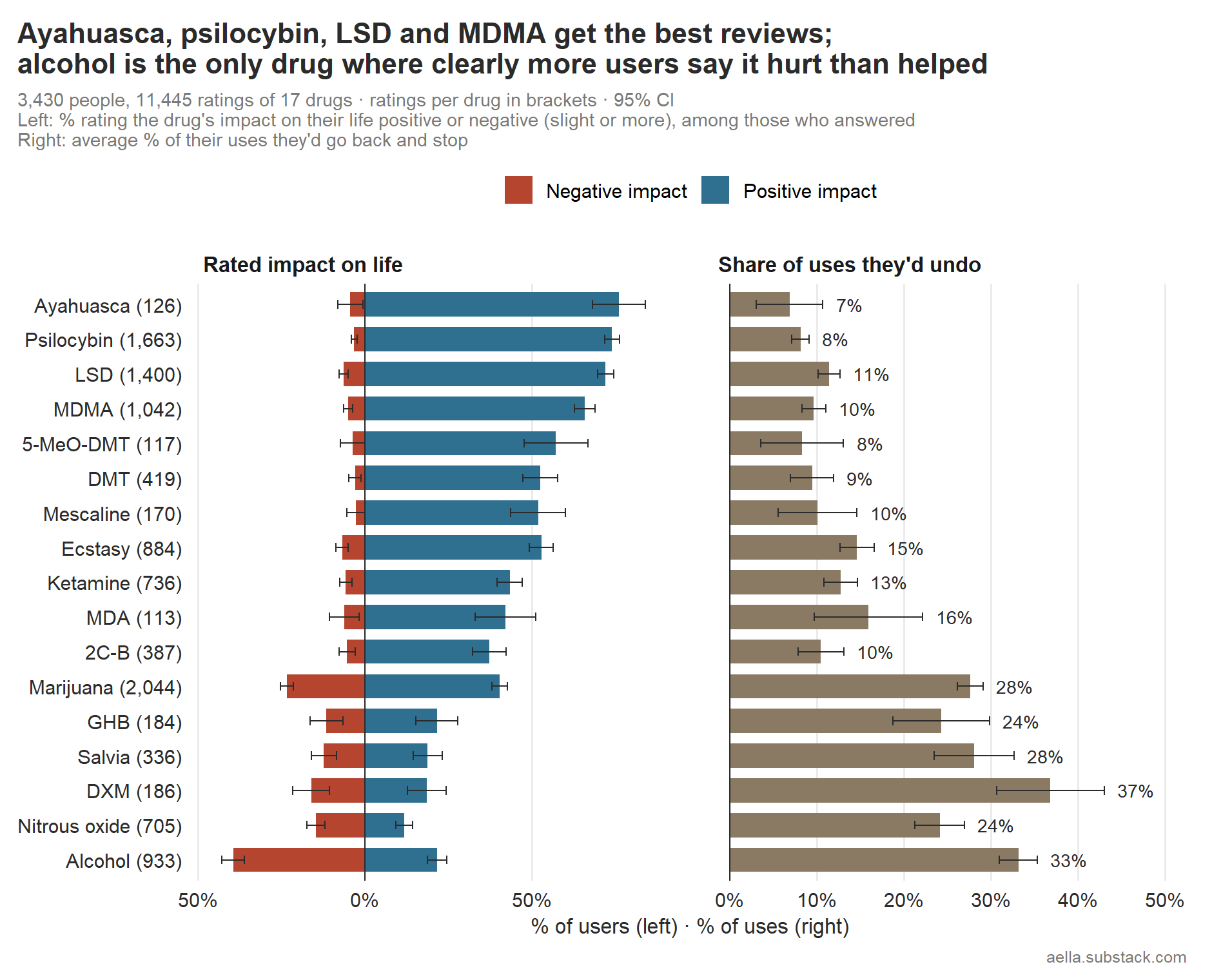
Ayahuasca, psilocybin, LSD and MDMA top the list. Three in four ayahuasca, psilocybin and LSD users rate the drug's impact on their life as positive, against 3–6% who rate it negative. MDMA follows at 66% positive. DMT, 5-MeO-DMT and mescaline are a step down (52–57%), mostly because more of their users answer neutral rather than negative, and 2C-B (37%) and MDA (42%) sit with ketamine (43%) and marijuana (40%). The bars count slightly positive answers. Counting only moderately or strongly positive, it's 44–50% for ayahuasca, psilocybin and LSD, 37% for MDMA, 25–38% for DMT, 5-MeO-DMT, mescaline and ecstasy, and 12% for 2C-B.
Alcohol is the one drug where negative answers clearly outnumber positive ones. 40% say it hurt their life and 22% that it helped. Nitrous (15% negative, 12% positive: 92 people against 73) and DXM (16% and 18%) are about even, salvia and GHB lean slightly positive, and marijuana is more positive than negative (40% vs 23.5%) but has the second-highest share saying it hurt. On the average score the order is the same but the gaps are small: alcohol −0.40, nitrous −0.09 and DXM +0.02 on a scale from −3 to +3, so alcohol is about a third of a point below nitrous. What sets it apart is the 40% who say it hurt, against 23.5% for marijuana and 16% or fewer for every other drug.
That gap is concentrated among people who rated many drugs. Among the 80 who rated only alcohol it's even (26% hurt, 25% helped); among people who rated 2 or 3 drugs it's 32% against 23%, for 4 to 7 drugs 44% against 21%, and for 8 or more 48% against 19%. This holds after allowing for how many times they'd drunk (p = 0.002 for the number of drugs rated). The survey can't say why.
Regret follows the same split. People would undo about one in ten uses of psychedelics, MDMA or ketamine (up to 16% for ecstasy and MDA), but a quarter to over a third of their uses of nitrous, GHB, marijuana, salvia, alcohol and DXM; DXM is highest at 37%. The question asks about the share of uses, which counts a regretted hangover the same as a regretted ceremony. The typical answer is 0 for most drugs (65% of psilocybin raters answered 0; the medians are 14% for marijuana, 16% for DXM and 22% for alcohol), so the averages for the psychedelics reflect a minority who'd undo some of their uses. Use counts differ enormously between these drugs (typically 301 to 500 times for alcohol, 201 to 300 for marijuana, 6 to 8 for psilocybin), so the split could just reflect how often people use a drug. It doesn't. Among people who've used a drug 4 to 50 times they'd take back 25% of alcohol uses and 28% of marijuana uses, against 8% for psilocybin, 9% for LSD and 10% for MDMA, and among people who've used a drug more than 50 times it's 5% of psilocybin uses, 10% of LSD uses and 12% of MDMA uses, against 25% for nitrous, 28% for marijuana and 35% for alcohol. For alcohol the share does grow with drinking: about a quarter of occasions for people with fewer than 100 drinks, 40% for people with over 1,000.
The share of people giving any regret at all is higher for drugs used more often, simply because there are more occasions to regret: 89% for alcohol and 75% for marijuana overall, against 35% for psilocybin. At similar use counts the gap is smaller: among people with 4 to 50 uses, 77% of drinkers, 70% of marijuana users and 69% of DXM users would take back some of their uses, against 40% for psilocybin, 43% for LSD and 43% for MDMA.
3. Where users say each drug helps and hurts
The same impact question was asked about five more areas: empathy ("your compassion, connection, communication"), creativity ("your originality, artistic ability, expression"), sexuality ("your sexual satisfaction, sexual shame, sense of gender, etc."), motivation ("your drive, work ethic, motivation") and cognition ("your memory, reasoning abilities, rationality").
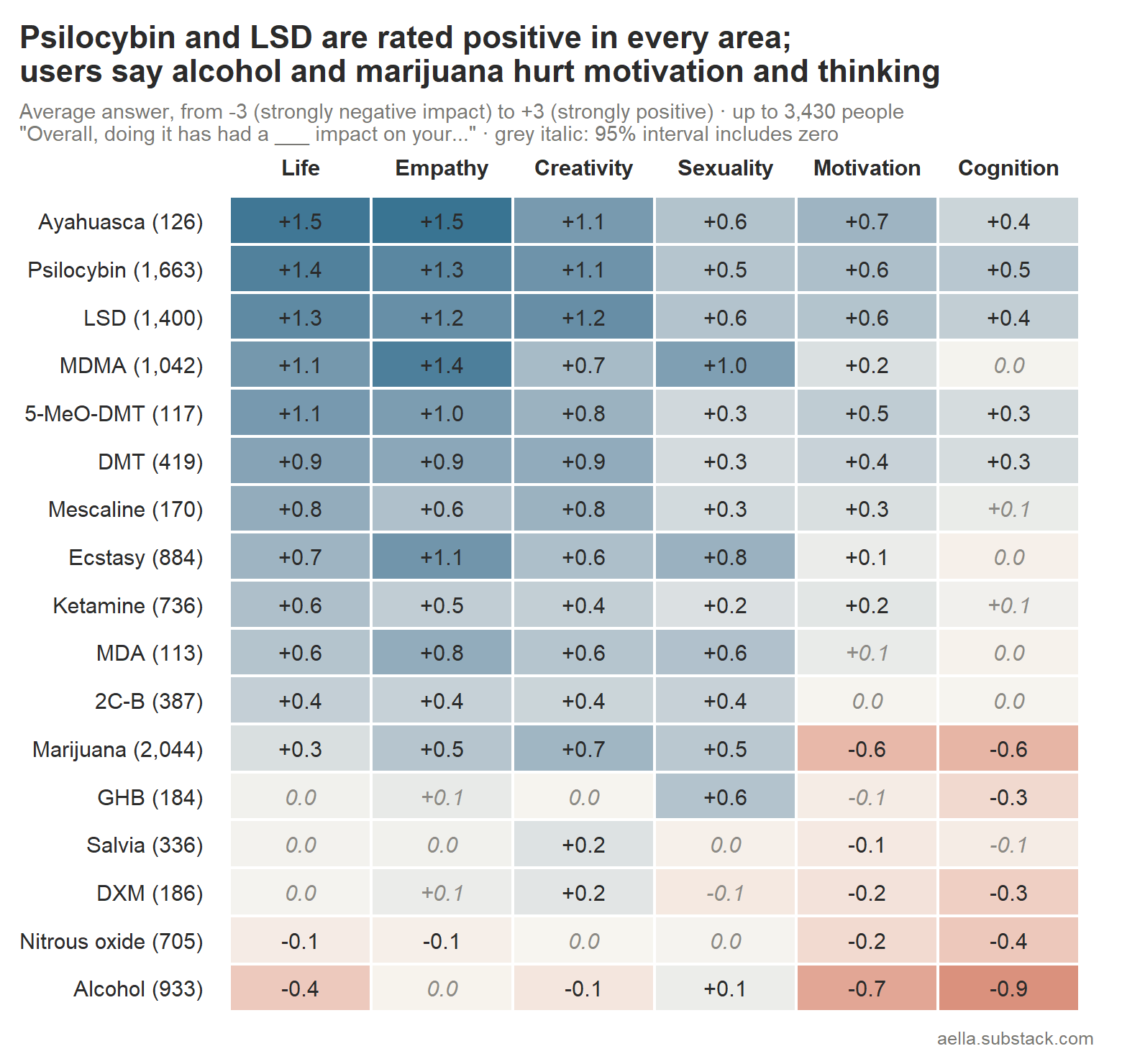
Each drug has its own profile:
- Psilocybin, LSD, ayahuasca, DMT and 5-MeO-DMT are rated positive in all six areas, most of all for life, empathy and creativity, and modestly for motivation (+0.4 to +0.7) and cognition (+0.3 to +0.5). The least certain cell is 5-MeO-DMT's cognition score (+0.3, 95% interval +0.05 to +0.5, 106 ratings). The other psychedelics are weaker: mescaline is positive for life, empathy, creativity, sexuality and motivation but about zero for cognition (+0.1), and 2C-B (motivation +0.01, cognition +0.01) and MDA (motivation +0.12, cognition −0.03) are indistinguishable from zero on both.
- MDMA and ecstasy are the empathy and sexuality drugs (+1.4 and +1.0 for MDMA; +1.1 and +0.8 for ecstasy), but do little for thinking (+0.03 and −0.05, both within noise of zero) and only a little for motivation (+0.24 and +0.10).
- Marijuana is rated as helping creativity (+0.7), empathy (+0.5) and sexuality (+0.5) and as hurting motivation and cognition (about −0.6 each).
- Alcohol is rated as hurting motivation (−0.7) and cognition (−0.9), the worst score of any drug in any area, and is rated as helping nothing much: empathy is about zero, creativity slightly negative, sexuality slightly positive (+0.1).
4. During the experience
Four questions asked what share of someone's trips had a particular quality. For example: "Out of your [drug] trips, what % did you experience paranoia, panic attacks, or acute anxiety?"
| Drug | Significantly pleasurable | Paranoia, panic or acute anxiety | Delusions | Contact with other beings | Typical intensity (0–5) |
|---|---|---|---|---|---|
| MDMA | 88% | 8% | 8% | 4% | 1.9 |
| Ecstasy | 86% | 10% | 10% | 5% | 1.9 |
| MDA | 82% | 10% | 8% | 6% | 2.0 |
| Mescaline | 79% | 12% | 22% | 19% | 2.2 |
| 2C-B | 77% | 12% | 10% | 5% | 1.9 |
| LSD | 77% | 22% | 26% | 14% | 2.3 |
| Psilocybin | 75% | 19% | 20% | 19% | 2.2 |
| Nitrous oxide | 71% | 6% | 9% | 5% | 2.8 |
| Ketamine | 71% | 10% | 14% | 9% | 2.4 |
| DMT | 65% | 15% | 26% | 47% | 3.5 |
| Marijuana | 64% | 24% | 12% | 5% | 1.6 |
| Alcohol | 63% | 9% | 7% | 2% | 1.5 |
| 5-MeO-DMT | 62% | 16% | 31% | 43% | 3.6 |
| GHB | 60% | 8% | 3% | 1% | 1.9 |
| Ayahuasca | 54% | 26% | 27% | 57% | 3.3 |
| DXM | 54% | 24% | 21% | 8% | 2.6 |
| Salvia | 32% | 31% | 45% | 26% | 3.5 |
Average share of each person's trips. Intensity is the answer to "On average, most of the time you've done [drug], how intense is this drug for you?", from 0 (no noticeable effects) to 5 (no connection to reality).
A good trip and a good outcome aren't the same thing. Ayahuasca has the best life-impact rating but only about half its trips are significantly pleasurable, and about a quarter involve panic or acute anxiety. Alcohol and nitrous are mostly pleasant and low on anxiety while they last, and still rate lowest overall. Salvia is the one drug that's unpleasant on both counts: a third of trips pleasurable, nearly a third anxious, and delusions in almost half.
The entity drugs stand out. Users report "the sensation of contacting other beings (like spirits, higher dimensional beings, aliens, etc.?)" on 57% of ayahuasca trips, 47% of DMT trips and 43% of 5-MeO-DMT trips.
5. What lasts
A set of statements asked about lasting changes, each answered disagree, slightly, moderately or strongly agree. The chart shows the share agreeing moderately or strongly.
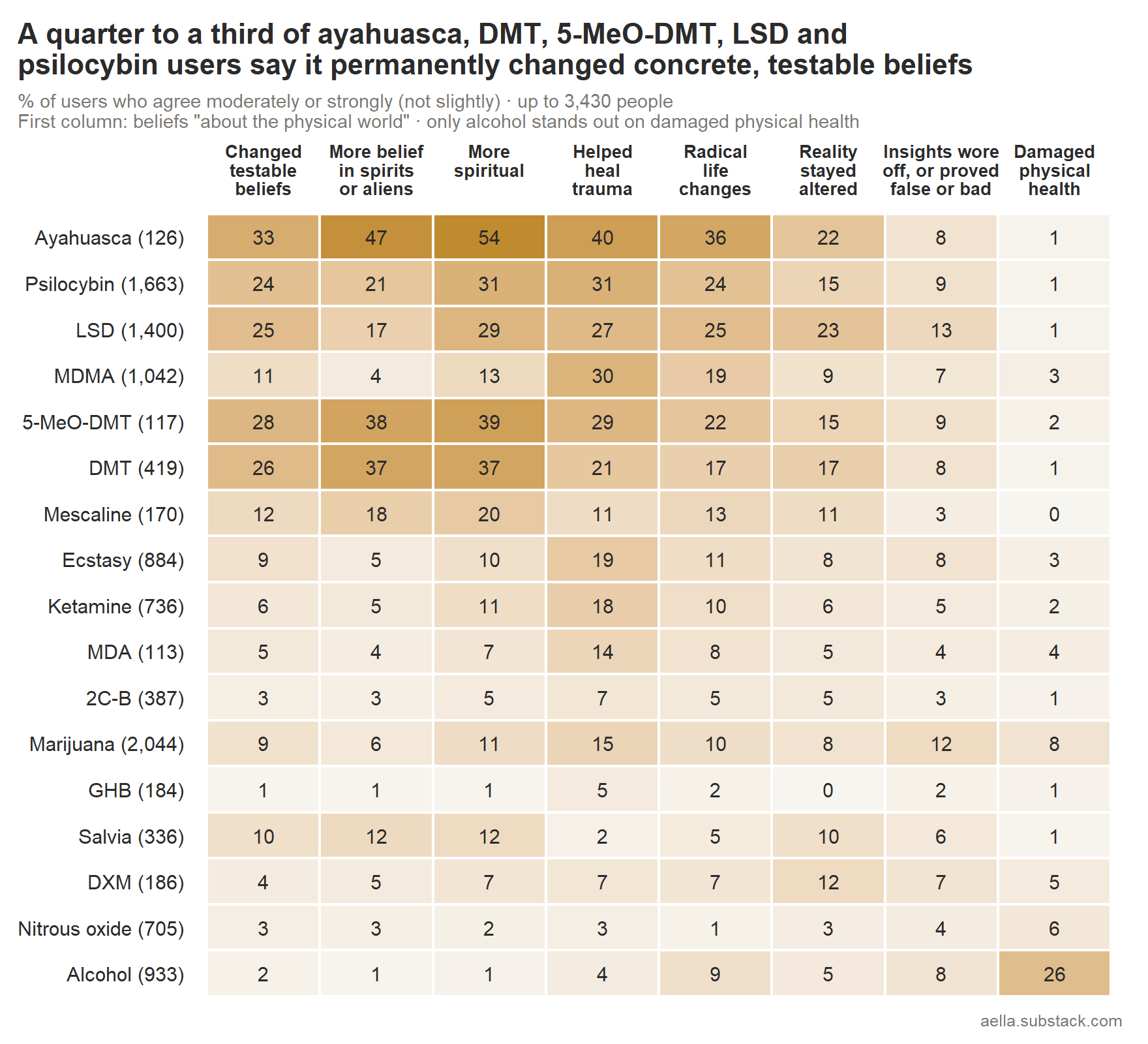
A quarter to a third of ayahuasca, DMT, 5-MeO-DMT, LSD and psilocybin users agree, moderately or strongly, that the drug permanently changed concrete, testable beliefs about the physical world. The statement is about "concrete, testable beliefs that I hold about the physical world around me". Agreement is 24–33% at moderately or strongly for these five drugs, against 12% or less for every other drug. How many agree depends on the cutoff, as the table shows: counting slight agreement it's 44–58%, and counting only strong agreement 12–23%.
It also depends strongly on how much people had used the drug. Among LSD and psilocybin users, 12–13% of those with three or fewer uses agree moderately or strongly, against about 45% of those with 36 or more (the 876 and 341 people in those two groups). Ayahuasca, DMT and 5-MeO-DMT raters had typically used them 2 or 3 times, against 6 to 8 times for LSD and psilocybin, so the five drugs aren't compared at equal use.
| Drug | Users | Permanently changed concrete, testable beliefs | Insights later wore off or proved false or bad | ||||
|---|---|---|---|---|---|---|---|
| Slightly or more | Moderately or more | Strongly | Slightly or more | Moderately or more | Strongly | ||
| Ayahuasca | 114 | 58%49–67 | 33%25–42 | 23%16–31 | 26%19–34 | 8%4–14 | 4%2–10 |
| 5-MeO-DMT | 103 | 47%37–56 | 28%20–38 | 18%12–27 | 31%23–41 | 9%5–16 | 5%2–11 |
| DMT | 363 | 44%39–49 | 26%22–31 | 18%14–22 | 20%16–25 | 8%6–11 | 3%2–5 |
| LSD | 1,292 | 46%44–49 | 25%23–28 | 13%11–15 | 35%32–37 | 13%11–15 | 5%4–6 |
| Psilocybin | 1,488 | 47%45–50 | 24%22–27 | 12%11–14 | 28%26–30 | 9%8–11 | 3%2–4 |
| Mescaline | 141 | 28%21–36 | 12%8–18 | 5%2–10 | 14%9–21 | 3%2–8 | 1%0–4 |
| MDMA | 923 | 28%25–31 | 11%9–13 | 4%3–6 | 24%21–27 | 7%5–9 | 2%1–3 |
| Marijuana | 1,824 | 24%23–26 | 9%7–10 | 4%3–5 | 33%31–36 | 12%10–13 | 4%3–5 |
| Alcohol | 803 | 9%7–11 | 2%1–3 | 0%0–1 | 26%23–29 | 8%6–10 | 2%1–3 |
Share of users agreeing at each level, with 95% intervals below. The wording of both statements is in the Figure 3 caption.
Ayahuasca, DMT and 5-MeO-DMT also lead on raising belief in spirits, higher-dimensional beings or aliens (37–47% moderately or strongly), and on making people more spiritual. Psilocybin and LSD are a notch lower on the supernatural (17–21%).
The second statement in the table asks something different: about shifts or realizations that seemed meaningful for a while but "wore of or turned out to be false or bad for me". It covers insights of any kind, not only the belief changes above, and it includes "bad for me", so the two columns can't be subtracted to say how many belief changes held up. Agreement is 8–13% at moderately or strongly for the five drugs, about the same as marijuana (12%) and alcohol (8%), and 20–35% counting slight agreement, highest for LSD (35%); marijuana is at 33%.
MDMA's lasting effect is emotional: 30% say it helped them heal from trauma, about as many as for psilocybin (31%), and well above its share for changed beliefs (11%). And for alcohol, one statement stands out: 26% say it damaged their physical health, against 8% for marijuana and 6% or less for everything else. At slight agreement or more that is 64% for alcohol, 33% for marijuana and 25% or less for everything else.
Other people notice too. Asked whether "People have expressed concern about changes in me that were caused by my [drug] use", 39% of drinkers and 30% of marijuana users said yes, against 18% for DXM and 3–11% for everything else. Those figures count "There's been no change" as no, and many users of the less-used drugs said nothing had changed. Among people who said their use had changed them, concern was 65% for alcohol and 52% for marijuana and DXM, against 15% for psilocybin. Approval runs the other way: 51% of ayahuasca users and 36–38% of LSD and psilocybin users say people have expressed approval of the changes, against 15% for alcohol.
6. Head to head
Different drugs attract different people, so the comparisons above could partly reflect who takes what. Comparing drugs within the same people sets aside differences between people, though not differences in how much they used each drug. Figure 4 shows ten pairs of similar or commonly compared drugs, each among the people who rated both.
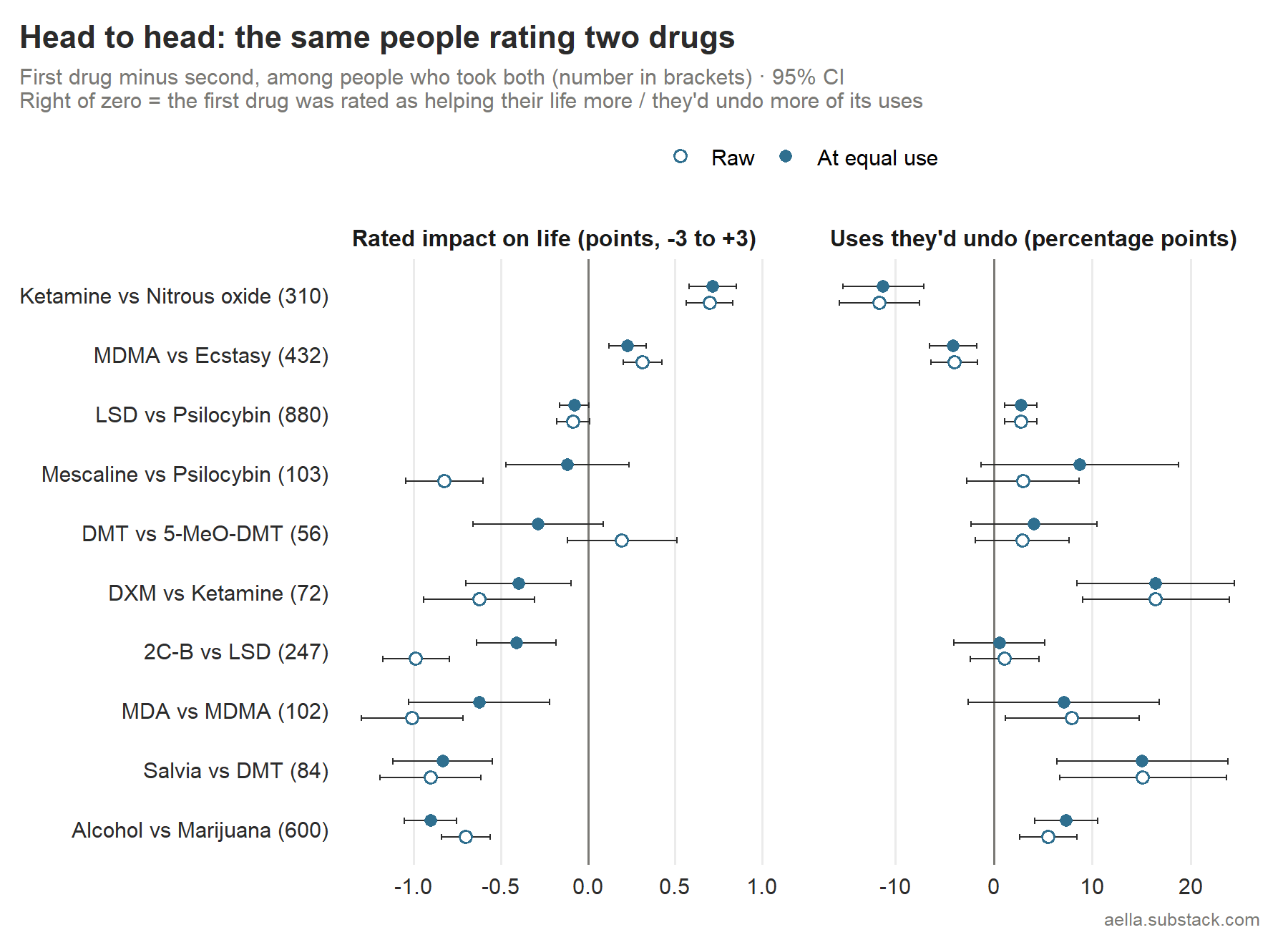
People have usually taken the two drugs in a pair a different number of times, and ratings rise with use (section 7). So the chart shows each comparison two ways: the raw difference (open circles), and the difference expected if people had used both drugs equally often (filled), estimated from how each person's difference changes with the gap in how many times they'd taken each drug.
- MDMA edges ecstasy, and the gap goes with how much more people had used MDMA. Among the 432 people who've had both, MDMA is ahead by 0.31 on life impact, and they'd take back 4 percentage points fewer of its uses (9% vs 13%). But they'd used MDMA more often (typically 9 to 13 times against 6 to 8), and the life-impact gap follows that, as the table shows. On the checklist the two were listed as "MDMA (pure, not ecstasy)" and "Ecstasy (not pure MDMA)", so this compares what people say they took; it can't show whether ecstasy pills are less pure.
| Which had they used more? | People | Typical uses (median range), MDMA / ecstasy | Life impact, MDMA | Life impact, ecstasy | Difference | Regret difference (points) |
|---|---|---|---|---|---|---|
| MDMA, at least twice as often | 157 | 14–20 / 3 | +1.24 | +0.57 | +0.67+0.50 to +0.84 | −4.4−9.5 to +0.6 |
| About equally (within a factor of two) | 197 | 9–13 / 9–13 | +1.16 | +0.93 | +0.23+0.07 to +0.39 | −3.0−5.6 to −0.5 |
| Ecstasy, at least twice as often | 78 | 4–5 / 14–20 | +0.60 | +0.79 | −0.19−0.43 to +0.05 | −5.6−10.5 to −0.6 |
Each person's MDMA rating minus their ecstasy rating, by which drug they'd used more often, with 95% intervals. Regret difference is the percentage of uses they'd undo for MDMA minus ecstasy. Among the 102 people who'd used the two exactly equally often, the life-impact gap is +0.18.
So MDMA's life-impact lead is about 0.2 points where people used the two about equally, much larger where they'd used MDMA far more, and gone where they'd used ecstasy far more. The regret gap doesn't change much with relative use: MDMA is 3 to 6 points lower in all three groups.
- Ketamine beats nitrous by a lot: +0.70 on life impact among 310 people, with half the regret (12% vs 23% of uses), though ketamine trips come with more anxiety.
- Psilocybin and LSD are nearly tied. Among 880 people who've had both, life impact is within 0.1 point. People would take back slightly more of their LSD uses (11% vs 8%), even though they found slightly more of their LSD trips pleasurable.
- Alcohol loses to marijuana (−0.70 on life impact, −0.90 at equal use, and 5.5 points more regret, 7.4 at equal use), though marijuana trips come with far more paranoia or panic (about a quarter vs 9%).
- Salvia and DXM lose badly. Salvia scores 0.90 below DMT with 15 points more regret; DXM scores 0.62 below ketamine (0.40 at equal use) with 16 points more regret.
- Mescaline, 2C-B and MDA mostly lose on experience. People had typically tried them two or three times, against 9 to 13 or 14 to 20 times for the drug they're compared with. At equal use, mescaline is about tied with psilocybin (−0.12), and the gaps for 2C-B and MDA shrink from about −1.0 to −0.4 and −0.6.
Ranking all 17 drugs with a separate baseline for each person, so every comparison is within someone, gives nearly the same order as Figure 1 (rank correlation 0.98): psilocybin, ayahuasca and LSD at the top, then MDMA, with nitrous and alcohol at the bottom.
7. The more you use it
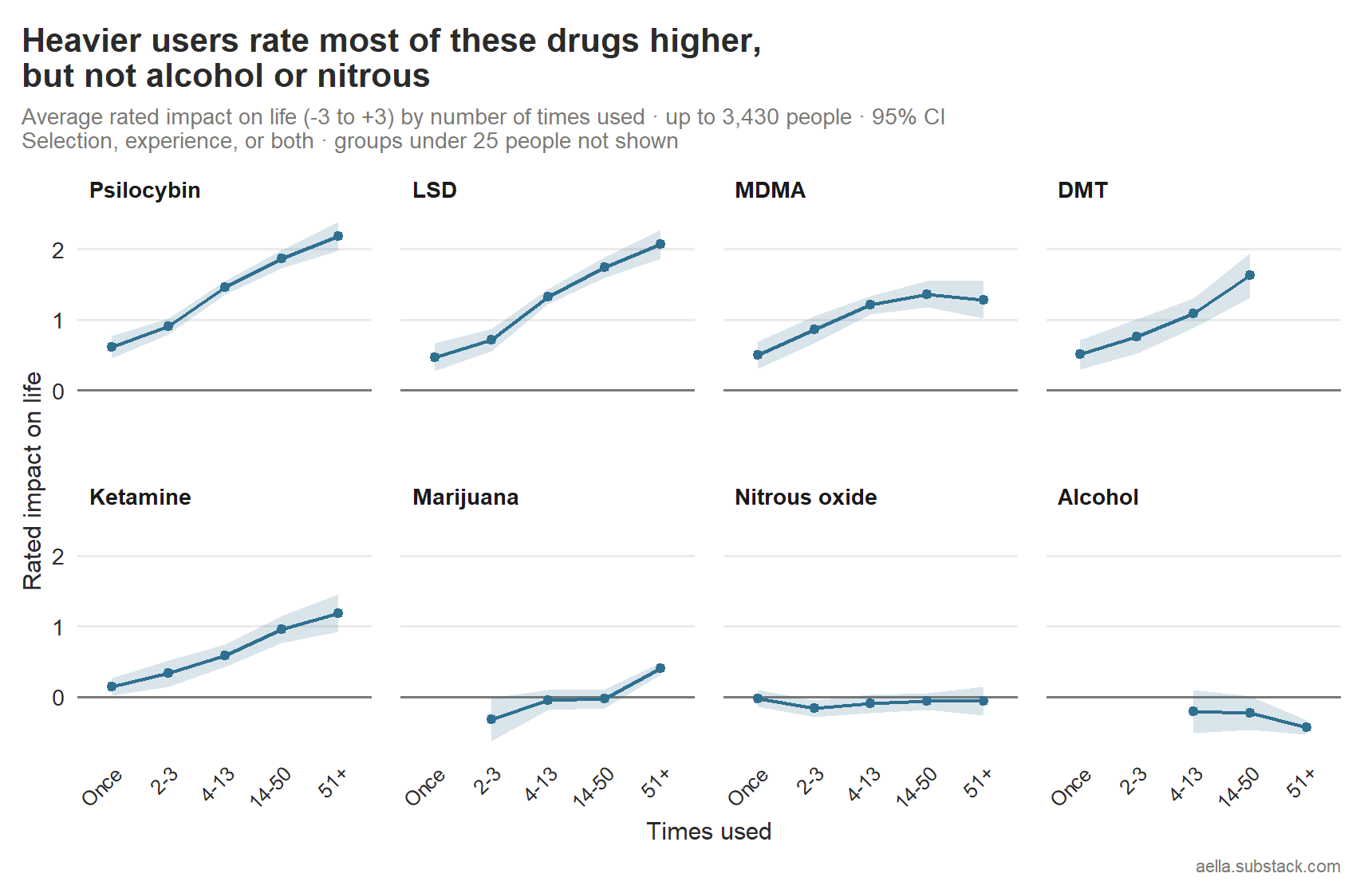
For most drugs, people who've used more rate it much better. Someone who's taken psilocybin once rates its life impact +0.6 on average; someone who's taken it 51 or more times, +2.2. The survey can't separate the possible reasons: people who had a bad experience stopping while those who got something out of it kept going, benefits building up with repeated use, or people justifying a habit. Older people have used drugs more often, but allowing for age, sex and politics barely changes the pattern (0.12 points of life impact per doubling of uses, with or without them). To the extent that people with bad experiences stopped, the ratings above lean positive for every drug.
Regret shows the filter at work. Among people who tried LSD only once, 16% say they'd go back and stop themselves every time (they answered 100%), against 5% of one-time psilocybin users. LSD users who kept going would undo only 8–10% of their uses.
Two drugs don't follow the pattern, and a third barely does. Nitrous stays flat near zero however much people use it, alcohol gets worse (regular drinkers rate it −0.43), and marijuana is near zero or slightly negative until people have used it more than 50 times. So the bottom of the table isn't just because alcohol and marijuana are used so much more often. Among people who'd used a drug 5 to 50 times, psilocybin averages +1.59, LSD +1.47 and MDMA +1.27, against −0.04 for marijuana, −0.08 for nitrous and −0.23 for alcohol.
8. Who regrets more
Holding the drug and the number of uses fixed, some people regret more than others. On average cis women would take back 20.7% of their uses, trans and nonbinary people 18.0% and cis men 16.6%. By politics it's 20.2% for people right of centre, 18.4% for the centre and 16.5% for people left of centre; each standard deviation further left (about 1.7 points on the 7-point politics scale) goes with 2.4 points less. People with a mental health diagnosis would take back 18.7% against 15.1% for people without one, and people who agree more with "I'm mentally well" regret slightly less (1.2 points per standard deviation). With a Holm correction for the eight terms tested together (seven traits and the number of uses), the sex (cis women vs cis men), politics and diagnosis differences hold up, "mentally well" only just (adjusted p = 0.04), and age, worry and the trans or nonbinary difference don't. Paranoia and panic during trips follow a similar pattern and are also more common for people who agree with "I worry about things."
Preparation goes with better outcomes. Within the same person, the drugs someone researched more beforehand ("how much research did you do about it (e.g. safety, how to have good outcomes, dosage, etc.)?", 0–100) got better ratings: for each 10 points more research, 0.8 percentage points less regret and slightly more pleasurable trips, though not less anxiety. This is still a correlation. People may research the drugs they take more seriously, or misremember their research after a good experience.
9. Could it be something else?
Isn't it just who takes which drug? Partly, which is why section 6 compares drugs within the same people. A ranking built that way gives nearly the same order as the raw averages (rank correlation 0.98).
Isn't it age, sex or where people found the survey? The order holds in every group. Ranking the drugs by average life impact within cis men, cis women, trans and nonbinary respondents, people under 25, 25 to 34 and 35 and over, and people who came from Twitter or from elsewhere gives a rank correlation of 0.96 to 1.00 with the whole-sample order (drugs with at least 30 raters in the group). Alcohol has the lowest average in every group, from −0.23 for people under 25 (barely below nitrous at −0.19) to −0.56 for people 35 and over, and psilocybin is between +1.1 and +1.5 in every group. In each sex group more people say alcohol hurt their life than helped: 40% vs 23% for cis men, 44% vs 22% for cis women and 34% vs 18% for trans and nonbinary people.
Do the 39 under-18s change anything? No. The 39 respondents aged 14 to 17 are included here, and adding them moved no drug's average life impact by more than 0.04 points or its regret by more than 0.3 points. They're too few to analyze on their own: they rated marijuana +0.9 on average (24 ratings, against +0.2 for adults) and alcohol −0.5 (20 ratings, against −0.4).
Are alcohol's raters an unusual group? Alcohol was added to the checklist about five days into the run. Of the 1,594 people who saw it and ticked at least one drug, 94% ticked it, so its 933 raters aren't a self-selected group of people who count alcohol among the drugs they've done. How many other drugs they rated does matter, though (section 2).
Methods and limits
Data. Drug Experiences survey, October 2024 to January 2025. Respondents ticked the drugs they'd ever taken from two checklists, then answered the same 31-item block for each ticked drug, in random order; people who dropped out partway answered a random subset of their drugs. Of 5,329 who started, 3,517 answered at least one block and 1,765 finished; people who stopped partway count for the drugs they rated. Removed: developer test runs; anyone who gave no age (none of them had answered a block); people whose every block was straight-lined (the same answer on every statement); finishers averaging under 1.75 minutes per block; and blocks for drugs taken zero times. People under 18 are kept: 39 of the 3,430 people shown are aged 14 to 17, and ages run from 14 to 81. The 17 drugs with at least 100 raters are shown: 3,430 people and 11,445 ratings. The survey had no honesty question.
Scales. Impact questions run from −3 (strongly negative) to +3 (strongly positive) in all versions. The agreement statements used a 4-point scale (disagree, slightly, moderately, strongly agree) for 92% of ratings; the first few days used a 7-point scale, whose answers were mapped onto the 4-point one (anything from strongly disagree to neutral counts as disagree). Number of uses was answered in ranges (for example 6–8, 9–13, 201–300, 301–500); where the page gives a typical number of uses, it is the range that contains the median. "People have expressed concern/approval" counts "There's been no change" as no.
Comparisons. The within-person rankings use a separate baseline for each person (person fixed effects) among people who rated two or more of the 17 drugs, with 95% intervals clustered by person. Head-to-head pairs are simple paired differences. "Who regrets more" is a regression of each rating on the drug, the number of uses (log scale) and person traits, clustered by person.
Limits.
- Users' verdicts, not measured effects. These are retrospective self-reports about drugs people chose to take, often years later.
- Survivors. People who had a bad time with a drug may have stopped after one or two tries, while people who liked it kept going, so for most drugs heavier users rate it higher. People with enthusiasm for drugs are also more likely to take a long drug survey.
- Setting. Drugs differ in how they're taken. Ayahuasca is usually a guided ceremony and alcohol a daily habit, and the ratings reflect the whole experience, not only the chemical.
- Who answered. Mostly experienced, left-leaning men who follow Aella; not a sample of all drug users, and nothing here says how a first-time user would fare. Only 39 respondents were under 18.
- Engagement. People who rated many drugs rate psychedelics higher and alcohol lower than people who rated one (psilocybin +1.55 vs +0.96; alcohol −0.62 vs −0.12), and for alcohol the share saying it hurt rises with the number of drugs rated (section 2). The 981 people who rated a single drug count in the averages but not in the within-person comparisons.
- Wording. The trip questions say "trips" for every drug, including alcohol, marijuana and nitrous.
Process. The analysis was done with AI assistance and re-run from the raw export. Corrected 13 November 2026: respondents under 18 are now included, and the headlines on MDMA versus ecstasy, belief change, "positive in every area" and alcohol were reworded.