TL;DRMostly not "made" by anything we can measure — but the exceptions are specific
If experiences created fetishes in any straightforward way, the experiences should show up in the data. Mostly, they don't: childhood adversity of every kind predicts adult kinks at trivial magnitudes; roughly half of fetishes predate first intercourse; a sixth-to-third predate porn itself; and most of the porn–kink correlation dissolves once you account for the fact that porn users are just kinkier across the board. What dominates instead is a general, trait-like kink disposition — how kinky you are overall predicts any specific fetish far better than anything that happened to you.
But "mostly innate-looking" isn't the whole answer, because the exceptions are content-specific in revealing ways: porn retains a genuine signature on a particular cluster (incest, multiple partners, voyeurism/exhibitionism, gender play, age play, mythical creatures, bestiality — the taboo/screen-genre kinks), especially with early exposure; childhood sexual abuse — alone among adversities — specifically predicts non-consent and incest interests (tiny but robust, and victim-role-specific only in women); and childhood spanking specifically predicts adult spanking interest. The answer differs by fetish (see the map) and by sex (content and channeling differ; timing is identical).
01How do you even test this with a survey?
You can't randomize childhoods, and this survey has no twins. What you can do with a million respondents is check whether the experience-causation story leaves the footprints it should:
- Timing. A cause precedes its effect. If porn or partnered sex creates fetishes, fetishes shouldn't predate them.
- Specificity. If an experience installs a kink, it should install that kink, not raise everything. This is where confounding lives, and the analyses here control the two big fakers:
- General kinkiness — people who endorse one fetish endorse many. Any variable correlated with being kinky (porn use, adversity, openness) will spuriously "predict" every fetish. We control each fetish for the person's mean arousal across the other 28 ("kink-breadth control").
- General adversity load — abuse types co-occur, so "physical abuse → sadomasochism" can just be "rough childhood → slightly kinkier." The adversity analysis controls total adversity, psychopathology, demographics, and breadth.
- Dose-response. More exposure → more fetish, with a gradient, is what cultivation predicts.
- Invariance. Things that are innate-ish tend to look the same across generations (despite wildly different media environments) and to show stable sex-typed patterns; things installed by environment should track the environment.
02Timing: fetishes mostly arrive before the experiences that supposedly cause them
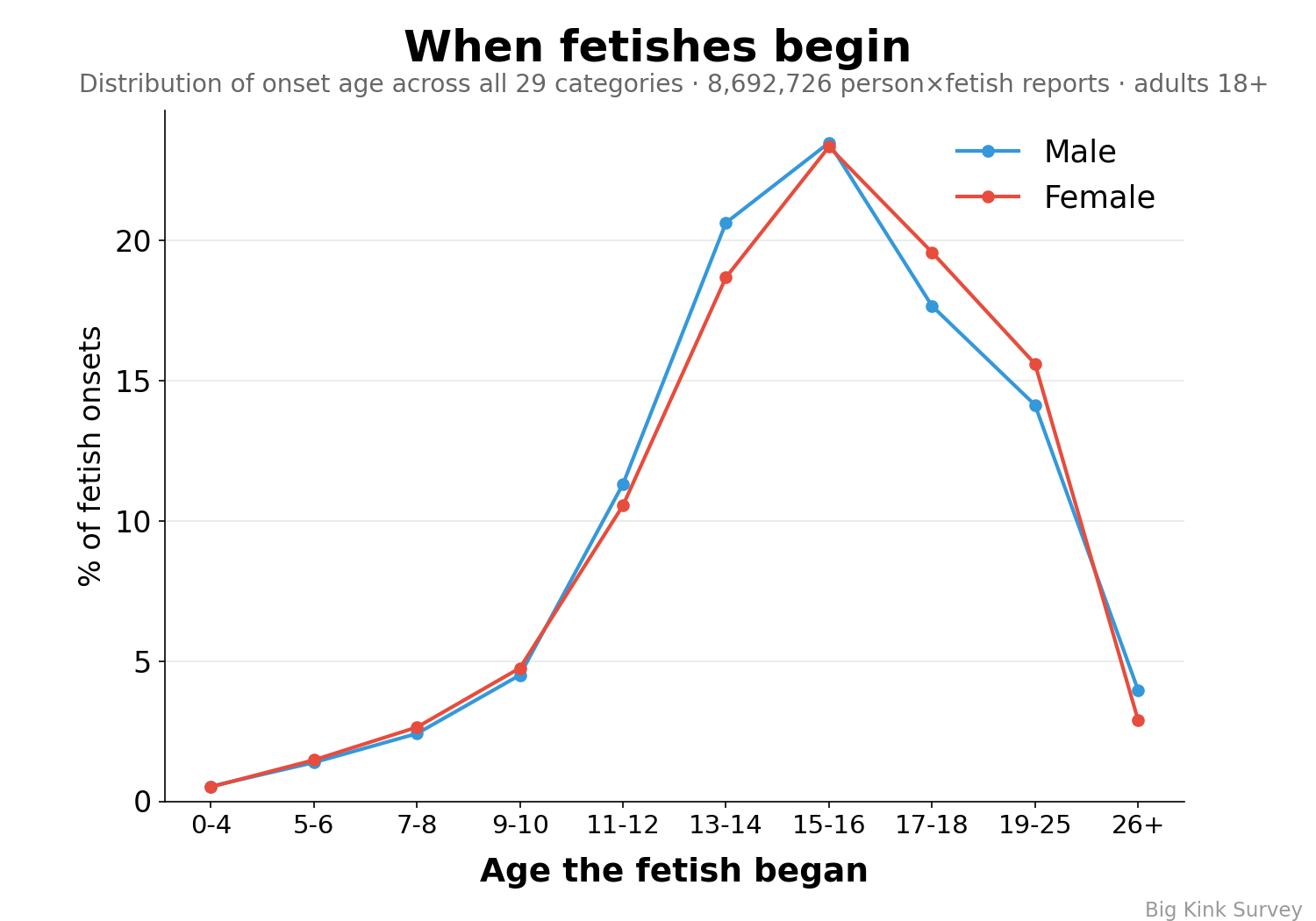
Fetish onset is concentrated in adolescence — peak at 15–16, ~9% before age 11, and on an identical schedule for both sexes (mean 14.87 for men and for women) — itself a striking regularity: whatever drives acquisition runs on the same developmental clock in both sexes, the way puberty-linked traits do.
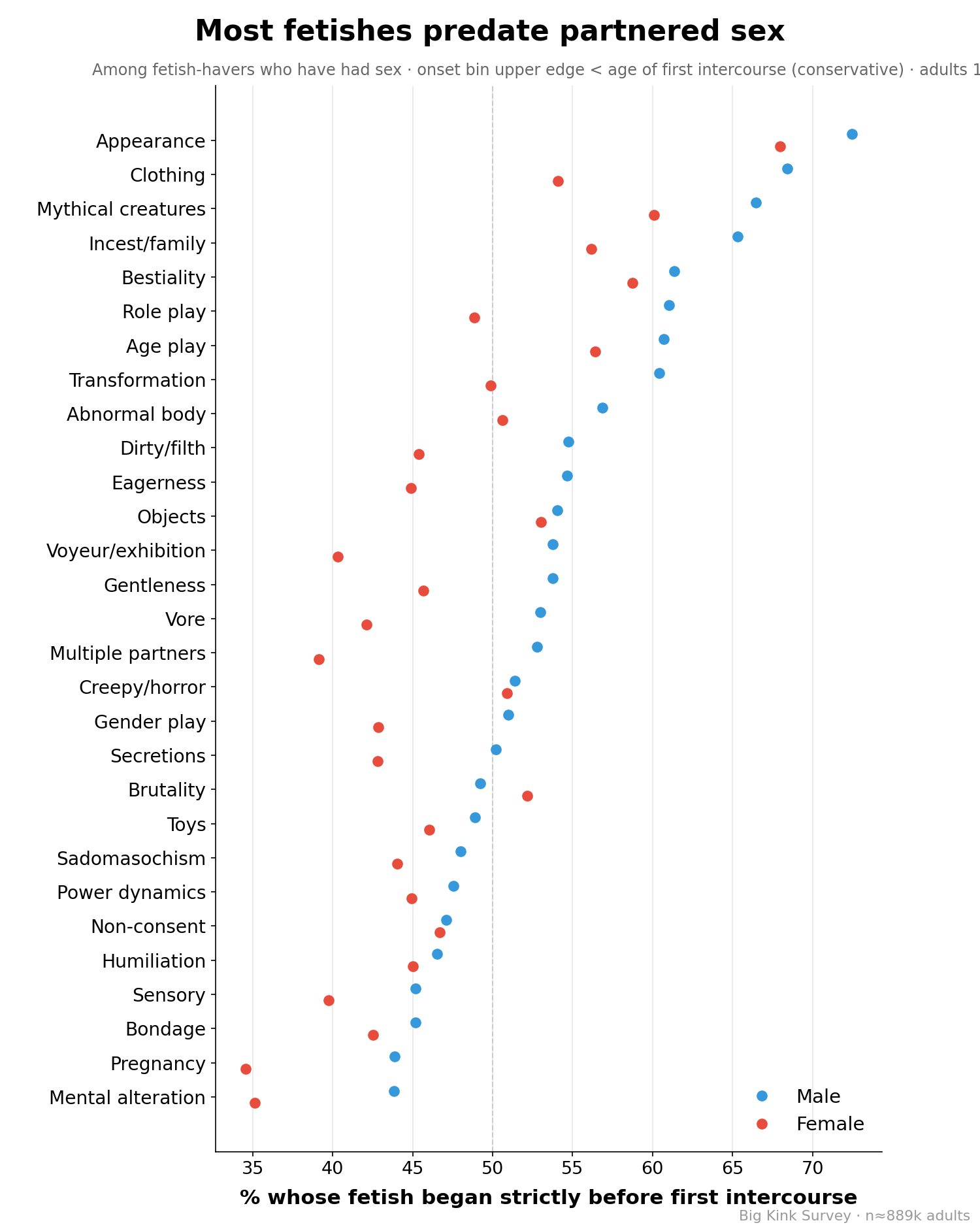
Against the most obvious experiential candidate — partnered sex — the ordering is decisive: across categories, 35–72% of fetish-havers report the fetish began strictly before their first intercourse (conservatively scored). You cannot acquire a fetish from sexual experiences you haven't had yet.
Against porn the ordering runs the other way for most people (typical porn onset is 11–12, before most fetish onsets), but 13–33% of fetish-havers predate even that — led by the childhood-imagination cluster: appearance (33%), mythical creatures, age play, clothing, vore. And within every category, earlier onset predicts a stronger adult fetish (29/29 categories, identical slopes by sex) — early-arriving templates consolidate hardest. Details on both in the companion report.
03Porn, disentangled: most of the correlation is confounding — what survives is specific
Raw porn–fetish correlations are substantial for every kink (age-adjusted β ≈ 0.03–0.26). But porn users are kinkier in general, so most of that is not about any particular fetish. Adding kink-breadth control — does porn use predict this fetish beyond your overall kinkiness? — collapses most associations to zero, and pushes some negative:
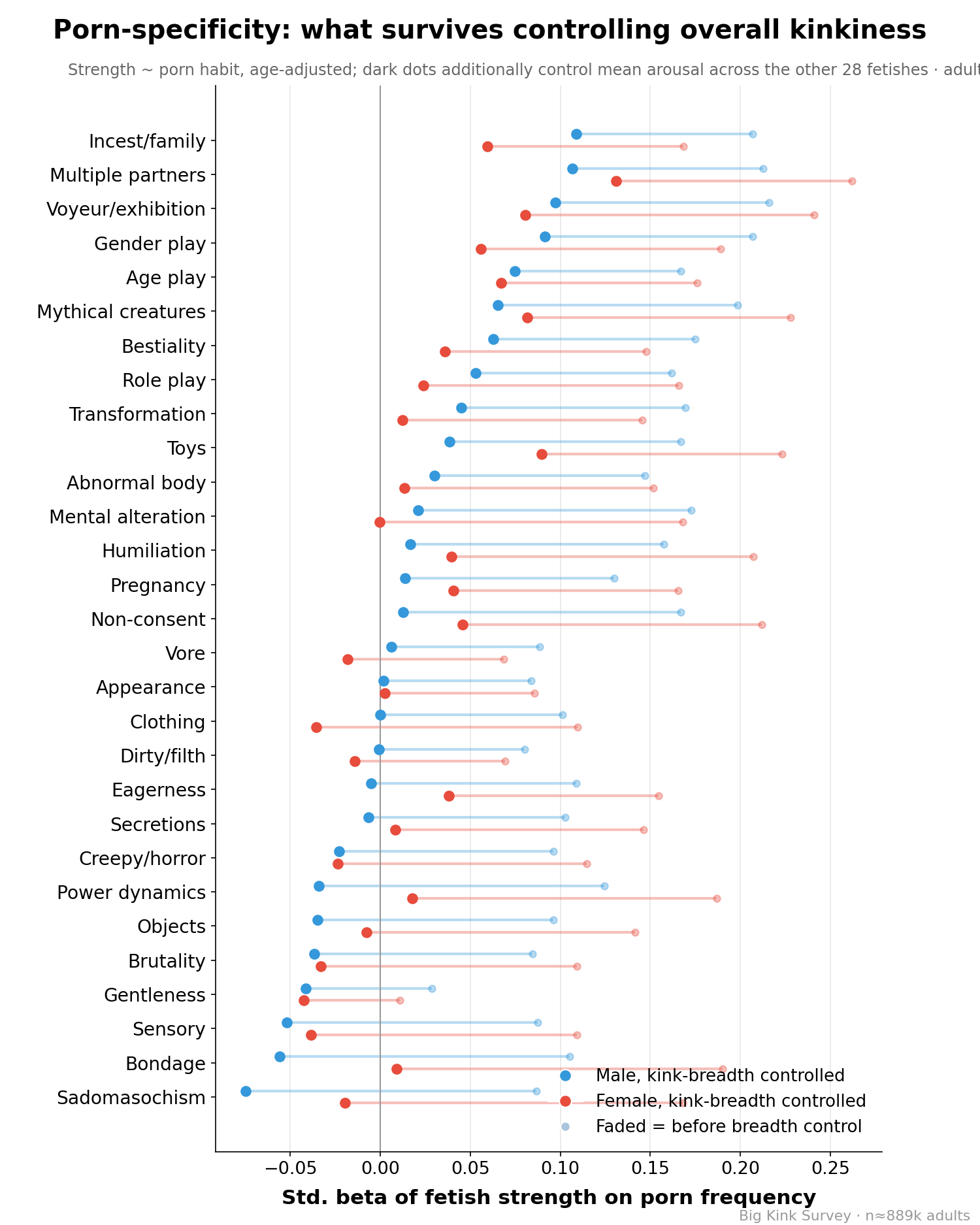
Three things to read off this chart:
- The survivors are the porn genres. Incest, multiple partners, voyeurism/exhibitionism, gender play, age play, mythical creatures, toys, bestiality keep real (if small, β ≈ 0.05–0.12) porn-specific signatures. These are disproportionately interests that exist mainly as screen content.
- The "porn makes people sadomasochists" story fails outright. After breadth control, sadomasochism, bondage, sensory, and power dynamics go negative — heavy porn users are slightly less into the partnered-body kinks than their overall kinkiness predicts.
- Magnitudes are modest. Even the surviving betas are small; nothing here supports porn as a dominant creator of fetishes — it looks like a content-channeler at the margin.
04Trauma: the classic theory mostly fails — except where the adversity is itself sexual
The oldest experience-causation story — abuse creates kink — was tested rigorously on this same dataset (1,015,060 respondents; hierarchical models controlling demographics, psychopathology, childhood SES, sexual repression, kink breadth, and total adversity load). The results are a dissociation:
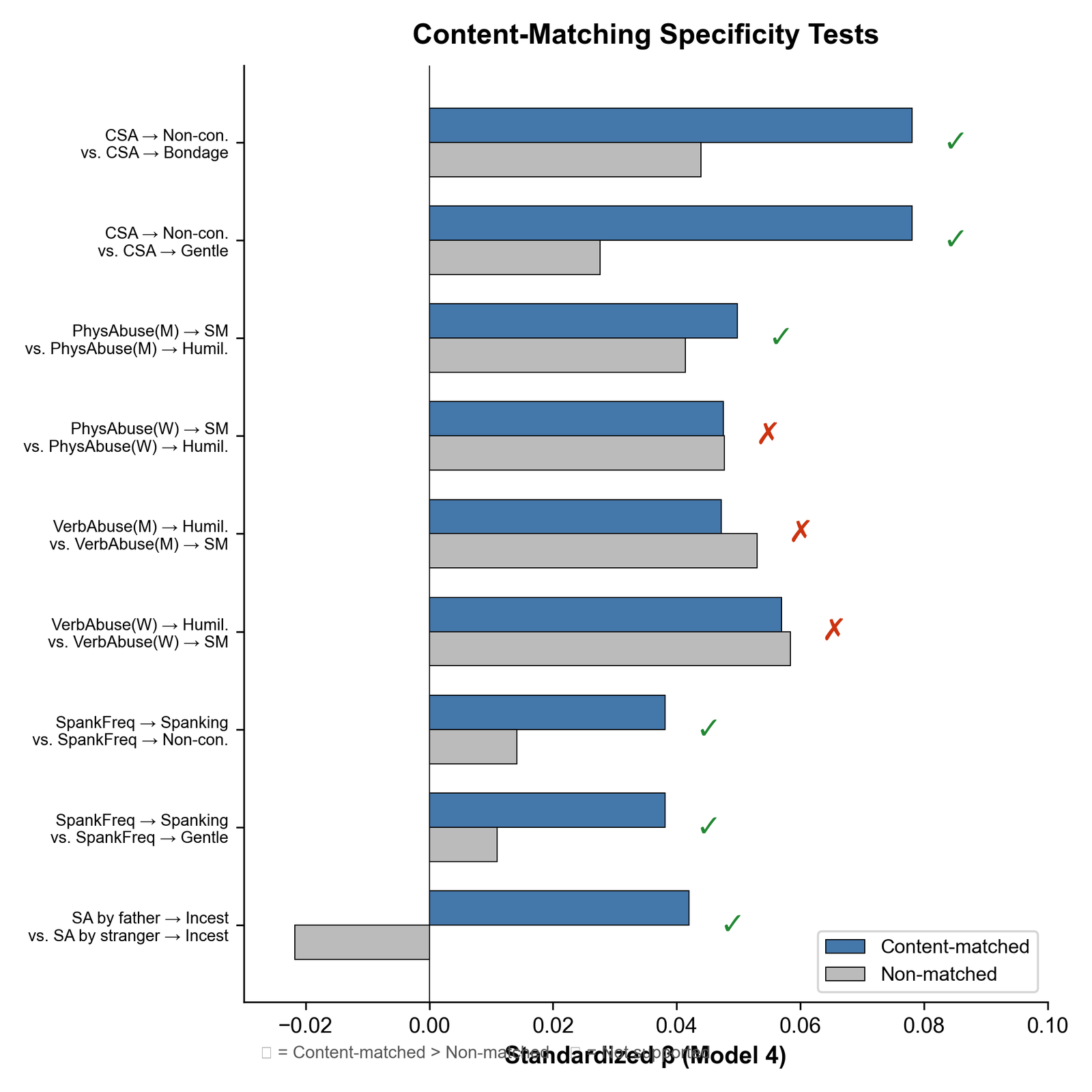
- Non-sexual adversity shows no content specificity. Physical abuse → sadomasochism and verbal abuse → humiliation are eliminated (99–124% attenuation) by general-adversity controls. A rough childhood makes people very slightly kinkier overall; it does not install the matching kink.
- Sexual adversity is the exception. Childhood sexual abuse uniquely predicts non-consent fantasy (β = 0.060) and incest interest (β = 0.049) after all controls. And perpetrator identity matters in a content-matched way: abuse by a parent positively predicts incest interest (β ≈ 0.04–0.05) while abuse by a stranger negatively predicts it.
- Spanking → spanking interest survives but small (β = 0.038, 85% attenuated by adversity load).
- Everything is tiny. No adversity variable explains even 1% of variance in any sexual interest; general kink breadth dwarfs them all.
05Sex differences: identical timetable, different content
Men and women acquire fetishes at the same ages and show the same onset-strength gradient — but what they acquire differs a lot, in a pattern that's hard to assign to any measured experience:
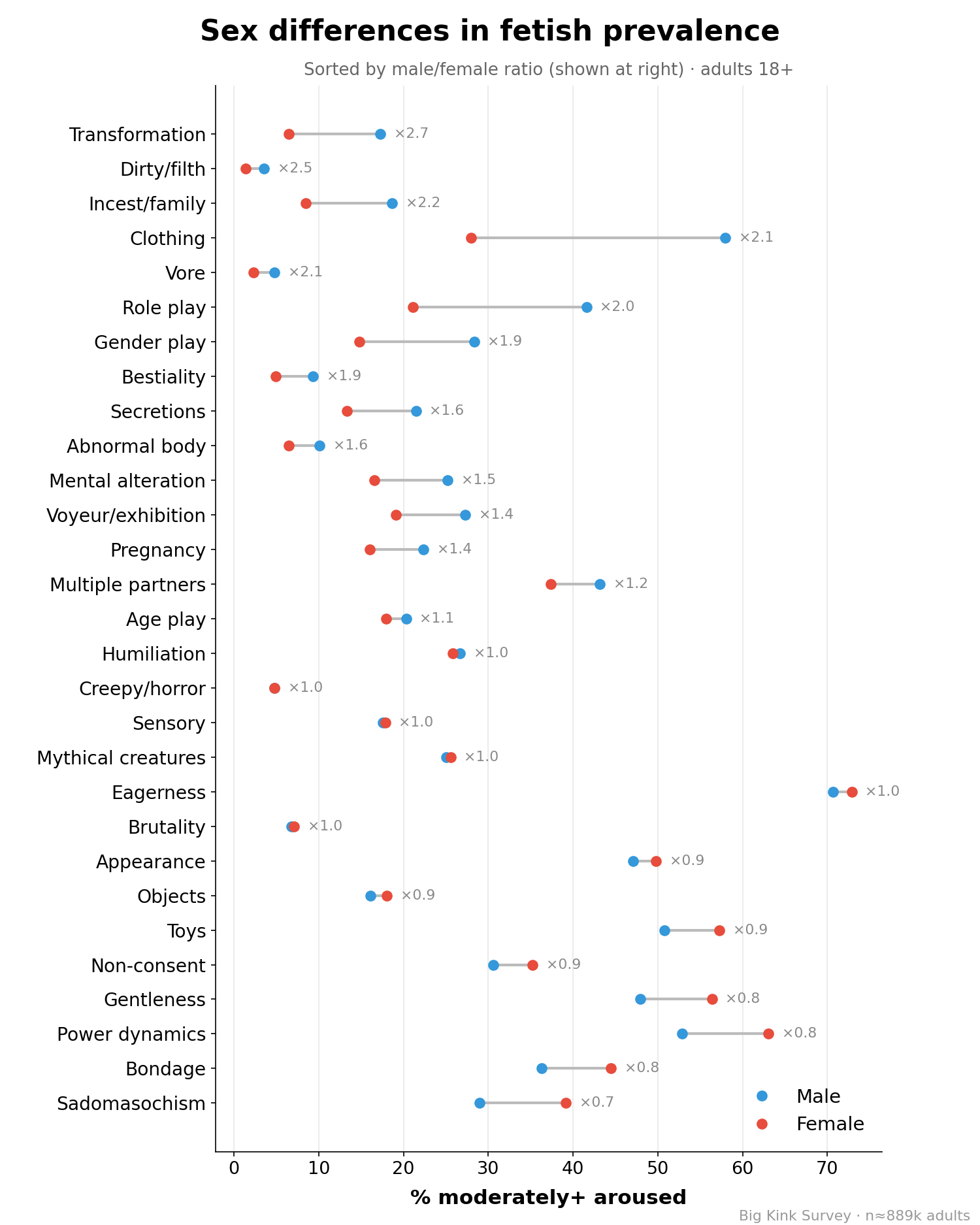
Male-skewed (×1.9–2.7): transformation, dirty/filth, incest, clothing, vore, role play, gender play, bestiality — heavily overlapping the screen-genre cluster. Female-skewed: sadomasochism (39% vs 29%), bondage, power dynamics, gentleness, non-consent, toys — the partnered-body and power kinks. Two further sexed patterns tie the lines of evidence together:
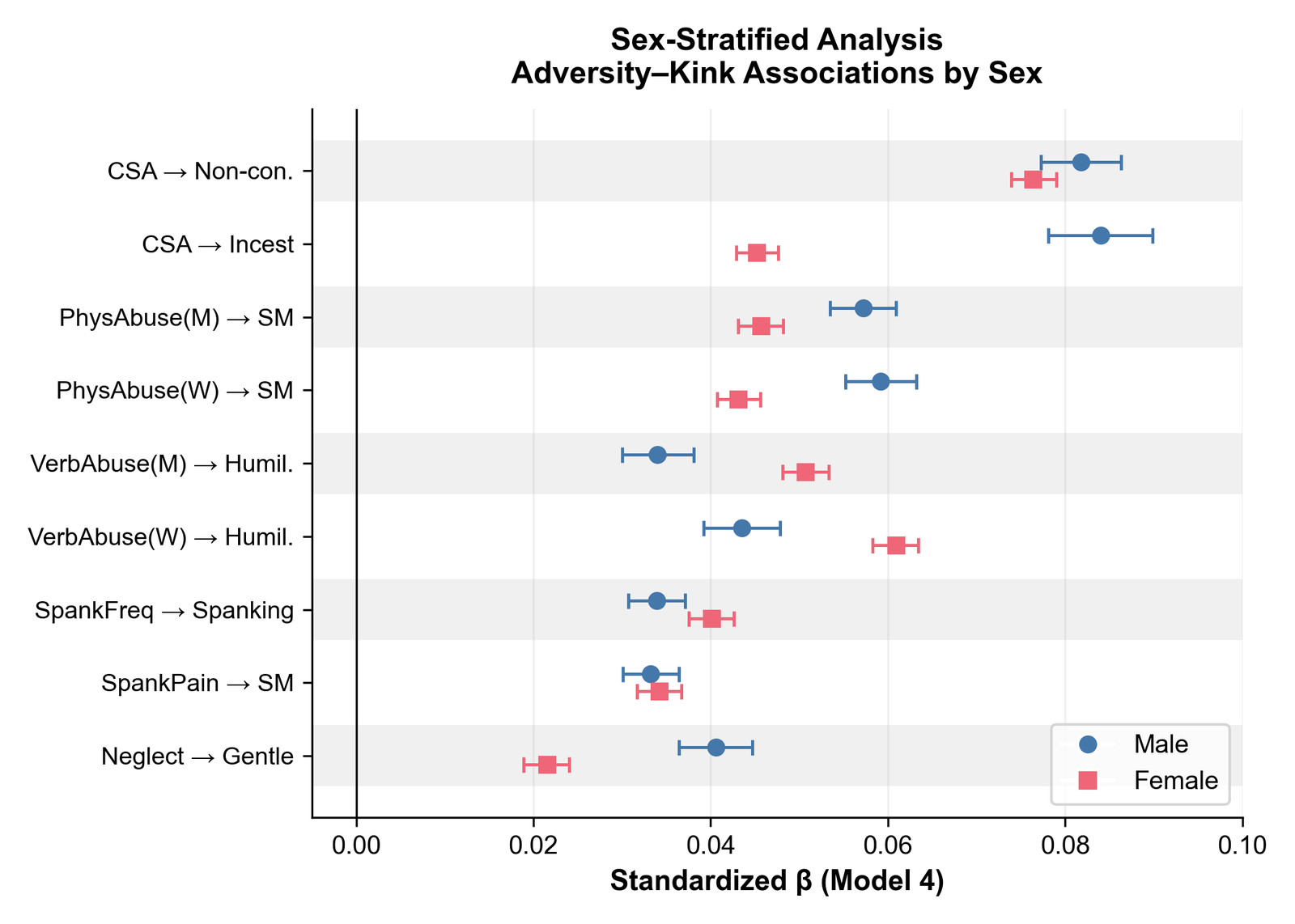
- Adversity channels by sex rather than by content. In the sex-stratified adversity models, non-sexual abuse pushes men toward sadism and women toward masochism — the same adversity amplifies each sex's pre-existing direction instead of installing the experience's content. Only CSA in women shows the victim-role specificity that trauma theory predicts.
- Women acquire the dark cluster earlier than men (brutality a full year earlier; humiliation and non-consent ~9 months) — and women's early porn exposure is disproportionately associated with exactly these kinks.
06Generations: the internet-native kinks are new; the partnered kinks are old
If a fetish is created by an environment, it should track the environment. Comparing 18–24-year-olds with 40+ respondents:
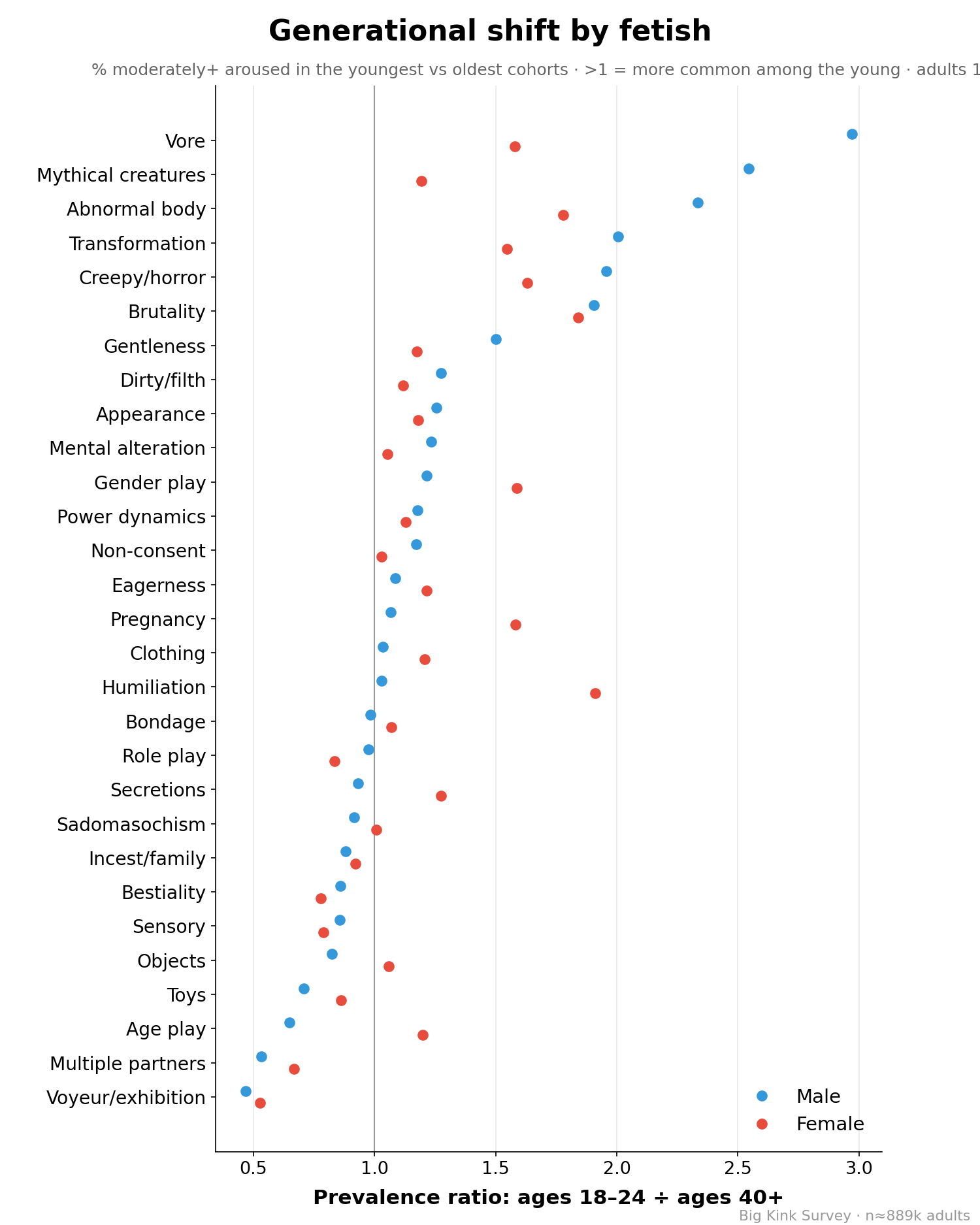
The young-skewed kinks (vore ~2.3×, abnormal body ~2.1×, mythical ~1.9×, creepy/horror ~1.8×, transformation ~1.8×, brutality ~1.9×) are precisely the digital-content genres that barely existed as stimuli before the internet. The stable or old-skewed kinks — sadomasochism, bondage, power dynamics, sensory, bestiality, incest — look like fixtures of human sexuality that every generation arrives at. (Voyeurism/exhibitionism and multiple partners skew old, but those plausibly grow with life-stage and opportunity rather than birth cohort — this analysis can't separate age from generation.)
07The map: where each fetish sits on the innate↔acquired spectrum
Putting the two most diagnostic axes together — does the fetish predate first intercourse, and does it carry a porn-specific signature after confound control:
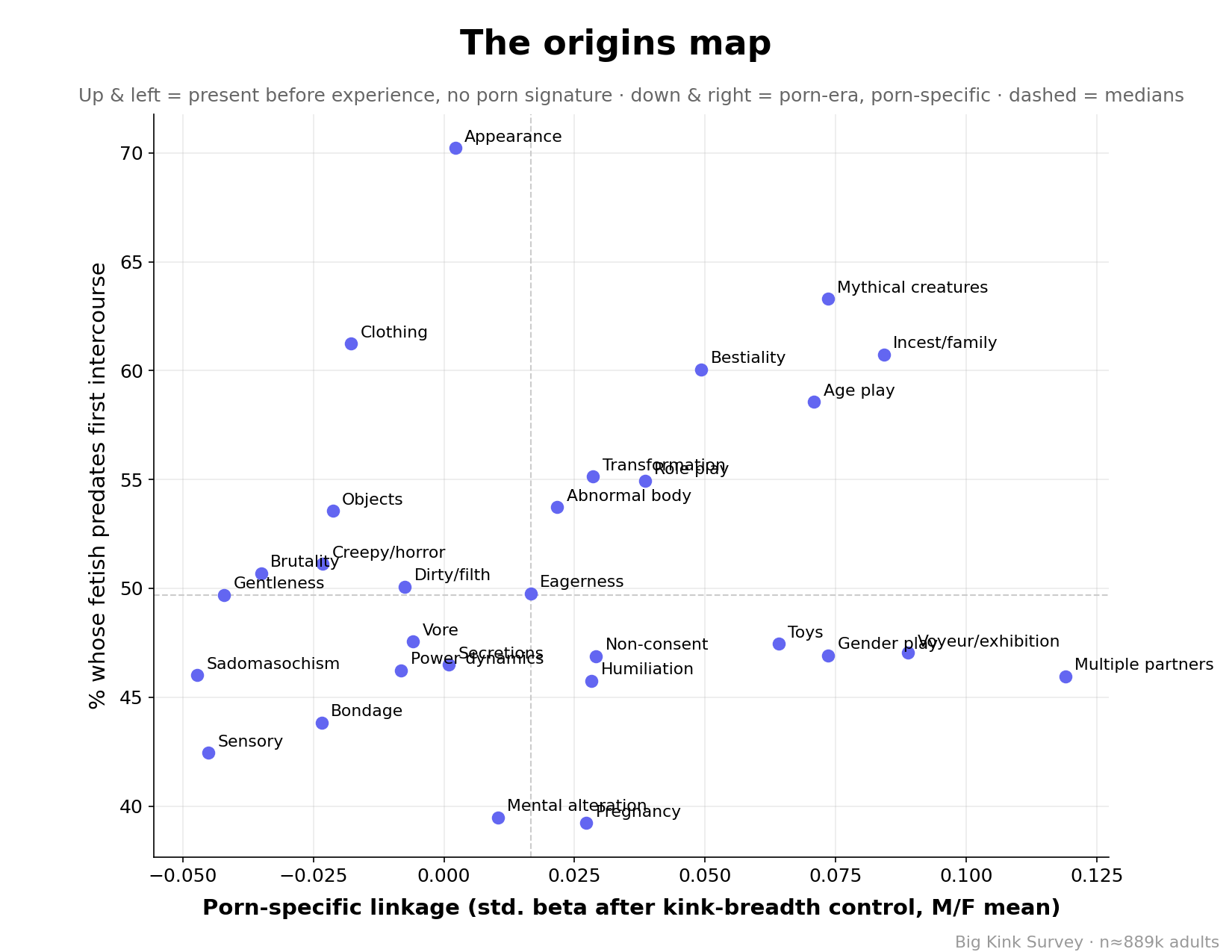
- Top-left — early templates, no porn signature: appearance, clothing, objects. Present before sex and porn alike, indifferent to porn dose: the most innate-looking cluster (classic "fetishes" in the narrow sense).
- Top-right — taboo imagination, porn-amplified: incest, mythical creatures, bestiality, age play. Emerge early — often before porn — and carry a porn signature: pre-existing templates that modern content feeds.
- Bottom-right — the porn-era cluster: multiple partners, voyeurism/exhibitionism, gender play, toys. Later onset, clear porn-specificity: the best candidates for genuinely media-shaped interests.
- Bottom-left — developmental/partnered: sadomasochism, bondage, sensory, power dynamics, pregnancy, mental alteration. Arrive with sexual maturity, no porn signature, generationally stable, female-tilted: they look like they grow out of sexuality itself, not out of exposure.
| Fetish | % mod+ (M) | % mod+ (F) | M/F | Mean onset | % onset ≤10 | % before first sex | % before porn | Porn β (breadth-ctl) | Young/old ratio |
|---|---|---|---|---|---|---|---|---|---|
| Multiple partners | 43% | 37% | 1.2 | 15.5 | 5% | 46% | 14% | +0.119 | 0.60 |
| Voyeur/exhibition | 27% | 19% | 1.4 | 15.2 | 9% | 47% | 16% | +0.089 | 0.50 |
| Incest/family | 19% | 8% | 2.2 | 14.0 | 15% | 61% | 19% | +0.084 | 0.90 |
| Gender play | 28% | 15% | 1.9 | 15.3 | 8% | 47% | 14% | +0.074 | 1.40 |
| Mythical creatures | 25% | 26% | 1.0 | 14.0 | 12% | 63% | 23% | +0.073 | 1.87 |
| Age play | 20% | 18% | 1.1 | 14.0 | 16% | 59% | 23% | +0.071 | 0.92 |
| Toys | 51% | 57% | 0.9 | 15.2 | 6% | 47% | 16% | +0.064 | 0.78 |
| Bestiality | 9% | 5% | 1.9 | 14.3 | 13% | 60% | 17% | +0.049 | 0.82 |
| Role play | 42% | 21% | 2.0 | 14.8 | 7% | 55% | 16% | +0.038 | 0.90 |
| Non-consent | 31% | 35% | 0.9 | 15.1 | 9% | 47% | 17% | +0.029 | 1.10 |
| Transformation | 17% | 6% | 2.7 | 14.6 | 12% | 55% | 19% | +0.029 | 1.78 |
| Humiliation | 27% | 26% | 1.0 | 15.2 | 8% | 46% | 14% | +0.028 | 1.47 |
| Pregnancy | 22% | 16% | 1.4 | 16.0 | 7% | 39% | 12% | +0.027 | 1.32 |
| Abnormal body | 10% | 6% | 1.6 | 14.6 | 11% | 54% | 17% | +0.022 | 2.06 |
| Eagerness | 71% | 73% | 1.0 | 15.0 | 7% | 50% | 16% | +0.017 | 1.15 |
| Mental alteration | 25% | 17% | 1.5 | 15.8 | 7% | 39% | 13% | +0.010 | 1.14 |
| Appearance | 47% | 50% | 0.9 | 13.1 | 18% | 70% | 33% | +0.002 | 1.22 |
| Secretions | 21% | 13% | 1.6 | 15.0 | 11% | 47% | 16% | +0.001 | 1.10 |
| Vore | 5% | 2% | 2.1 | 14.7 | 14% | 48% | 20% | -0.006 | 2.27 |
| Dirty/filth | 4% | 1% | 2.5 | 14.5 | 15% | 50% | 18% | -0.007 | 1.20 |
| Power dynamics | 53% | 63% | 0.8 | 15.3 | 7% | 46% | 16% | -0.008 | 1.15 |
| Clothing | 58% | 28% | 2.1 | 14.1 | 10% | 61% | 21% | -0.018 | 1.12 |
| Objects | 16% | 18% | 0.9 | 14.6 | 9% | 54% | 17% | -0.021 | 0.94 |
| Creepy/horror | 5% | 5% | 1.0 | 14.5 | 12% | 51% | 16% | -0.023 | 1.79 |
| Bondage | 36% | 45% | 0.8 | 15.4 | 7% | 44% | 15% | -0.023 | 1.03 |
| Brutality | 7% | 7% | 1.0 | 14.3 | 13% | 51% | 16% | -0.035 | 1.87 |
| Gentleness | 48% | 56% | 0.8 | 14.9 | 8% | 50% | 19% | -0.042 | 1.34 |
| Sensory | 18% | 18% | 1.0 | 15.7 | 7% | 42% | 15% | -0.045 | 0.82 |
| Sadomasochism | 29% | 39% | 0.7 | 15.2 | 8% | 46% | 16% | -0.047 | 0.96 |
Scorecard sorted by porn-specific beta. "% mod+" = moderately+ aroused. Mean onset and % ≤10 among fetish-havers; "% before first sex" conservative (onset-bin upper edge < first-intercourse age, M/F mean); "% before porn" pooled; young/old = prevalence ratio 18–24 vs 40+ (M/F mean). Shaded cells mark the high end of each column.
08Verdict
Are fetishes caused by experience or innate? The weight of this evidence: the disposition to have fetishes, and much of their broad content, behaves like a trait — it emerges on a fixed adolescent timetable in both sexes, frequently before any candidate experience, is patterned by sex in ways no measured environment explains, and is barely dented by even severe childhood experiences. Experience acts mainly as a channeler of content at the margins: porn channels toward screen-genre kinks (small but real, larger with early exposure), sexual abuse leaves a small content-matched mark (non-consent, incest — the one place trauma theory survives), and spanking leaves a trace of itself. Nothing measured here comes close to explaining most of why one person has a fetish and another doesn't.
Does it differ by gender? Timing and the onset-strength gradient: identical. Content: substantially different (men toward transformation/taboo-genre, women toward power/pain-receiving). Channeling: adversity amplifies each sex's existing direction (men→sadism, women→masochism), and only women show CSA victim-role specificity.
Does it differ by fetish? Strongly — see the map. Appearance/clothing-type fetishes look near-innate; sadomasochism/bondage/power look developmentally emergent but exposure-independent; incest/mythical/bestiality/age-play look like early templates amplified by content; multiple-partners/voyeurism/gender-play/toys carry the most acquired-looking profile.
09Methodology & limitations
- Sample: Big Kink Survey live export (June 2026), 888,999 adults 18+ with fetish-module data (adversity analyses: 1,015,060 from the same survey, all ages cleaned). Self-selected, kinky, young, online; cross-fetish and cross-group comparisons are the point, not population prevalence.
- Kink-breadth control: per person, mean arousal across the other 28 categories (leave-one-out), entered alongside age + age² in OLS of standardized strength on porn habit, per sex. This is the key confound treatment; it may overcontrol (see §3 bracketing note).
- Before-first-sex: fetish onset bin upper edge < reported age of first penetrative intercourse (conservative), among fetish-havers who have had sex. Recall-based; bins coarse.
- Adversity results: from the content-specificity analysis of this dataset (hierarchical OLS; controls: demographics, psychopathology, childhood SES, childhood sexual repression, kink breadth, total adversity load; sex-stratified models). Betas quoted are standardized; all <0.10.
- Cohort analysis: cross-sectional age comparison; cannot separate birth-cohort from life-stage effects (flagged where it matters). 40+ group is small relative to the sample (median age ~22).
- Limits: retrospective self-report throughout; no genetic/twin data, so "innate" is inference from timing, sex-patterning, invariance, and the absence of measured causes — not a heritability estimate; reporting honesty differences between groups can masquerade as real differences; same-survey results reused across sections share any survey-level biases.