TL;DRThe shape of it
- Autism is the trans signature. Roughly half of trans men and trans women report autism, ~39% of nonbinary people, ~10% of cis people. ADHD follows the same step (53–57% vs 33%). [Hardweight population estimates: trans 34%, nonbinary 26%, cis 3.8% — levels drop because hardweight calibrates overall autism to a ~4.5% population benchmark, but the trans–cis gap survives at roughly 9×.]
- Distress is real but splits by assigned sex: anxiety, depression, and sexual-assault history all run highest in the AFAB groups (trans men, AFAB-nonbinary), with cis men far lowest on everything.
- Every trans/NB group is kinkier than every cis group — trans women most of all. And the content divides cleanly: AMAB trans/NB people own the transformation cluster (transformation, futanari, gender-swap); AFAB trans/NB people own the pain/submission cluster (brutality, humiliation, receiving pain).
- Porn tracks assigned sex, shame tracks transness. Daily porn: AMAB-NB 53% > trans women/cis men ~43% > trans men 32% > AFAB-NB 24% > cis women 17%. Sexual shame is highest in trans men, lowest in cis people.
- Attraction to trans people splits on identity, hard: every trans/NB group is at or above neutral (trans women: 26% net-attracted), while cis people sit deep in "not attracted" (cis men 2.3%).
THE SAMPLEWho's in each group
The survey records six identities from one question (cis/trans man, cis/trans woman, nonbinary by birth assignment). Even the smallest group is ~29,000 people, so every comparison here is precise; the question is what the self-selection means (see caveats).
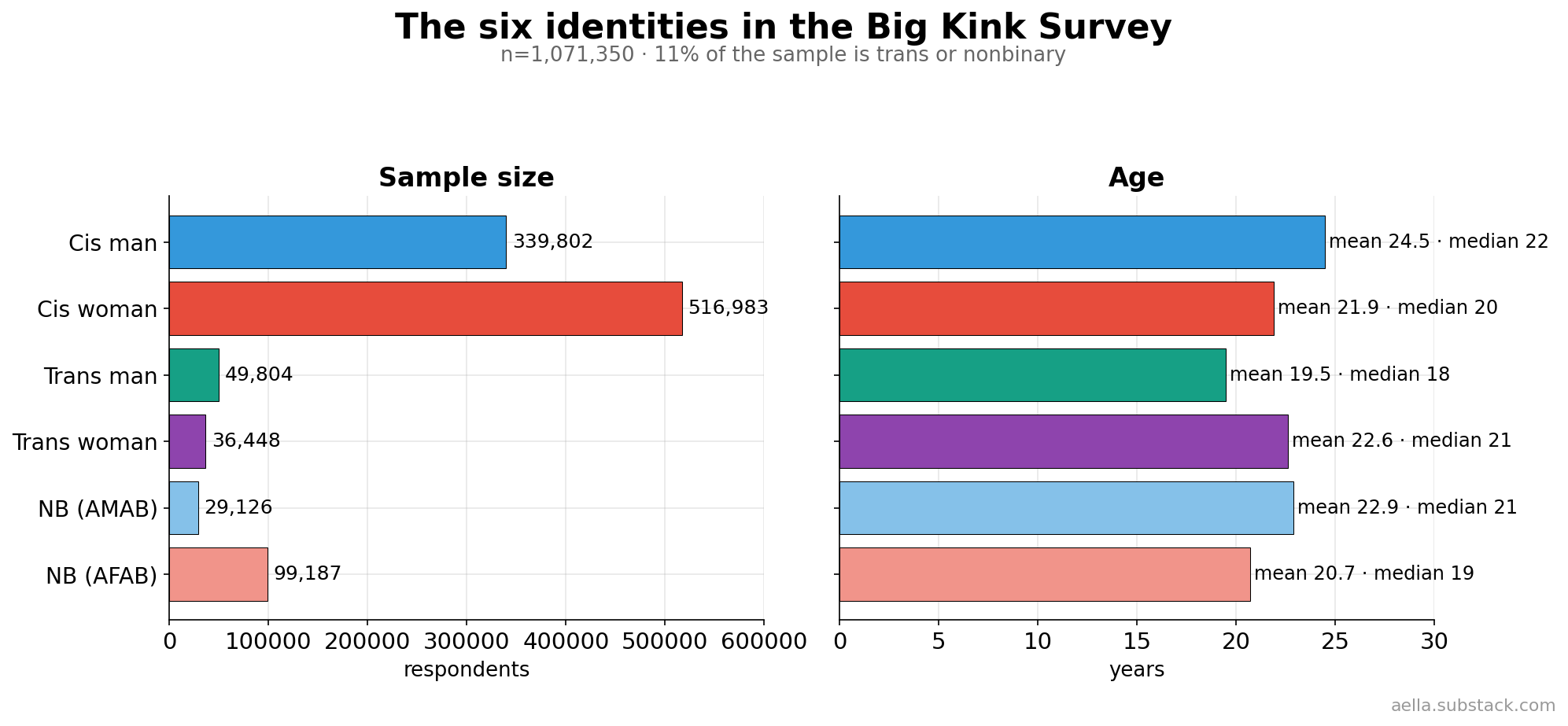
Eleven percent of a million-person kink survey is trans or nonbinary — far above population rates, as you'd expect for a young, online, sex-positive sample. The groups also differ in age: trans men are the youngest (median 18) and cis men the oldest (median 22), so where age matters we say so.
ORIENTATIONStraightness falls with gender-nonconformity
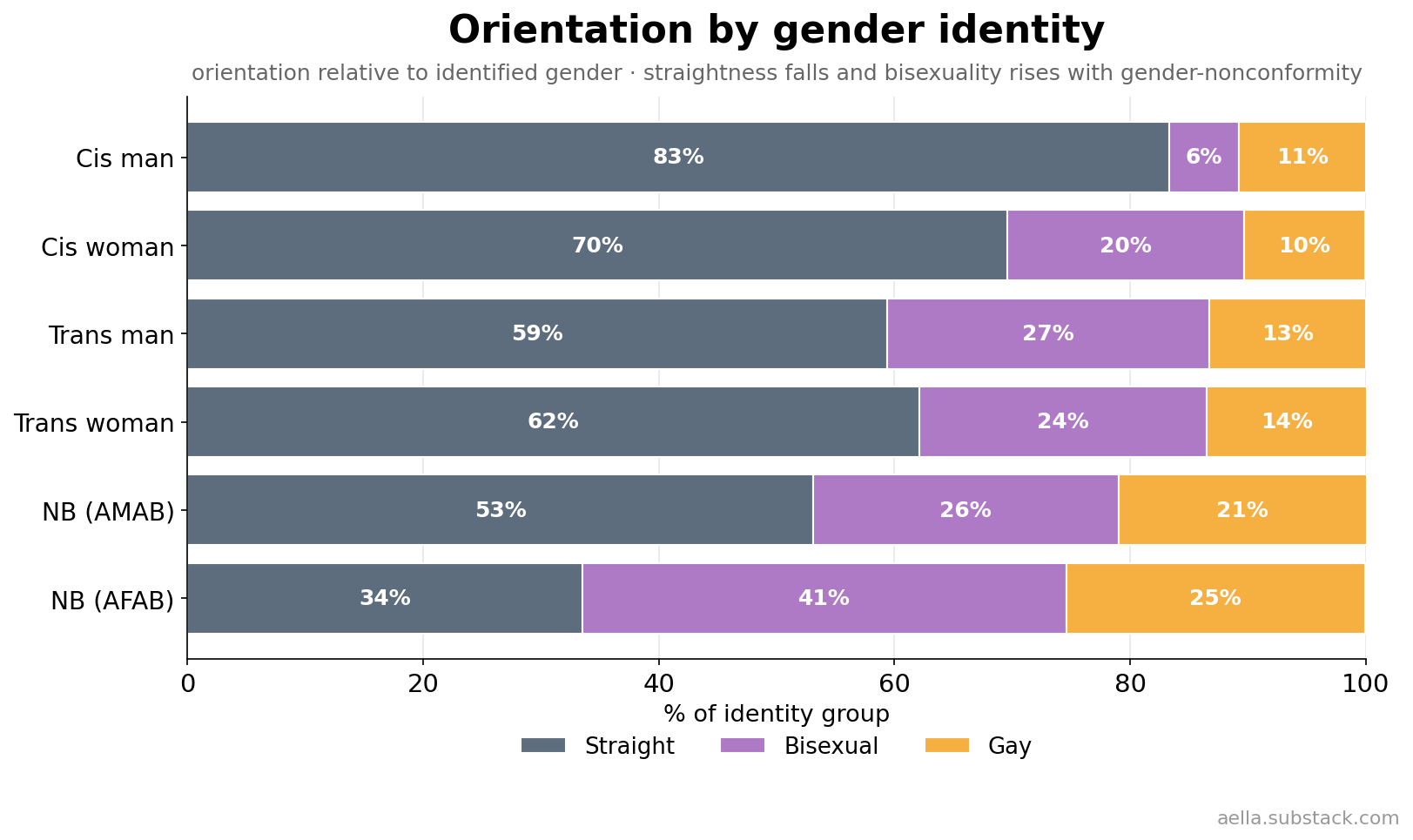
Cis men are the most heterosexual group (83% straight) and AFAB-nonbinary people the least (34% straight, 41% bi, 25% gay). The gradient is monotone: the further from cis-male, the more bisexual the group. Note orientation here is relative to identified gender, as respondents reported it.
MENTAL HEALTHAutism is the trans signature; distress tracks assigned sex
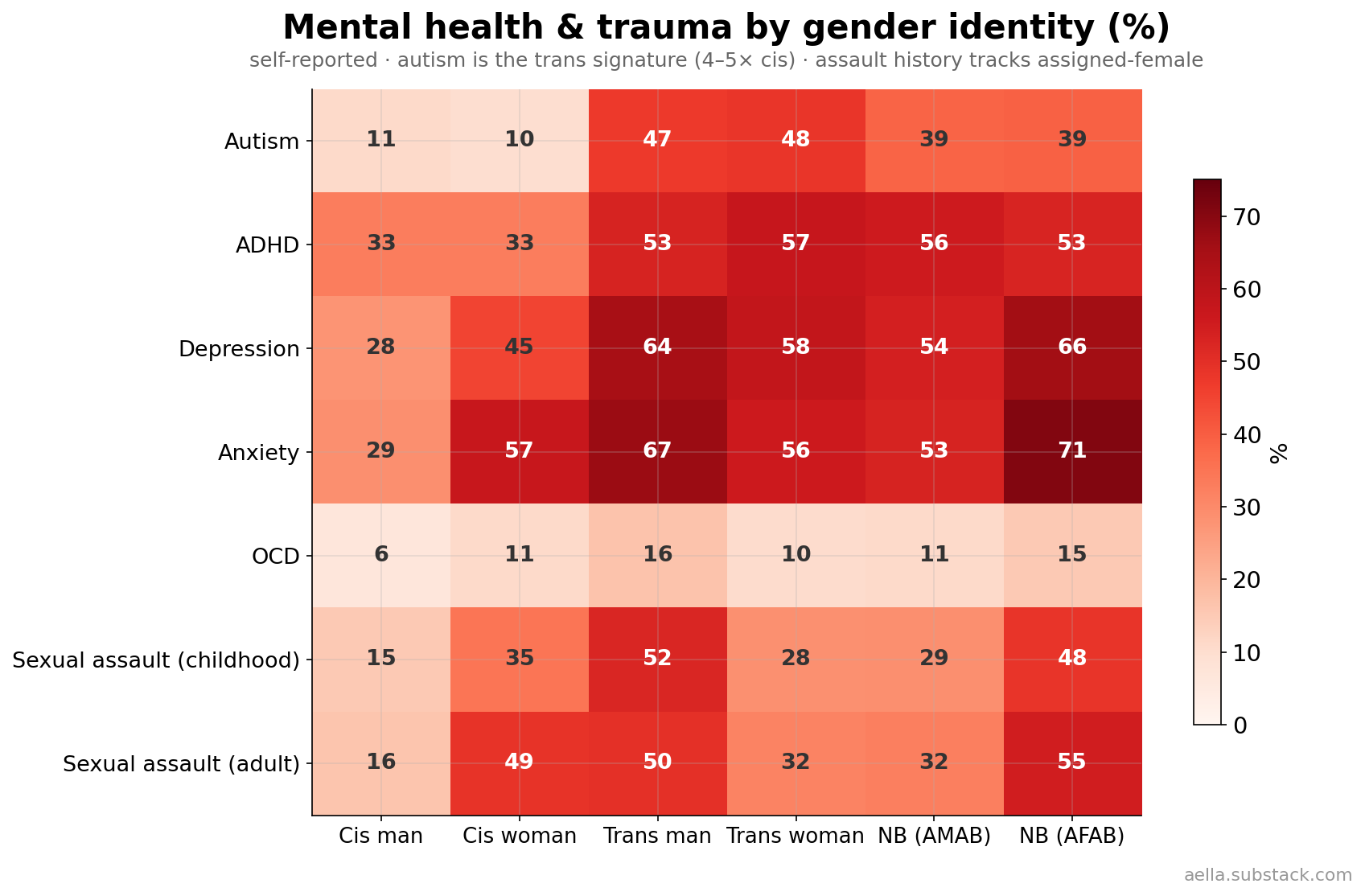
Three distinct patterns hide in one heatmap:
- Autism (and ADHD) step up with transness itself — trans men 47%, trans women 48%, nonbinary ~39%, cis ~10–11%. The trans-autism association is one of the most replicated findings in this literature; here it appears at full scale, similar for both directions of transition.
- Depression and anxiety run highest in the AFAB trans/NB groups (anxiety 67–71%, depression 64–66%), with trans women and AMAB-NB close behind cis women, and cis men dramatically lowest (anxiety 29%). Caveat: these are self-reported diagnoses in a young sample, and willingness-to-report differs by group.
- Sexual assault history tracks assigned female — childhood: trans men 52% and AFAB-NB 48% vs cis women 35%; adult: 50–55% vs cis women's 49%. Trans women and AMAB-NB (~28–32%) report roughly double cis men (15–16%). The AFAB trans/NB groups report more assault than cis women — consistent with either higher exposure, or higher recognition/reporting, or both.
SEX LIFEPorn tracks assigned sex; shame tracks transness
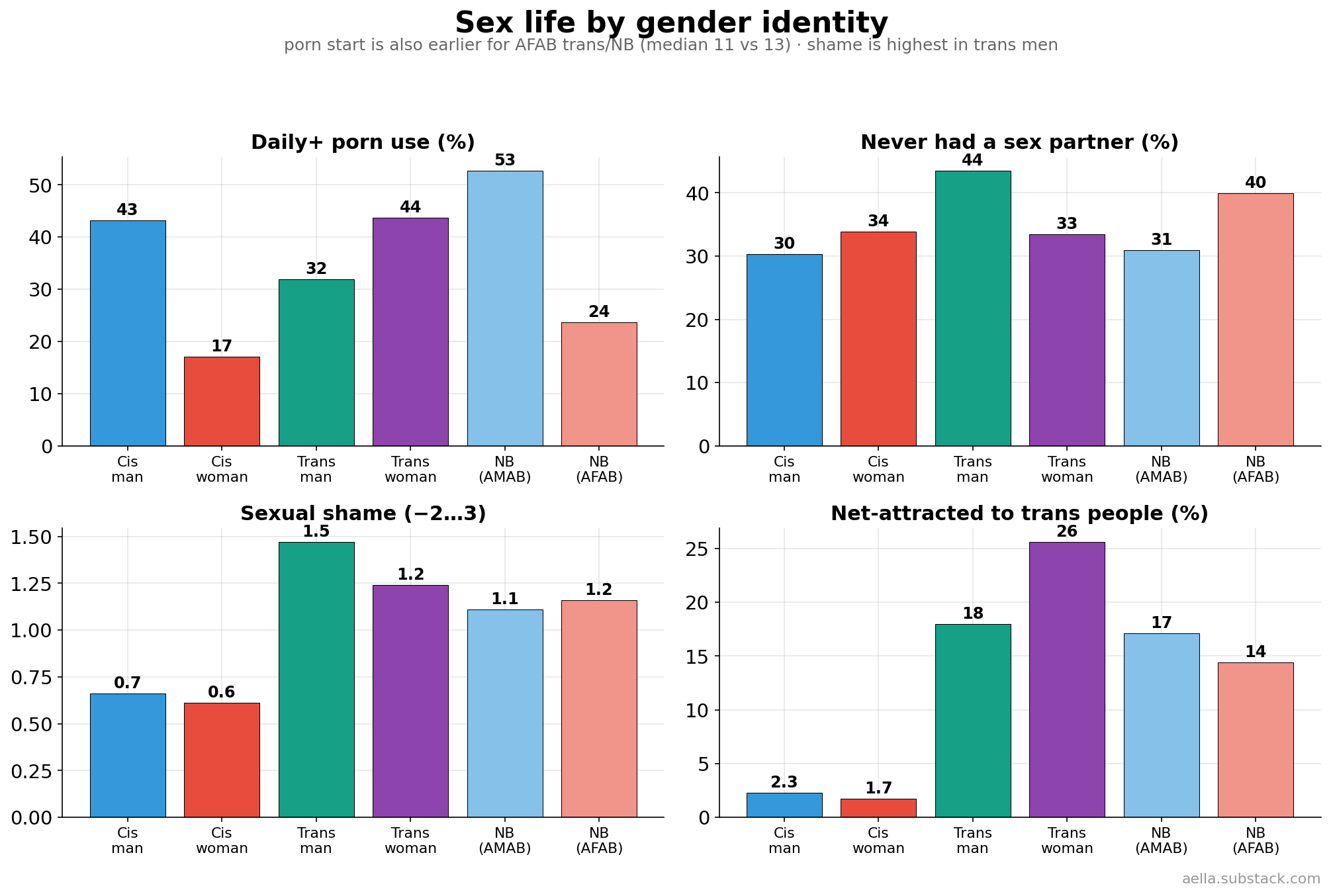
- Daily porn use orders almost perfectly by assigned sex — AMAB groups 43–53%, AFAB groups 17–32% — with nonbinary AMAB people the heaviest users in the survey (53%) and trans men sitting between the cis sexes. AFAB trans/NB people also started porn earliest (median age 11 vs 13 for everyone else).
- Trans men are the most likely to have never had a partner (44%, vs ~30% for cis men) — partly their youth, partly the dating market.
- Sexual shame is a trans phenomenon, not a kink one: trans men highest (1.47 on a −2…3 scale), all trans/NB groups above 1.1, cis people at 0.6–0.7 — despite cis people being the least kinky groups.
- Attraction to trans people: trans women 26% net-attracted, trans men/NB ~14–18%, cis women 1.7%, cis men 2.3%. Whatever drives attraction to trans partners, identifying as trans/NB is its strongest correlate in this data.
KINK FINGERPRINTSTwo clusters split the trans groups by assigned sex
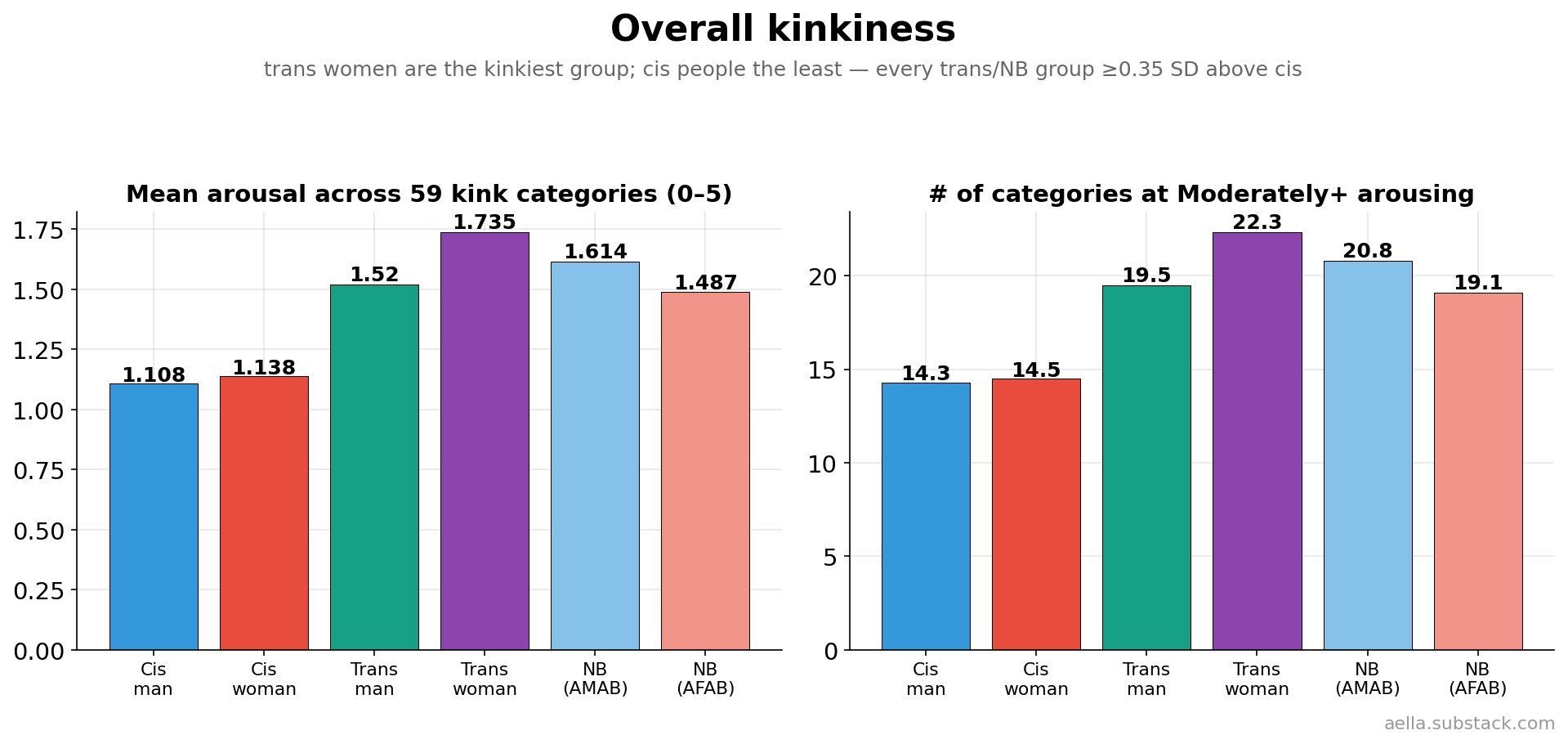
Every trans/NB group is substantially kinkier than every cis group — trans women most (mean arousal 1.74 vs cis ~1.1; 22 categories at Moderately+ vs 14). Some of that is age and selection, but the gap is large and consistent. The interesting part is which kinks (standardized deviations from the overall mean, so general kinkiness is the baseline):
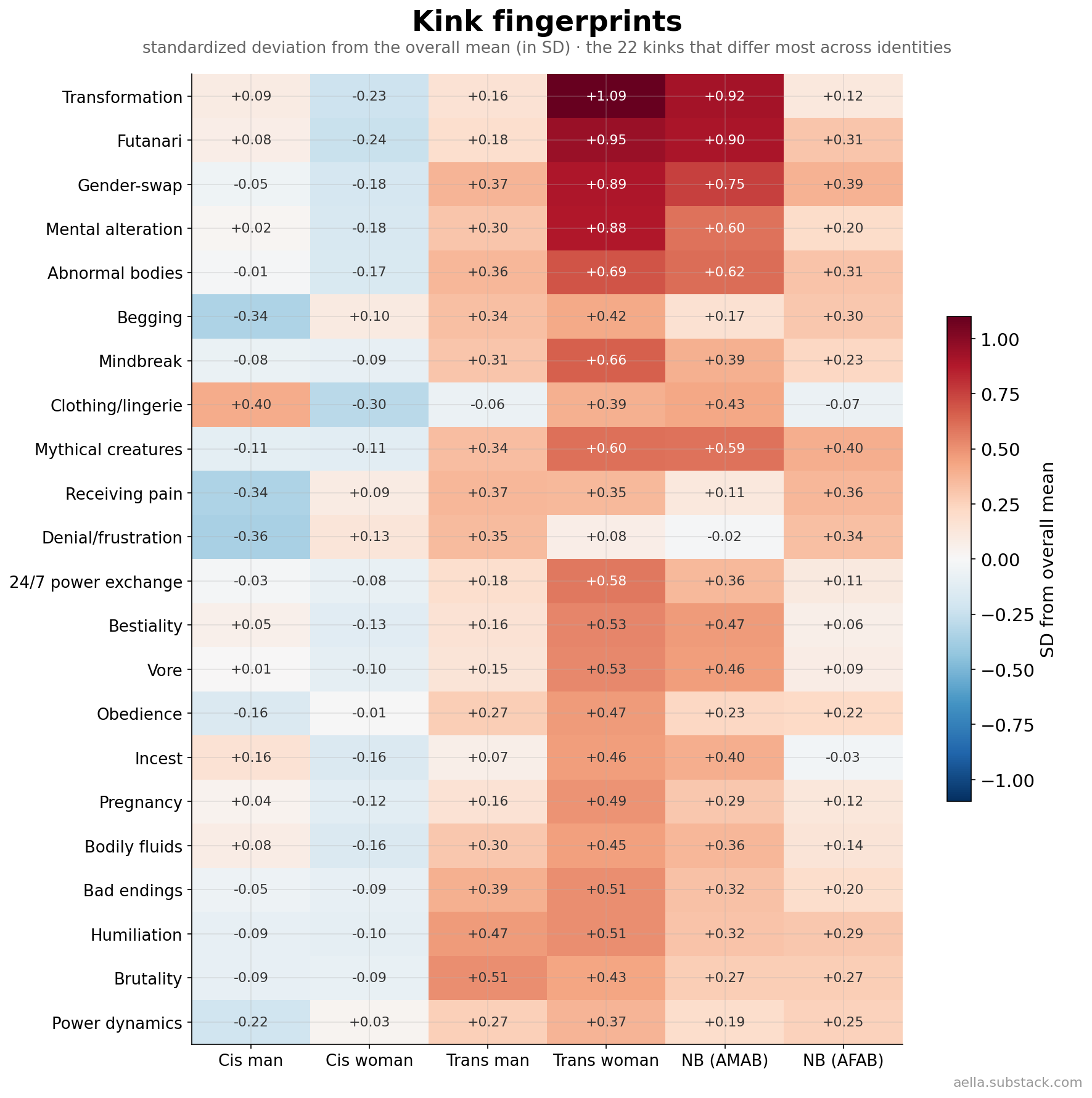
- The transformation cluster belongs to AMAB trans/NB people: transformation (+1.1 SD in trans women), futanari, gender-swap, mental alteration, abnormal bodies. The fantasy content mirrors the gender journey — bodies changing into other bodies.
- The pain/submission cluster belongs to AFAB trans/NB people: trans men lead on brutality (+0.51), humiliation, psychological pain, receiving pain, sadomasochism, with AFAB-NB close behind. (Trans women share the humiliation/power end but not the somatic-pain end.)
- Cis men's only distinctive kink is clothing/lingerie (+0.40) — and they're notably low on begging, denial, and receiving pain. Cis women sit near the average on nearly everything, slightly toward the receiving side.
- The taboo/creature corner (bestiality, vore, mythical, incest, pregnancy) leans toward trans women and AMAB-NB, echoing the transformation theme.
CAVEATSHow to read this
Self-reported everything. "Autism" etc. are self-reports, not clinical diagnoses; groups differ in diagnosis access and willingness to identify. Assault items are severity-coded self-reports, binarized at any-vs-none.
Age differs by group (median 18–22). Where it matters (partner counts, mental health) it compresses but does not create the gaps.
Unweighted, cross-sectional, fantasy-not-behavior for all kink items; arousal ratings are 0–5 category-level. No causal claims anywhere. Update (Aug 2026): green bracketed figures re-estimate key base rates under the BKS hardweight population weighting (12-margin census-style rake, ages 14–50, US/CA/UK/W-Europe). Note autism, ADHD, and depression are themselves calibrated dimensions in that rake, so hardweight levels for those track external benchmarks; the group contrasts are the informative part.