TL;DRHot men really do. Hot women barely. Strangers assume both.
- In reality, hotter men have had a lot more partners: +32% per standard deviation of crowd-rated attractiveness, after adjusting for age. Among 22-35 year olds, 42% of the hottest fifth of men have had 10+ partners, vs 20% of the least hot fifth.
- Hotter women have only slightly more (+10% per SD), and it's mostly that they're less likely to be virgins. The hottest fifth of women are no more likely to have had 10+ partners than anyone else.
- Strangers assume hot = high bodycount for both sexes. Shown two faces, guessers pick the hotter one as the higher-bodycount person 63% of the time for men and 59% for women. The real rates are 54% and 49%.
- The actual best clue is age, and guessers ignore it. When one person is 8+ years older, they have the higher bodycount 81-83% of the time. Guessers pick them about half the time.
- Faces do leak a little real information. Single guesses are right 51-58% of the time; pooled crowd verdicts get to 54-64%. Politics, net worth and bodycount are the most readable; porn habits are basically invisible.
- Attractiveness bleeds into everything. The crowd thinks hot men are more dominant, hot women are richer, and hot women are more right-wing, far more than is actually true.
01Reality: do hotter people have more partners?
Everyone who submits a photo to Study Of Us also answers a background survey, including "How many people have you had sex with?" Their photo gets rated by strangers in head-to-head matchups, which gives each person a crowd attractiveness score. So we can just check.
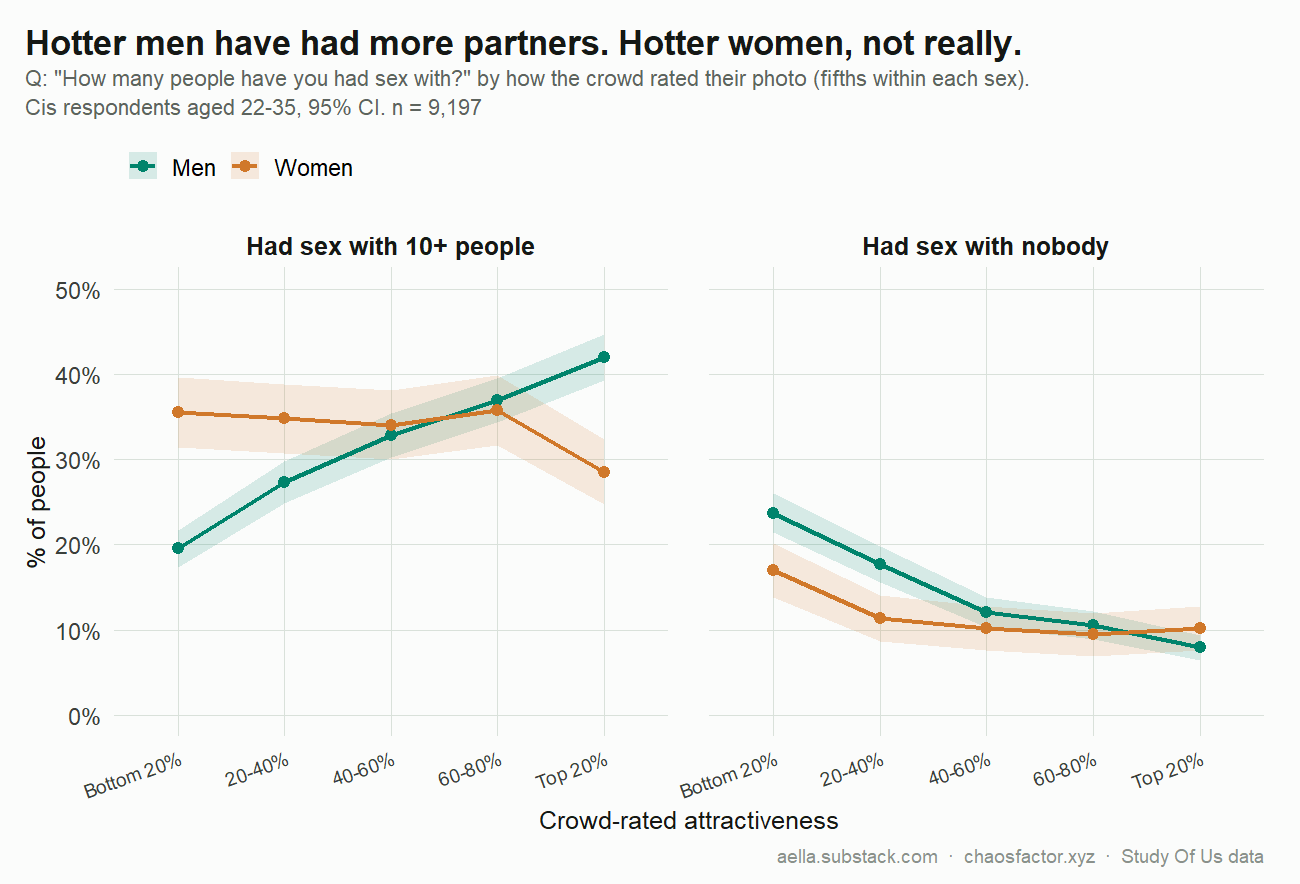
For men, it's a clean staircase. Among cis men aged 22-35, 20% of the least attractive fifth have had sex with 10+ people, rising steadily to 42% of the most attractive fifth. Virginity runs the other way: 24% of the bottom fifth vs 8% of the top.
For women, the 10+ line is flat at about 35%, and the hottest fifth is actually the lowest (29%). The one place hotness shows up for women is at the very bottom: 17% of the least attractive fifth are virgins vs about 10% of everyone else.
02Is it just age?
The obvious confounder: bodycount goes up with age, and attractiveness ratings go down with age. Younger people look hotter but haven't had as much time. So the raw relationship could be hiding or faking something.
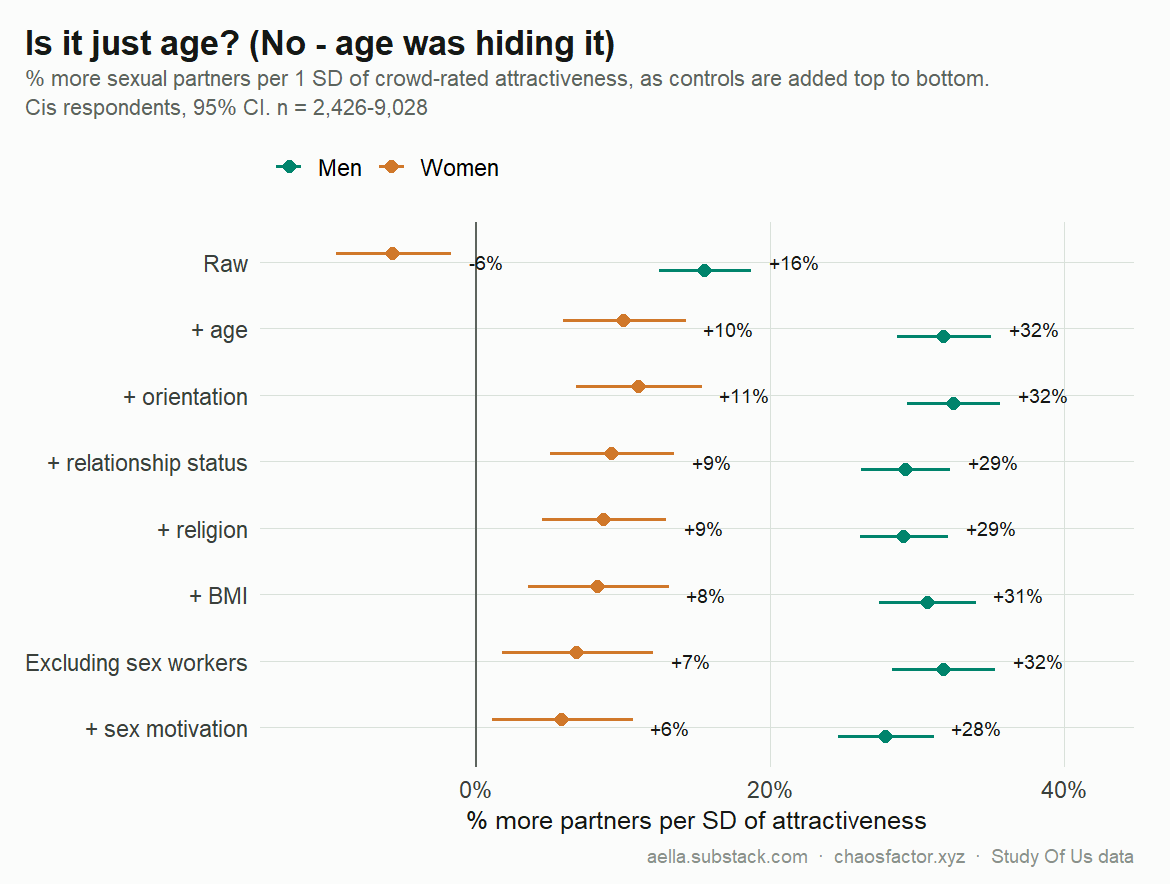
It was hiding something. Raw, hotter women have had slightly fewer partners (−6% per SD), because hotter women in this sample skew younger. Once age is in the model, the effect flips to +10%. For men, adjusting for age doubles the effect, from +16% to +32% per SD.
After that, the numbers barely move. Adding sexual orientation, relationship status, religion and BMI, or dropping everyone who's done sex work, keeps men around +29-32% and women around +7-11%. The gap between men and women is big and holds up under every set of controls: men's effect is about three times women's.
03Why would hotness matter so much more for men?
One plausible story: casual sex is mostly limited by women's choosiness. Most women who want more partners can find them regardless of looks, so a woman's count is more about how many she wants. A man's count depends more on how many women say yes, which is where looks come in. If that's right, hotter men should both want and get more, while hotter women's numbers should track their own desire.
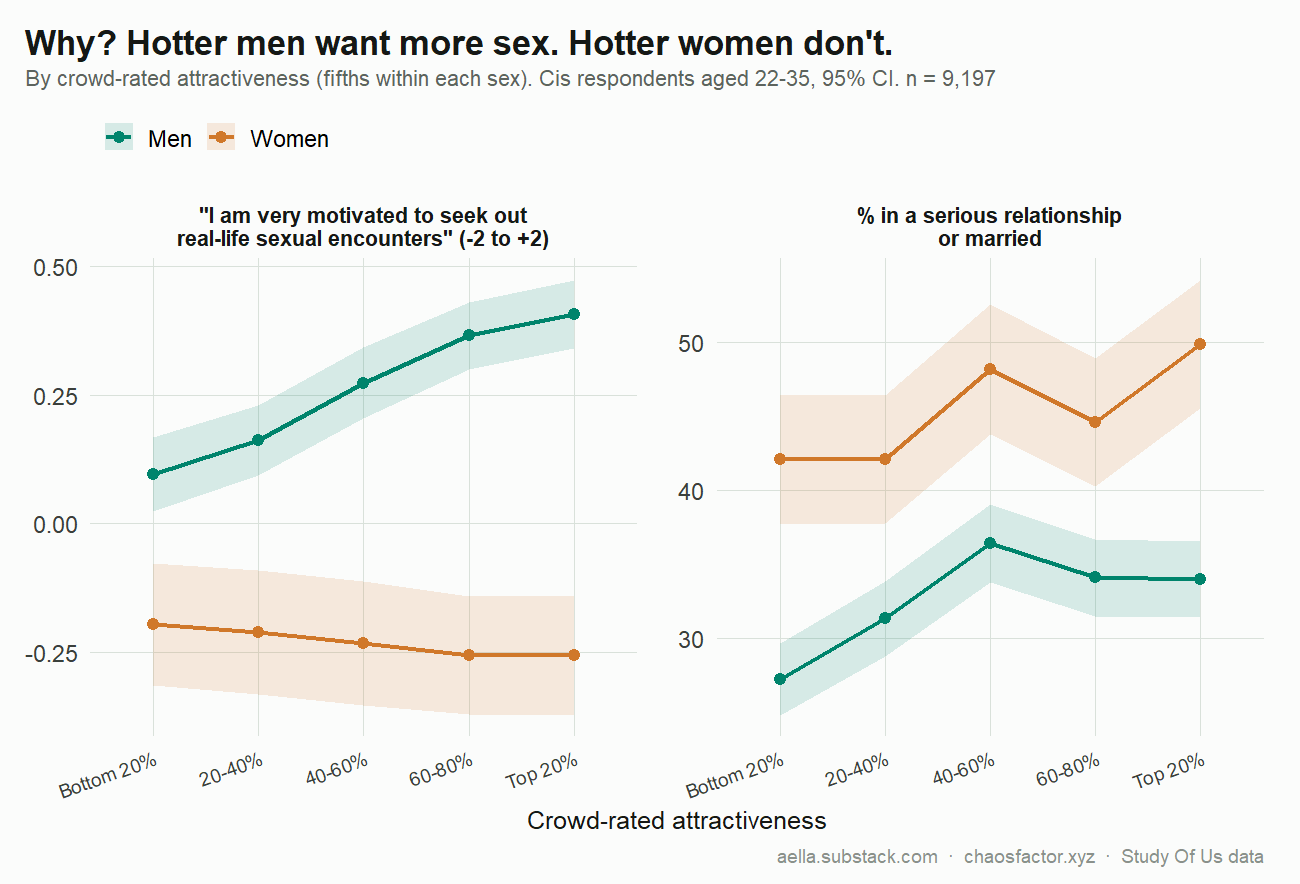
The data fits. Hotter men agree more with "I am very motivated to seek out real-life sexual encounters": possibly because they get better results when they try, possibly because they're just more confident. Hotter women are no more motivated than less attractive women (if anything slightly less). Both sexes are a bit more likely to be in a serious relationship or married as they get hotter. Adding sex motivation to the model explains a little of men's effect (+32% → +28%), but most of it remains.
04What strangers guess
Study Of Us has a guessing game: you're shown two faces and asked "Guess who has a higher bodycount." The pairs are real people who answered the bodycount question with different answers, and the game scores you against their real answers (correct guesses earn credits). After cleaning out junk accounts (see methods), that's 1.3 million graded guesses on pairs of cis people.
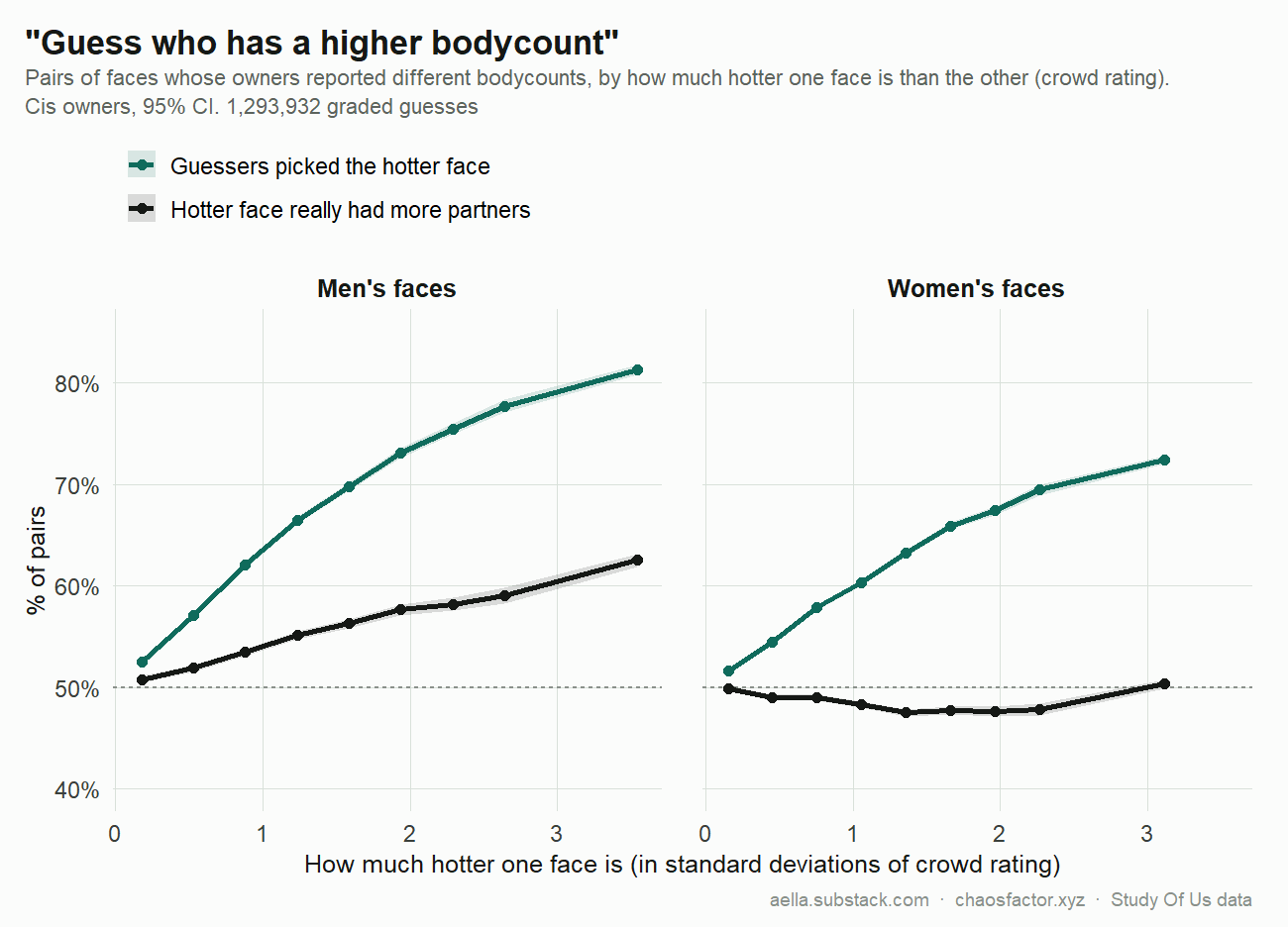
The teal line is how often guessers chose the hotter of the two faces. The black line is how often the hotter face really had the higher bodycount.
For men's faces, guessers have the right idea but push it too hard. The hotter man really does have more partners 54% of the time overall, rising to about 62% when one man is much hotter. Guessers pick him 63% of the time overall, and over 80% of the time at the biggest gaps.
For women's faces, the guessers apply the same rule, and it's simply wrong. The hotter woman has the higher bodycount 49% of the time, a coin flip at every size of attractiveness gap. Guessers pick her 59% of the time overall and 72% when she's much hotter.
05The clue everyone ignores: age
If hotness isn't a good clue for women, what is? The single strongest predictor of bodycount in this data, for both sexes, is boring: age. Older people have had more time.
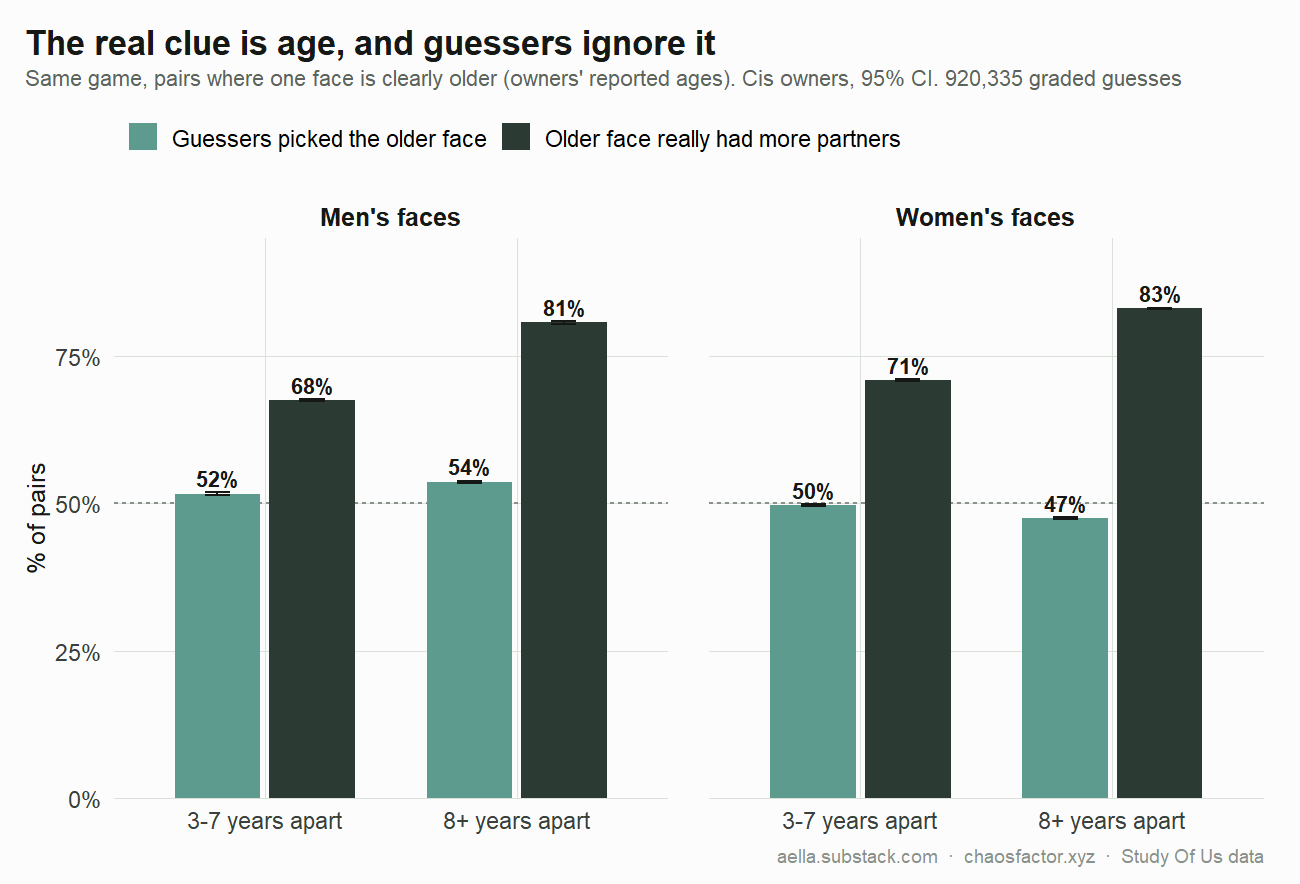
When the two people are 8+ years apart, the older one has the higher bodycount 81% (men) and 83% (women) of the time. Even at 3-7 years apart, it's 68-71%. Guessers basically don't use this. They pick the older man 52-54% of the time, and for women they're slightly against it, picking the older woman just 47% of the time at 8+ years apart.
Some of this might be that age is hard to see in a single photo. But 8+ year gaps between, say, a 22 and a 35 year old are usually visible. It looks more like guessers are reaching for "who seems like the type" (hot, confident, sexy) rather than "who's had more time."
06What the crowd's verdict is built from
Pooling every clean guess about each photo gives a crowd verdict: the share of its bodycount matchups each face "won." We can ask how much that verdict leans on attractiveness and age, and compare it to how much the real bodycount does.
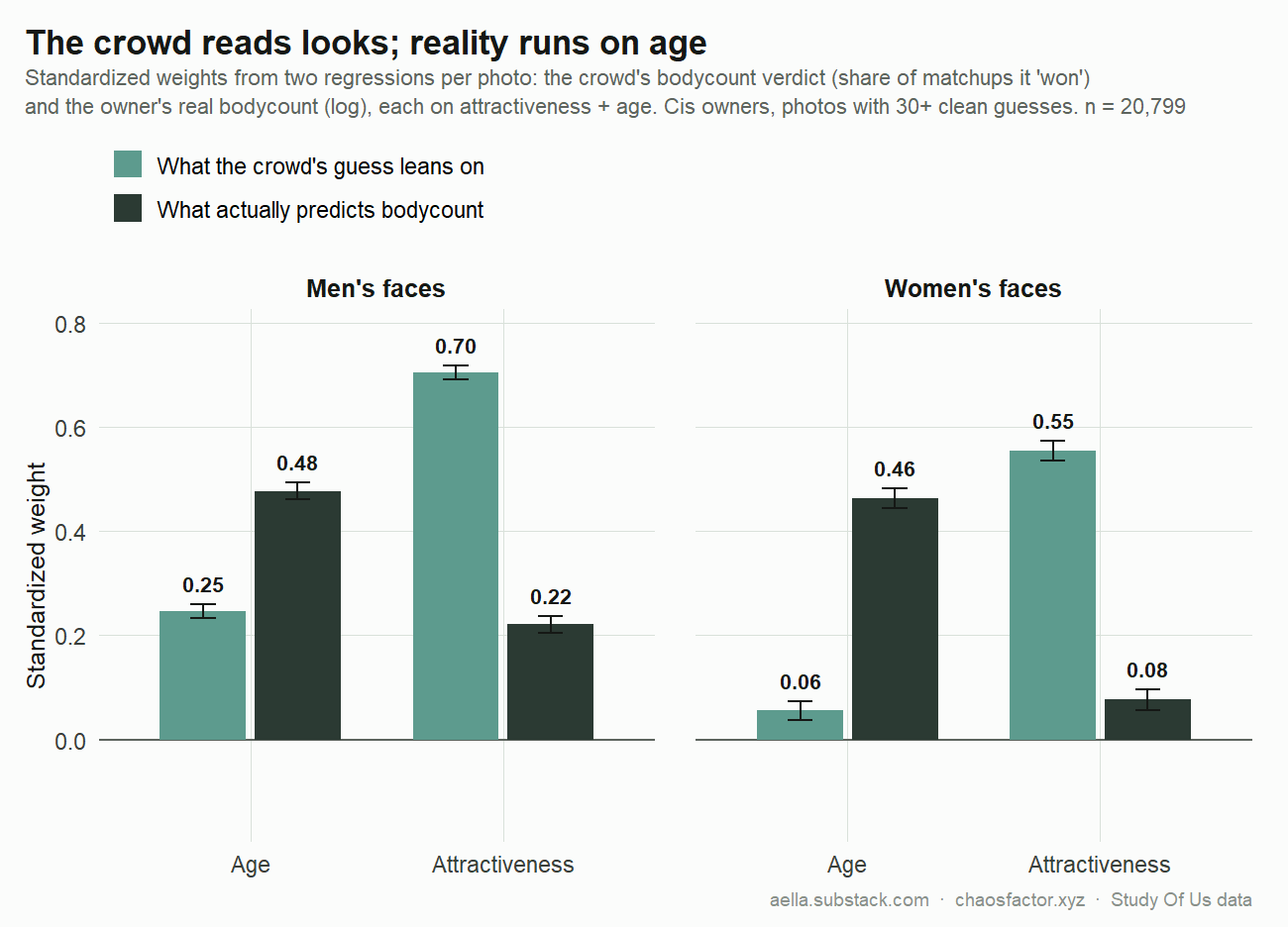
Almost a mirror image. The crowd's verdict is mostly attractiveness (weights 0.70 for men, 0.55 for women) with a little age. Real bodycount is mostly age (0.48 and 0.46), with attractiveness mattering for men (0.22) and barely for women (0.08).
07How readable are faces, anyway?
Bodycount is one of five traits in the game. The others: "Guess who is more politically left-leaning," "Guess who has a higher net worth," "Guess who is more dominant (in the bedroom)" and "Guess who is more of a gooner." Each is scored against the owners' own answers.
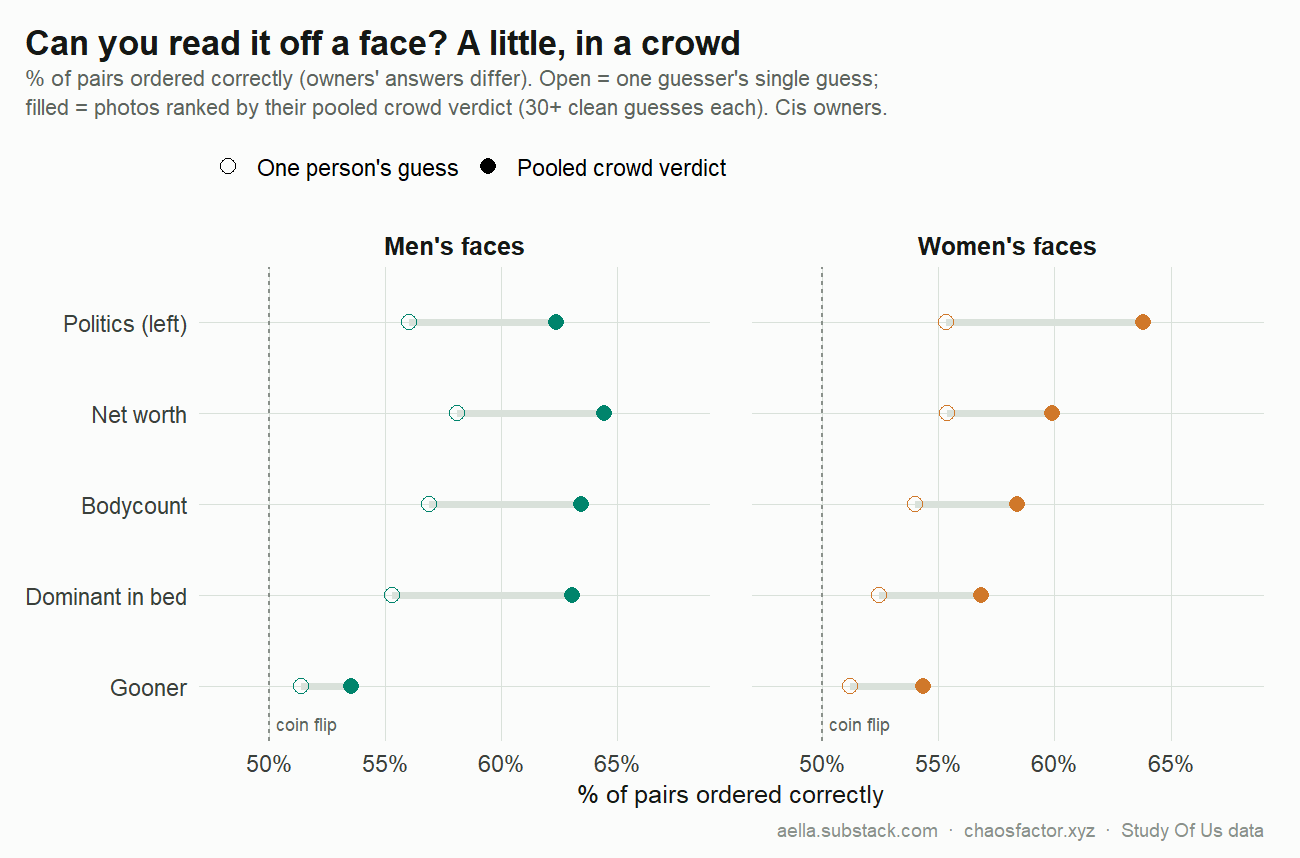
A single guess is barely better than chance: 51-58% depending on the trait. Pooling many guesses per photo helps: ranking faces by their crowd verdict orders pairs correctly 54-64% of the time. The most readable traits are politics (62-64%), net worth (60-64%, mostly by reading age) and bodycount (58-64%). Dominance is readable in men (63%) more than women (57%). Gooner-ness is essentially invisible (54%).
Most traits read better on men's faces than women's; politics is the exception (gooner-ness is near chance either way). One guess: makeup, filters and more deliberate photo curation may make women's photos less revealing.
08The beauty halo
The bodycount stereotype is one case of something general: attractiveness leaks into every judgment the crowd makes. Here's how strongly each trait correlates with attractiveness in the crowd's guesses vs in reality:
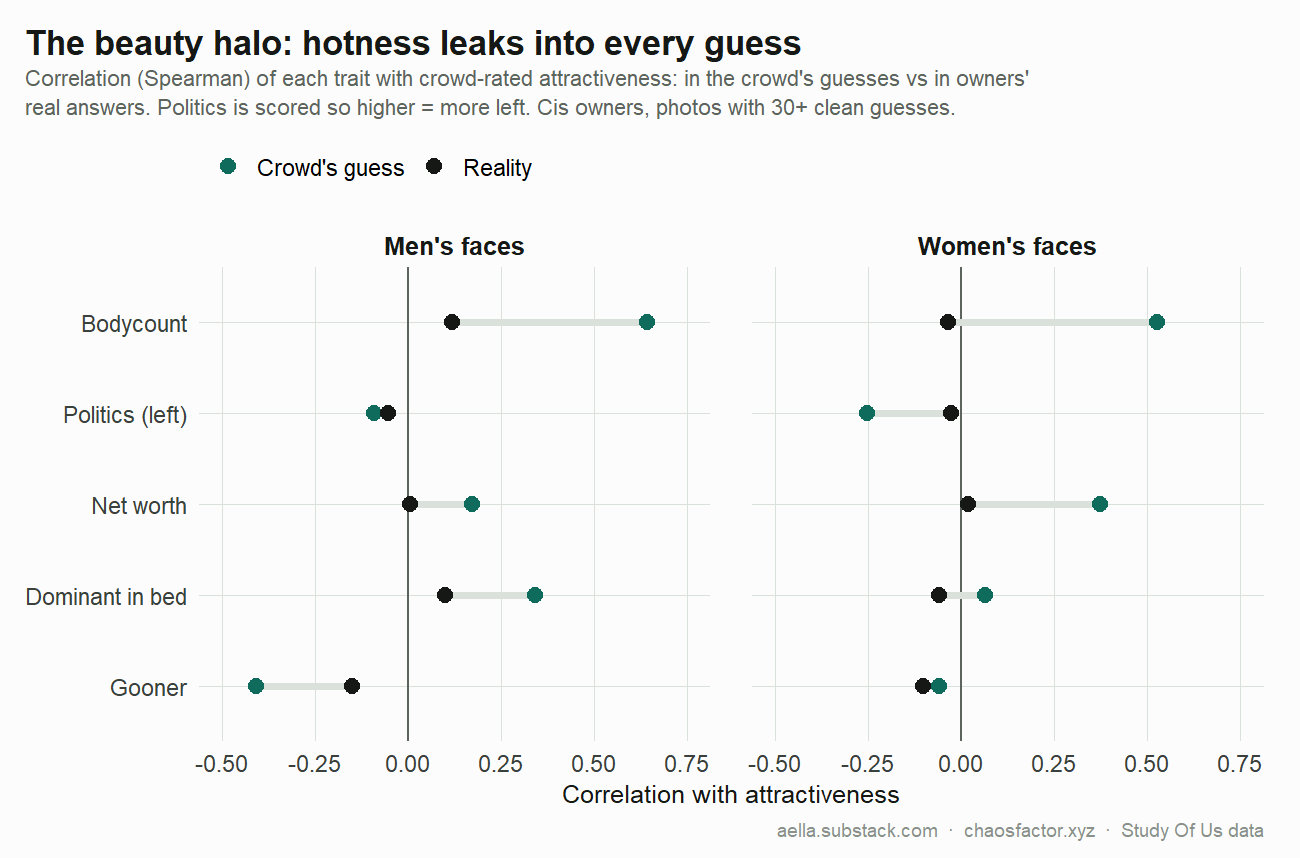
- Bodycount: the crowd links it strongly to hotness (0.64 for men, 0.53 for women); reality is 0.12 and −0.04 (this is raw, without adjusting for age).
- Net worth: the crowd thinks hot women are richer (0.37). In reality there's no link (0.02).
- Dominance: the crowd sees hot men as more dominant in bed (0.34). Real link: 0.10.
- Gooner: the crowd thinks hot men gooner less (−0.41). Directionally right, but the real link is −0.15.
- Politics: the crowd thinks hot women are more right-wing (−0.25). Real link: −0.03. (After adjusting for age, more attractive people are very slightly more right-leaning, about 0.04-0.07 SD per SD of attractiveness. Tiny.)
In most cases the crowd's direction is right; the halo just exaggerates small real differences by 2-5x. Women's bodycount and women's net worth are the cases where the crowd invents a link that isn't there.
09Is anyone a bodycount savant?
Maybe the average guesser is bad, but some people have a real eye for it?
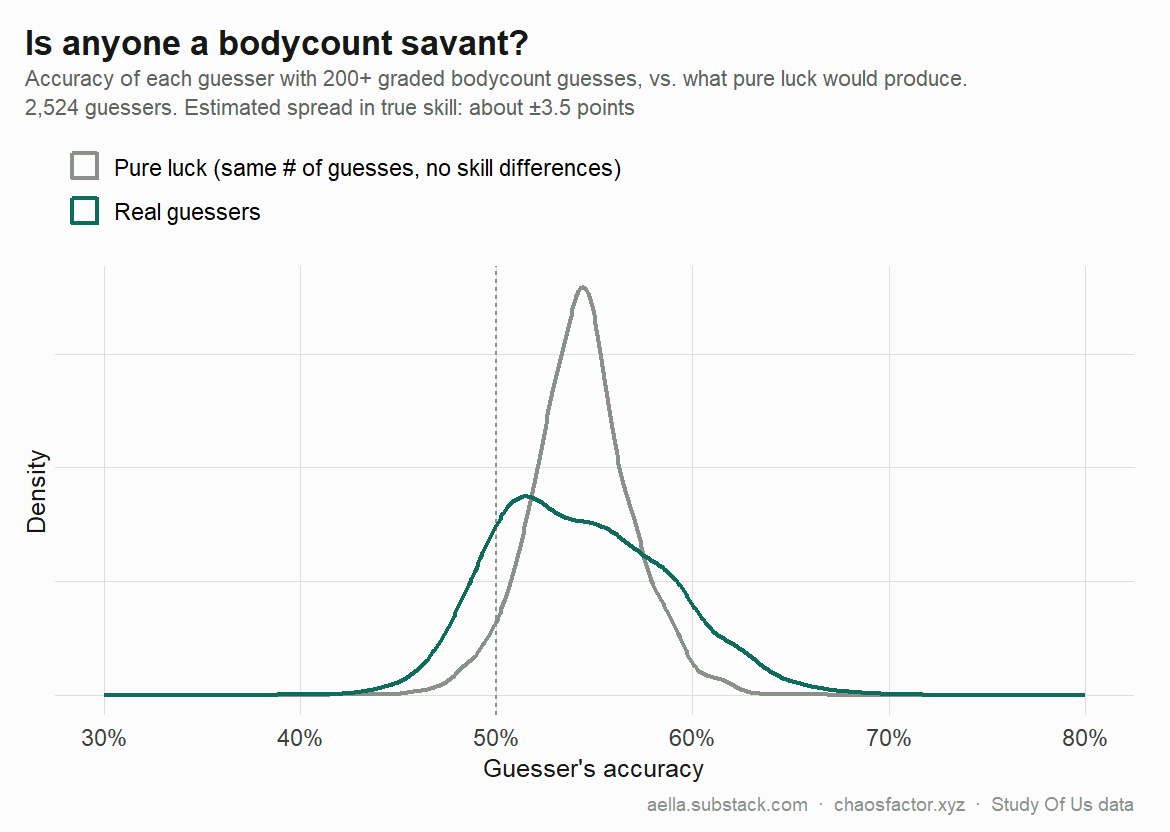
Real guessers are more spread out than pure luck would produce, so skill differences exist, but they're small: the estimated spread in true skill is about ±3.5 percentage points around an average of 54%. Nobody is reliably reading bodycounts off faces. There's also a lump right at 50%, which looks like heavy players clicking without really trying.
Who does slightly better? Guessers who are older (58.6% vs 56.4% on men's faces for 36+ vs 18-22) and who've had more partners themselves (58.5% vs 56.6% for 20-79 partners vs virgins), both by about 2 points. Men and women guessers are equally accurate.
10Methods & caveats
People and photos. Study Of Us users who submitted a photo and answered "How many people have you had sex with?" (banded: 0, 1, 2-4, 5-9, 10-19, 20-39, 40-79, 80-150, 150+). Attractiveness is each person's crowd rating from head-to-head face matchups (averaged over their photos with 75+ matchups), standardized within the men's and women's pools. The reality analyses use 9,028 cis men and 4,045 cis women aged 18-70; the 10+/virgin charts restrict to ages 22-35.
Reality models. Linear regressions of log(1 + bodycount) on standardized attractiveness, with age as a flexible curve (natural spline), adding orientation (Kinsey-style 0-6 self-report), relationship status, religion practice, BMI (from self-reported height and weight), and "I am very motivated to seek out real-life sexual encounters." Effects are converted to % more partners per SD.
The guessing game. Votes from August 19 to October 5, 2026. Players see two faces and pick one; graded pairs are drawn from photos whose owners answered the trait question differently, and correct answers earn credits. Politics truth is the average of "Socially speaking, you tend to be more:" and "Economically speaking, you tend to be more:" (liberal/left to conservative/right). Net worth: "Your CURRENT net worth is closest to". Dominance: "In the bedroom, are you more dominant or submissive?". Gooner: the site's composite of porn frequency, whether porn is more satisfying than sex, and paying for porn. Pair analyses only use pairs where both owners are cis; ages are the owners' self-reported ages.
Cleaning. Raw vote counts were dominated by a few accounts: a handful of accounts cast enormous numbers of votes at exactly chance accuracy (one alone had over a million), and a few were implausibly accurate (85%+ over 200+ graded guesses, likely exploiting the game). I excluded the 10 implausibly accurate accounts and capped everyone at their first 300 votes per game per face set, so no single player dominates. This changed the picture substantially; before capping, the random-clicking accounts diluted every effect toward 50%.
Crowd verdicts. For each photo, the share of its clean matchups in a given game it "won," for photos with 30+ clean guesses. "Pooled crowd verdict" accuracy is the share of random photo pairs (with different true answers) ordered correctly by that verdict.
Caveats. Everything is self-reported, and people may shade their bodycount (in either direction, and possibly differently by sex or attractiveness). The sample is people who chose to submit their photo to a rating site run by a sex researcher: 16% of cis women aged 22-35 here report having done sex work, far above any general population. A crowd rating of one photo isn't the same as how attractive someone is in person. Vote-level confidence intervals treat votes as independent, but the same pairs and players repeat, so true uncertainty is larger than the error bars show (with this many votes, not enough to change any conclusion here).
No photos or individual answers are shown. All results are aggregates over hundreds to millions of data points.