What a million kinky people
say about porn
Every porn-related finding in the Big Kink Survey, split by biological sex, age-controlled where it matters — with special attention to the four items added in May 2026 (shame, healing, sex-life impact, porn-vs-sex).
Throughout: ■ Male · ■ Female. "Weighted" = population-raked (sex×age×cis/trans×BMI×politics×ethnicity), ages 14–34, Western countries.
How many people are using pornography?
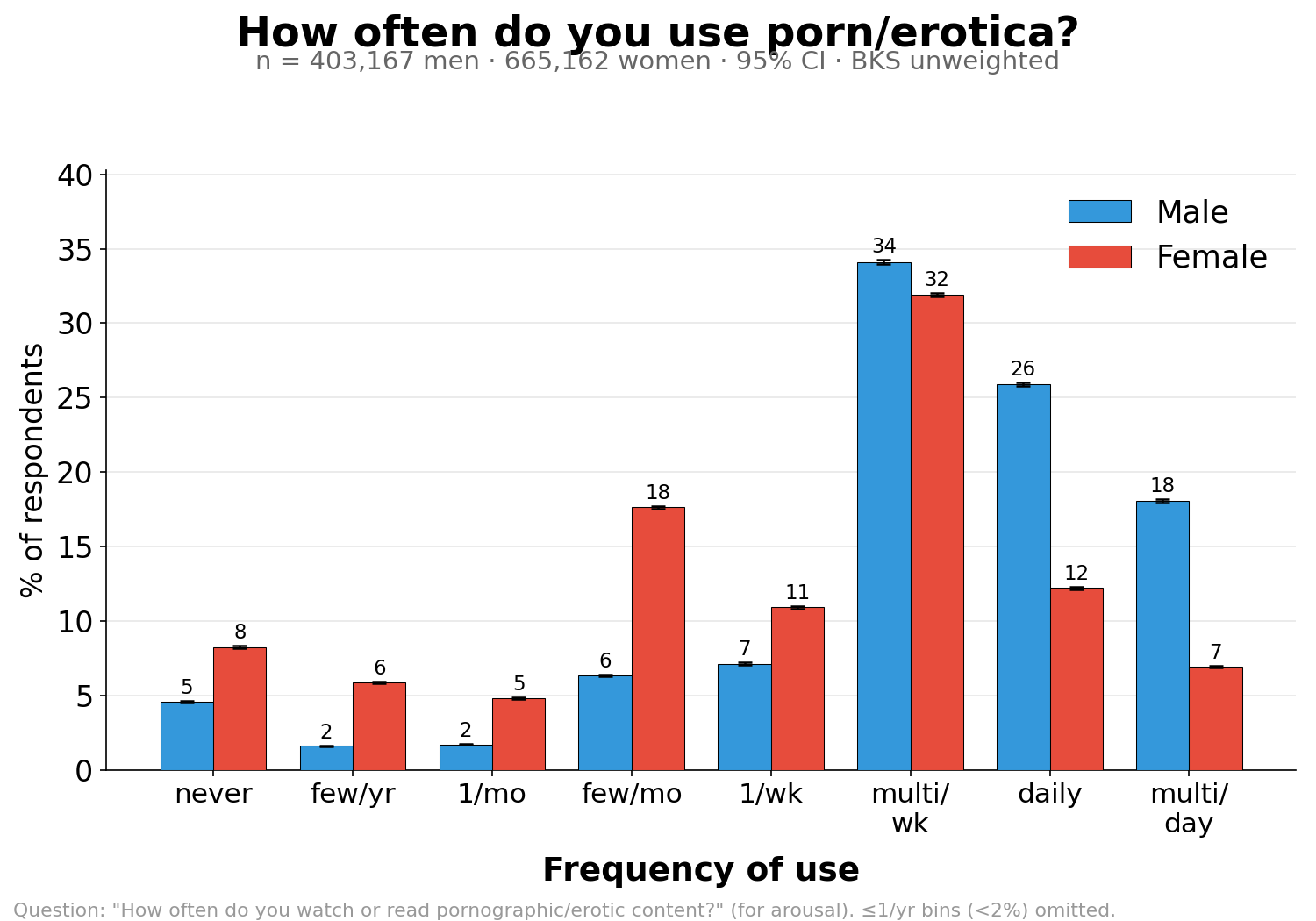
Nearly everyone. 95% of men and 92% of women in BKS use porn or erotica at least sometimes; the modal man uses it multiple times per week, and 18% of men report multiple times a day. Population-weighting moves these only a few points (full weighted versions of every number: Appendix W). [The stricter hardweight population rake (12 margins, ages 14–50; added Aug 2026) lands in the same place: any-use 95% of men / 88% of women, daily+ 39% / 15%, multiple-times-a-day men 15%. Porn use is one BKS base rate that survives aggressive reweighting nearly intact.]
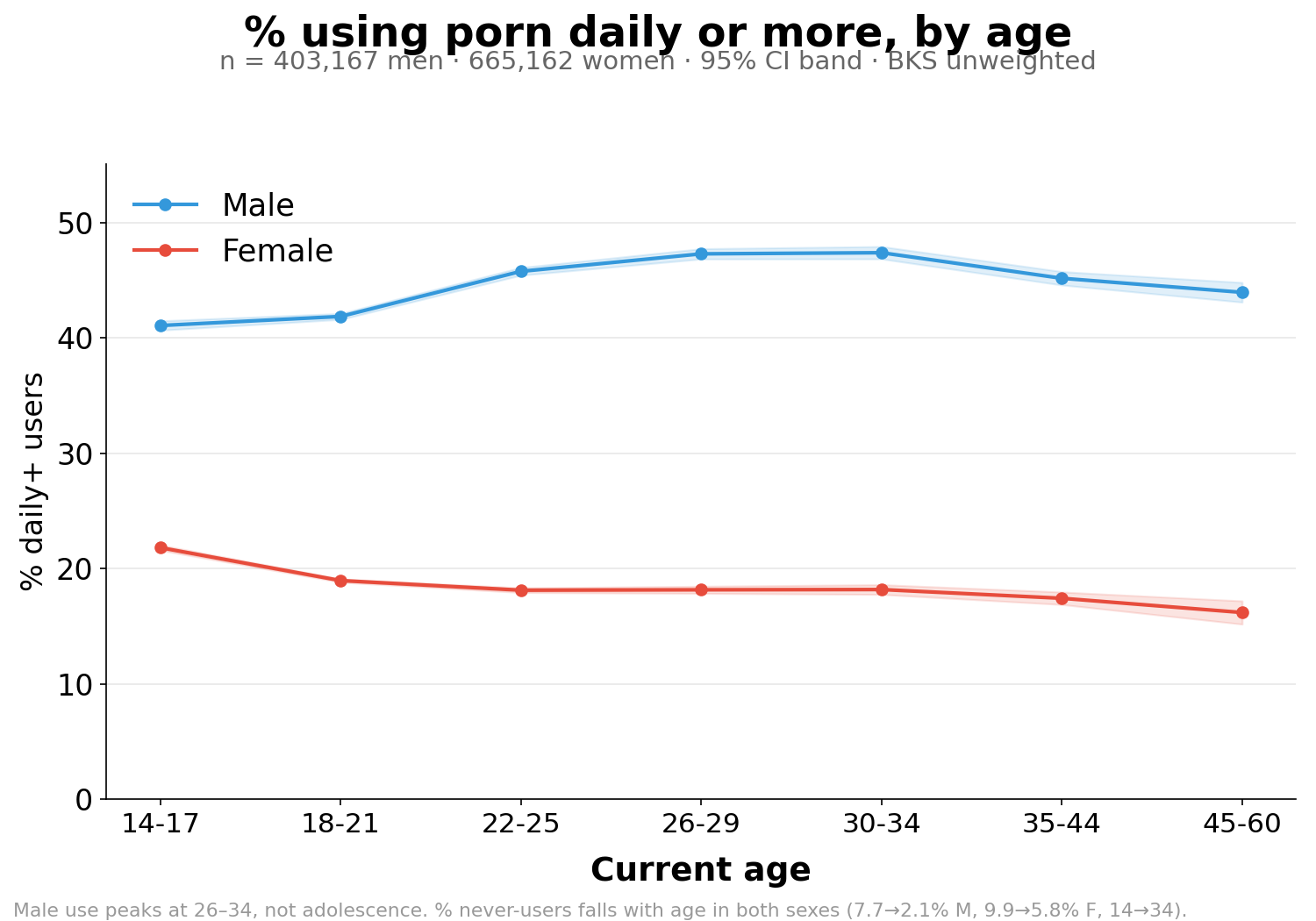
Age-confound check on the headline sex gap: the base rates above pool ages 14–60, and men in the sample are ~2 years older than women (median 22 vs 20) while use rises with age — so part of the M/F gap could in principle be age composition. It isn't: age-standardizing the male rates to the female age distribution moves daily+ only from 44.0% → 43.3% and never from 4.6% → 5.2% (vs women's 19.2% / 8.3%). The ~25-point sex gap survives essentially untouched, and the weighted numbers are age-raked by construction. Per-age-bin rates are in the table under Fig 2 and Appendix T1b.
Confounders: politics matters a little, current devoutness matters a lot
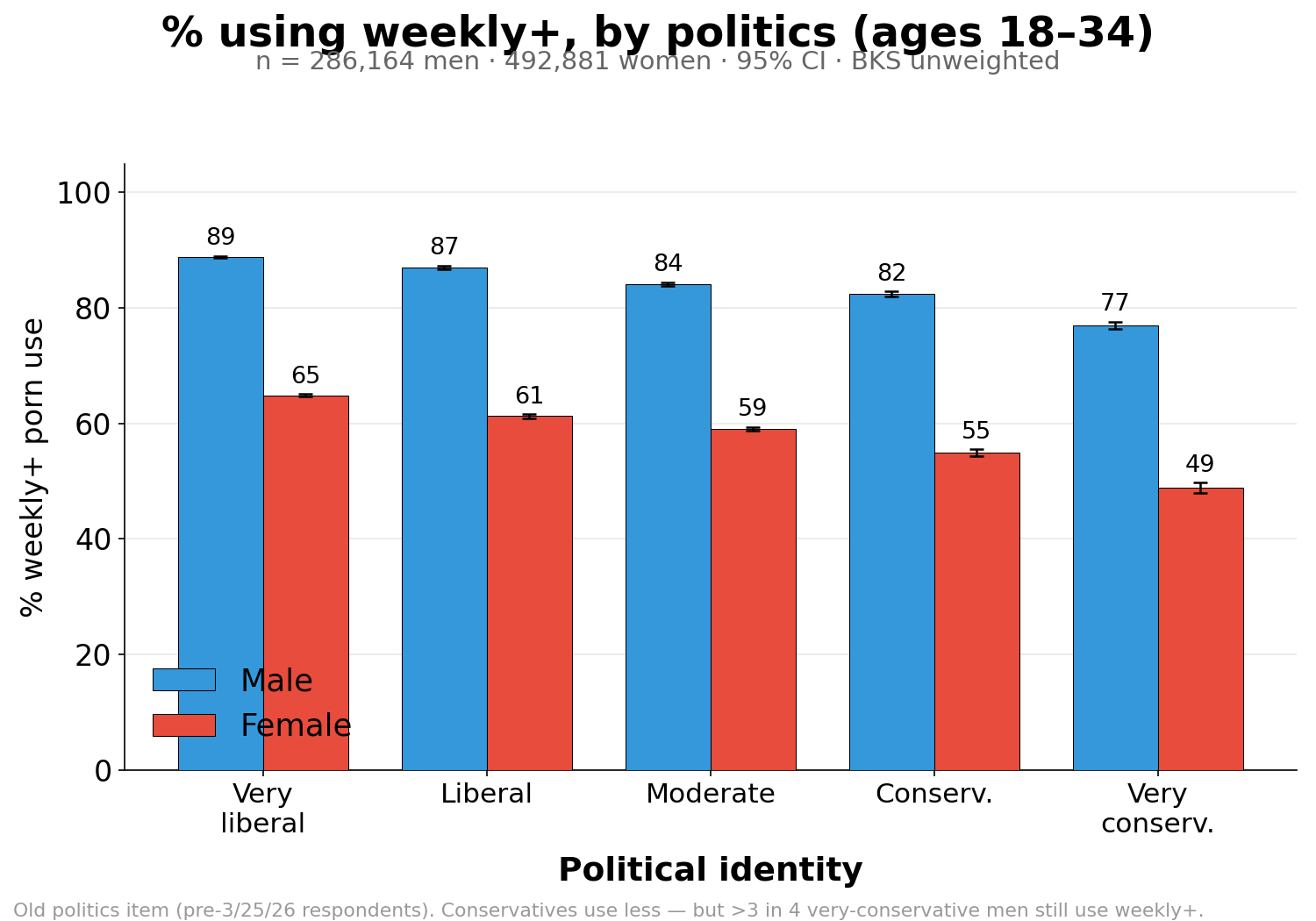
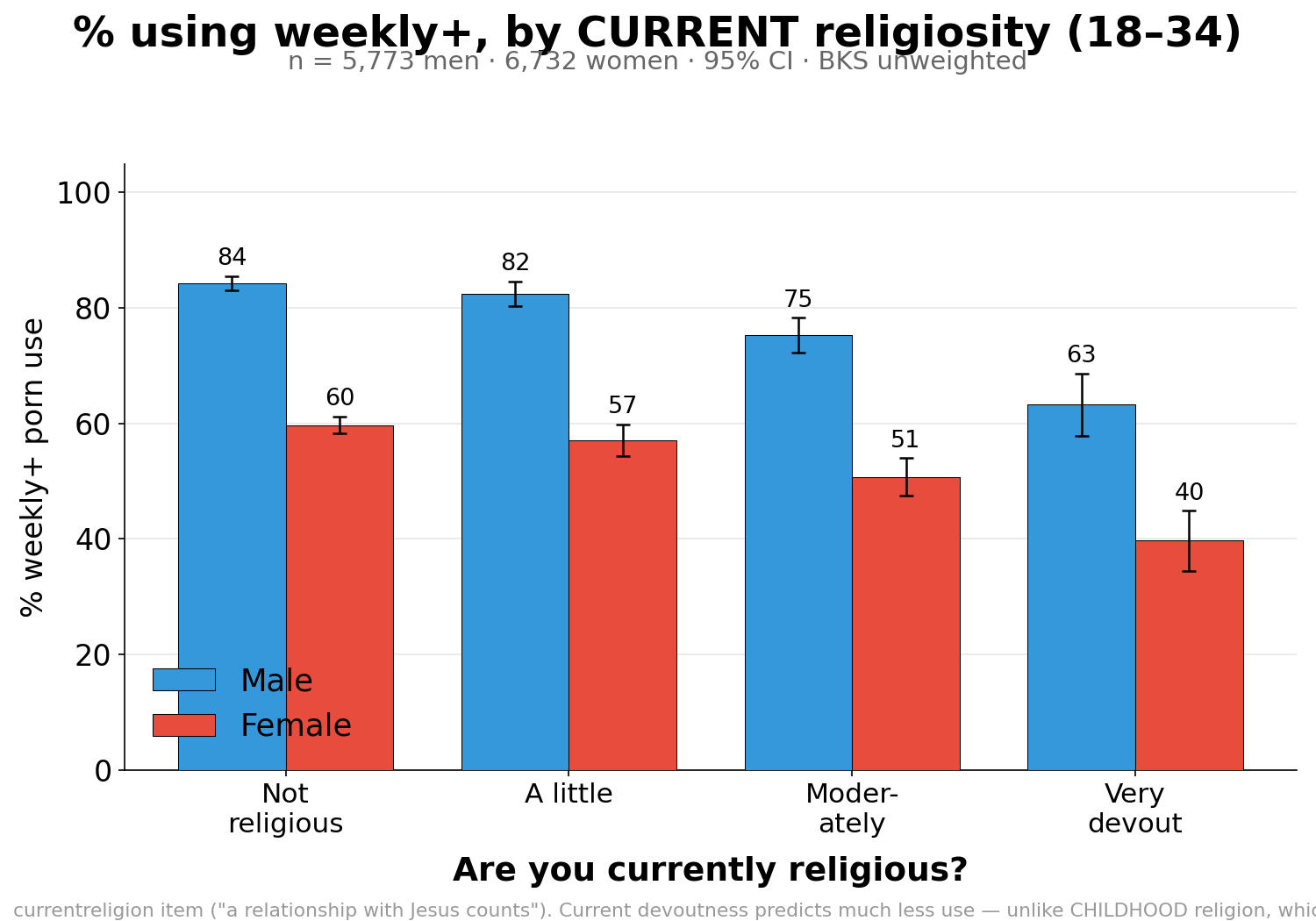
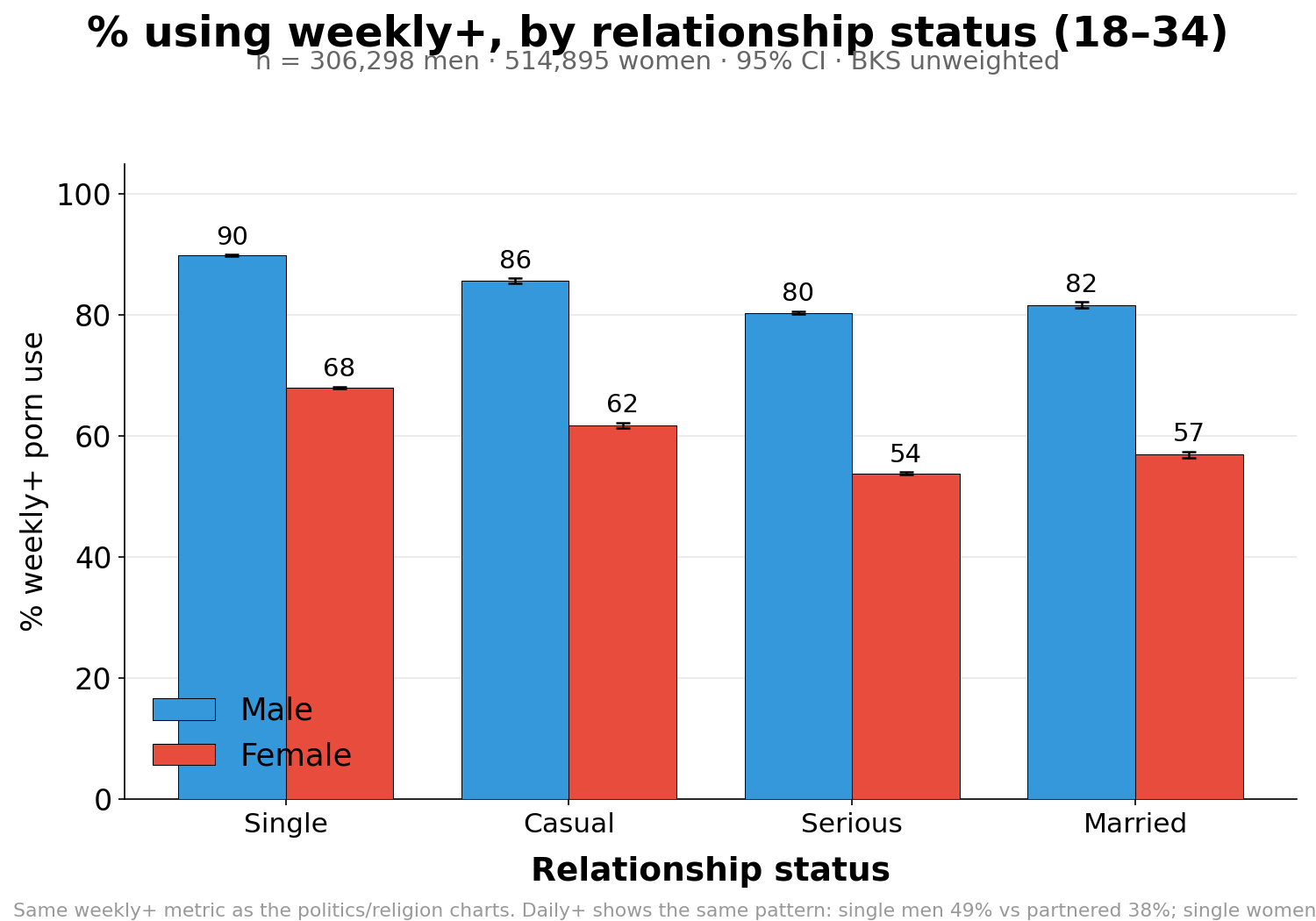
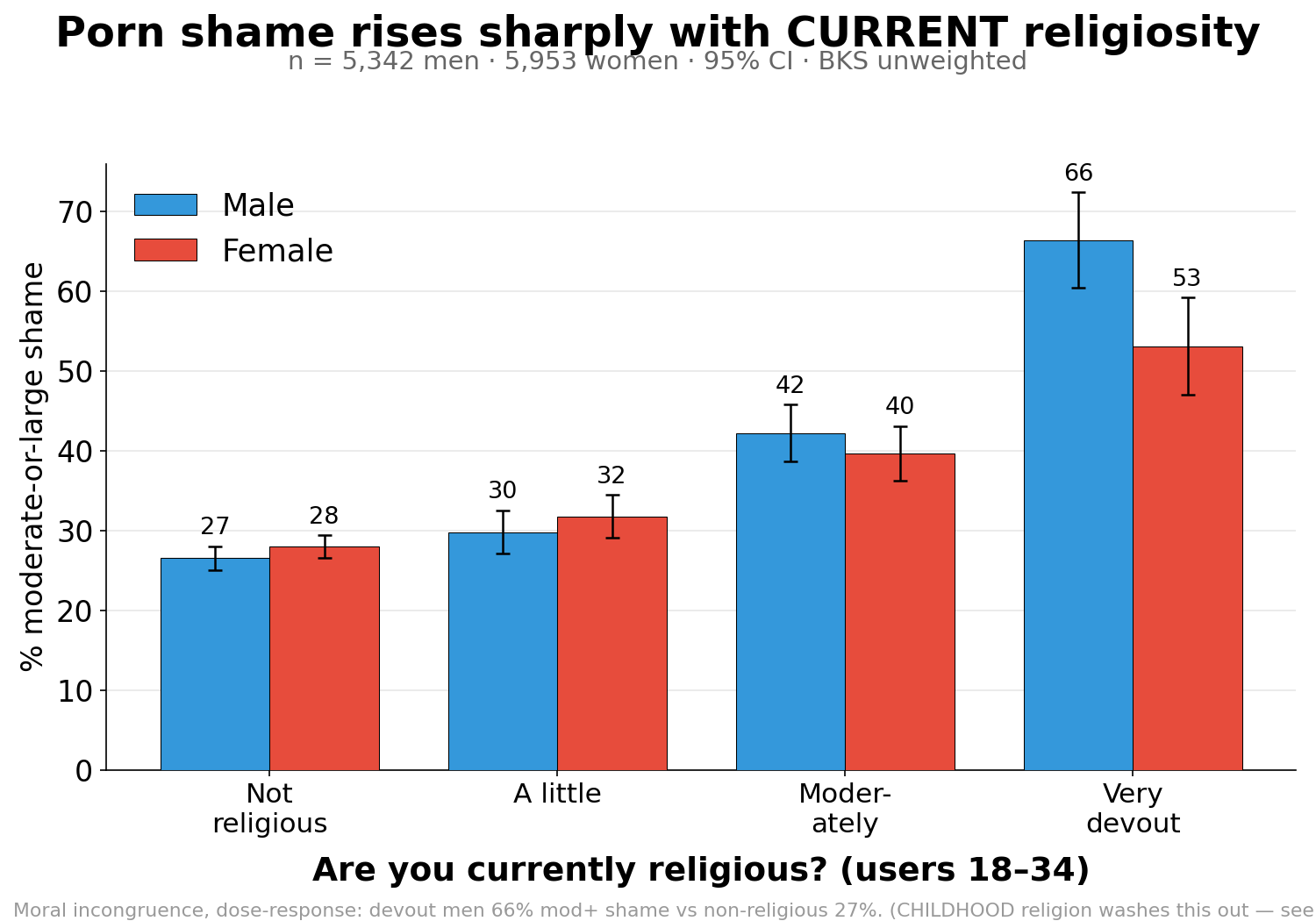
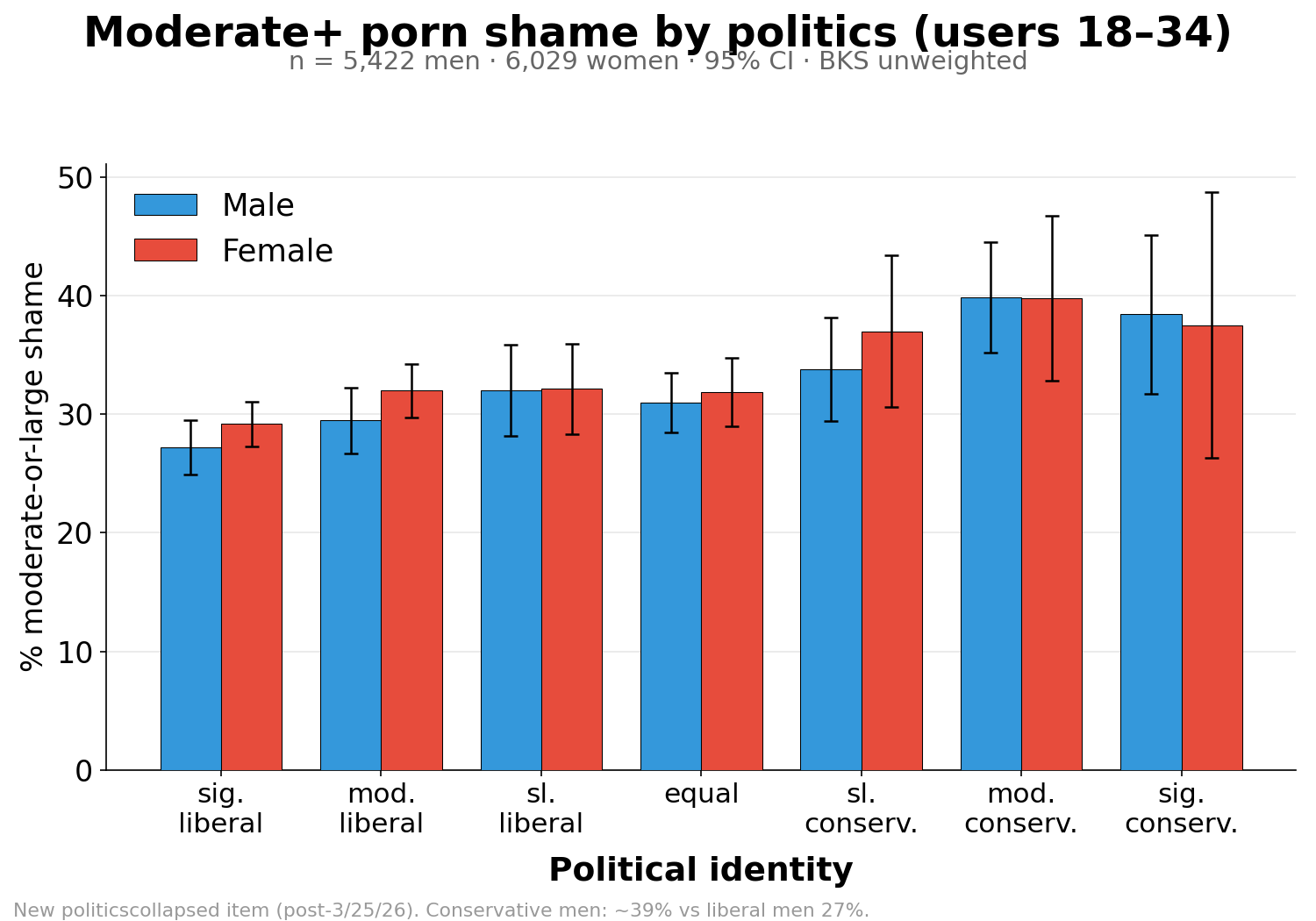
Very-conservative men use less than very-liberal men — but over three-quarters of very-conservative men still use weekly+. The religion story depends entirely on which religion question you use: the religion someone was raised in barely predicts use, but current devoutness predicts substantially less — devout men 63% weekly+ vs non-religious 84%, and devout never-use jumps to 20–24% (vs 6–10%).
Onset: the real adolescent peak — and a generational convergence
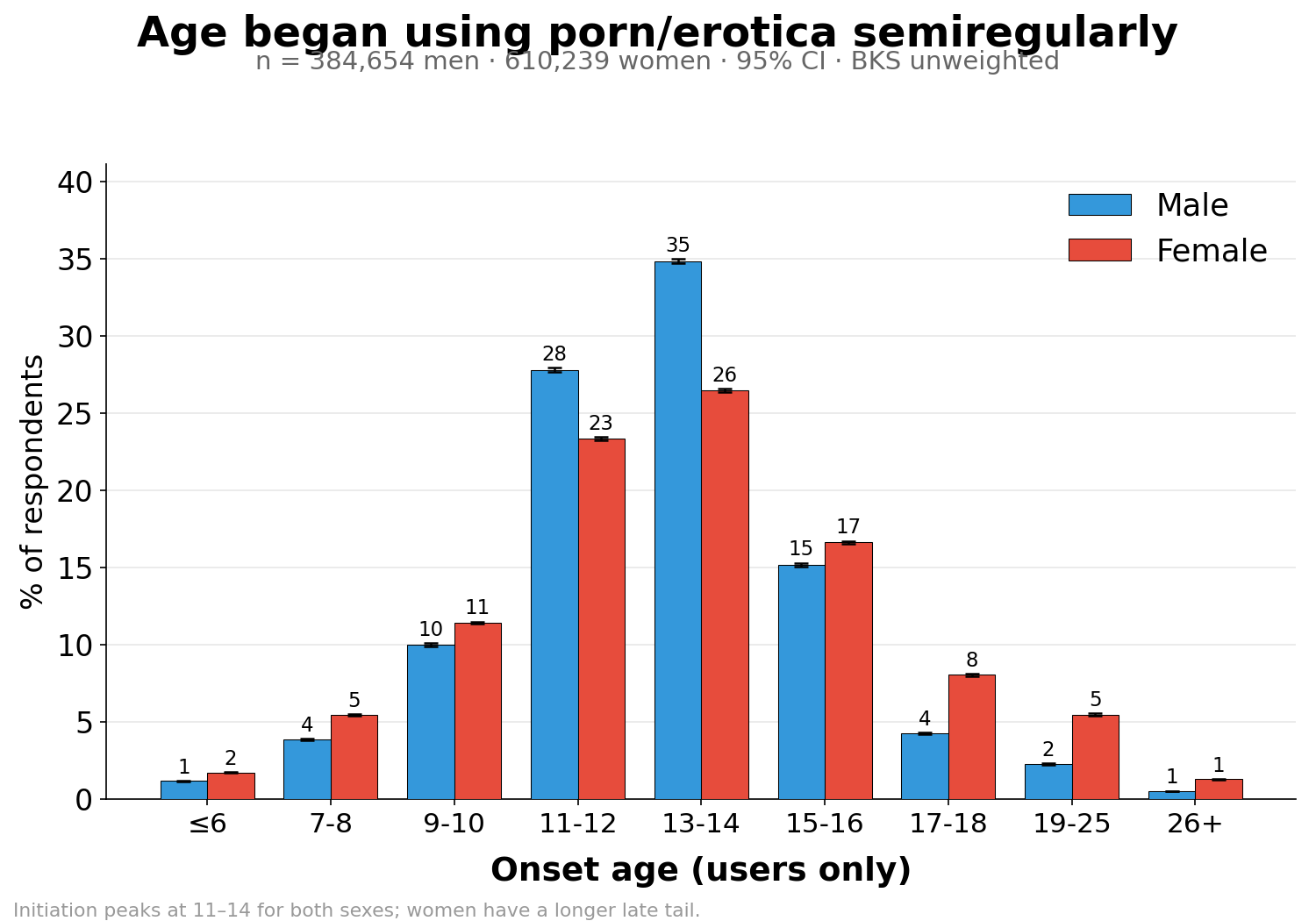
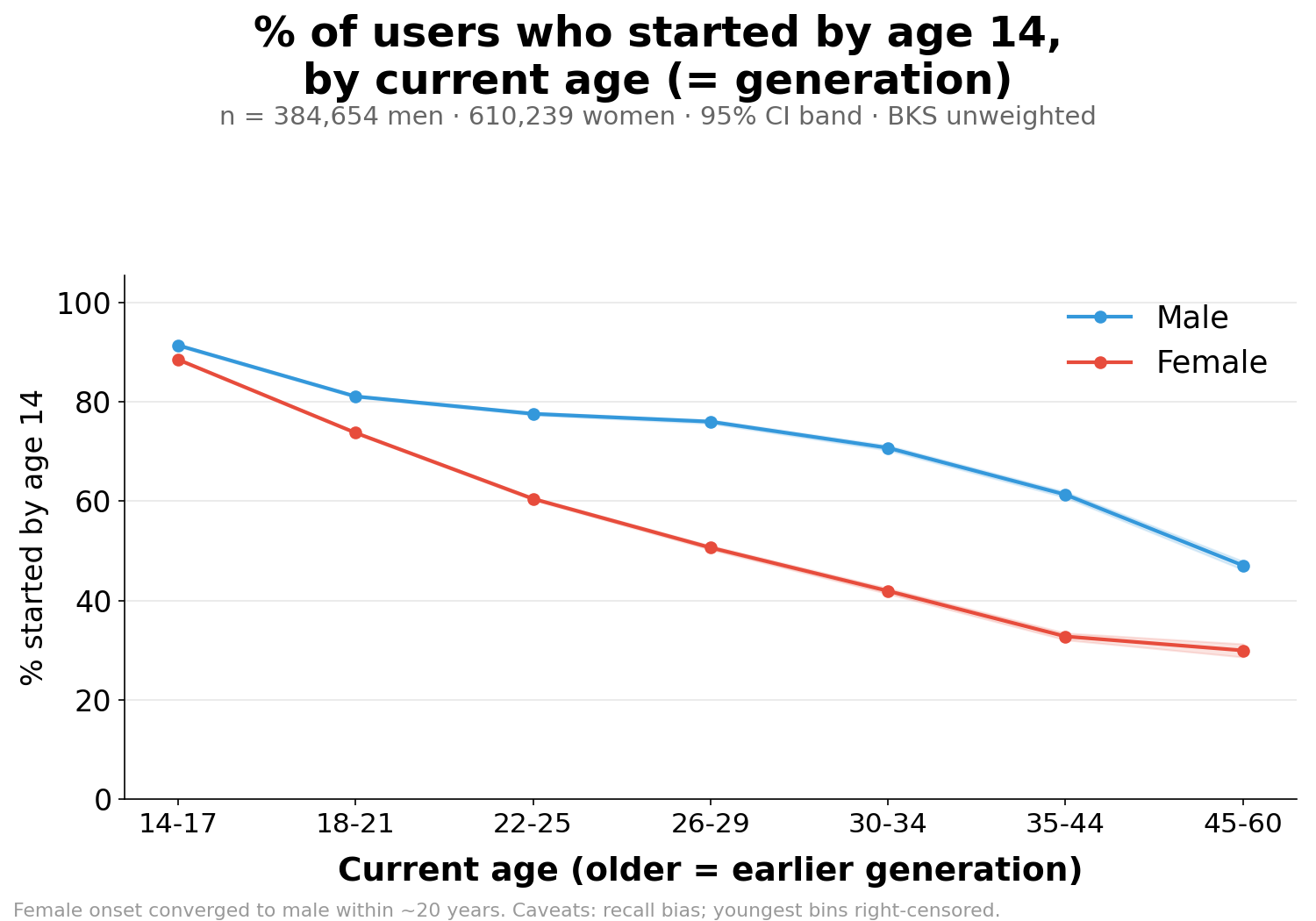
Initiation peaks at 11–14 for both sexes: 78% of male users and 68% of female users started by 14. Meanwhile masturbation onset is essentially identical by sex (mean 11.7 vs 11.8) — the sex difference is in porn adoption, not sexual development.
What they consume
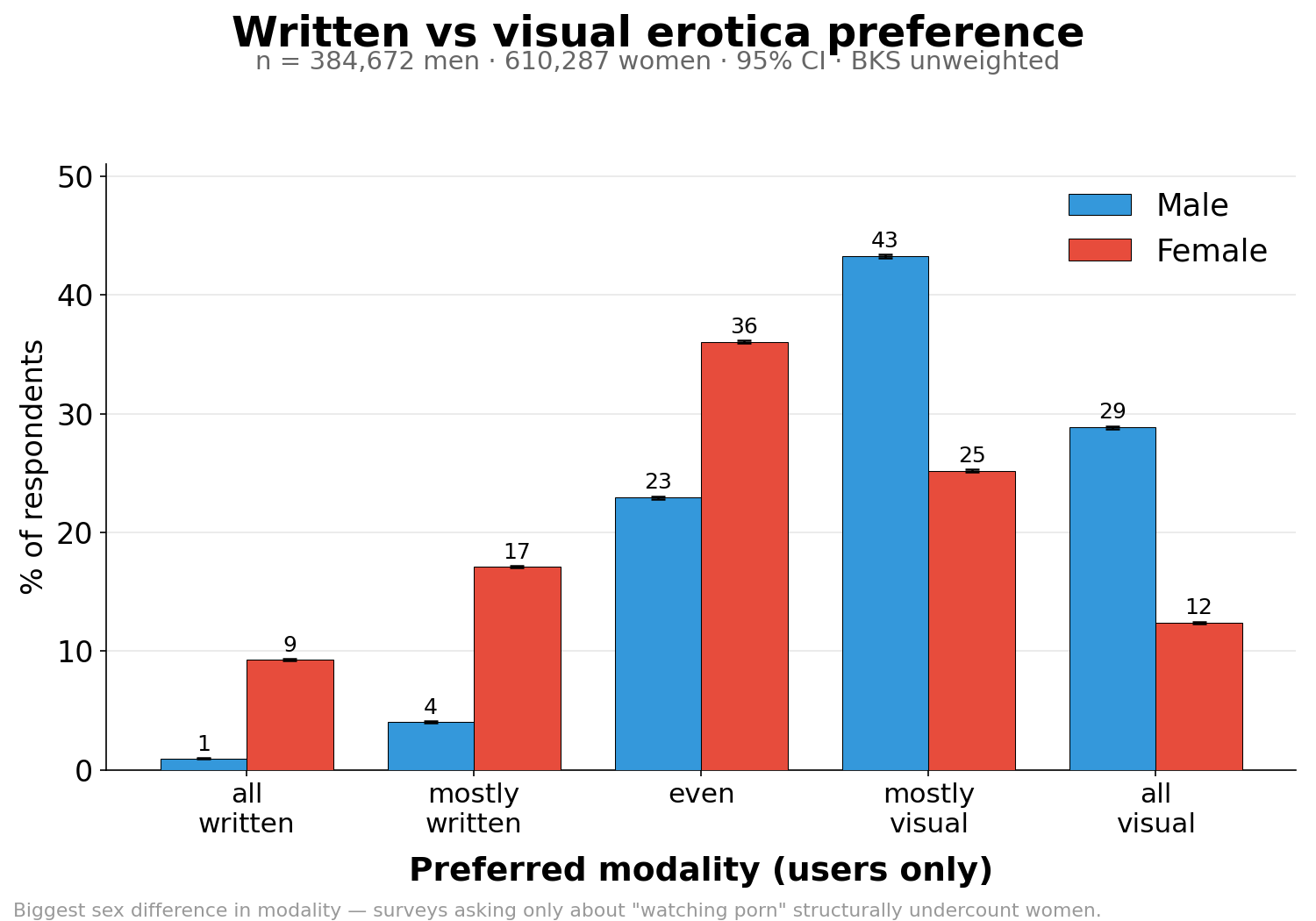
The biggest modality split: 26% of women consume mostly/entirely written erotica vs 5% of men. Any survey that asks only about "watching porn" structurally undercounts women — a definitions point directly relevant to inconsistent measurement of porn prevalence.
Other content facts worth having loaded
| Fact | Men | Women |
|---|---|---|
| Ever paid for porn | 36% | 12% |
| Pay regularly | 2.8% | 0.9% |
| Mostly/entirely animated content | 18% | 22% |
| Find opposite-gender pairing erotic (two women for men / two men for women) | 74% | 57% |
The new items: shame, healing, sex life, porn vs sex
Added May 2026 — only n ≈ 15–18k each, but plenty for stable estimates. These are the freshest numbers in the room.
4a · Shame
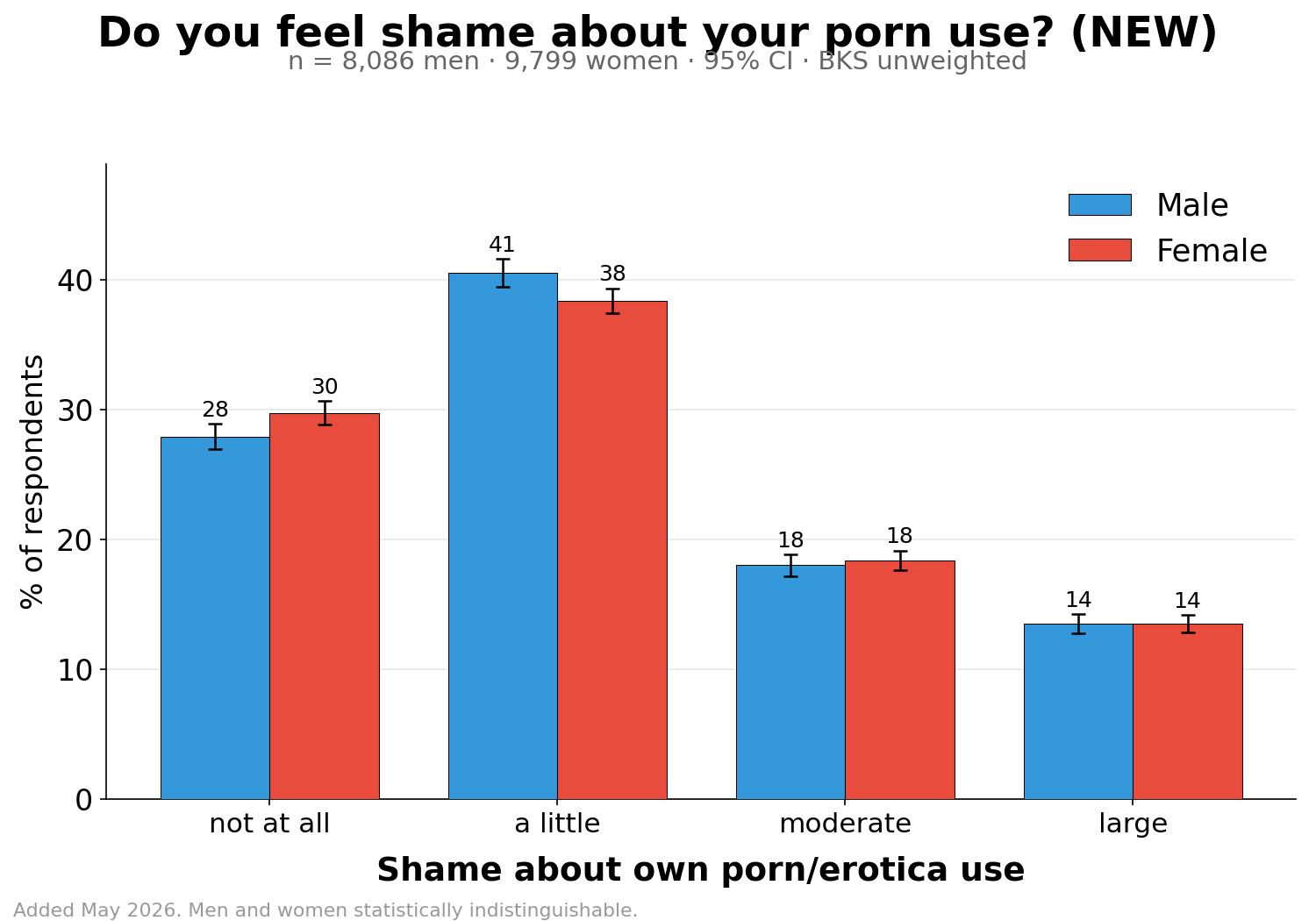
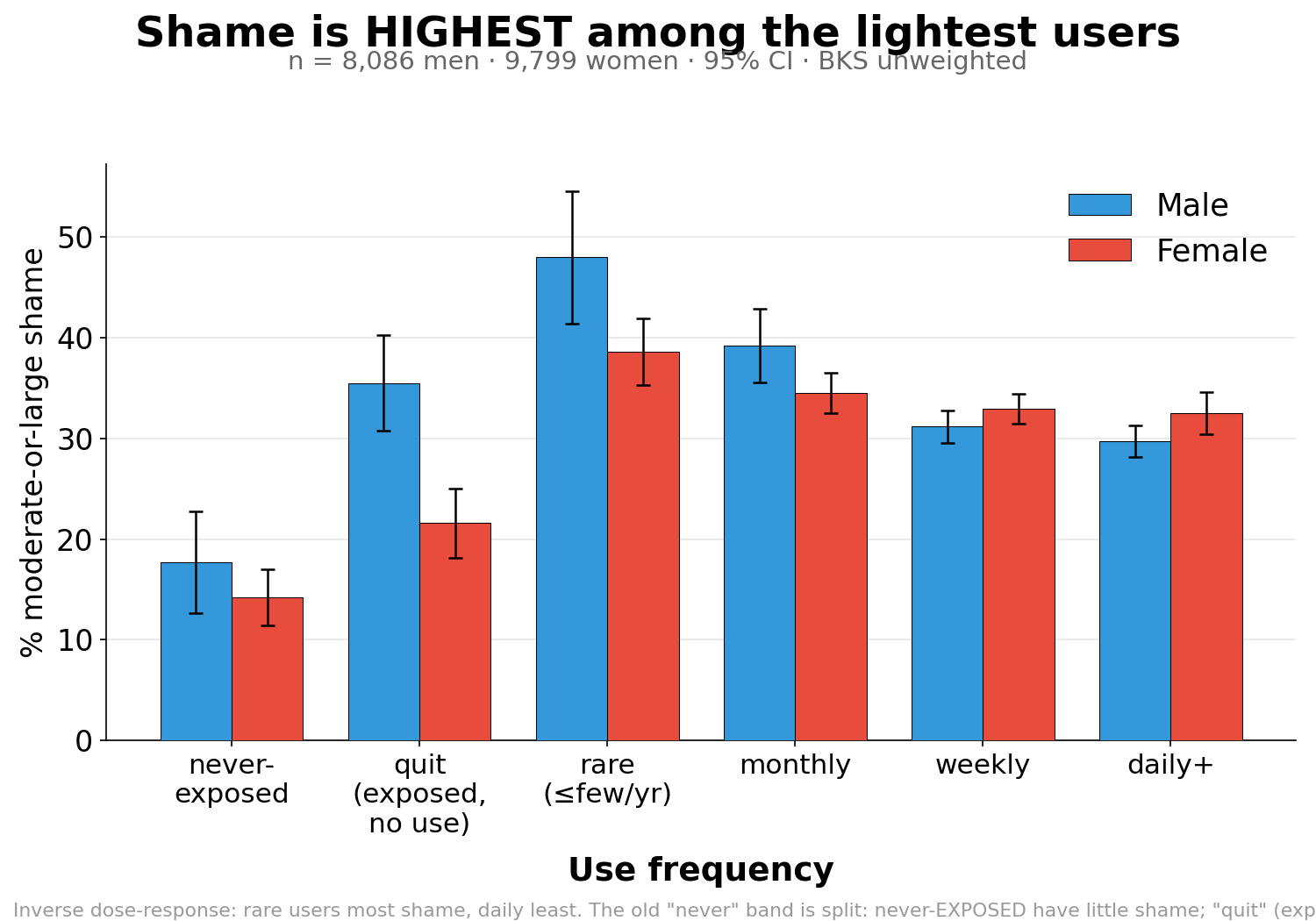
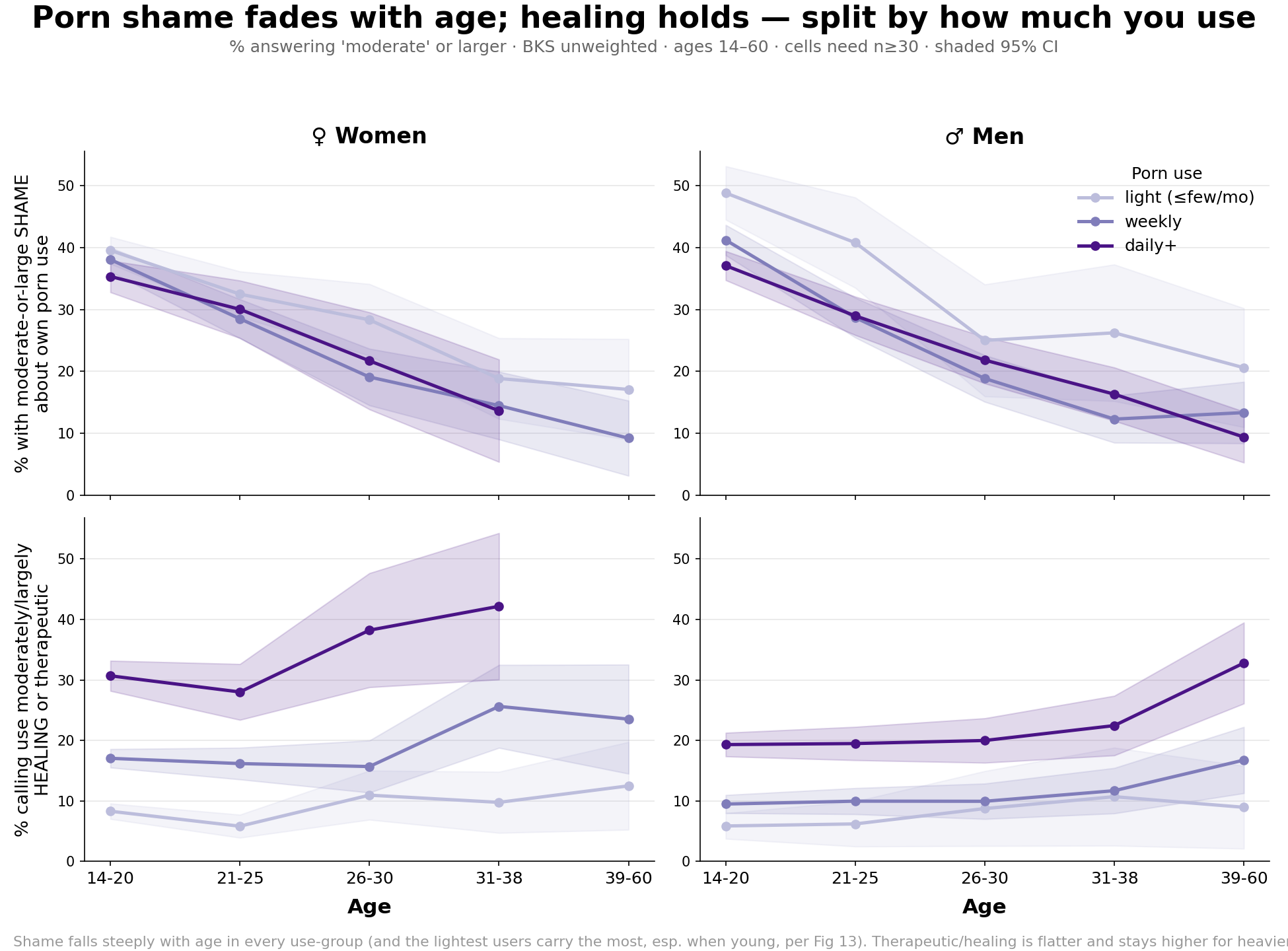
About 1 in 3 users feels moderate-to-large shame about their use — and men and women are statistically indistinguishable. The surprise is the direction of the frequency gradient:
4b · Healing / therapeutic
52% of male users and 57% of female users say their porn use has been at least a little healing or therapeutic. It rises with frequency, and — the notable part — with mental-illness burden:
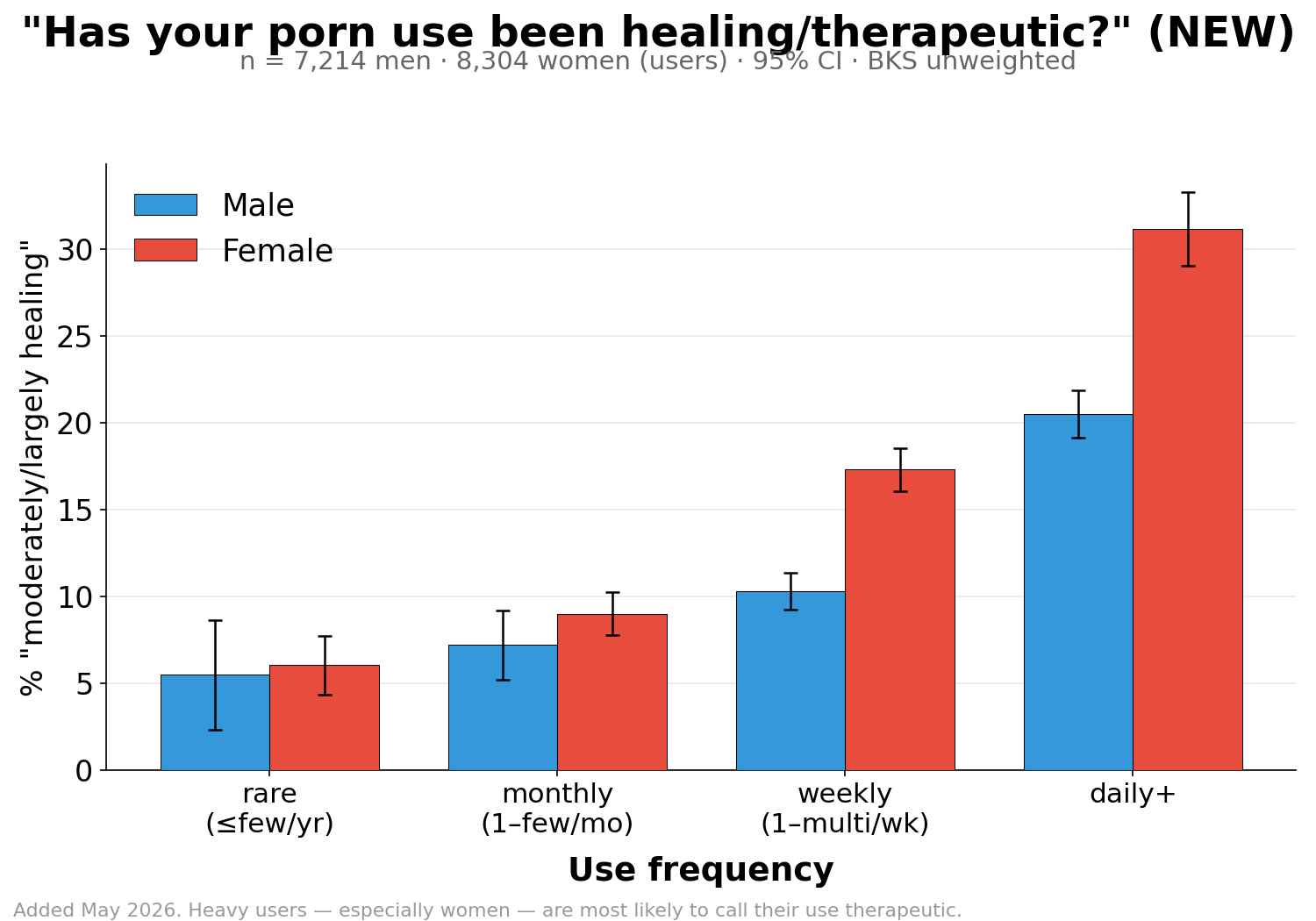
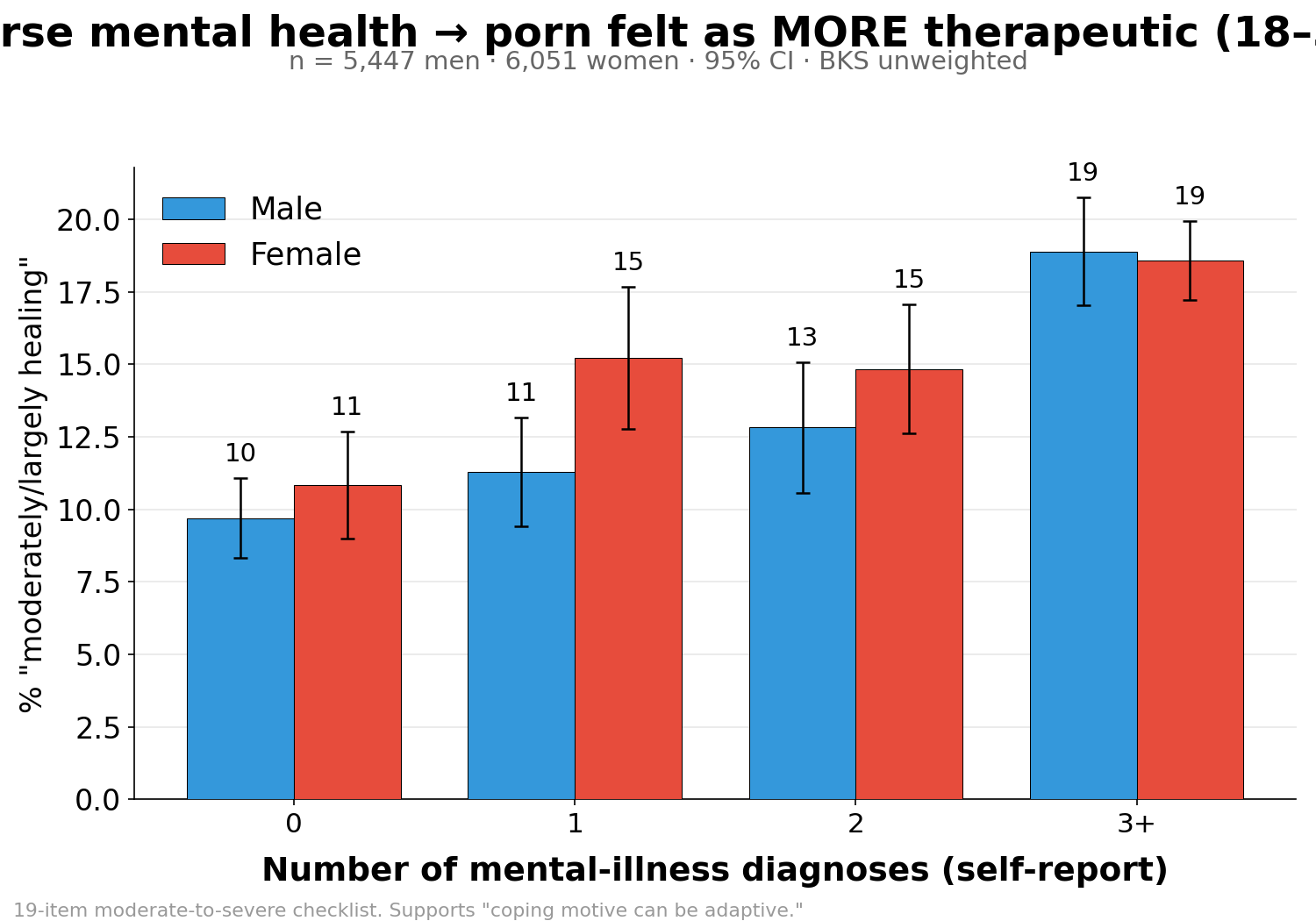
Shame and healing coexist: their correlation is only −0.09, and 27% of people reporting moderate+ therapeutic benefit also report moderate+ shame. They are not opposite ends of one axis.
4c · Effect on sex life — the money item
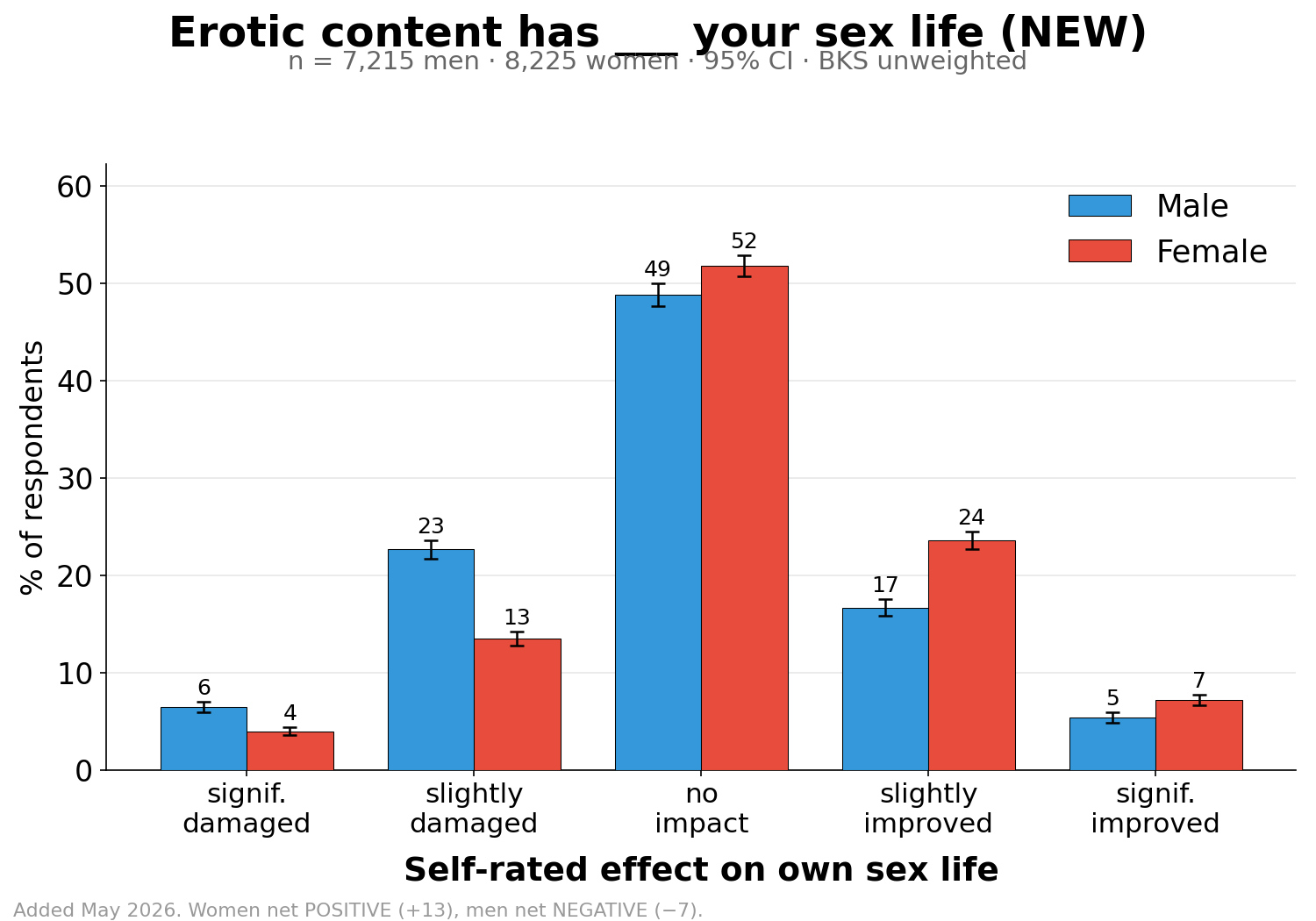
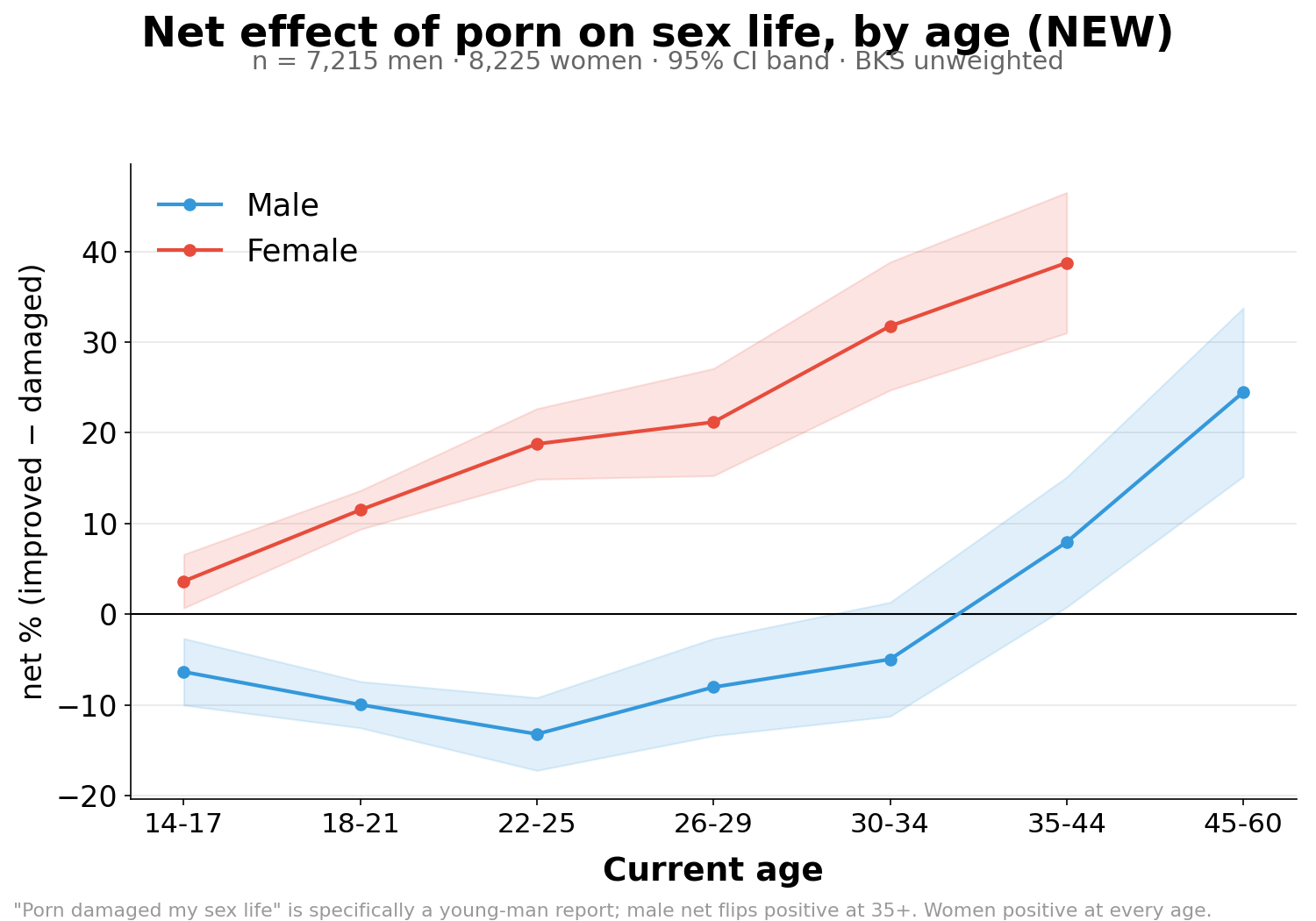
The same split by bodycount sharpens it further — and it's one of the cleaner sex-divergence stories in the deck:
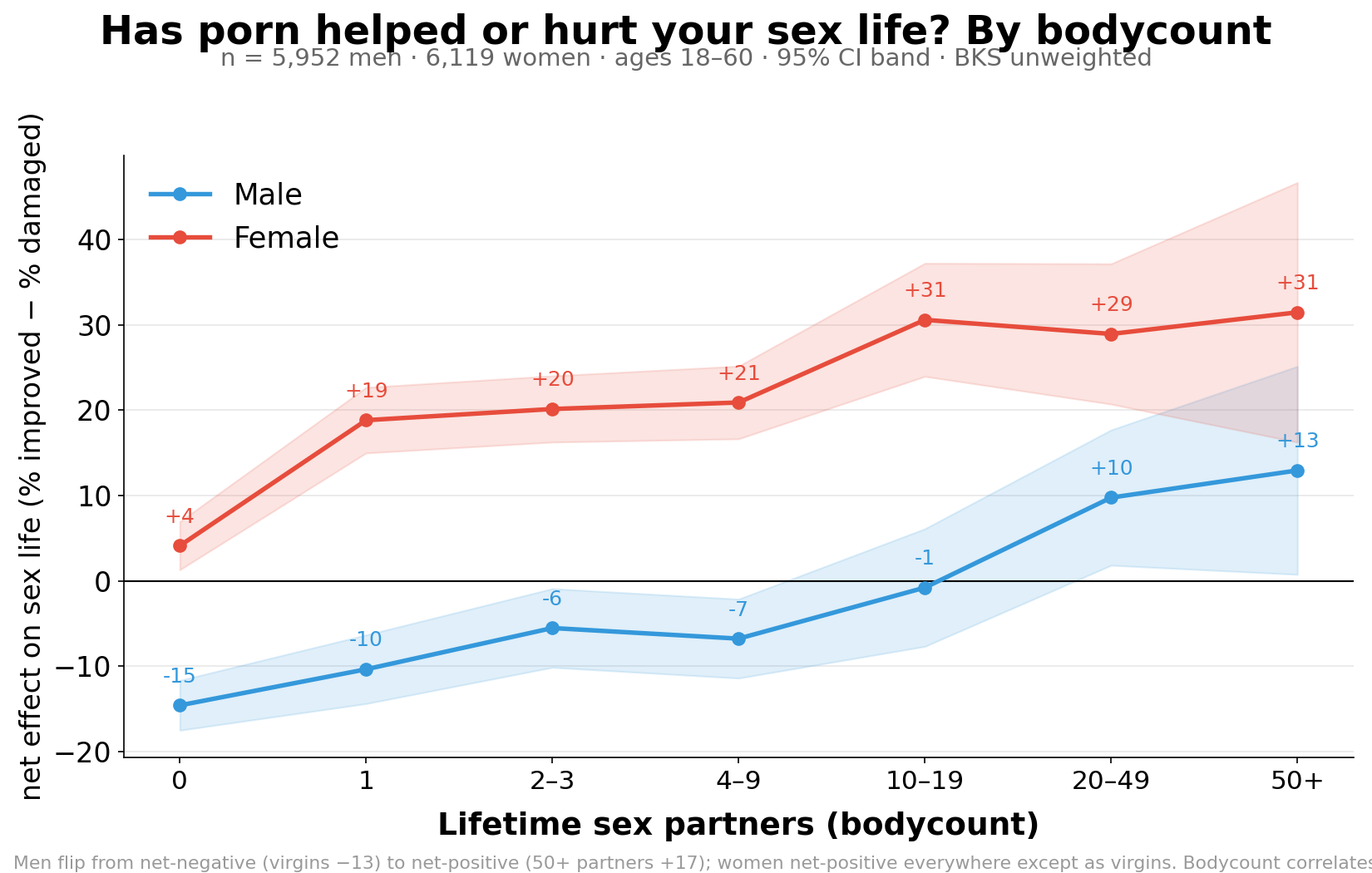
Fine print: by frequency, male damage is flat-ish across use levels — and worst among non-users with porn histories, the "quit" group examined in §4e. Women get more positive with more use. Conservative men are most negative (−16 to −19) vs significantly-liberal men at −1; women are positive across the whole political spectrum.
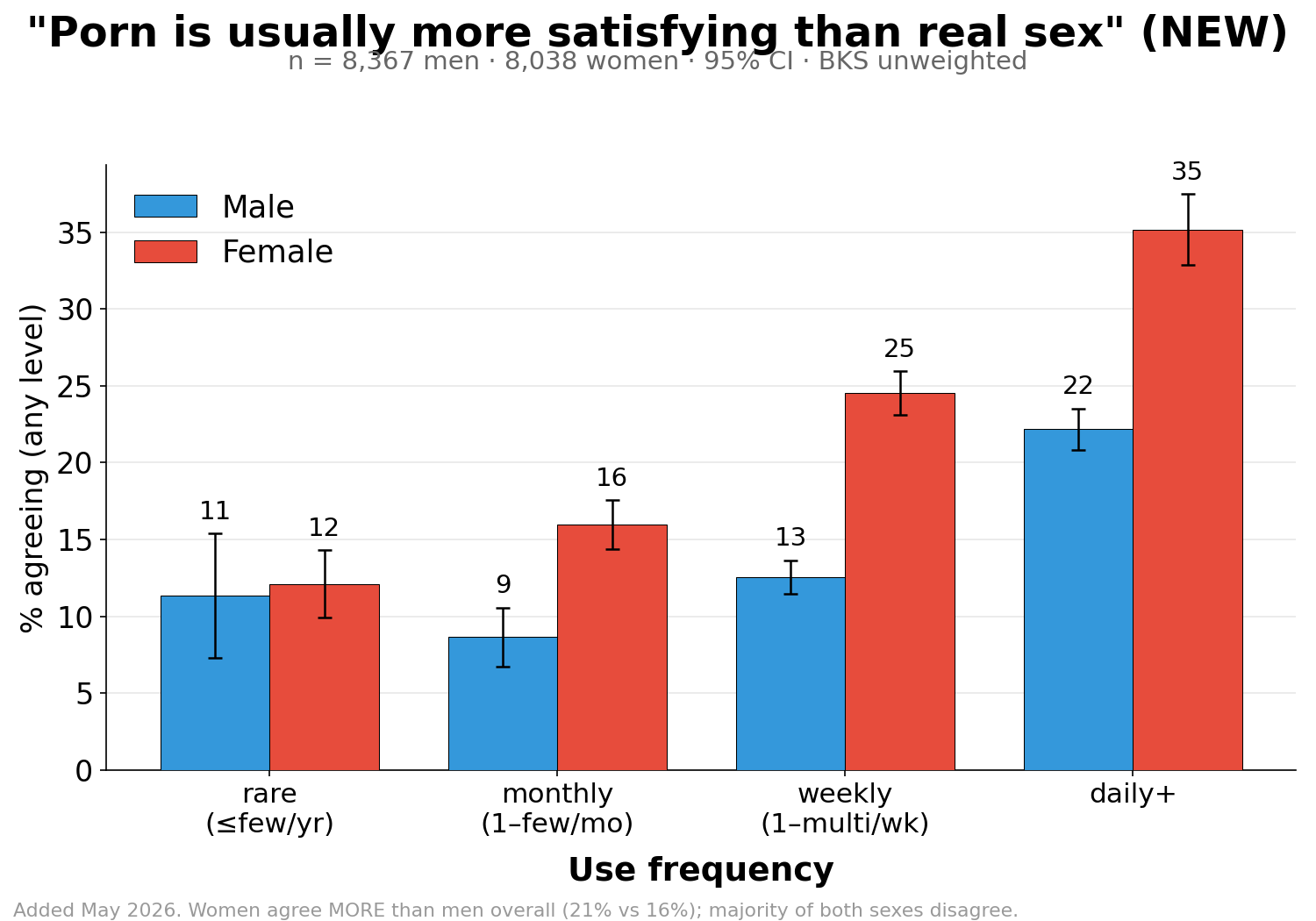
4d · "Porn is usually more satisfying than sex with a real person"
21% of women agree vs 16% of men — women agree more, which pairs neatly with the written-erotica and violent-content findings: porn delivers content and control that partnered reality often doesn't. A majority of both sexes disagree.
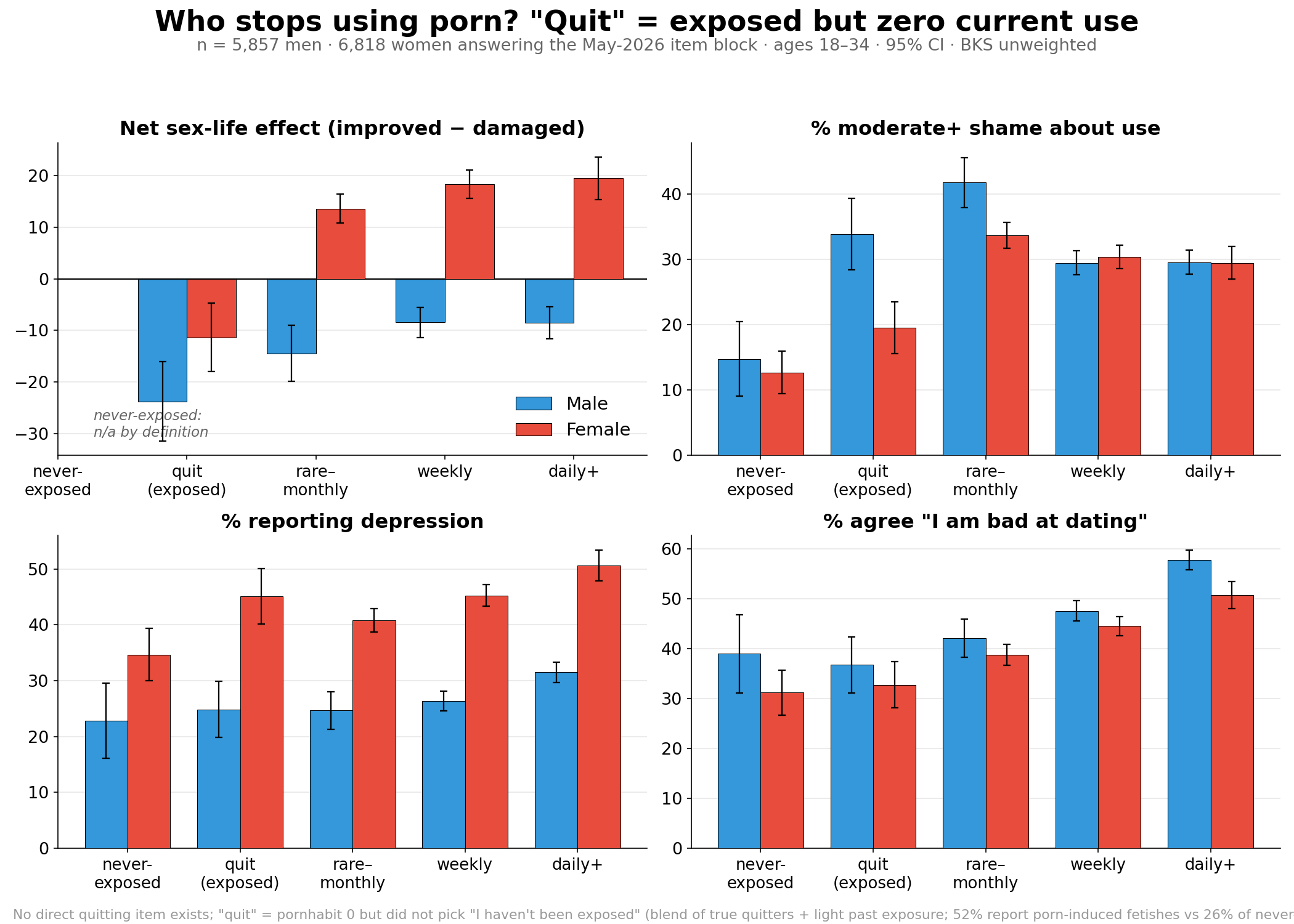
4e · Who stops? The "quit" group — and a survivorship warning
There is no direct quitting item in BKS — but the sex-life question offers "I haven't been exposed" and isn't gated on use. So respondents reporting zero current use who still rated porn's effect are, by their own account, exposed non-users. They look substantially like former real users rather than incidental browsers: 52% say porn induced fetishes in them (vs 26% of the never-exposed), 8% have paid for porn (vs 1%), and 60% answered "has your porn use been therapeutic" rather than "I haven't viewed any." Read them as a blend of true quitters and light past exposure.
Porn × dating, drive & relationships
How does porn use line up with real-world sexual and romantic life — current arousal, the drive to seek out real sex, dating difficulty, casual-sex experiences? Three of these items (sexmotivated, badatdating, plus the May-2026 satisfaction item) are recent additions; horniness and hookup quality come from the large older items. Read everything here as correlational — the master confound is libido itself: high-drive people both watch more porn and report more of nearly everything below.
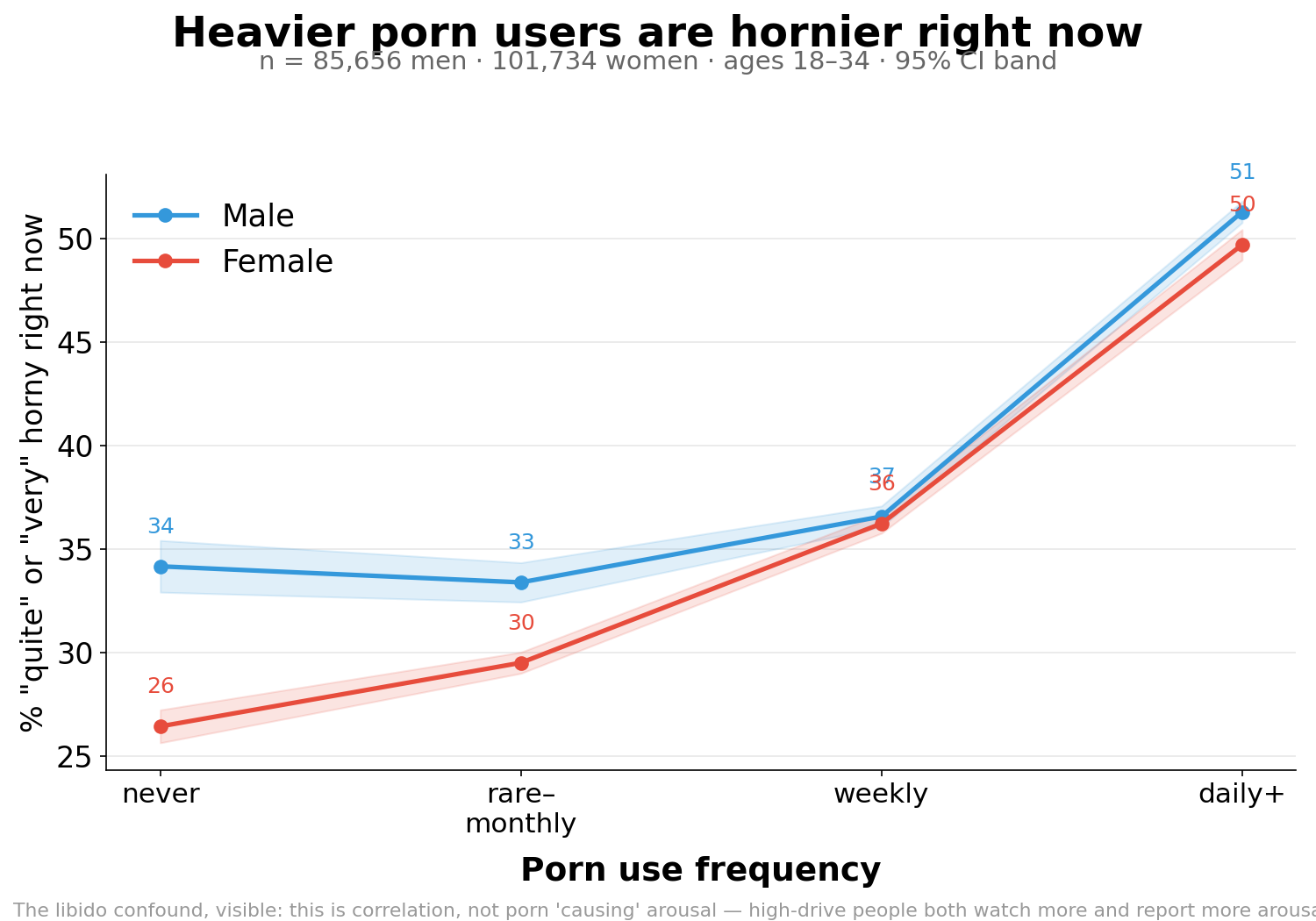
5a · Current horniness
Heavier users are simply hornier in the moment: 51% of daily+ men and 50% of daily+ women say they're "quite" or "very" horny right now, vs 34% / 26% of never-users. The jump is concentrated at the daily+ level.
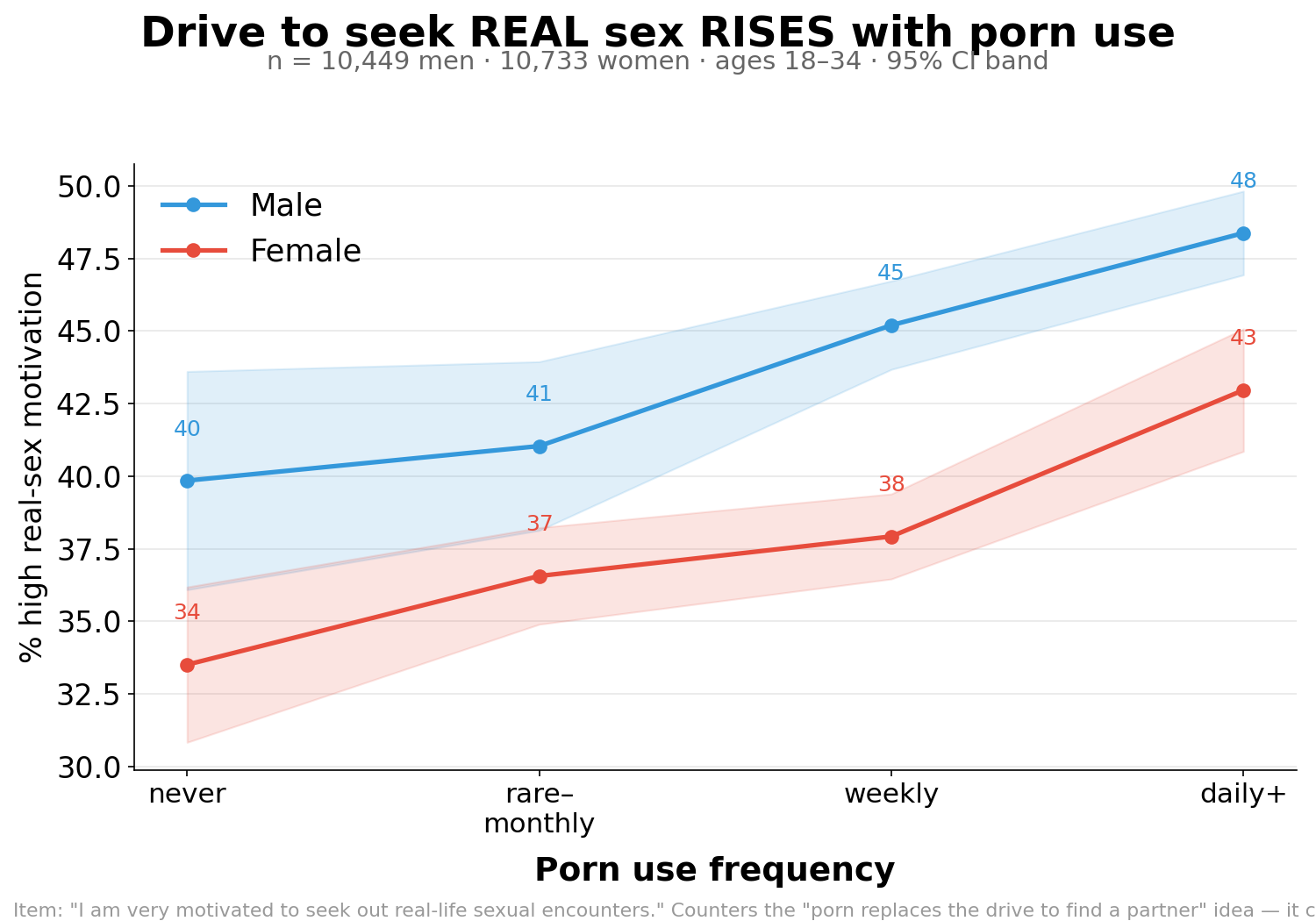
5b · Drive to seek real sex
5c · Dating difficulty — the strongest real-world correlate
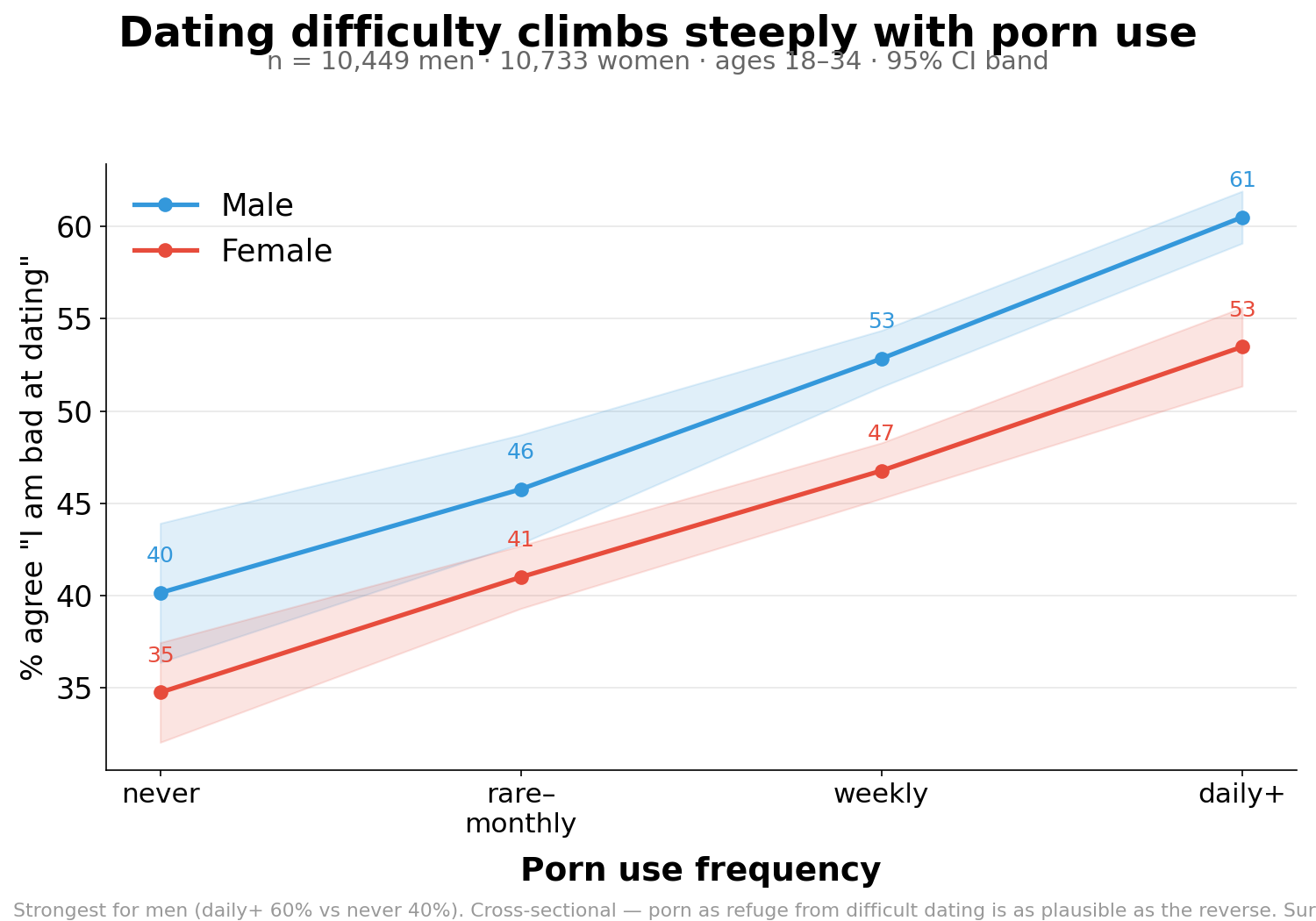
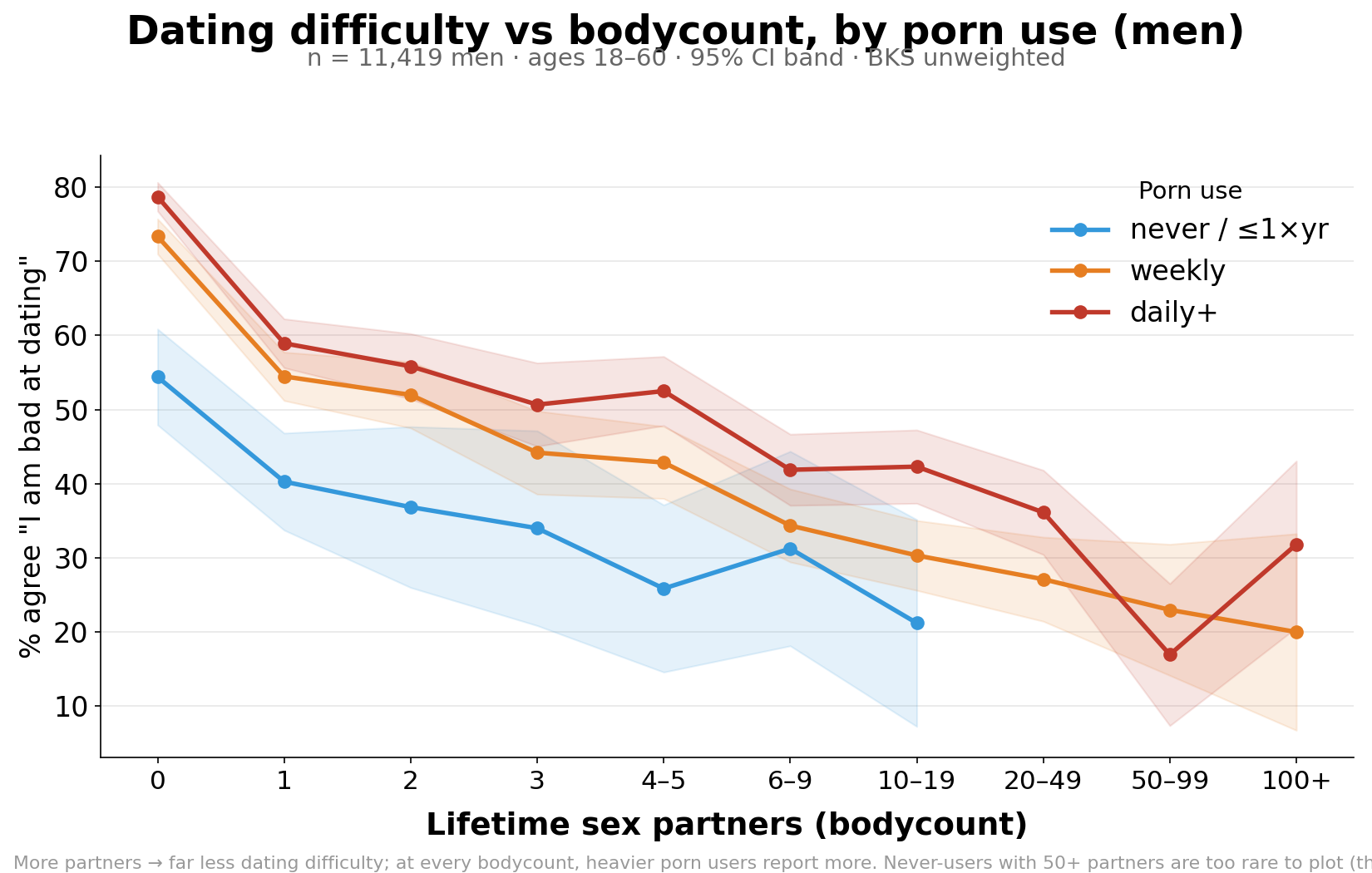
This is the steepest gradient in the whole dating/drive cluster. Self-reported difficulty with dating climbs sharply with porn frequency, especially for men: 61% of daily+ men say "I am bad at dating" vs 40% of male never-users (women 53% vs 35%).
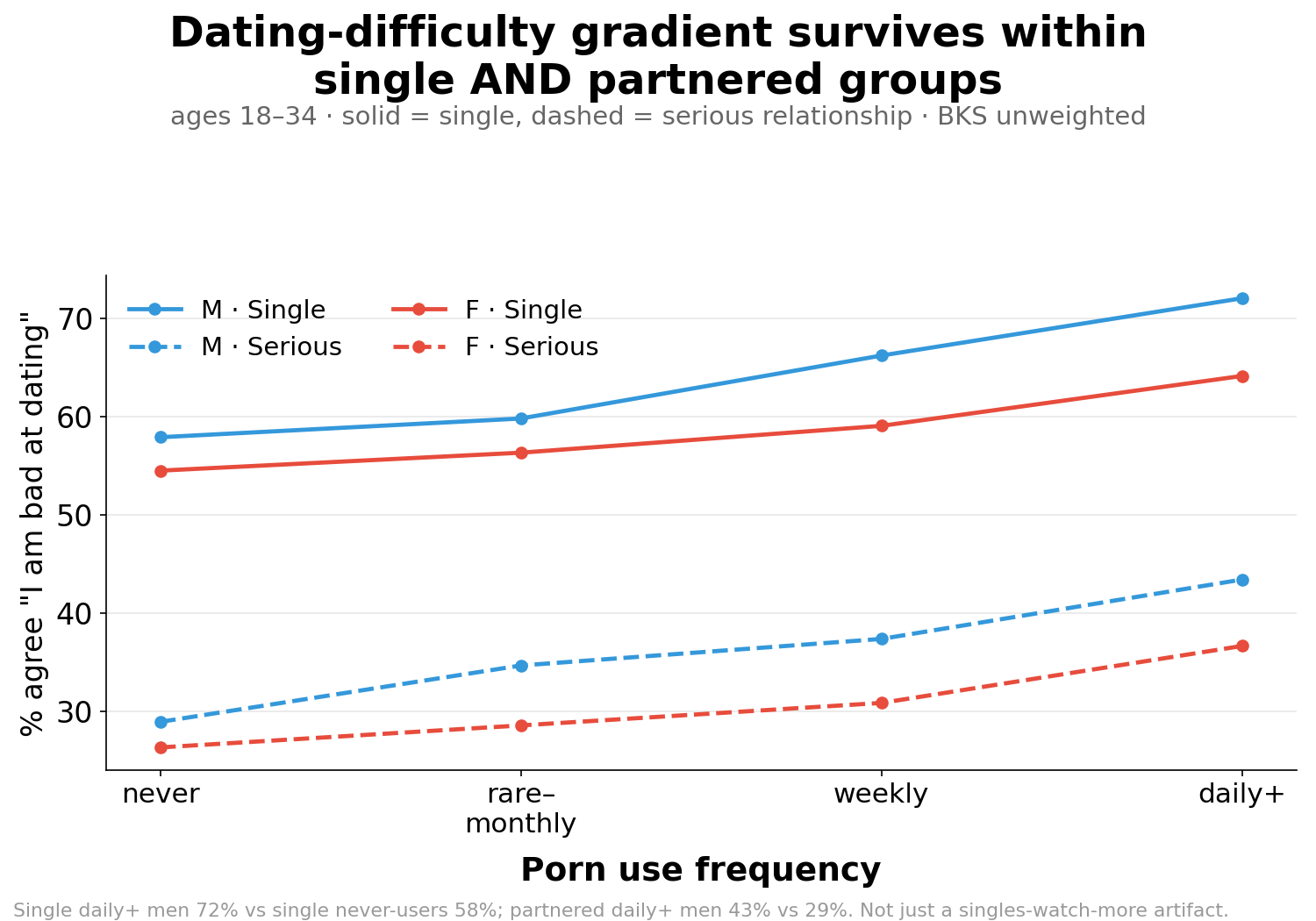
And critically, it survives controlling for relationship status — it's not just that single people both date worse and watch more. Within singles and within people in serious relationships, the gradient persists:
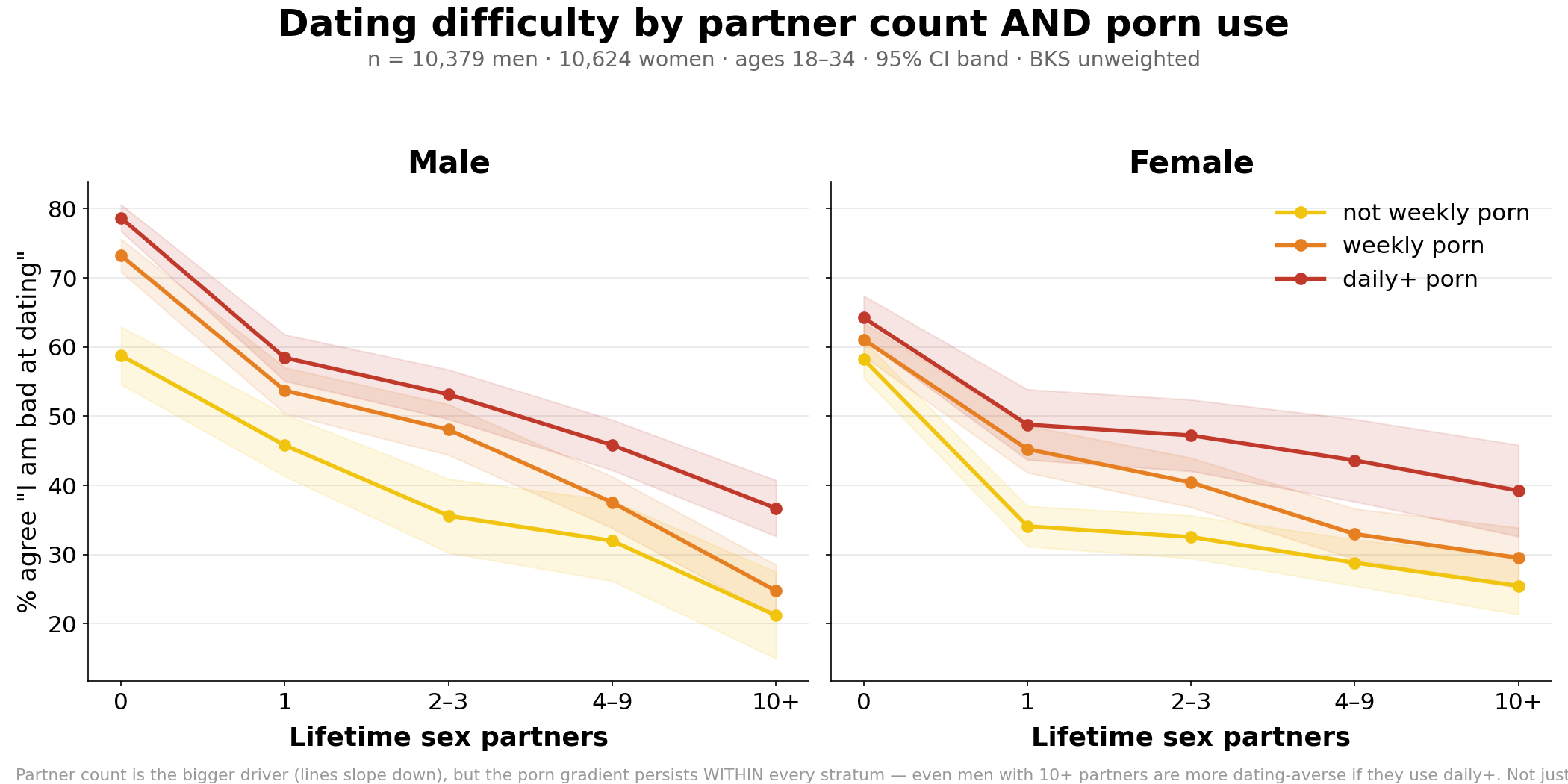
The sharper control is lifetime partner count (sexcount) — a direct proxy for real-world sexual success, and the obvious worry behind "maybe it's just inexperienced people watching porn." It does two things at once:
5d · Casual-sex experience (women)
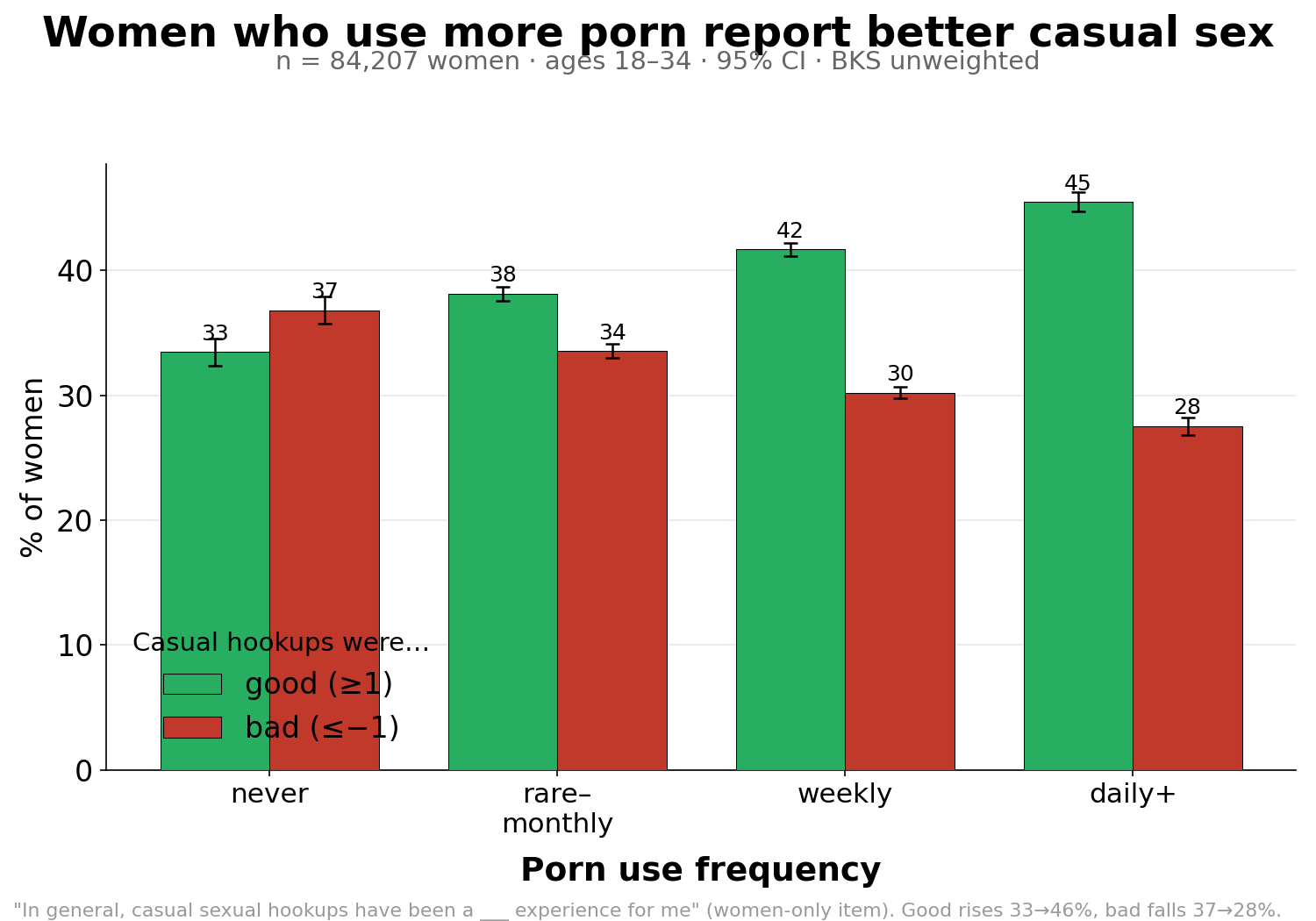
The casual-hookup-quality item is women-only. Counter to a "porn ruins women's real sex" expectation, women who use more porn report better casual sex: among daily+ women, 46% say hookups have been good and 28% bad, vs 33% good / 37% bad among never-users. Consistent with the §4c finding that women are net-positive on porn's effect on their sex lives.
5e · The substitution subgroup is real — but a minority
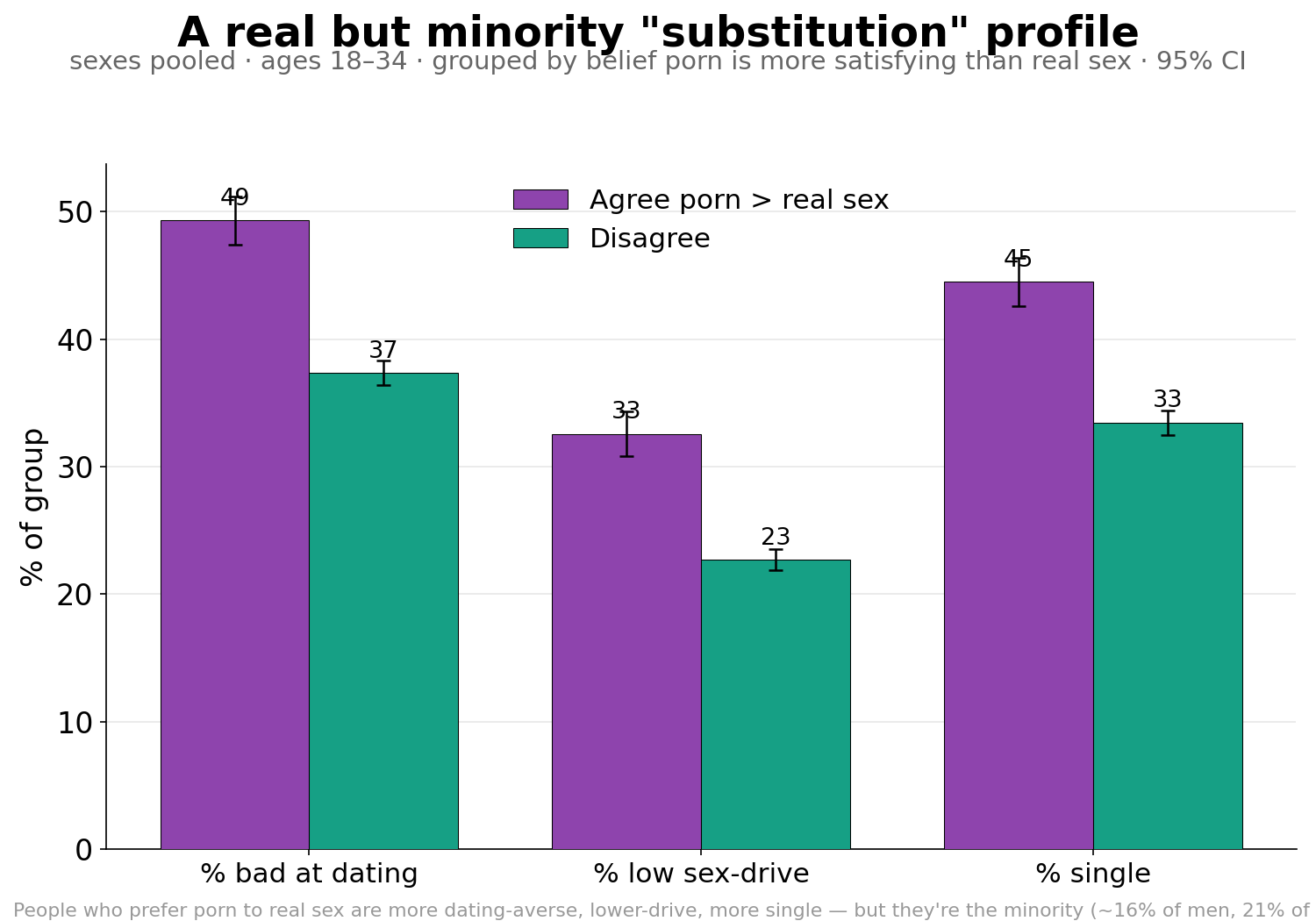
All of the above is the average. There's a distinct minority for whom porn genuinely looks substitutive: people who agree "porn is more satisfying than real sex" (~16% of men, 21% of women) are meaningfully more dating-averse, lower-drive, and more often single. So both stories are true at once — net complement, minority substitute.
5f · What confounds the porn ↔ dating link? (the capstone)
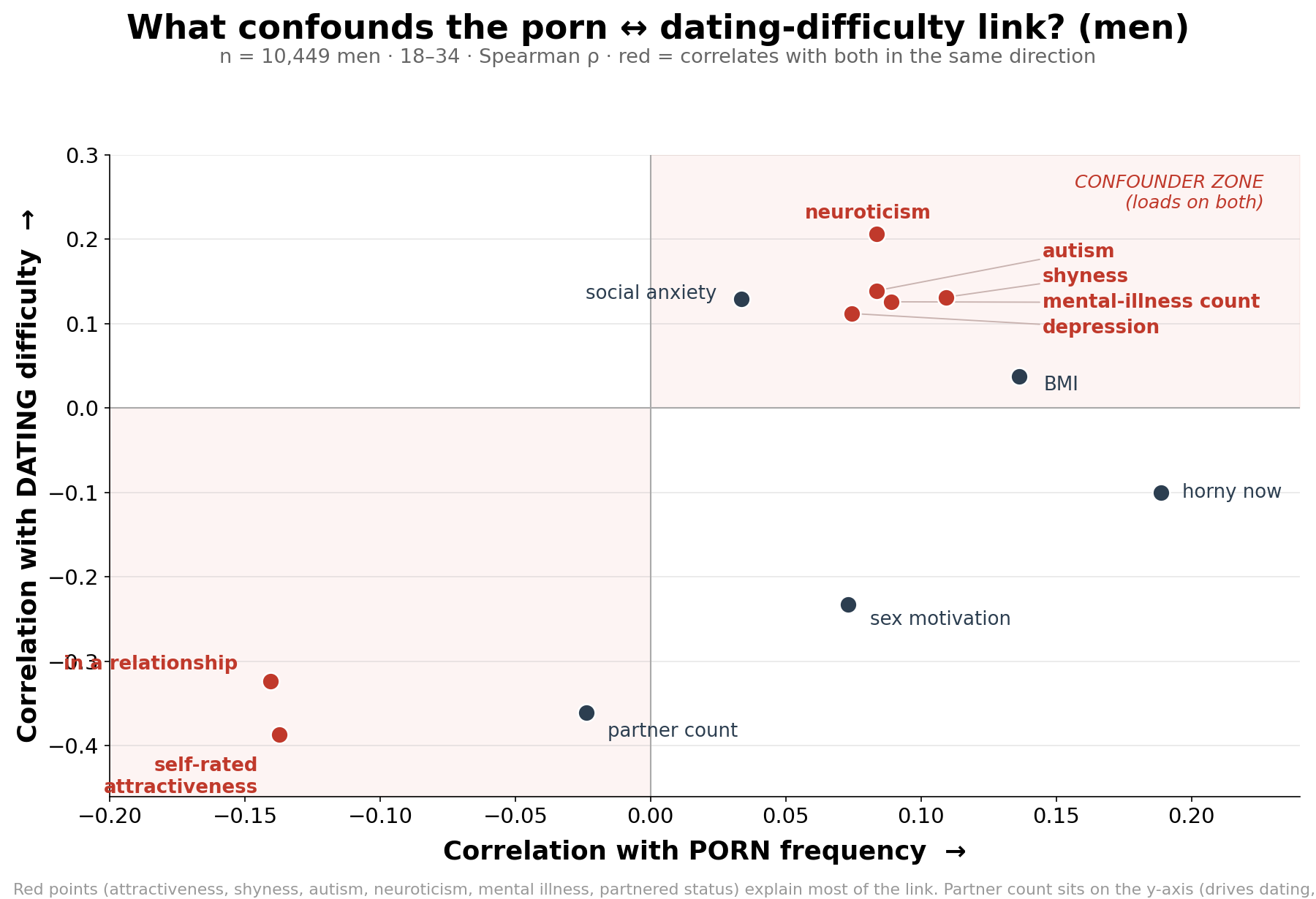
The dating-difficulty result survived controlling for relationship status (Fig 29) and partner count (Figs 32–33) — so what does explain it? Mapping every candidate variable by how it correlates with both porn use and dating difficulty isolates the real confounders: variables sitting in the shaded "loads-on-both" quadrants.
| raw ρ | + attractiveness | + everything | |
|---|---|---|---|
| Men | +0.136 | +0.091 | +0.058 |
| Women | +0.137 | +0.107 | +0.033 |
hotterthanothers is self-rated attractiveness, itself entangled with self-esteem and mental health — so it likely absorbs some variance that isn't "looks" per se. Treat it as "self-perceived desirability," not an objective beauty measure.Mental health
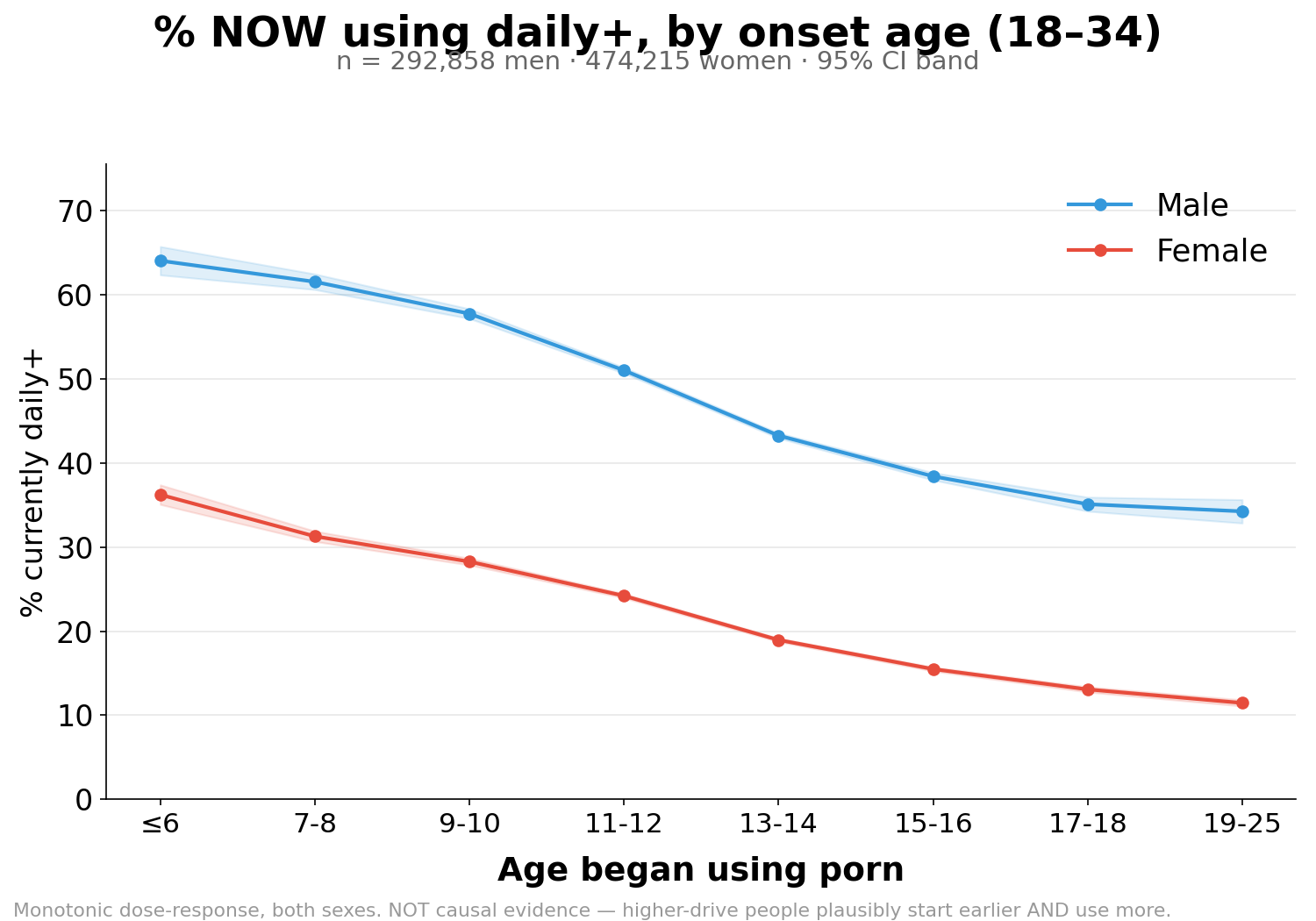
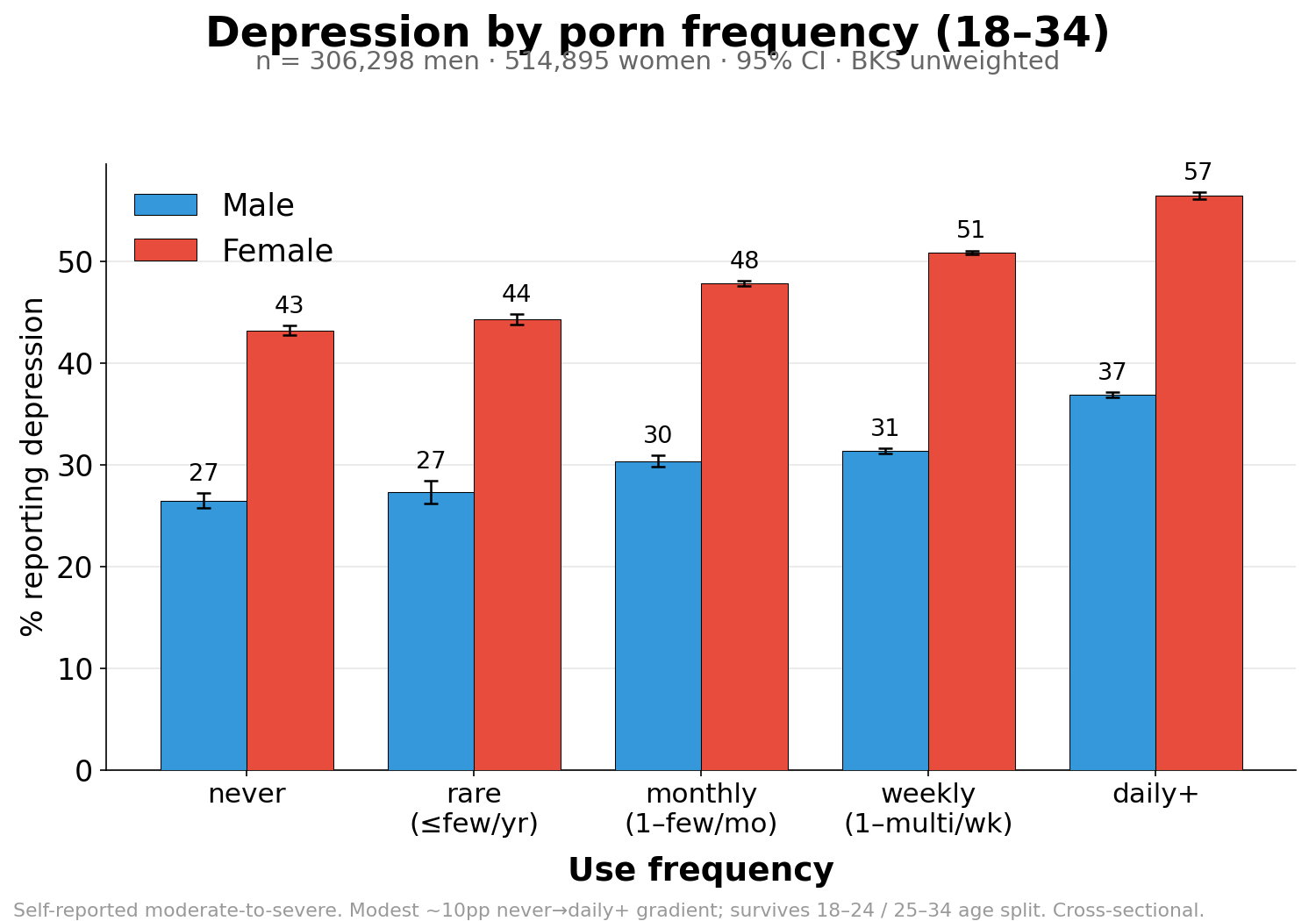
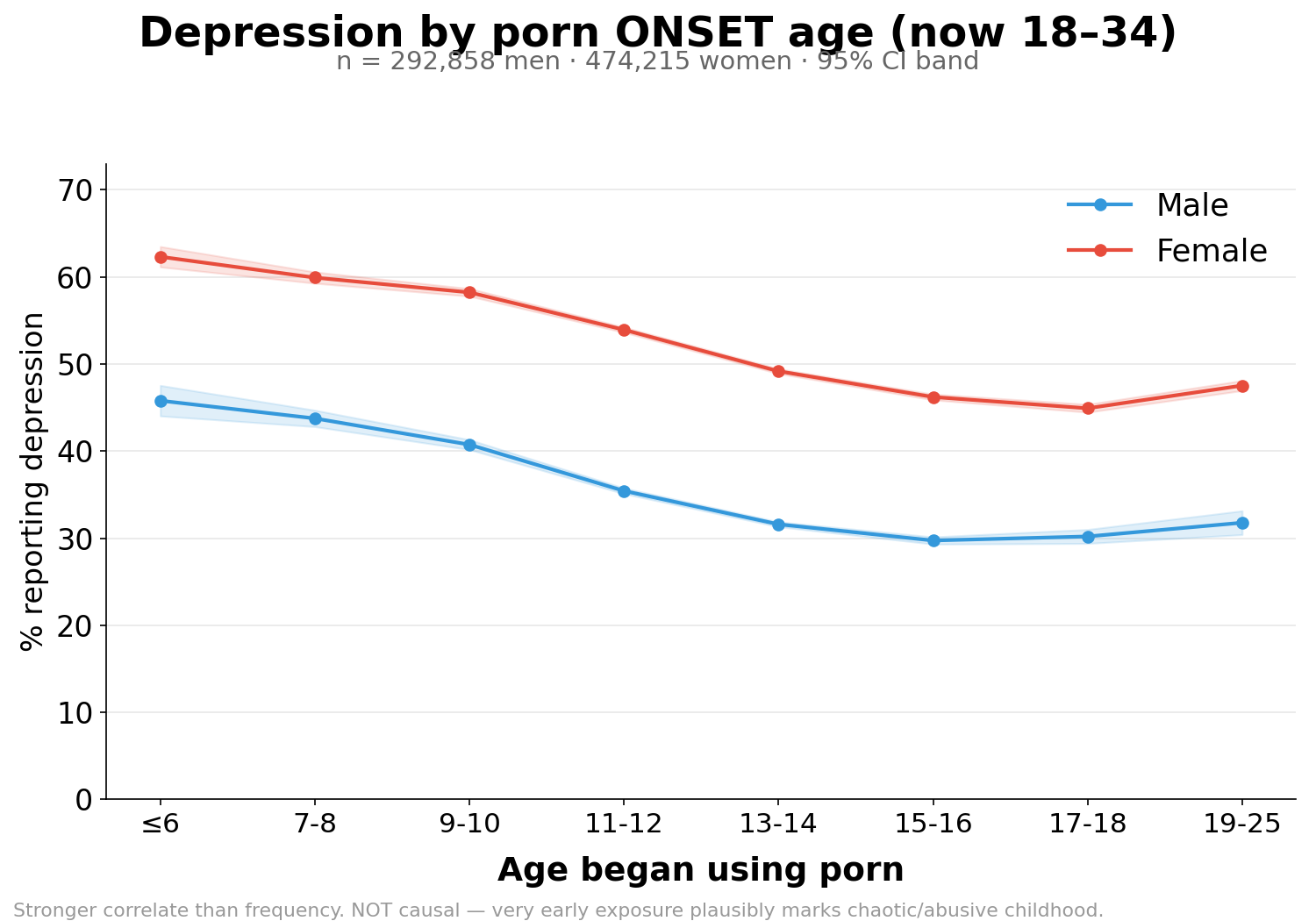
Within sex and age band, depression rises with frequency — but only by ~10 points from never to daily+, and nobody's mental health is better among non-users. The much steeper correlate is onset age.
Porn-induced fetishes
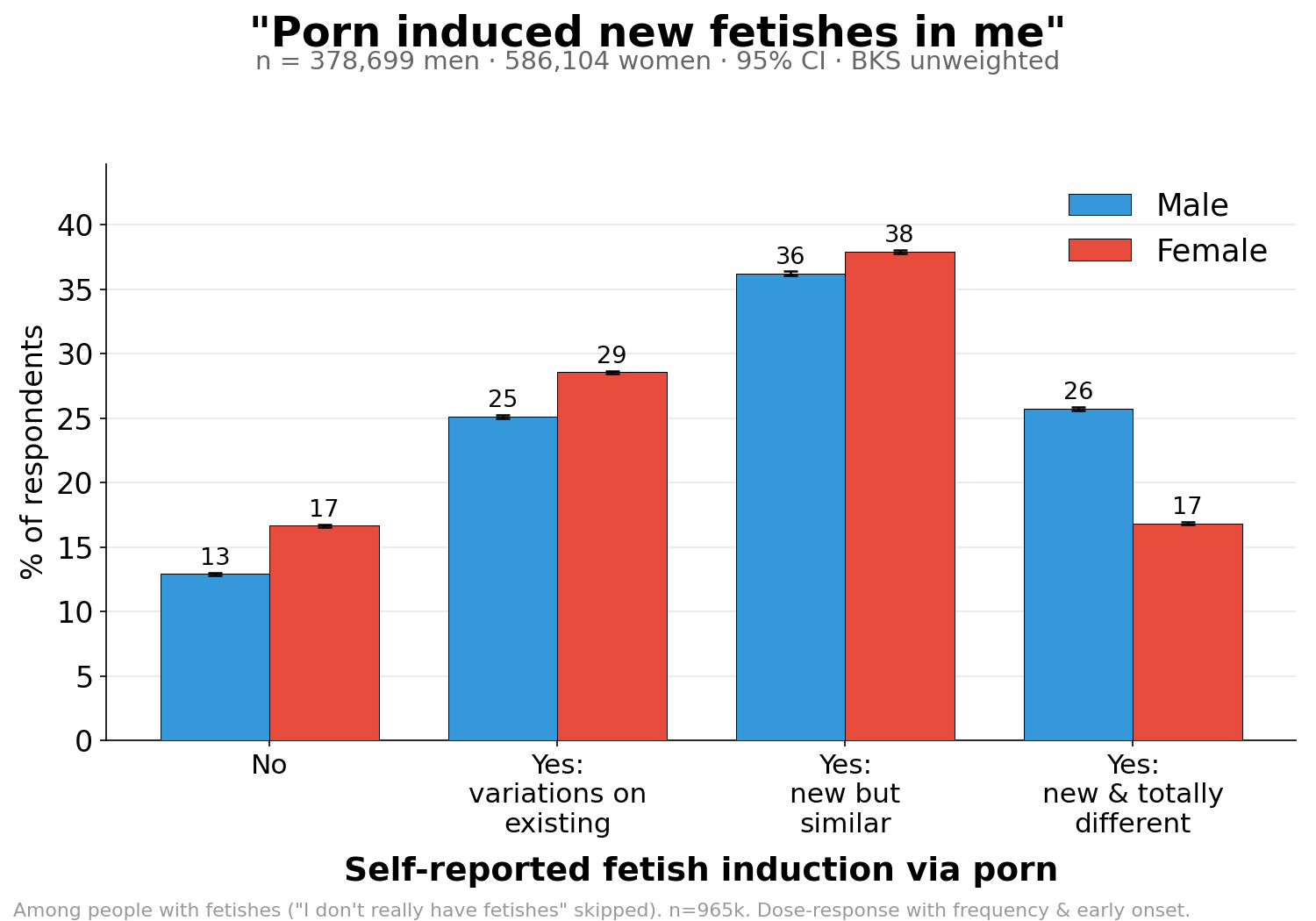
~85% of fetish-havers say porn induced new fetishes in them; a quarter of men say "new and totally different" from anything pre-existing. Dose-responsive in both frequency (93% among daily+ vs 68% among rare users) and onset (early starters report more "totally different"). Self-reported induction also tracks actual fetish counts: mean 6.2 fetishes for "no" vs 9.9 for "totally different."
Special populations
Porn performers
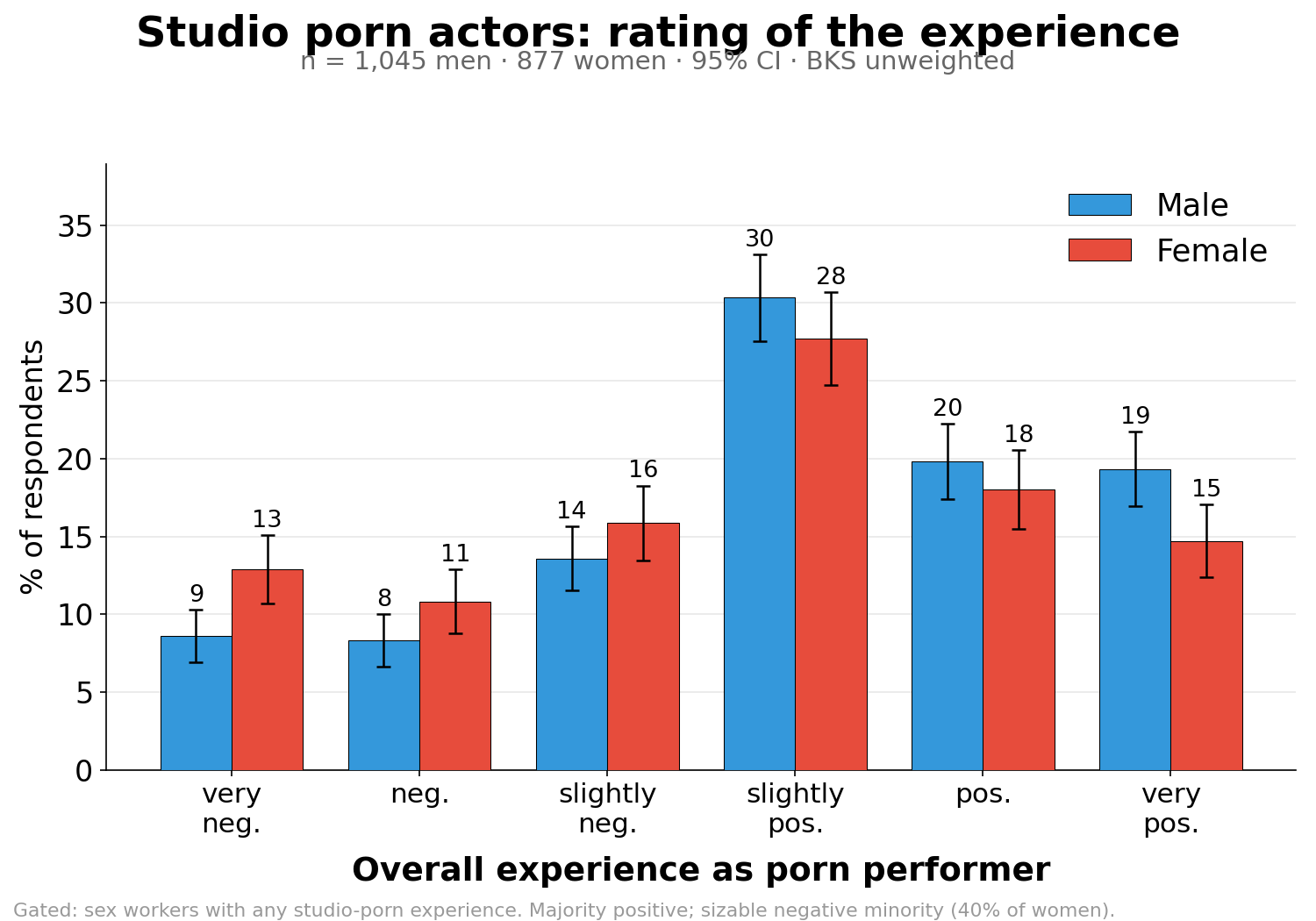
Among sex workers (n≈20k), 8–12% have studio porn-acting experience. Of those, 69% of men and 60% of women rate the experience positively — but the negative minority is real (40% of women), and performers who left the industry traumatized are plausibly underrepresented in a kink survey.
Respondents reporting pedophilic arousal (handle with extreme care, if at all)
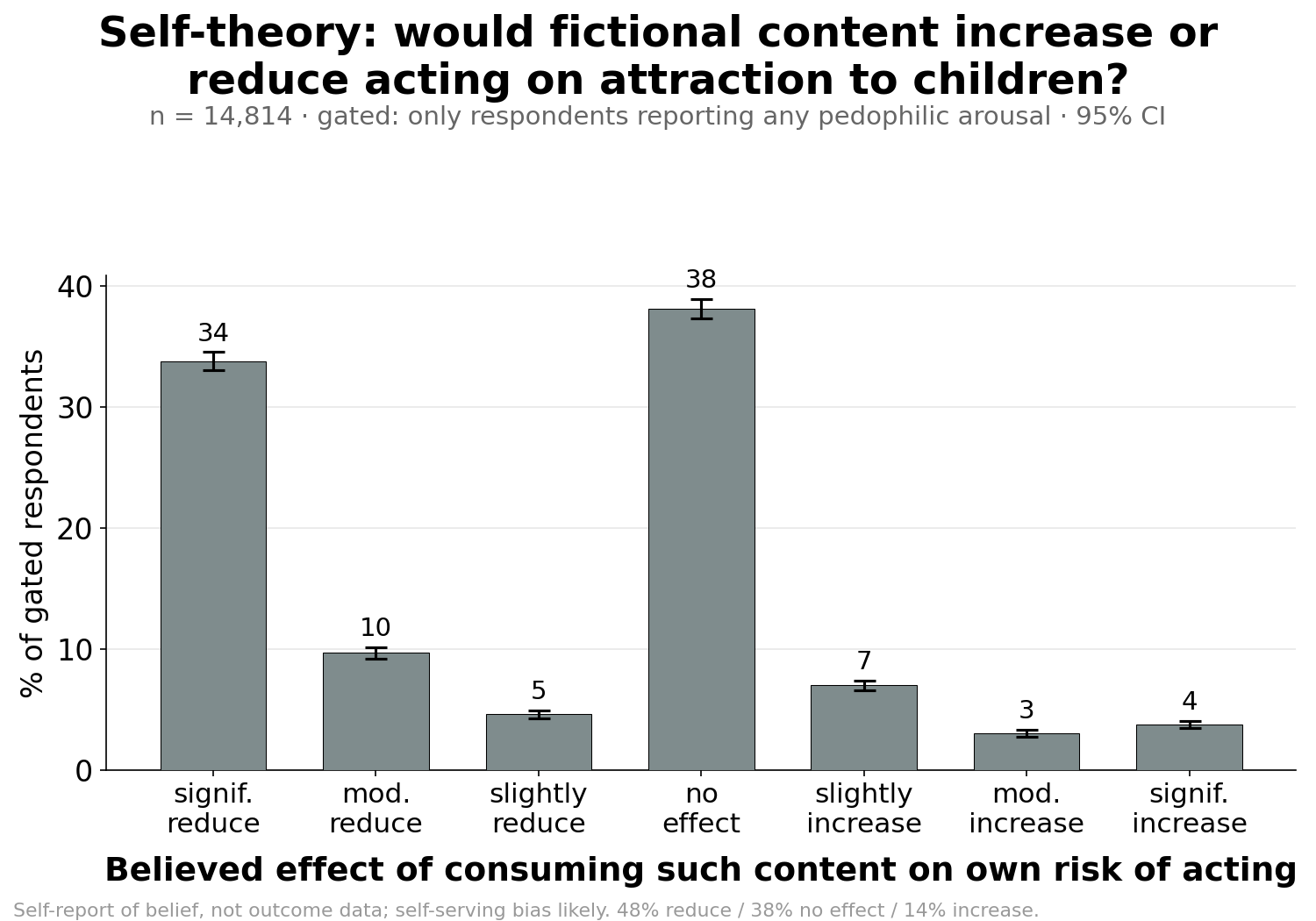
BKS gates a question to respondents reporting any arousal to prepubescent children (n≈15k): would consuming erotic content about children increase or reduce their own likelihood of acting? 48% say reduce, 38% no effect, 14% increase — sexes nearly identical.
Methodology notes
1 · Definitions drive prevalence. "Watch or read erotic content for arousal" yields 92% female use; surveys saying "pornography" (read: video) lose the 26% of women who are mostly-written consumers. Part of every male–female "gap" in the literature is a measurement artifact.
2 · Self-selection, measured. BKS is enormous, but its self-selected sample is sex-positive, very liberal, and extremely online. Raking to population demographics moves prevalence a few points (men daily+ 44→39%) and changes no qualitative conclusion — a useful empirical answer to "does your weird sample matter?" Selection plausibly matters less for correlations than for levels. The deeper selection problem is survivorship within the user pool (§4e): those who felt harmed appear to quit, so current-user samples — everyone's, not just BKS's — skew toward people porn works for.
3 · Which measure you pick changes the conclusion. The sharpest example in this dataset: childhood religion barely moves either use or shame, while current religiosity strongly predicts both (less use, far more shame). Use the raised-in variable and you'd report a null on moral incongruence; use the current-devoutness variable and you confirm it. Same caution applies to self-report quirks worth flagging — never-users reporting shame about use; "therapeutic" and "shameful" co-endorsed by the same people; the rare-user shame spike — single items hide motive structure.
4 · "Adolescent peak" conflates onset with use. Onset peaks at 11–14 and is converging across sexes by cohort; frequency peaks at 26–34 for men and is flat for women. The pleasure→coping framing looks shaky too: therapeutic-framing rises with frequency and mental-illness load while use-shame falls — heavy adult users look more like comfortable copers than escalating addicts.
Common questions about pornography use
Appendix · Weighted results
Frame: ages 14–34, Western countries, n=481,560 (Kish effective n≈160k). Raking: sex×age×cis/trans×BMI×politics×ethnicity. The unweighted columns are recomputed on the same frame (weights off), so differences show the pure effect of weighting; they can differ slightly from main-report numbers computed on the full 14–60 sample. Weighted CIs use Kish effective-n. Because raking includes sex×age, weighted numbers are inherently age-adjusted.
Not weightable from this extract: diagnosis count, self-rated attractiveness, autism/shyness (§5f confounder analysis), performer ratings, fetish counts, and anything 35+ (the male sex-life age-flip, the 45–60 onset cohort tail).
T1 · Headline use rates (ages 14–34)
Weighting rakes sex×age to population, so weighted numbers are inherently age-adjusted.
| metric | M unweighted | M weighted | F unweighted | F weighted |
|---|---|---|---|---|
| % never | 5.8 | 6.3 ±0.2 | 9.7 | 11.5 ±0.2 |
| % weekly+ | 83.7 | 82.1 ±0.3 | 60.1 | 55.7 ±0.4 |
| % daily+ | 42.2 | 39.2 ±0.3 | 18.4 | 17.1 ±0.3 |
| % multiple/day | 17.1 | 15.3 ±0.2 | 6.7 | 6.0 ±0.2 |
T1b · Base rates by age bin
Within-bin rates remove the M/F age-composition difference entirely.
| metric | M unweighted | M weighted | F unweighted | F weighted |
|---|---|---|---|---|
| % daily+ · age 14-17 | 41.2 | 35.6 ±0.7 | 21.5 | 19.8 ±0.5 |
| % daily+ · age 18-21 | 37.4 | 35.5 ±0.5 | 16.6 | 16.2 ±0.3 |
| % daily+ · age 22-25 | 44.2 | 40.2 ±0.6 | 17.6 | 15.6 ±0.5 |
| % daily+ · age 26-29 | 46.2 | 42.5 ±0.8 | 18.2 | 16.9 ±0.7 |
| % daily+ · age 30-34 | 46.9 | 42.3 ±0.9 | 18.6 | 16.9 ±0.9 |
| % never · age 14-17 | 8.0 | 10.1 ±0.4 | 10.9 | 13.7 ±0.4 |
| % never · age 18-21 | 8.4 | 9.2 ±0.3 | 13.3 | 14.6 ±0.3 |
| % never · age 22-25 | 4.2 | 5.3 ±0.3 | 7.8 | 10.5 ±0.4 |
| % never · age 26-29 | 2.9 | 3.9 ±0.3 | 5.9 | 8.8 ±0.6 |
| % never · age 30-34 | 2.1 | 2.9 ±0.3 | 5.7 | 9.8 ±0.7 |
T2 · Onset
Cohort gradient is truncated here (frame caps at 34; the 45-60 cohort lives only in the unweighted full sample).
| metric | M unweighted | M weighted | F unweighted | F weighted |
|---|---|---|---|---|
| % of users started by 12 | 44.7 | 43.9 ±0.3 | 40.1 | 34.1 ±0.4 |
| % of users started by 14 | 80.8 | 79.7 ±0.3 | 66.3 | 58.0 ±0.4 |
| mean onset age (binned) | 12.23 | 12.32 ±0.0 | 13.16 | 14.05 ±0.0 |
| mean masturbation onset (fapage) | 11.72 | 11.77 ±0.0 | 11.93 | 12.38 ±0.0 |
| cohort: % started by 14 · now 14-17 | 91.5 | 91.8 ±0.4 | 88.3 | 87.2 ±0.4 |
| cohort: % started by 14 · now 18-21 | 81.7 | 81.9 ±0.4 | 70.7 | 69.8 ±0.5 |
| cohort: % started by 14 · now 22-25 | 78.1 | 78.0 ±0.6 | 58.6 | 53.4 ±0.7 |
| cohort: % started by 14 · now 26-29 | 76.7 | 76.0 ±0.7 | 49.7 | 43.7 ±1.0 |
| cohort: % started by 14 · now 30-34 | 71.0 | 70.7 ±0.9 | 42.2 | 34.4 ±1.2 |
| % NOW daily+ · started ≤10 (18-34) | 57.6 | 54.7 ±1.1 | 28.8 | 27.0 ±1.1 |
| % NOW daily+ · started 15-16 (18-34) | 37.3 | 34.9 ±0.9 | 15.7 | 16.6 ±0.8 |
T3 · Content type & payment (ages 14–34)
| metric | M unweighted | M weighted | F unweighted | F weighted |
|---|---|---|---|---|
| % mostly/entirely WRITTEN (users) | 4.4 | 3.0 ±0.1 | 26.6 | 25.0 ±0.3 |
| % mostly/entirely animated (users) | 16.8 | 11.2 ±0.2 | 20.3 | 17.2 ±0.3 |
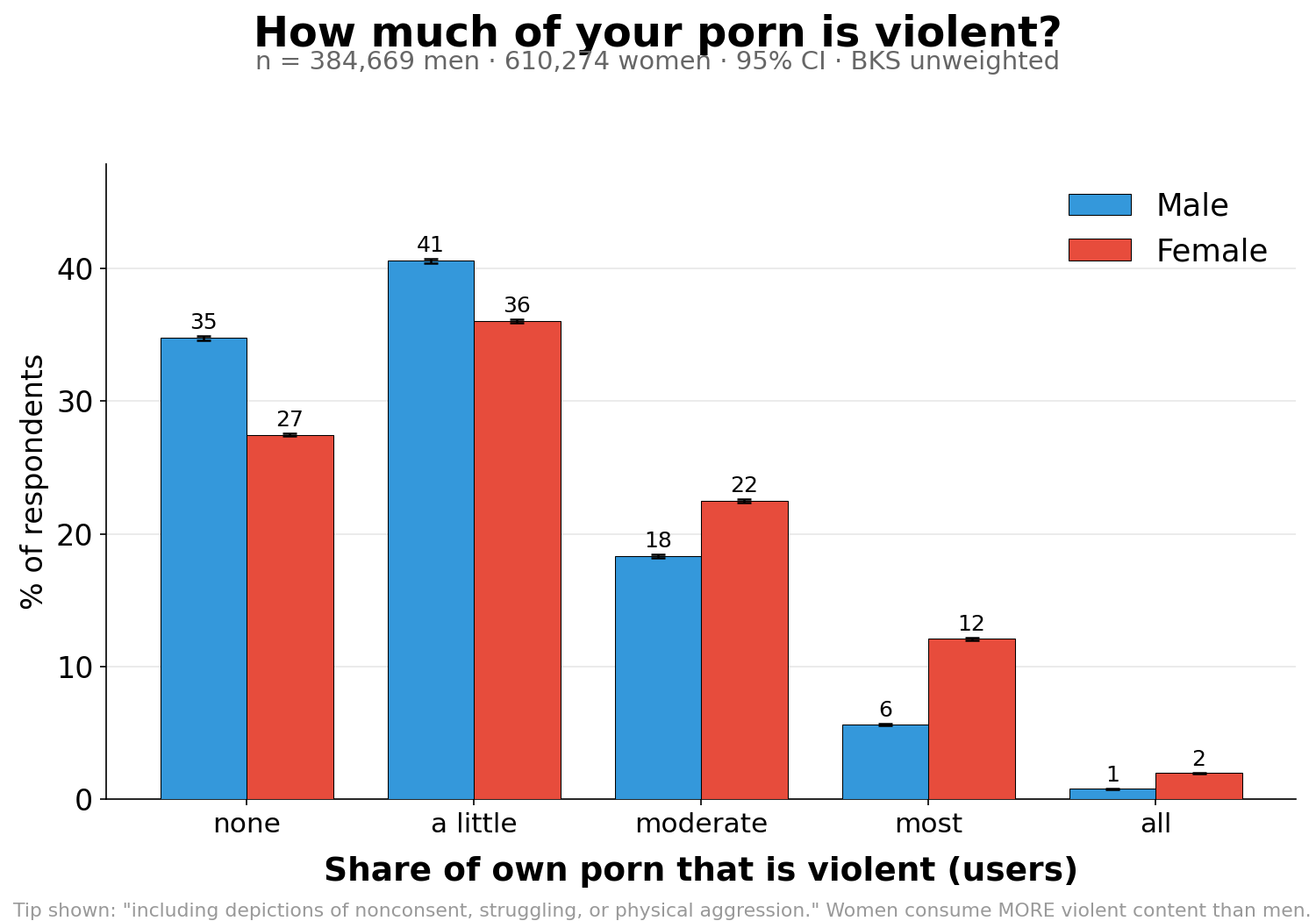
| % violent porn moderate+ (users) | 22.5 | 20.2 ±0.3 | 34.9 | 33.2 ±0.4 |
| % violent porn most/all (users) | 5.6 | 4.7 ±0.1 | 13.3 | 12.2 ±0.3 |
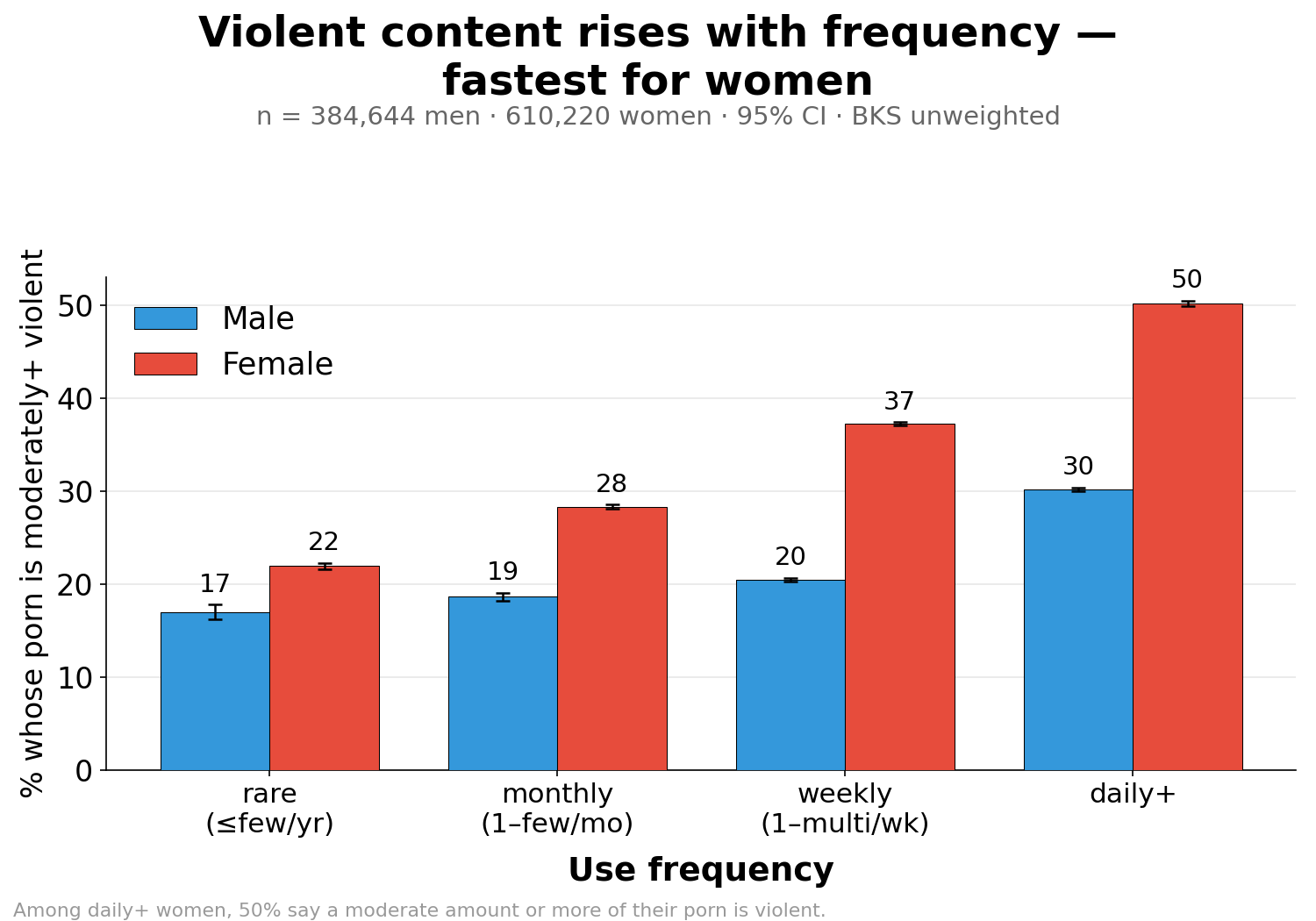
| % violent mod+ among DAILY+ users | 28.2 | 25.7 ±0.5 | 49.1 | 47.9 ±0.8 |
| % agree opposite-gender pairing erotic | 75.0 | 80.1 ±0.3 | 53.1 | 47.0 ±0.4 |
| % ever paid for porn | 33.5 | 34.2 ±0.3 | 12.8 | 10.9 ±0.2 |
T4 · Shame (NEW item; ages 18–34)
New-item cells are small in the weighted frame (total n≈8.4k split by sex × group) — expect wide CIs.
| metric | M unweighted | M weighted | F unweighted | F weighted |
|---|---|---|---|---|
| % mod+ shame (all respondents) | 31.2 | 30.4 ±2.5 | 26.8 | 26.2 ±3.6 |
| % mod+ shame · QUIT group | 39.5 | 38.4 ±9.6 | 19.4 | 18.1 ±12.1 |
| % mod+ shame · rare users (1-3) | 49.4 | 40.5 ±15.4 | 37.9 | 40.7 ±12.6 |
| % mod+ shame · daily+ users | 28.9 | 28.4 ±4.1 | 24.2 | 23.3 ±9.3 |
| % mod+ shame · users, not religious | 25.0 | 23.9 ±3.4 | 23.9 | 21.6 ±4.7 |
| % mod+ shame · users, very devout | 69.4 | 66.4 ±10.0 | 52.8 | 54.3 ±16.5 |
| % mod+ shame · users, sig-liberal | 27.0 | 24.1 ±3.6 | 24.8 | 24.0 ±3.4 |
| % mod+ shame · users, mod/sig-conservative | 37.2 | 34.1 ±5.6 | 37.0 | 41.4 ±11.2 |
T5 · Healing/therapeutic (NEW; 18–34)
Mental-illness-count gradient can't be weighted (TotalMentalIllness not in weighted extract).
| metric | M unweighted | M weighted | F unweighted | F weighted |
|---|---|---|---|---|
| % at least 'a little' healing (viewers) | 46.6 | 47.3 ±2.9 | 54.0 | 52.1 ±4.4 |
| % moderate+ healing (viewers) | 12.0 | 11.8 ±1.8 | 15.5 | 12.7 ±2.9 |
| % mod+ healing · daily+ users | 18.2 | 17.4 ±3.5 | 31.9 | 23.3 ±9.4 |
| % mod+ healing · rare users (1-3) | 5.1 | 8.6 ±9.2 | 5.2 | 2.7 ±4.4 |
T6 · Sex-life impact, net = %improved − %damaged (NEW; 18–34)
The 35+ male flip to positive is OUTSIDE this frame (caps at 34). Bodycount capped at 10+ here (older high-count people excluded by frame).
| metric | M unweighted | M weighted | F unweighted | F weighted |
|---|---|---|---|---|
| net sexlife (all answering) | -13.0 | -18.1 ±4.1 | +19.2 | +18.5 ±5.9 |
| net · rare 1-3 | -20.0 | -15.8 ±23.0 | +15.6 | +13.2 ±16.3 |
| net · weekly 6-7 | -11.7 | -17.9 ±6.3 | +23.6 | +23.1 ±8.4 |
| net · daily+ 8-9 | -10.7 | -15.8 ±7.2 | +29.0 | +32.6 ±16.1 |
| net · QUIT group | -24.6 | -29.7 ±12.8 | -9.4 | -2.9 ±19.7 |
| net · bodycount 0 | -16.3 | -22.5 ±7.0 | +4.6 | +4.5 ±9.1 |
| net · bodycount 1 | -12.9 | -17.4 ±8.0 | +24.5 | +18.0 ±14.5 |
| net · bodycount 2-3 | -11.0 | -14.4 ±9.1 | +21.5 | +19.1 ±12.7 |
| net · bodycount 4-9 | -15.9 | -24.3 ±9.8 | +21.8 | +18.9 ±13.1 |
| net · bodycount 10+ | -7.3 | -13.1 ±11.4 | +26.0 | +27.2 ±13.0 |
T7 · 'Porn more satisfying than real sex' (NEW; 18–34)
| metric | M unweighted | M weighted | F unweighted | F weighted |
|---|---|---|---|---|
| % agree porn > real sex | 14.3 | 12.2 ±1.7 | 21.0 | 20.1 ±3.0 |
| % agree · daily+ users | 21.2 | 18.3 ±3.3 | 36.9 | 32.3 ±9.5 |
| % agree · single | 15.0 | 12.7 ±2.9 | 27.4 | 21.8 ±5.4 |
| % agree · serious relationship | 12.9 | 11.9 ±2.4 | 16.6 | 18.4 ±4.2 |
T8 · Dating, drive, horniness (18–34)
Hookup rows: women-only item, value shown in the M columns. Attractiveness/autism/shyness confounder analysis can't be weighted (cols not in extract).
| metric | M unweighted | M weighted | F unweighted | F weighted |
|---|---|---|---|---|
| % quite/very horny now · never-users | 36.5 | 40.9 ±2.3 | 29.1 | 31.8 ±2.3 |
| % quite/very horny now · daily+ | 53.4 | 56.8 ±1.2 | 53.8 | 57.9 ±2.6 |
| % high real-sex motivation · never-users | 41.7 | 45.9 ±7.0 | 34.9 | 33.8 ±7.9 |
| % high real-sex motivation · daily+ | 50.6 | 57.8 ±3.5 | 45.2 | 42.6 ±8.3 |
| % bad at dating · never | 40.5 | 41.7 ±6.9 | 33.2 | 35.2 ±8.0 |
| % bad at dating · weekly | 48.2 | 42.5 ±3.4 | 43.8 | 38.6 ±5.0 |
| % bad at dating · daily+ | 57.6 | 51.5 ±3.5 | 51.6 | 41.9 ±8.3 |
| % bad at dating · SINGLE daily+ | 71.7 | 69.6 ±4.4 | 65.1 | 50.4 ±11.3 |
| % bad at dating · SINGLE never/rare-mo (0-5) | 55.7 | 54.1 ±8.5 | 53.5 | 49.1 ±8.3 |
| % bad at dating · PARTNERED daily+ | 39.7 | 33.9 ±6.1 | 35.4 | 30.7 ±14.1 |
| % bad at dating · PARTNERED never/rare-mo | 31.0 | 25.9 ±5.5 | 27.9 | 23.2 ±5.8 |
| % bad at dating · bodycount 0, not-weekly (0-5) | 53.9 | 55.9 ±8.9 | 55.5 | 58.2 ±8.1 |
| % bad at dating · bodycount 0, daily+ | 79.0 | 78.2 ±5.0 | 63.1 | 52.4 ±11.3 |
| % bad at dating · bodycount 10+, not-weekly (0-5) | 23.4 | 15.4 ±10.0 | 26.9 | 21.7 ±9.3 |
| % bad at dating · bodycount 10+, daily+ | 30.7 | 23.8 ±7.4 | 42.2 | 33.5 ±17.6 |
| women: % hookups GOOD · never-users | 32.2 | 30.7 ±2.8 | — | — |
| women: % hookups GOOD · daily+ | 45.4 | 44.3 ±2.5 | — | — |
T9 · Substitution cluster (18–34)
| metric | M unweighted | M weighted | F unweighted | F weighted |
|---|---|---|---|---|
| % bad at dating · agree porn>sex | 48.5 | 44.3 ±6.7 | 44.9 | 41.9 ±7.9 |
| % bad at dating · disagree | 39.5 | 35.1 ±2.8 | 32.1 | 28.4 ±4.1 |
| % low sex-drive · agree porn>sex | 25.8 | 17.6 ±5.1 | 32.4 | 28.6 ±7.2 |
| % low sex-drive · disagree | 20.3 | 16.3 ±2.1 | 25.9 | 29.5 ±4.2 |
| % single · agree porn>sex | 36.1 | 32.5 ±6.3 | 43.7 | 32.6 ±7.5 |
| % single · disagree | 33.3 | 29.4 ±2.6 | 29.4 | 28.4 ±4.1 |
T10 · Mental health (self-reported mod-severe)
Diagnosis-count (TotalMentalIllness) not in weighted extract; binary has_* used.
| metric | M unweighted | M weighted | F unweighted | F weighted |
|---|---|---|---|---|
| % depression · never-users (18-24) | 23.2 | 21.6 ±1.3 | 39.5 | 38.3 ±1.2 |
| % depression · daily+ (18-24) | 33.6 | 29.2 ±0.7 | 56.1 | 52.2 ±1.1 |
| % depression · never-users (25-34) | 28.9 | 24.1 ±2.6 | 45.4 | 40.0 ±2.4 |
| % depression · daily+ (25-34) | 38.6 | 30.9 ±0.8 | 61.1 | 52.4 ±1.7 |
| % anxiety · never-users (18-34) | 29.2 | 25.9 ±1.3 | 56.6 | 54.5 ±1.3 |
| % anxiety · daily+ (18-34) | 34.4 | 28.8 ±0.5 | 65.2 | 61.1 ±1.0 |
| % depression · porn onset ≤10 (18-34) | 40.7 | 35.2 ±1.0 | 59.7 | 55.6 ±1.2 |
| % depression · porn onset 13-14 (18-34) | 29.9 | 24.5 ±0.6 | 50.2 | 46.4 ±0.9 |
| % depression · porn onset 15+ (18-34) | 28.3 | 23.2 ±0.7 | 47.2 | 42.6 ±0.7 |
T11 · Porn-induced fetishes (14–34)
| metric | M unweighted | M weighted | F unweighted | F weighted |
|---|---|---|---|---|
| % any porn-induced fetish | 86.2 | 85.5 ±0.2 | 82.1 | 80.0 ±0.3 |
| % 'new & totally different' | 24.7 | 23.5 ±0.3 | 16.2 | 15.8 ±0.3 |
| % any induced · daily+ (18-34) | 92.7 | 92.5 ±0.3 | 93.2 | 92.5 ±0.6 |
| % any induced · rare 1-3 (18-34) | 68.5 | 69.8 ±2.5 | 66.0 | 65.6 ±1.6 |
T12 · Content-as-risk belief (gated: pedophilic-arousal reporters; 14–34)
| metric | M unweighted | M weighted | F unweighted | F weighted |
|---|---|---|---|---|
| % says REDUCE | 49.3 | 49.5 ±2.2 | 46.1 | 47.8 ±5.0 |
| % no effect | 36.8 | 36.6 ±2.1 | 41.3 | 37.8 ±4.9 |
| % says increase | 13.9 | 13.9 ±1.5 | 12.7 | 14.4 ±3.5 |
T13 · Quit group vs daily+ (18–34)
Quit cells are ~100-200 raw / fewer effective — treat weighted values as directional only.
| metric | M unweighted | M weighted | F unweighted | F weighted |
|---|---|---|---|---|
| sexlife net · QUIT | -24.6 | -29.7 ±12.8 | -9.4 | -2.9 ±19.7 |
| sexlife net · daily+ | -10.7 | -15.8 ±7.2 | +29.0 | +32.6 ±16.1 |
| % depression · QUIT | 22.1 | 22.7 ±8.3 | 45.0 | 41.5 ±15.5 |
| % depression · daily+ | 35.8 | 30.2 ±0.5 | 58.1 | 52.4 ±1.0 |
| % bad at dating · QUIT | 40.0 | 42.5 ±9.8 | 30.0 | 32.4 ±14.7 |
| % bad at dating · daily+ | 57.6 | 51.5 ±3.5 | 51.6 | 41.9 ±8.3 |
T14 · Age-standardized male base rates (full sample 14–60, unweighted)
Male rates re-weighted to the FEMALE age distribution (men are ~2y older; use rises with age, so crude male rates are slightly inflated).
| metric | M crude | M age-std to F dist | F crude | |
|---|---|---|---|---|
| % never | 4.6 | 5.2 | 8.3 | (standard) |
| % weekly+ | 85.2 | 84.4 | 62.0 | (standard) |
| % daily+ | 44.0 | 43.3 | 19.2 | (standard) |