TL;DRFive headlines
- The repression→kink theory basically fails. A purity upbringing predicts adult BDSM arousal at β≈0.03 standard deviations — detectable at this sample size, invisible in a human life. The twist: the entire (small) effect lives in people who left the religion; among stayers the slope is flat zero.
- Purity culture works — at keeping people in. Within every major childhood religion, higher-purity upbringings produce fewer apostates (odds of leaving fall ~26% per SD of purity). In this very secular sample, the "strict religion drives kids away" story is the opposite of what the data shows.
- But the leavers it does produce look bruised. High-purity-raised people who left their religion are the worst-off group in the survey: lowest wellbeing, low self-love, the most partners, the least monogamy, the most childhood "at war with yourself" — worse than secular-raised people on every one of those.
- The inner war isn't about sex rules. Mutually adjusted, the purity items that predict feeling "at war with yourself in trying to be a good person" are obedience-as-virtue, evolution-was-a-lie, and women-as-housewives — the authority and ideology items, not porn blocking or church attendance.
- Keep the effect sizes honest. The whole 14-item battery explains 7.5% of the inner-war item, ~3% of adult wellbeing, and under 1% of kink or partner count. General childhood quality explains several times more of the wellbeing outcomes.
THE MEASURESWhat was actually asked
Every childhood item was asked twice — "during ages 0–12" and "during ages 13–18" — on a 7-point agree scale (−3..+3). The purity battery, verbatim:
| Item | Question text (as written, ages 0–12 / 13–18) | % agree* |
|---|---|---|
| purity1 | taught a purity culture that encouraged abstinance [sic] / waiting until marriage | 43% |
| purity2 | you were required to participate in religious customs (e.g., church attendance) | 60% |
| purity3 | taught evolution was a lie | 18% |
| purity4 | your parents attempted to prevent you accessing porn or erotica | 50% |
| purity5 | obedience was a virtue | 75% |
| purity6 | women's ideal role viewed as housewives | 36% |
| purity7 | parents monitored/restricted your media intake to wholesome stuff; nothing disturbing or obscene | 51% |
*agree (>0) in either age window, full sample.
The purity score used throughout is the survey's own composite: the mean of all 14 ratings (7 items × 2 age windows), range −3..+3, Cronbach's α = .87, available for 36,932 respondents. Sample mean −0.47 — this crowd skews secular.
Religion comes in two parts: childhood religion ("What religion did you grow up in?") and current practice ("Do you currently actively practice a religion?", No / slightly / moderately / very seriously). Apostate = grew up in a religion, currently practices none.
Two data repairs worth knowing about. (1) The survey software never recorded the answer "None" to the childhood-religion question — 12,253 secular-raised respondents were invisible in the raw export and were reconstructed (they answered the current-religion question but have no childhood religion saved). (2) The top answer of the BDSM question was saved to a typo'd variable (vdsm); the 7,391 "Extremely" responses are merged back in here. Earlier cuts of this dataset lack both fixes.
WHO GETS ITPurity by childhood religion
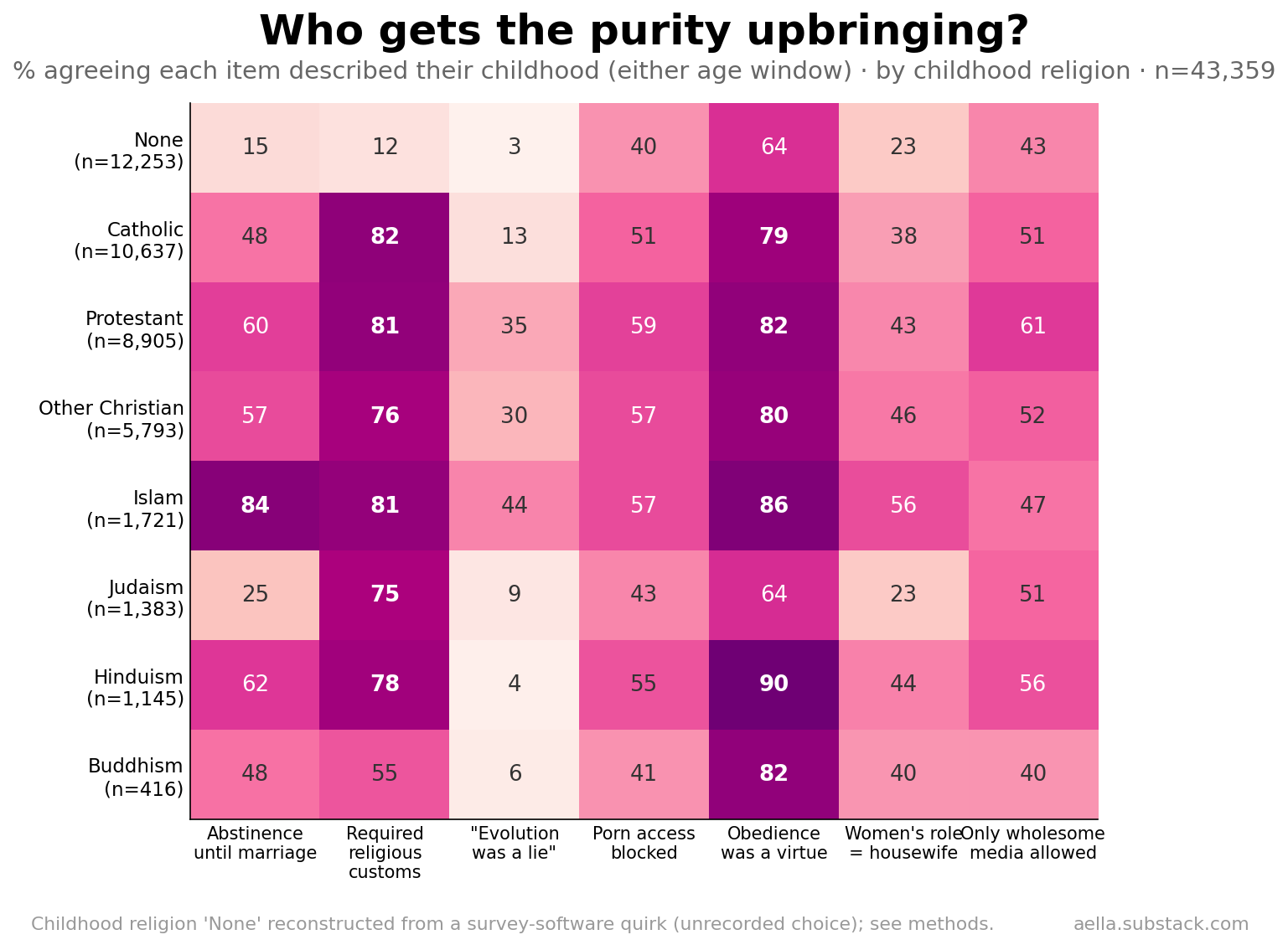
The battery behaves sensibly, which is itself a validity check. Evolution-denial is rare outside Protestant/other-Christian and Muslim homes (35%, 30%, 44%) and nearly absent in Jewish (9%) and Hindu (4%) ones. Islam tops abstinence teaching at 84%. Judaism pairs high religious-custom requirements (75%) with low purity content everywhere else — required observance without the sexual-purity package. And the secular-raised aren't at zero: 40% had porn blocked, 64% were raised with obedience-as-virtue. Purity score by childhood religion: Islam +0.54 > Protestant +0.17 > Hinduism ≈ other Christian ≈ 0 > Catholic −0.33 > Buddhism −0.60 > Judaism −0.76 > none −1.43.
By sex, the items are close to symmetric (girls got slightly more abstinence teaching, 47% vs 40%, and evolution-denial; boys got slightly more porn-blocking and media restriction, consistent with parents aiming the censorship where they expected the porn).
THE GRADIENTPurity → adult sexuality and wellbeing
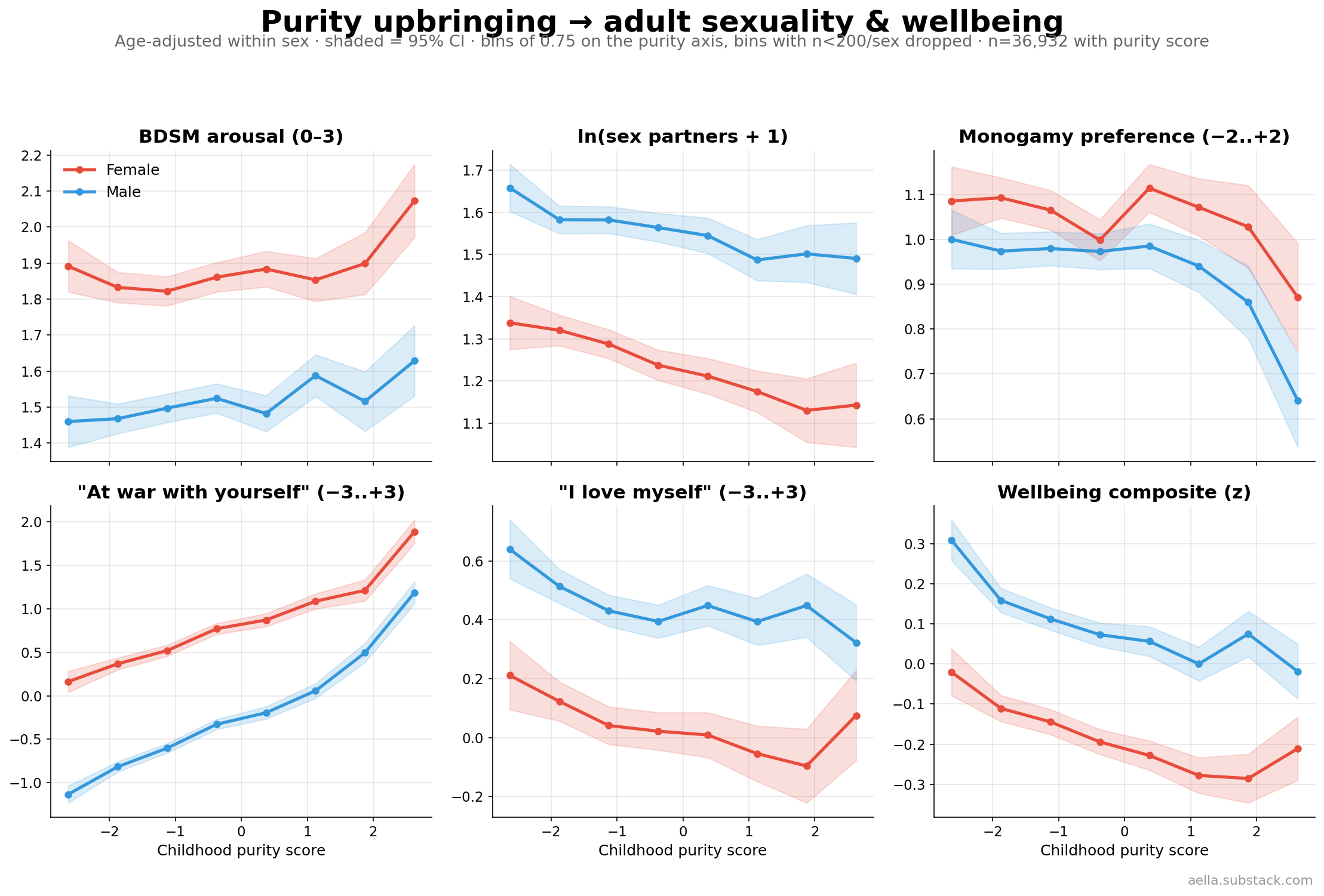
Reading the six panels (age-adjusted within sex; the regression table below adds further controls):
- BDSM arousal: nearly flat, with a small uptick at the very purest upbringings. Hold that thought for the next section.
- Partner count: declines modestly with purity (β ≈ −0.03 SD with sex+age controls; −0.04 for women). One honesty note: the raw association is slightly positive, because high-purity respondents are older; control age and it flips. Medians barely move (women 2→2, men 3→3).
- Monogamy preference: the most interesting shape on the page — flat, then falling at high purity. The purest upbringings produce, if anything, more nonmonogamous adults. In this sample, growing up with "one man, one woman, forever" does not make people want that.
- "At war with yourself": the strongest gradient in the survey for this battery — β = +0.21 SD per SD of purity (sex+age controlled), a clean dose-response across the entire range, slightly steeper for men.
- Self-love and wellbeing: small, steady negative slopes (β ≈ −0.03 and −0.06). Both steepen when current religiosity is controlled — i.e., among the equally-secular-now, a purer past looks a bit worse.
| Outcome | raw β | + sex, age | + current religiosity | women only | men only |
|---|---|---|---|---|---|
| BDSM arousal | +.022 | +.029 | +.038 | +.027 | +.032 |
| ln partners | +.025 | −.032 | −.019 | −.041 | −.025 |
| Monogamy pref | −.044 | −.028 | −.048 | −.018 | −.035 |
| "At war with yourself" | +.194 | +.214 | +.219 | +.189 | +.245 |
| Self-love | −.005 | −.027 | −.045 | −.033 | −.022 |
| Wellbeing composite | −.038 | −.064 | −.082 | −.069 | −.062 |
Standardized β per SD of purity score; sex-specific models control age; all |β|≥.018 have p<.05, most p<10⁻⁵. n = 23,198 (BDSM) to 36,932.
THE TESTDoes repression breed kink?
The folk theory writes itself: forbid sex hard enough and it comes back wearing leather. This survey is unusually well-placed to test it — a real purity battery, a direct BDSM-arousal question, and a sample where kink is common enough to see clearly (63% of women and 48% of men report at least moderate BDSM arousal).
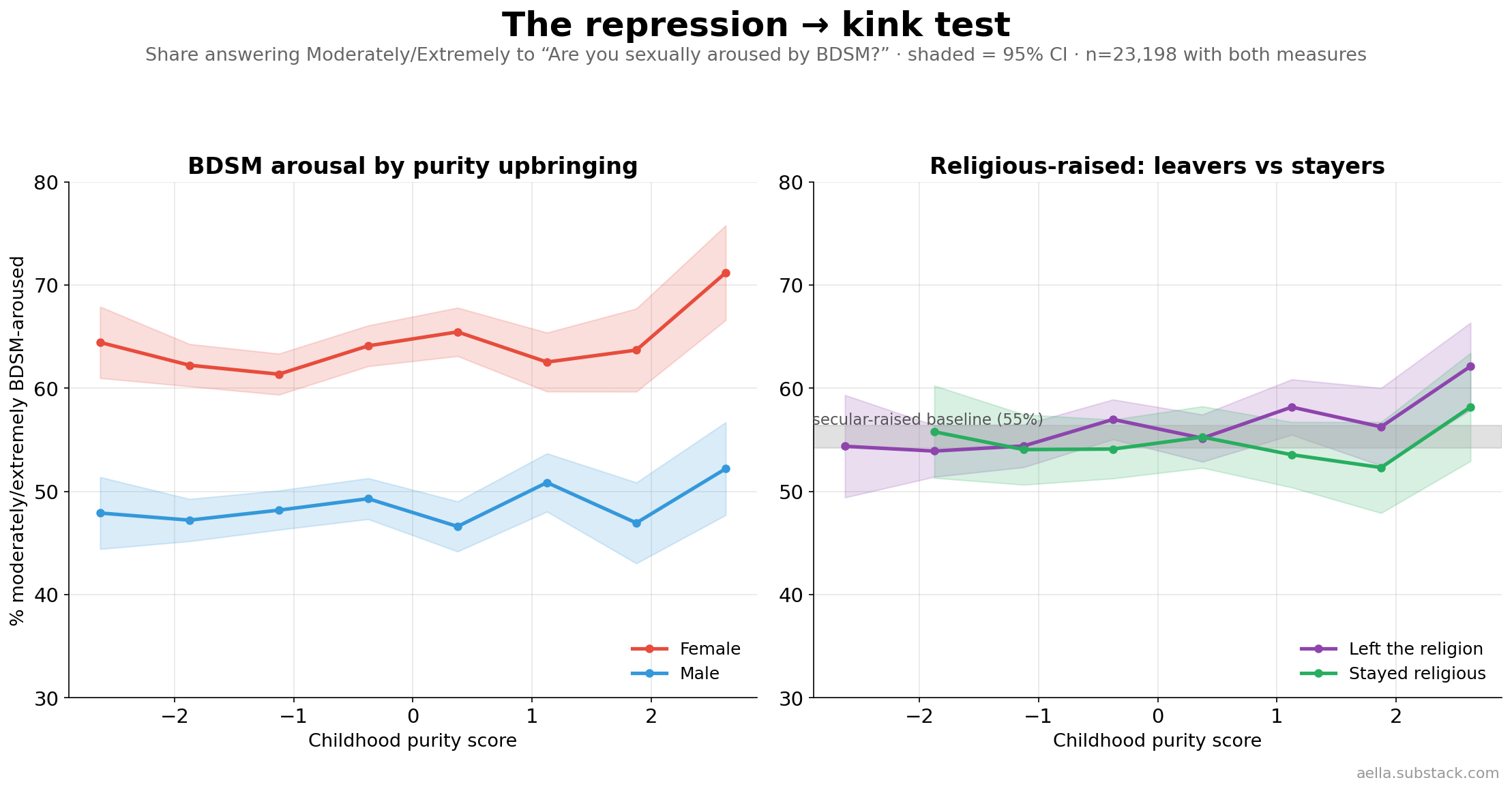
The answer is close to a null. From the least pure fifth of upbringings to the purest: women 62.8% → 66.6% moderately+ aroused, men 47.4% → 49.6%. As a standardized effect that's β = +0.02 raw, +0.03 with sex and age controls, +0.04 also holding current religiosity — "statistically significant" at n=23,198 and substantively trivial. If purity culture manufactured kinksters, a sample this kinky and this measured would show it. It shows a rounding error.
The one real wrinkle is the right panel. Split the religious-raised by whether they kept the faith: among stayers, the purity slope is exactly zero (β = −0.001); among leavers it's positive (β = +0.06 per SD; interaction p = .0007). The purest-raised leavers reach ~62% moderately+, several points above the secular-raised baseline (55%). So the honest summary: purity upbringing alone does not predict adult kink; purity upbringing followed by deconversion predicts a little extra. Whether that's repression finally uncorking, or the same rebellious streak driving both the exit and the exploration, the cross-section can't say.
APOSTASYWho leaves the childhood religion?
First, the base rate is brutal: 68% of everyone raised in a religion currently practices none (this sample is very online and very secular — read gradients, not levels). Catholics lose the most (74%), Jews and Muslims the fewest (51%, 55%).
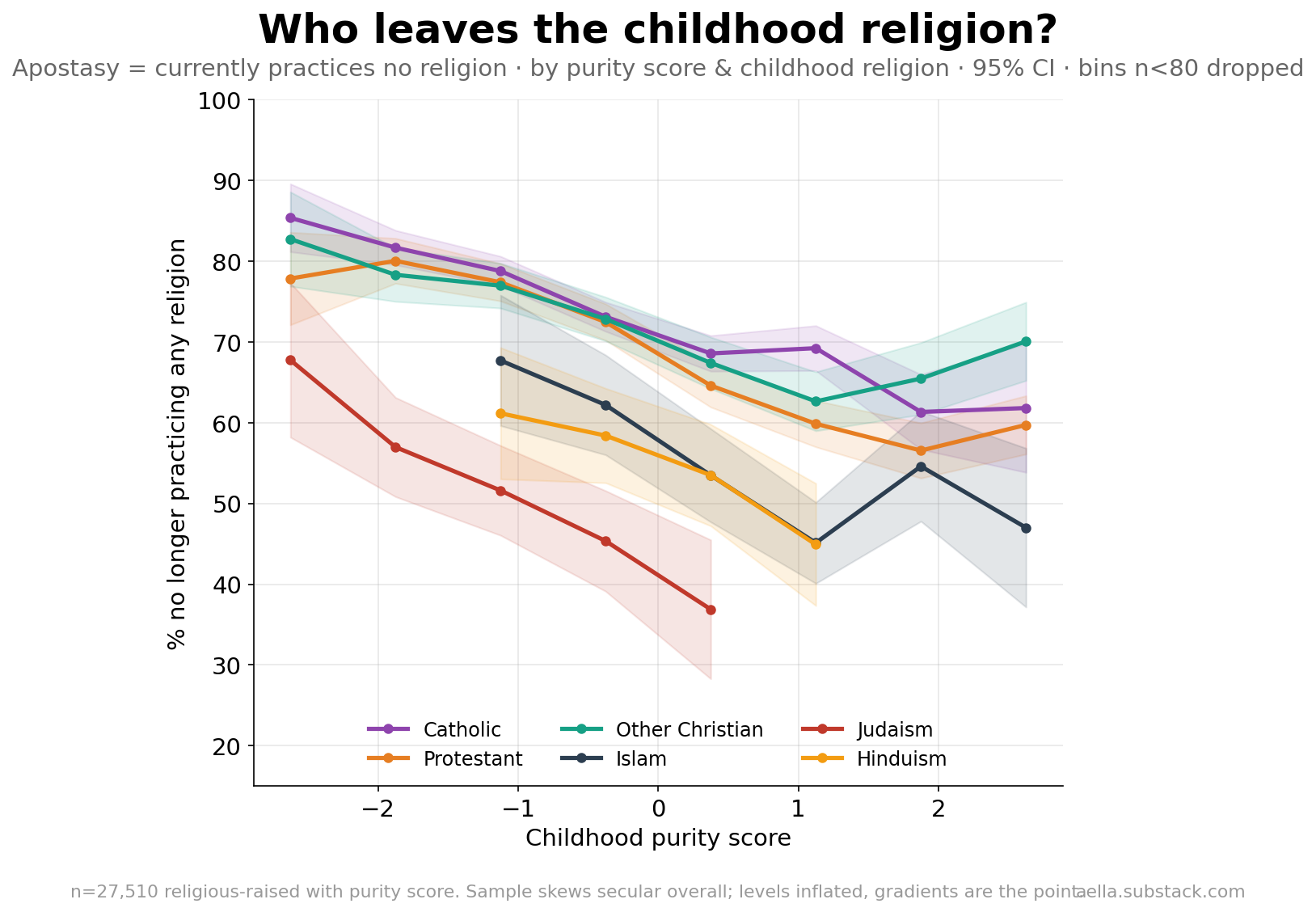
Now the surprise. You might expect strictness to backfire — purity-pressured kids fleeing hardest. Instead the slope runs down in every major tradition: low-purity upbringings lose 76% of their children; high-purity upbringings lose 61%. Per SD of purity, the odds of leaving fall 26% (OR 0.74, CI 0.72–0.76, sex and age controlled). Purity here partly proxies how seriously religious the home was, so we also controlled the survey's separate religious-adherence-importance item: purity still independently predicts staying (OR 0.85). Strict works, as retention strategy.
Hinduism is the partial exception — its curve is shallow and bumpy — and Judaism retains well at every purity level (being lowest-purity to begin with).
THE CENTERPIECEPurity-raised leavers vs stayers vs the secular-raised
Retention is the religion's outcome. What about the kids' outcomes? Split the religious-raised by purity tercile (within-group cuts at −0.79 and +0.43) and by whether they left, with the secular-raised as reference:
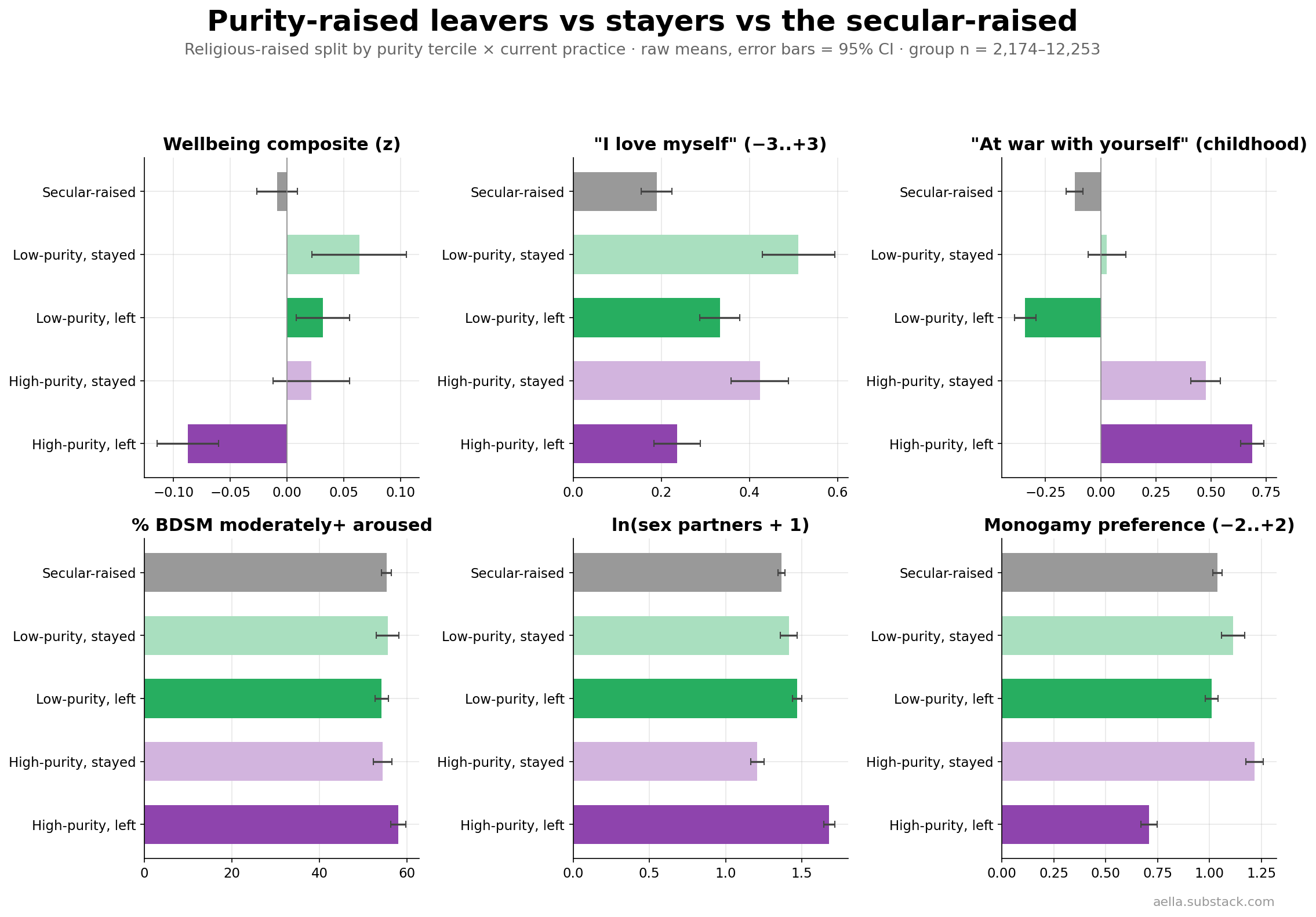
One group separates from the rest of the chart: the high-purity-raised who left (n=5,256).
- Wellbeing: the only group below the secular-raised baseline — −0.18 SD vs secular after sex and age adjustment. High-purity stayers sit at baseline; low-purity groups slightly above.
- "At war with yourself": +0.69 on the −3..+3 scale, versus +0.48 for high-purity stayers, −0.12 for the secular-raised, and −0.34 for low-purity leavers. (Remember this is a childhood-retrospective item: the war was already raging before they left — which is presumably part of why they left.)
- Sexuality: most partners (highest ln-partner-count of all five groups), least monogamy preference (0.71 vs 1.22 for high-purity stayers — a huge gap on a −2..+2 scale), and the most BDSM arousal (58% moderately+). The high-purity stayers are their mirror: fewest partners, strongest monogamy.
- Self-love: stayers of both purity levels report the most; high-purity leavers the least of the religious-raised. Oddly, the secular-raised come last overall on this one item — irreligion is no self-esteem program either.
So purity culture doesn't produce one kind of adult; it produces a fork. Those who stay look conventional and reasonably content (at the price of the highest at-war scores among stayers). Those who leave — a third of the high-purity group — carry the inner war out with them and live, statistically, the exact life the upbringing warned against: more partners, less monogamy, more kink, less faith. The data can't tell whether leaving causes the distress or distress causes the leaving; what it can say is that the casualties of purity culture are concentrated almost entirely in its exiles.
THE INNER WARWhich purity items predict it?
The survey asks whether, as a child, "you felt as though you were 'at war' with yourself in trying to be a good person." It's the battery's strongest correlate by far — so which ingredient of the purity package carries it? All seven items entered simultaneously (each the average of its two age windows), plus age, within sex:
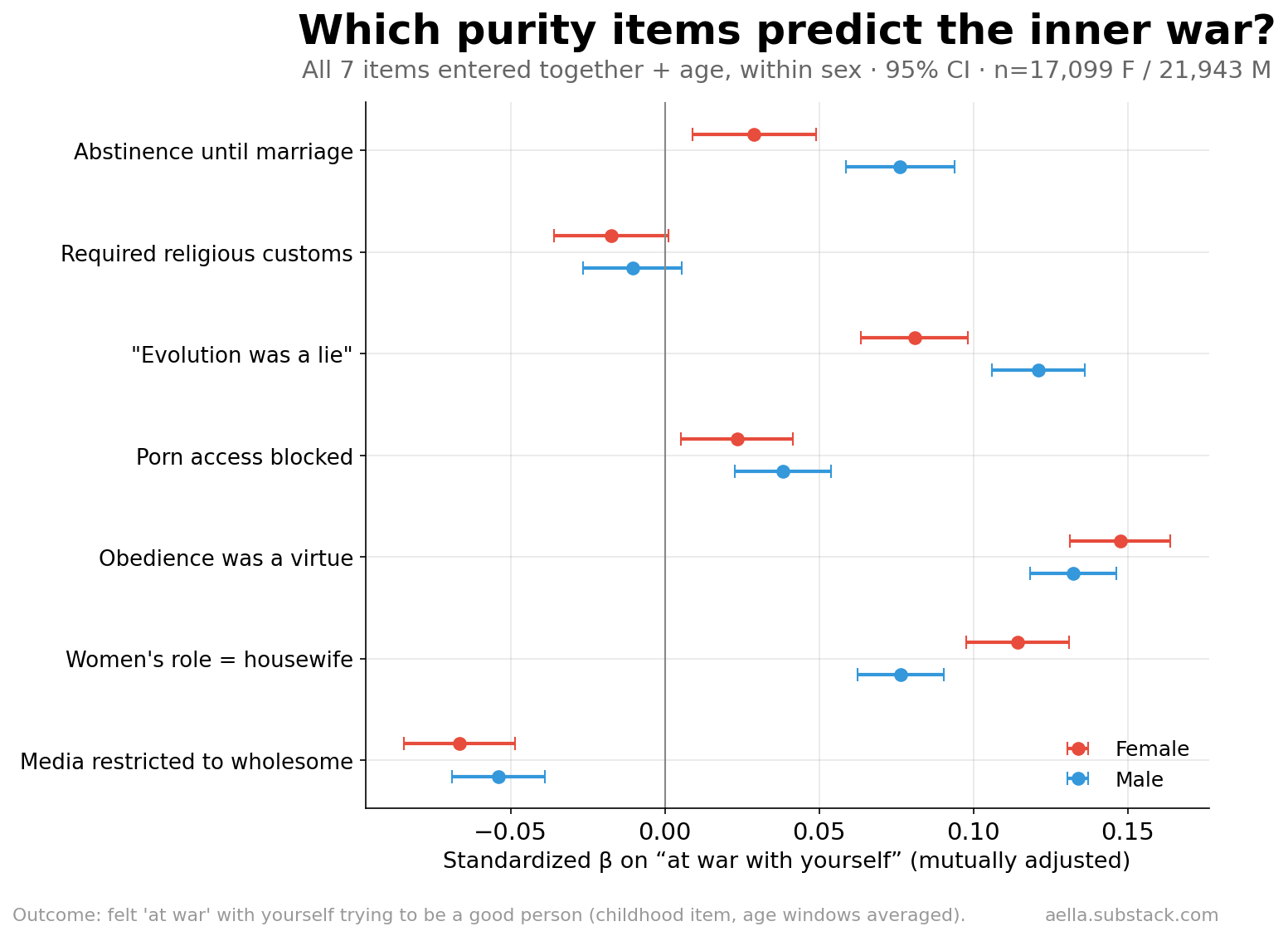
The hierarchy is the same for both sexes and it isn't the sex stuff. Obedience-as-virtue is the top predictor (β = .15 women, .13 men), then evolution-was-a-lie (.12 men, .08 women — the marker of reality-denying ideology, not merely religiosity), then women-as-housewives — notably stronger for women (.11) than men (.08), as you'd expect for the people the role was aimed at. Abstinence teaching itself contributes more for men (.08) than women (.03). And two genuinely informative non-effects: required church attendance predicts nothing once the rest is held constant, and wholesome-media-only flips mildly protective (β ≈ −.06) — censoring Disney-style isn't what hurt anyone; the conflict tracks demands on the child's will and beliefs, not on their media diet.
ITEM BY ITEMSame battery, three different signatures
The at-war forest above begs a question: is obedience-as-virtue just the master variable for everything, or do different outcomes pick different ingredients out of the purity package? Same setup as before — all seven items entered together (mutually adjusted), plus age, within sex — now for adult wellbeing, BDSM arousal, and apostasy (a logit among the religious-raised, additionally holding the adherence-importance item constant):
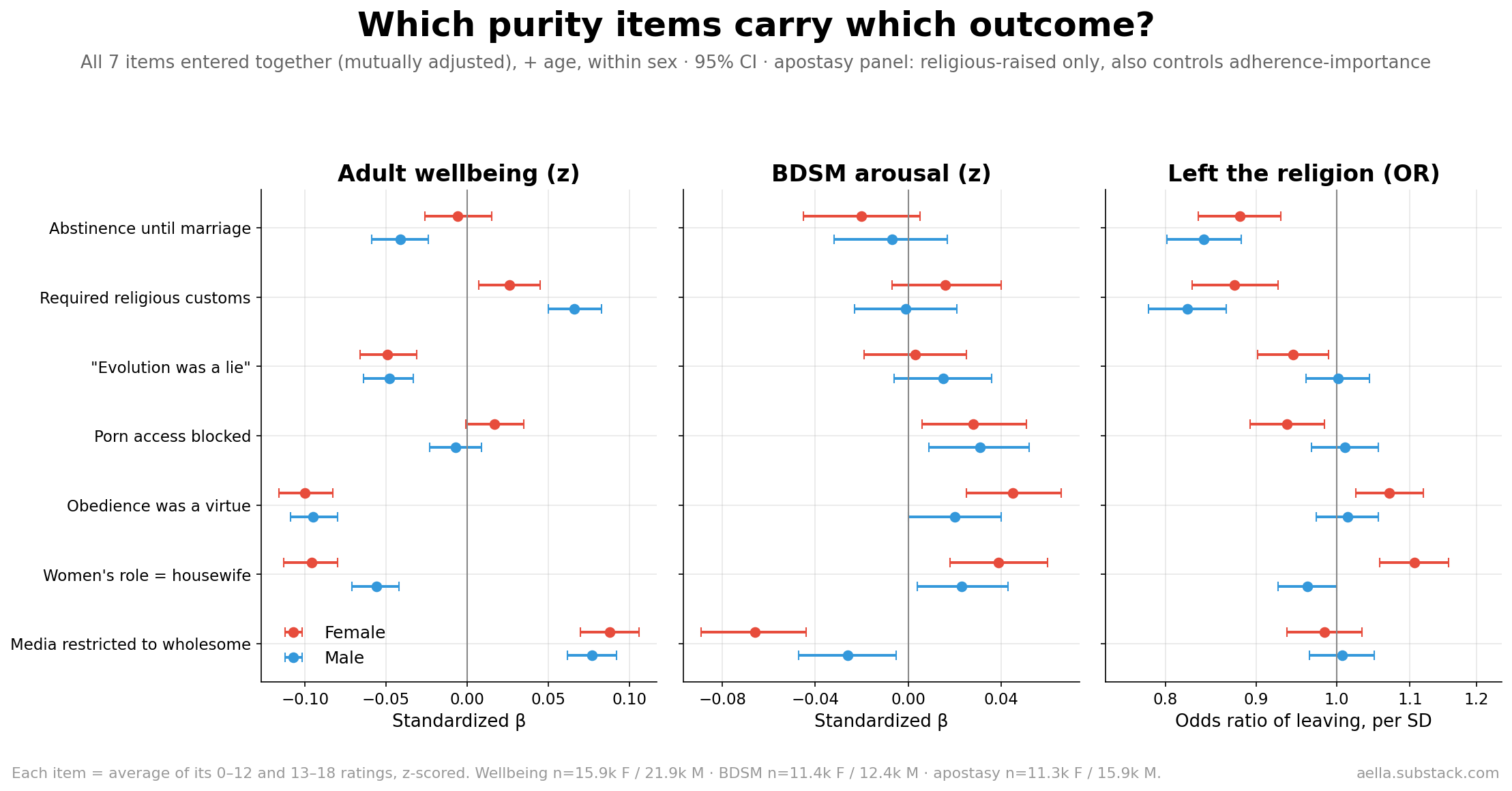
- Wellbeing repeats the at-war story. Obedience-as-virtue is again the worst item (β = −.10 women, −.09 men), then women-as-housewives (−.10 / −.06) and evolution-denial (−.05 both). And the same two flips: required church attendance predicts better adult wellbeing once the rest is controlled (+.03 / +.07), and wholesome-media-only is the single most positive item on the panel (+.09 / +.08). What damages isn't the religious practice or the censorship — it's the authority-and-ideology core.
- Kink has its own (tiny) signature. The composite's near-null hides a clean split: porn-blocking is the one item that predicts more BDSM arousal in both sexes (β ≈ +.03), with obedience and women-as-housewives adding a little for women — while blanket media restriction predicts less kink (−.07 women, −.03 men). To the extent there's any repression→kink effect at all, it's specifically about blocking the erotic, not about wholesomeness in general. (All of these are sub-.07 effects; don't build a theory on them.)
- Apostasy inverts the damage ranking. What keeps people in is the doctrine-and-observance pair — abstinence teaching (OR 0.88 women / 0.84 men per SD) and required religious customs (0.88 / 0.82). Evolution-denial, the item you'd nominate for "obviously collides with reality, drives kids out," does nothing of the sort (OR 0.95 / 1.00). And the items that push anyone out are the gender-and-authority ones, for women only: women-as-housewives raises women's odds of leaving 11% per SD (OR 1.11, CI 1.06–1.16) and obedience 7% — both ≈null for men. The people told what their role would be are the ones who walk.
So: no single master item. The damage items (obedience, ideology) are not the retention items (abstinence, observance), and the kink item (porn-blocking) is neither. One footnote from splitting each item into its two age windows (14 collinear predictors, so read gently): the retention power of required customs appears to sit almost entirely in the 13–18 window — practice that survives adolescence predicts practice that survives adulthood.
Does the leaver damage concentrate on specific items?
The centerpiece result was that high-purity leavers carry the wellbeing scar. Is that scar item-specific — do, say, obedience-raised leavers crash while others don't? Take the three biggest damage items and plot adult wellbeing against item agreement, separately for leavers and stayers:
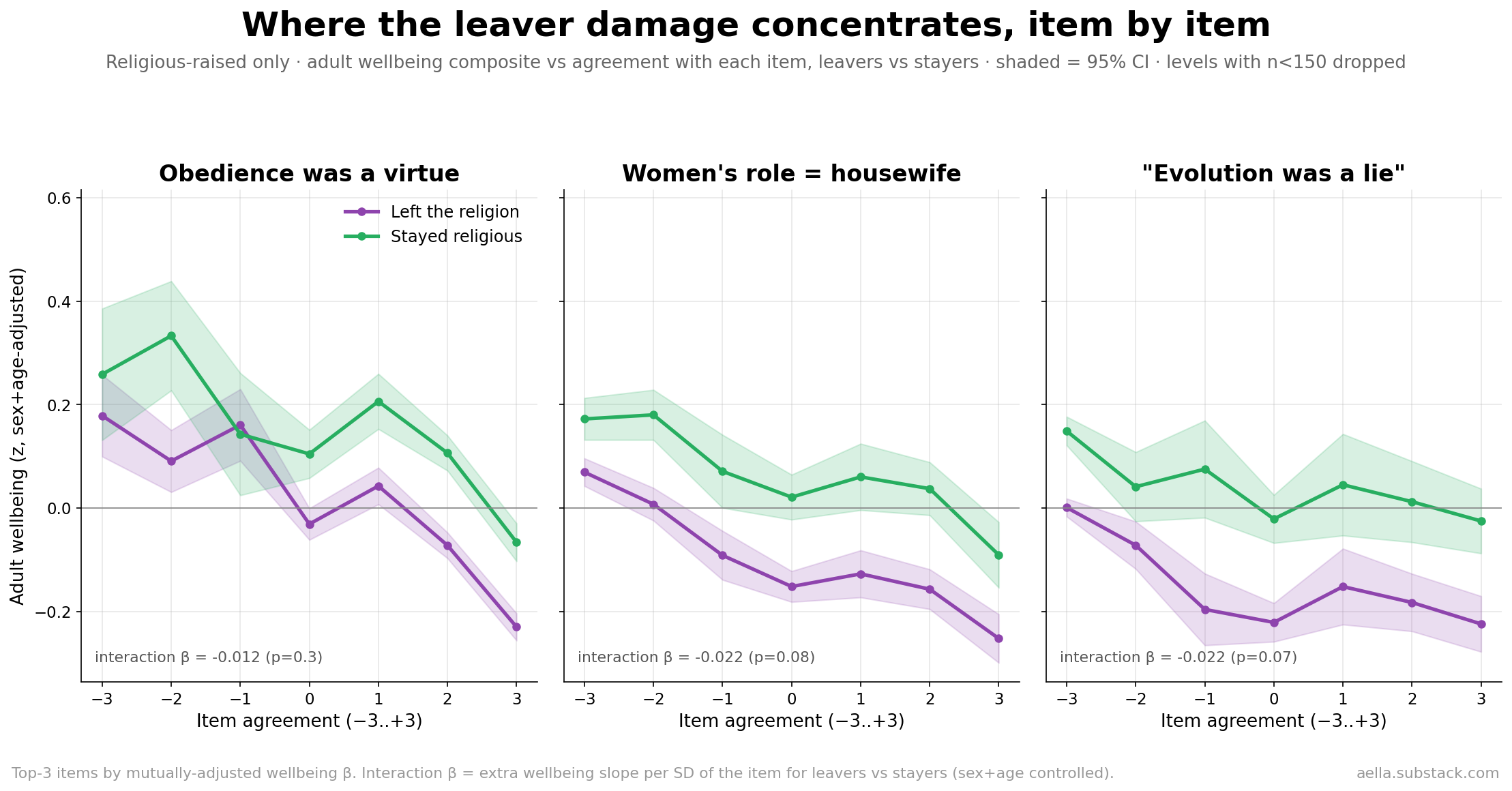
The answer is no — and that's informative. The leaver-vs-stayer gap is essentially a constant penalty, not an item interaction: at high endorsement (+2 or more) the gap is −0.17, −0.18, and −0.20 SD of wellbeing for obedience, housewife, and evolution respectively, and the formal item×leaver interactions are all small and non-significant (β = −.01 to −.02, p = .07–.34). The items set the slope of the damage; leaving adds the same surcharge everywhere. Even the leavers from low-obedience homes sit below their stayer counterparts.
One battery, three sub-clusters
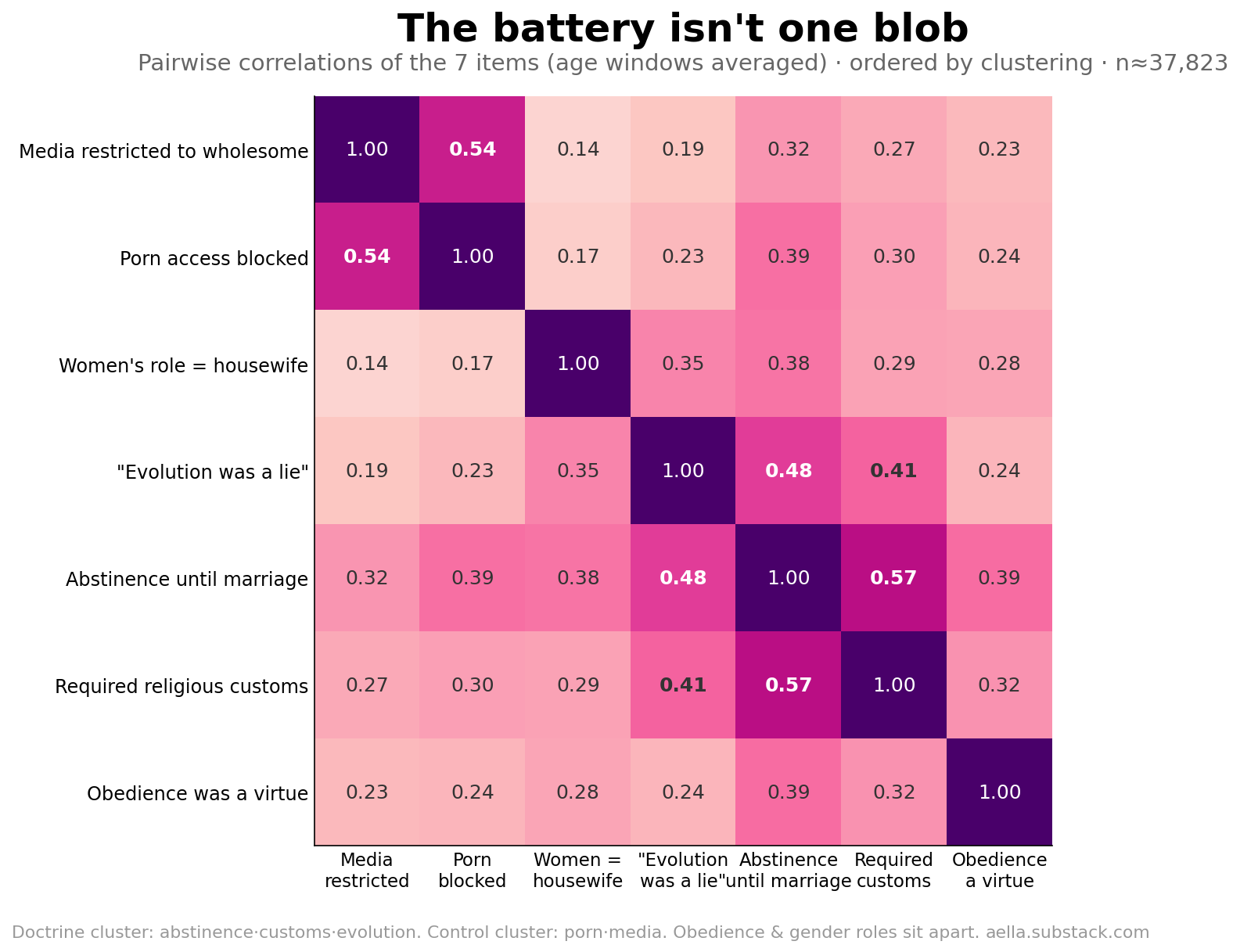
The battery's α = .87 makes it look monolithic; the item correlations say otherwise (pairwise r = .14–.57). Three lumps: a religious-doctrine cluster — abstinence, required customs, evolution-denial (r = .41–.57 among themselves); a content-control cluster — porn-blocking and media restriction (r = .54), which travels with doctrine only weakly; and obedience + gender roles, which sit apart from everything (no r above .39). Obedience-as-virtue — the battery's most-endorsed item (75%) and its most damaging — is also its least specifically religious: 64% of the secular-raised got it too. Which is why the section above keeps finding that the harm of a "purity" upbringing is mostly not the purity.
PERSPECTIVEHow much does purity actually explain?
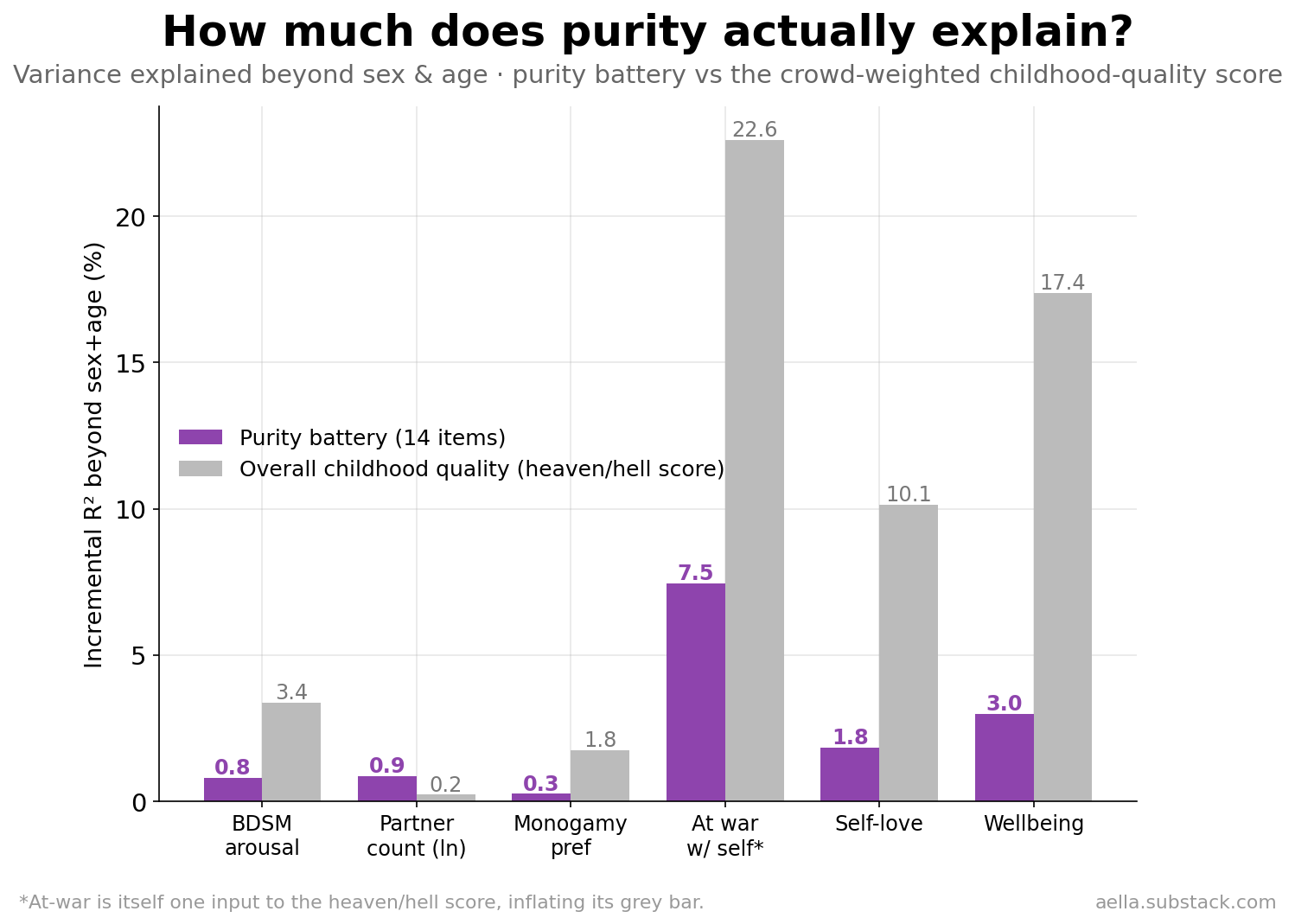
Give the full 14-item battery every advantage — 14 free parameters against one — and beyond sex and age it explains 7.5% of the variance in the at-war item, 3.0% of adult wellbeing, 1.8% of self-love, and under 1% of BDSM arousal, partner count, or monogamy preference. The survey's overall childhood-quality score (a crowd-weighted composite across all batteries) explains several times more of the wellbeing outcomes — 17% of adult wellbeing, 10% of self-love. (Its towering at-war bar is partly circular — that item is one of its inputs — but the wellbeing comparison is fair.)
Two readings, both true. Purity culture is not destiny: ~97% of the variance in how these adults are doing lies elsewhere, and a generically bad childhood — yelling, neglect, instability — is far more damaging than a pure one (the two are only modestly linked: r = −.27 with overall childhood quality). And: for one specific thing — a child's sense of being at war with themselves while trying to be good — this battery is genuinely predictive, and its apostates carry the largest measurable scar.
CAVEATSHow to read this
Self-selected, very-online sample — left-leaning (mean +1.4 on a −3..+3 scale), kink-tolerant, heavily secular. Absolute levels (the 68% apostasy, the 55% BDSM baseline) are inflated; comparisons and gradients are the load-bearing results. High-purity stayers who'd never take a survey like this are underrepresented, which plausibly flatters the leaver-vs-stayer comparison.
Cross-sectional, not causal. "Purity → kink" and "leaving → distress" are associations. Heritable temperament could drive both a family's religiosity and a child's outcomes; distress can cause apostasy rather than follow it.
Religiosity ↔ selection confounds. Purity score, childhood religion, religiosity intensity, and who stays religious are tangled; we control what's measured (sex, age, current practice, adherence importance), which is not everything.
The at-war item is a childhood measure. No adult version exists in the survey, so "carry the war into adulthood" claims rest on the adult wellbeing/self-love items, not on the war item itself.