Are Rationalists More Poly?Glosso users who score higher on the rationalist quiz are more okay with their partner being with other people. Is it the Bay Area, autism, or something else?
Glosso has a "How Rationalist Are You?" quiz and an exclusivity quiz that asks how you'd feel about your partner doing various things with other people. 1,086 people have taken both. This report checks whether the people who score as more rationalist are more open, and then tries to break that with every confounder glosso has data on.
Share of everyone in this report who is "totally fine" with their partner doing each thing. These are the four rungs of the exclusivity quiz that most people get walked up; the full item is "financially supporting someone else (romantically)."
Short version
- Yes, rationalists are more open, and it's not small at the top. 20% of "Normie" and lower tiers are totally fine with their partner falling in love with someone else, against 46% of Highrats and above. It's flat from Not A Rat through Toe-in Rat and climbs from Lightrat up.
- The Bay Area explains about a quarter of it. Bay Area users are more rationalist and much more open (46% fine with falling in love, against 25% elsewhere in the US and 19% outside it). But outside the Bay the gradient is still there, in the US and abroad.
- Autism isn't it. Autistic users are a bit more rationalist and a bit more open, but controlling for autism leaves 93% of the effect, and the slope looks the same either way.
- Neither is anything else glosso has. Sex, age, partner count, religion, politics, education, kink, orientation and personality each leave 93% or more of the effect; all of them at once leave 93%. Two of them were actually hiding it: rationalists lean economically right and are a little straighter, both of which go with being less open.
- It lives with the people who like LessWrong. Among LessWrong fans the gradient is strong. Among people who dislike LessWrong it's flat, but almost none of them score as high-tier rationalists, so this can't tell the community apart from the mindset.
- The plain "are you poly?" question points the same way, more noisily, because only 298 people answered both it and the rationalist quiz.
01A first look
The rationalist quiz scores agreement with a set of rationalist-culture markers and sorts people into eleven named tiers, from The Destroyer through Normie, Toe-in Rat, Lightrat, True Rat and Highrat up to The Rat King. The ends are thin, so the charts here merge them.
The obvious thing to check first is glosso's direct question, "Are you more monogamous or polyamorous?", on a six-point scale. Only 298 people have answered both it and the rationalist quiz.
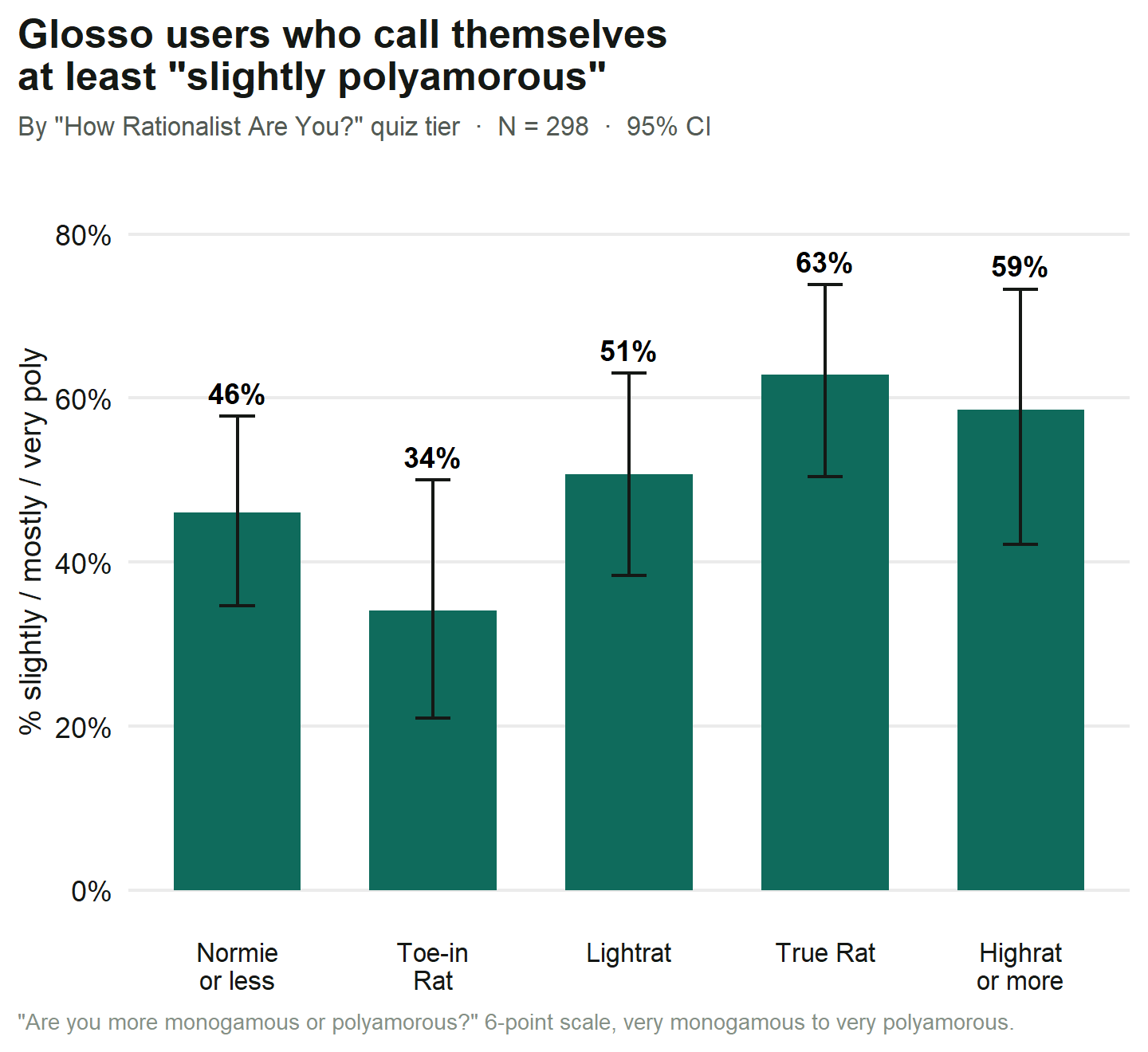
It points the right way but it's a small, noisy sample. Glosso has a better instrument with nearly four times the people.
02A better measure: the exclusivity quiz
The exclusivity quiz shows one thing at a time, "Your partner…" followed by an item like "flirting with others," "sexting others," or "having kids with other people," and you answer totally fine, slightly uncomfortable or very uncomfortable. The items are ranked by how many people accept them, and the quiz is adaptive: it hunts for the rarest thing you're still totally fine with. The score runs 0 to 100, where higher means you're fine with rarer things.
It tracks the poly question closely. Among the 223 people who did both, they correlate at 0.79.
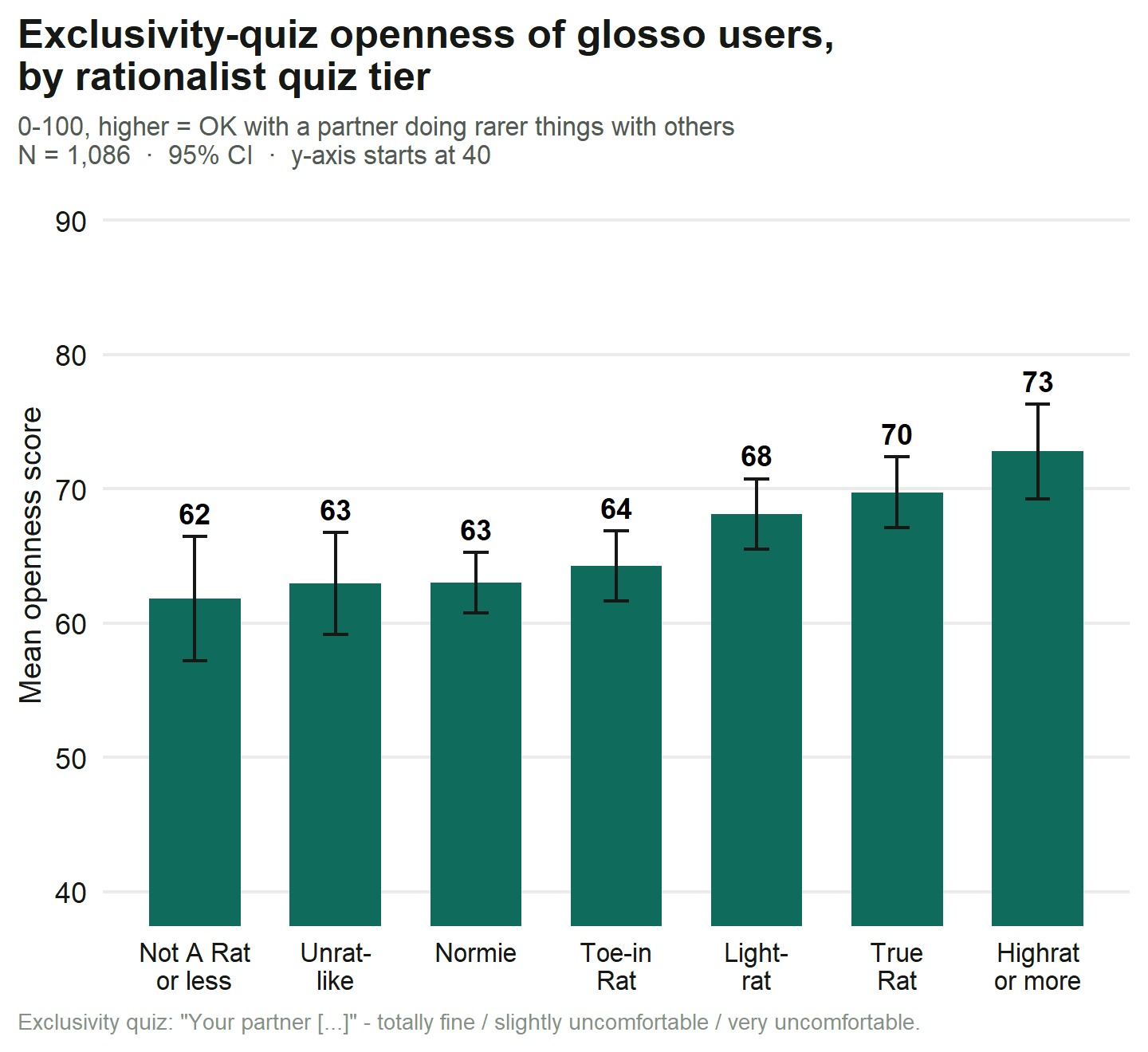
A score out of 100 doesn't mean much to anyone, though, so the rest of this report mostly uses the individual items.
03What rationalists are fine with
In practice almost everyone walks the same path through the quiz. Everyone is asked about their partner cuddling someone else (clothed). People who are totally fine with that get sexting; people fine with sexting get falling in love; people fine with that get financially supporting someone else romantically. Anyone who stopped earlier on the ladder is counted as not fine with the later rungs, which is the quiz's own assumption.
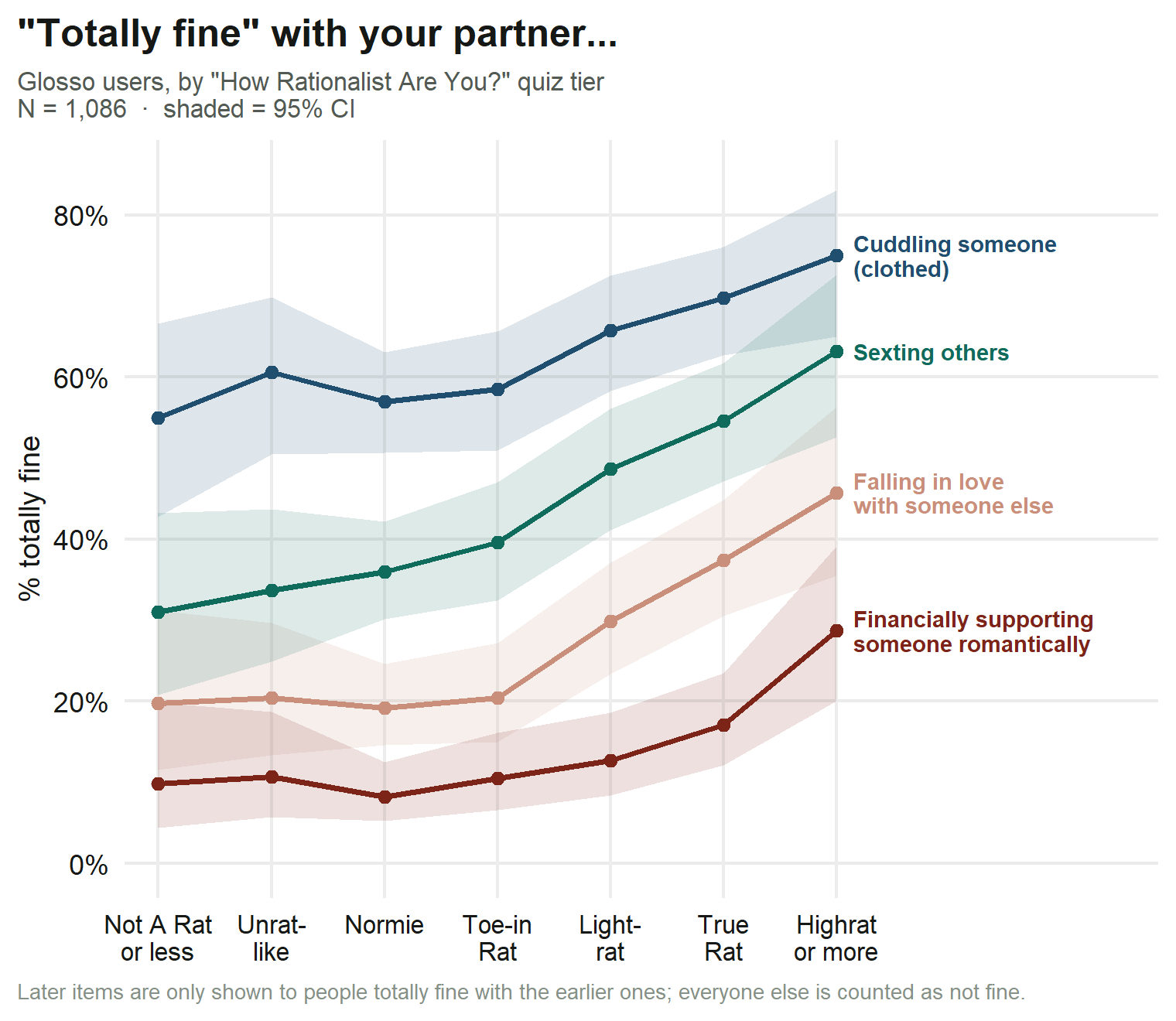
All four rungs show the same shape: flat across the bottom four tiers, then rising from Lightrat up.
| Totally fine with partner… | Not A Rat or less | Normie | Toe-in Rat | Lightrat | True Rat | Highrat + |
|---|---|---|---|---|---|---|
| Cuddling someone (clothed) | 55% | 57% | 58% | 66% | 70% | 75% |
| Sexting others | 31% | 36% | 40% | 49% | 55% | 63% |
| Falling in love with someone else | 20% | 19% | 20% | 30% | 37% | 46% |
| Financially supporting someone romantically | 10% | 8% | 10% | 13% | 17% | 29% |
| n | 71 | 258 | 183 | 182 | 192 | 96 |
Unratlike (n=104) is on the chart but left out of the table for width; it sits with the bottom tiers. The other items in the quiz (flirting, kissing, swinging, private sex with others) can't be scored this way, because the adaptive path only shows each of them to a small, pre-selected slice of people.
Falling in love is the most divisive rung, so the confounder checks below use it, along with the full openness score for the regressions.
04Is it just the Bay Area?
The obvious worry: the Bay Area is where the rationalist community lives, and the Bay Area rationalist scene is famously poly. If high scorers are mostly Bay Area people, the "rationalist effect" might just be a Bay Area effect.
Glosso doesn't ask where you live directly, but profiles have a zip code and city, and two survey questions ask your country. Between them, 859 of the 1,086 people can be placed: 162 in the Bay Area, 380 elsewhere in the US and 317 outside the US.
The Bay Area really is different. Bay Area users average about three-quarters of a standard deviation higher on the rationalist quiz, and 46% of them are totally fine with a partner falling in love with someone else, against 25% elsewhere in the US and 19% outside it. Controlling for living in the Bay Area cuts the rationalist effect on openness by about a quarter. The rest survives (p ≈ 10⁻⁵).
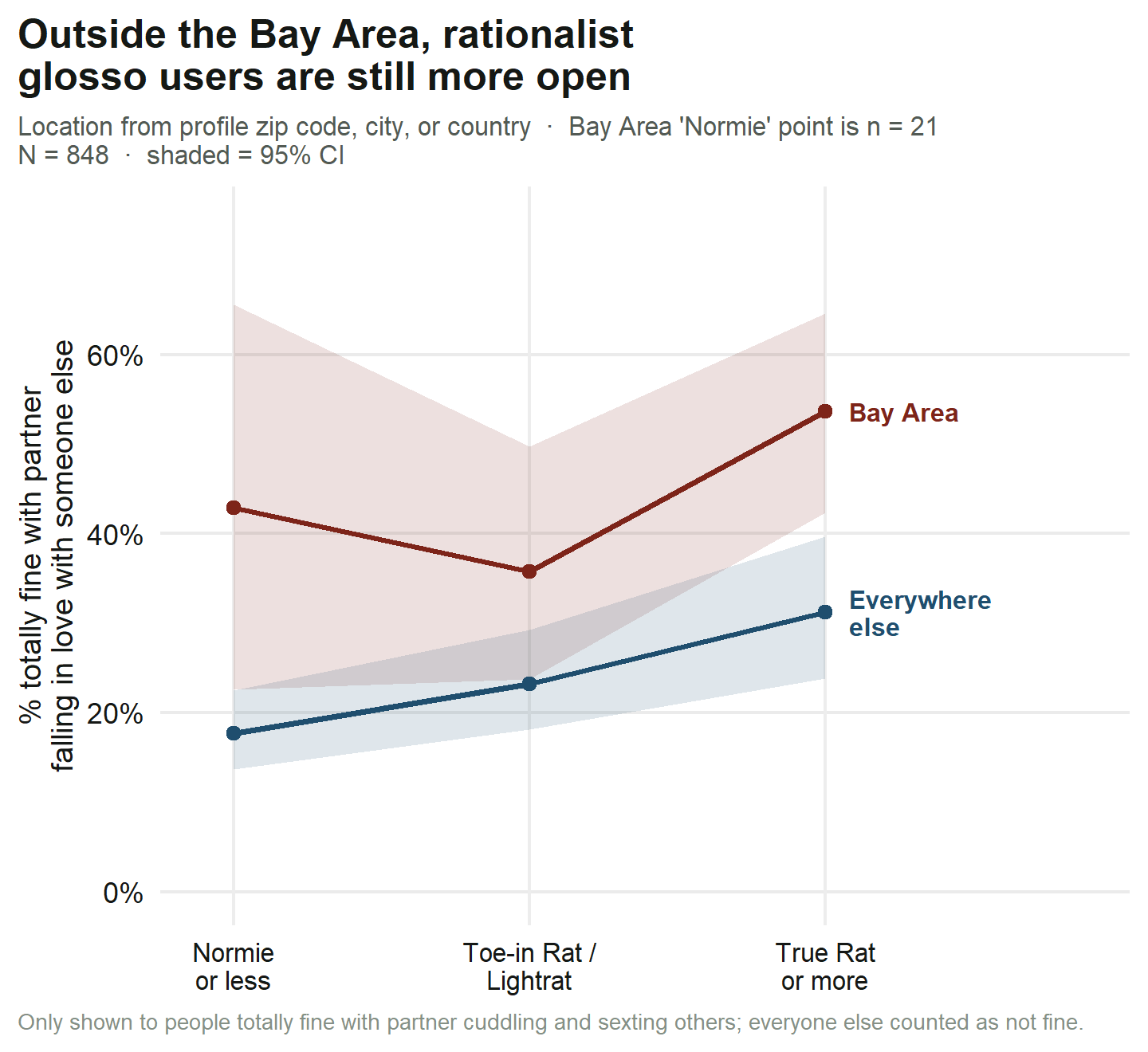
Splitting "everywhere else" further, the rationalist effect on openness is significant both elsewhere in the US (p = .03) and outside the US (p = .002). So rationalists who don't live in the Bay are more open too, just from a lower starting point. Living in the Bay adds its own bump on top.
05Is it autism?
The other suspect is autism, which is common among rationalists and might go with caring less about conventional relationship rules. Glosso asks about it in three places: two versions of a "Do you have any of the following" checklist (asked in different tests), and a standalone question, "Are you on the autism spectrum?" I counted someone as autistic if they ticked autism on either checklist or answered "Yes" to the standalone question. 756 people answered at least one of these, and 213 (28%) are autistic by that definition.
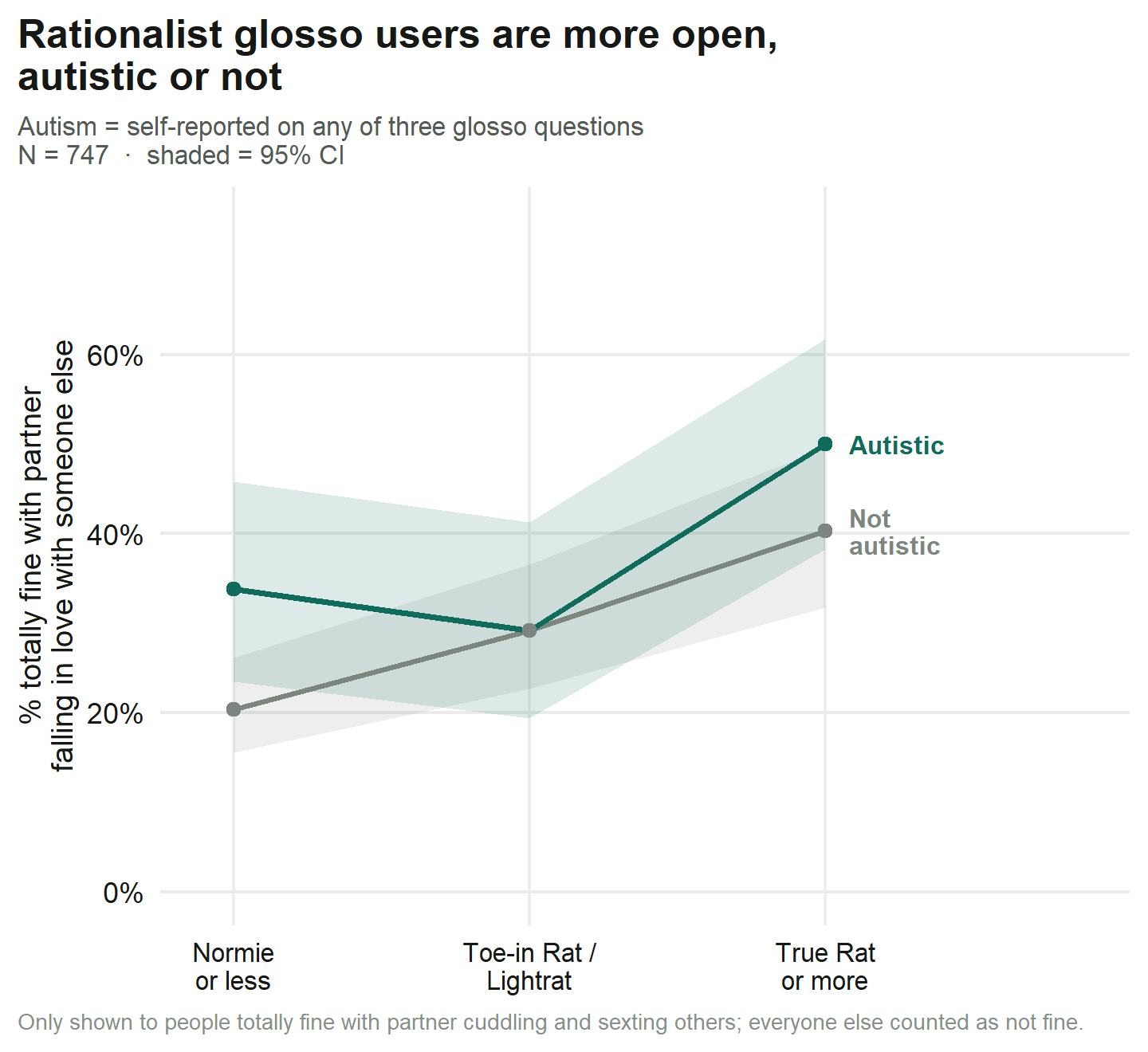
Autism does rise with rationalist tier, from 24% of Normies and below to 35% of True Rats and above. Autistic users are also somewhat more open. But it barely touches the rationalist effect: controlling for autism leaves 93% of it, and the slope is the same for autistic and non-autistic people (p = .91 for a difference).
06Everything else
Glosso asks a lot of the same things more than once in different places (age, religion, kinkiness, education and sex partners each have two versions), so I merged duplicates to get the most coverage. Then, for each possible confounder, I compared the rationalist effect on openness with and without controlling for it, in the same people.
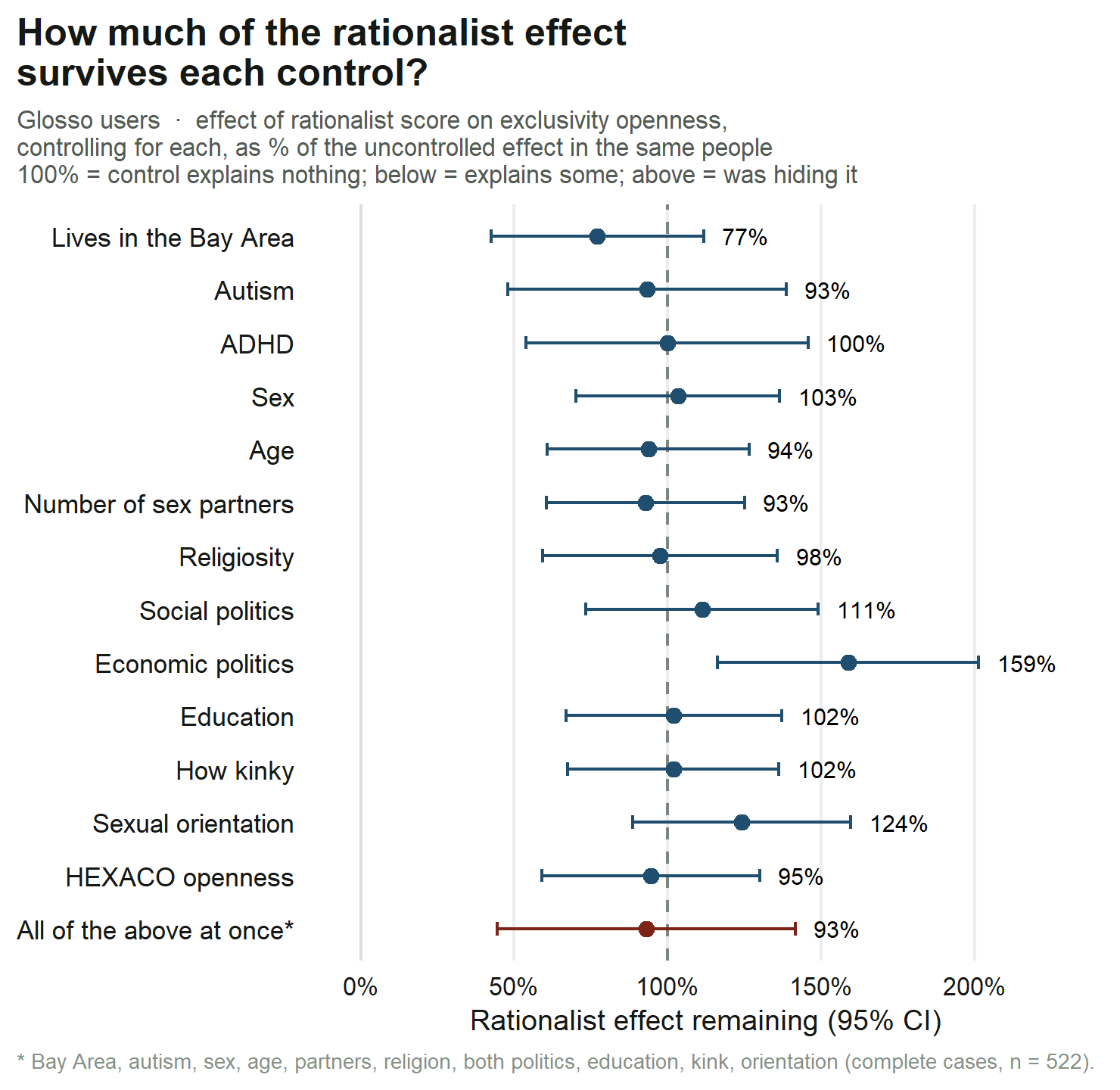
Nothing knocks it out. The Bay Area is the only control that takes a real bite. Sex, age, number of sex partners, religiosity, education, how kinky you are and HEXACO openness to experience each move it by less than ten percent. Put everything together in one model (n=522 with complete answers) and 93% of the effect is still there.
Two controls make the effect bigger, which means they were hiding part of it:
- Economic politics. Rationalists on glosso lean economically right (ρ = −0.47 between rationalist score and economic liberalism), and economic leftists are slightly more open. Holding economics constant, the rationalist effect is 59% larger.
- Sexual orientation. Rationalists are a little more likely to be straight, and non-straight people are much more open. Holding orientation constant, the effect is 24% larger.
Men and women both show it. It looks stronger in women (5.3 openness points per standard deviation of rationalist score, against 2.9 for men), but there are only 232 women here and the difference isn't significant (p = .08). Only two people are under 18; dropping them changes nothing.
07Is it the community?
One more question on glosso, "I like the forum 'LessWrong'," is close to a measure of rationalist community membership. It correlates 0.74 with the rationalist quiz, so it isn't a confounder so much as nearly the same thing measured differently. Holding it constant cuts the rationalist effect by about 40%, and both stay significant.
Splitting by it is more interesting:
| Totally fine with partner falling in love | Normie or less | Toe-in / Lightrat | True Rat + |
|---|---|---|---|
| Likes LessWrong (n=551) | 21% | 27% | 41% |
| Neutral (n=149) | 22% | 23% | 40% (n=16) |
| Dislikes LessWrong (n=377) | 19% | 20% | 14% (n=7) |
Among LessWrong fans the gradient is strong. Among people who dislike LessWrong it's flat, and their openness score doesn't move with rationalist score at all. But only seven people who dislike LessWrong score as True Rats or higher, so there's almost nobody to compare. Within the range of scores both groups actually share, their slopes aren't distinguishable (p = .44). The honest answer is that this data can't tell whether it's the rationalist mindset or the rationalist community that goes with openness; the two arrive together.
08What this doesn't show
- Direction. This is one snapshot. Rationalist culture may make non-monogamy feel normal, open people may find rationalism appealing, or both.
- Practice. The exclusivity quiz measures how okay you'd be with your partner doing things, not whether you're poly or in an open relationship.
- Everyone. Glosso users are a self-selected group with a lot of rationalist-adjacent people in it, which is why there's enough range on the rationalist quiz to look at this at all. Nothing here is weighted to any population.
- Unmeasured confounders. Glosso doesn't have good data on relationship status for most of these people (only about 300 answered), and some of the controls (partner count, kinkiness) could be consequences of openness rather than causes, which would make controlling for them too strict, not too loose.
09Methods
Data pulled from the glosso database on 5 Oct 2026: every non-banned user with both a rationalist-quiz score and an exclusivity-quiz score (N = 1,086). The poly-question chart uses the 298 users with a rationalist score who answered it in the drip feed; answers to a differently-scaled version in the relationship test were excluded.
Ladder items. For each rung, people who weren't totally fine with an earlier rung count as not fine; people who quit the quiz before reaching a rung they'd have been shown are excluded for that rung (up to 14 people).
Location. In order of preference: profile zip code (matched to coordinates; Bay Area = California zips between 37.1° and 38.6° N and 121.5° and 123.2° W, which catches San Francisco, the East Bay, the Peninsula, San Jose, Napa and Santa Rosa), profile city text (matched against Bay Area city names), profile region, and country from two survey questions (non-US = not Bay Area). Zip and city agreed on every one of the 492 people who had both.
Autism. Autism ticked on either "Do you have any of the following" checklist, or "Yes" to "Are you on the autism spectrum?" Not autistic = answered at least one of these without saying so.
Controls. Age (two items), biological sex, log number of sex partners (two items, values over 500 dropped), religiosity (mean of two items), social and economic politics, education (two items), kinkiness (mean of two items), sexual orientation (0–6), and HEXACO openness from glosso's personality test. Each control was tested in its own ordinary least-squares regression of openness on standardized rationalist score, against the uncontrolled regression in the same people; the combined model uses complete cases. Percentages have Wilson 95% intervals; means have t intervals.