TL;DRThe shape of it
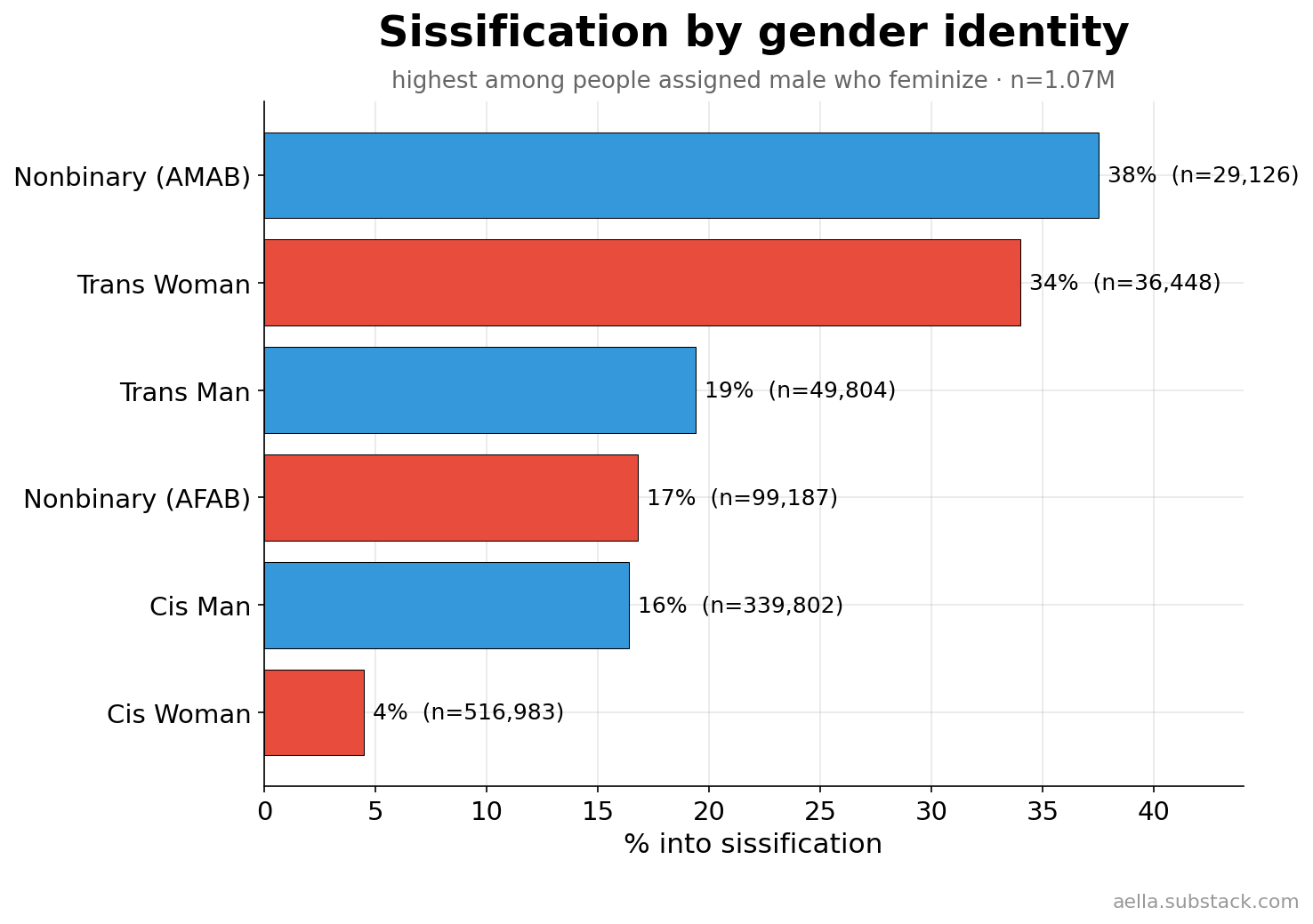
- It's a feminization kink, and it skews to people assigned male. Cis men 16%, trans women 34%, AMAB-nonbinary 38%. Cis women are lowest at 4.5% — but the cis women who are into it overwhelmingly want to do it to someone else (85%), while trans women want it on themselves (67%). Cis men split down the middle.
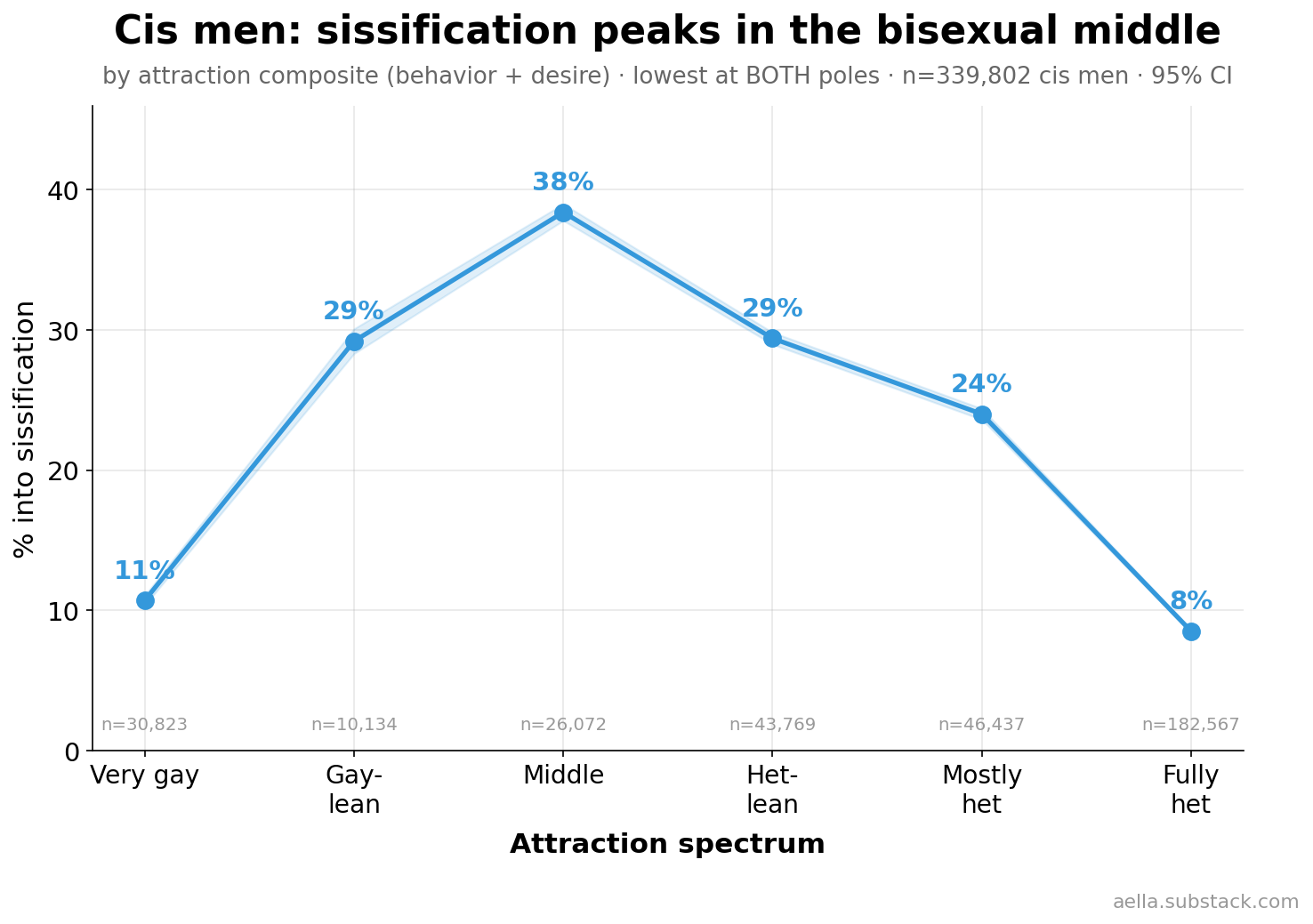
- Bisexuality is the strongest demographic amplifier — and it's an inverted U, not a "likes men" effect. Cis bi men: 36%. Cis gay men are the lowest male group (13%), below straight men (15.5%). Across the full attraction spectrum, interest peaks dead-center (38%) and falls at both poles (8–11%).
- Its kink signature is gender-transformation and psychological feminization — not physical BDSM. Controlling for overall kinkiness, sissification loads hard on futanari, transformation, gender-swap, mental-alteration and humiliation, and loads negatively on spanking, pain, bondage and S&M.
- Almost every "disorder" link dissolves once you control sex and kinkiness. Sissification skews male while depression/anxiety/abuse are reported far more by women, so pooled comparisons mislead. Compared to same-sex, equally-kinky peers, depression, ADHD, anxiety and childhood abuse add nothing (adjusted ORs ≈ 0.9–1.0). The lone specific survivor is autism — though a cis-only re-check shows it's strong in cis women (OR 1.4) and only modest in cis men (OR 1.2), with part of the male signal running through trans/nonbinary identity.
THE MEASUREWhat "into sissification" means here
The survey asks how arousing respondents find gender play in general (0–5), and those with any interest pick which elements appeal. One option is "Sissification (degradation by feminization)." Throughout this report, into sissification = selected that element. It's a clean, fully-answered flag (non-selectors coded 0), so the 12.0% base rate is across the whole sample.
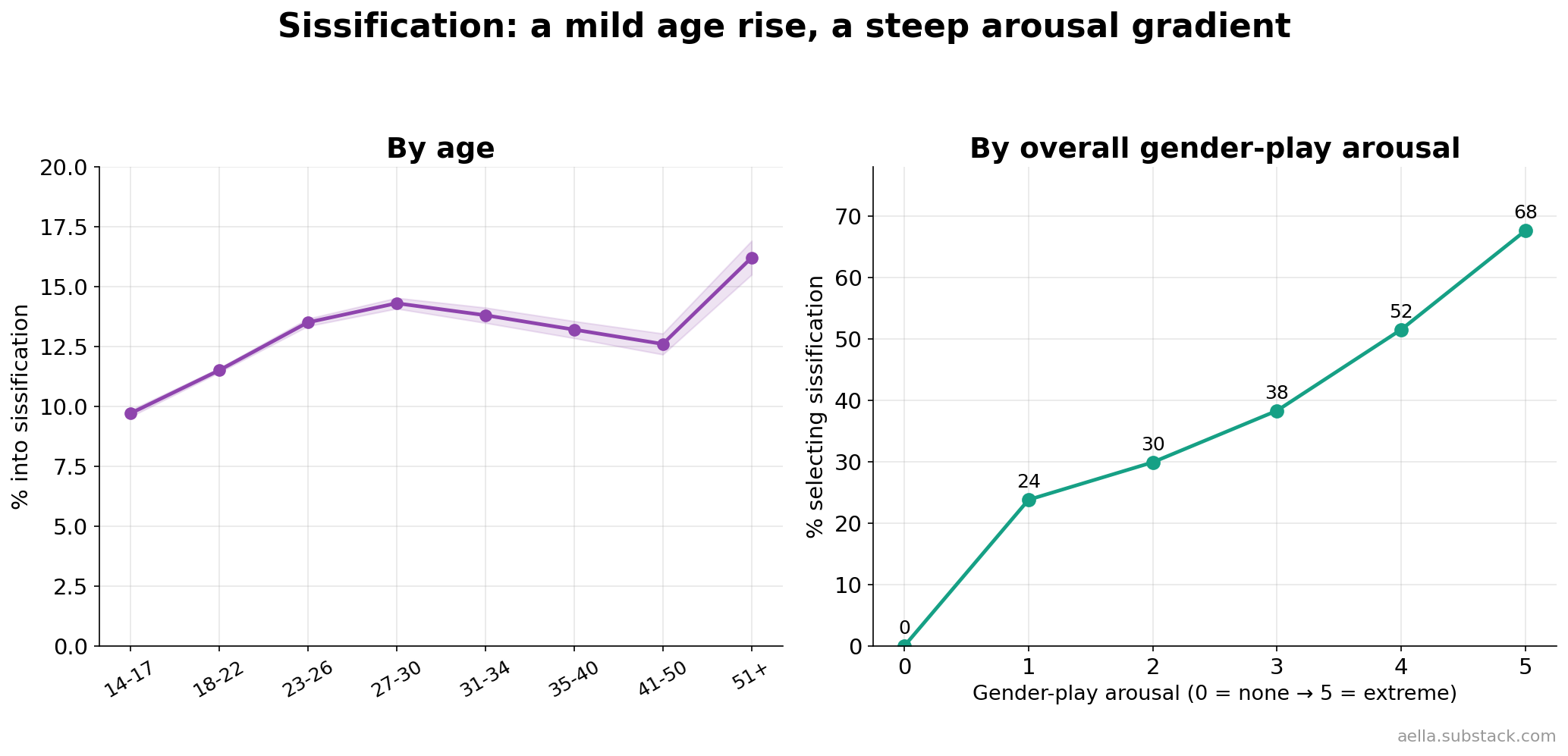
It is firmly a sub-type of gender play: nobody with zero gender-play arousal selects it, and the share who do climbs from 24% at the mildest gender-play interest to 68% at the most intense. Among the 224k respondents into gender play at all, sissification is the single most-commonly-chosen "most arousing" element (23%), narrowly ahead of passable crossdressing (22%) and androgyny (20%) — it's the modal gender-play kink, not a fringe one.
WHOWho's into it
Sissification is male-skewed and bisexual-amplified. Straight men are at 18%, but bisexual men leap to 38% — the highest of any sex×orientation cell. Women run roughly half the male rate at each orientation, topping out at 12% among bi women.
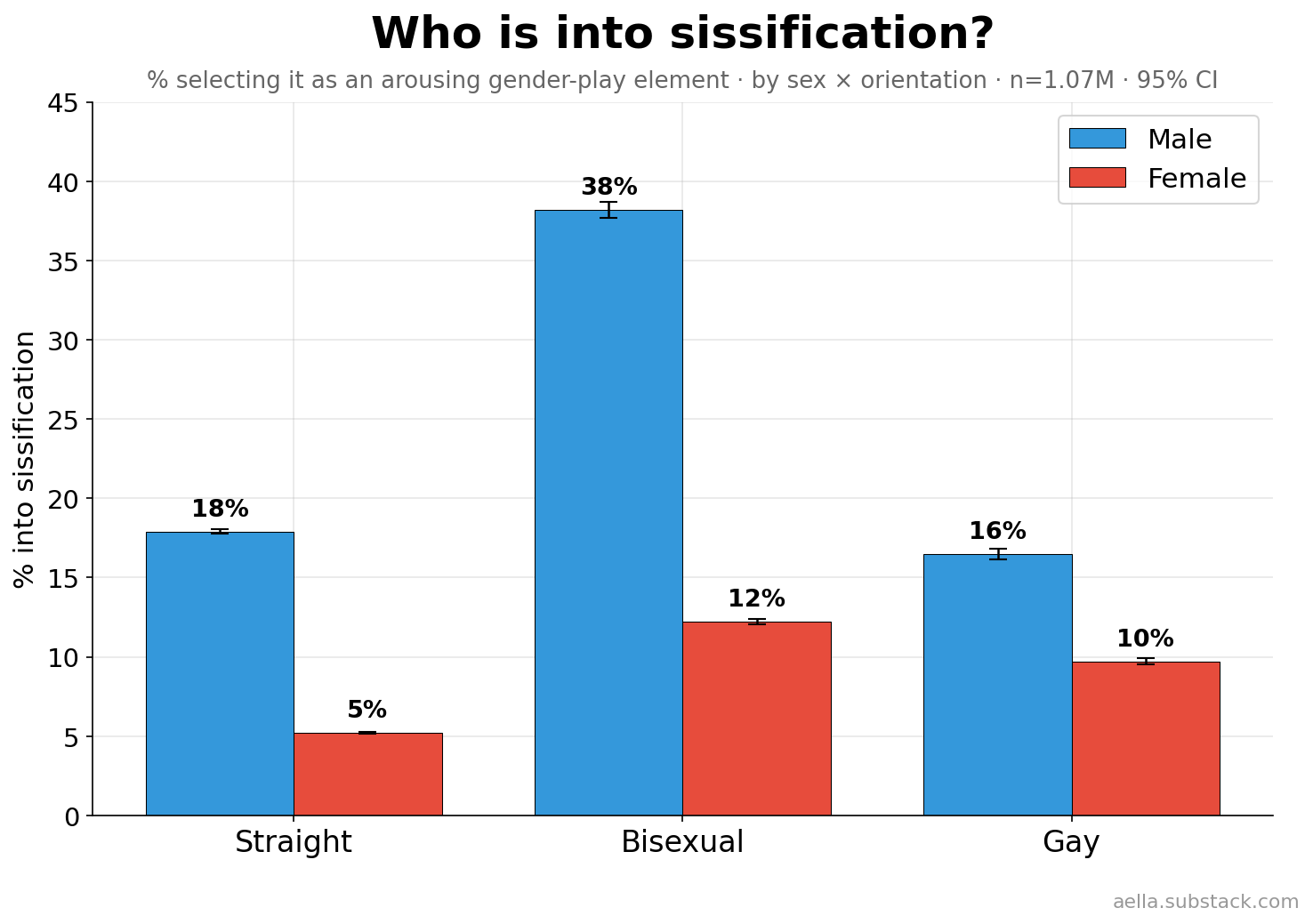
Because the "Male" column above is biological sex (it includes trans women, who are both high-interest and more often bi), we re-checked among cis people only: cis bi men are at 36%, so the bisexual spike is real, not a gender-identity artifact. The surprise is on the other side: cis gay men are the lowest male group at 13% — below straight men's 15.5%. Sissification interest is not about liking men; degradation-by-feminization seems to need femininity to feel like a descent, which may matter less to men already comfortable outside straight masculinity. The full attraction spectrum makes the shape vivid:
By gender identity the pattern sharpens into a clear story: interest is highest among people assigned male who feminize — AMAB-nonbinary (38%) and trans women (34%) — then trans men and AFAB-nonbinary in the high teens, cis men at 16%, and cis women lowest at 4.5%. For a kink defined as being feminized, the people most drawn to it are disproportionately those moving toward femininity from a male starting point.
Age matters only mildly — a gentle rise from 10% among teens to ~14% in the late twenties, then flat. The far steeper gradient is internal: how strongly someone is into gender play overall.
DIRECTIONBe the sissy, or make one?
The survey asks whether your gender-play arousal is about yourself or the other person. Among the sissification-interested, the split follows assigned sex and femininity-direction with remarkable cleanness:
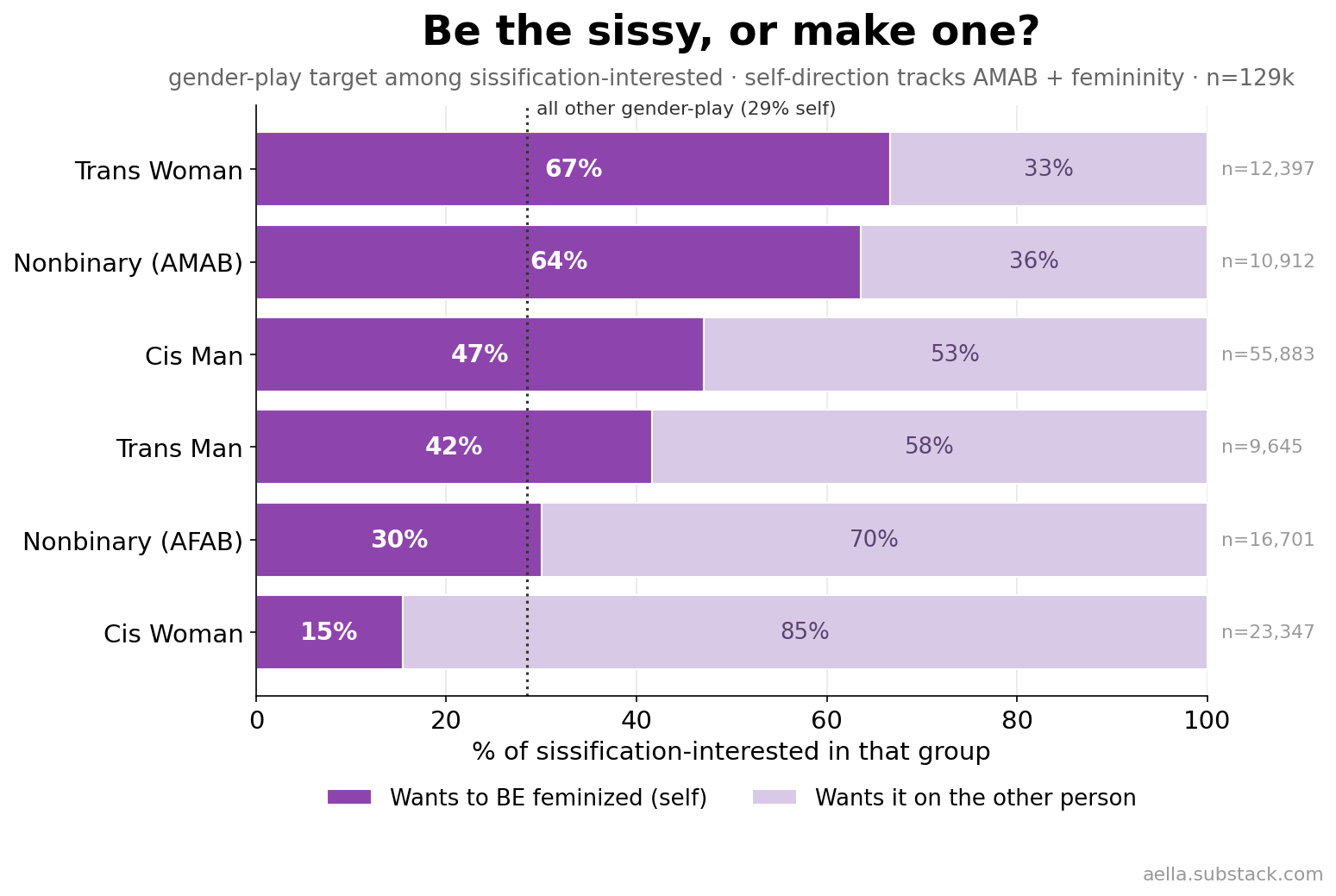
- Cis women into sissification are mostly the sissifiers — 85% want it on the other person. Their version of the kink is largely a domme role: feminizing him.
- Trans women and AMAB-nonbinary people want to be the target (67% / 64% self) — for them it's about being feminized.
- Cis men split almost exactly in half (47% self) — half "make me the sissy," half "I'll do the making." For comparison, gender-play people not into sissification are 29% self-directed — so sissification pulls strongly toward the self side for everyone assigned male.
Two more findings from the expanded sweep, one loud and one quiet. The loud one: among cis straight men, sissification interest comes with a full standard deviation more attraction to trans women (d = 1.0; net-attracted 5.2% vs 1.3% — four times the base rate). The feminized-male-body theme (futanari, gender-swap, sissification, attraction to trans women) is one coherent cluster of desire. The quiet one: onset age is unremarkable — gender-fetish interest starts at a median of 15 for sissification people, same as other gender-play, with the usual early-adolescent peak; and religion barely matters (a narrow 9–13% band across every major affiliation, protestants slightly highest, Muslims/Hindus slightly lowest).
WIDER LENSEthnicity, country, and the life course
Splitting further (always within sex, after the confound lesson above):
Ethnicity
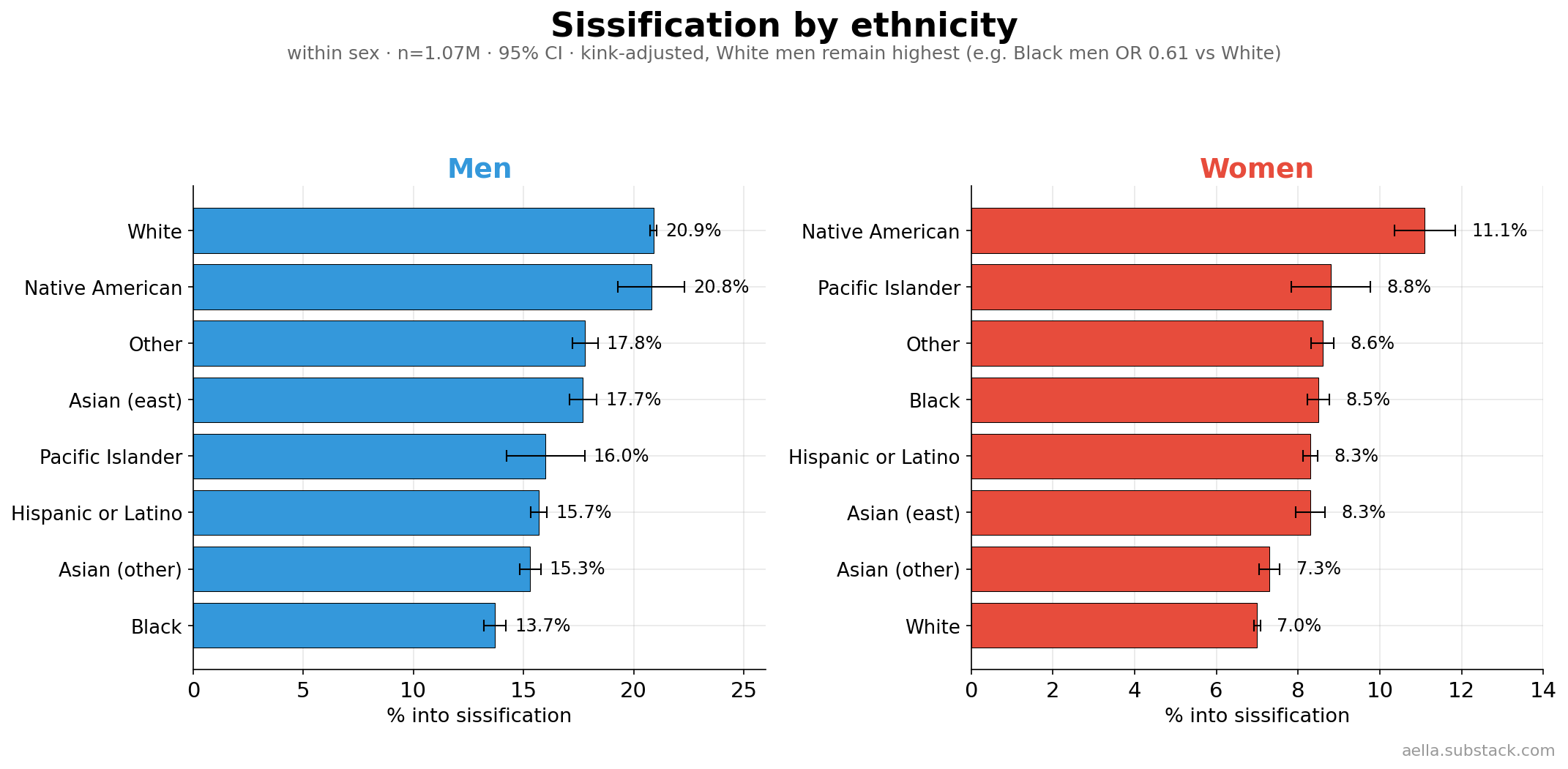
Among men, White and Native American men are highest (~21%) and Black men lowest (13.7%) — and this is not just group differences in general kinkiness: controlling kinkiness and age, Black men sit at OR 0.61 vs White men, Hispanic 0.68, Asian 0.73–0.86. Sissification is a disproportionately White male kink even among equally-kinky people. Among women the ordering flips: White women are the lowest female group (7.0%) and every minority group sits slightly higher — a small but cute inversion, given that women's version of the kink is mostly the dominant/sissifier role.
Country
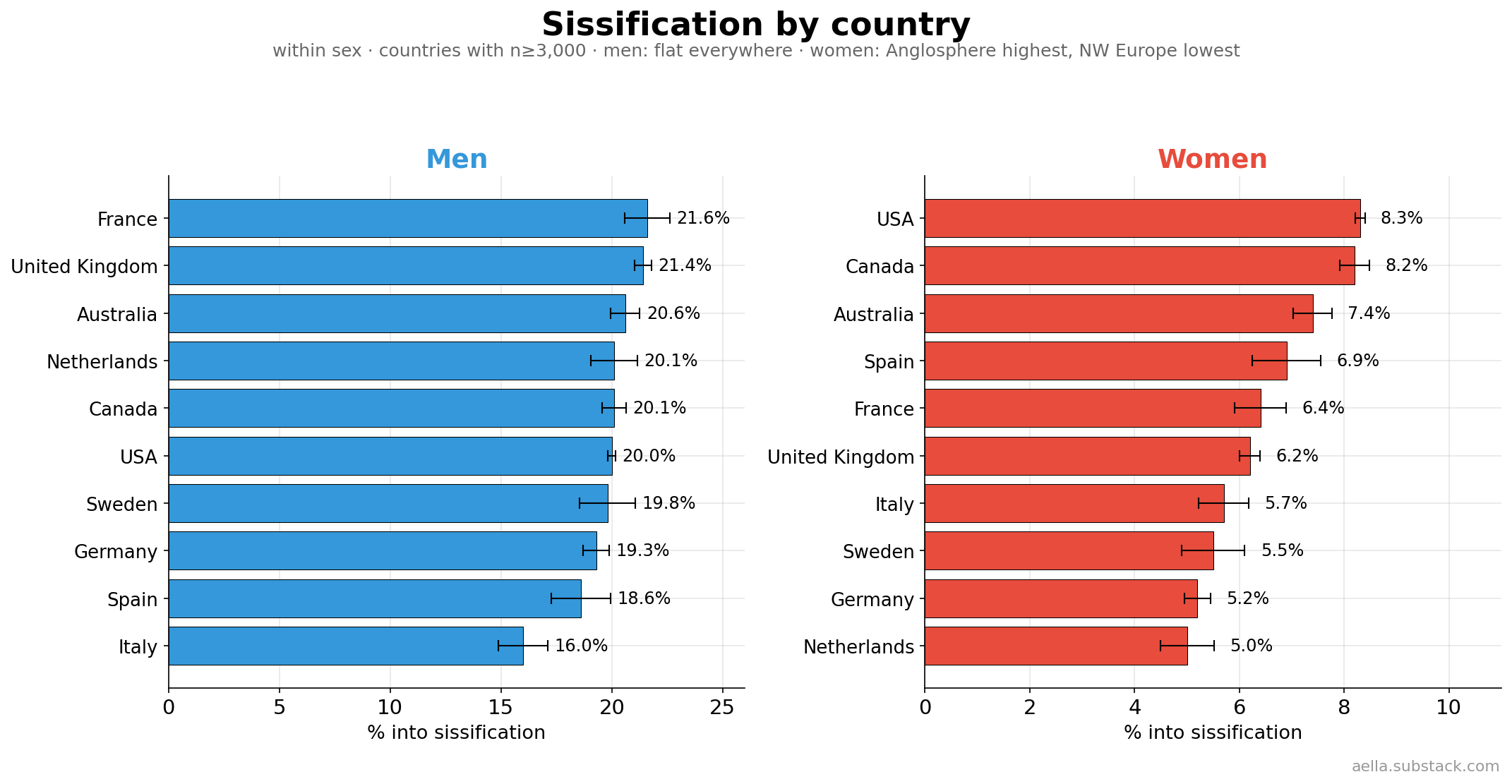
For men, the striking thing is the flatness: every large country lands between 16% and 22% (Italy lowest, France/UK top). Whatever produces sissification in men, it operates at nearly the same rate across the Western world. Women show a real cultural gradient: Anglosphere women (USA/Canada 8.3%) are ~60% more likely to be into it than northwest-European women (Germany 5.2%, Netherlands 5.0%) — plausibly a femdom-culture difference, since women's interest is mostly sissifier-side.
Age, porn onset, first sex
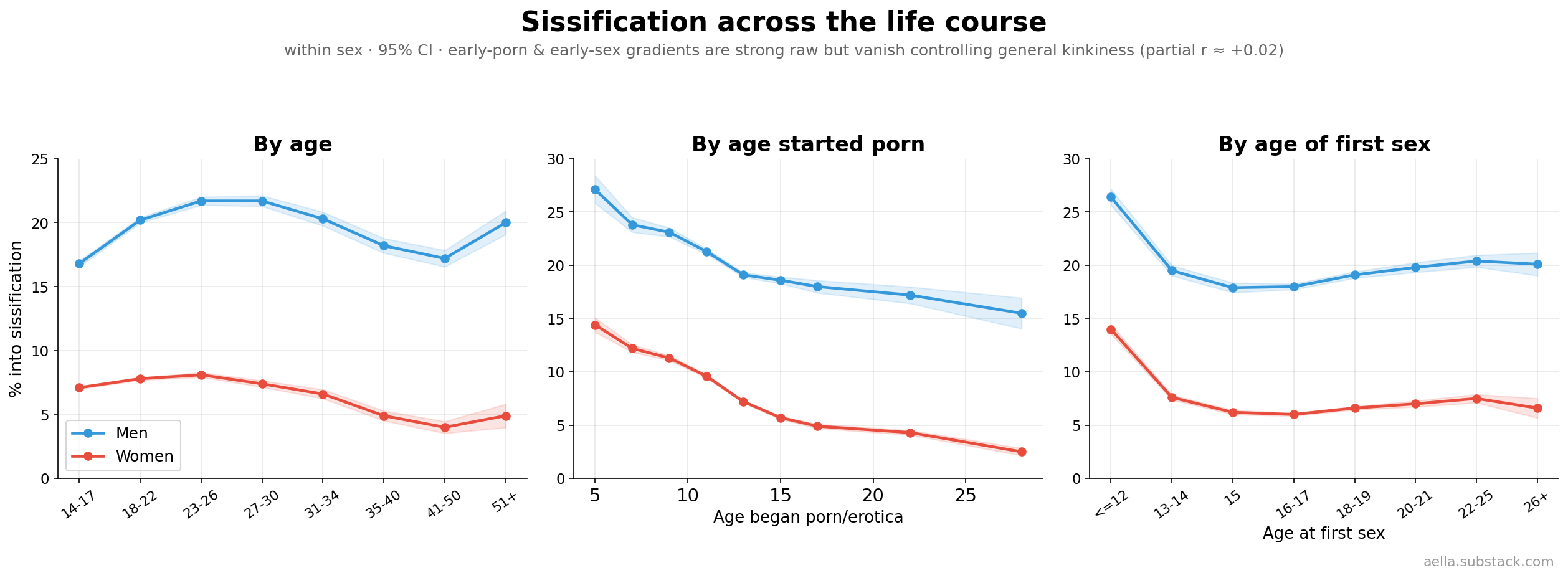
- Men keep it for life; women age out of it. Men: 17% as teens, peaking ~22% at 23–30, still 20% at 51+. Women: ~8% through the twenties, then halving to ~4–5% after 35. (Cross-sectional, so cohort effects can't be ruled out.)
- Earlier porn predicts more sissification — but it's not specific. The raw gradient is steep, especially in women (14.4% among those who started ≤5 vs 2.5% among 26+ starters). Yet controlling general kinkiness, the partial correlation collapses to ≈ +0.02: early porn predicts being kinkier across the board, and sissification just rides that. Same story for the early-first-sex (≤12) spike — elevated for everything, not this kink in particular.
- Virgins/non-answerers are exactly at their sex's average — interest doesn't depend on sexual experience.
KINK SIGNATUREWhat it's really about
Sissification correlates with being kinky in general (r = .33 with overall arousal breadth), so the interesting question is what's distinctive about it. The chart below shows partial correlations with every other kink category, holding overall kinkiness, age, and sex constant — i.e. how a sissification-interested person differs from an equally-kinky same-sex peer who isn't. (Unlike the mental-health results, this pattern barely moves when sex is added — it's robust.)
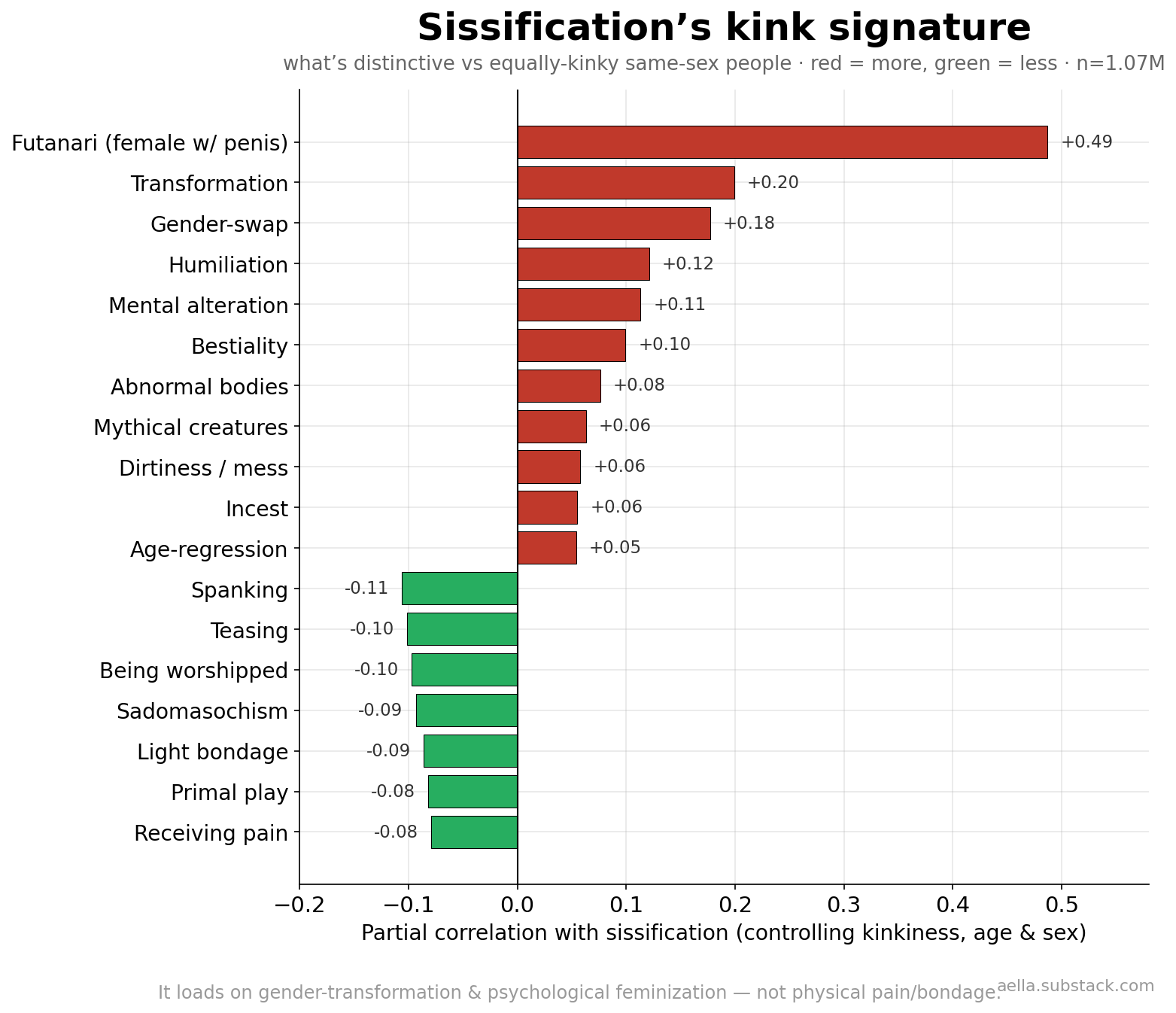
The answer is unusually clean. Sissification is a gender-transformation and psychological-feminization kink:
- Futanari (female-with-penis) is its overwhelming companion (partial r = .51) — the same fantasy of feminized/androgynous bodies.
- Transformation, gender-swap, and mental alteration follow — the appeal is becoming, or being made into, something feminine, often against the will (humiliation, mindbreak).
- It loads negatively on the classic physical-BDSM cluster — spanking, receiving pain, S&M, bondage, teasing. Whatever sissification is, it is not primarily about sensation or impact.
- There's a faint taboo-transgression tail (incest, age-regression, abnormal bodies) typical of transformation-adjacent fantasy, but these are small relative to the gender-transformation core.
MENTAL HEALTHDisorder, or just kinkiness — and sex?
People into sissification report more autism, ADHD, depression and anxiety than average. But two things inflate that before you read anything into it. First, they're a kinky subgroup, and kinky people report more of nearly everything. Second — and this is the trap — the group is heavily male, while depression, anxiety, and abuse history are reported far more by women (anxiety: 60% of women vs 33% of men). A male-skewed group will look "less anxious" for reasons that have nothing to do with the kink. The honest test compares sissification people to equally-kinky peers of the same sex.
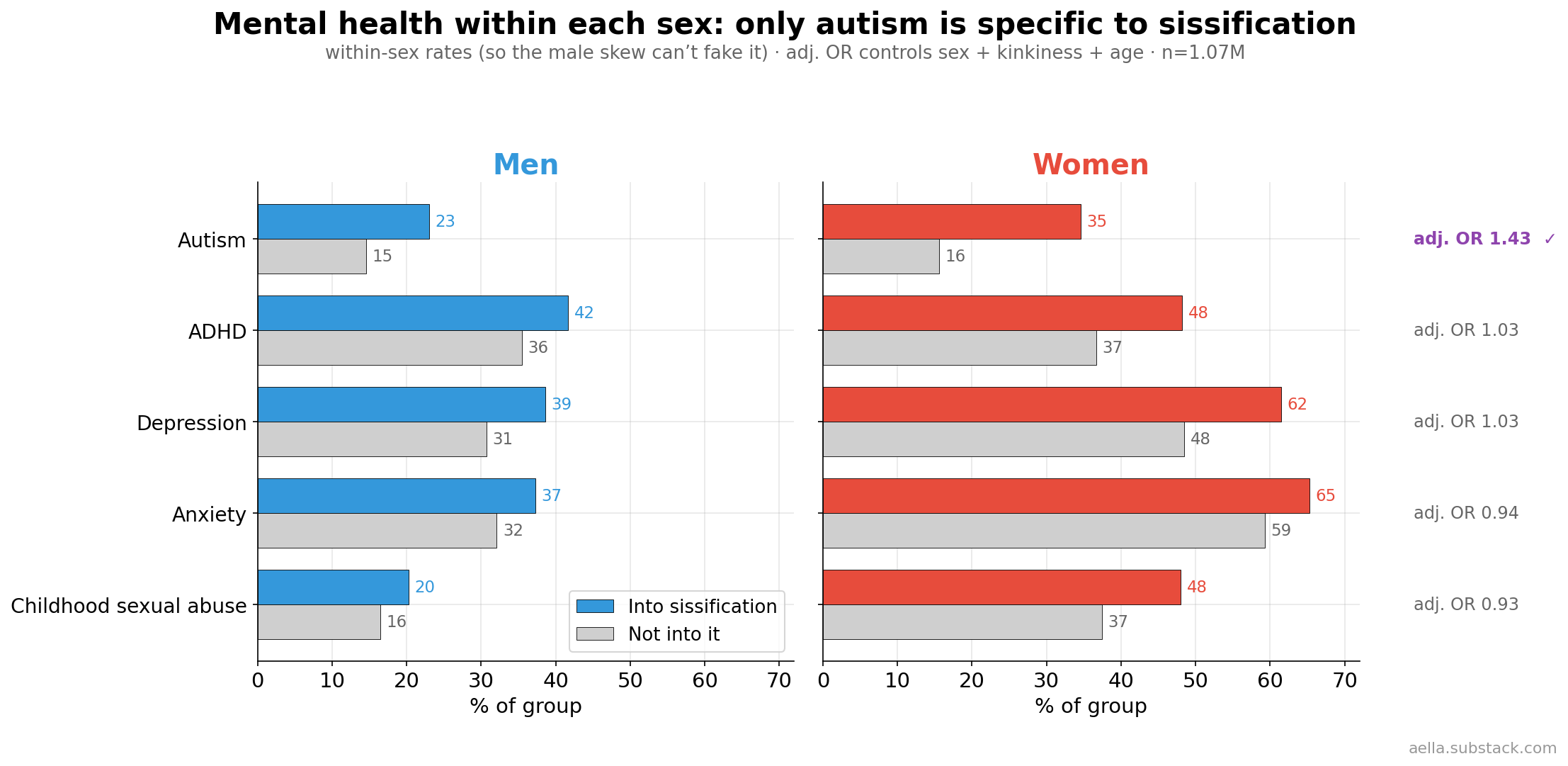
Split by sex, the confound is plain: the women's panel sits far higher on depression/anxiety/abuse regardless of sissification. Within each sex, sissification people are above their non-sissi peers on every measure — the generic kinky-subgroup lift. The adjusted odds ratios on the right (controlling sex, kinkiness and age) isolate what is actually specific to sissification:
- Autism is the one real, specific signal — with a caveat. Elevated in both sexes (women 35% vs 16%; men 23% vs 15%) and holding at OR 1.4 overall after controlling sex, kinkiness and age. But autism is also elevated among trans/nonbinary people, who are high-interest — so we re-ran it among cis people only: cis women keep nearly the full effect (17.4% vs 9.6%, OR 1.42) while cis men retain only a modest one (14.1% vs 10.3%, OR 1.16). So the autism link is robust but partly routed through gender-nonconformity, especially in males. It echoes autism's links to transformation- and fantasy-heavy kinks generally.
- Depression, ADHD, anxiety, and childhood sexual abuse are not specific to it. Their raw gaps shrink to adjusted ORs of ~0.9–1.0 — among same-sex, equally-kinky people, sissification adds essentially nothing. (An earlier version of this page reported these as slightly protective; that was an artifact of not controlling sex, now fixed.)
- Shame is mostly generic too. More sexual shame raw (d = 0.44), but only a sliver survives adjustment (partial r ≈ .09).
- Porn-linked: heavier porn use and a younger porn-start age — again largely via general kinkiness, and notably not tilted toward violent porn, consistent with the humiliation-not-pain signature.
CAVEATSHow to read this
Fantasy, not behavior. "Into sissification" = arousal/interest, with no question about real-world practice.
Unweighted. Figures use the freshest full pull (n=1,071,355) without population weighting — appropriate for the correlational claims here (per house preference: weighted for base rates, unweighted for correlations), but another reason the 12% is sample-specific.
"Adjusted" = controlling sex, a 60-item arousal-breadth composite, and age, via partial correlation / logistic adjustment. Sex matters because sissification is male-skewed and many traits/kinks are sex-skewed too; the kink composite separates "specific to sissification" from "this person is just very kinky." The kink signature is barely changed by adding sex (it shrinks ~15%); the mental-health picture changes a lot. Cross-sectional — no causal claim.