TL;DRFour headlines
- Raw, the classic result replicates with a twist. Angry spanking predicts much worse adult wellbeing (−0.45 SD). Calm spanking predicts slightly better wellbeing (+0.13 SD) — already in the raw data, before any controls.
- Adjusted, nearly everything collapses — including angry spanking. Against people from equally loud, cold, unpredictable households, angry spanking at 0–12 keeps only −0.05 SD (still significant); teen angry spanking, calm spanking, and general physical discipline keep essentially nothing. The expectation "angry survives, calm collapses" is half right: calm collapses to zero, but angry nearly collapses too. The harm signal lives almost entirely in the household, not the hitting.
- "Calm" spanking usually isn't the whole story: 41% of people calm-spanked at 0–12 were also angry-spanked at 0–12. But calm spanking itself is uncorrelated with household chaos (r=−.05) and slightly positively correlated with parental warmth (r=+.10) — angry spanking is the chaos marker (r=.52 with the aggro battery, −.43 with warmth).
- In matched homes, the residue is small and asymmetric. In warm homes, calm-only-spanked kids end up indistinguishable from (even trivially better than) the never-physically-disciplined: Δ=+0.02 SD (women), +0.07 (men), both within CI of zero. In chaotic homes, angry-spanked kids do worse than unspanked kids from the same chaos: Δ=−0.19 (women), −0.12 (men).
THE QUESTIONSWhat was actually asked
Every childhood item is rated twice (ages 0–12 and 13–18) on a 7-point agree scale (−3 = strongly disagree … +3 = strongly agree). Verbatim, from the survey source:
| Variable | Question ("during ages 0–12 / 13–18:") | n |
|---|---|---|
| angryspank/b | "Your parents used angry/uncontrolled/unpredictable spankings as a form of discipline" (tip: if they were calm/controlled/predictable, this does NOT count) | 26,398 / 26,378 |
| calmspank/b | "Your parents used calm/controlled/predictable spankings as a form of discipline" (tip: if they were angry/uncontrolled/unpredictable, this does NOT count) | 26,428 / 26,409 |
| loud7/b | "your parents physically disciplined you in an irregular, emotionally expressive way" | 39,387 / 39,366 |
| etc6/b | "your parents physically disciplined you" (general) | 37,566 / 37,552 |
Definitions used throughout. "Endorsed" = any agreement (>0). Adult wellbeing = mean of five z-scored adult items — depression, anxiety, suicide ideation, "I am not happy" (all reversed) and the quality-of-life composite — re-standardized, higher = better (n=42,096; mean inter-item r=.51). The survey's "at war with yourself" item exists only as a childhood question, so it is excluded from the adult composite. There is no relationship-with-parents-today question in this survey, so that outcome can't be tested. Family environment controls = (a) the aggro-household battery — loud/confrontational culture, adults yelled at you, verbal/emotional abuse of you, father→mother and mother→father verbal abuse, parents had a bad relationship, parents unpredictable — with the physical-discipline item deliberately excluded so the control doesn't swallow the exposure; (b) parental warmth (the 14-item goodparent battery: guidance, respect, unconditional love, honesty, humor, physical affection, apologizing). The angry/calm spanking battery was added late (survey version 315+), so those analyses run on ~25–26k respondents; per-figure n is printed on each chart.
WHO GOT SPANKEDPrevalence and the co-occurrence problem
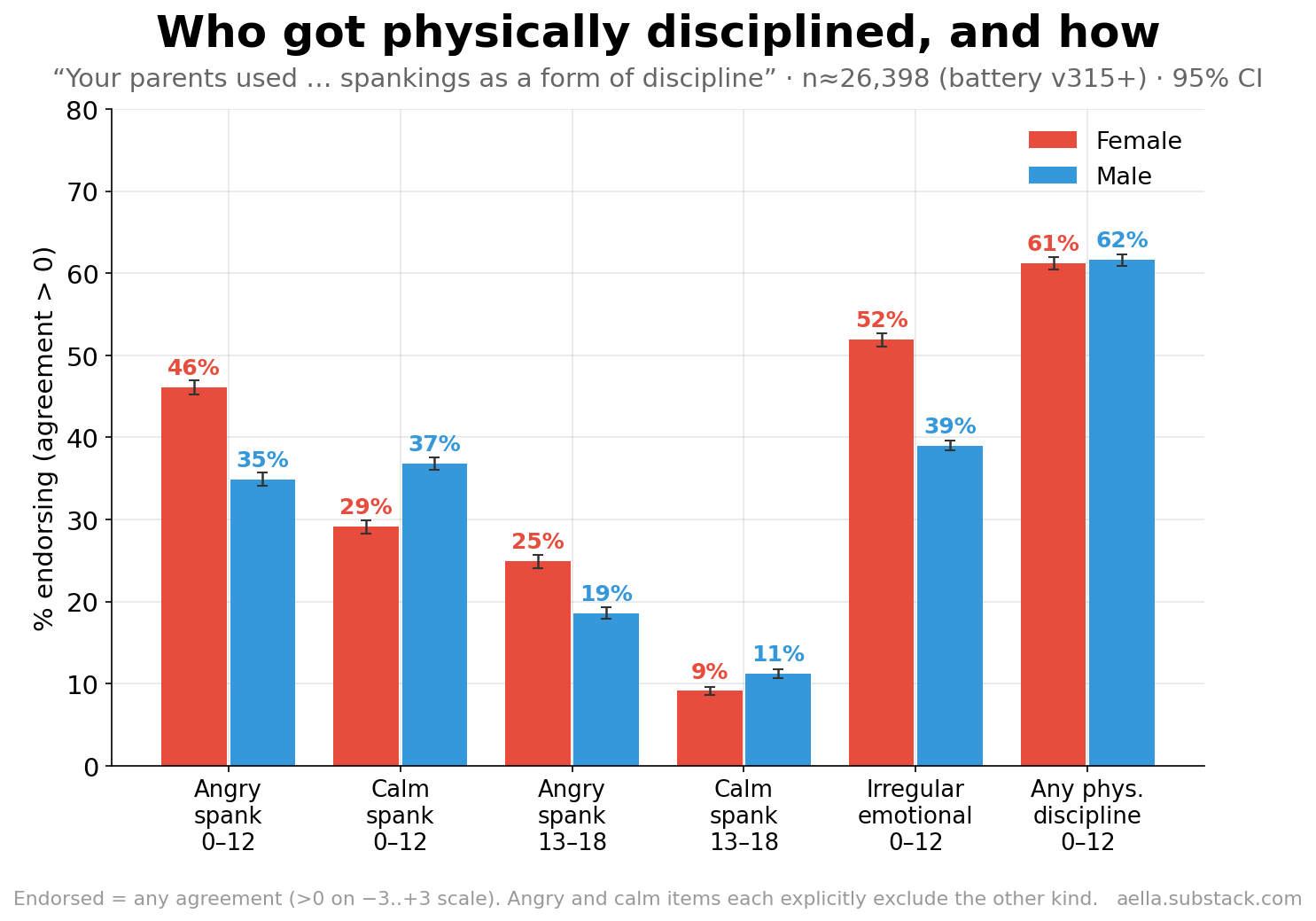
Physical discipline was the norm: 61% report at least some at 0–12. Angry spanking at 0–12 hits 40% (women 46%, men 35%); calm spanking 33% — with the sex pattern reversed (men 37%, women 29%). Either women's parents really did spank daughters more angrily and sons more calmly, or the same childhood is remembered differently by sex; this data can't separate those, and the same caution applies to the "irregular, emotionally expressive" item (women 52% vs men 39%). Everything drops sharply for ages 13–18: angry 22%, calm 10% — spanking teens is much rarer, and when it happens it's disproportionately the angry kind.
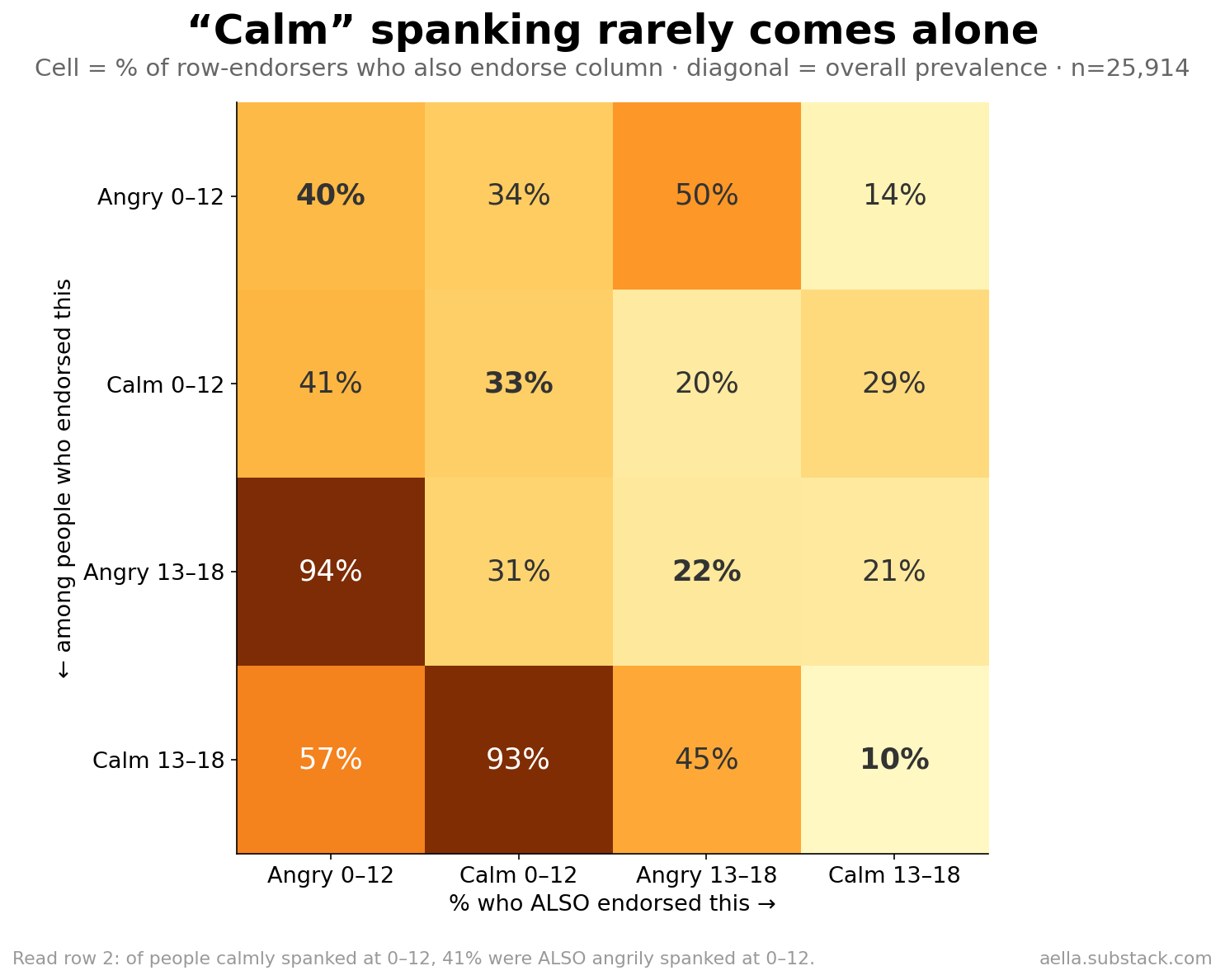
The matrix shows why "I was spanked calmly and I'm fine" and "spanking ruined people" talk past each other. Of those calm-spanked at 0–12, 41% were also angry-spanked at 0–12 — so a naive "ever calm-spanked" group is heavily contaminated with angry spanking. Teen spanking is almost never new: 94% of teen-angry-spanked were already angry-spanked as kids, 93% of teen-calm-spanked already calm-spanked. Still, the two styles are nearly orthogonal as traits (item correlation r=.09): plenty of homes had only one kind.
RAW OUTCOMESAngry spanking devastates; calm spanking… helps?
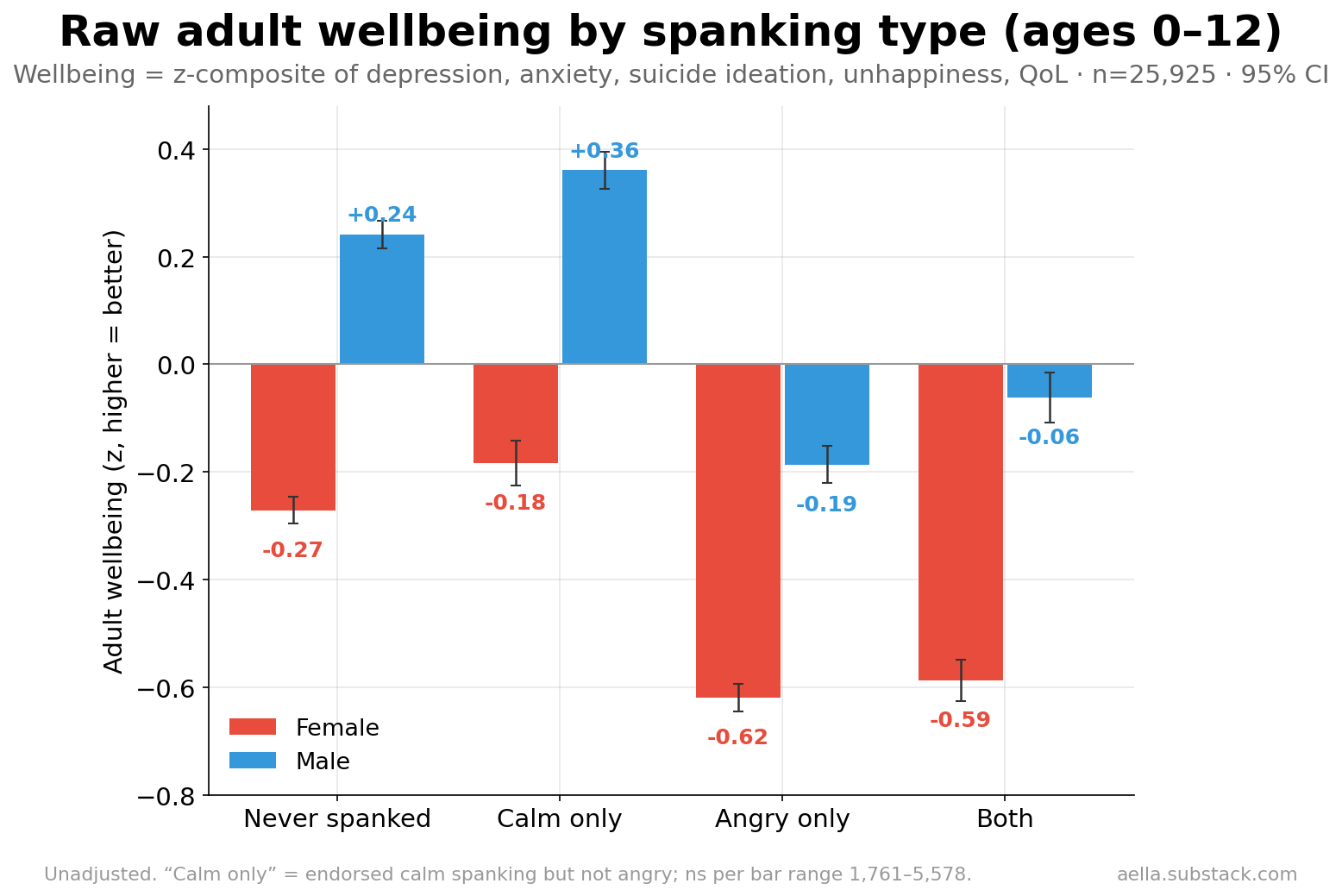
Unadjusted, in mutually exclusive 0–12 groups: anyone with angry spanking in the mix lands far below the never-spanked — angry-only is −0.35 SD below never-spanked among women and −0.43 among men. But the calm-only group sits above the never-spanked in both sexes (+0.09 women, +0.12 men). Raw spanking-vs-not comparisons that don't split by style average these opposites together, which is how "any physical discipline" shows a moderate raw penalty of −0.24 SD.
Why would calm spanking look protective raw? Because of who does it: calm spanking is essentially uncorrelated with the aggro-household battery (r=−.05) and slightly positively correlated with parental warmth (r=+.10). Angry spanking is the opposite — r=.52 with household aggression, r=−.43 with warmth. "Was your spanking angry or calm" is mostly a question about what kind of family you had.
THE CENTERPIECESpanked, vs equally-chaotic-but-not-spanked
The trick: instead of comparing spanked kids to everyone else, compare them to people from equally loud, hostile, unpredictable, equally warm-or-cold households (plus sex and age) who weren't spanked. Whatever survives that comparison is the part you can still try to pin on the spanking itself.
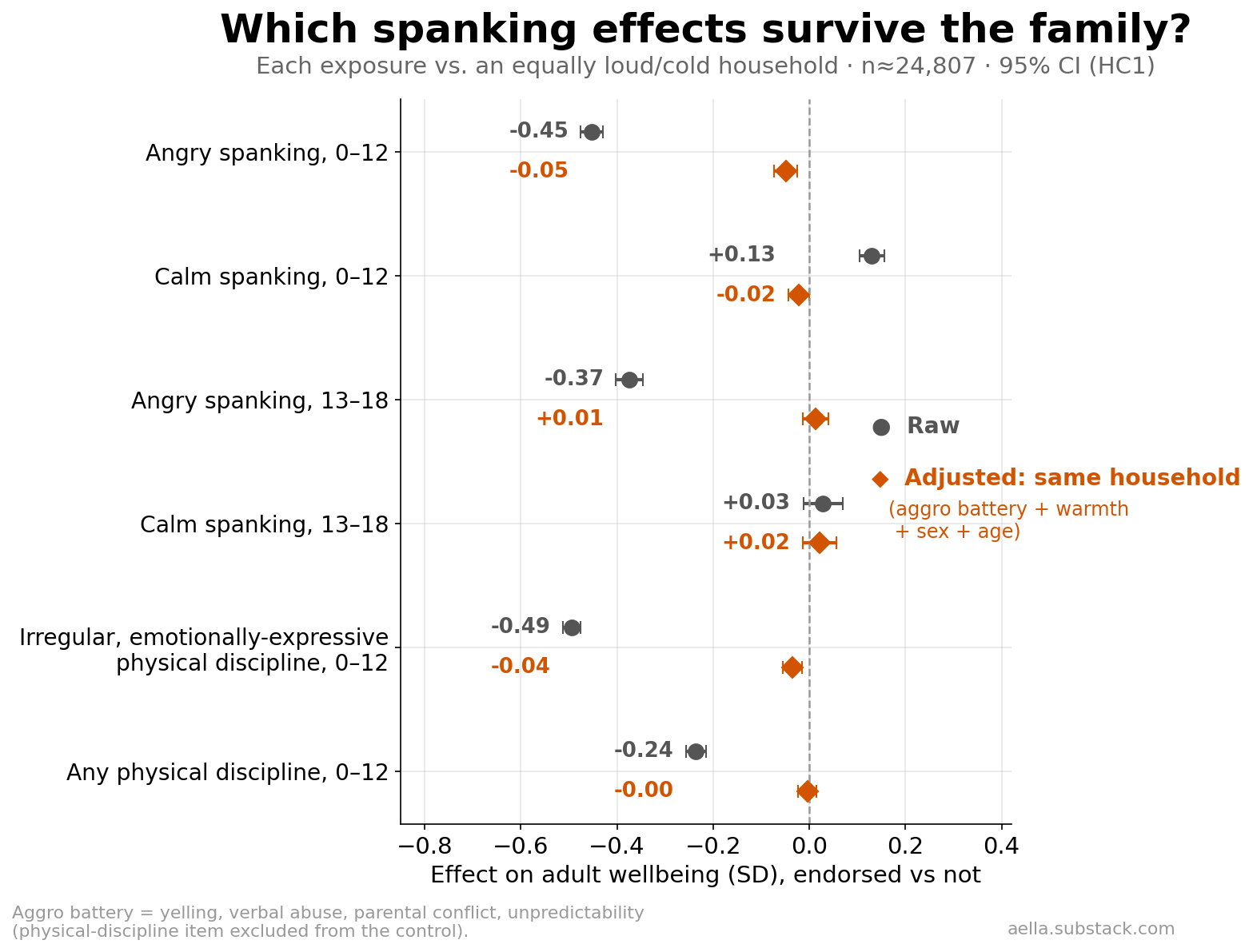
What survives: almost nothing.
- Angry spanking 0–12: −0.45 → −0.05 SD. Ninety percent of the raw penalty is the household. The residual −0.05 (95% CI −0.07 to −0.03) is real but tiny — and sex-split, it's carried by women (−0.08 ± 0.03) more than men (−0.02 ± 0.04, ns).
- Angry spanking 13–18: −0.37 → +0.01. The teen version collapses completely. Teen angry spanking marks a chaotic home, and adds nothing measurable beyond it.
- Calm spanking: +0.13 → −0.02 (0–12), +0.03 → +0.02 (13–18). The raw "benefit" was the warm-family halo; against matched households calm spanking is a precise zero. It neither helps nor measurably hurts.
- "Irregular, emotionally expressive" physical discipline: −0.49 → −0.04. The single most predictive item raw, and it also nearly vanishes. General physical discipline: −0.24 → −0.00.
Entering all four spanking types simultaneously with the environment controls (n=24,807) tells the same story with one wrinkle: angry 0–12 keeps −0.07 ± 0.03, calm 0–12 −0.03 ± 0.03, while both teen terms flip trivially positive (+0.05 ± 0.03 and +0.04 ± 0.04) — classic suppression residue once childhood spanking and household are held, not evidence teen spanking helps. For scale: in that same model, household aggression carries −0.20 and warmth +0.25.
SAME HOMEWarm homes that spank calmly, chaotic homes that spank angrily
A more concrete version of the same question, in plain group means. Take only warm homes (top tercile of the warmth battery): compare calm-only-spanked kids (calm yes, angry no) to kids never physically disciplined at all (no angry, no calm, no general physical discipline). Then take chaotic homes (top tercile of the aggro battery): compare angry-spanked to never-physically-disciplined.
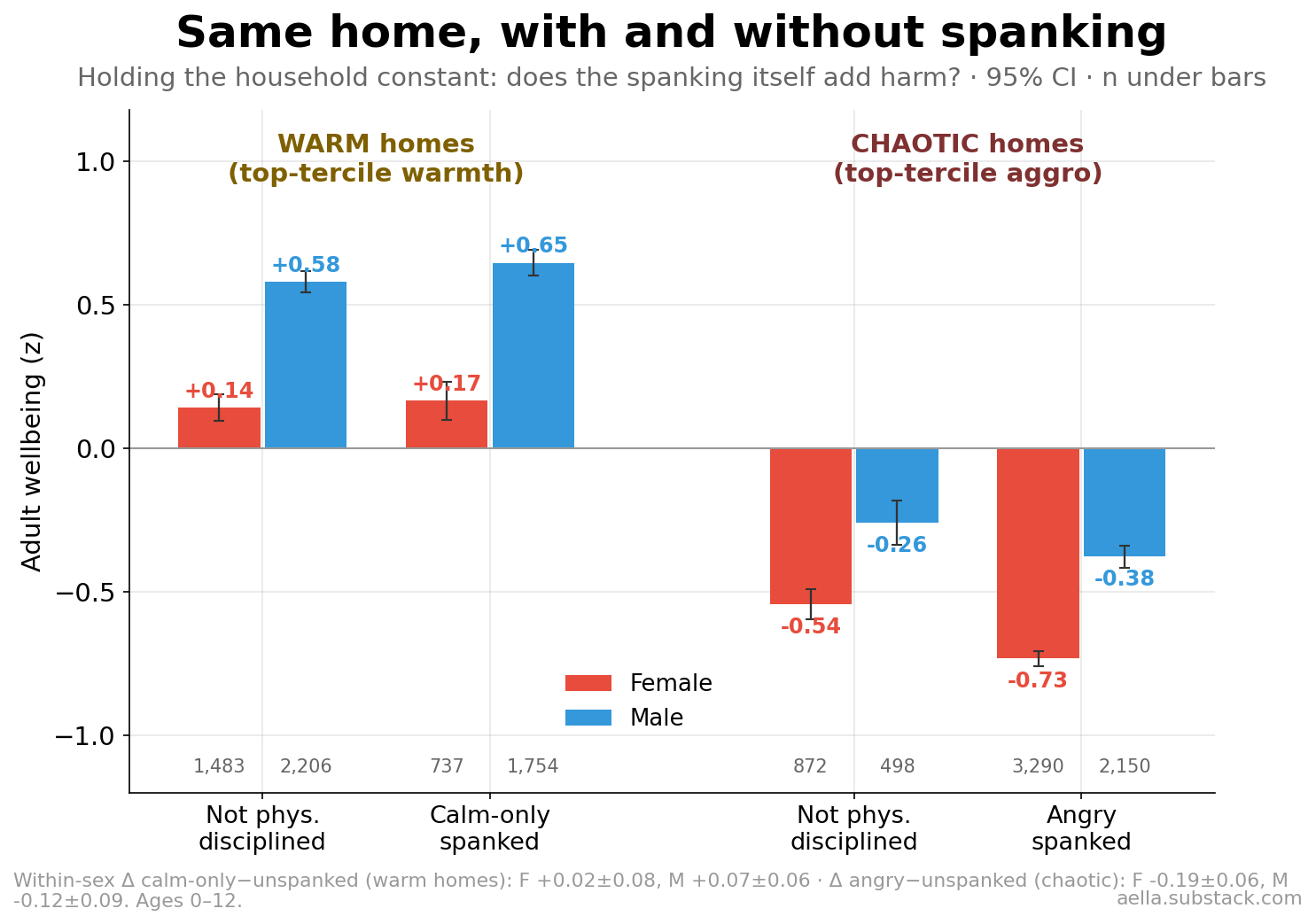
Warm homes: calm-only-spanked kids are statistically indistinguishable from unspanked kids — Δ = +0.02 ± 0.08 SD (women), +0.07 ± 0.06 (men). If calm spanking by otherwise-warm parents leaves a scar on adult wellbeing, it is smaller than this design can see at n≈6,200. Chaotic homes: angry spanking does add measurable harm beyond the chaos — Δ = −0.19 ± 0.06 (women), −0.12 ± 0.09 (men). Consistent with the forest plot: the only place a spanking-specific penalty shows up is angry spanking, and it's a tenth-or-two of an SD, not the half-SD the raw numbers suggest.
Caveat for the warm-home cell: "warm home + angry spanking" exists too (warmth and angry spanking are negatively but not perfectly correlated), and within warm homes the angry-spanked also sit slightly lower. The clean reading: style matters more than act — and even style is mostly a proxy for everything else the parents did.
DOSE-RESPONSEGradients, and whether teen spanking is different
The items are agreement scales, not frequency counts — but agreement intensity behaves like a dose here (a "strongly agree" on angry spanking is a stronger exposure claim than "slightly agree").
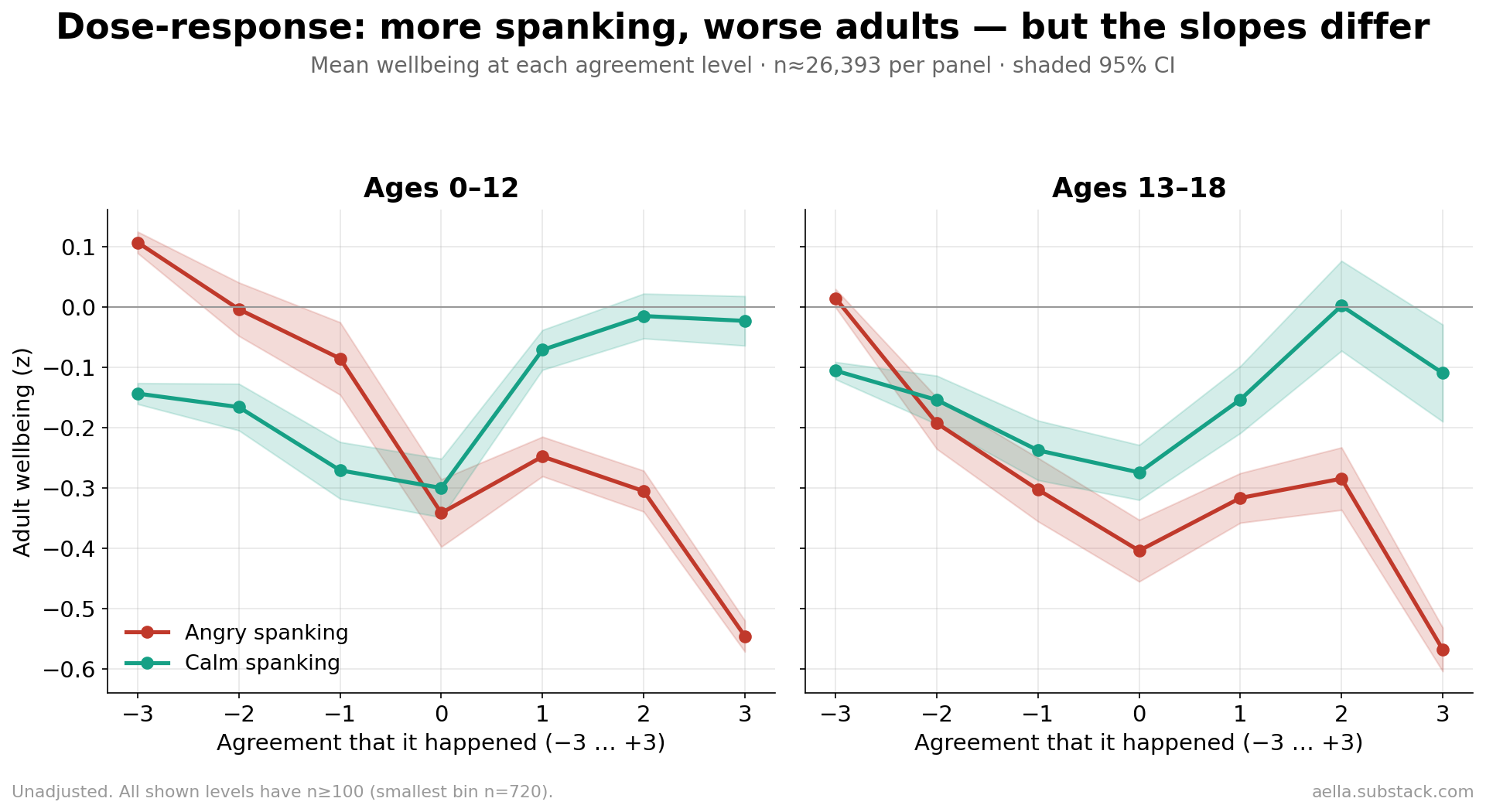
Angry spanking shows a clean monotone slide on the endorsement side: each step from "slightly" to "strongly agree" costs more wellbeing, ending −0.55 SD below the sample mean at strong agreement (0–12), with the teen curve nearly as steep. Calm spanking's line is comparatively flat on the endorsement side — strong-agree calm spanking sits about where slight-agree does. Standardized: a 1-SD increase in angry-spanking agreement predicts −0.25 SD wellbeing raw but only −0.03 adjusted; calm +0.04 raw, −0.02 adjusted; teen angry −0.19 raw, −0.00 adjusted. So the teen "signature" is: identical confounded signal, even less surviving adjustment than the 0–12 version. The dip at the disagree-end (people who answer −1/0 do worse than firm −3 responders) appears for both items and likely mixes mild exposure with unsure/ambivalent responding.
R² HONESTYHow much information is actually in the spanking items?
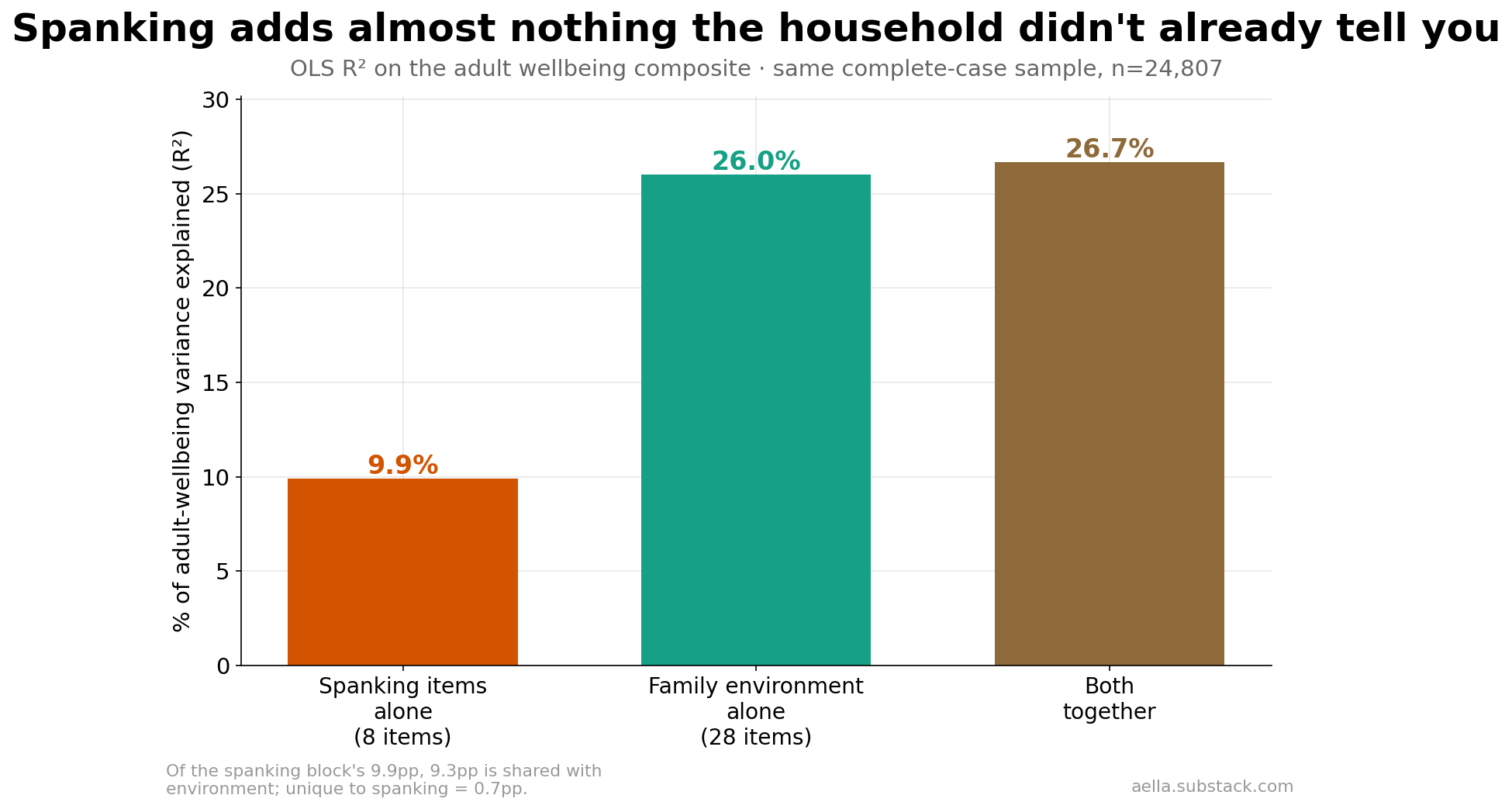
On the same complete-case sample (n=24,807): all 8 physical-discipline items together explain 9.9% of adult-wellbeing variance. The 28 environment items (aggro battery + warmth, both age bands) explain 26.0%. Both together: 26.7%. So of spanking's 9.9 points, 9.3 are shared with the environment measures and 0.7 are unique; environment keeps 16.8 unique points. Stated plainly: once you know how loud, hostile, unpredictable, and warm the household was, asking about spanking improves your prediction of adult wellbeing by less than one percentage point of variance — and the reverse is not true.
INSIDE THE HOUSEHOLD BATTERYWhich items do the absorbing?
Everything above controlled for the household using two composite scores — the aggro battery and the warmth battery, which were built as public-facing constructs for the survey's results page. Composites can hide their own action: "the household absorbs the spanking effect" doesn't say which facts about the household. So here the composites are unbundled: all four spanking types plus every individual battery item (each item = its 0–12 and 13–18 ratings averaged, per SD) enter one model together, with sex and age. The duplicate item is dropped (the survey engine copies "parents had a bad relationship" into the aggro battery; it's used once), and "parents were predictable" is reversed to read as unpredictability.
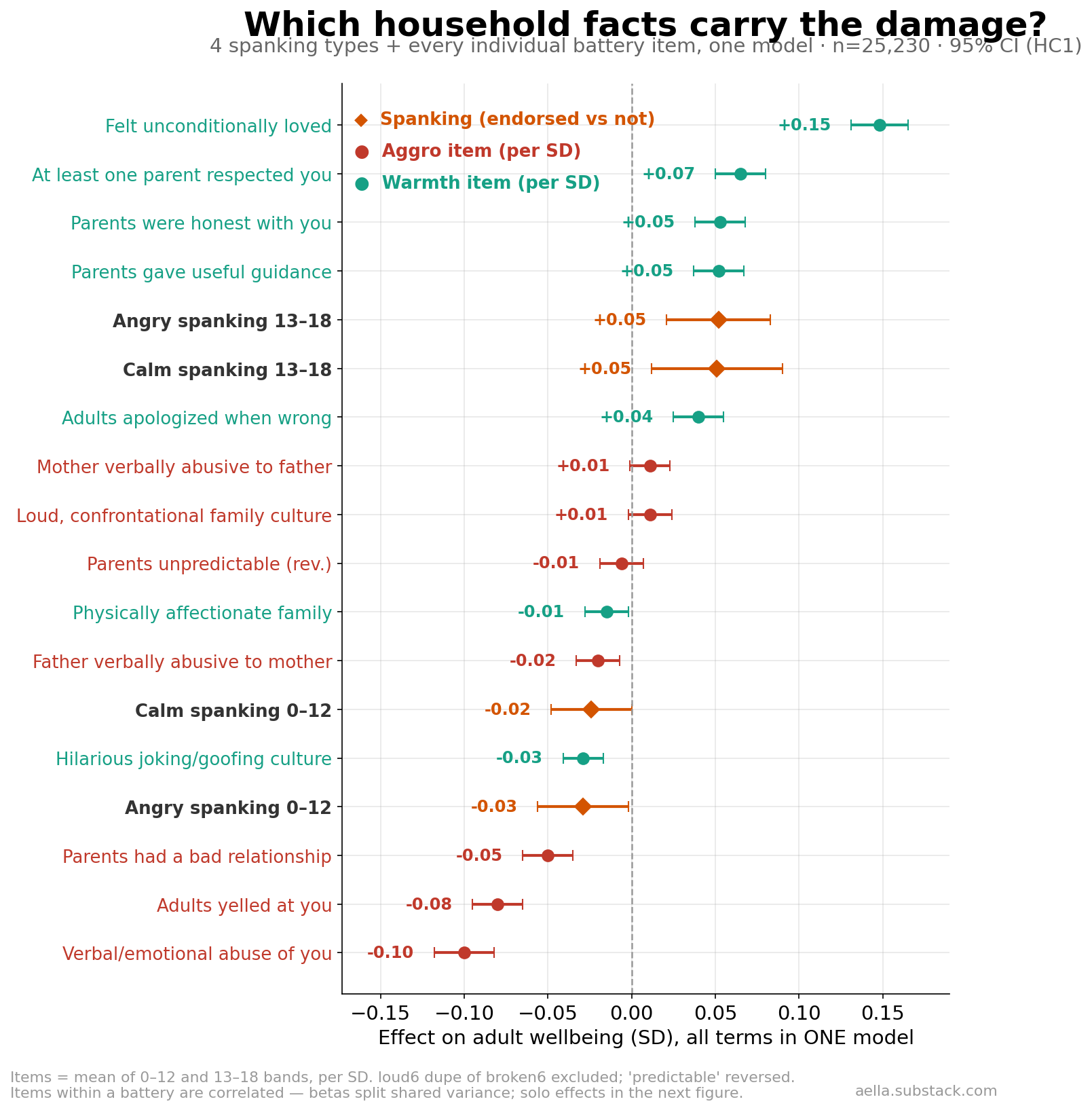
The damage is carried by a specific, short list:
- Verbal/emotional abuse of you (−0.10 per SD) and adults yelling at you (−0.08) are the two strongest negative household facts — direct verbal aggression at the child, not ambient noise.
- Parents having a bad relationship (−0.05) and father→mother verbal abuse (−0.02) add smaller independent penalties; mother→father abuse and a generally "loud, confrontational culture" carry nothing once the directed-at-you items are in the model — and unpredictability, the standard theoretical reason angry spanking should be worse, is a flat zero (−0.01 ± 0.01) as an independent item.
- On the warmth side one item towers over everything in the model, spanking included: "you felt unconditionally loved" (+0.15 per SD), followed by being respected (+0.07), honesty (+0.05), useful guidance (+0.05), and adults apologizing (+0.04).
- With the 14 items in place of the composites, angry spanking 0–12 shrinks further, from −0.05 to −0.03 ± 0.03 (p=.03, barely significant); calm 0–12 is −0.02 (ns). The teen terms show the same trivial positive suppression residue as before (+0.05 each). So even the report's headline residual was partly the composite control being too coarse.
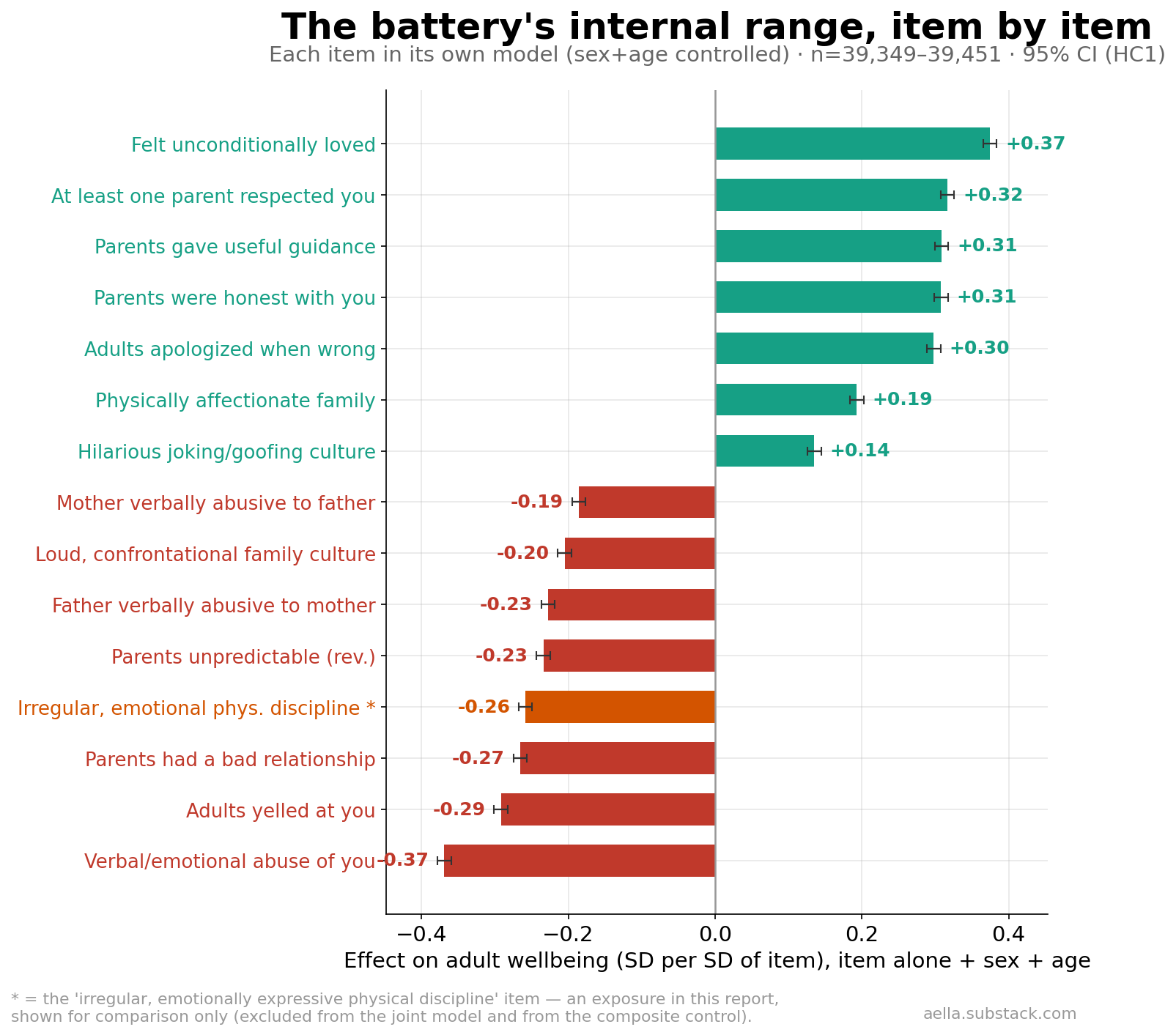
Item by item (each alone, sex+age controlled), the aggro battery spans a 2× internal range: from −0.19 SD per SD (mother→father verbal abuse) up to −0.37 (verbal/emotional abuse of you), with yelling at −0.29, a bad parental relationship −0.27, unpredictability −0.23. For comparison, the "irregular, emotionally expressive physical discipline" exposure item sits mid-pack at −0.26. The warmth items run +0.14 to +0.37, topped by unconditional love — solo, the single most predictive item in either battery. The batteries are not seven copies of one number, and the items that matter most are the relational ones (abuse aimed at you; love you could count on), not the structural ones (volume, predictability).
Does the residual −0.05 hide in unloved homes?
There's no "parents were proud of me" item in this survey; the two strongest warmth items are "you felt unconditionally loved" and "at least one parent respected you", so those carry the interaction test (angry spanking 0–12 × item, on top of the full control set). The naive linear interaction comes out significantly negative for both (−0.05 ± 0.02) — which would read "angry spanking hurts more in loving homes" — but it's an artifact: the item→wellbeing curve is convex, and allowing a quadratic item term nulls the interaction completely (unconditional love: +0.00, p=.88; respect: −0.01, p=.25). The honest readout is the stratified one: the adjusted angry-spanking penalty is −0.09 among people who strongly deny the item (bottom group on either love or respect) versus −0.03 to −0.05 everywhere else. Suggestive of concentration at the very bottom — angry spanking with no felt love behind it — but with overlapping CIs (±0.04–0.06), it's a hint, not a finding.
Do items beat the composites overall?
Same complete-case sample (n=24,807): the report's composite control set (aggro + warmth + sex + age) explains 29.3% of wellbeing variance; the 14 items + sex + age explain 31.1% (+1.8pp; 31.8% if every age band enters separately). Adding the four spanking terms on top of the items moves it by +0.06pp. So unbundling buys slightly sharper measurement — enough to halve the already-tiny angry residual — and spanking remains a rounding error either way.
CAVEATSHow to read this
Self-selected, very-online sample — young (mean age 27), left-leaning, heavily LGBT-enriched. Absolute prevalences (the 40%, the 61%) describe this sample, not the population; the comparisons and orderings are the robust part. The spanking battery exists only for respondents from survey version 315 on (n≈26.4k of 43.9k).
Cross-sectional, no causal claims. "Survives adjustment" means "predicts beyond measured household variables," not "causes."
Genetic and unmeasured confounding. Parents who spank in rage differ from other parents in many ways — including temperament their children partly inherit. Twin and adoption designs typically shrink discipline effects further; nothing here controls genes, neighborhood, school, or anything outside the home batteries. The honest bound on the spanking-specific effect is therefore "−0.05 SD or smaller."
One outcome family. Adult wellbeing (mood, suicidality, QoL) is the target here. Spanking could matter for outcomes not modeled (e.g., the parent-child relationship today — not asked in this survey).