TL;DRFive headlines
- AGP-type fantasy is normal, not niche. Nearly two-thirds of cis straight men report at least slight arousal at picturing themselves with a female body; 38% say Moderately+. [Hardweight population estimate: 56% any, 31% moderately+ — lower, but still nothing like a rare paraphilia.] The clinical framing of AGP as a rare paraphilia does not survive contact with anonymous data.
- The famous typology fails at scale — backwards. Blanchard's theory says AGP should concentrate in trans women attracted to women and be near-absent in those attracted to men. In 11,363 trans women, the women-attracted score lowest (60% mod+) and the men-attracted highest (81%).
- Autoandrophilia is real and common. Half of cis straight women report some arousal imagining a male body; trans men show the same elevated pattern as trans women, with the same reversed orientation gradient.
- In cis straight men, AGP travels with sissification, crossdressing, and attraction to trans women — not autism. Sissification interest runs 4.8% → 37.5% from no-AGP to high-AGP; the autism link is ~zero once kinkiness is controlled (unlike sissification's).
THE MEASURESA short history of AGP questions in this survey
The user hunch that "we measure it a few different ways, some discontinued" is exactly right. The inventory:
| Measure | Status | Coverage | What it asks |
|---|---|---|---|
| blanchard1m/2m/3m | added ~Mar 2025, active | 128,263 males | Core Autogynephilia items: picturing self with nude female body / own female parts / being admired as a woman (0–5 arousal; items 2–3 gated on item 1) |
| blanchard1f/2f/3f | added ~Mar 2025, active | 157,255 females | the autoandrophilia mirror |
| "existing as a biological female/male is erotic" (4 items) | removed 5/17/25 | not in current export | nonsexual-existence + masturbating-as versions, agreement scale |
| genderswapped (0–5) | long-running | full 1.07M | arousal to genderswapped body parts (e.g. men with breasts) — more about others' bodies than self |
| genderplay (0–5) + elements | long-running | full 1.07M | gender play overall; crossdressing/sissification/transgenderism element flags |
Methodology, stated plainly: every number on this page is raw, unweighted survey data — no population weighting exists for this pull, and none is applied. The Blanchard items use the survey's standard arousal scale (Not arousing / Slightly / Somewhat / Moderately / Very / Extremely), stored raw as {0,1,2,3,5,8} and recoded here to 0–5. "AGP composite" = mean of the three items with the gate honored (gate-skipped items scored 0 = not aroused). "Mod+" = Moderately or higher. Items live since ~March 2025.
THE ITEMS, VERBATIMThe six questions, exactly as asked
Both forms use the same three-item structure. Item 1 is asked of everyone on that form; items 2–3 appear only if item 1 was answered above "Slightly" (the gate). Assignment is by assigned sex at birth (biomale), so trans women get the male form and trans men the female form — which is what makes the typology test possible.
| Question (verbatim) | Gate | Answered | |
|---|---|---|---|
| blanchard1m | "When I picture myself as having a nude female body, I find this:" (tip: Where *your own* body is that of a nude female) | everyone AMAB | 128,263 |
| blanchard2m | "When I picture my own nude female breasts, buttocks, legs, or genitals, I find this:" | item 1 > Slightly | 68,323 |
| blanchard3m | "The thought of someone else admiring me while I am a woman in the nude is:" | item 1 > Slightly | 68,054 |
| blanchard1f | "When I picture myself with a nude male body, I find this:" (tip: Where *your own* body is that of a nude male) | everyone AFAB | 157,255 |
| blanchard2f | "When I picture my own nude male buttocks, legs, or genitals, I find this:" | item 1 > Slightly | 70,351 |
| blanchard3f | "The thought of someone else admiring me while I am a man in the nude is:" | item 1 > Slightly | 69,788 |
Where they come from: items 1–2 are modeled on Blanchard's Core Autogynephilia construct — arousal at picturing oneself with female anatomy, his anatomic-autogynephilia measure — while item 3 corresponds to his separate Autogynephilic Interpersonal Fantasy construct (arousal at being admired as a woman by someone else). So the survey carries one anatomic-general item, one anatomic-specific item, and one interpersonal item per form, rather than the full original scales. The items cohere accordingly: on the male form the two anatomic items correlate r = .70, while the interpersonal item sits looser (r ≈ .51–.53 with each).
A wording asymmetry to know about: the male-form item 2 lists "breasts, buttocks, legs, or genitals" but the female-form item 2 lists only "buttocks, legs, or genitals" — no chest term. Mirror-comparisons of item 2 across forms inherit that asymmetry.
HOW COMMONTwo-thirds of cis straight men feel at least a flicker
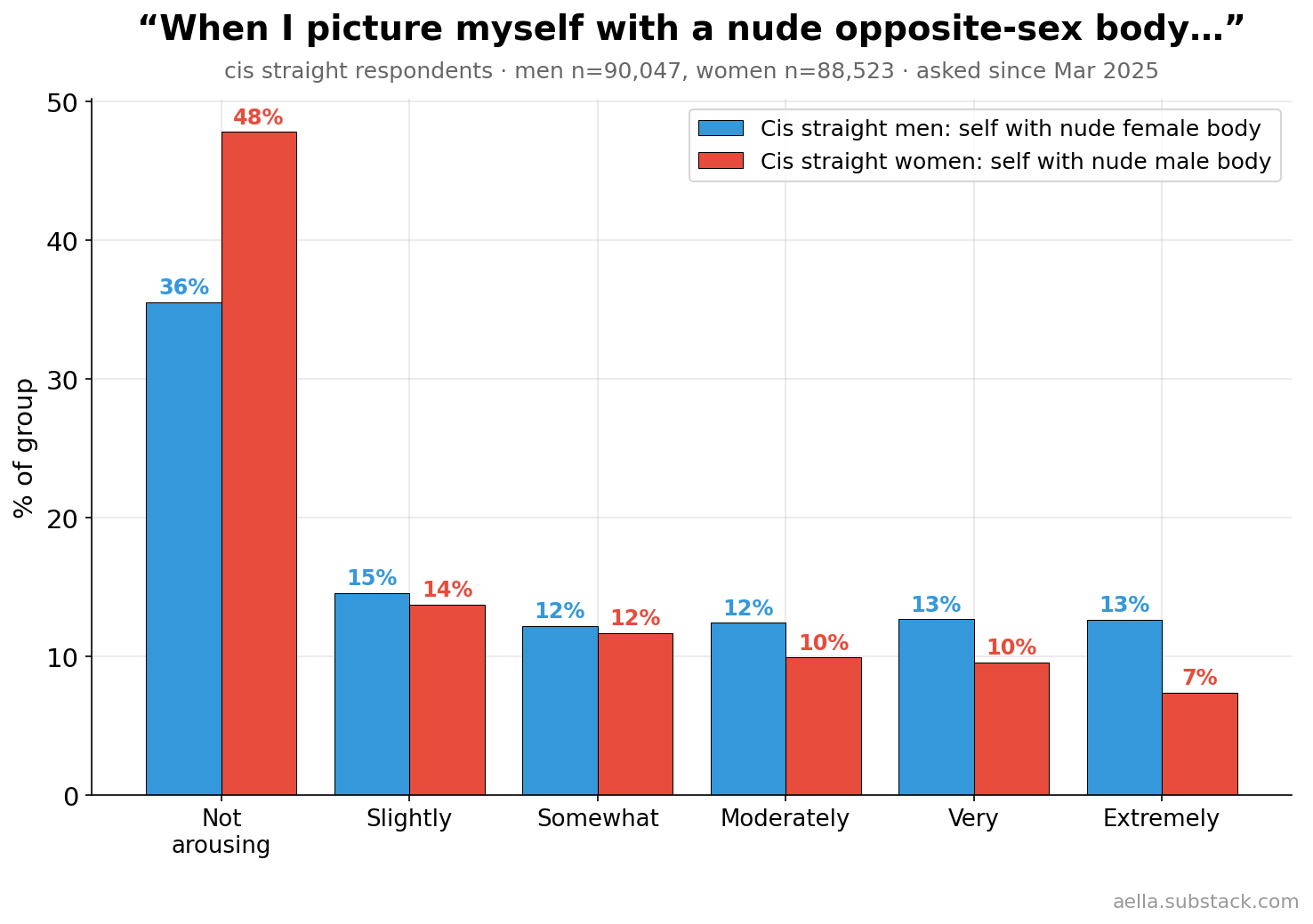
The full distributions for the cis straight majority. Men: 36% nothing, then a long plateau — 13% each at Very and Extremely. Women on the mirror item: 48% nothing, 7% Extremely. The male curve sits higher everywhere, but the female one is far from empty — these are fantasies a large minority of everyone has, with intensity declining smoothly rather than splitting into "normal vs paraphilic" clusters.
ITEM BY ITEMBreaking the composite apart
The headline numbers above use item 1 (or the composite). Here is every item separately — first the full answer distributions for the contrast groups, then Moderately+ rates for each item in each group.
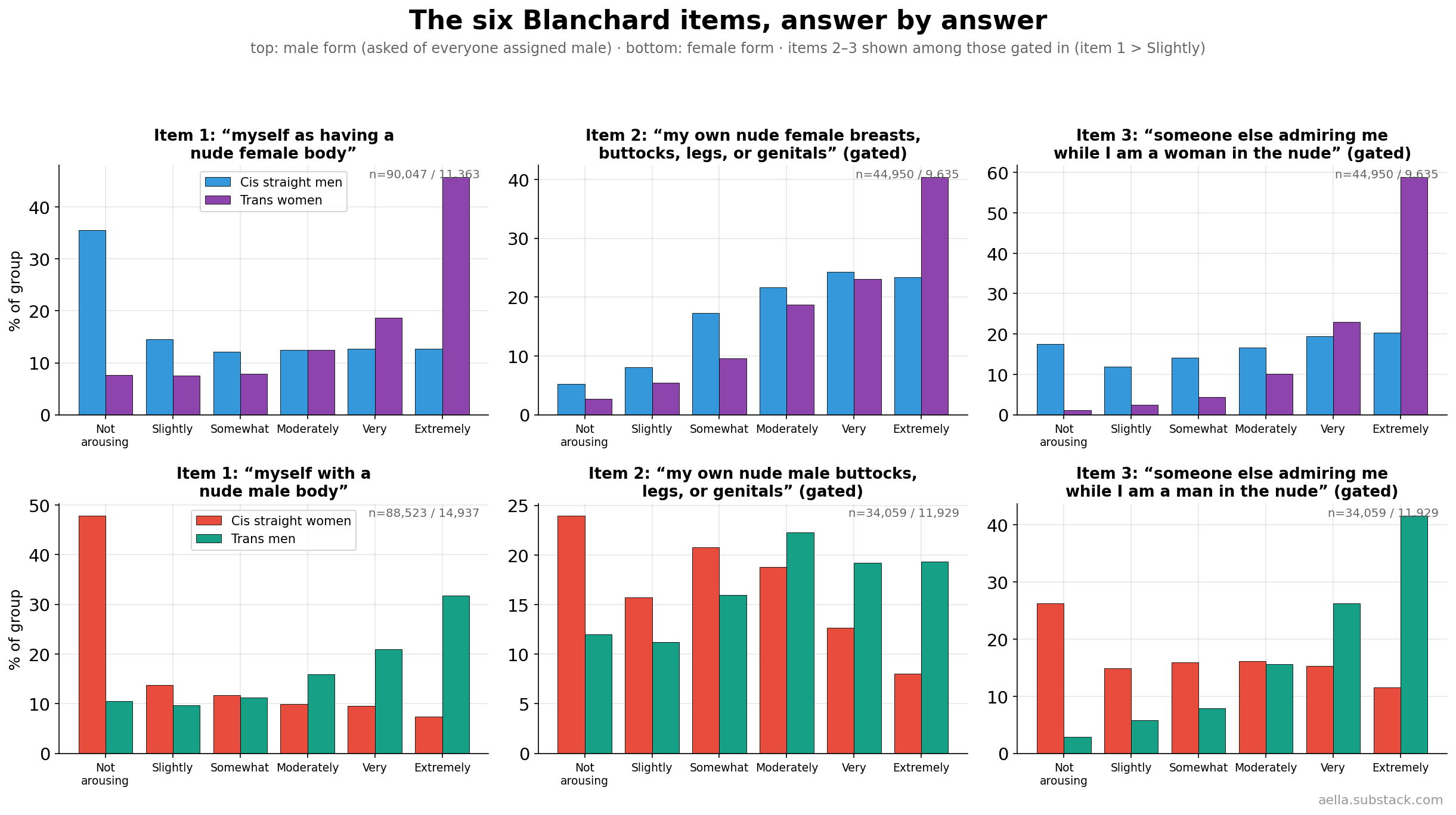
Reading the male form (top row): cis straight men pile up at "Not arousing" (36%) and then spread almost flat — while trans women stack hard at "Extremely" on all three items. The gate matters for interpretation: 49.9% of cis straight men pass the item-1 gate and get items 2–3; among the gated, 69% are Moderately+ on their own female body parts and 56% on being admired. Among trans women attracted to men, 87.5% pass the gate, and the order flips: admiration is their strongest item (92% of gated Moderately+) ahead of anatomy (84%).
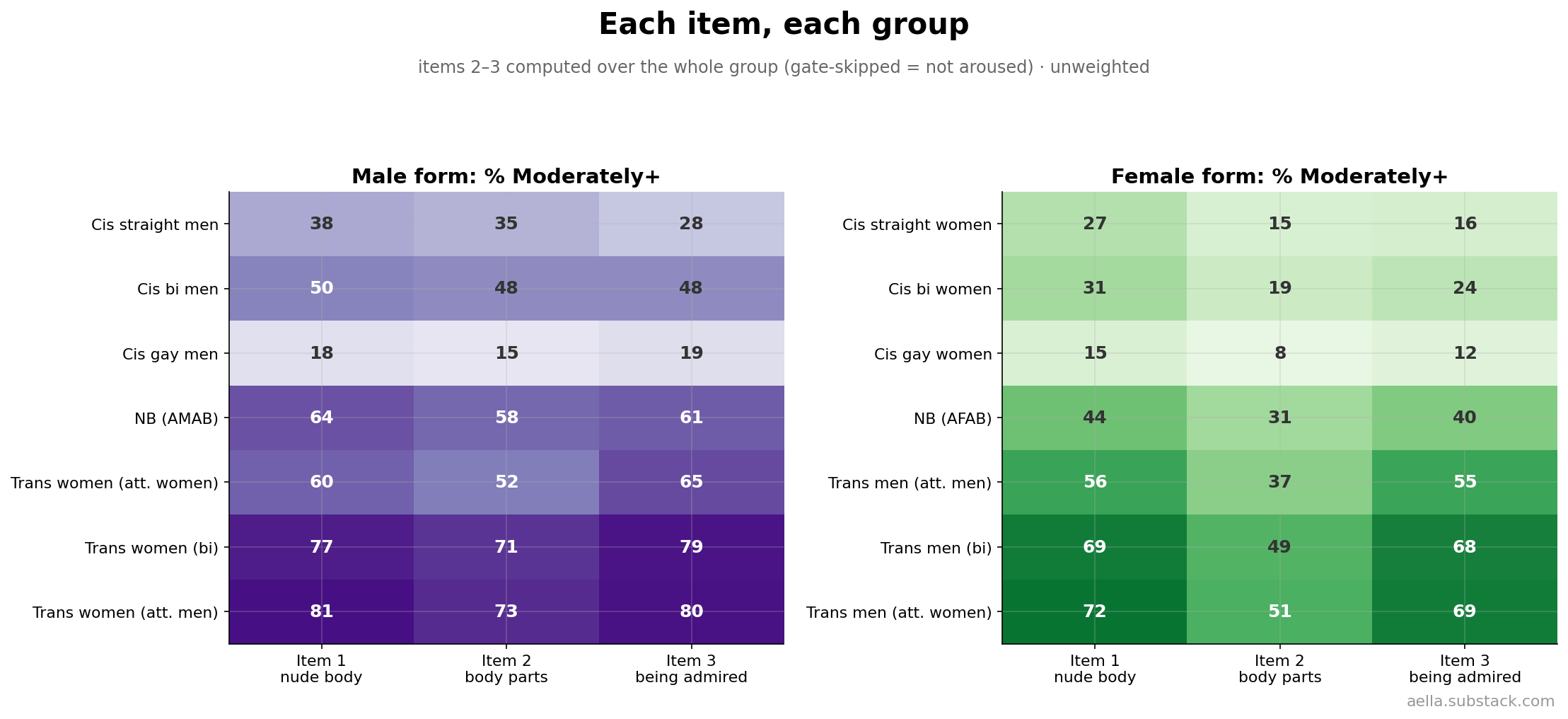
Inter-item correlations (all three answered): male form r₁₂ = .70, r₁₃ = .51, r₂₃ = .53 (n=68,054); female form r₁₂ = .45, r₁₃ = .37, r₂₃ = .53 (n=69,788). In the per-group heatmap, items 2–3 are computed over the whole group with gate-skipped respondents counted as not-aroused — the same convention as the composite — so columns are comparable.
THE TYPOLOGY TESTBlanchard's two-type theory, on 11,000 trans women
Blanchard's typology claims two distinct kinds of trans women: those attracted to men (his "homosexual" type, supposedly without AGP) and those attracted to women (the "autogynephilic" type, transitioning because of AGP). If that's right, AGP should be dramatically higher in the women-attracted group.
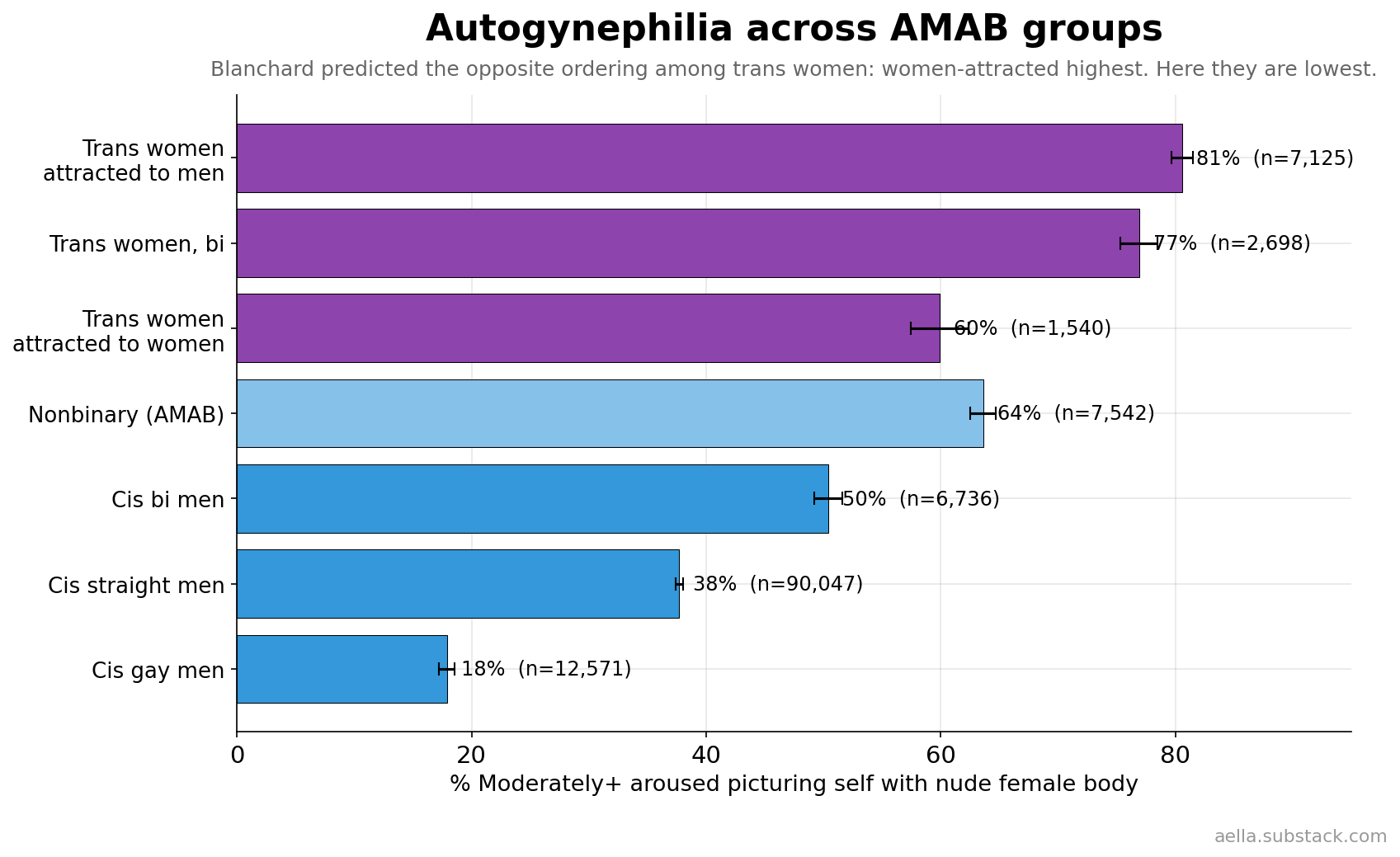
The data says otherwise, in order: trans women attracted to men: 81% mod+ · bi: 77% · attracted to women: 60%. All trans-women groups report far more AGP than cis men, but the orientation gradient runs opposite to the theory. Also note cis gay men at the bottom (18%) — arousal at self-as-female needs the female form to be attractive in the first place, which is consistent with the gradient among cis men (gay 18% < straight 38% < bi 50%) but cannot explain why men-attracted trans women top the chart.
THE MIRRORAutoandrophilia: same structure, slightly smaller
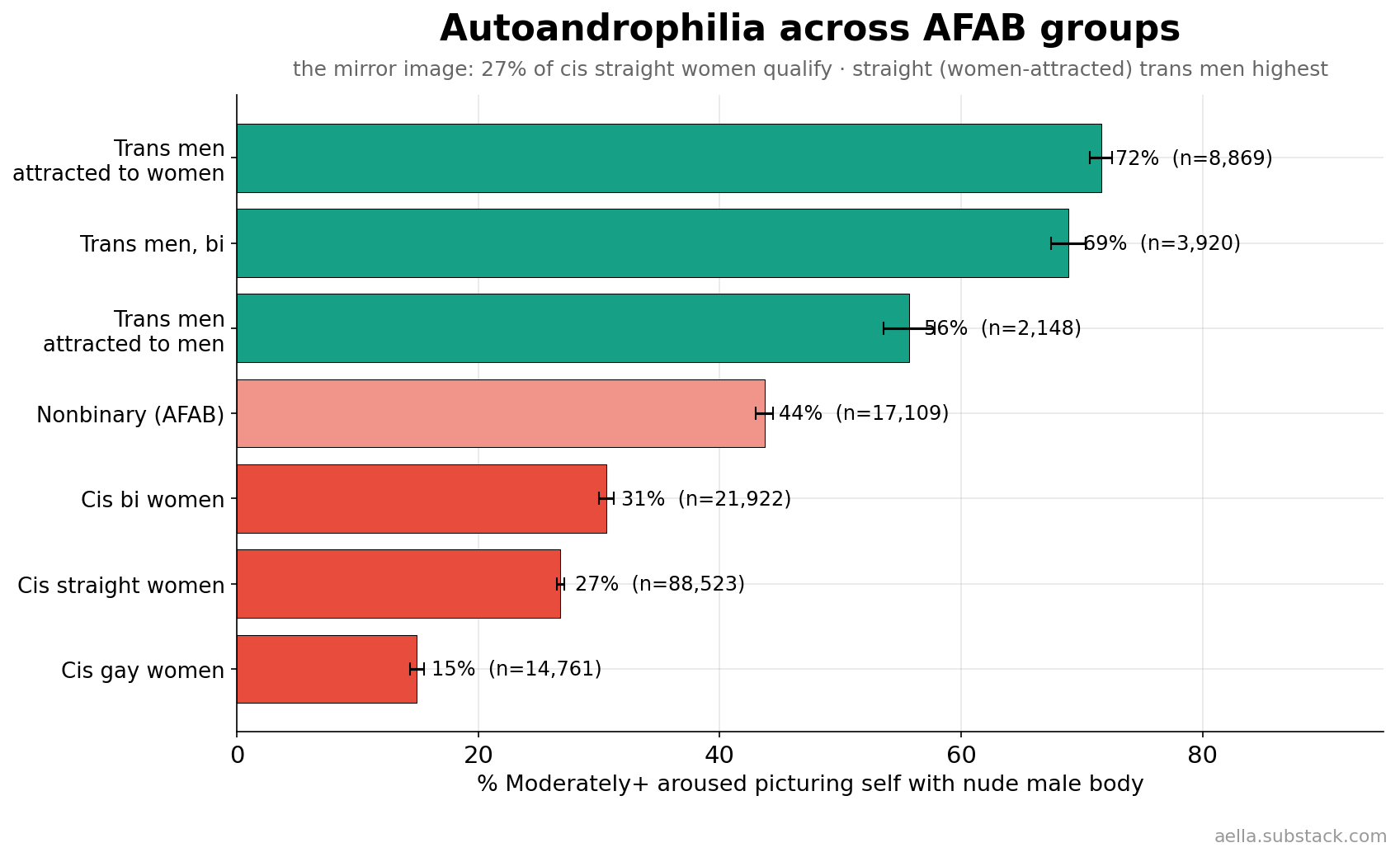
Blanchard held that autoandrophilia (the female mirror) barely exists — at times calling it essentially never observed. Here: 27% of cis straight women are Moderately+ aroused picturing themselves with a nude male body, and trans men replicate the trans-women pattern exactly, including the reversed orientation gradient (women-attracted trans men 72% vs men-attracted 56%). Whatever this auto-arousal dimension is, it exists robustly in both natal sexes, scaled down ~30% in females — about the size of typical male–female differences in erotic responsiveness generally, not a categorical absence.
OLDER PROXIESWhich long-running questions actually capture it?
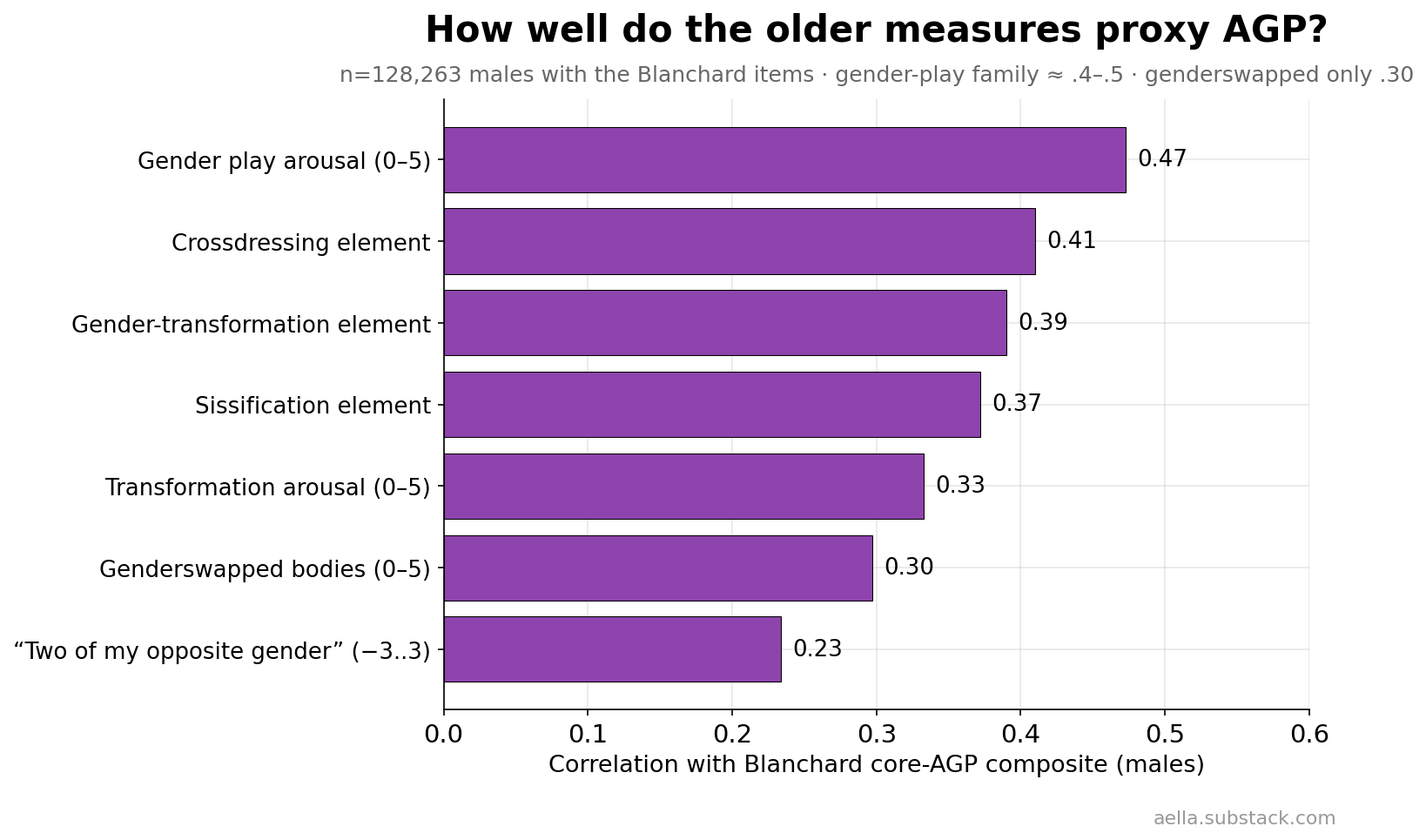
Within males who answered the Blanchard items: the gender-play family does best (overall arousal r = .47, crossdressing element .41, gender-transform .39, sissification .37). The genderswapped item — the closest thing to an "AGP question" in the survey for years — manages only r = .30, because it mostly measures attraction to other people's mixed-sex bodies (futanari-style) rather than the self-directed fantasy. Conclusion for past and future analyses: genderswapped under-measures AGP; gender-play arousal is the better historical proxy.
CORRELATESWhat AGP travels with, in cis straight men
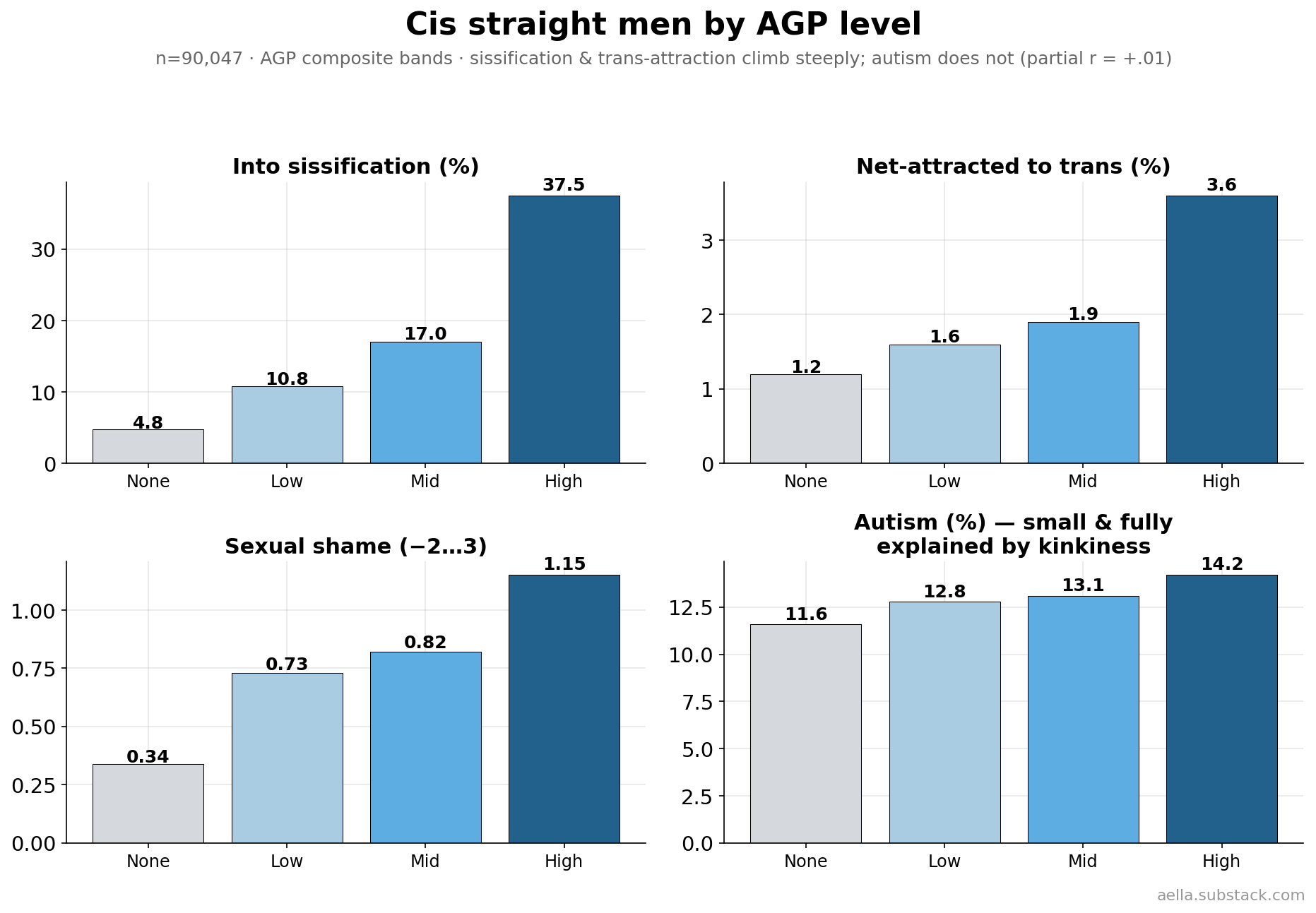
Among 90,047 cis straight men (bands: none / low / mid / high on the composite):
- Sissification interest is the strongest companion — 4.8% → 37.5% across bands. High-AGP straight men are, to a large extent, the sissification demographic from the previous report; the two fantasies share the feminized-self core.
- Attraction to trans women triples (1.2% → 3.6% net-attracted; partial r = .22 even controlling kinkiness) — the gynandromorphophilia connection, now visible from the AGP side.
- Shame rises with AGP (0.34 → 1.15; partial r = .12 beyond kinkiness) — unusual among kinks, where shame is mostly generic. The self-directed gender fantasy seems specifically shame-loaded for straight men.
- Autism does not move once kinkiness is controlled (partial r = +.01). Notable because autism is elevated in trans people (~47%) and in sissification — but AGP in cis straight men is not an autism phenomenon. The autism-transness link evidently runs through something other than this fantasy.
CAVEATSHow to read this
The Blanchard items only exist since ~March 2025, so every number here comes from the most recent ~130k respondents per sex form; earlier respondents have only the proxies.
Orientation is self-reported, relative to identified gender, post-transition. The typology debate partly hinges on whether such labels are trustworthy; this data can't resolve that, only report what people say at n=11,363.
Unweighted throughout. This pull of the survey has no population weights; nothing on this page is weighted. Prevalences describe this sample only.
Fantasy, not etiology. Nothing here tests whether AGP causes transition (Blanchard's actual causal claim) — only how the arousal pattern distributes. Cross-sectional, no causal claims.