TL;DRThere's a real ovulation peak — and the pill doesn't erase it.
Because the survey asks women, near the start, where they currently are in their cycle — and then asks how horny they are and what they're into — we can watch behavior change within the cycle across a huge sample. The result is one of the cleanest demonstrations of a periovulatory libido peak you'll see in survey data: horniness jumps ~30% at ovulation and falls right back. Attraction to masculinity rises in lockstep. The twist: the peak is just as strong in women on hormonal birth control, which suppresses real ovulation — so this isn't a simple "ovulatory hormone surge drives lust" story.
01First: do people report their phase meaningfully?
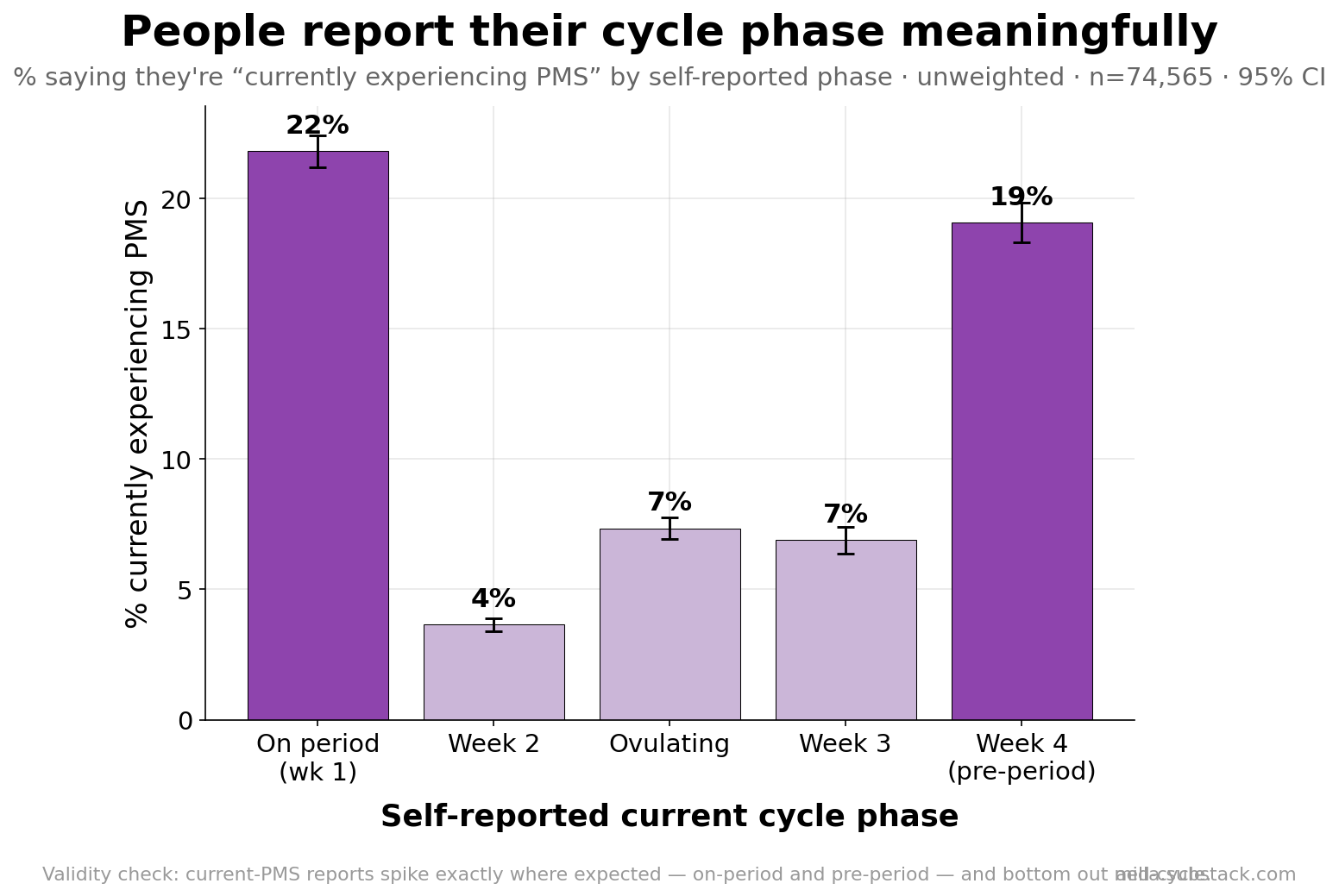
Self-reported cycle phase could be noise. It isn't. A separate question — "are you currently experiencing PMS symptoms?" — lines up exactly with phase: 22% on-period and 19% in the pre-period week say yes, versus just 4% in week 2. [Hardweight population weighting (Aug 2026): 18% / 18% / 2% — same shape, slightly lower levels.] People are placing themselves on the calendar accurately enough for the rest of this to mean something.
02The libido peak
Horniness rises smoothly from menstruation through week 2, spikes sharply at ovulation, and drops straight back down in the luteal phase. "Horny right now" goes from ~1.09 across most of the cycle to 1.41 at ovulation (0–3 scale); "horny in the last 24 hours" peaks at 2.06. Both items, same shape, enormous sample.
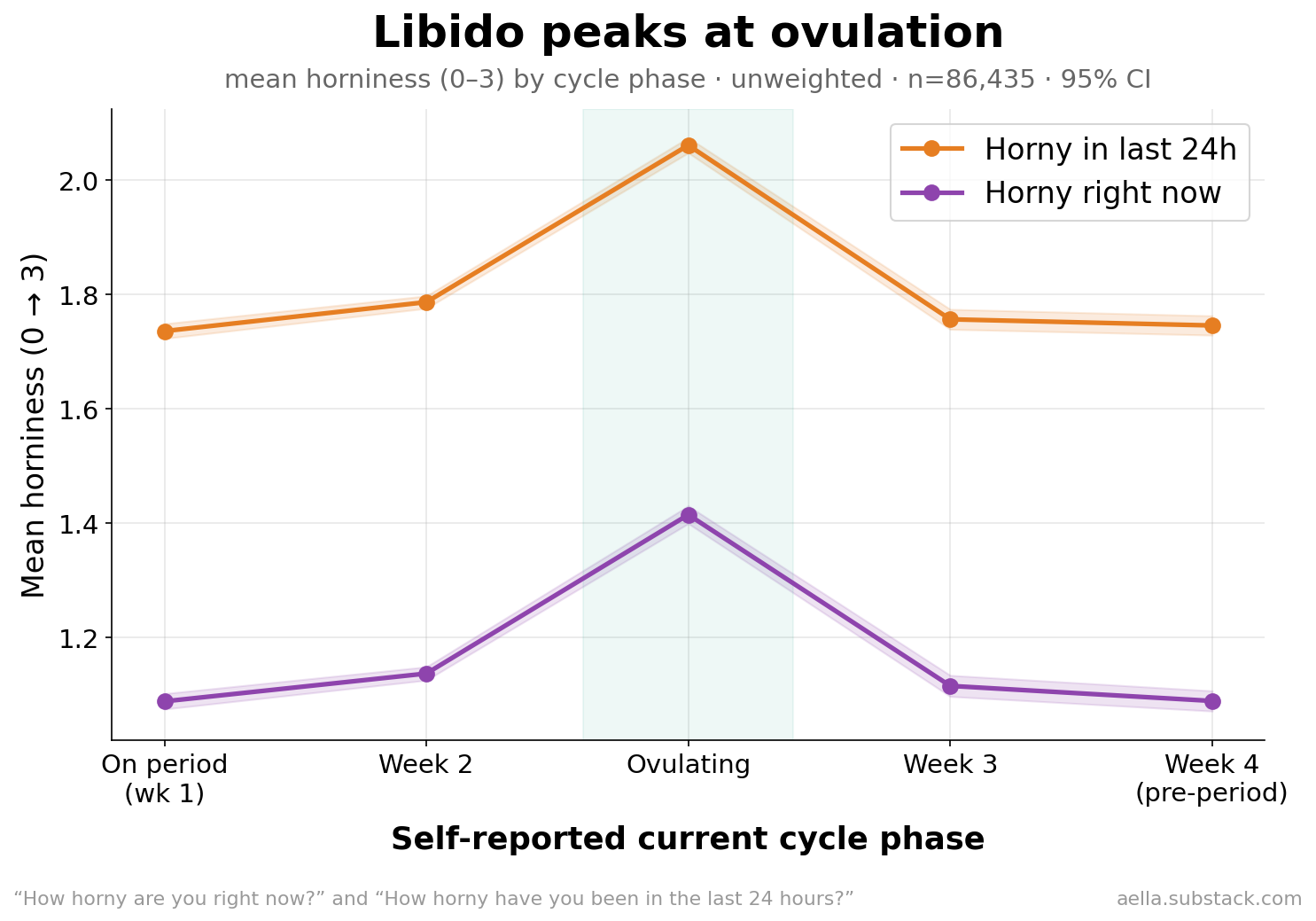
This is the textbook periovulatory desire peak — the window of peak fertility coinciding with peak reported sexual desire — and it's rarely seen this cleanly because most studies have a few hundred women, not 86,000.
03The surprise: the pill doesn't flatten it
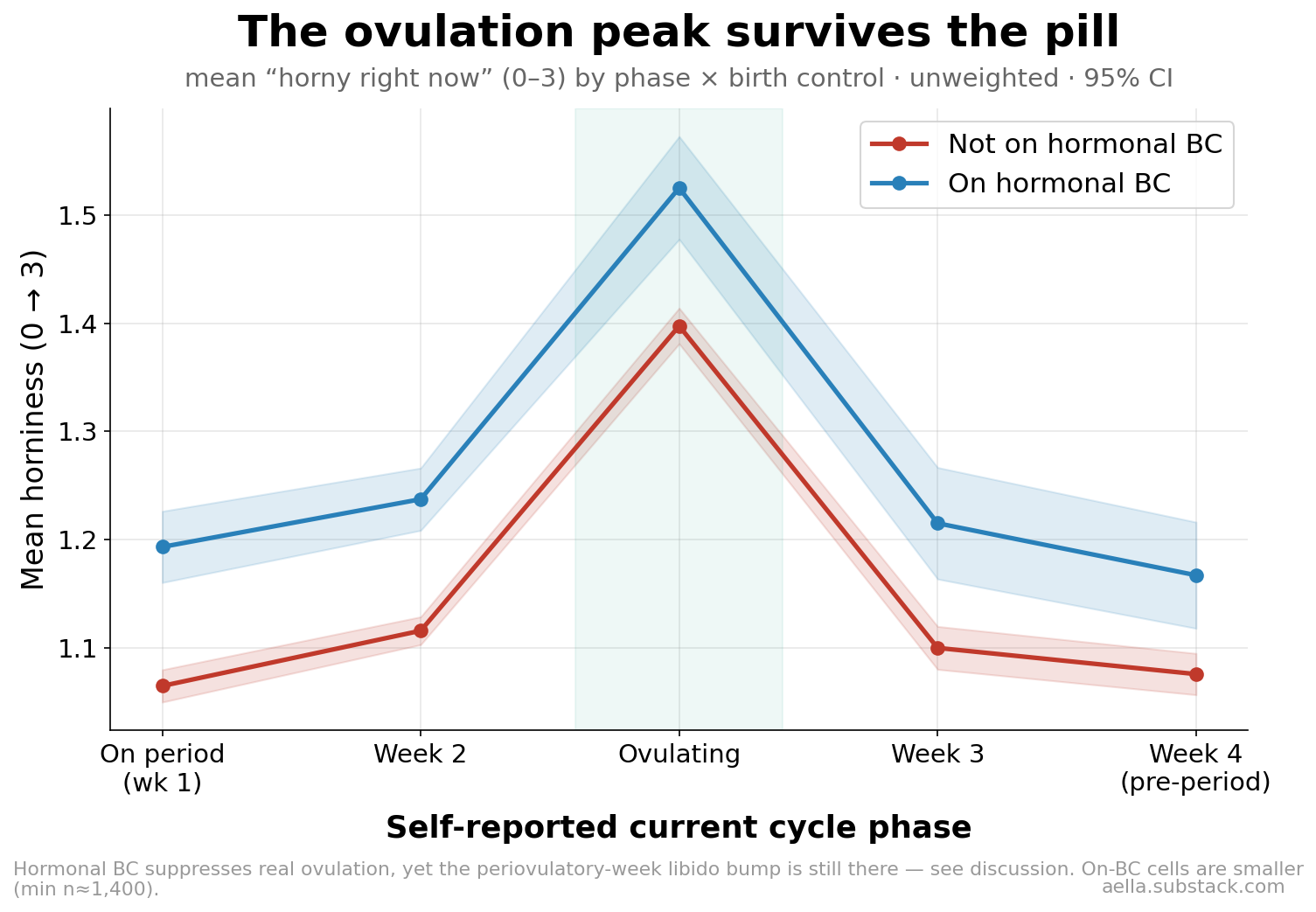
Hormonal birth control suppresses ovulation. So the obvious prediction is that the ovulation libido peak should vanish in pill users. It doesn't: the peak is just as large — if anything slightly larger — in women on hormonal BC.
04Tastes shift too — toward masculinity
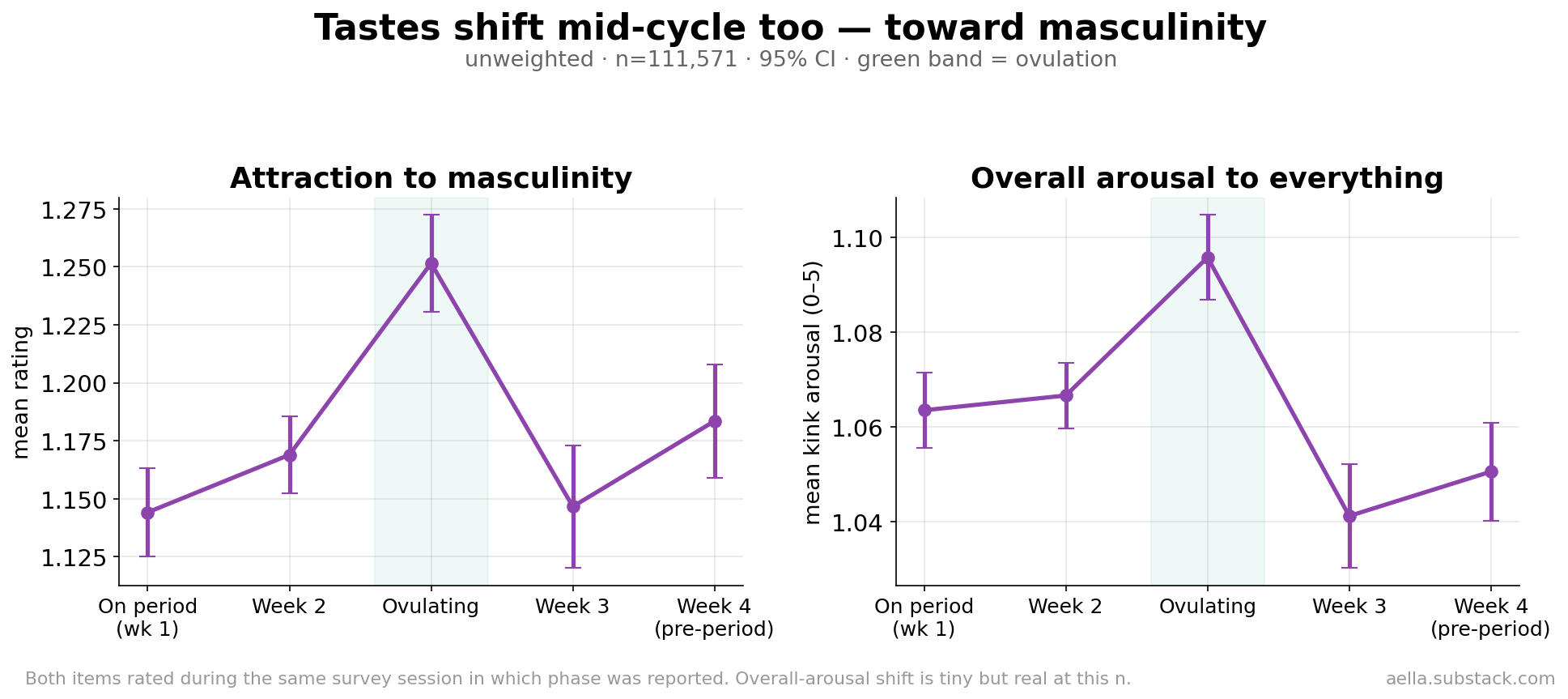
It's not just raw drive. Attraction to masculinity peaks at ovulation (1.14 → 1.25 → 1.15), echoing a much-debated hypothesis that women's mate preferences shift mid-cycle toward more "masculine" cues. Overall arousal to everything on the survey also ticks up at ovulation — a tiny shift (1.06 → 1.10 on the 0–5 kink-arousal composite) but unmistakable at this sample size.
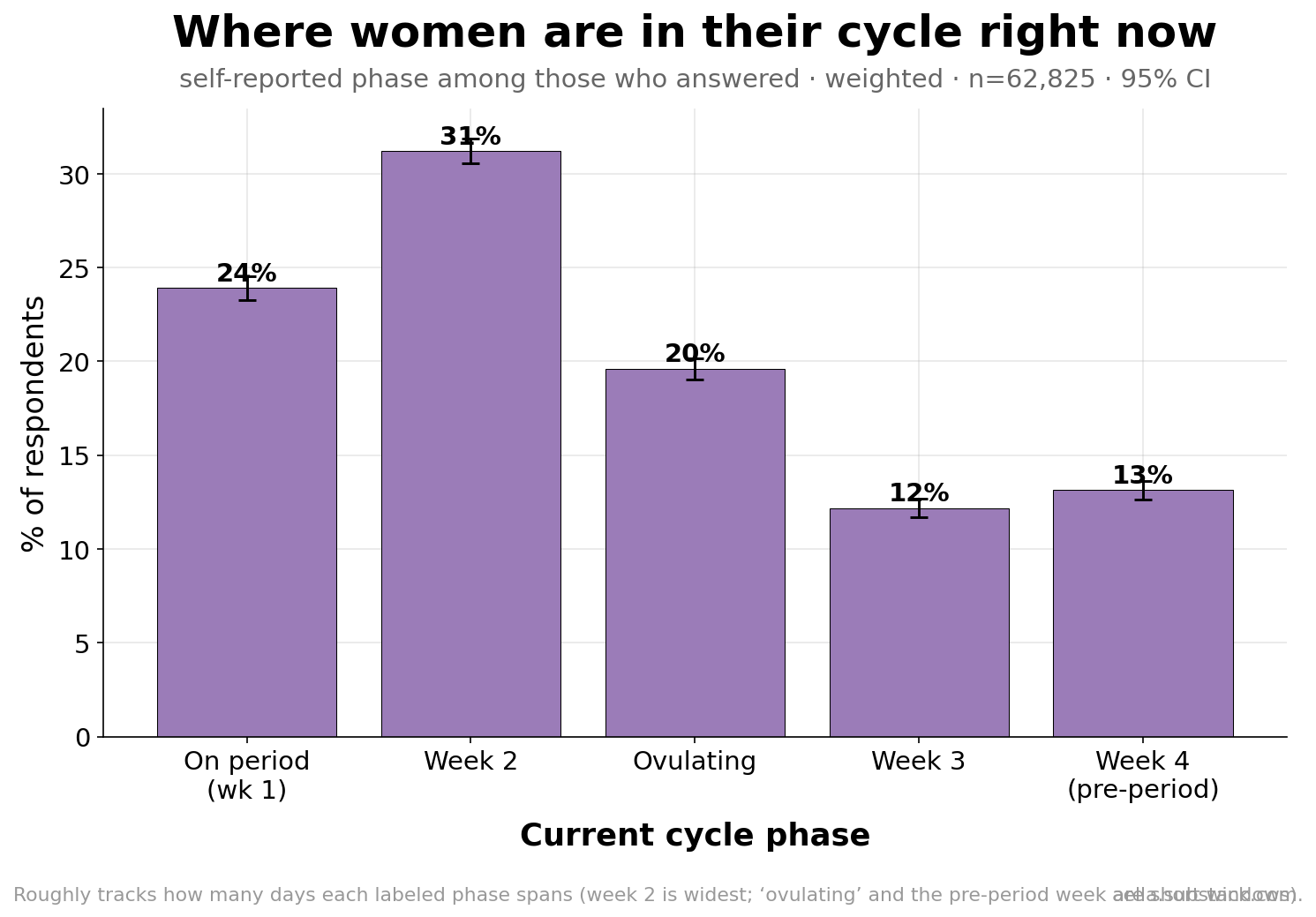
05Where women are in their cycle right now
For reference, the distribution of self-reported current phase (weighted), which roughly tracks how many days each labeled window spans — "week 2" is the widest bucket, "ovulating" and the pre-period week are short.
06Methodology & limitations
Design
Aella's Big Kink Survey (GuidedTrack), n=1,071,355. Near the start, menstruating respondents answer "Where are you currently at in your menstrual cycle?" with options On period (wk 1) / Week 2 / Ovulating / Week 3 / Week 4 (pre-period). The rest of the survey — including "how horny are you right now/in the last 24h," attraction items, and dozens of kink-arousal ratings — is answered in the same session. So this is a between-women, cross-sectional comparison (different women in each phase), not the same woman tracked over a cycle. With ~111,000 women and random assignment to "today's phase," that approximates a clean comparison, but it can't rule out that women who happen to take a sex survey while ovulating differ from those who take it pre-period.
Phase analyses are unweighted (correlational, precision-first); the phase-distribution chart is population-weighted. Restricted to natal-sex-Female respondents (incl. nonbinary AFAB) not flagged as pregnant, reporting one of the five phases. Bands/bars are 95% CIs.
Limitations
- Cross-sectional, not within-woman. The ideal design follows individuals across their cycle; this compares different women at different phases.
- Self-reported phase, on a "typical 28-day" template — cycle lengths vary, "ovulating" is a guess, and pill users' phase is calendar-based.
- Selection. The desire peak could be partly a "who-answers-a-sex-survey-when" effect rather than a pure within-person change — though the consistency across drive and preference measures argues for something real.
- Not representative. A self-selected, very-online sample (the survey spread virally, well beyond Aella's own following); ages 14–33 in the weighted frame.
Analysis pipeline: pandas + numpy; scripts and full tables available on request.