Do Drug Users Come in Types?
Loosely. Among 3,442 people, nearly everyone had tried marijuana and most had tried mushrooms or LSD; rarer drugs turn up mainly in long lists. Across 11,445 ratings of 17 drugs, experiences fall into five loose types, and each drug has its own mix. Panic and regret go more with the person than with the drug, though most of the variation goes with neither. And a strongest experience of 5 out of 5 ranges from about half of salvia and DMT users, and a third of drinkers (almost all of them heavy drinkers), to 3 or 4% of MDMA, ecstasy, MDA and 2C-B users.
The Drug Experiences survey (October 2024 to January 2025) asked people which of 47 drugs they had ever done, then asked the same 31 questions about each one. The Drug Report Card ranked the drugs; this page looks for types. The checklists, "Which of the following drugs have you done?" and "Now for some more uncommon ones. Have you done any of the following?", cover marijuana, alcohol, psychedelics, MDMA and ecstasy, dissociatives, GHB, kratom and many research chemicals, but not cocaine, amphetamines, opioids or benzodiazepines.
Short version
- Drug lists nest loosely. 94% of people who had tried any listed drug had tried marijuana, and 89% psilocybin or LSD; rarer drugs turn up mainly in long lists (people who had tried DMT had tried a median of 10 listed drugs, against 5 for everyone). The survey asked only whether people had ever done each drug, not when, so this isn't an order of use.
- Five loose portfolio types, mostly reflecting how many drugs people have tried. They run from marijuana and mushrooms (39%) to nearly everything (4%), with a split in the middle between club drugs (26%) and DMT, salvia, kratom or DXM (14%). Younger people have tried fewer drugs, which explains most of the age gap: 58% of 18 to 24-year-olds are in the first type, against 30 to 35% of 25 to 54-year-olds (58% against 47 to 49% among people who have tried three to six drugs).
- Experiences come in five loose types, and each drug has its own mix. 60% of ayahuasca ratings are deep, 59% of MDMA ratings fun, 49% of nitrous ratings intense but not deep, and 40% of salvia and of DXM ratings rough; DMT splits between deep (40%) and intense but not deep (37%).
- Panic and regret go more with the person than with the drug, though most of the variation goes with neither. Who was answering goes with 17 to 18% of the variation in panic and regret, which drug it was with 8 to 11%, and neither with 72 to 75%. People who panicked on more than half their trips with one drug panicked on 28% of trips with their other drugs, against 13% for people who never panicked on it.
- The same kinds of people report more panic across drugs; few drug-specific matches were detectable. People who agree "I worry about things." report panic on 18% of their trips, against 13% for those who disagree. Of 1,300 combinations of a trait and a drug, 9 passed a strict test with little power for less common drugs; one is that people with PTSD or C-PTSD would take back more of their uses of other drugs (19% against 14%) but not of marijuana (26% against 28%).
- How rare is a 5 out of 5? About half of salvia and DMT users put their strongest experience at 5, "no connection to reality, completely unaware of what's happening", against 12 to 13% for psilocybin and LSD and 3 to 4% for MDMA, ecstasy, MDA and 2C-B. It rises steeply with use, and alcohol's 31% comes from heavy drinkers (10% among those who have drunk 50 times or fewer). Of people who rated every drug they had tried, 33% have had a 5 on a drug other than alcohol.
- Which drugs go together
- Five portfolio types
- Five kinds of experience
- Is it you or the drug?
- Who does better on what
- Ways of relating to drugs
- How intense does it get?
- Could it be something else?
- Methods and limits
1. Which drugs go together
3,442 people answered both checklists and had tried at least one listed drug other than alcohol, which was added to the checklist a few days into the run. They're 71% cis men, 17% cis women and 12% trans or nonbinary, aged 14 to 81 (median 32); 68% lean left and 72% came from Twitter. They had tried a median of 5 of the 46 listed drugs (mean 6.3): 94% marijuana, 81% psilocybin, 71% LSD, 56% MDMA, 48% ecstasy, 42% ketamine, 39% nitrous oxide, and about a quarter each DMT and 2C-B. 84% had tried marijuana and at least one of psilocybin and LSD.
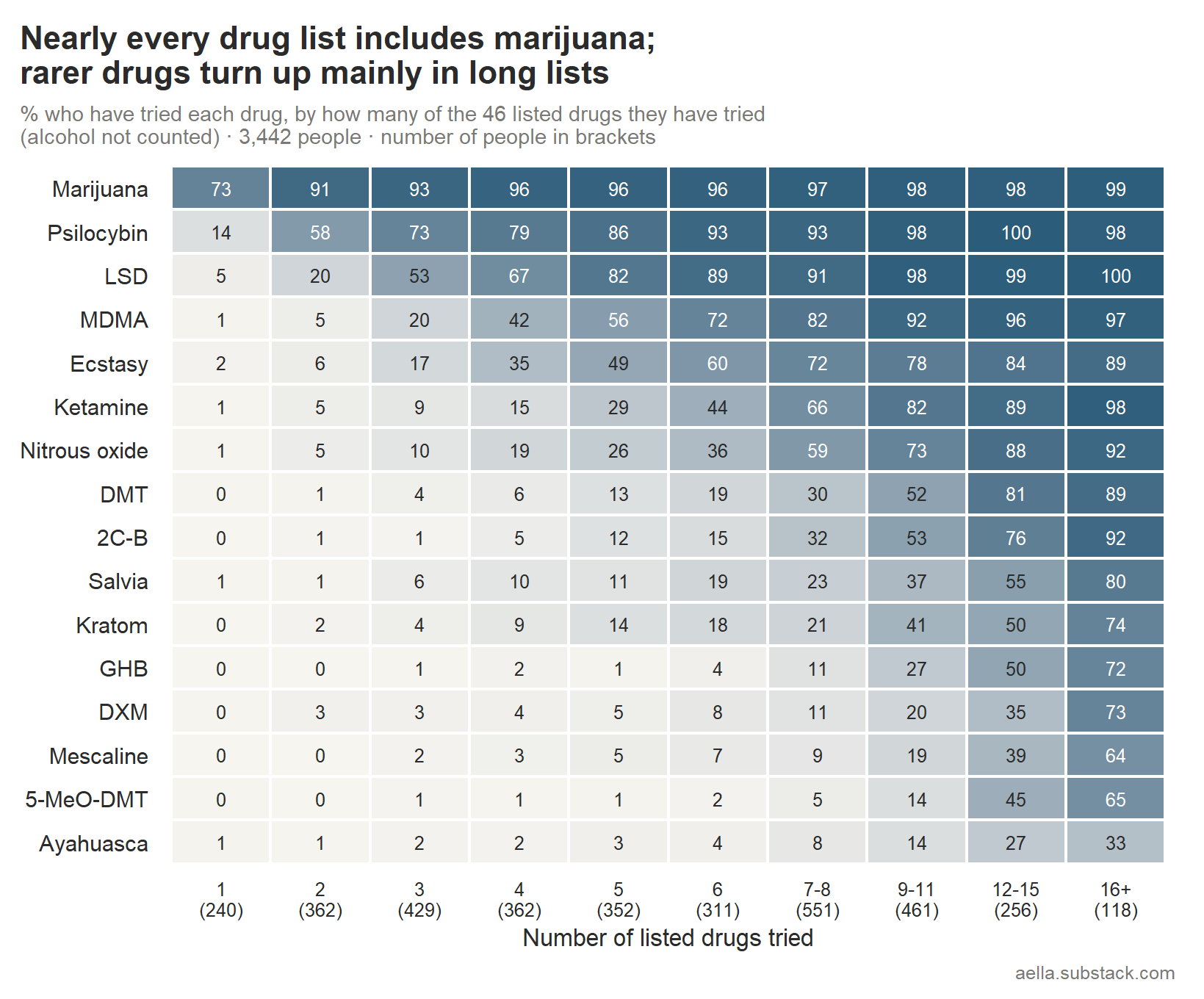
The longer someone's list, the more predictable what's on it, but only loosely. People who had tried one listed drug had mostly tried marijuana (73%) or psilocybin (14%); with two, the usual pair was marijuana and psilocybin (52%) or marijuana and LSD (16%). MDMA and ecstasy become common in lists of four to six drugs, ketamine and nitrous at seven or eight, DMT and 2C-B at around ten, and 5-MeO-DMT, GHB, mescaline, DXM, salvia and kratom mostly at twelve or more.
The nesting is loose. Among the 2,832 people who had tried two to seven of the eight most common drugs, 36% had exactly the most common ones for their count (someone with three had marijuana, psilocybin and LSD; someone with four added MDMA, and so on), against 18% expected if people picked drugs independently. Loevinger's H, a standard measure of how well items form one cumulative scale, is 0.41, a moderate scale. Since the survey asked only whether people had ever done each drug, none of this describes an order in which people took them.
2. Five portfolio types
A latent class model sorts people into groups whose members tend to have tried the same drugs. Fitted to the 25 drugs tried by at least 2% of people, it finds five types:
- Marijuana and mushrooms (39%). Marijuana (91%), often psilocybin (62%), sometimes LSD (40%). A median of 3 listed drugs.
- Psychedelics and club drugs (26%). Psilocybin and LSD plus MDMA (86%), ecstasy (76%) and often ketamine (57%). Median 6.
- Psychedelics, few club drugs (14%). Psilocybin (93%) and LSD (88%), with less MDMA (42%) than the type above and more DMT (39%), kratom (38%), salvia (34%) and DXM (25%). Median 6.
- Wide explorers (18%). Nearly all the common drugs, plus DMT (64%) and 2C-B (59%), and often kratom, salvia and GHB. Median 11.
- Nearly everything (4%). Median 17, including research chemicals such as 2C-I, 2C-E and 4-AcO-DMT, each tried by about half.
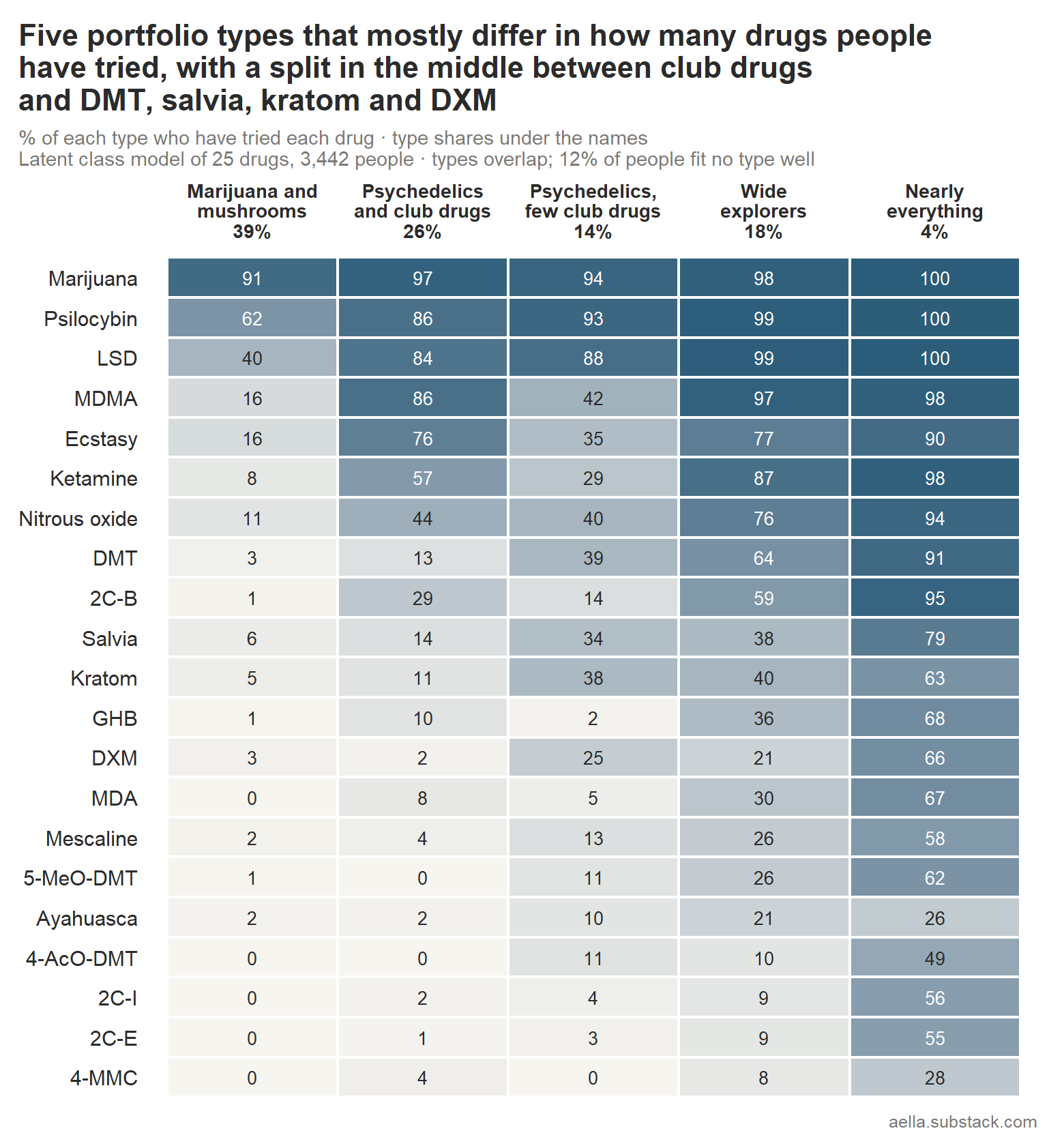
Most of the difference between types is how many drugs people have tried, with one split in the middle. At around six drugs, people divide between club drugs (MDMA, ecstasy, ketamine, 2C-B) and DMT, salvia, kratom and DXM. The boundaries are fuzzy, and many people sit between two types.
Because the types track list length, they also track age: younger people have tried fewer drugs (4.5 on average at 18 to 24, against 7.2 to 7.3 at 35 to 54). 58% of 18 to 24-year-olds are in the marijuana-and-mushrooms type, against 30 to 35% of 25 to 54-year-olds and 48% of people 55 and over (and 81% of the 36 people aged 14 to 17). List length explains most of that gap but not all: among people who had tried three to six drugs, it shrinks to 58% against 47 to 49%, so about 10 points remain. Sex makes a few points' difference: 30% of cis women are in the psychedelics-and-club-drugs type against 26% of cis men (5 points after age adjustment). Politics and education make almost none.
3. Five kinds of experience
For each drug, people answered 26 questions about how it went: typical and strongest intensity; what share of their trips were "significantly pleasurable", or involved "paranoia, panic attacks, or acute anxiety", "delusions" or "the sensation of contacting other beings"; what share of their uses they'd go back and stop; the drug's impact on six areas of life; and 13 agree-disagree statements. A factor analysis finds five dimensions:
| Dimension | Answers that make it up | Highest | Lowest |
|---|---|---|---|
| Helped my life | Positive impact on motivation, life, cognition and empathy; helped heal trauma; creativity; sexuality | Ayahuasca, psilocybin, LSD | Alcohol, nitrous oxide, DXM |
| Spiritual | More belief in "spirits, higher dimensional beings, or aliens"; "made me more spiritual"; contact with beings; "permanently changed concrete, testable beliefs" | Ayahuasca, 5-MeO-DMT, DMT | GHB, alcohol, nitrous oxide |
| Fun and functional | Good "while partying", "to enhance sex", "while doing things that require physical skill" and, more weakly, "while at work" | MDMA, ecstasy, MDA | Salvia, ayahuasca, DMT |
| Rough | More trips with panic or acute anxiety; more uses they'd take back; fewer pleasurable trips | Salvia, DXM, marijuana | MDMA, ecstasy, MDA |
| Intense | Typical intensity; strongest experience | DMT, 5-MeO-DMT, salvia | 2C-B, MDA, MDMA |
Highest and lowest are among the 17 drugs with 100 or more raters, on each drug's average score.
Sorting each rating by its scores on these dimensions gives five loose types of experience. Deep: very high on spiritual, high on helped my life, intense. Fun: high on fun and functional, somewhat high on helped my life, low on rough. Intense, not deep: intense, slightly below average on everything else. Mild: below average on everything, especially intensity. Rough: high on rough, low on helped my life and fun. Most ratings sit between types rather than in tight clusters.
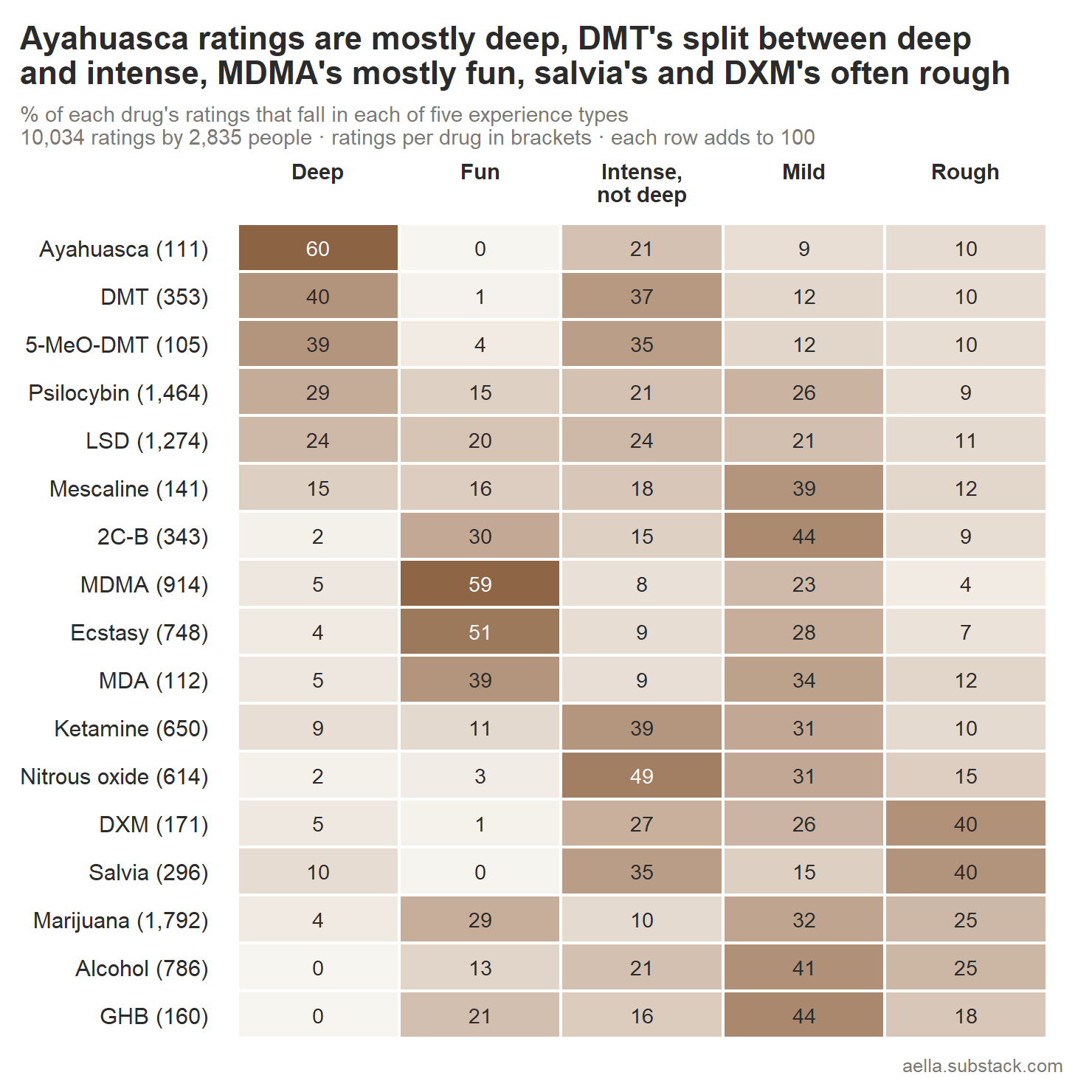
Each drug has its own mix. Ayahuasca is the most often deep (60%). DMT and 5-MeO-DMT split between deep (40% and 39%) and intense but not deep (37% and 35%). MDMA (59%) and ecstasy (51%) are mostly fun; nitrous (49%) and ketamine (39%) most often intense but not deep. Salvia and DXM are the most often rough (40% each), then marijuana and alcohol (25% each). GHB, 2C-B, alcohol and mescaline are most often mild (39 to 44%). Psilocybin and LSD are the most even mix: for psilocybin, 29% deep, 26% mild, 21% intense but not deep, 15% fun and 9% rough.
"Mild" undersells alcohol. The types leave out "[drug] has damaged my physical health", and alcohol is far ahead on it: 26% of drinkers agree moderately or strongly, against 8% for marijuana and 6% or less for every other drug, and so do 15% of the alcohol ratings classed as mild. Alcohol is also the only drug whose average impact on life is negative (−0.40 on a −3 to +3 scale; 40% say it hurt their life, 22% that it helped).
A person's type on one drug says something about their type on another: among people who rated two or more drugs, a deep rating for one drug went with a deep rating for a second 28% of the time, against 11% expected from those drugs' usual mix, and rough went with rough 20% of the time, against 15%.
4. Is it you or the drug?
Many people rated several drugs, so the variation in each answer can be split three ways: differences between drugs, differences between people (some people report more panic, or more pleasure, on all their drugs), and what's left over, which is the particular pairing of person and drug plus noise in how people answered.
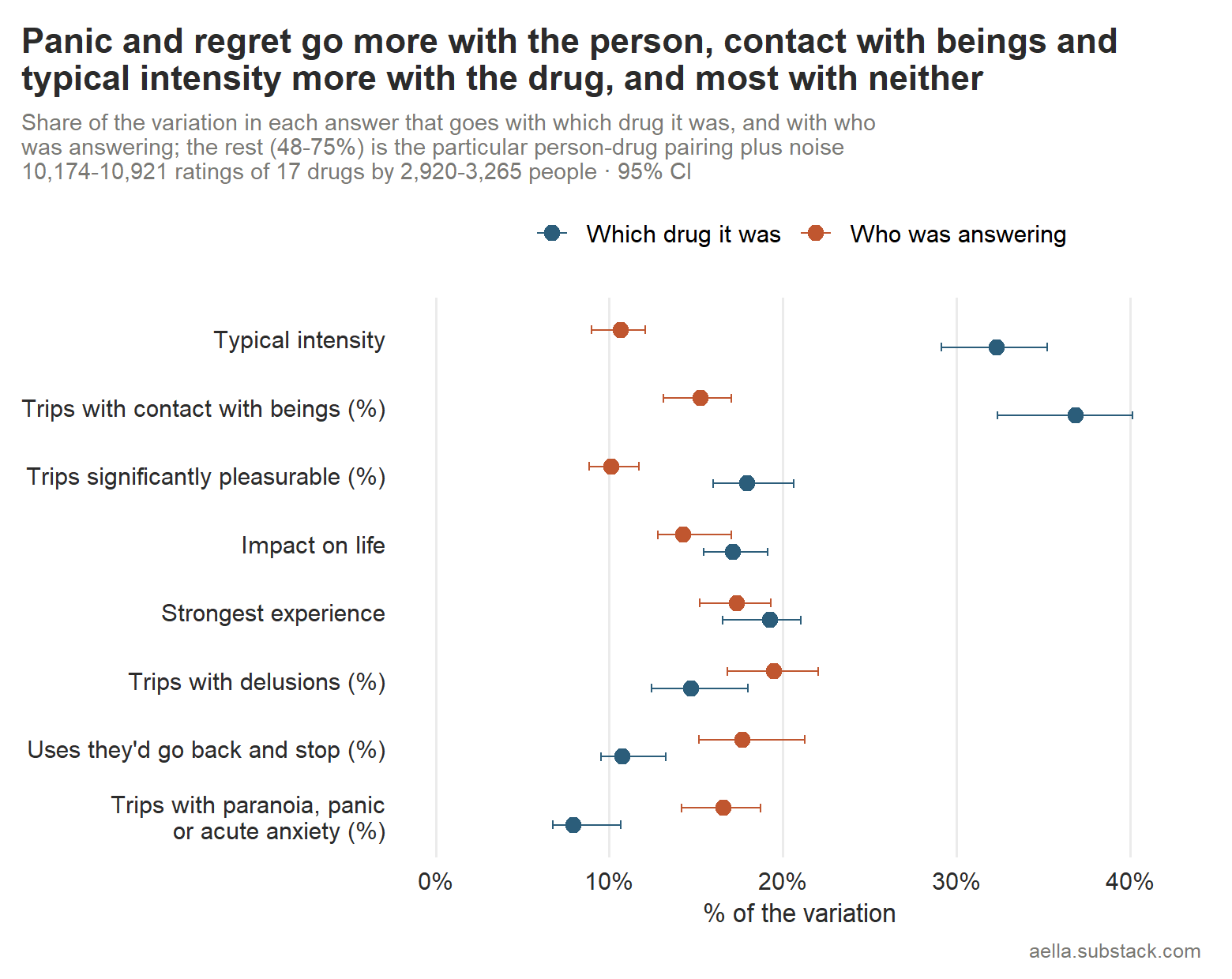
Panic and regret go more with the person; contact with beings and typical intensity go more with the drug; most goes with neither. Who was answering goes with 17% of the variation in panic and 18% in regret, against 8% and 11% for which drug it was, and the person stays ahead whichever drug is left out. Contact with beings goes with the drug more than any other answer (37% drug, 15% person), then typical intensity (32% and 11%). Pleasure seems to go with the drug (18% against 10%) only because of salvia: without it, person and drug tie at 11%. For strongest experience and impact on life the two are about even. In every case the largest part, 48 to 75%, goes with neither. Put another way, for any two drugs rated by the same person, each compared with that drug's average, answers correlate 0.19 for panic and regret, 0.22 for delusions and 0.12 for pleasure.
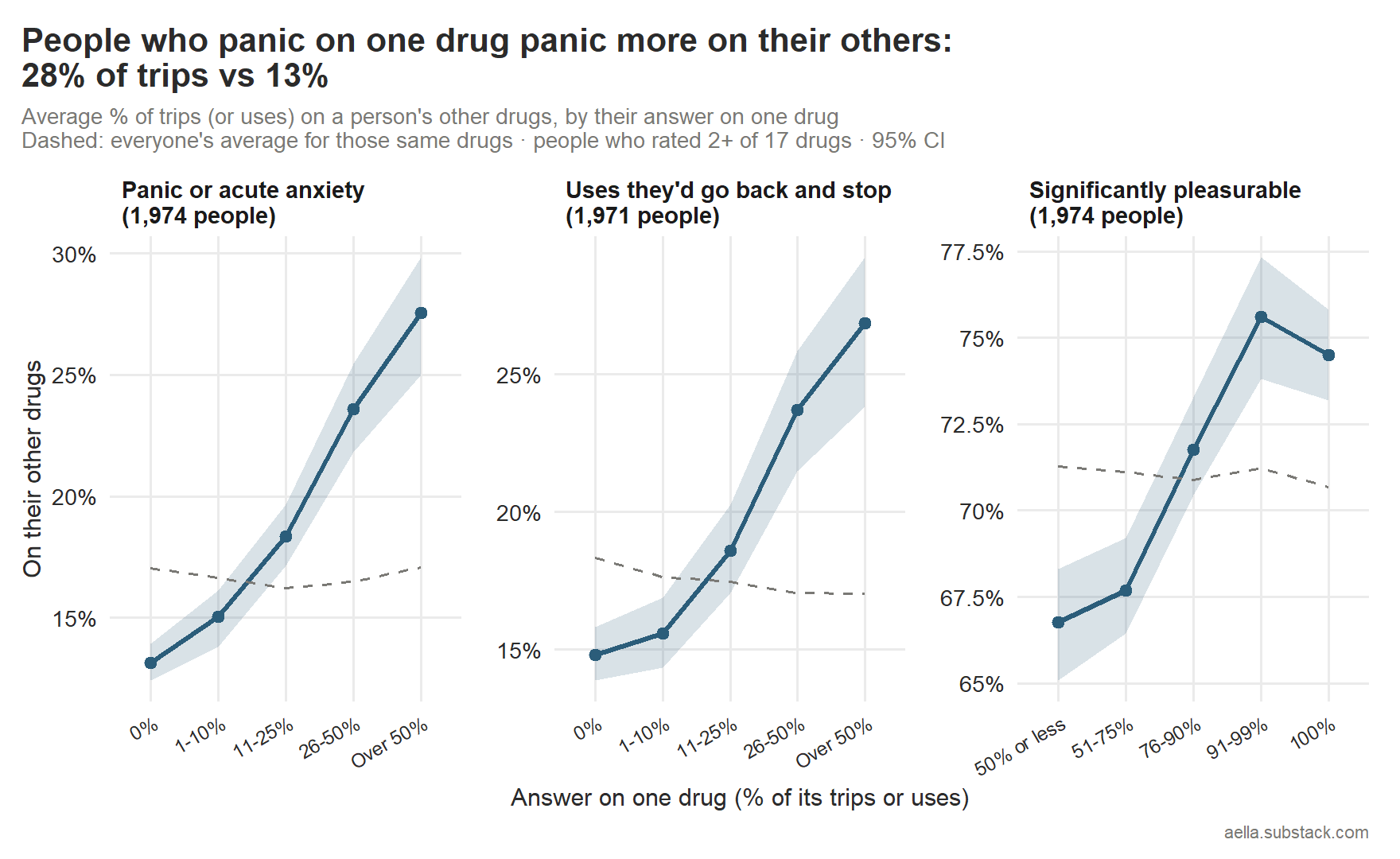
People who panicked on more than half their trips with one drug panicked on 28% of trips with their other drugs; people who never panicked on that drug, on 13%, against an average of about 17% for those drugs. Regret works the same way (27% against 15%); pleasure less so (74% against 67%). So a bad run with one drug is a modest warning sign for others, panic most of all; the rest is the pairing, noise, or things the survey didn't ask about, such as dose and setting.
5. Who does better on what
Figure 6 compares groups on panic and regret, averaged over the 13 drugs with 180 or more raters, with the drug, number of uses, age and sex held constant.
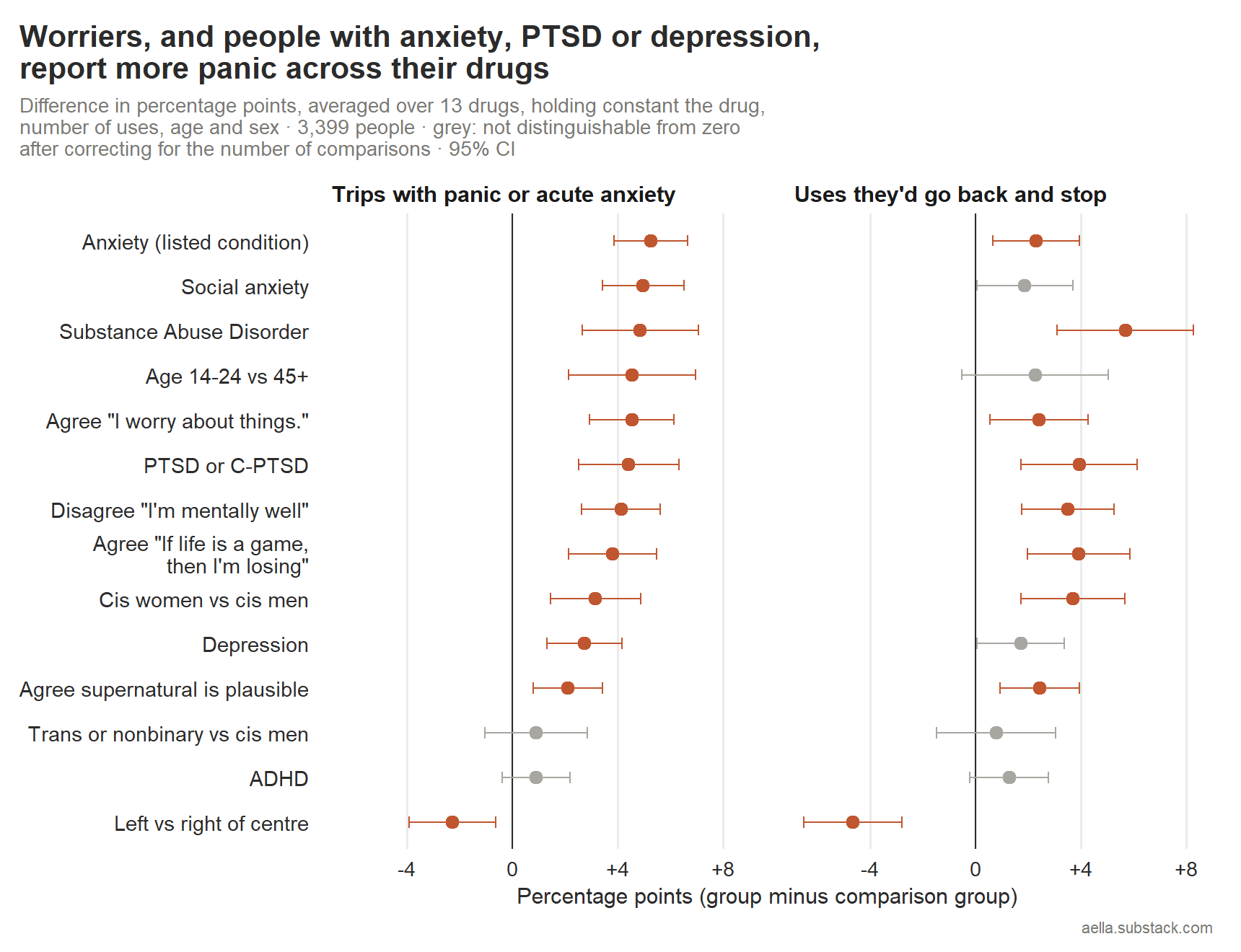
The same kinds of people report more panic across their drugs. People who agree "I worry about things." report panic on 18% of their trips on average, against 13% for those who disagree; the gap is more than a point on 10 of the 13 drugs, with none for salvia or nitrous and a slight reversal for 2C-B. People who ticked anxiety as a condition report panic on 22% of trips against 15% (higher on all 13 drugs), and so do people with PTSD or C-PTSD and people with social anxiety (22% against 16% each). Panic is also higher for 14 to 24-year-olds (20%, against 13% at 45 and over) and cis women (20%, against 16% for cis men).
Regret follows some of the same lines: 24% of uses for people with a substance abuse disorder against 18%, 23% against 17% for PTSD, 22% against 16.5% for people who disagree "I'm mentally well". Right-of-centre people would take back more of their uses than left-of-centre people (22% against 17%), but this is mixed by drug: about 10 to 12 points more for GHB, alcohol and marijuana and 9 for nitrous, near zero or reversed for ketamine, psilocybin, LSD and DXM. Cis women report fewer pleasurable trips than cis men (68% against 72%), lower on all 13 drugs.
Few matches between particular kinds of people and particular drugs were detectable. We tested whether each of 25 traits (demographics, personality, wellbeing, beliefs and mental health conditions) went with panic, regret, pleasure or impact on life differently for each of the 13 drugs: 1,300 combinations. A drug-specific difference had to pass a correction for all 1,300 tests and show up in each of two random halves of the sample, a high bar for drugs with 170 to 400 raters, so modest real matches could easily be missed. Nine passed:
| Drug and answer | Groups | Raters of this drug | On this drug | On their other drugs |
|---|---|---|---|---|
| Marijuana: uses they'd take back | PTSD or C-PTSD, yes / no | 244 / 1,568 | 26% / 28% | 19% / 14% |
| Marijuana: uses they'd take back | Right / left of centre | 350 / 1,224 | 35% / 25% | 16% / 15% |
| Marijuana: trips with panic | Age 25+: no bachelor's degree / bachelor's or higher | 376 / 1,085 | 29% / 22% | 16% / 14% |
| Marijuana: impact on life (−3 to +3) | Conscientiousness items: lower / higher scorers | 687 / 611 | +0.08 / +0.41 | +0.68 / +0.79 |
| Salvia: trips with panic | ADHD, yes / no | 129 / 174 | 36% / 27% | 15% / 17% |
| 2C-B: trips significantly pleasurable | Age 35+ / 14–24 | 142 / 44 | 71% / 86% | 71% / 77% |
| Alcohol: uses they'd take back | Age 35+ / 14–24 | 274 / 208 | 41% / 25% | 18% / 19% |
| Alcohol: impact on life (−3 to +3) | Supernatural plausible, agree / disagree | 345 / 380 | −0.52 / −0.25 | +0.86 / +0.69 |
| Alcohol: impact on life (−3 to +3) | Agreeableness items: higher / lower scorers | 193 / 326 | −0.73 / −0.30 | +0.97 / +0.68 |
Each cell gives the first group, then the second. "On their other drugs" is the same people's average over the other drugs they rated, among the 13. "Lower" and "higher scorers" are the bottom 38% and top 33% of people on the two conscientiousness items, and the bottom 42% and top 21% on the two agreeableness items (the scores are too coarse for equal thirds). Answers are percentages of trips or uses, except impact on life (−3 to +3).
Four are about marijuana and three about alcohol. The right-versus-left marijuana gap is about as large for alcohol and GHB, so it is less specific to marijuana than it looks. Older drinkers' higher regret may partly reflect drinking more, since the use question tops out at "1000+". The 2C-B row has only 44 people in the younger group.
6. Ways of relating to drugs
Some questions are about how people use and see a drug rather than the experience. To get at a person's style rather than their choice of drugs, each answer is compared with other users of the same drug and averaged over the person's drugs, for the 2,449 people who rated two or more of the 17 drugs. About half the approval and concern answers were "There's been no change"; those count as missing.
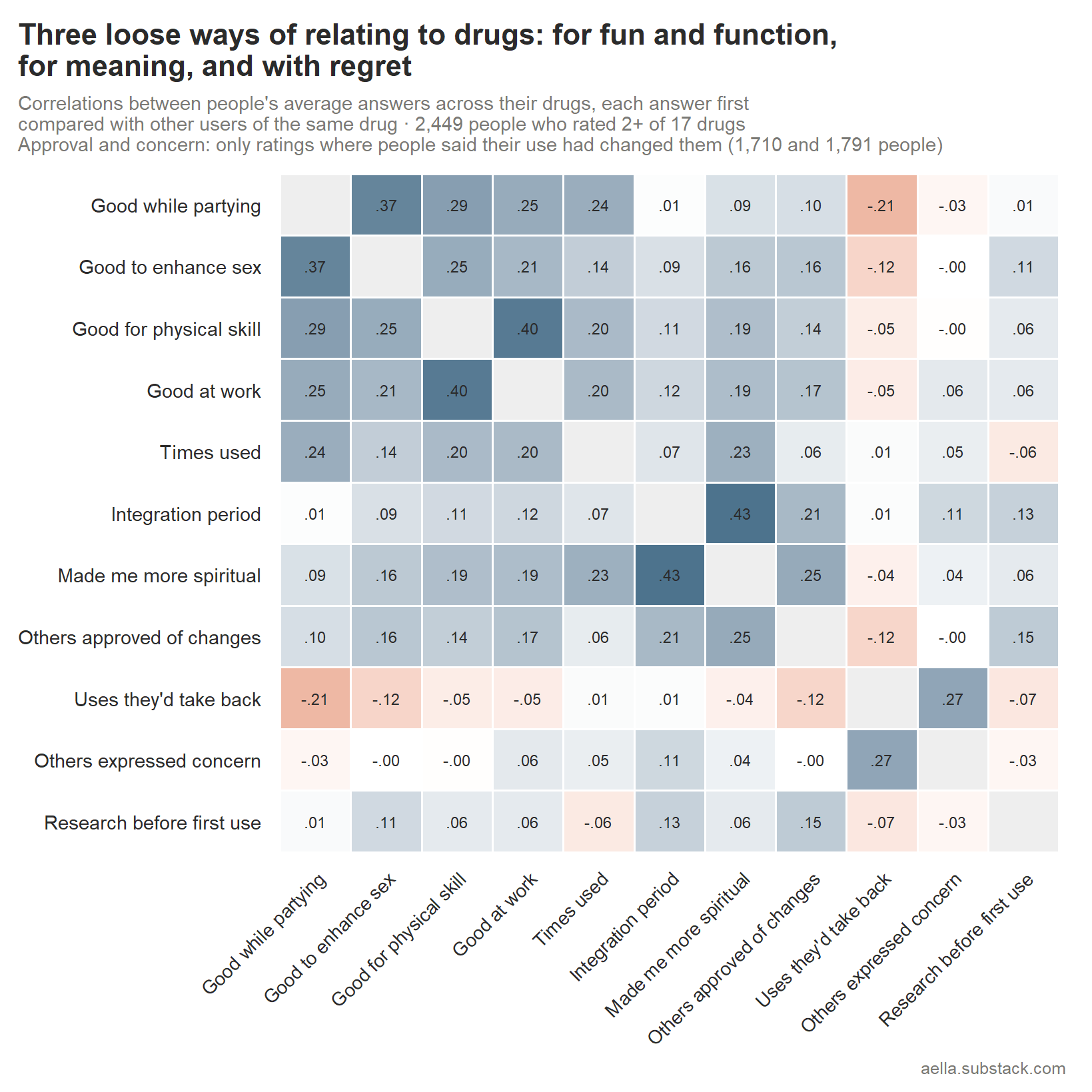
There are three loose styles, not one general enthusiasm. One is fun and function: rating your drugs as good for partying, sex, physical activity and work, and using them more often. A second is meaning: an integration period and becoming more spiritual, with others' approval going along more weakly (0.21 and 0.25). A third is regret: taking back more of your uses, and others expressing concern. Research stands mostly apart. Fun and meaning correlate 0.24; regret is slightly negative with fun (−0.11) and unrelated to meaning (0.00). Sorting people into clusters gives only weak separation, so these are tendencies, not camps.
Agreeing with "I find the existence of the supernatural to be plausible" goes with the meaning style more than anything else measured (0.27 standard deviations per standard deviation); the survey can't say which comes first. Openness and wellbeing go with meaning more weakly (0.13 each), extraversion with fun (0.11), and having ticked any listed mental health condition with regret (0.18). Younger people report more research before first use (0.19 standard deviations per decade), and cis women less than cis men (0.19).
7. How intense does it get?
Two questions asked about intensity: "On average, most of the time you've done [drug], how intense is this drug for you?" and "How strong was your strongest experience on [drug]?". Both were answered from 0 to 5 in half points, with these labels on the whole numbers:
- 0: "no noticeable effects at all"
- 1: "noticeble effects, but can easily do both simple and complex tasks with no issues."
- 2: "can still do simple tasks with no issues, but would need help from someone else to do complex tasks"
- 3: "needs help from people to do simple tasks, incapable of doing complex tasks even with help"
- 4: "incapable of doing simple or complex tasks even with help, but still has some connection to reality (like can see and hear what's going on)"
- 5: "no connection to reality, completely unaware of what's happening"
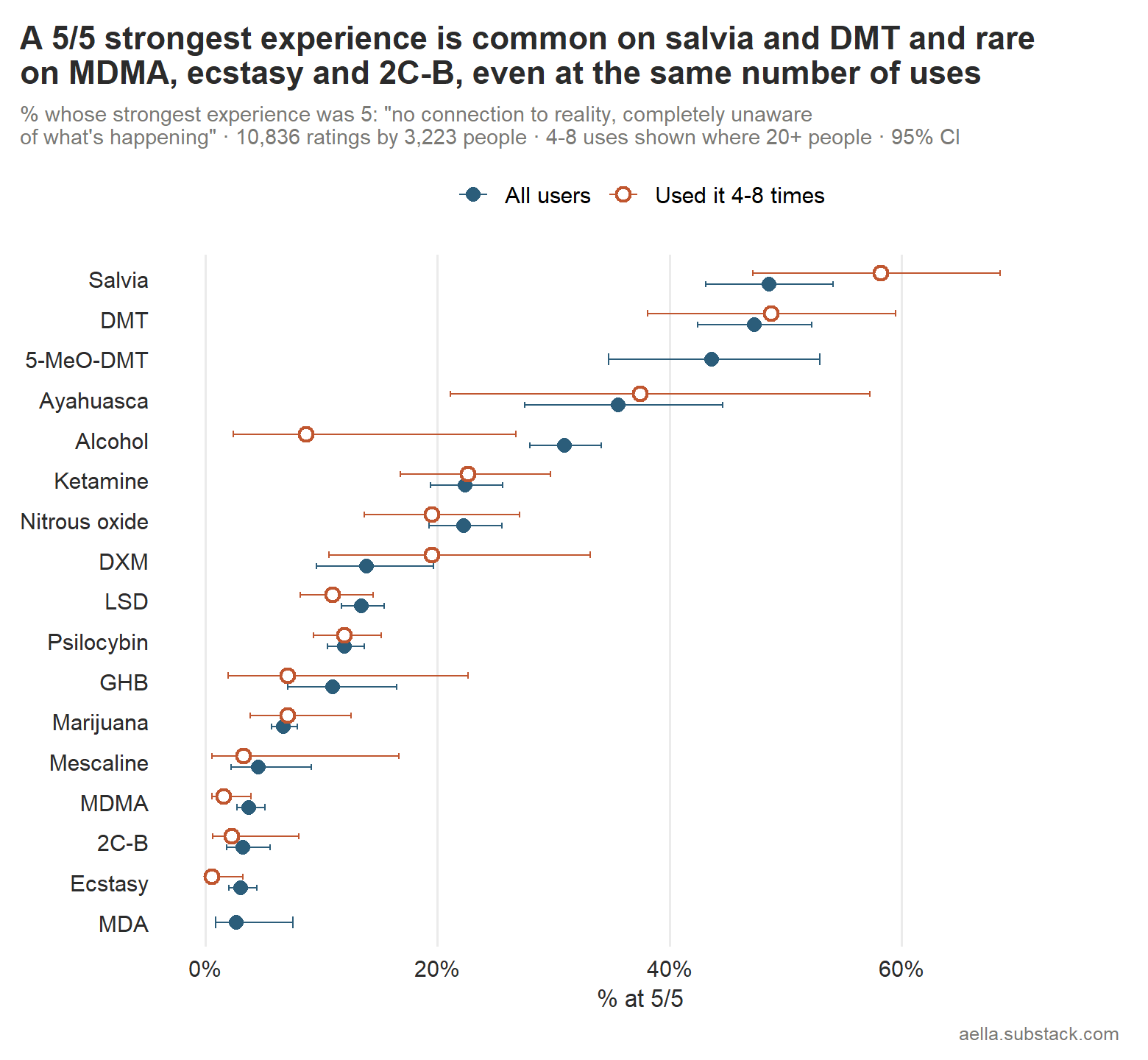
How rare a 5 is depends more on the drug than on the person, and strongly on how many times someone has used it. About half of salvia (49%) and DMT (47%) users put their strongest experience at 5, and 44% of 5-MeO-DMT and 36% of ayahuasca users. For ketamine and nitrous it's 22%, LSD and psilocybin 12 to 13%, marijuana 7%, and MDMA, ecstasy, MDA and 2C-B 3 to 4%. Split as in section 4, which drug it was goes with 18% of the variation and who was answering with 9%; most goes with neither. Alcohol is the outlier: its typical intensity is low (a median of 1.5), but 31% of drinkers rate their strongest experience a 5, almost all of them heavy drinkers. Among people who have drunk 50 times or fewer it's 10%; among those with more, 35%, about the same as psilocybin users with more than 50 uses (36%).
By kind of drug, counting each person once per group, 5s are most common for salvia (49%) and the DMT family (45%), then alcohol and GHB (28%) and the dissociatives (ketamine, nitrous, DXM; 25%), then the classic psychedelics (16%), marijuana (7%) and MDMA, ecstasy and MDA (4%).
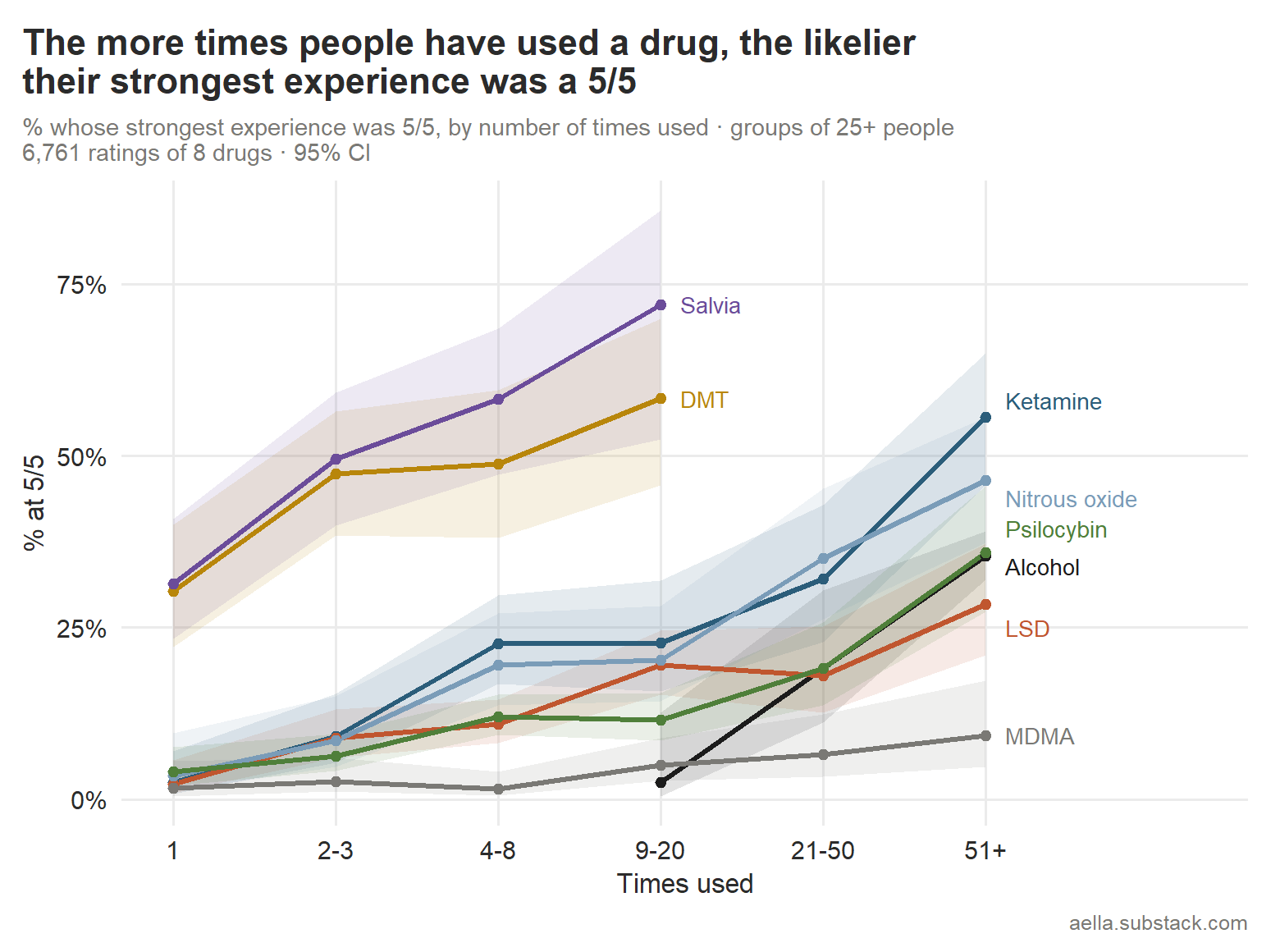
More uses mean more chances for a big experience (and perhaps a higher dose): for ketamine, 2% of one-time users and 56% of people with more than 50 uses have had a 5; for alcohol, 2% of people who have drunk 9 to 20 times and 35% of those with more than 50 occasions. Apart from alcohol, the drugs keep roughly their order at the same number of uses: among people with 4 to 8 uses, 58% of salvia and 49% of DMT users had had a 5, against 12% for psilocybin, 11% for LSD and 2% for MDMA.
Among the 1,704 people who rated every drug they had ticked, 33% have had a 5 on a drug other than alcohol (69% at least a 4), rising from 16% of people who rated two such drugs to 70% of those who rated eight or more. Among the 722 of them who could also report alcohol, 45% have had a 5 on something.
Class. For drug class, see the grouping above. For social class, the survey has no income or class question; education is the nearest proxy, and among people 25 and over 15 to 17% of ratings at each education level are 5s (adjusted differences within 1.2 points).
Where do you fall? The table gives each drug's typical answers and the share of users at or above each strongest-experience level. If your strongest psilocybin trip was a 4, you're among the 37% of psilocybin users who rated theirs 4 or higher; a 5 puts you among the top 12%.
| Drug | Users | Typical intensity (median) | Strongest (median) | Strongest 3 or more | Strongest 4 or more | Strongest 5 |
|---|---|---|---|---|---|---|
| Salvia | 315 | 4 | 4.5 | 78% | 69% | 49%43–54% |
| DMT | 393 | 4 | 4.5 | 85% | 78% | 47%42–52% |
| 5-MeO-DMT | 110 | 4 | 4.5 | 81% | 69% | 44%35–53% |
| Ayahuasca | 118 | 3.5 | 4 | 83% | 71% | 36%28–45% |
| Alcohol | 862 | 1.5 | 4 | 78% | 61% | 31%28–34% |
| Ketamine | 693 | 2 | 4 | 67% | 52% | 22%19–26% |
| Nitrous oxide | 669 | 3 | 4 | 68% | 55% | 22%19–26% |
| DXM | 180 | 2.5 | 3 | 67% | 42% | 14%10–20% |
| LSD | 1,357 | 2 | 3.5 | 65% | 40% | 13%12–15% |
| Psilocybin | 1,588 | 2 | 3 | 60% | 37% | 12%11–14% |
| GHB | 173 | 2 | 2.5 | 47% | 32% | 11%7–17% |
| Marijuana | 1,940 | 1.5 | 3 | 63% | 40% | 7%6–8% |
| Mescaline | 153 | 2 | 2.5 | 43% | 20% | 5%2–9% |
| MDMA | 978 | 2 | 2.5 | 40% | 18% | 4%3–5% |
| 2C-B | 370 | 2 | 2 | 32% | 13% | 3%2–6% |
| Ecstasy | 825 | 2 | 2.5 | 41% | 18% | 3%2–4% |
| MDA | 112 | 2 | 2 | 33% | 14% | 3%1–8% |
Users who answered the strongest-experience question. Medians are on the 0 to 5 scale. The last column has a 95% interval below each number. Drugs are sorted by the share at 5.
8. Could it be something else?
Isn't the person effect just how people use the sliders? If some people simply gave bigger numbers to every percentage question, the people who report more panic would also report more pleasurable trips. Instead, people's tendencies to report panic and pleasure across their drugs correlate −0.35, and regret and pleasure −0.38. That rules out a plain big-numbers habit, but not a general tendency to describe things negatively, which would produce the same pattern.
Isn't it just how often people used each drug? Holding the number of uses constant leaves the person shares almost unchanged (16% for panic, 18% for regret). Uses matter a lot for 5s, which is why Figures 8 and 9 show them.
Aren't these just the people who kept going? Partly. People who had a bad time may have stopped after a try or two, and enthusiasts are likelier to take a long drug survey. These are people's own accounts of drugs they chose, often years later, not measured effects.
Methods and limits
Data. Drug Experiences survey, October 2024 to January 2025, with the same cleaning as The Drug Report Card. People answered the same block of 31 questions for each drug they ticked, in random order, so people who dropped out partway answered a random subset of their drugs; person-level summaries weight people, not ratings.
| Step | Dropped | Left |
|---|---|---|
| Runs in the export | 5,329 | |
| Didn't reach the first drug checklist | 1,665 | 3,664 |
| Developer test runs | 5 | 3,659 |
| Gave the same answer to every statement for every drug they rated | 29 | 3,630 |
| Finished in under 1.75 minutes per rated drug (this leaves the cleaned sample) | 14 | 3,616 |
| Didn't answer the second checklist | 25 | 3,591 |
| Ticked no listed drug other than alcohol (98 ticked nothing, 51 only alcohol) | 149 | 3,442 |
Table. The 3,442 people in the last row are the portfolio sample (sections 1 and 2). The drug ratings (sections 3 to 7) come from the 3,616 people in the cleaned sample: after dropping ratings of drugs used zero times, 3,430 rated at least one of the 17 drugs with 100 or more raters, giving 11,445 ratings; 2,449 rated two or more.
Ages and scales. People under 18 are included as one more age band (36 aged 14 to 17 in the portfolio sample, 39 among raters; ages 14 to 81). Education comparisons use people 25 and over. Agreement statements used a 4-point scale for 92% of ratings; early 7-point answers were mapped onto it, with strongly disagree to neutral counted as disagree. Alcohol was on the checklist only from about five days into the run, so it is left out of the portfolios and of the 33% figure for person-level 5s; the 45% figure counts it only for the 722 people who could tick it. The survey spells ayahuasca "Ayahuascha".
Models. Portfolios: latent class models on the 25 drugs tried by at least 2% (alcohol excluded); six classes fit very slightly better by BIC but replicated worse in random halves (adjusted Rand index 0.46 to 0.77, against 0.57 to 0.73 for five), and with five a sixth to a third of people changed type between halves. A tetrachoric factor analysis found one dominant factor (first eigenvalue 10.7, then 1.2). Experiences: factor analysis (minres, oblimin) of polychoric correlations of the 26 answers; five factors kept (59% of the variance; split-half congruence 0.94 or more; a general factor, omega hierarchical 0.67, is essentially the spiritual dimension). Types are k-means clusters of the five scores (silhouette about 0.2, weak structure). Person or drug: mixed models with crossed random intercepts for person and drug, intervals from 60 resamples of people. Who does better: mixed models with a person intercept, a separate intercept and log-uses slope per drug, age, sex, and a trait slope per drug; a drug-specific difference (a drug's slope minus the average across the 13) needed a Benjamini-Hochberg q below 0.05 across 1,300 tests and the same sign with one-sided p below 0.05 in each random half. Styles: answers standardized within drug, averaged within person, factor-analysed (three factors; reliabilities 0.40 to 0.62, so rough measures).
Limits. Mostly experienced, left-leaning cis men who follow Aella, not all drug users. Each rating sums up all of someone's uses of a drug, with no dose, setting or single occasions. The trip questions say "trips" even for alcohol, marijuana and nitrous. The checklists record only whether people had ever done each drug, so nothing here shows which drug led to which.
Process. This analysis was done with AI assistance.