What Explains the Mono–Poly Dip?
People who are neither firmly monogamous nor firmly polyamorous rate their relationships somewhat lower than very-monogamous people and well below very-polyamorous people. On the monogamous side, much of the gap goes with wanting others and cheating, partly by definition; on the poly side, most of it is unexplained. Data from 52,434 people aged 14 to 80.
Ask people how monogamous or polyamorous they are, then ask how their relationship is going. The answers form a lopsided U: people at the two ends rate their relationships highest, very-poly people most of all, and people in between rate them lower. The shape shows up in every year of this survey. This report looks at what does and doesn't go with it.
Short version
- The dip is real, and lopsided. People in the middle average 1.58 on flourishing (−3 to +3), against 1.80 for very-mono and 2.02 for very-poly people: about a fifth of a standard deviation below the first and nearly half below the second. It's the same for men and women and shows up in every survey year, adult age band and couple type; among 14- to 17-year-olds the middle scores 0.23 below very-mono teens, but only 58 teens are very poly, too few to compare with that end. The exception is people who want others a lot: for them, ratings just rise from mono to poly.
- General answer style doesn't explain it, but kinder self-ratings at the ends can't be ruled out. Most people in every group rate their relationship well: 85% of the middle agree at least slightly that it is good for them, vs 90% of very-mono and 92% of very-poly people. But the middle has more doubters: 12.5% agree at least slightly that getting into it was a bad idea, against 8% and 6% (5%, 3% and 3% at "Agree" or stronger). Whether people with a firm identity describe their relationships more generously is something the survey can't test.
- Ratings dip; how often couples fight or have sex doesn't. The middle fights no more often than very-mono people and has sex about as often, though fewer are satisfied with their sex life. The one behaviour that peaks in the middle is cheating, which is two to three times as common there as at the very-mono end.
- The dip is two different things. On the monogamous side it goes with wanting other people and cheating, partly by definition: comparing people with the same desire and cheating history shrinks that side's gap by half to 84%, depending on whose mix of people is used, and among people who want others a lot there is no dip at all. On the poly side, very-poly people rate their relationships higher at every level of desire from "Somewhat" up, and the same matching shrinks the gap by only about a third.
- It isn't a man-versus-woman conflict. Men and women dip equally, and same-sex couples dip too.
- One plausible explanation is untested. The survey never asks whether partners agree on how open the relationship should be. Politics is no guide: there, ratings simply climb toward the liberal end, with no dip in the middle.
- There is a dip
- Is it real, or how people answer?
- Ratings vs how often couples fight or have sex
- Two different dips
- Is it a sex thing?
- Politics: a ramp, not a U
- Scorecard of explanations
- What we can't tell
- What would settle it
- Methods
1. There is a dip
The survey asks "Are you more monogamous or polyamorous?" and offers six answers, from "Very monogamous" to "Very polyamorous". A tip explains that "poly" just means not monogamous, including couples who are allowed to sleep with other people even if they don't. Most people say very monogamous (60%) or mostly monogamous (22%). The rest are spread across slightly mono (4%), slightly poly (8%), mostly poly (4%) and very poly (3%).
Relationship quality here is the survey's flourishing score. It averages six statements, each answered from "Strongly disagree" (−3) to "Strongly agree" (+3):
- "This relationship is good for me"
- "I think this relationship will last for a very long time"
- "My partner enables me to learn and grow"
- "I feel confident in my relationship's ability to withstand everything life has to throw at us"
- "I am careful to maintain a personal identity separate from my partner"
- "In hindsight, getting into this relationship was a bad idea" (reversed)
It runs from −3 to +3, and the average is 1.7.
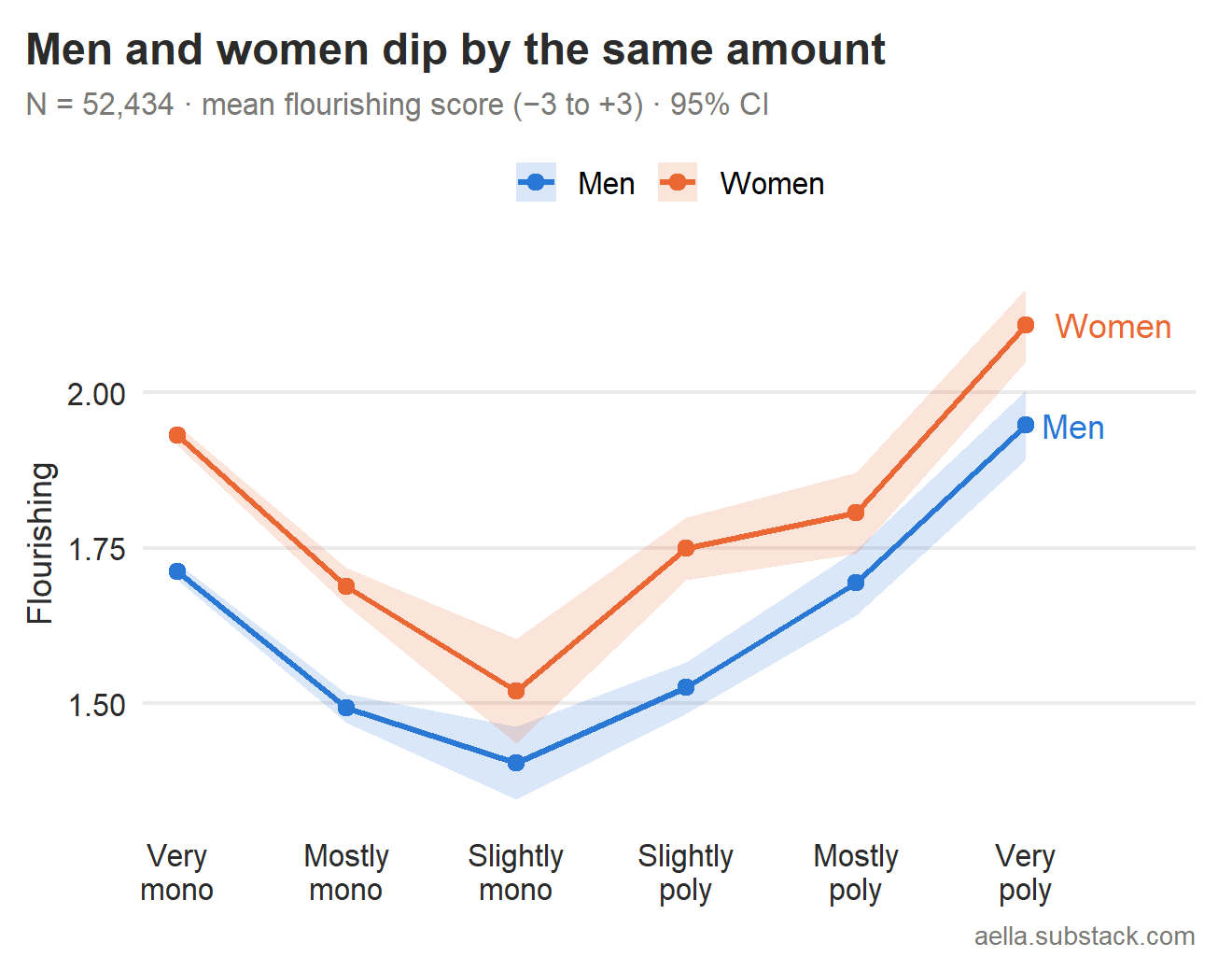
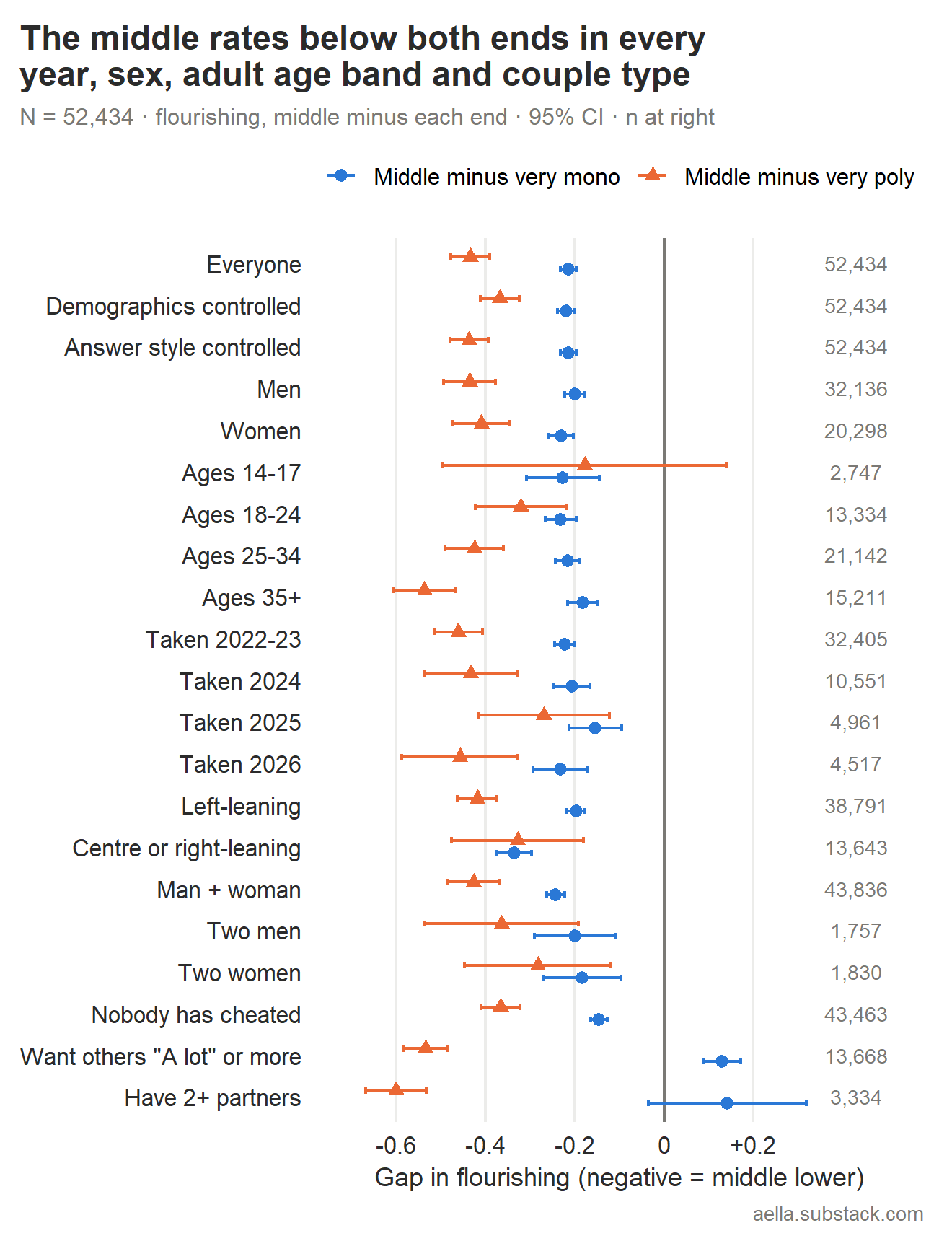
The four middle groups pooled average 1.58, against 1.80 for very mono and 2.02 for very poly. So the middle sits 0.21 points below very mono and 0.43 below very poly (95% CIs 0.20 to 0.23 and 0.39 to 0.48): about a fifth and nearly half of a standard deviation. Against all firm people pooled, the gap is 0.23. For scale, couples where someone has cheated score 0.54 below couples where nobody has. Being below both ends is what makes this a U, and Figure 3 shows it group by group.
Some comparisons below use a single summary number, "the dip": the middle minus the average of the two ends, which is −0.32 (95% CI −0.35 to −0.30). It is a summary, not a size. It counts the small very-poly group (3% of people) as much as the very-mono majority, and because two-thirds of the middle is on the monogamous side, it comes out negative even for something that only rises from mono to poly: it gives −0.14 for "I am careful to maintain a personal identity separate from my partner", which does just that. The dip is −0.32 for both men and women, and holding demographics constant barely moves it (−0.29); the controls are age, sex, gender identity, same-sex couple, relationship length, marriage, kids, religion, income, politics and survey year.
2. Is it real, or how people answer?
Answer style
Some people use the ends of every scale, and some hug the middle. Suppose the people who pick "very" on the mono/poly question also pick "strongly agree" on everything else. Then you would get a U without any real difference in relationships.
General answer style doesn't explain the dip:
- On four statements unrelated to relationship quality, middle respondents answer just as far from neutral as very-mono respondents do. Very-poly respondents answer a little more extremely.
- Holding that answer style constant leaves the middle 0.21 below very mono and 0.44 below very poly, and leaves very-poly people's lead over the poly-side middle unchanged (−0.30 either way, with demographic controls). The dip is also about the same size among the most extreme, middling and mildest answerers (−0.34, −0.32, −0.31). Four statements make only a rough measure of style, though.
- It isn't people at the ends agreeing with everything. The dip also shows up on the one negatively worded statement, "In hindsight, getting into this relationship was a bad idea", where agreeing with everything would push the ends the other way.
- The middle doesn't just answer more mildly. It has more people on the bad side of neutral, even though most people in every group rate their relationship well: 85% of the middle agree at least slightly that "This relationship is good for me", vs 90% of very-mono and 92% of very-poly people.
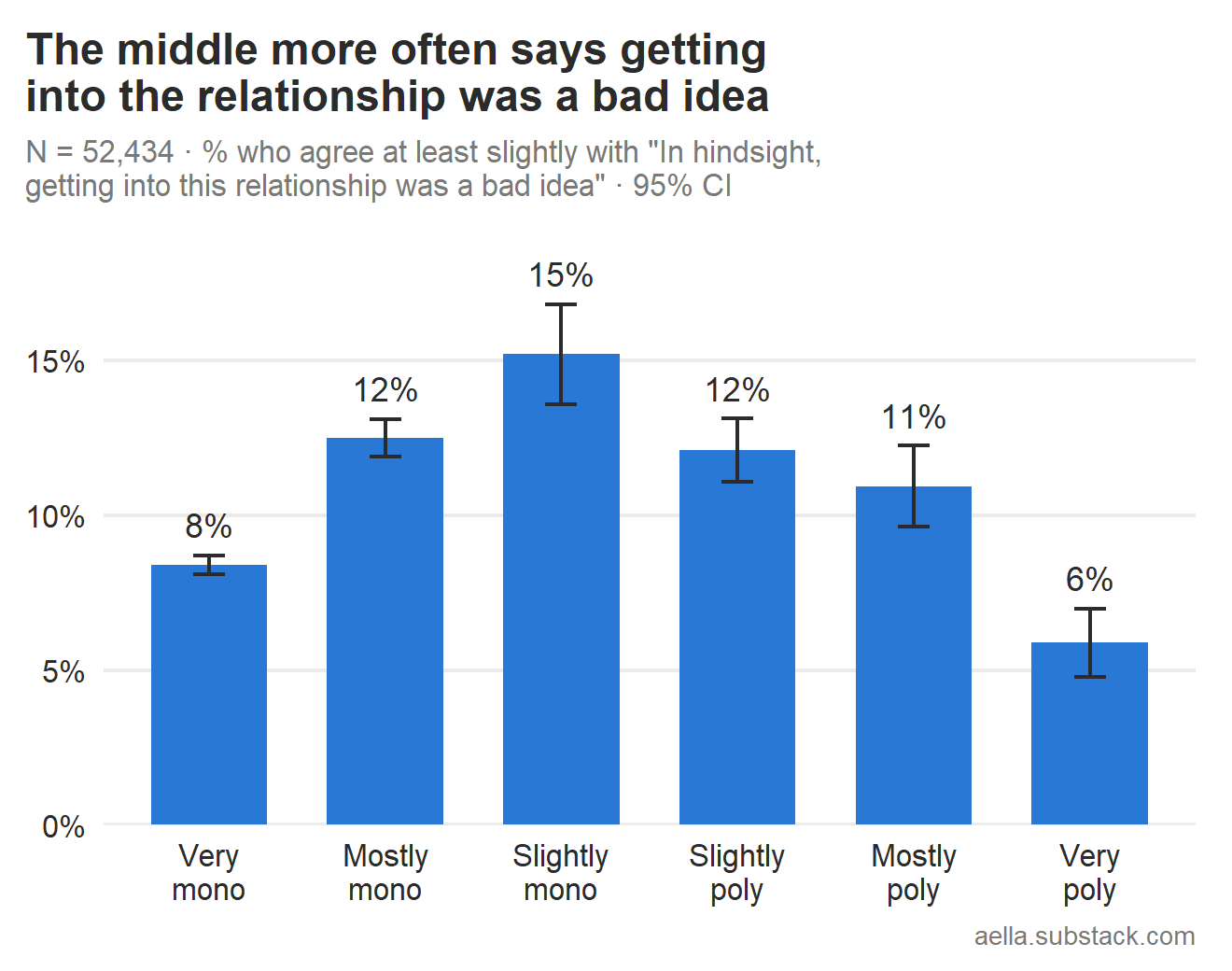
What those checks can't rule out is narrower. People with a firm identity at either end might describe their own relationship more kindly while answering everything else normally. The survey has no outside measure of how a relationship is going, so this stays open (section 8).
The five flourishing statements other than the separate-identity one hang together the same way in all six groups, with the same reliability (0.85–0.88) and near-identical weights. That can't rule out a group answering all of them more generously.
Who takes the survey
This is Aella's audience, not a random sample. Three questions a skeptic would ask:
- Does it depend on where people came from? The dip is smaller among people who came from Reddit, Fetlife or Discord (−0.17 to −0.26) than from Twitter (−0.34), even comparing people who took the survey in the same year. Knowing Aella doesn't seem to matter: the question about her was asked only in 2024 and 2025, and in those years the dip is about the same for people who have never heard of her (−0.22) as for people who have (−0.25).
- Is it an age thing? The middle is below both ends in every adult age band (Figure 3). Among 14- to 17-year-olds it scores 0.23 below very-mono teens, but only 58 teens are very poly, too few to compare with that end.
- Is it one period or one political camp? The middle is below both ends in every survey year from 2022 to 2026, and among both left-leaning and centre or right-leaning people.
3. Ratings dip; how often couples fight or have sex doesn't
If middle relationships were simply worse day to day, you'd expect more fighting and less sex. Neither happens: how often couples fight or have sex doesn't dip.
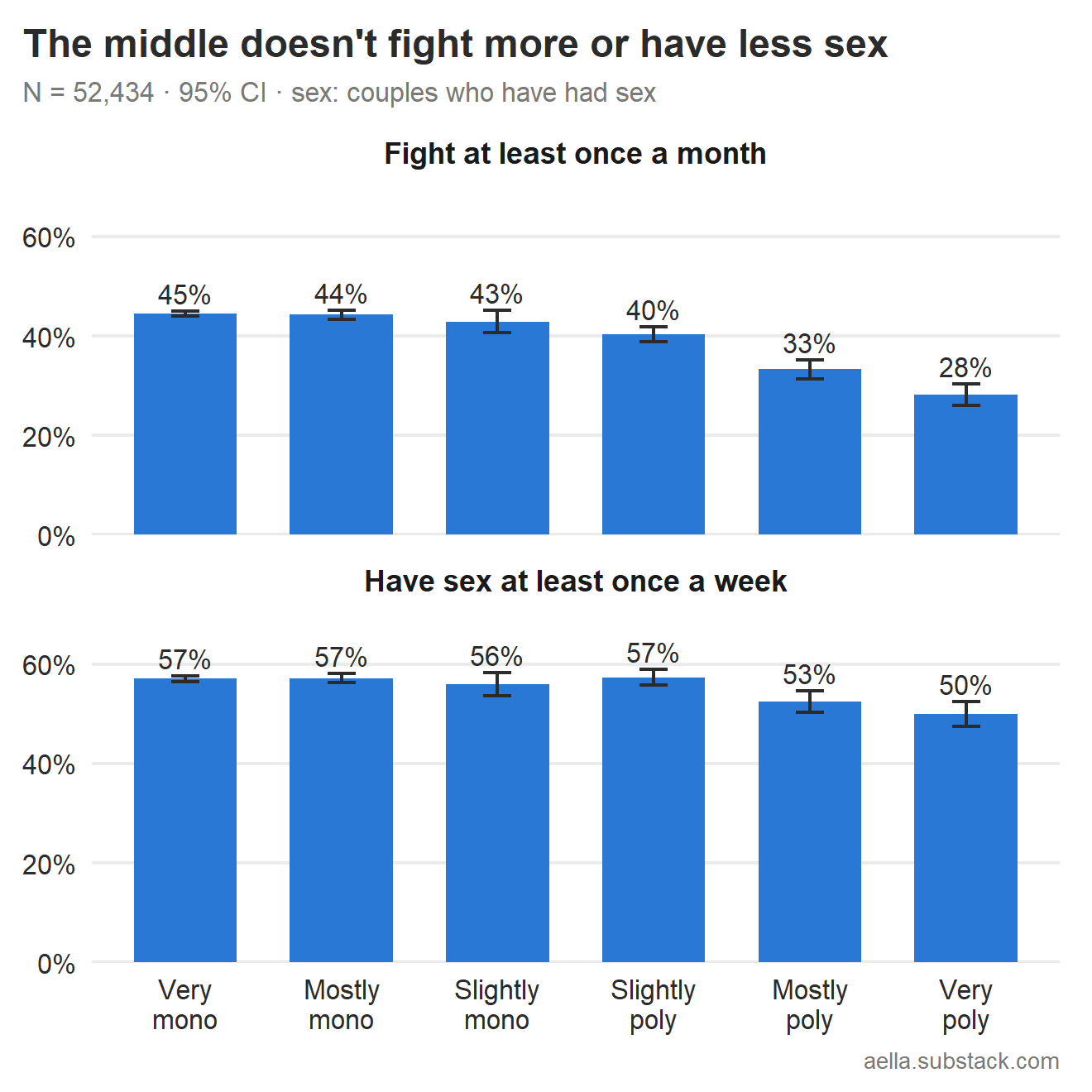
How the sex feels is another matter. The survey's sex-satisfaction score dips in the middle (1.34 for very mono, 1.14 for the middle, 1.38 for very poly; lowest at slightly mono, 1.04), and fewer agree "I'm satisfied with our sex life" (63%, 59% and 64%). Statements about toxicity also peak in the middle.
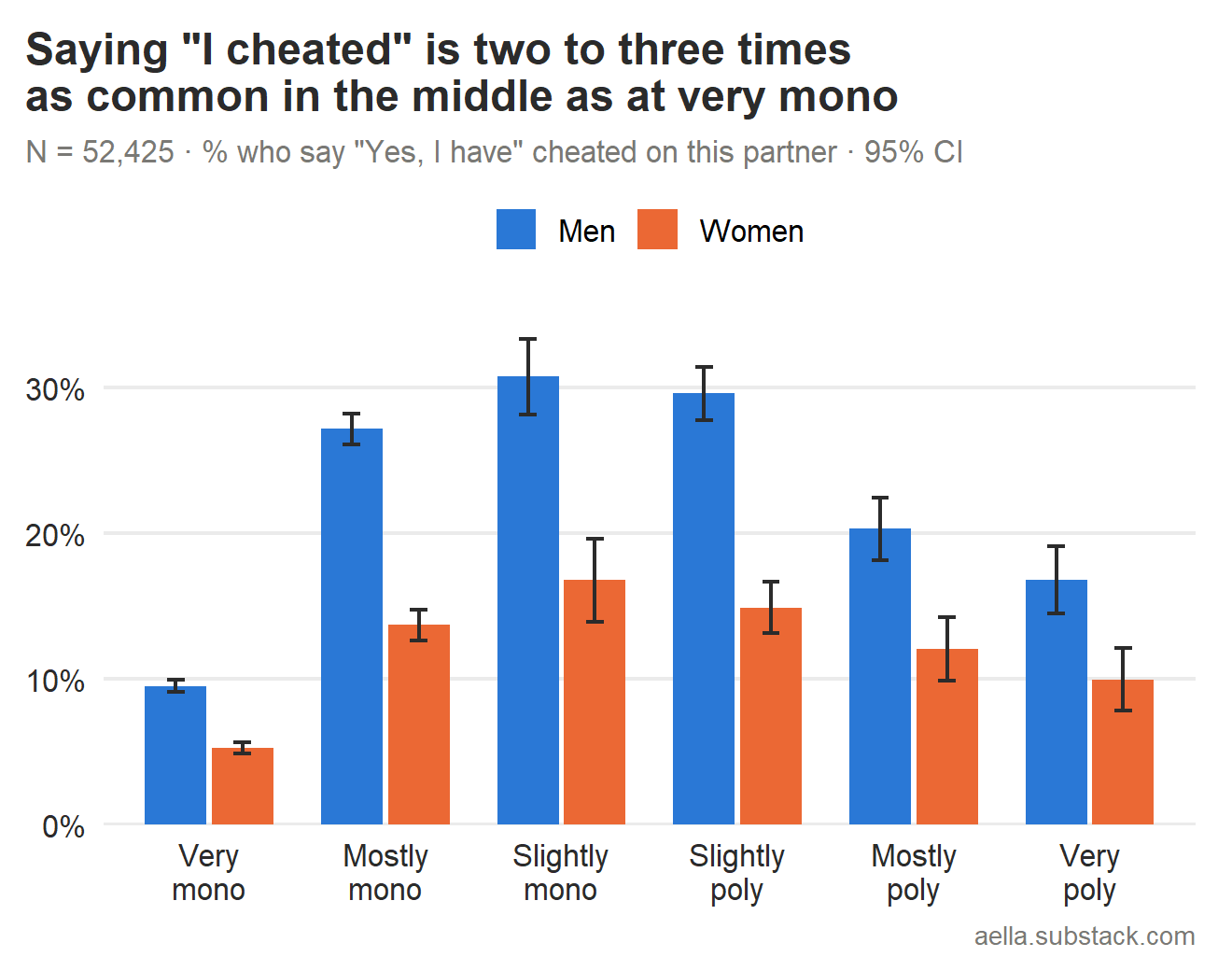
The behaviour that does peak in the middle is cheating. Asked "Have you or your partner ever cheated on each other?", someone has in 11% of very-mono relationships, 22–30% of middle ones (two to three times as often), and 17% of very-poly ones.
The biggest gaps on individual statements are mostly about the relationship's future and worth:
- "I think this relationship will last for a very long time"
- "In hindsight, getting into this relationship was a bad idea"
- "I have no secrets from my partner"
- "This relationship is good for me"
- "I feel confident in my relationship's ability to withstand everything life has to throw at us"
One caution: flat fighting and sex frequency with a dip in ratings is also what you'd see if people at either end simply rated their relationships more generously, perhaps because they have a clear identity to defend. This survey can't rule that out.
4. Two different dips
The middle is not one group. Two-thirds of it (68%) is on the monogamous side, mostly or slightly mono, and the two sides behave differently. The clearest way to see this is to split people by their answer to "In a world where your partner was fully aware and deeply okay with it, how much would you be interested in having sexual/romantic experiences with people besides your partner?"
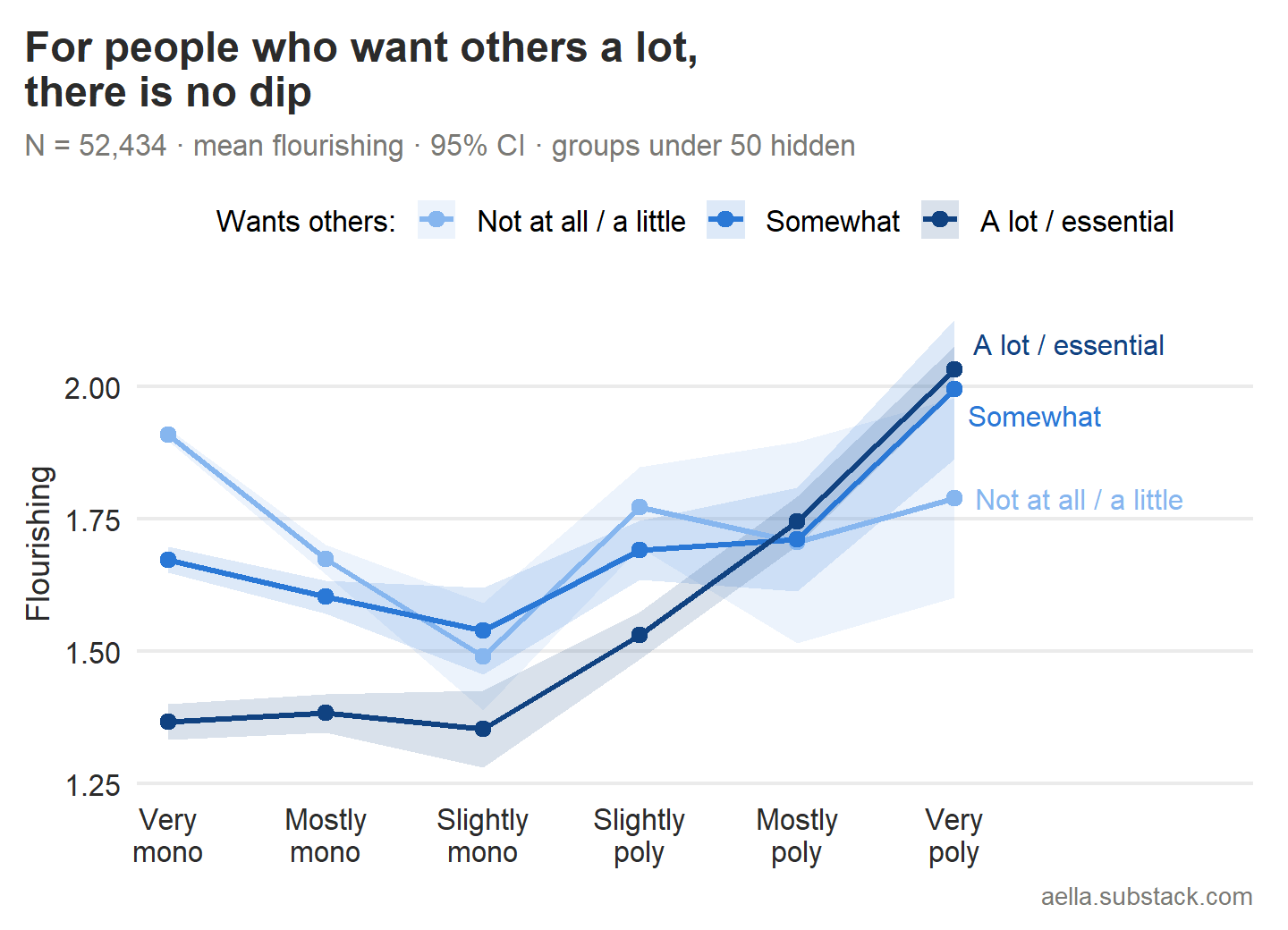
For people who want others a lot, there is no dip. Flourishing is flat across the monogamous labels (1.37, 1.38, 1.35) and rises steadily to 2.03 at very poly. For people who don't want others much, very-mono people rate highest (1.91); mostly mono (1.67) and slightly mono (1.49) are well below, and the 84 very-poly people at this level (1.79) are too few to tell apart from very mono. Since the monogamous end is mostly people who don't want others and the poly end mostly people who do, the overall U is largely these two patterns stitched together.
4a. The monogamous side: wanting others, and cheating
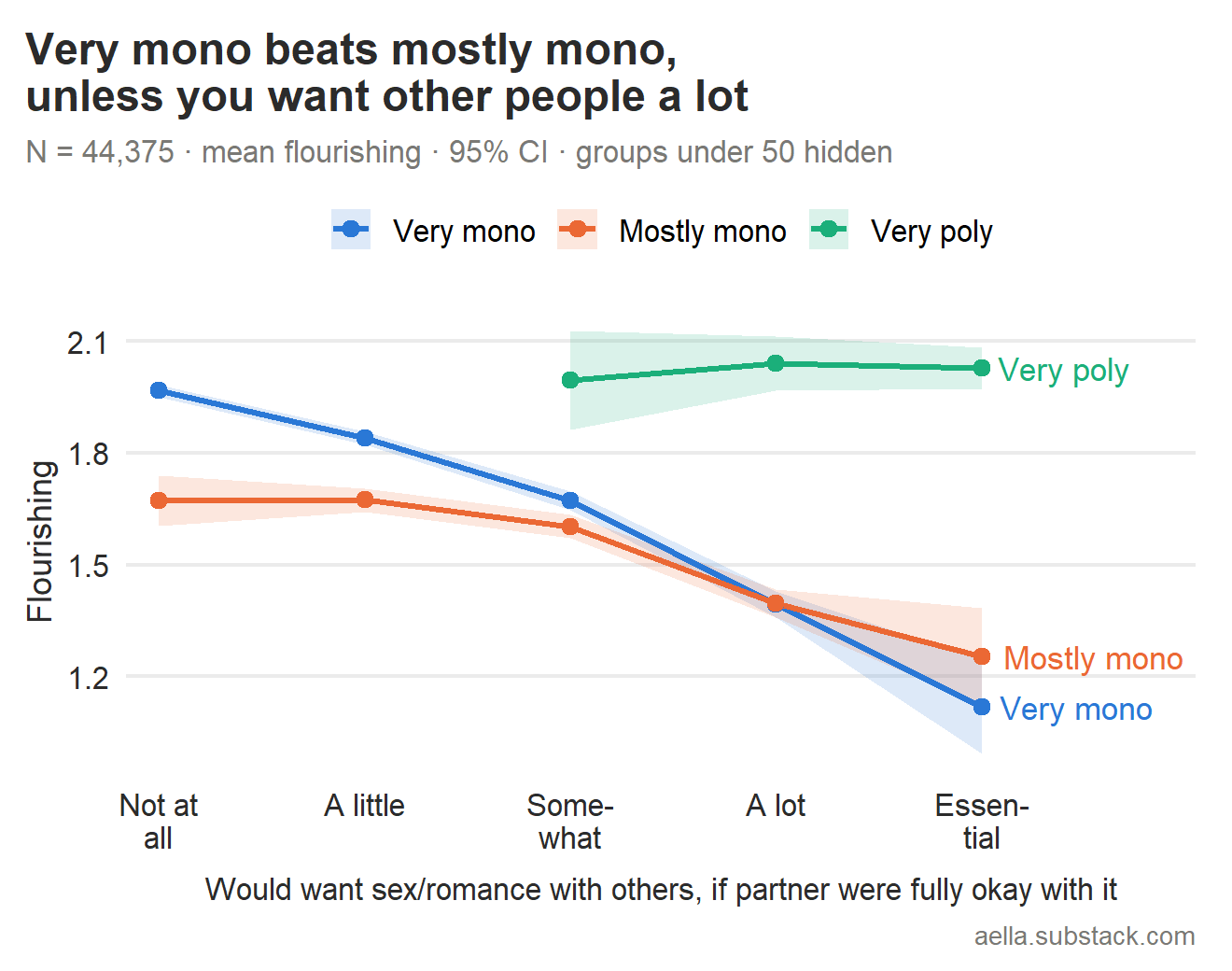
Among very-mono people, each step up in wanting others goes with 0.18 points lower flourishing. Among very-poly people, there's no such link (−0.01).
Compare mostly-mono and very-mono people who want others the same amount (with demographic controls), and the gap depends on how much they want:
- "Not at all": mostly mono is 0.28 lower
- "A little bit": 0.15 lower
- "Somewhat": 0.07 lower
- "A lot": no difference
- "Extremely, this is essential": mostly mono is 0.20 higher
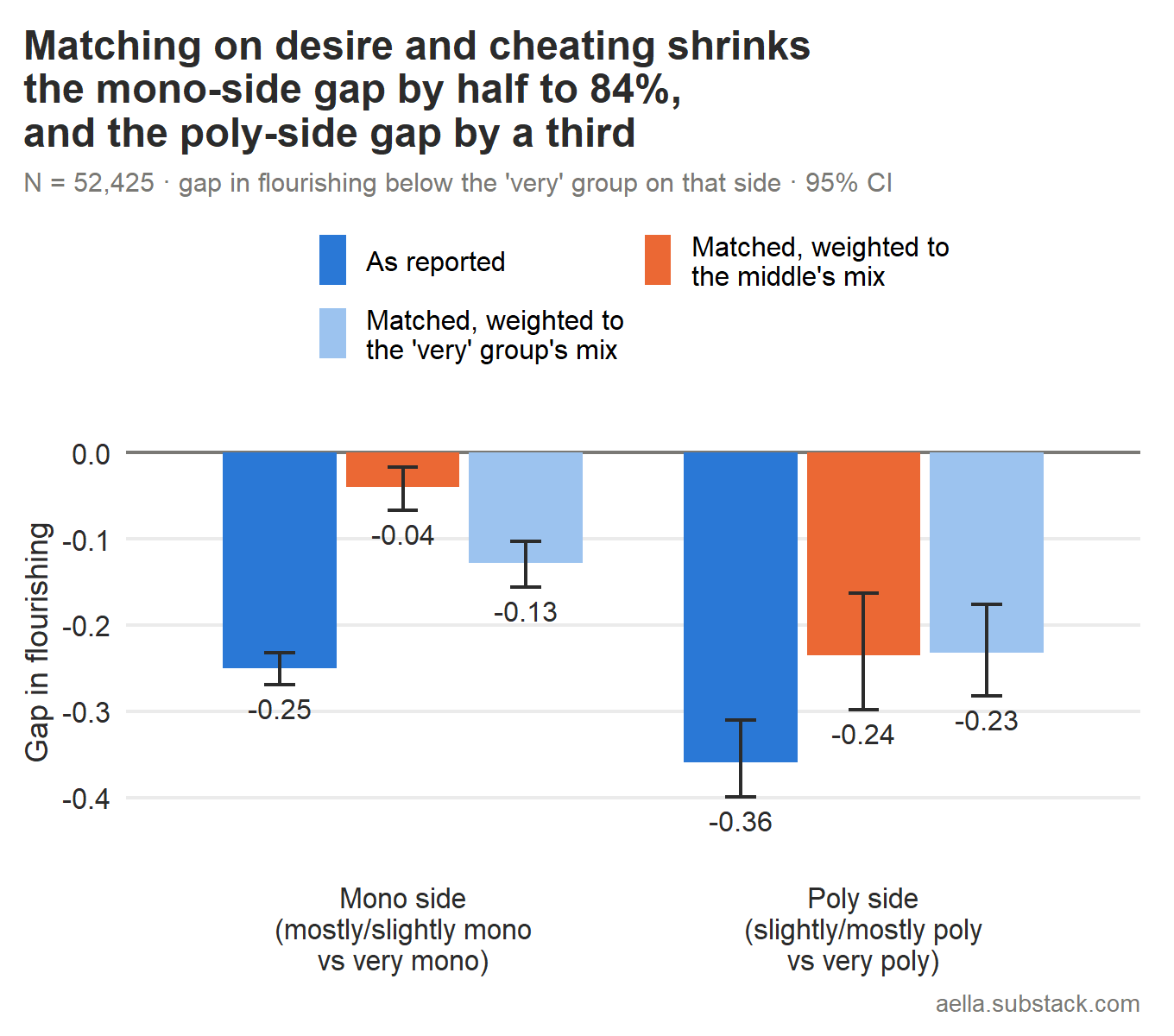
Now compare people who match exactly on three things: how much they want others, how much they think their partner does, and whether anyone has cheated. That shrinks the monogamous-side gap by between about half and 84%, depending on whose mix of people the comparison uses. The answer depends on the mix because the gap between labels is largest among people who barely want others:
- At the middle's own mix, where most people want others at least "Somewhat", the gap shrinks from 0.25 to 0.04 (by 84%).
- At the very-mono group's mix, where 69% want others "Not at all" or "A little bit", it shrinks only to 0.13 (by 49%). There, own desire alone shrinks it by a quarter, and adding the partner's desire by a third.
The part that remains is concentrated among people who barely want others, which is the next section.
This is partly true by definition: calling yourself "mostly" rather than "very" monogamous is close to saying "I want others a bit, or something has happened." So it's better read as a description of who is on the monogamous side of the middle (relationships where monogamy has cracks) than as proof that wanting others causes unhappiness. The causation could easily run the other way: unhappy people start wanting others and stop describing themselves as very monogamous. Cheating is part of the same picture. Among mostly- and slightly-mono people with two or more current partners, 64–65% say they have cheated on the partner they answered about, vs 8% of very-mono people with one partner.
4b. When neither partner wants others much
About 29% of the monogamous-side middle say that neither they nor their partner would want others more than "A little bit". Most of them (80%) do say "A little bit", against 45% of very-mono people at this level, so their label may still partly reflect desire. Compared with very-mono people giving exactly the same two answers, they score 0.19 lower (with controls). For some of them, "mostly monogamous" may mean "less all-in". Compared with very-mono people at this level:
- among adults, 18% are married, vs 30% (19% vs 30% at the same ages)
- 77% agree at least slightly that "If my relationship ended I would be absolutely devastated", vs 87%
- 66% agree at least slightly that "The long-term routines and structure of my life are intertwined with my partner's", vs 77%
Among adults, holding relationship stage (length, marriage, kids) constant shrinks their gap by only 11%. Holding statements about commitment and entanglement constant shrinks it by 62%, but generic quality statements shrink it by 50%, so this is thin support for a commitment story.
4c. The poly side: very poly is its own group
From "Somewhat" up, where 95% of very-poly people are, very-poly people rate their relationships higher than slightly- and mostly-poly people at each level of desire (gaps of 0.28–0.35, with controls), and also among people who currently have two or more partners (0.37). Below that, there are too few very-poly people (84) to tell. Matching on desire, partner's desire and cheating shrinks the gap by about a third (0.36 → 0.23–0.24), whichever group's mix is used.
What's left looks like a difference in how people do non-monogamy. Compared with very-poly people, more slightly-poly people agree at least slightly that:
- "I often feel jealousy in my relationship" (19% vs 14%)
- "I try to stay aware of my partner's potential infidelity" (22% vs 11%)
- "I rely on my partner for a sense of self worth" (35% vs 28%)
- "My partner takes priority over everything else in my life" (48% vs 37%)
Fewer agree that "I am careful to maintain a personal identity separate from my partner" (75% vs 83%). Most have no second partner: 18% do, vs 58% of very-poly people.
Two readings fit. Non-monogamy may go better when it's fully embraced, along with the psychology that suits it; or people call themselves "very poly" when it's working and hedge when it isn't. This survey can't tell them apart.
5. Is it a sex thing?
No. Men and women dip by the same amount (−0.32 each), and for both, the middle rates below both ends. Women score higher overall at every point (Figure 1).
Men want others more at every point on the scale: among slightly-mono people, 52% of men say "A lot" or "Extremely, this is essential", vs 33% of women. Men also more often say they have cheated themselves. But the cheating rate rises from very mono to the middle by about the same factor for both sexes: men go from 9.5% at very mono to 27–31% from mostly mono through slightly poly, and women from 5.3% to 14–17%.
It isn't mainly one partner, typically the man, wanting out while the other resists:
- In the middle, women say they want others much more than their partner does 17–21% of the time, and that their partner wants others much more only 5–8% of the time.
- Couples where both partners want others equally (as the respondent sees it) dip as much as everyone else (−0.30).
- Same-sex couples dip too: two men −0.28, two women −0.23, a man and a woman −0.33. The two-women estimate leaves room for a somewhat smaller dip.
There are some sex differences in the details. Men in the middle lose more sexual satisfaction (−0.24 vs −0.15 on the survey's sex-satisfaction score), and women more on toxicity statements (+0.28 vs +0.22).
6. Politics: a ramp, not a U
Does the same thing happen with politics? No: ratings rise toward the liberal end, and moderates score about the same as conservatives. Centrists average 1.59 and the most liberal 1.87 (Figure 9). The most conservative average 1.64, but that small edge disappears once age and other demographics are held constant (−0.01 against centrists, 95% CI −0.07 to +0.06), while the most liberal stay 0.25 ahead. That lead isn't the mono/poly mix either: it is still 0.25 with the mono/poly label held constant.
Agreement with a partner does vary across the scale. Centrists are the least likely to agree that "My partner an [sic] I are politically aligned": 60%, vs 74% of the most conservative and 92% of the most liberal. Holding that answer constant shrinks the most liberal respondents' edge from 0.25 to 0.04. Alignment differs far more across the political scale than hobbies do, which is why it absorbs the gap; whether agreement itself matters can't be told, and at the conservative end more alignment doesn't come with higher ratings (the alignment gap alone would put the most conservative 0.09 above centrists; they sit at −0.01).
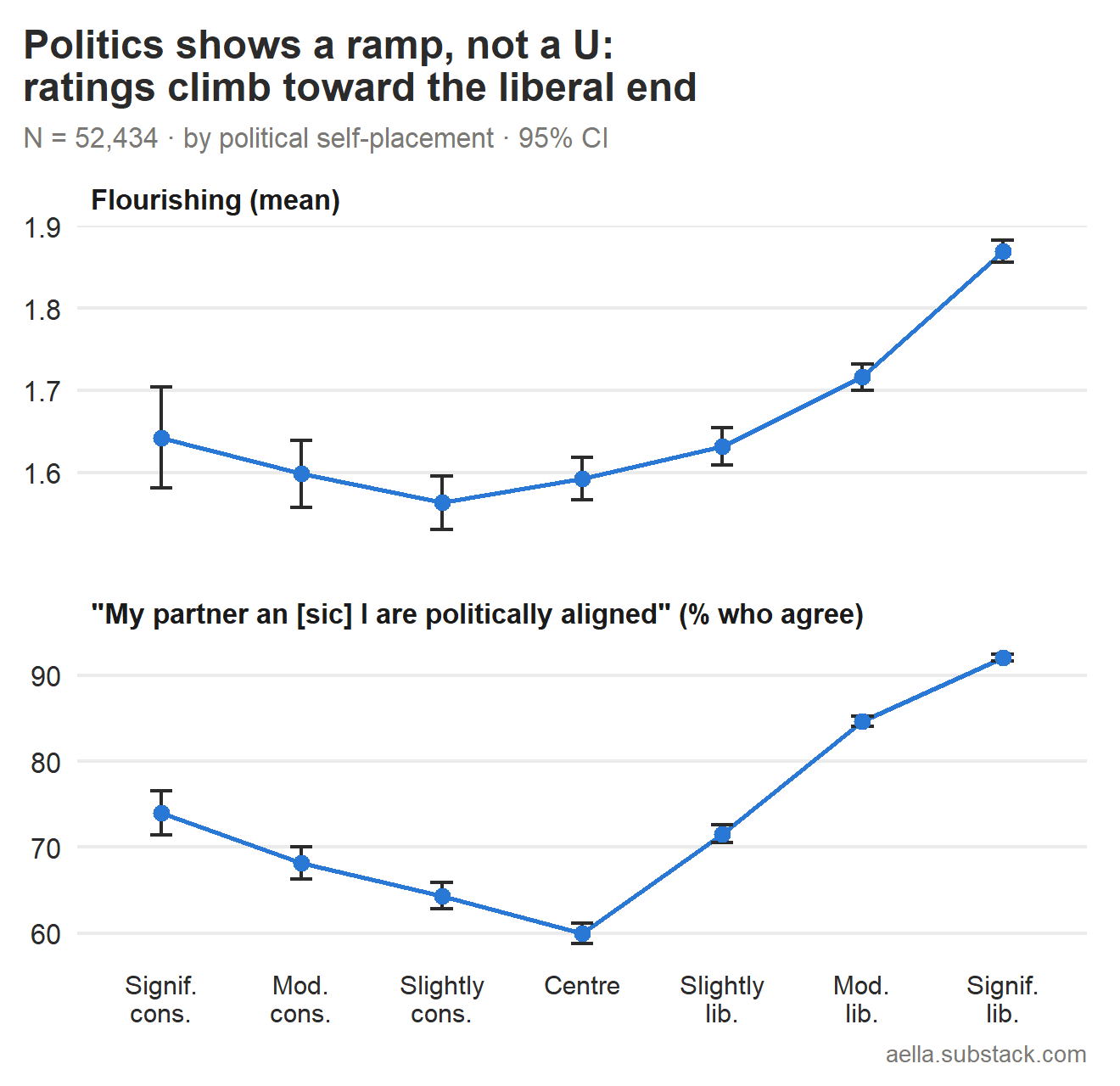
Holding political alignment constant barely changes the mono/poly dip (−0.29 → −0.28). So politics doesn't repeat the U, and it can't show whether partner agreement would explain one. The survey has never asked the mono/poly version: do you and your partner agree on how open your relationship should be? Respondents' guesses about their partner's desire are only a rough stand-in.
7. Scorecard of explanations
| Explanation | Verdict | What the data says |
|---|---|---|
| Mild or yes-saying answer style | Ruled out | The middle answers unrelated statements as extremely as very mono; the gaps don't change with style held constant; the dip shows on the negatively worded statement too. |
| Kinder self-ratings at the ends | Can't be tested | Would fit flat fighting and sex frequency alongside a dip in ratings. Equal reliability across groups can't rule it out. |
| Who takes the survey | Not the cause | The middle is below both ends in every year. Smaller among people from Reddit, Fetlife and Discord than from Twitter. |
| Demographics | Ruled out | Dip −0.32 → −0.29 with eleven controls. |
| Mental health | Ruled out | Diagnoses about equally common; dip −0.28 → −0.27 (2026 respondents). |
| Libido or sexual history | Weak | 5% of the monogamous-side gap. |
| Men vs women | Ruled out | Same dip in both sexes; same-sex couples dip too. |
| Partner wants something different (as guessed) | Minor | Couples whose desire matches dip −0.30. |
| Wanting others, and cheating | Fits the mono side | Matching shrinks the monogamous-side gap by half to 84%, partly by definition. Where nobody has cheated, the dip is still −0.26. |
| Less all-in commitment | Weak | Low-desire mono side: holding commitment statements constant shrinks the gap 62%; generic quality statements, 50%. |
| Doing poly half-heartedly / identity strength | Open, poly side | Two-thirds of the poly-side gap survives matching; can't be told apart from people calling themselves "very poly" when it's working. |
| Partners disagree about the arrangement | Untested | Never asked for mono/poly. |
8. What we can't tell
- Which way it runs. The mono/poly label isn't a treatment people were assigned. "How monogamous are you?" partly reflects how things are going, so these results describe who ends up in the middle, not what the middle does to you. Repeat respondents can't be linked, so there's no before-and-after.
- Partners aren't linked. Everything about the partner is the respondent's guess, so "mismatch" here is perceived mismatch.
- Survivorship. Relationships that already ended aren't in the data. If mismatched middle couples break up quickly, the true middle is worse than it looks.
- Kinder ratings at the ends. People with a firm identity may rate their own relationships more kindly. That would fit flat fighting and sex frequency with a dip in ratings, and none of the answer-style checks in section 2 can rule it out.
- What a share of the gap means. When comparing people at the same level of a factor shrinks the gap by some share, that says nothing about cause. The share depends on how much the factor differs between the labels, and on whose mix of people is used (section 4a).
- Across 36 other relationship statements, the share of the dip a statement "explains" closely tracks how much it overlaps with flourishing (about 103 × r²; fit R² 0.90). Respect, humor, being intellectually matched and playfulness "explain" half the dip simply because they're other measures of a good relationship.
- Wanting others and cheating overlap with flourishing far less (R² 0.08, vs 0.50 for those four statements) yet go with nearly as much of the dip (44% vs 52%). That doesn't make them special: they differ hugely between the labels, partly by definition, and any factor that differs that much between the groups, and is even loosely tied to ratings, will take a large share of the gap between them.
9. What would settle it
- "My partner and I agree on how open our relationship should be." This is the mono/poly version of the politics question, and a natural candidate for what's left.
- Separate the arrangement ("Are you allowed to sleep with other people?") from disposition ("How monogamous or polyamorous are you?"). The current question mixes them.
- "Was this relationship monogamous when it started? If it changed, when, and who proposed it?"
- When any cheating happened, relative to a change in the arrangement.
- A couple code so partners' answers can be linked, and a stable respondent ID so repeat takers can be followed over time.
Methods
Data. The Your Relationships survey, December 2022 to November 2026. People answer about their primary partner.
Cleaning. Of 142,853 submissions, we kept 52,434. People were removed if they:
- didn't finish the survey (78,770)
- said they answered only slightly or not at all honestly (2,256)
- had no partner (888)
- were outside ages 14–80, or had a partner outside ages 14–90 (40)
- reported a relationship length impossible for their ages (380)
- finished in under 2 minutes 20 seconds (36)
- said their partner watched them take it (4,246)
- were resubmitting for an additional partner, or had taken the survey before (3,733)
- gave the same answer to 90%+ of statements, or strongly agreed with both sides of two or more opposite statements (70)
The data is unweighted.
Ages. Respondents are 14 to 80. The 2,747 people aged 14 to 17 (5%) are included throughout and shown as their own band in Figure 3; the marriage and relationship-stage figures in section 4b are for adults only.
Measures. Flourishing is the survey's own six-statement score (−3 to +3; standard deviation 0.98). The main results were also checked with a five-statement version that drops "I am careful to maintain a personal identity separate from my partner", which is unrelated to the other five statements and endorsed more by poly people. On that version the dip is −0.36, or −0.32 standard deviations (−0.33 on the six-statement score); matching shrinks the monogamous-side gap by 48–80% and the poly-side gap by about a third; and the politics and age results are the same.
Models. The dip is the coefficient contrast "middle minus the average of very mono and very poly", estimated by ordinary least squares with robust (HC1) standard errors; the middle-versus-each-end gaps come from the same kind of model. Demographic controls:
- age and age², sex, own and partner's trans/nonbinary status, same-sex couple
- relationship length and length², marriage, kids
- religion, log income, politics
- survey year
Missing income and politics were filled with neutral values and flagged; missing religion was treated as none. In section 6, politics is the grouping variable, so it is left out of the controls there.
"Matching" means exact cells of own desire × perceived partner desire × anyone-cheated, with 200-replicate bootstrap intervals. Section 4 reports it both ways: the "very" group reweighted to the middle's mix of cells, and the middle reweighted to the "very" group's mix. Answer style was measured as the average distance from neutral on four statements that each correlate less than 0.1 with flourishing: "If my partner and I ever split up, it would be a logistical nightmare (e.g., separating house, friends)", "I rely on my partner for a sense of self worth", "I feel like I would still be a desirable mate even if my partner left me" and "I'm worried I'm not good enough for my partner". Charts hide groups under 50 people.
Replication. The key results were rerun on two random halves of the sample:
- dip with demographic controls: −0.30 and −0.29
- monogamous-side gap, as reported → matched at the middle's mix / at the very-mono mix: −0.24 → −0.02 / −0.11, and −0.26 → −0.06 / −0.14
- poly side, the same way: −0.36 → −0.21 / −0.19, and −0.35 → −0.26 / −0.26
Other data. An earlier analysis of 332 Glosso users who answered the same mono/poly question found a middle-minus-ends gap of −0.32 on Glosso's own version of the flourishing score (95% CI −0.53 to −0.10). It wasn't rerun for this page.
Process. The analysis was done with AI assistance.
Correction, 13 November 2026: an earlier version said the dip appears in every subgroup and that politics shows the same shape; neither holds.