Poly vs Mono, RevisitedAn updated, more careful rerun of Polyamory vs Monogamy: How Relationships Differ
The original post used about 23,000 responses and a single age control. The survey kept running. This is the same set of questions on 52,410 people, with more controls, a check on whether the poly effects are really just trans and queer people, and a few questions the first post couldn't ask.
n=52,410 people aged 14–80 answering about their primary relationship · Dec 2022 – Sept 2026. The survey says "poly" means any ethically open arrangement, even one you don't act on.
Short version
- It isn't a trans/queer effect. Trans and nonbinary people are about 3× as likely to call themselves poly (35% vs 13% of cis people), which could have faked a lot of the original results. It didn't. When you look only at cis men and women in opposite-sex couples, nearly every difference stays the same size.
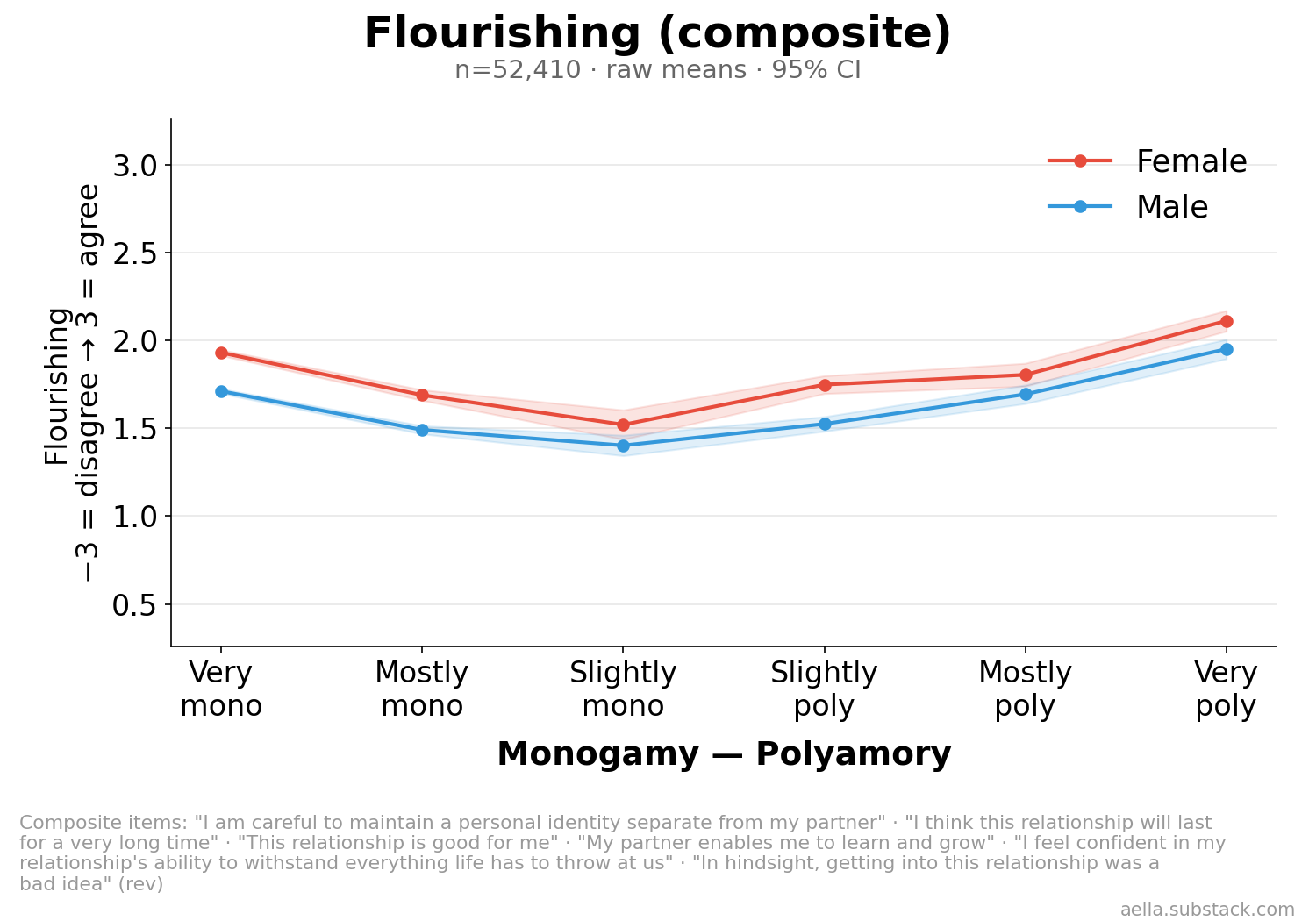
- The U shape holds. Very mono and very poly people report the best relationships. The "slightly mono" group is still the worst on almost everything.
- The middle is mostly about mismatch. What predicts a bad relationship best is wanting outside partners while being in a monogamous relationship. Very mono people who say outside partners would be "essential" have the lowest flourishing of anyone on the chart (1.12 vs 1.97 for very mono people who want none).
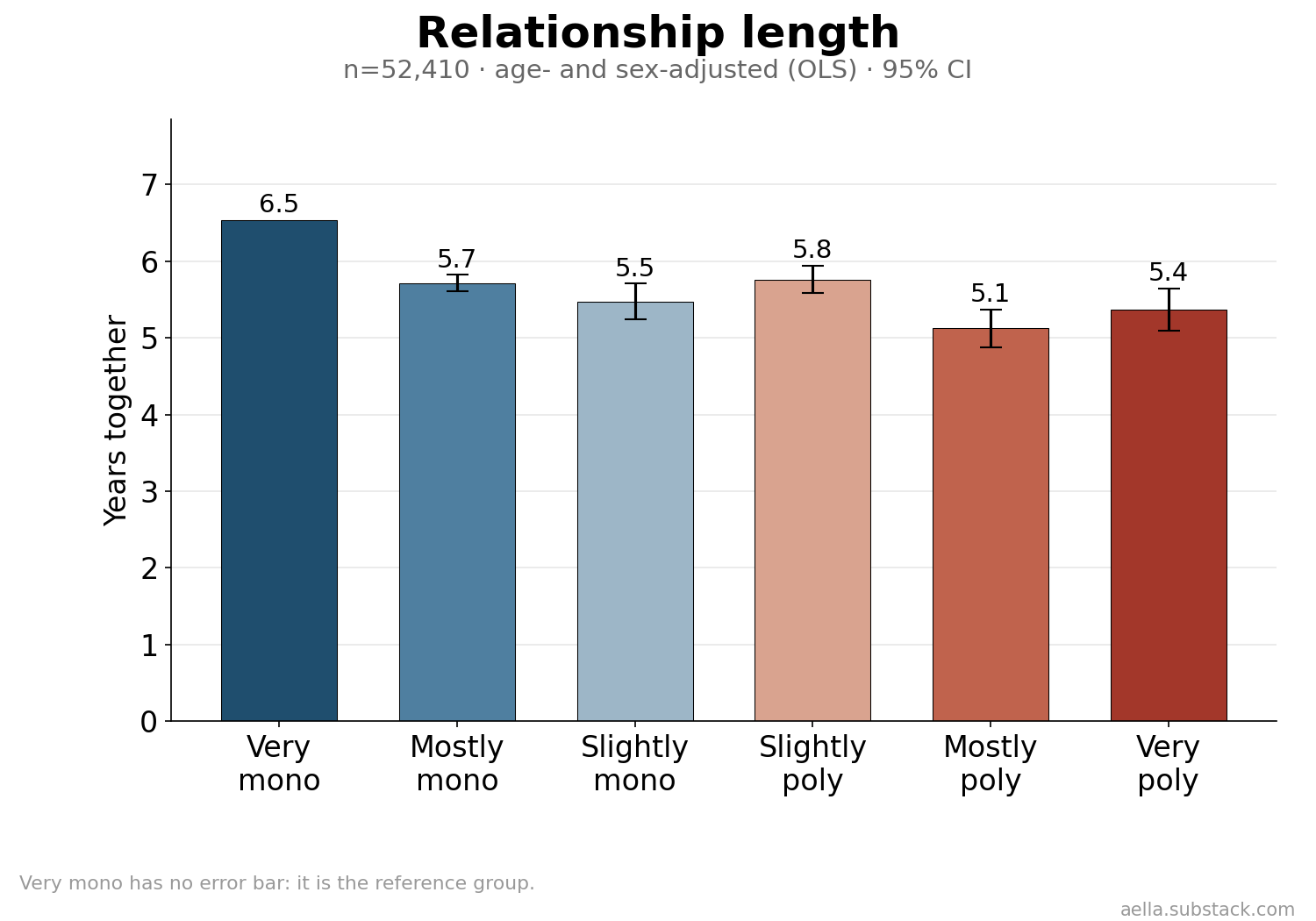
- Poly relationships are shorter once you account for age. The first post said about 2 months shorter. With more data and age controls it's more like 15 months. Poly people are older, which hides this in raw averages.
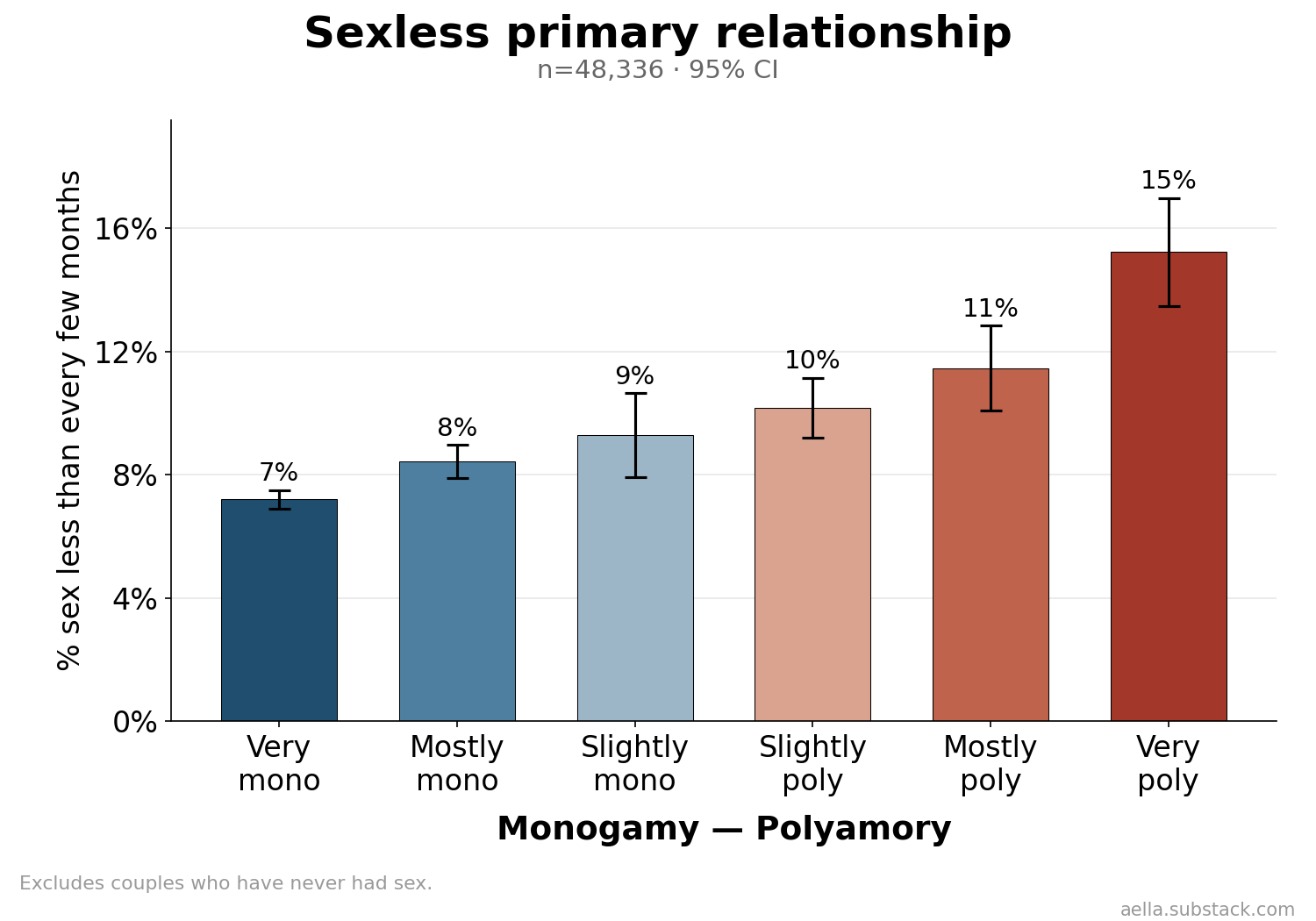
- Poly primaries are less intertwined and less jealous. They are not sexless, but they are a bit more likely to be. 15% of very poly primaries have sex less than every few months, vs 7% of very mono.
- Secondary partners look great mostly because they're new. Once you account for how long the relationship has lasted, most of the gap goes away. What's left: better sex, less entanglement.
01Who took it
Everyone here was in a relationship and answered about their primary (or longest) partner. 39% are female, the median age is 29 (5% are 14–17), and 11% are trans or nonbinary. The sample is people who follow me, found the survey through the personality-test sites, or were forwarded after the Big Kink Survey. It is not a random sample of anyone, so the percentages below describe this group, not the general public.
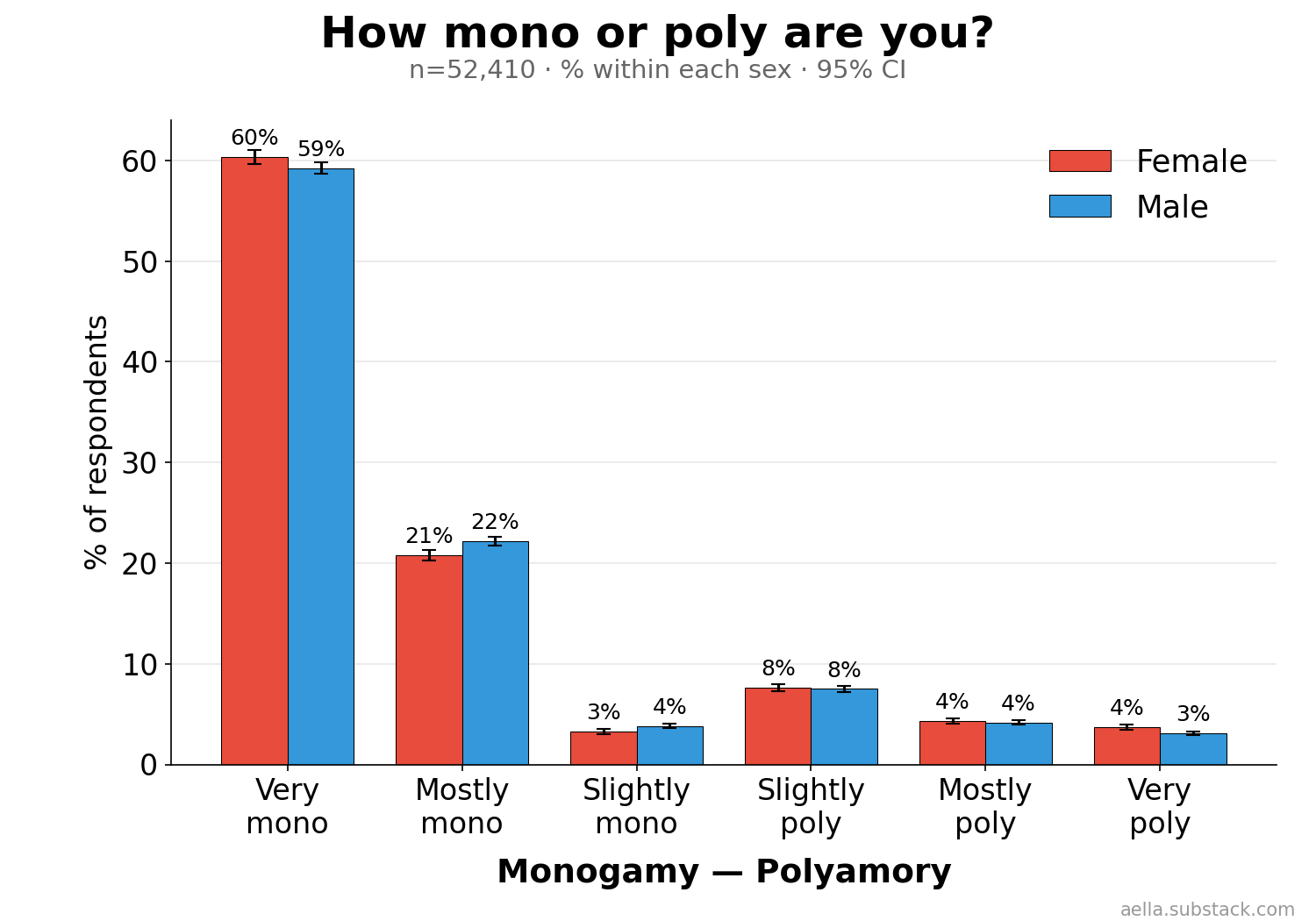
The groups are not otherwise alike. As you move toward poly, people get older, more likely to be trans or nonbinary, more likely to be in a same-sex couple, less religious, and more socially liberal. And of course more likely to actually have more than one partner.
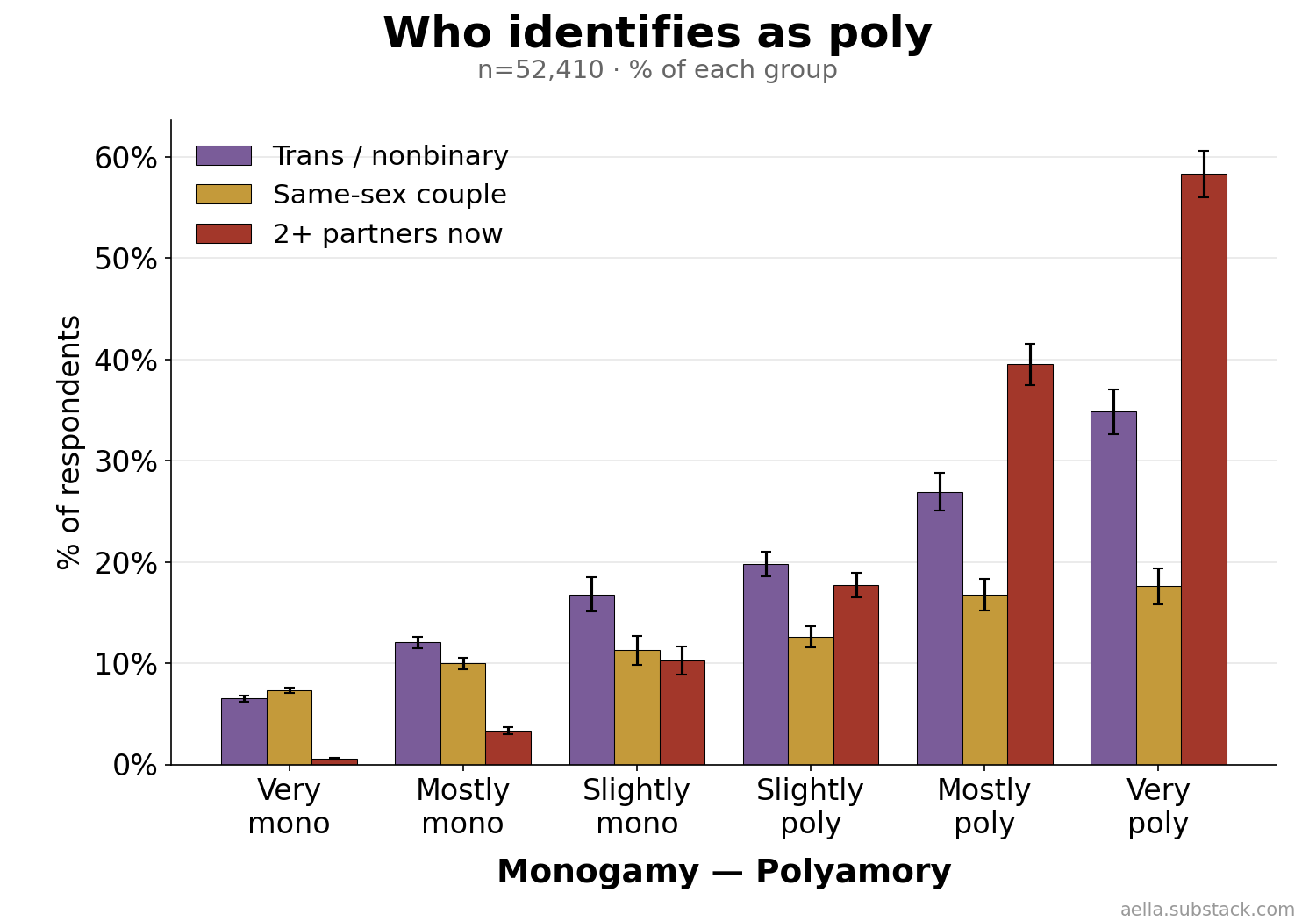
02Is it just trans and queer people?
This was the obvious worry with the original post. If trans, nonbinary, and gay/bi couples differ from straight cis couples on relationship quality for their own reasons, and they're also much more likely to be poly, then "poly vs mono" differences might just be demographic differences in disguise.
I ran every comparison three ways: raw, with a full set of controls (age, sex, own and partner's trans/nonbinary status, same-sex couple, relationship length, married, kids, religion, income, politics), and then restricted to cis men and women in opposite-sex couples only (n=43,069), with the same controls.
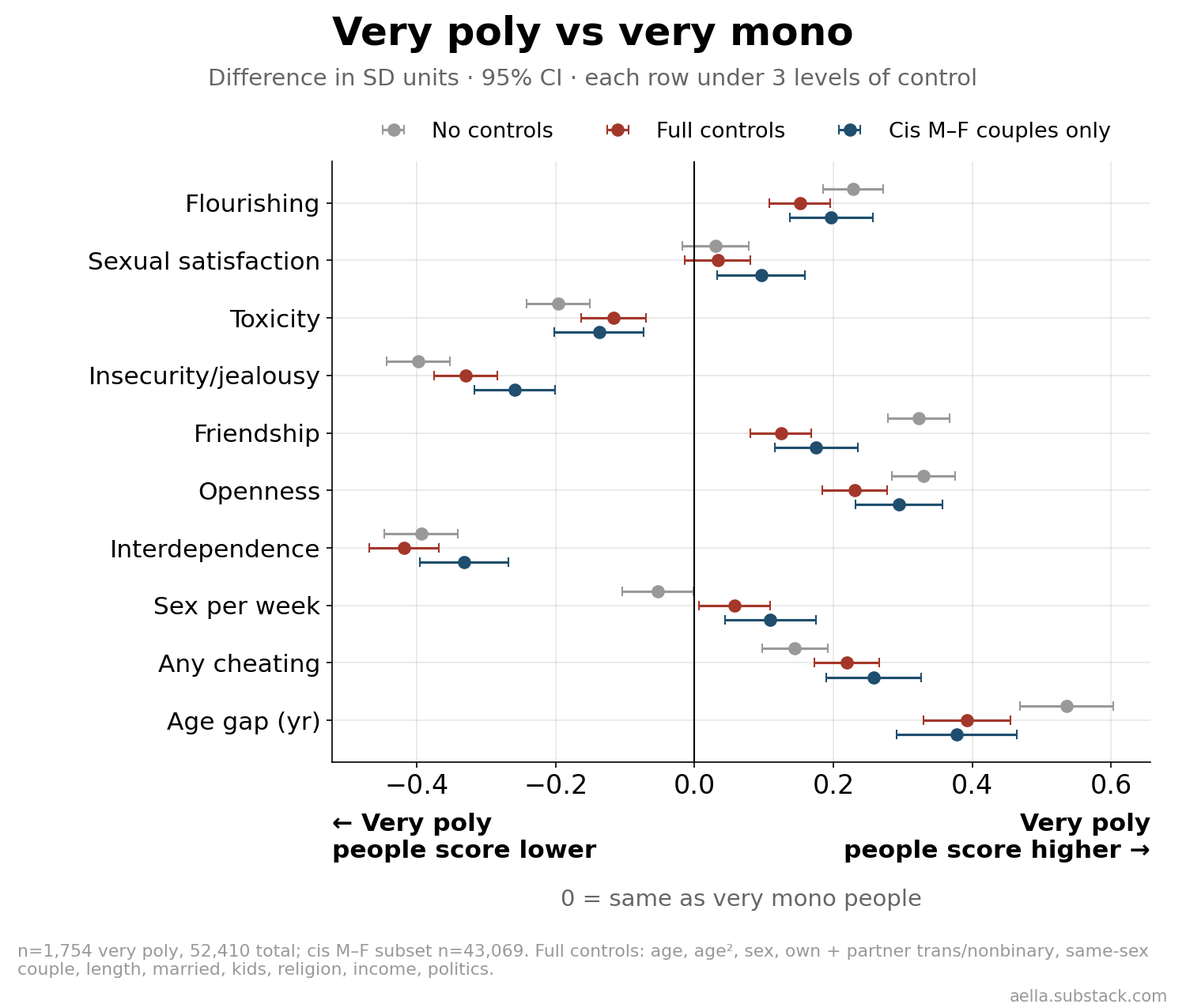
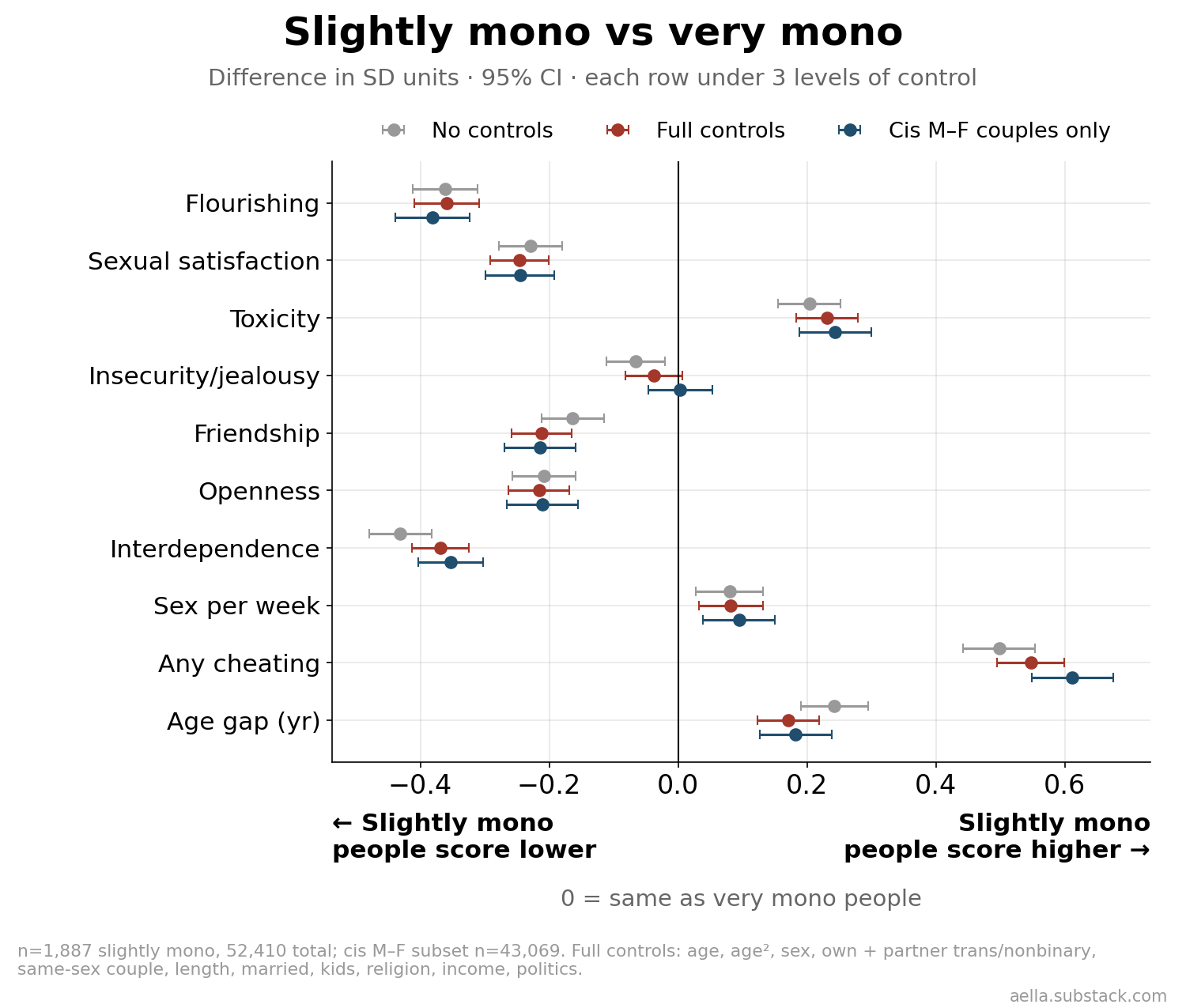
Trans and nonbinary respondents do report slightly better relationships than cis respondents at every point on the spectrum. The U shape is the same for both groups.
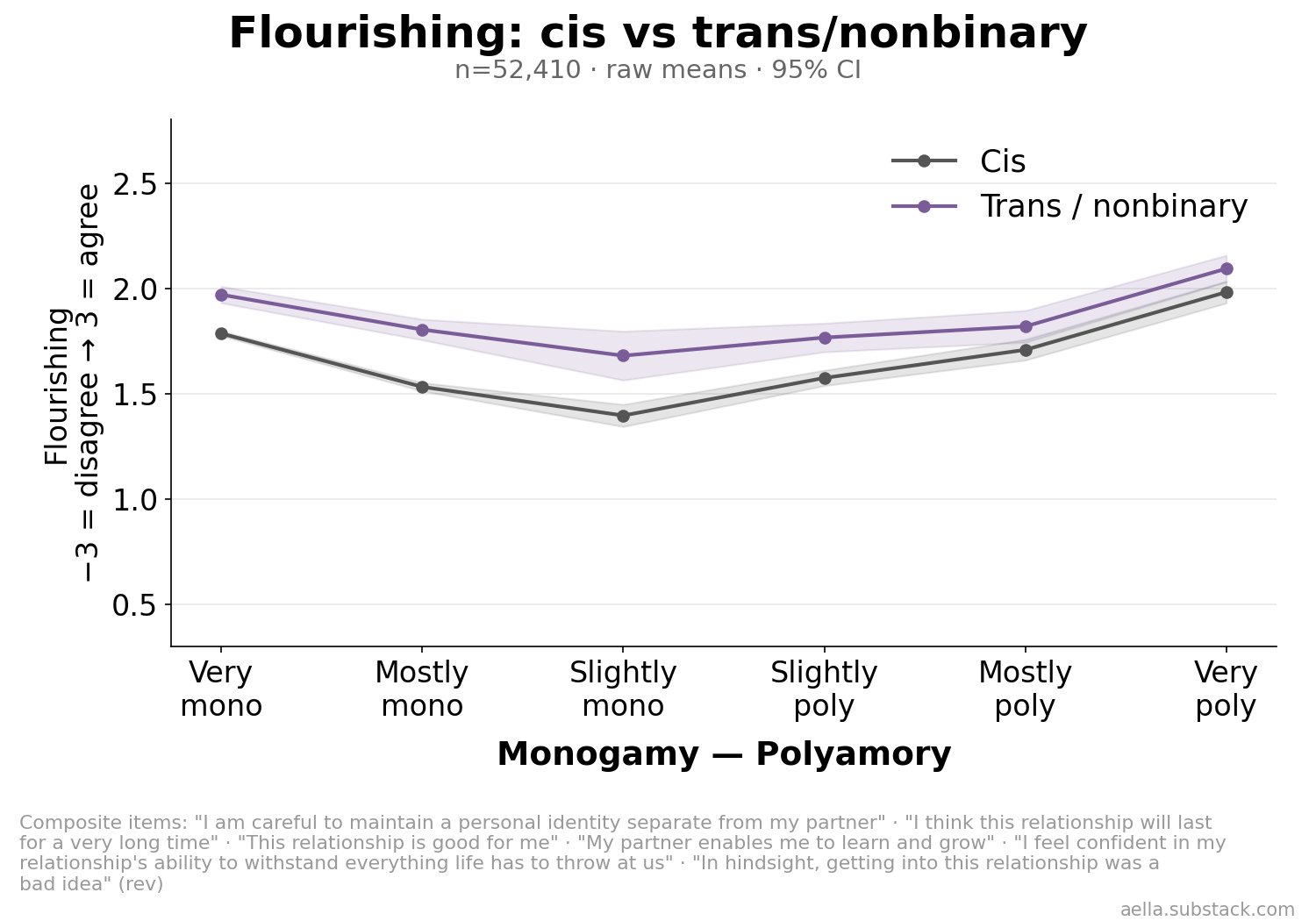
Controls change a few things a little. Friendship and openness shrink by a third to a half with full controls. But the cis M–F estimate is about as big as the fully controlled one, so it isn't gender identity doing the shrinking. Sex frequency flips sign: raw, very poly people have slightly less sex with their primary, but that's because they're older and in longer relationships. At the same age and length, they have slightly more.
03The U shape
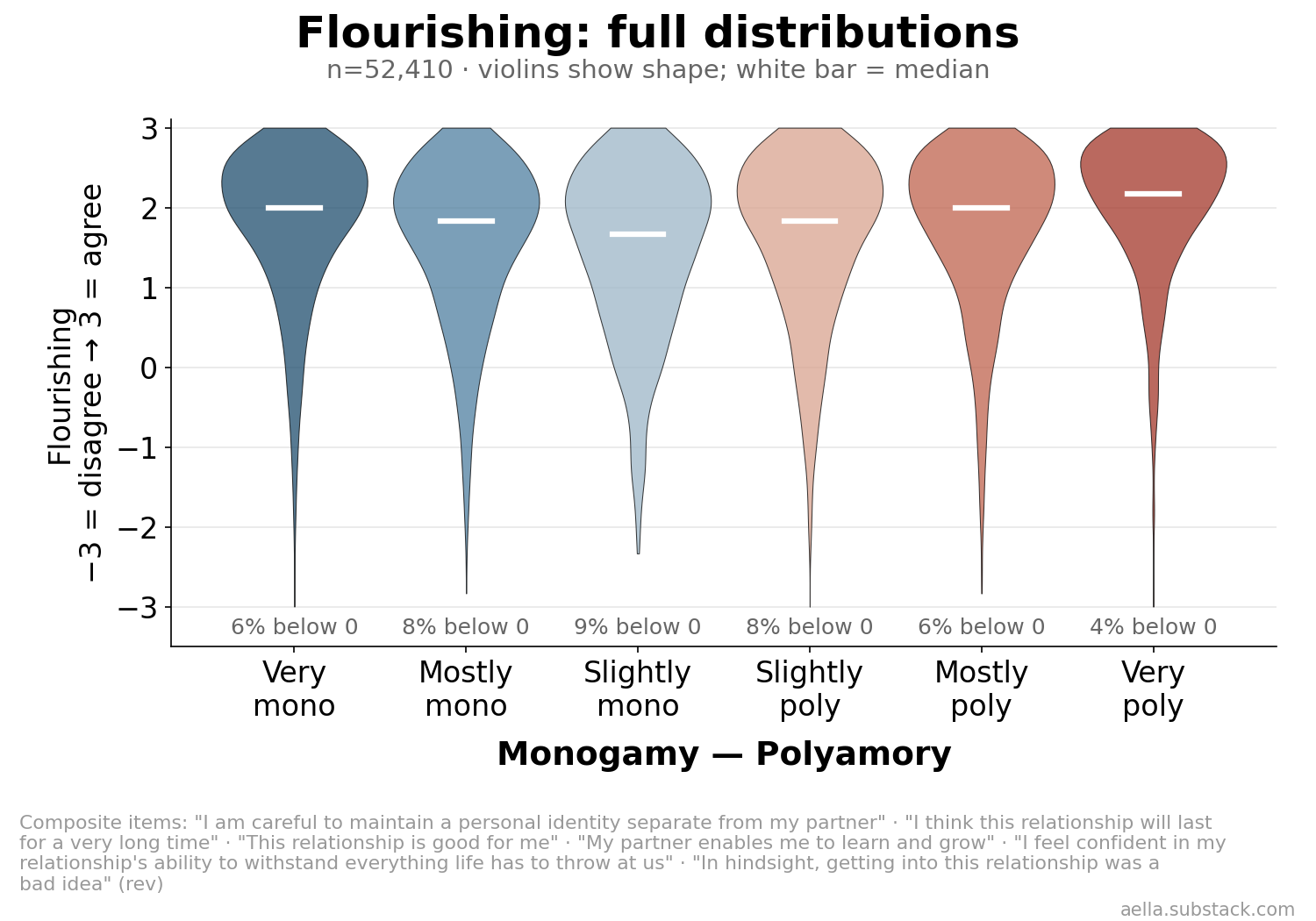
"Flourishing" is the survey's overall relationship-goodness score: this relationship is good for me, it'll last, my partner helps me grow, no regrets. It's the closest thing to "how good is your relationship."
Averages hide the shape of the distribution. The violins show everyone. The middle groups don't only have a lower average, they have a fatter bottom tail: more people who say their relationship is outright bad.
04Why the middle does worst: mismatch
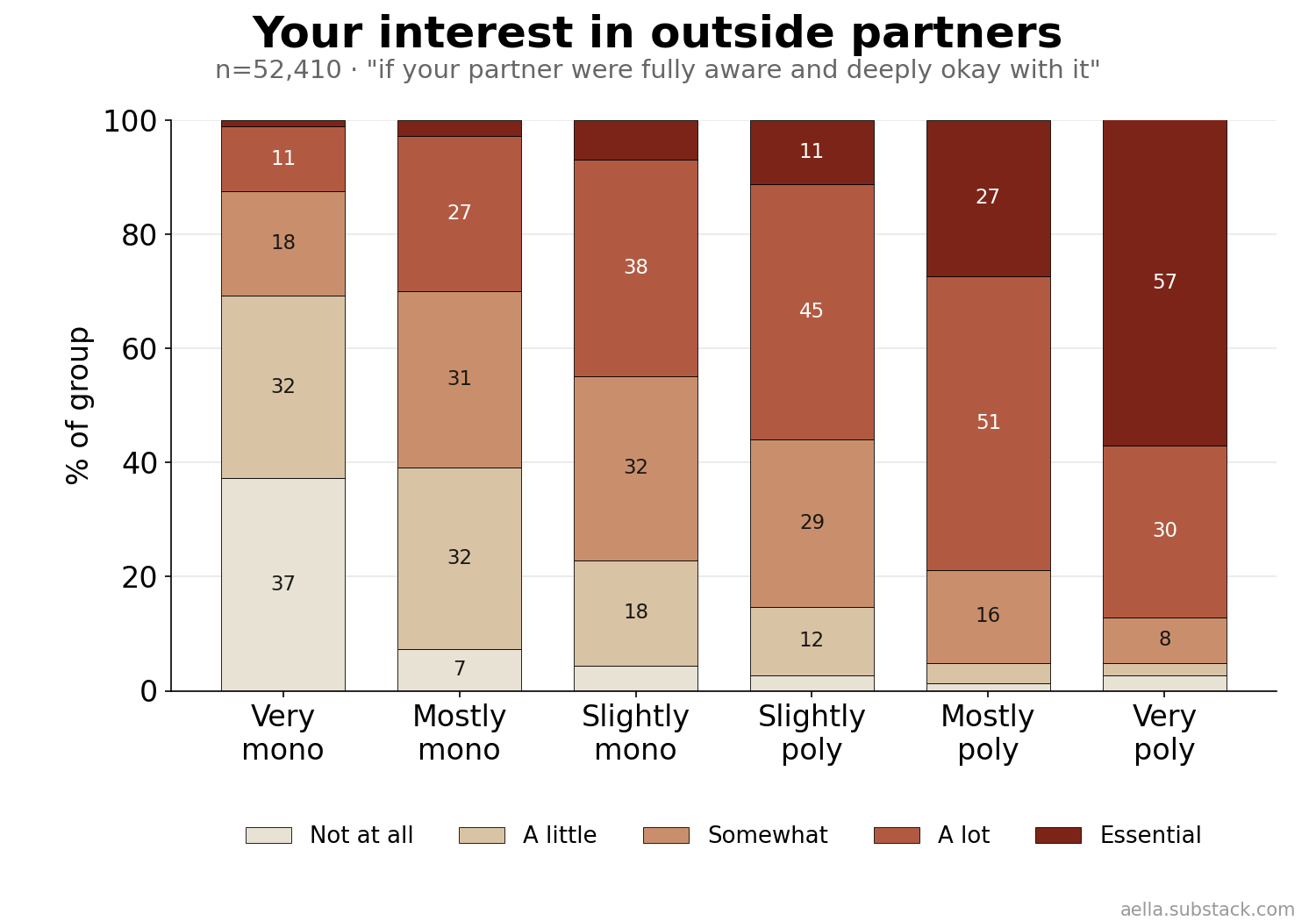
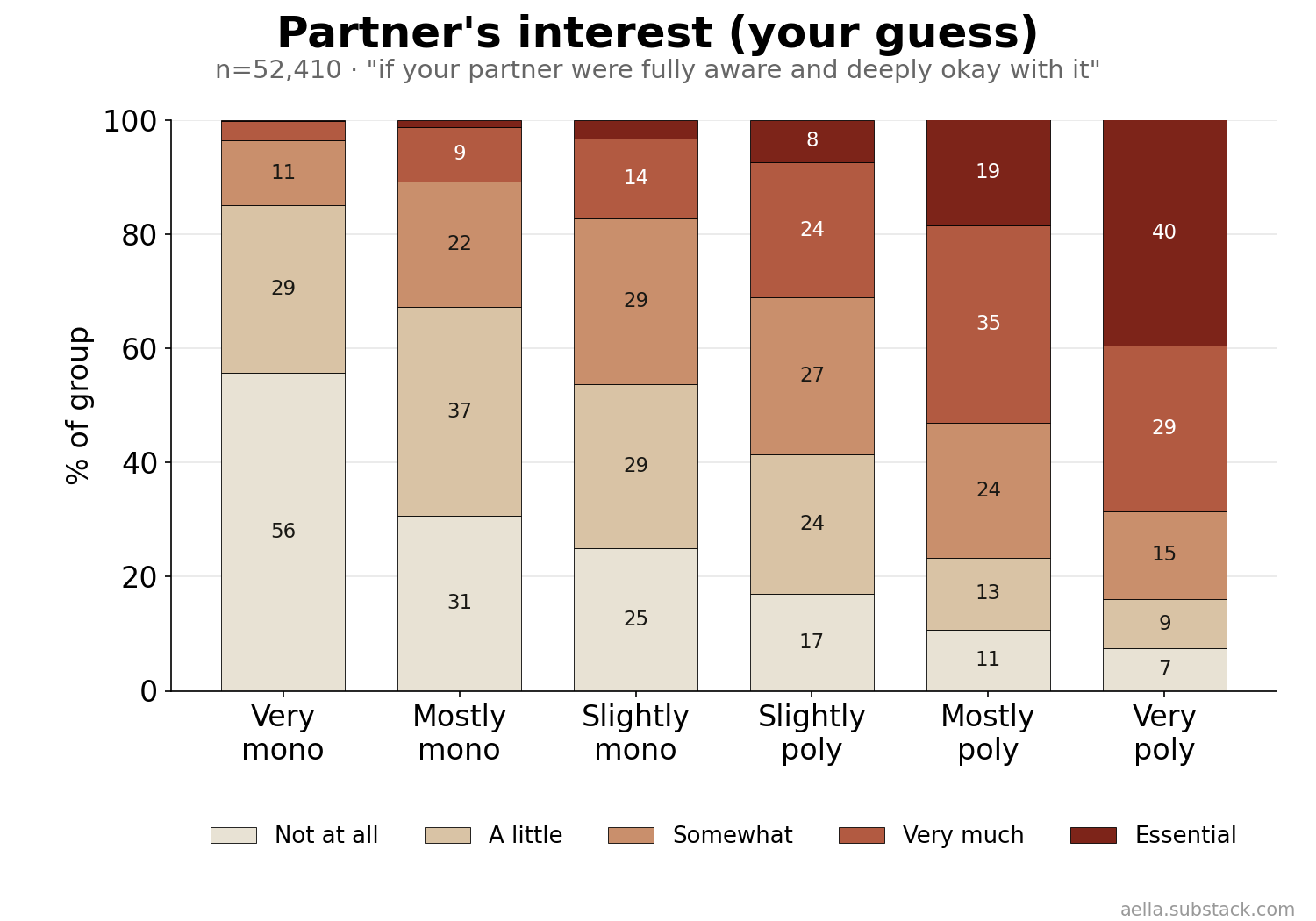
The poly question mixes two things: what kind of relationship you're in, and what you want. The survey also asks separately how much you'd want outside sexual or romantic experiences "in a world where your partner was fully aware and deeply okay with it." That lets us pull the two apart.
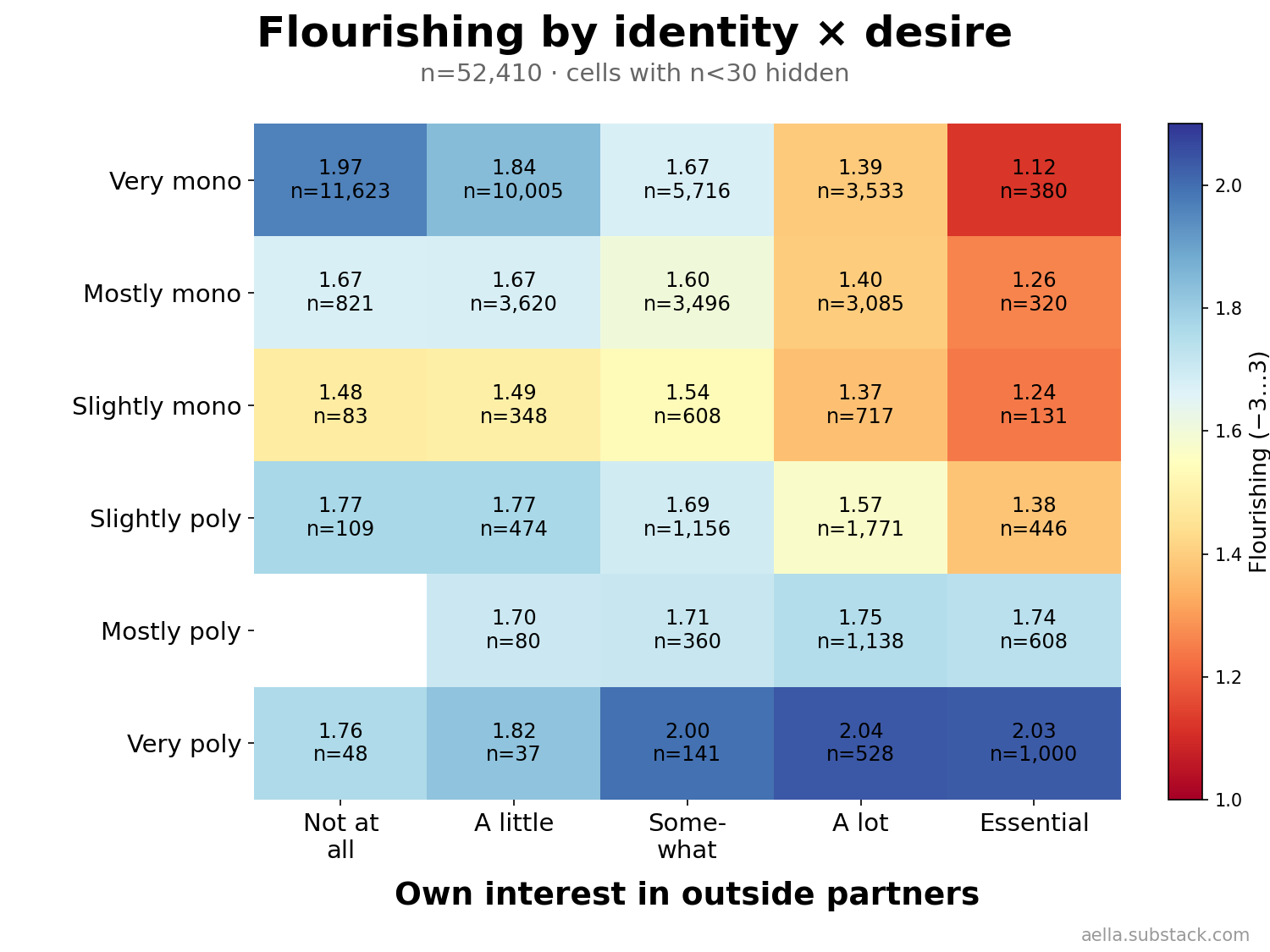
Read across the top row: among very mono people, every step up in wanting other people goes with a worse relationship. Read across the bottom row: among very poly people, it's flat or goes the other way. Wanting other people isn't the problem. Wanting them in a relationship that doesn't allow it is.
If you control for how much people want outside partners, the "slightly mono" dip shrinks by about half (−0.35 → −0.18 points) and the very poly advantage roughly triples (+0.15 → +0.46). At the same level of desire, being poly goes with better relationships. So a lot of what looks like "the middle is bad" is mono-ish people who want out.
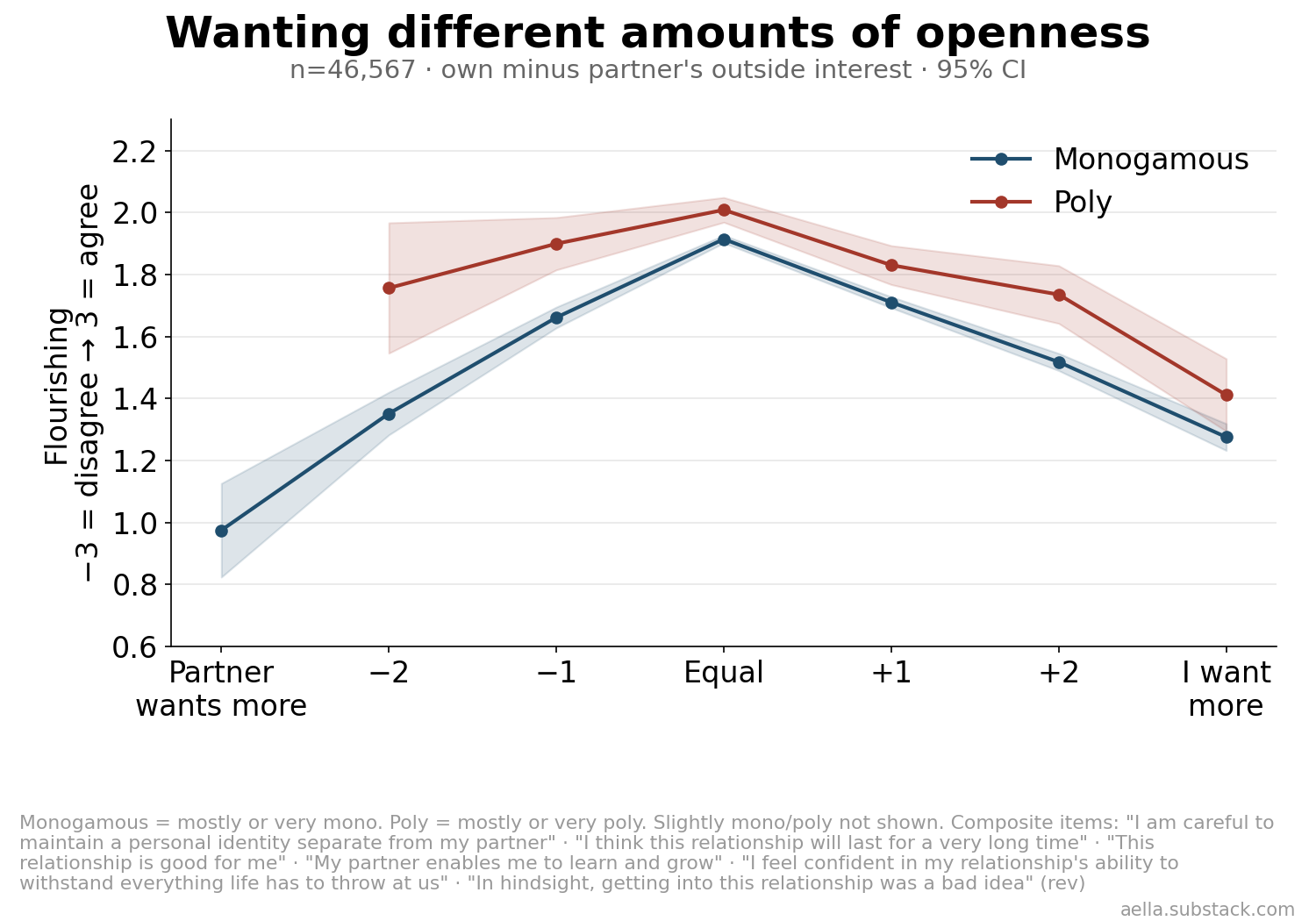
The same thing shows up between partners. When you and your partner want different amounts of openness, in either direction, things are worse. This holds for mono and poly people alike.
05Relationship quality, one score at a time
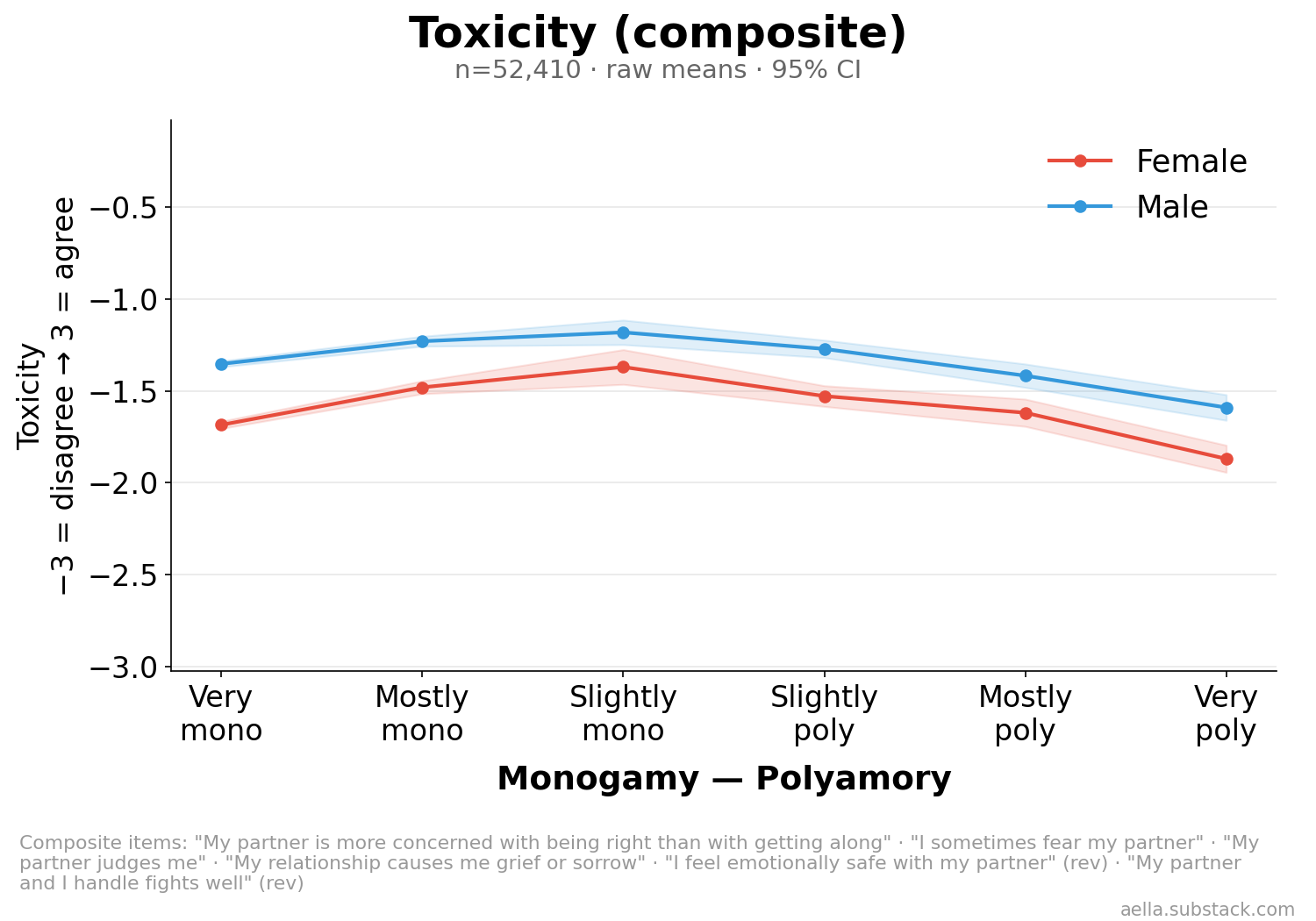
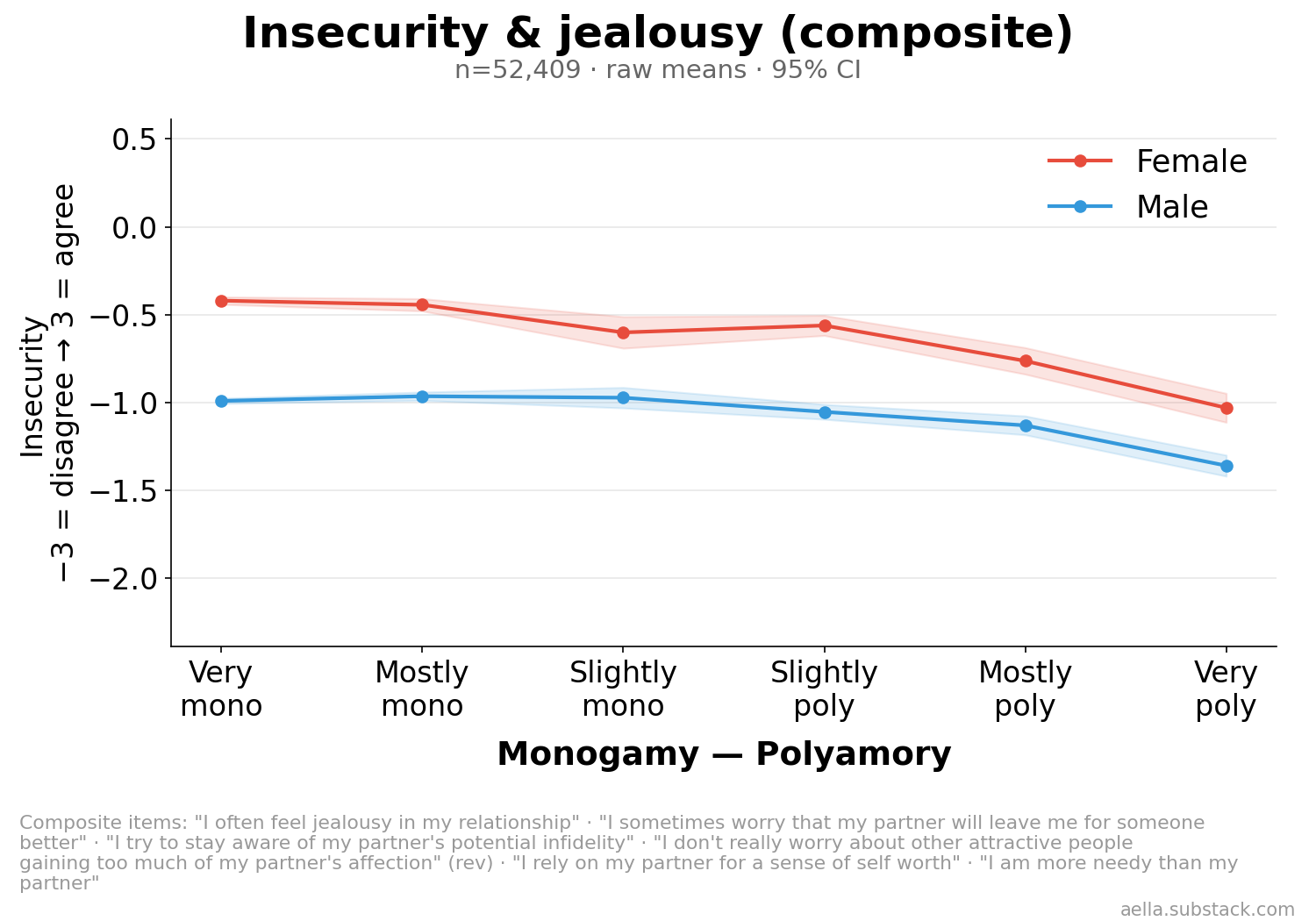
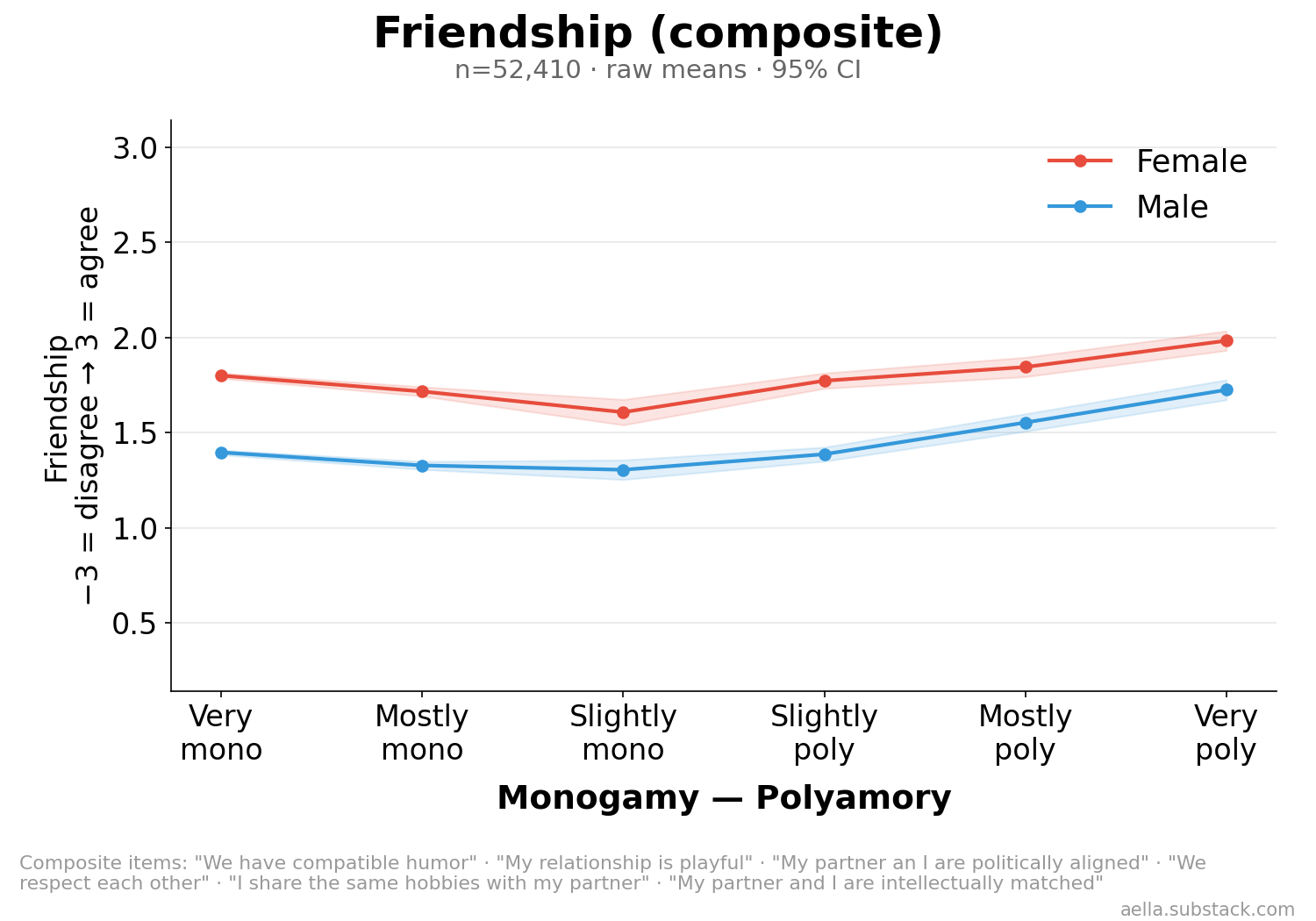
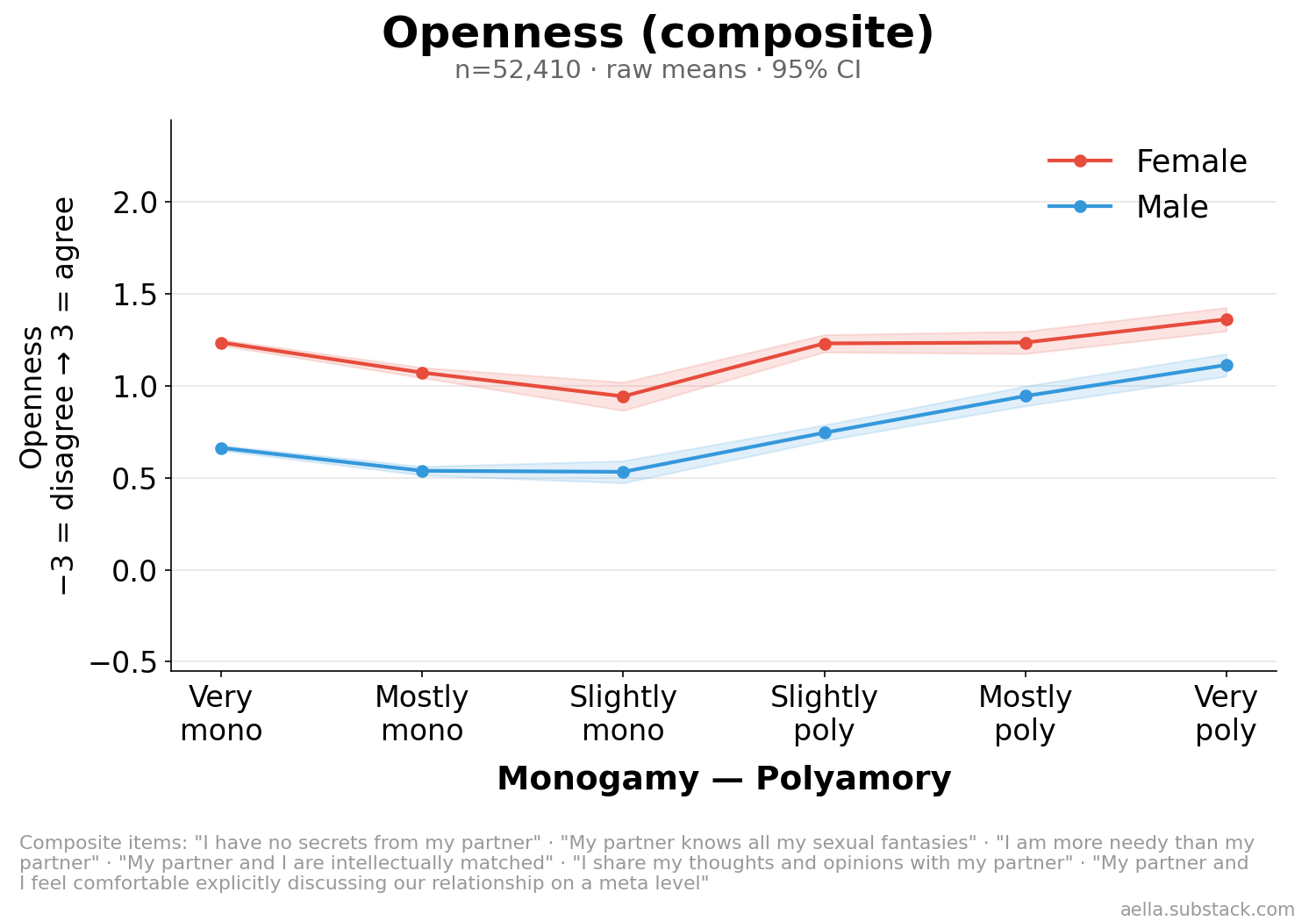
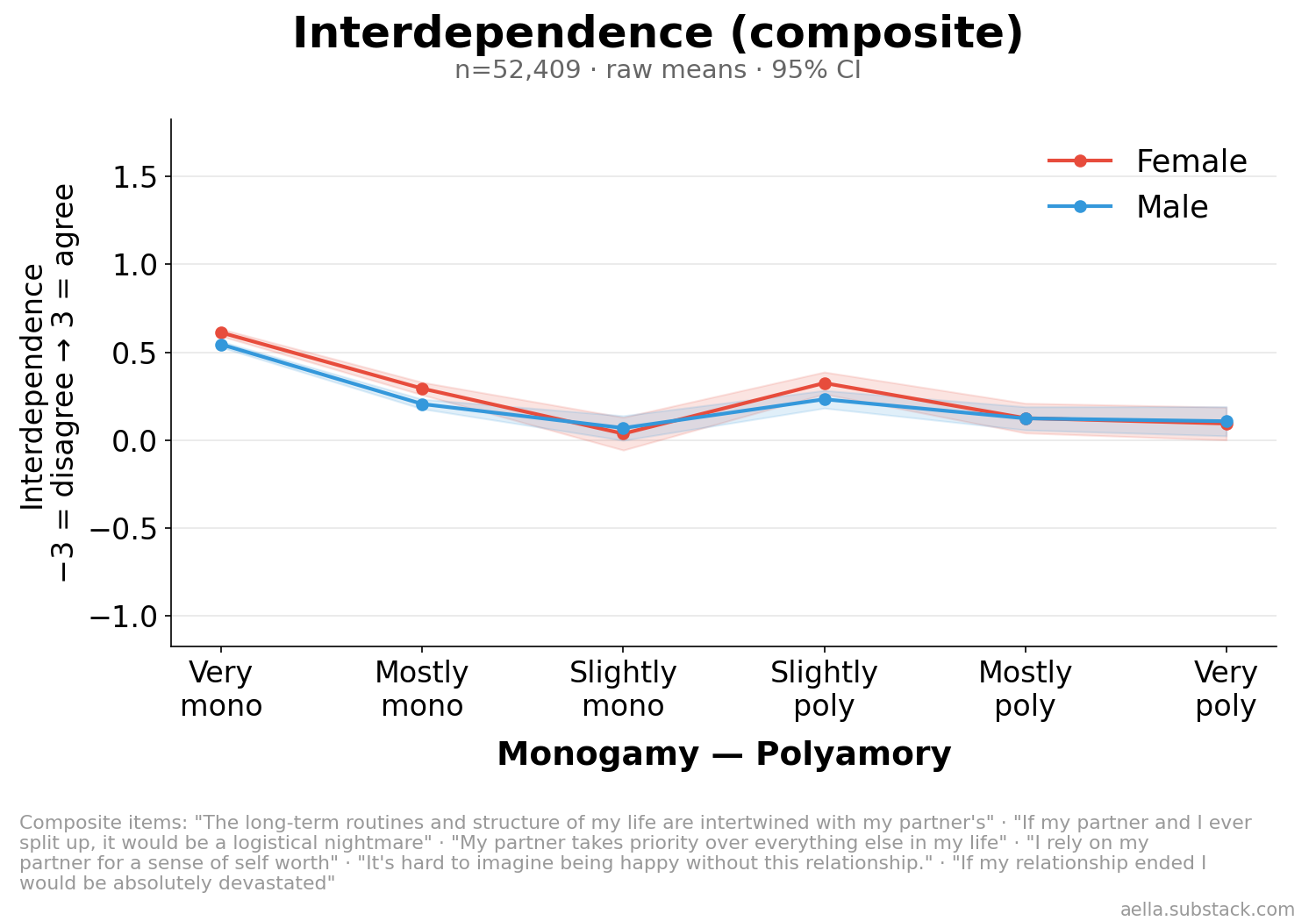
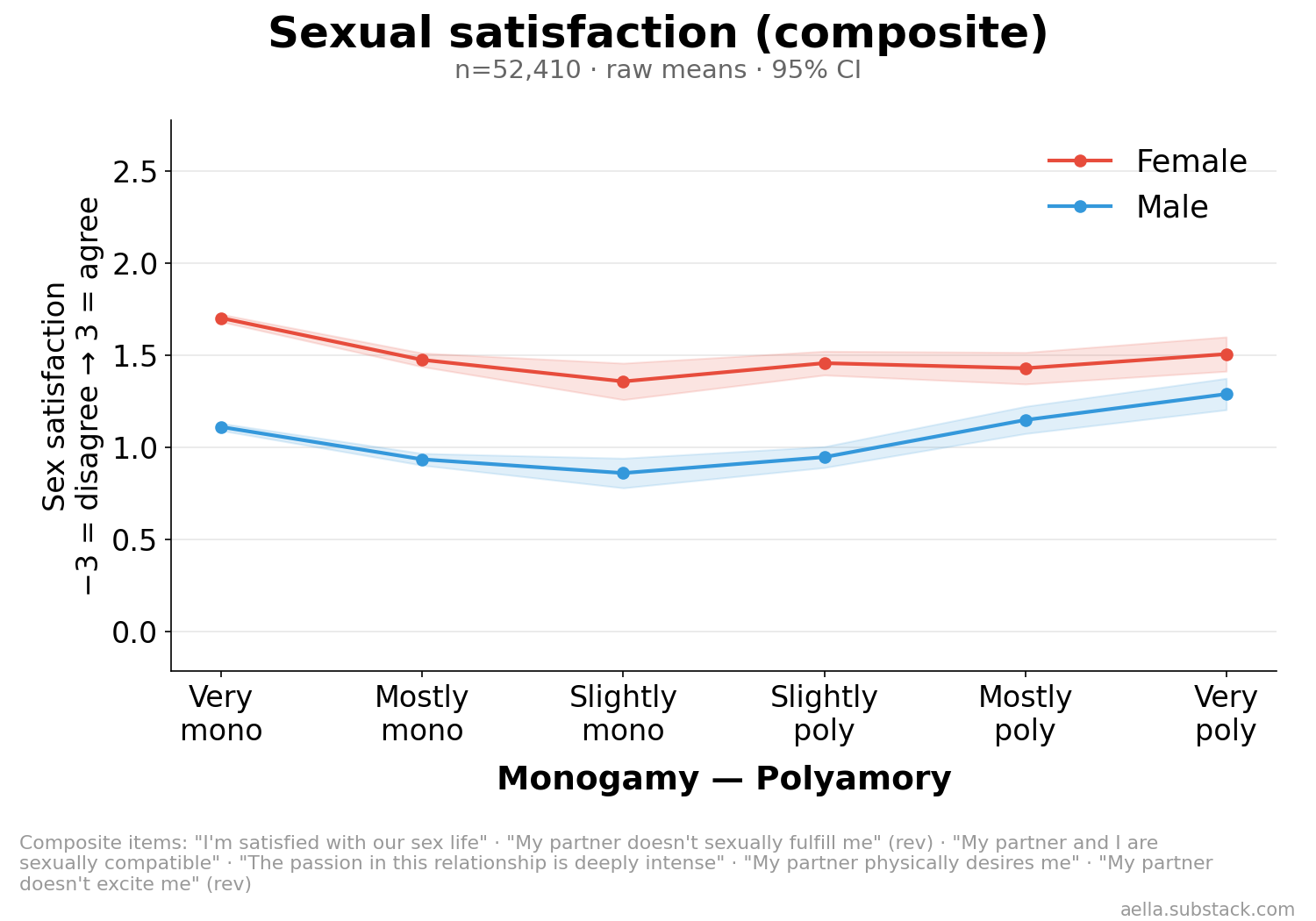
These are the composite scores the survey reports back to people. Each one averages six agree/disagree statements (listed under each chart). Note that the survey builds some of them from overlapping items: "I am more needy than my partner" counts toward both insecurity and openness, for example. The item-level chart below avoids that problem.
Toxicity
Insecurity and jealousy
Friendship
Openness
Interdependence
Sexual satisfaction
06Every question
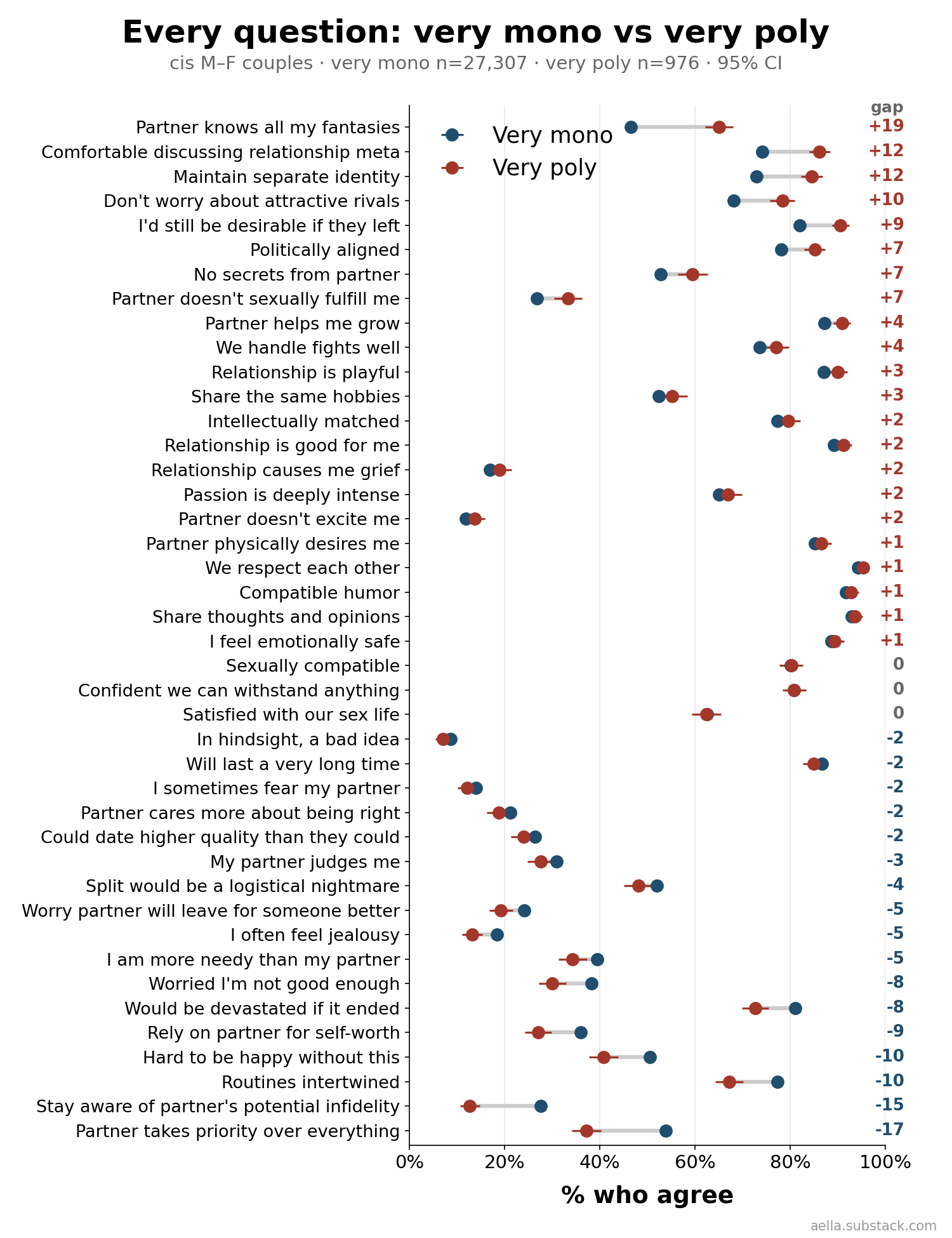
Composite scores blur together items that behave differently. The first chart is the simple version: for every statement, the share of very mono and very poly people who agree with it. Cis opposite-sex couples only, no controls.
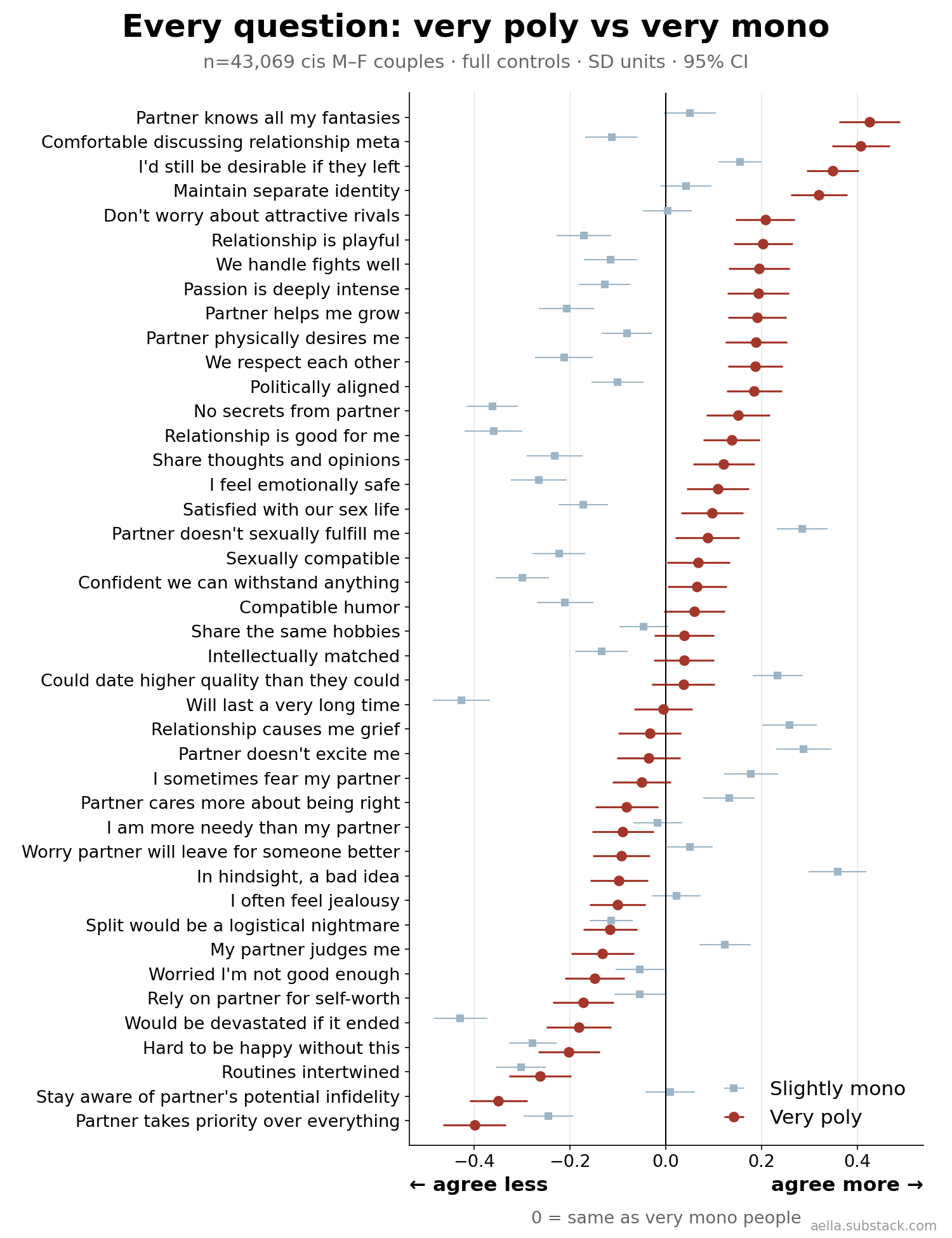
The second chart adds the slightly mono group, the low point of the U. It uses full controls and puts everything on the same scale (standard deviations). Where very poly (red) and slightly mono (blue-grey) land on the same side of zero, the difference is about not being very mono, not about being poly. Where they split, that's the U.
07Relationship length
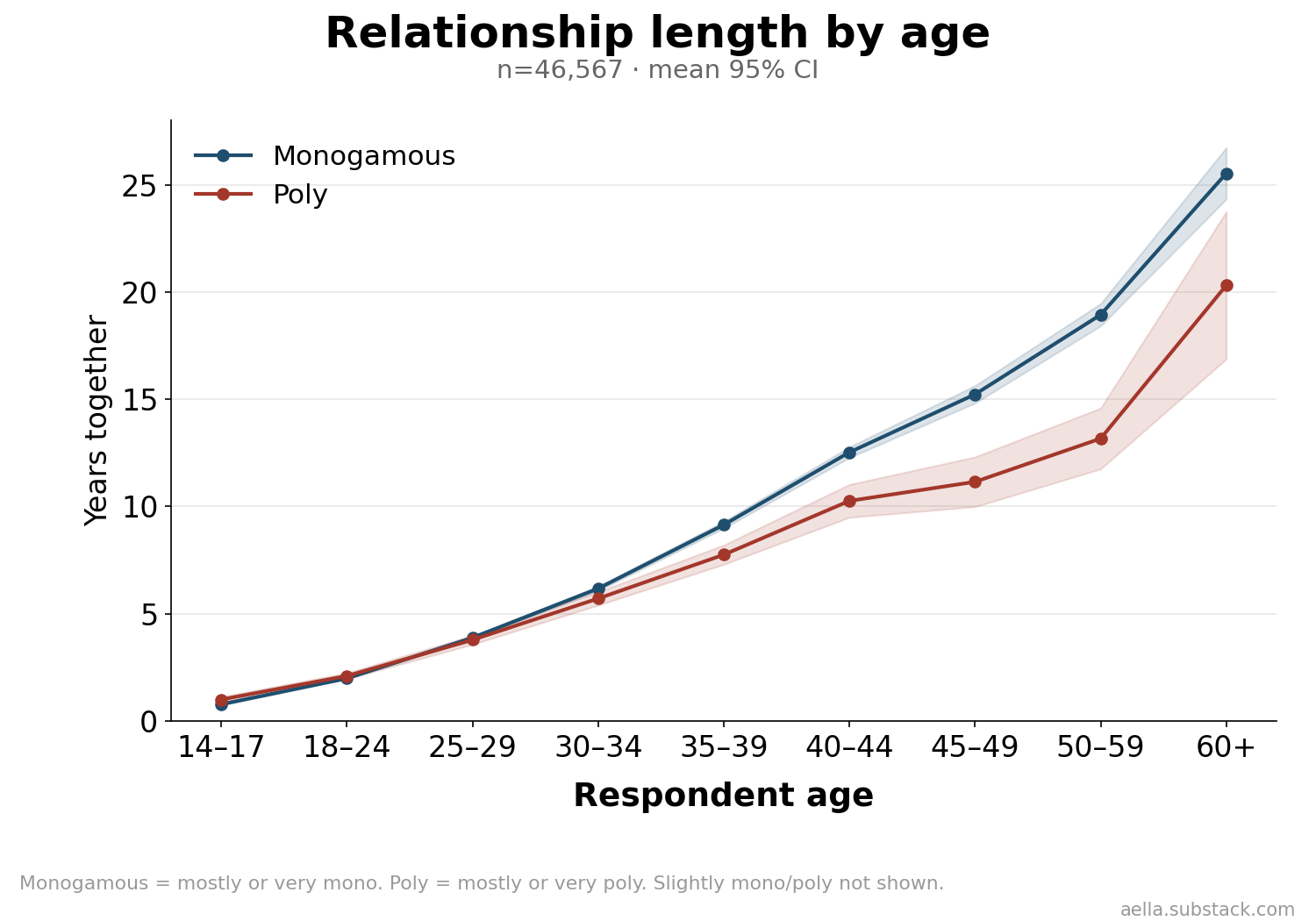
Raw, very mono and very poly relationships are about the same length: 6.3 and 6.5 years on average. But poly people are three years older, and older people have longer relationships. At the same age, poly relationships are shorter.
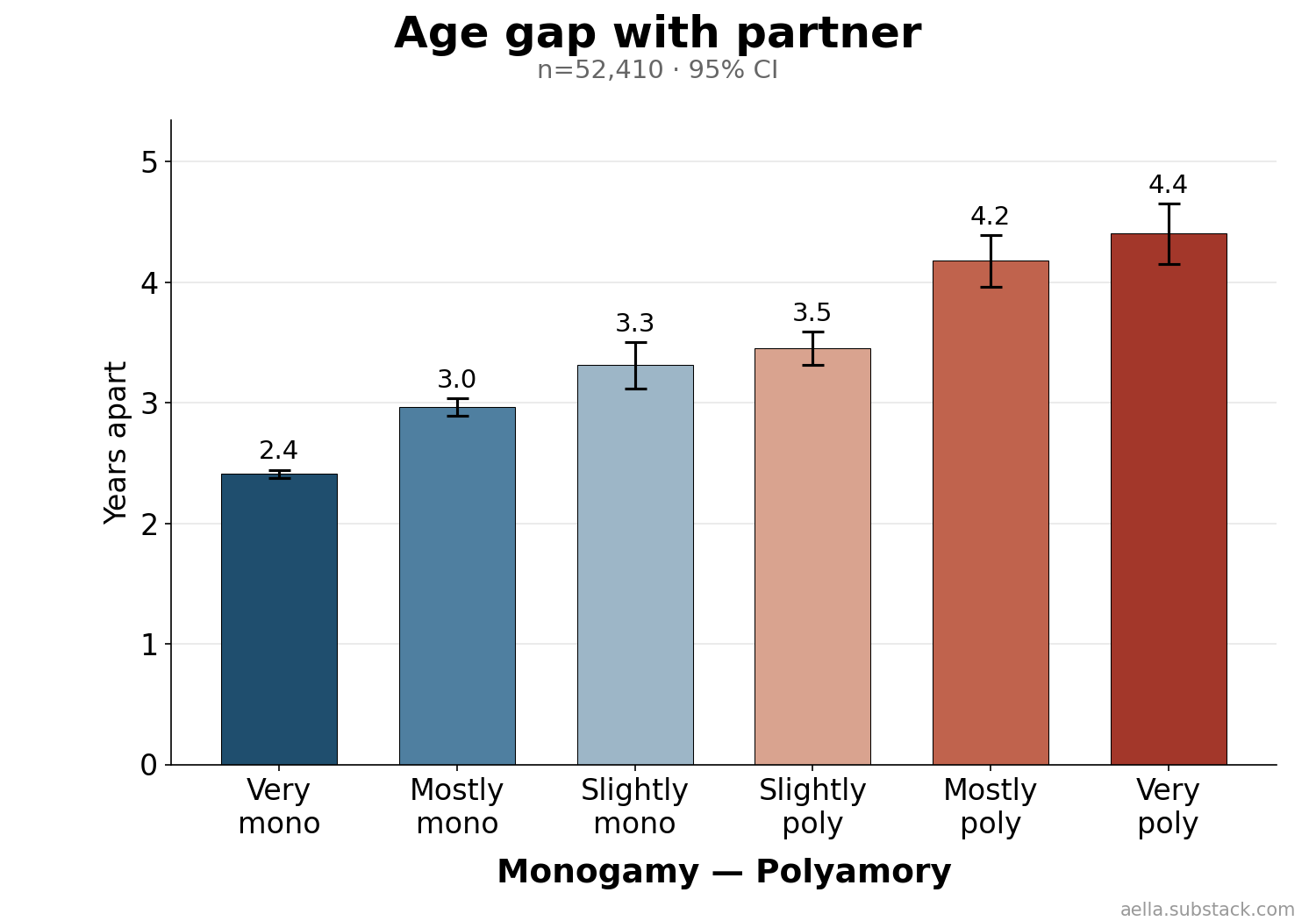
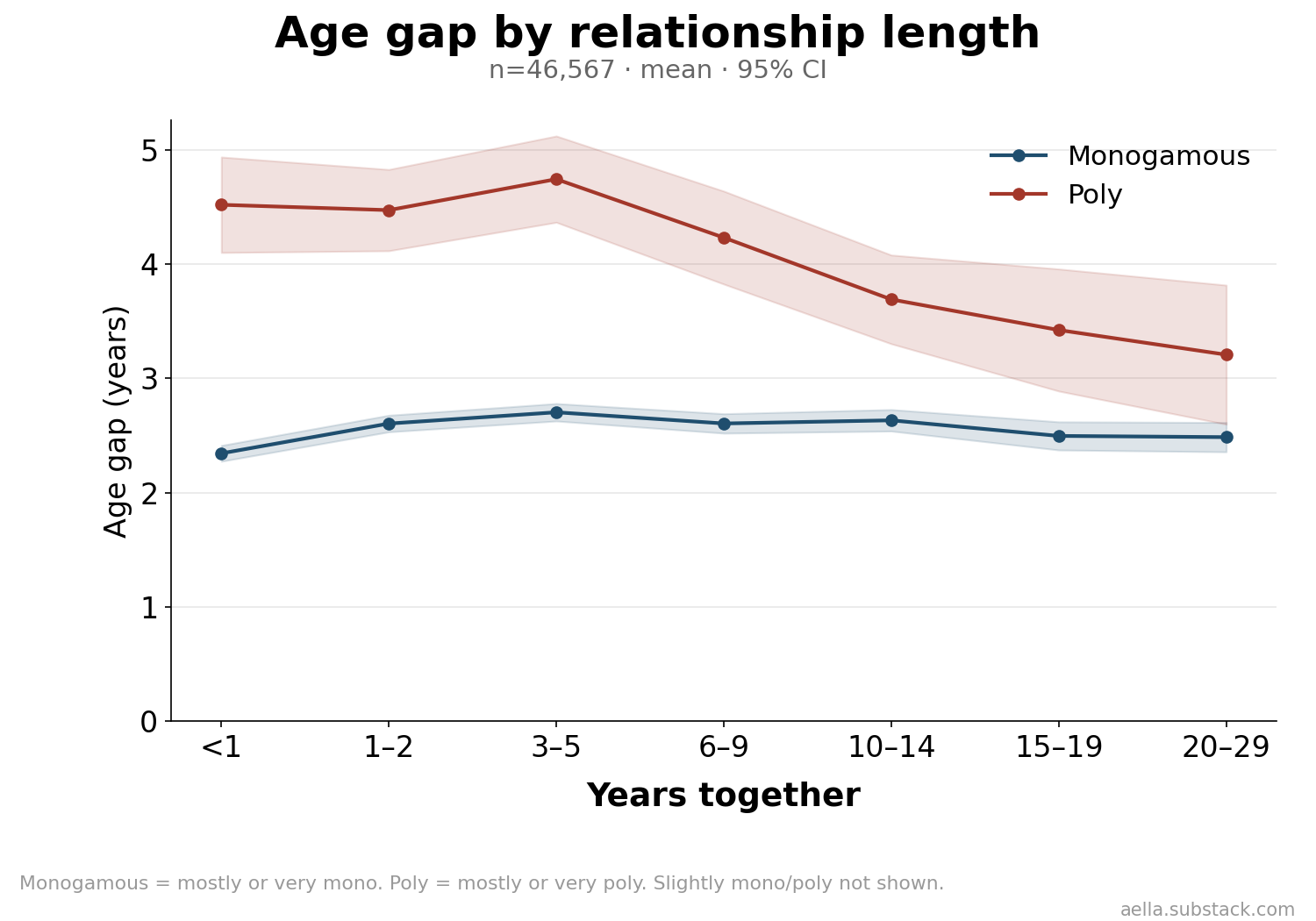
08Age gap
09Sex
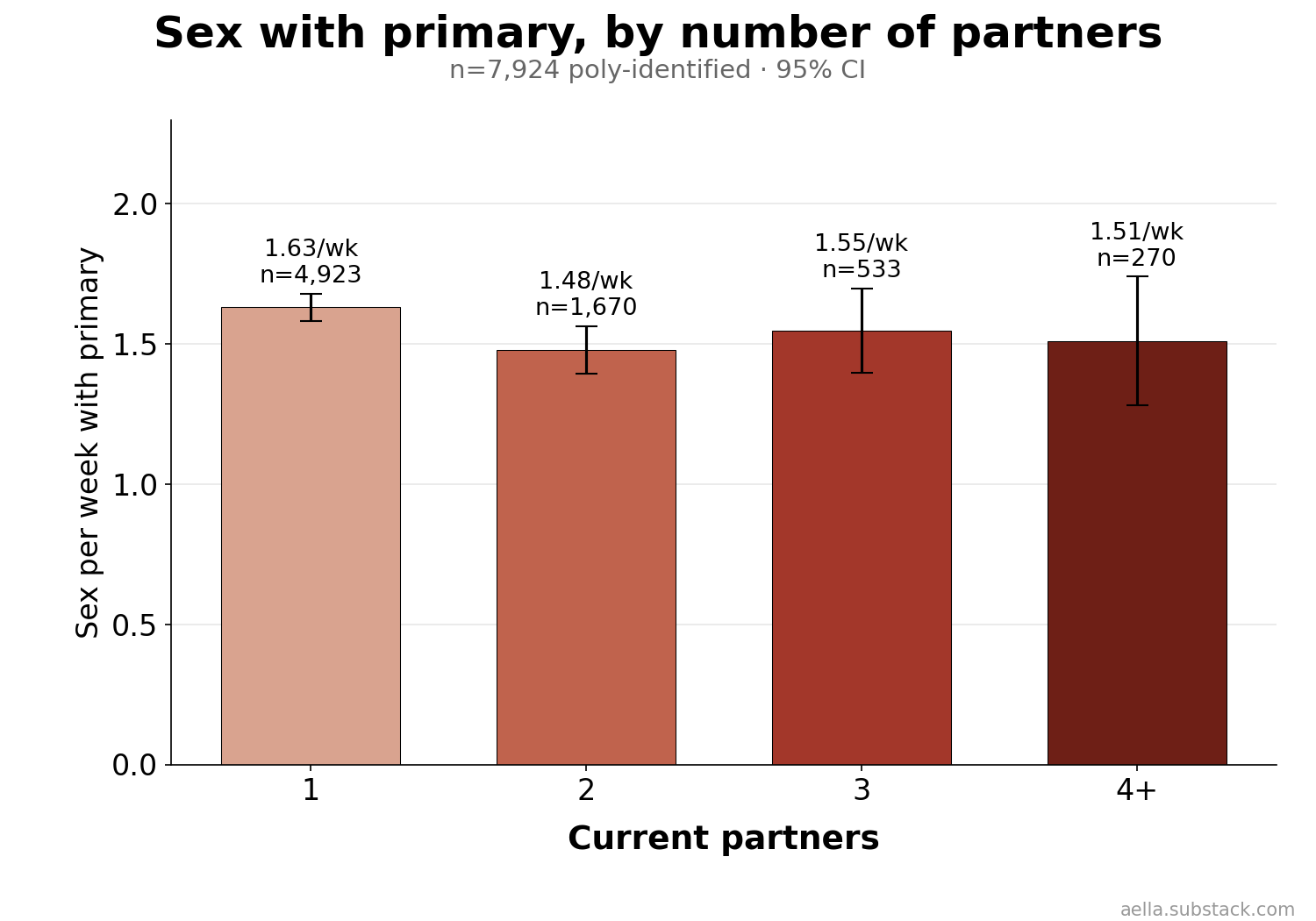
Sex with the primary partner is about the same across the spectrum: roughly 1.5 times a week. The poly side has a slightly lower average, but that's age and relationship length. Matched on those, it's slightly higher.
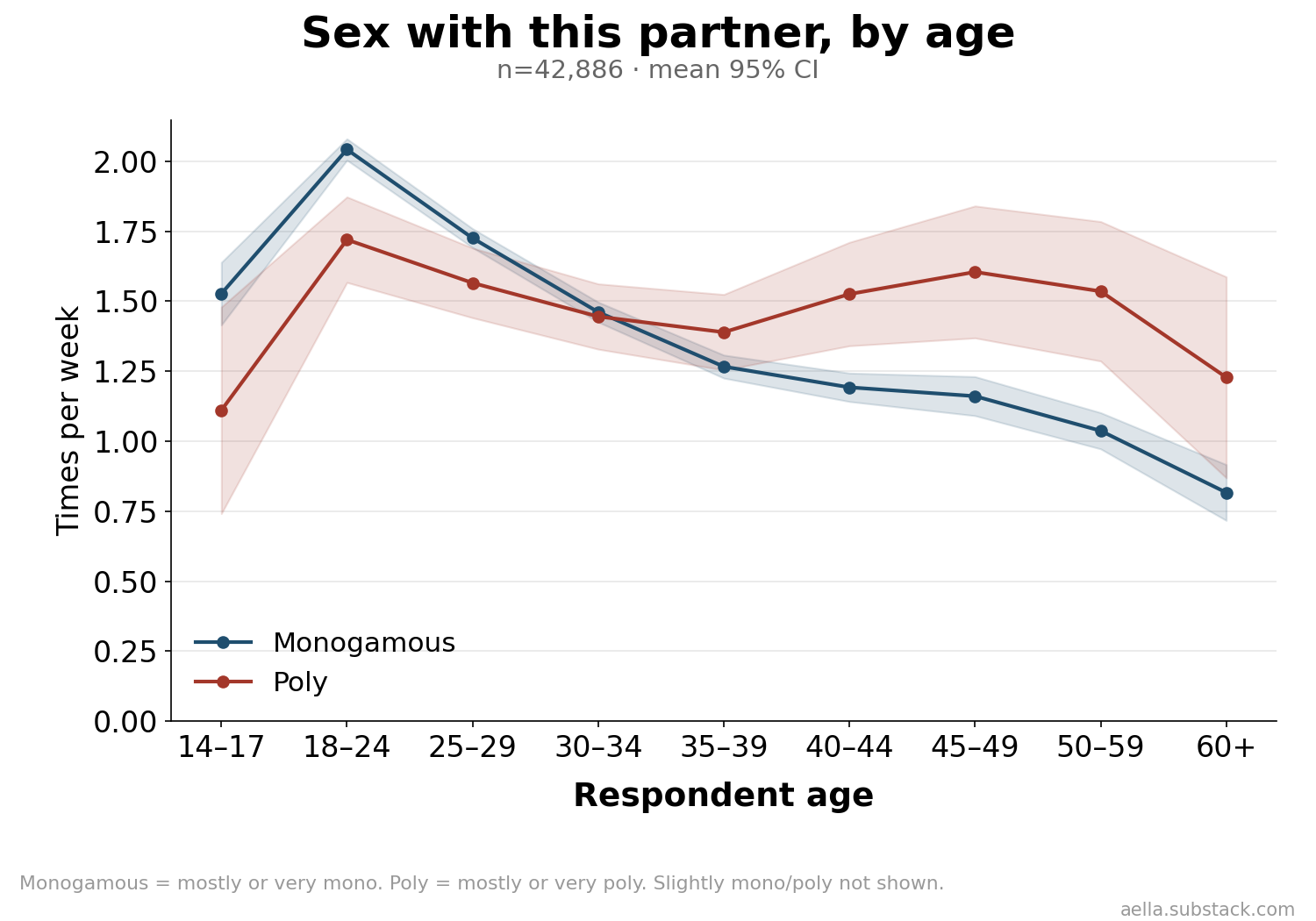
But the share of primaries who have basically stopped having sex does go up toward the poly end. Some poly primaries seem to have become sexless and opened up, or opened up and then stopped having sex with each other. We can't tell which from this survey.
10Body count
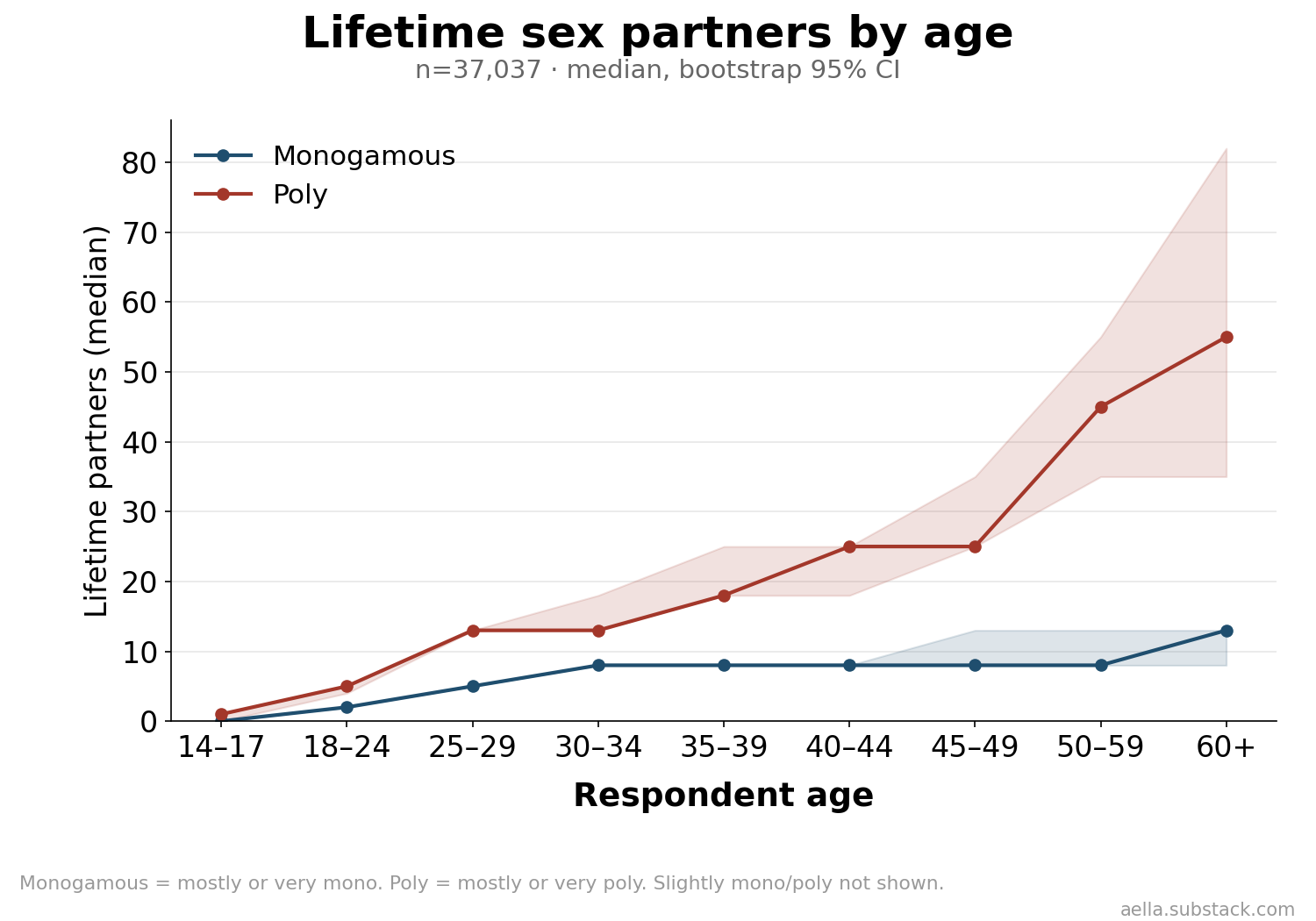
Median lifetime sex partners: 4 for very mono, 13 for very poly. The gap widens with age. Among people 50+, the poly median is 45, vs 8 for monogamous people.
11Marriage and kids
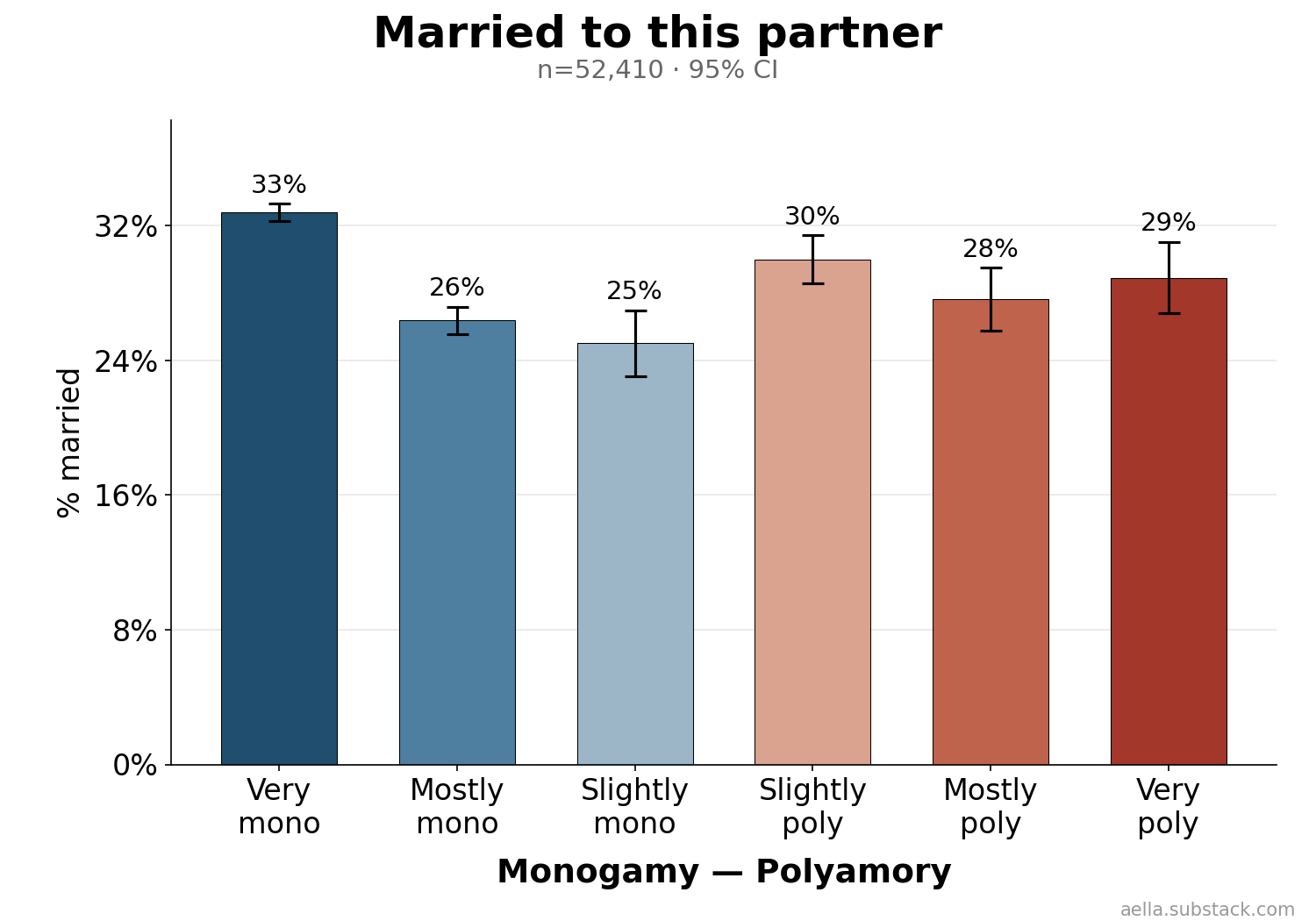
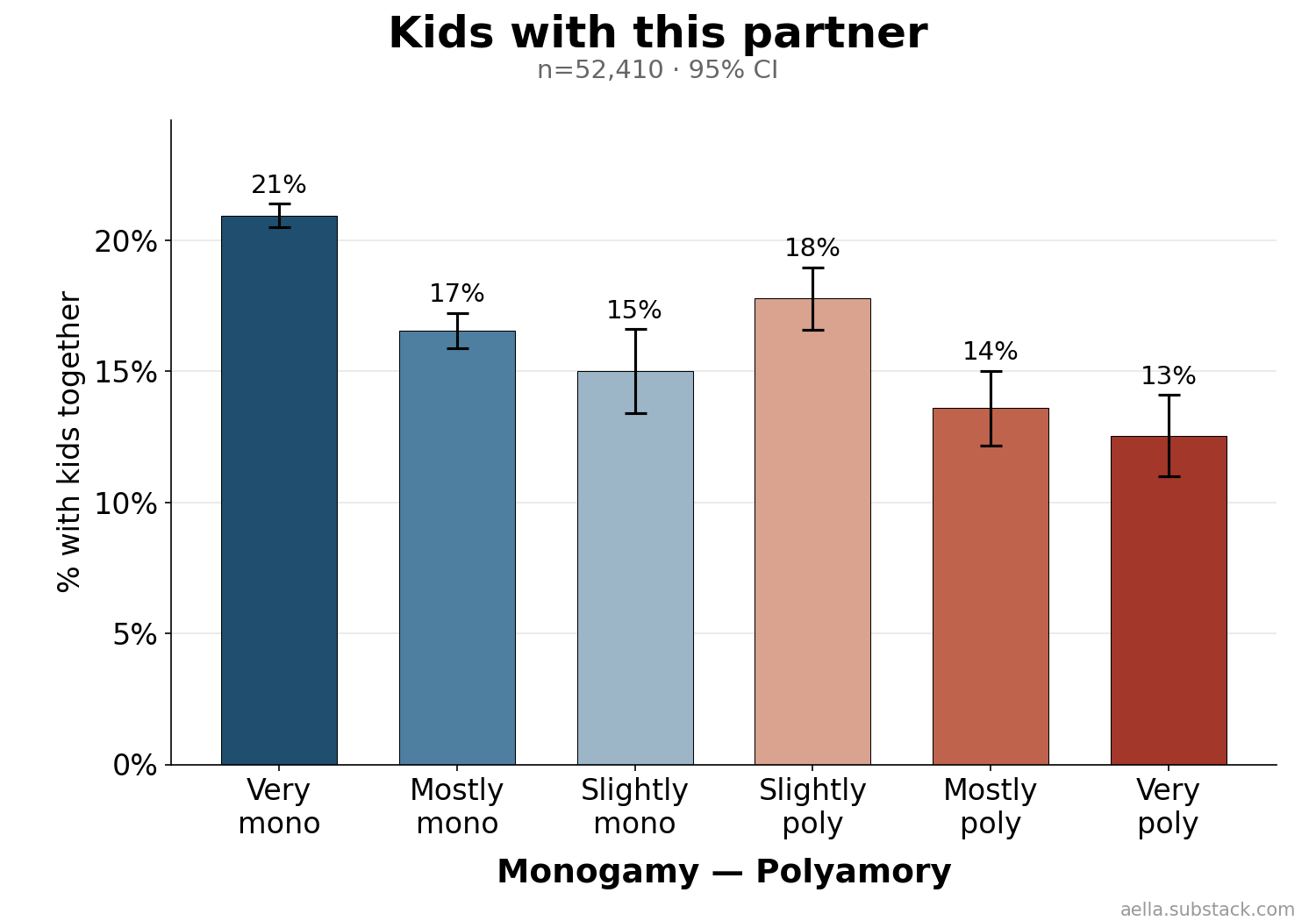
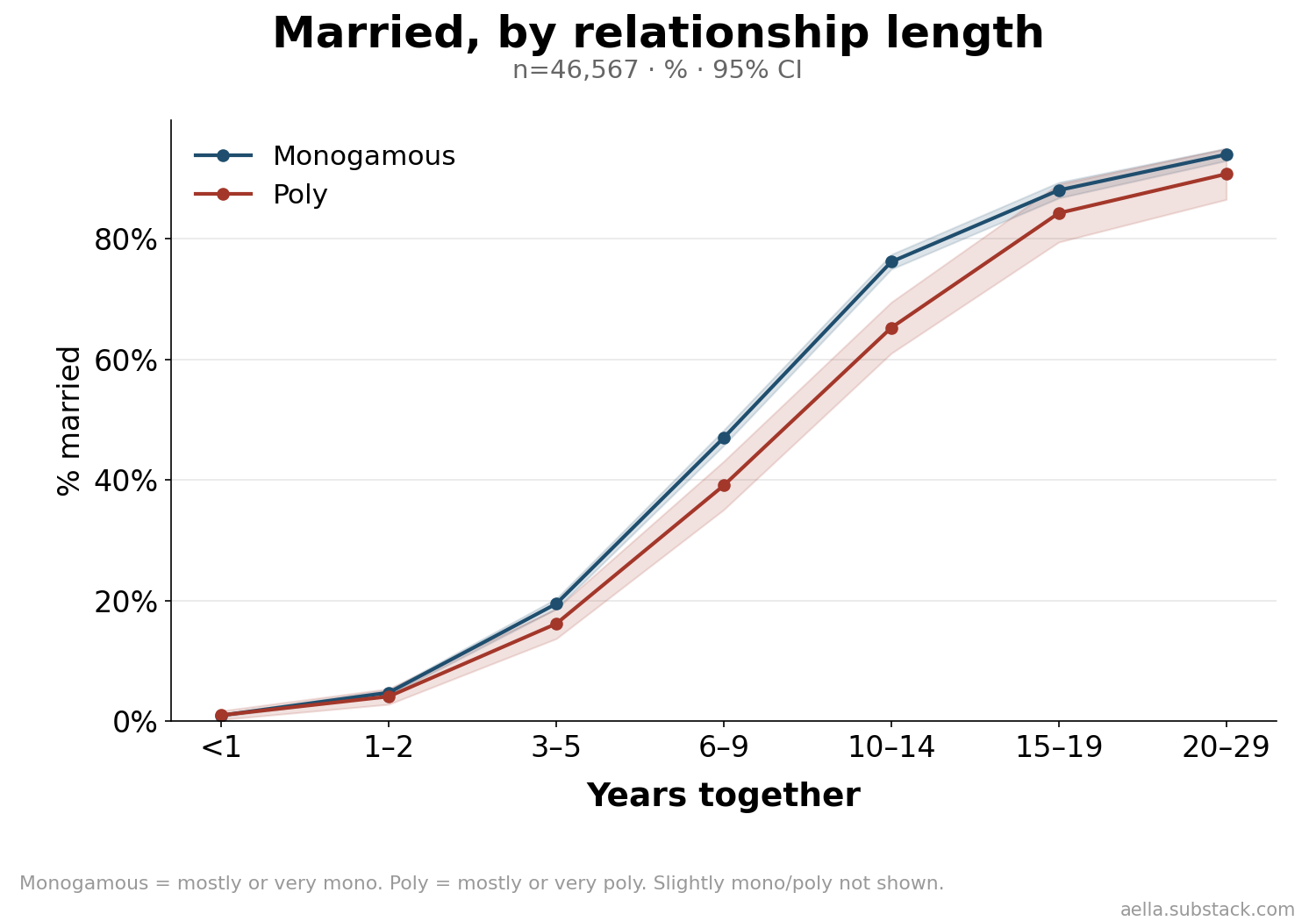
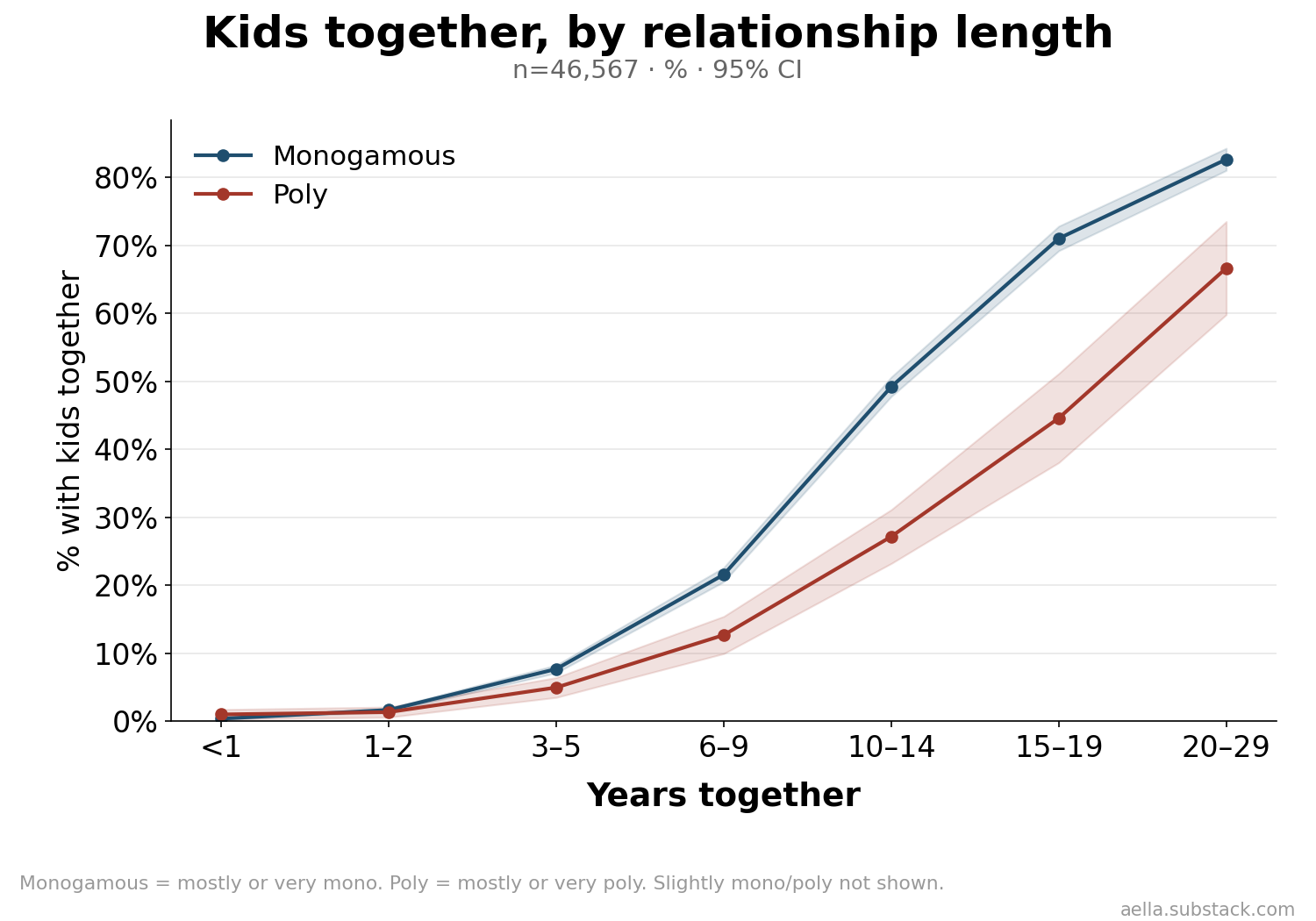
Very mono people are the most likely to be married (33% vs 29% for very poly) and much more likely to have kids together (21% vs 13%). With full controls, very poly people are about 5 points less likely to be married and 9 points less likely to have kids. The original post said poly people had about half as many kids. That's still roughly true.
12Cheating
This one wasn't in the original post. The question is "Have you or your partner ever cheated on each other?" For poly people, cheating means breaking whatever the agreement is.
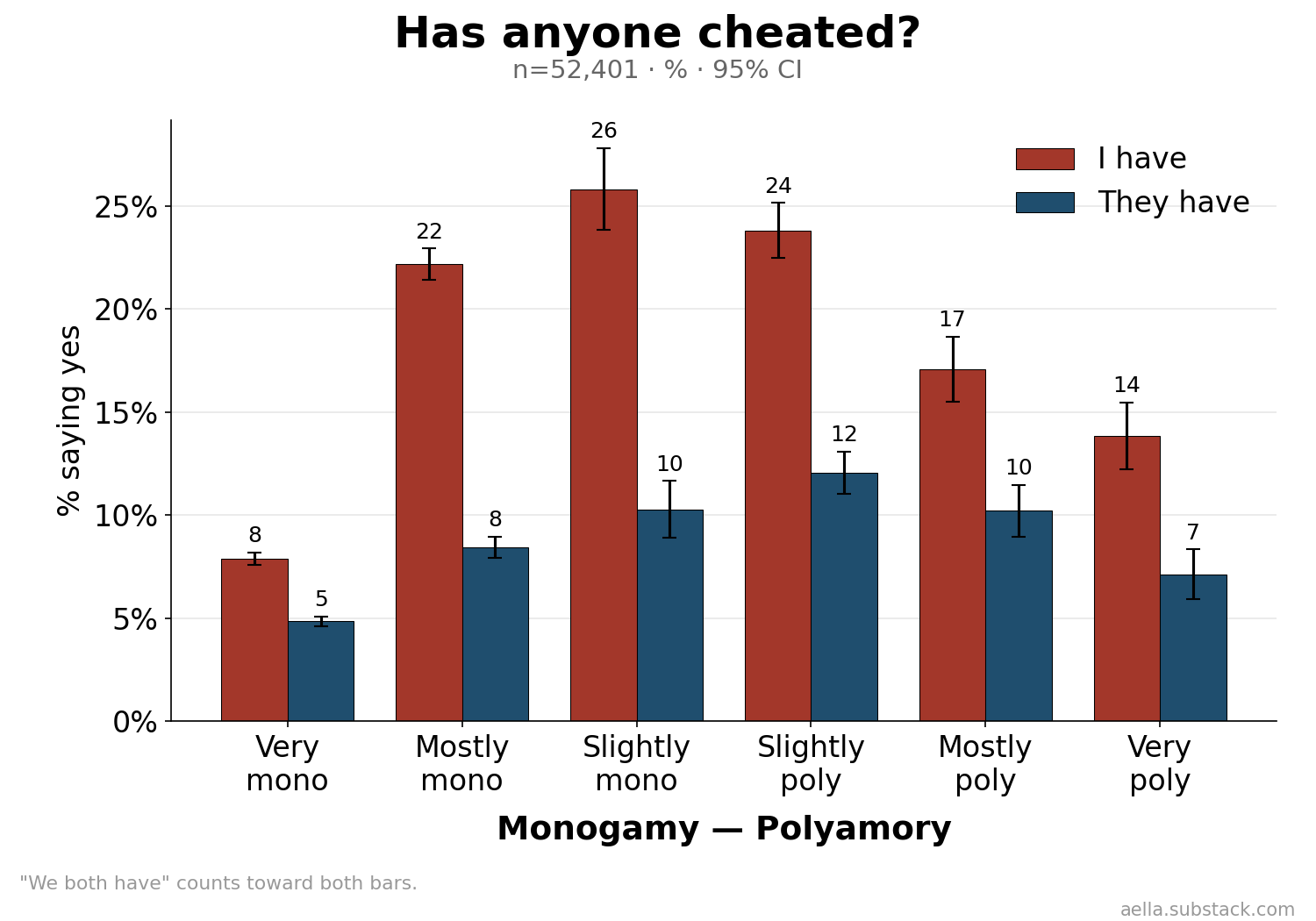
This is also a sign that the arrow goes both ways. Cheating inside a monogamous relationship might move people toward "slightly mono" or "slightly poly," rather than the label causing the cheating.
13Poly in theory vs poly in practice
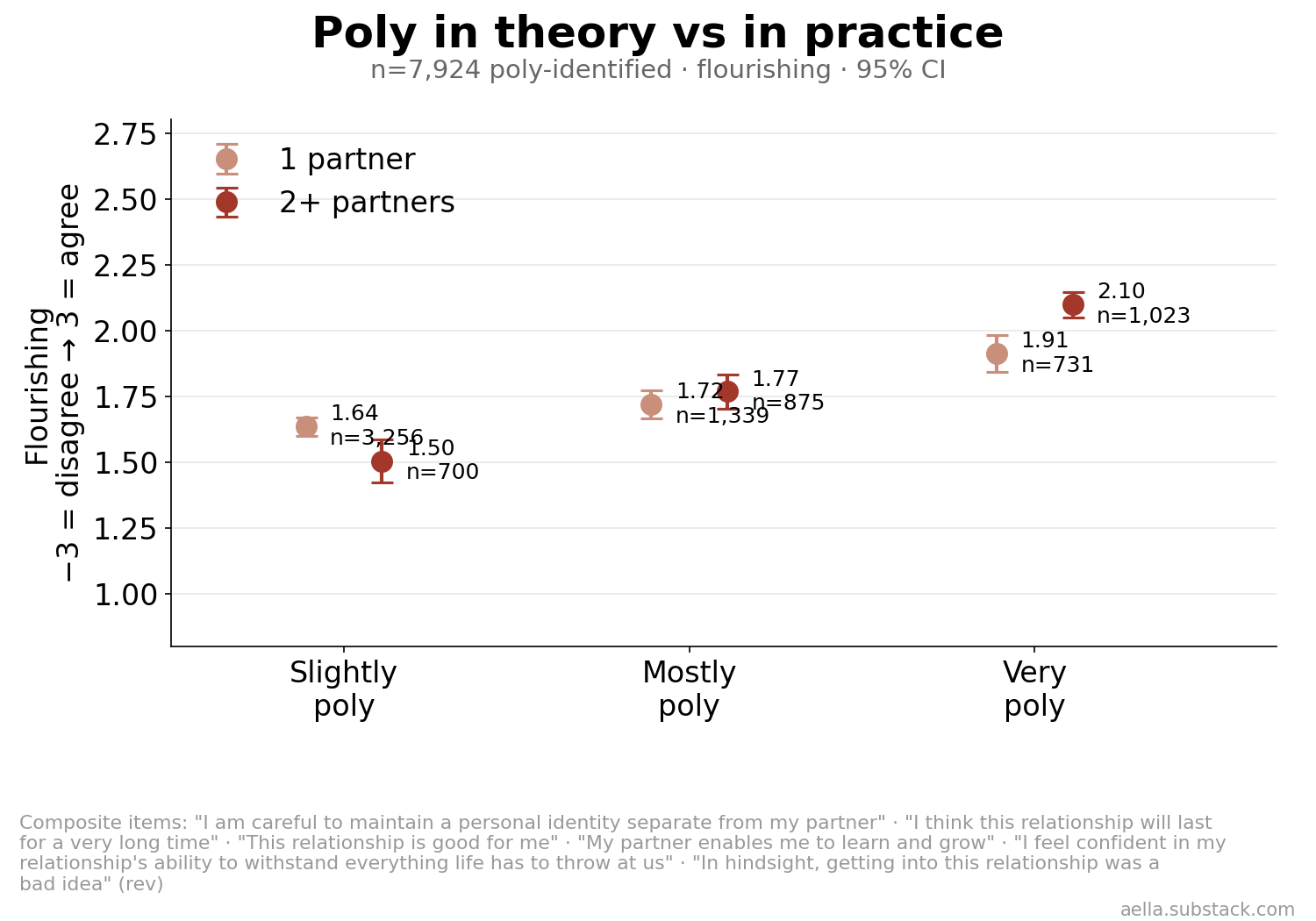
42% of very poly people and 82% of slightly poly people currently have just one partner. Does it matter whether you're actually seeing other people?
14Secondary partners
People with more than one partner were asked to fill out the survey again for each additional partner. 546 of those resubmissions pass the same quality filters. We can't link them to the same person's first submission, but we can compare them to the primaries of people with 2+ partners as a group.
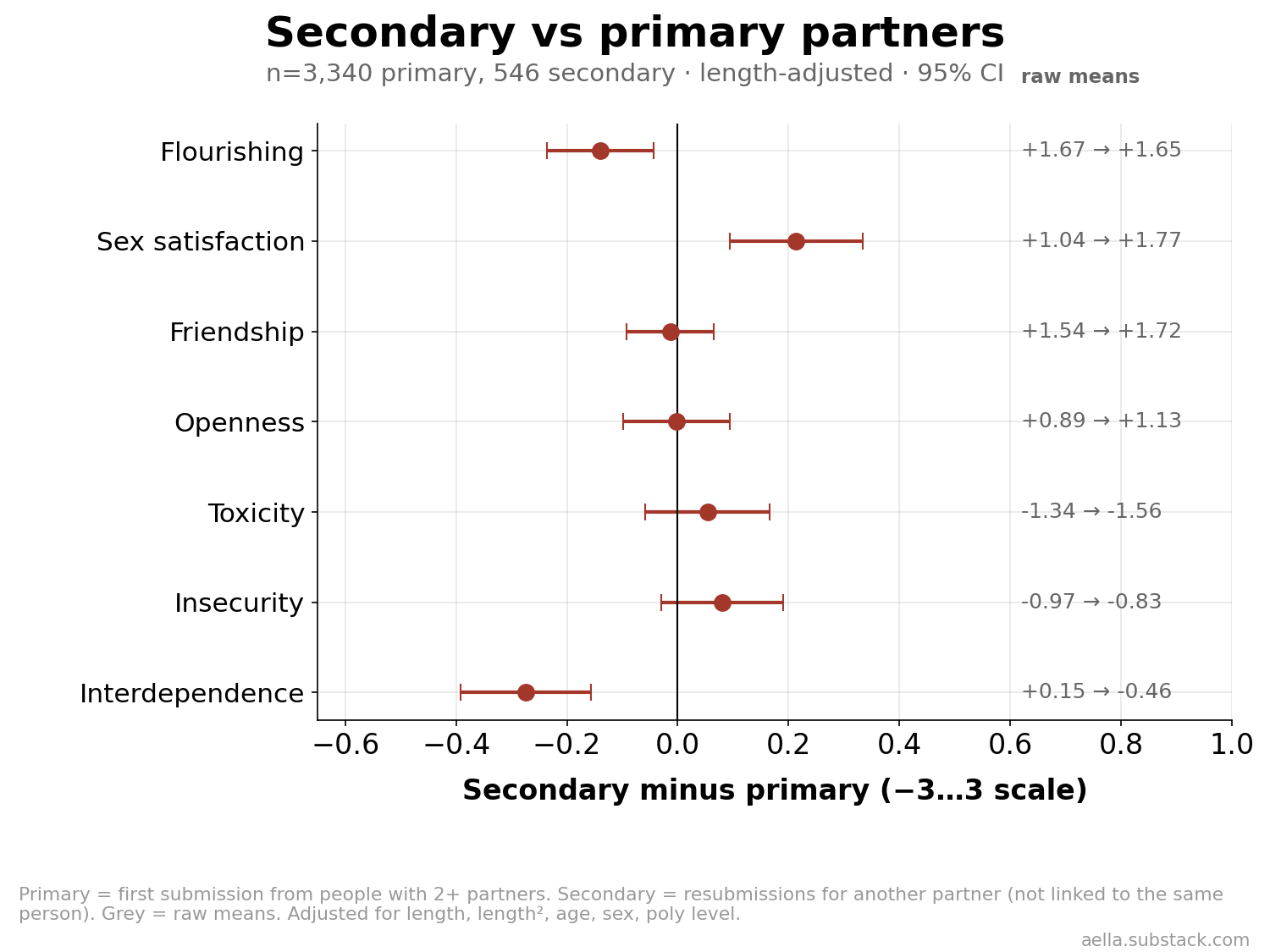
What survives the length adjustment: secondaries still have better sex (+0.21) and are less intertwined (−0.27), and primaries have slightly higher flourishing (+0.14).
15Newer questions (2026 takers only)
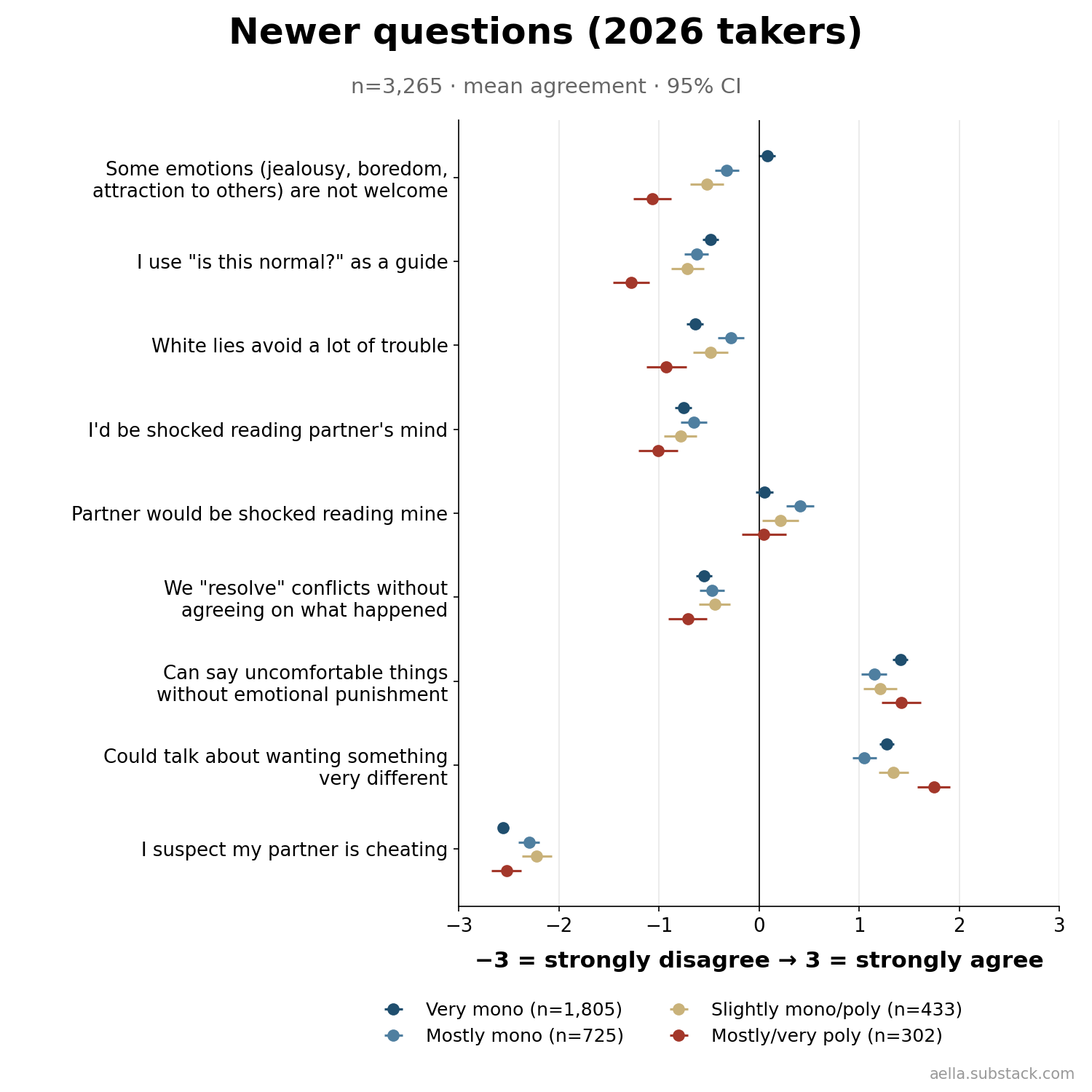
A batch of new statements was added in 2026, so these come from a smaller group (n=3,265). The poly groups are combined because of the smaller numbers.
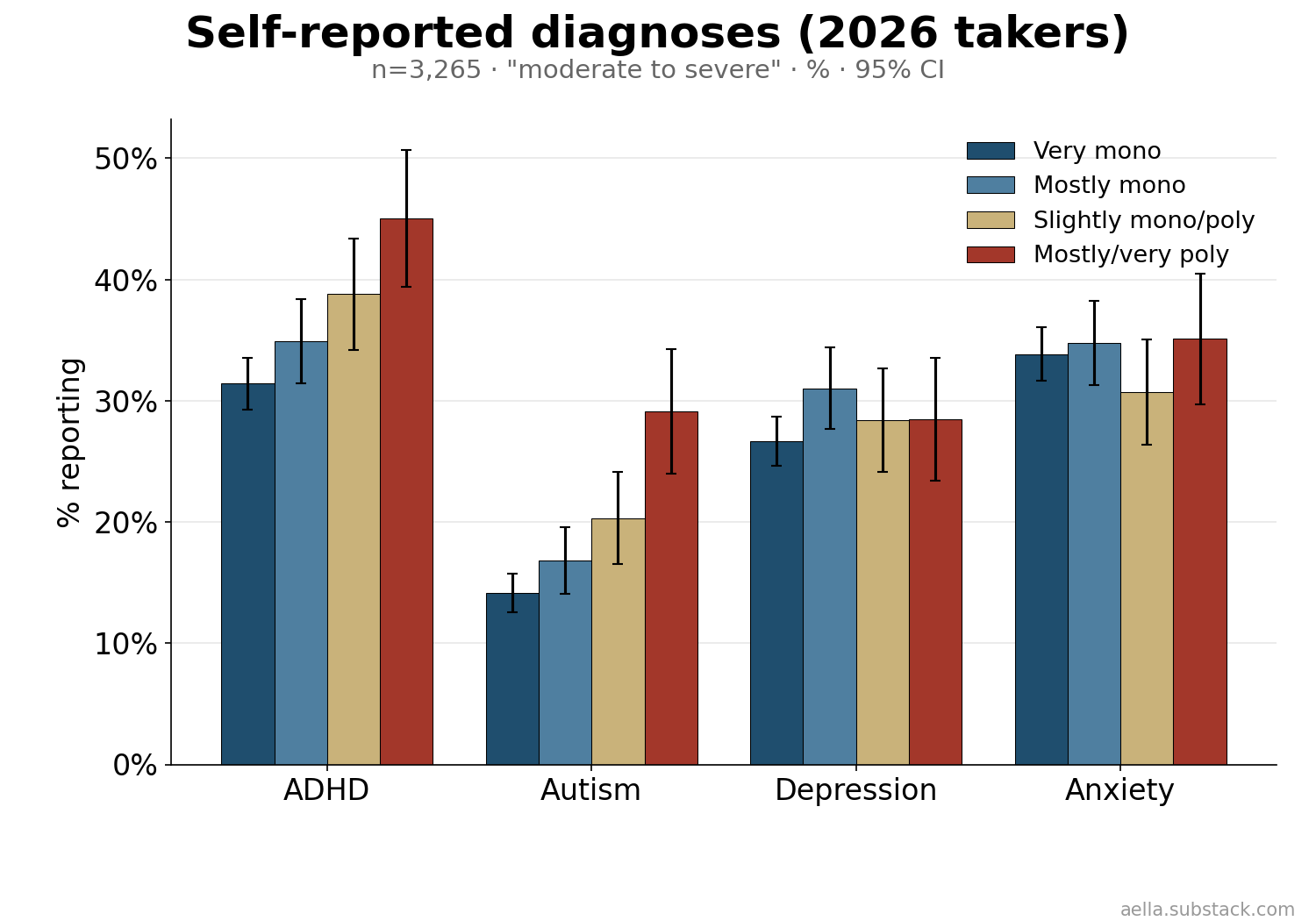
2026 takers were also asked about mental health diagnoses. Poly people report much more ADHD and autism. Depression and anxiety are about the same.
16Methods
Cleaning
| Step | Remaining |
|---|---|
| All survey runs, Dec 2022 – Sept 2026 | 142,451 |
| Finished the survey | 63,962 |
| Answered "mostly" or "fully" honestly | 61,709 |
| Currently in a relationship | 60,823 |
| Age 14–80, partner 14–90, length possible given both ages | 60,404 |
| Took at least 2 minutes 20 seconds | 60,368 |
| Partner wasn't watching them take it (this inflates scores a lot) | 56,132 |
| First submission, not a repeat taker or an extra-partner resubmit | 52,410 |
Updated Oct 21, 2026. The sample now includes 14–17-year-olds (and partners as young as 14), the minimum time is 2 minutes 20 seconds instead of 3 minutes, and repeat takers who answered the 2024+ version of "Was this your first time taking the survey?" are now removed. The September version missed them. The results barely moved.
Controls
"Full controls" means an ordinary least squares regression with: age and age², sex, own trans/nonbinary status, partner's trans/nonbinary status, same-sex couple, relationship length and length², married, kids together, religion, income, and economic and social politics. Politics was only asked of 58% of respondents; missing values were filled with the median and flagged. Error bars are 95% confidence intervals with robust standard errors. Nothing is weighted. The survey has no population weights, and these are correlational comparisons within one self-selected sample.
Relationship length, marriage, and kids are partly outcomes of being poly, not just confounders. Controlling for them can hide real differences. That's why the forest plots show the raw gap too.
Fixes to the survey data
- Relationship length had a coding bug: "19 years" was saved as 218 months and "20 years" as 220. Both are corrected here (228 and 240).
- The cheating question appears under two different IDs, one before and one after February 2024. Both are combined here (the September version only used the older one).
- The "time to first child" question overwrites the "time before marriage" variable, so time-to-marriage isn't used anywhere.
- Sex frequency is answered as a range ("2x a week" etc.) and converted to times per week. "We've never had sex" is dropped from frequency charts.
Caveats
- This is a snapshot, not a before-and-after. We don't know whether being poly changes relationships or whether certain relationships become poly. The cheating and "slightly mono" results suggest some of both.
- Survivorship: relationships that ended aren't in the data. If poly relationships that go badly end faster, the surviving ones will look better than poly relationships in general.
- Everyone answered about one partner, from one side. Partner-interest numbers are guesses.
- The sample leans toward people who know my work, and I'm openly poly-friendly. That could make happy poly people more likely to take it.
17Better questions for the next version
A lot of the ambiguity above comes from one question doing two jobs. If the survey gets revised, these would make the poly analysis much sharper:
- Split structure from identity. "Is your current relationship open?" (yes / one-sided / no) separately from "Do you consider yourself poly?" The current question can't tell a mono-by-nature person in an open relationship from a poly-by-nature person in a closed one, and the mismatch results suggest that's the most important thing.
- When did it open? "Was this relationship monogamous at first? If so, how many years in did it open?" This directly tests the "people open up old relationships vs start new ones" idea, and whether opening up follows trouble.
- Who wanted it? "Who first suggested opening the relationship?" (me / them / both). Reluctant partners are probably the unhappy ones.
- Link secondary submissions. Give each person a short code on the first submission to reuse when answering for other partners. Then primaries and secondaries could be compared within the same person, which would control for everything about them.
- Ask about past relationships. Were your previous relationships poly or mono? How did they end? This gets at the survivorship problem.
- Hierarchy and logistics. Nesting partner or not, number of metamours, time per week with each partner.
- Keep the orientation question. It stopped being asked partway through (only 29% have it). Partner sex is a decent stand-in, but bisexual people in opposite-sex couples are invisible without it.