Do Partners See the Same Relationship?
Both partners' answers from 394 couples, including 90 people aged 14 to 17. Partners agree about as well on how often they have sex and fight as on the best-agreed feelings, and least on statements about their own inner state or standing, such as whether they could date someone better. Guesses about a partner's interest in other people run a little low. Worrying about being left for someone better goes with a partner who feels less desirable, but shows no sign of a partner who thinks they could date better or wants others more.
Almost everything we know from the relationship survey comes from one person describing a relationship that has two people in it. This report looks at couples where both partners answered, so the two descriptions can be compared:
- Do partners agree on shared events, like how often they have sex?
- How alike are their feelings about the relationship?
- Do they agree on who's needier, or who could do better?
- Do they know whether the other wants other people?
- Are their worries about each other accurate?
The couples come from two places, described in section 1.
Short version
- Partners agree about as well on shared events (how often they have sex and fight) as on the best-agreed feelings, and better than on the rest. Leaving out couples who both say they've never had sex or never fought, mostly new couples, their answers correlate 0.73 for sex and 0.59 for fights (0.82 and 0.72 with them). Feelings agree only moderately: six of the seven combined scores run from 0.31 to 0.56 (the seventh, jealousy, is 0.13), led by friendship (0.56) and sexual satisfaction (0.55). Setting aside pairs who took the survey within 10 minutes of each other as well, sex is 0.65 and fights 0.58, a tie with the best feelings (friendship 0.55, sexual satisfaction 0.58).
- Among feelings, partners agree most on the shared atmosphere and least on statements mostly about their own inner state or standing. Friendship correlates 0.56, sexual satisfaction 0.55, politics 0.53 and conflict 0.51. At the bottom are "I don't really worry about other attractive people gaining too much of my partner's affection" (0.05), "I rely on my partner for a sense of self worth" (0.10), "I am careful to maintain a personal identity separate from my partner" (0.11) and "If we broke up, I think I could date a higher quality person than they could" (0.03). Both partners claim that last edge in 6% of couples, the same as unrelated answers give. Flourishing correlates 0.38, and couples are within a point of each other 82% of the time against 72% for random pairs, since nearly everyone scores high.
- When both partners name who's needier, it's usually the woman, but in a third of couples at least one is neutral. Both name the woman in 37% of opposite-sex couples and the man in 13%; in 33% at least one answers 0, the middle of the scale. The two answers correlate −0.40, where a perfect mirror would be −1.
- Guesses about a partner's interest in other people run a little low for both sexes. Over everyone, guesses fall 0.20 points short on the 0 to 4 scale (95% CI 0.13 to 0.28). Women guessing their male partner are 0.34 short (guess 1.02, men's average answer 1.36); men guessing their female partner are 0.10 short (0.95 against 1.04; the interval includes zero). About half of that gap is that men's own answers run higher: for partners who gave the same answer it shrinks to 0.11, which isn't statistically clear. Among partners with any interest, about half are guessed too low (54% for women's guesses, 47% for men's).
- Worry about being left for someone better goes with a partner who feels less desirable, but shows no sign of a partner who thinks they could date better or wants others more. 23% of worriers' partners disagree that they'd still be a desirable mate if left, against 11% (+12 points, CI +6 to +17), and they score lower on flourishing (correlation −0.16). 25% of worriers' partners think they could date better, against 23% of others (+3 points, CI −3 to +9). 17% would want others "a lot" or more, against 17%; at "a little bit" or more it is 58% against 68%, if anything the other way.
- Within a couple, men report more porn use and more interest in others than their partners do. 41% of the men and 15% of the women watch porn or erotic content 3-4 times a week or more; 21% of men and 15% of women would be interested in others "a lot" or more. Flourishing and sexual satisfaction differ little: on the −3 to +3 scale men average 1.99 and women 2.09 on flourishing, 1.74 and 1.90 on sexual satisfaction, and both sexes score high.
- Where the couples come from
- How often they have sex and fight
- All the measures on one scale
- Who's needier, who could do better
- Do you know what your partner wants?
- Does worry about being left match what the partner thinks?
- Men and women in the same couple
- Could it be something else?
- Methods and limits
1. Where the couples come from
Glosso couples (48). On Glosso, people can link their relationship survey to their partner's account. These 48 couples are confirmed: each partner's survey points to the other.
Matched survey couples (346). The main survey is anonymous, but couples who take it around the same time leave a trace. Two submissions are counted as a couple when they were started within three hours of each other, give the same relationship length (allowing one month), the same marriage and living-together answers, and each person's age and sex match the other's description of their partner. Only unique, two-way matches count.
The rule has to be strict. On busy days, when thousands of people took the survey after it went viral, strangers matched by coincidence. How often partners agree on sex frequency helped set the rule, so the 48 confirmed Glosso couples, which didn't go through it, are the independent check:
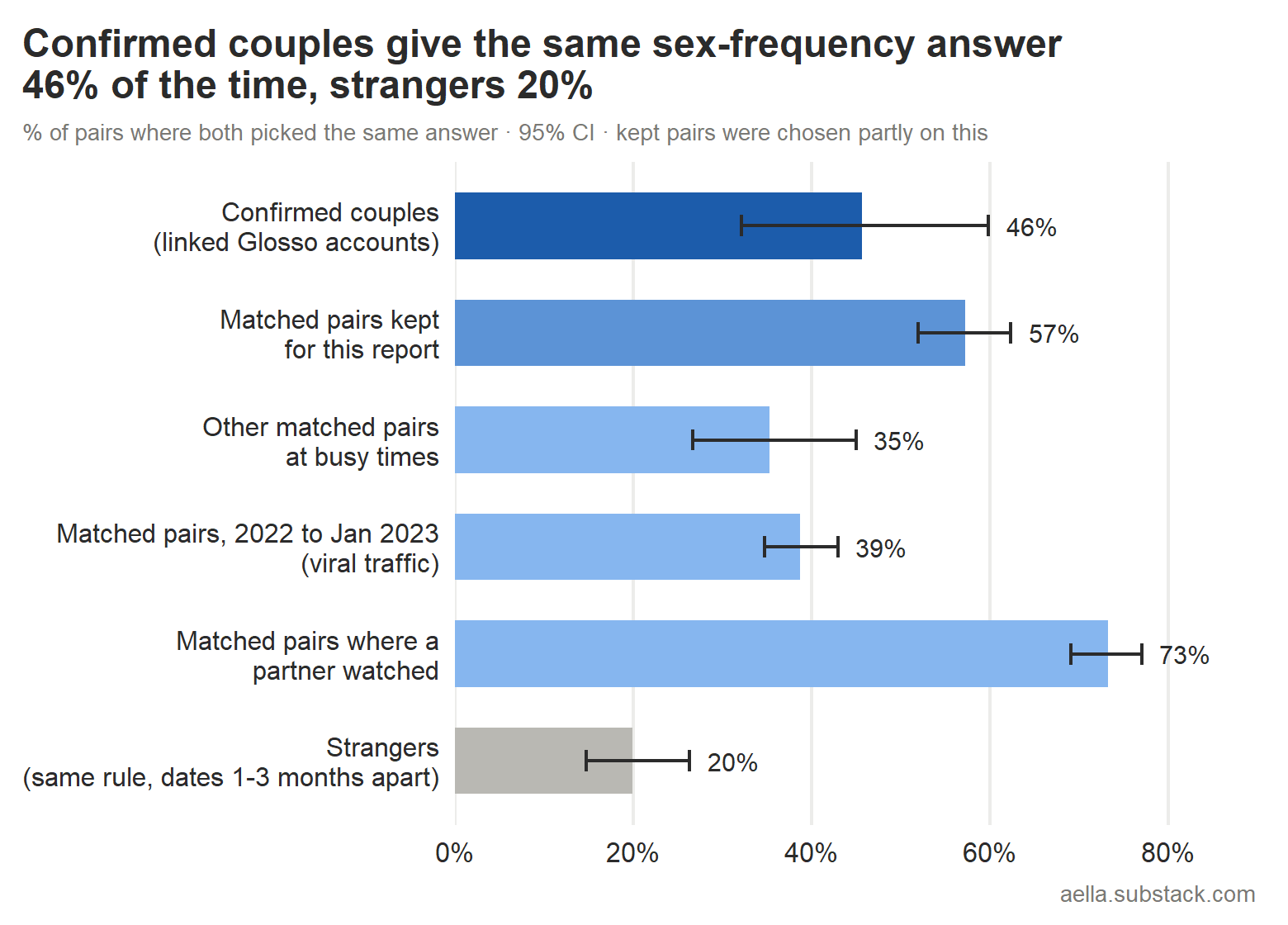
Real couples mostly submit close together. Matches more than three hours apart give the same sex-frequency answer 22–33% of the time, against about half within three hours (when neither partner watched) and about 20% for strangers, so they aren't counted. At busy times (more than 40 other people starting the survey within three hours either side), only pairs started within 30 minutes of each other are kept. Those kept agree at least as often as the confirmed couples. Other busy-time matches, and pairs from the viral weeks of late 2022, agree much less, which is what you'd expect if many of them are strangers. They're left out. So are pairs where either partner said their partner watched them take it: those couples often filled it in together, and agree much more often (73% on sex frequency). That's covered in When Your Partner Is Watching.
80% of the matched couples kept started the survey within 30 minutes of each other, and 43% within 10 minutes. Coincidental pairs probably run from a few percent up to about 14%. With one partner's date shifted by 30 to 90 days, the same rule finds only 1–3% as many matches as the real pairs; a 7-day shift finds about 10%, though that can include people who took the survey twice. Disagreement on the number of children, which the rule doesn't use, is 1.7% in the kept pairs and 12.7% in the shifted ones, which caps coincidental pairs at about 14%. They would make the agreement numbers below slightly too low, not too high.
So the report uses 394 couples: 346 matched survey couples from 2023–2026 plus 48 Glosso couples. 336 are opposite-sex. Ages run from 14 to 60 (median 25); age is unknown for 53 people in Glosso couples. 90 people are aged 14 to 17, in 51 couples (39 where both partners are under 18). Every question applies to them, so they're included; section 8 shows the results with and without them. These are couples who both chose to take a relationship survey, often on the same evening, so they're probably more engaged than average.
2. How often they have sex and fight
The survey asks "On average, over the last six months, about how often do you and your partner have sex?", with 12 answers from "We've never had sex" to "Multiple times a day", and "How often do you and your partner have a fight?", with 9 answers from "We've never fought" to "Daily". Both partners are describing the same events.
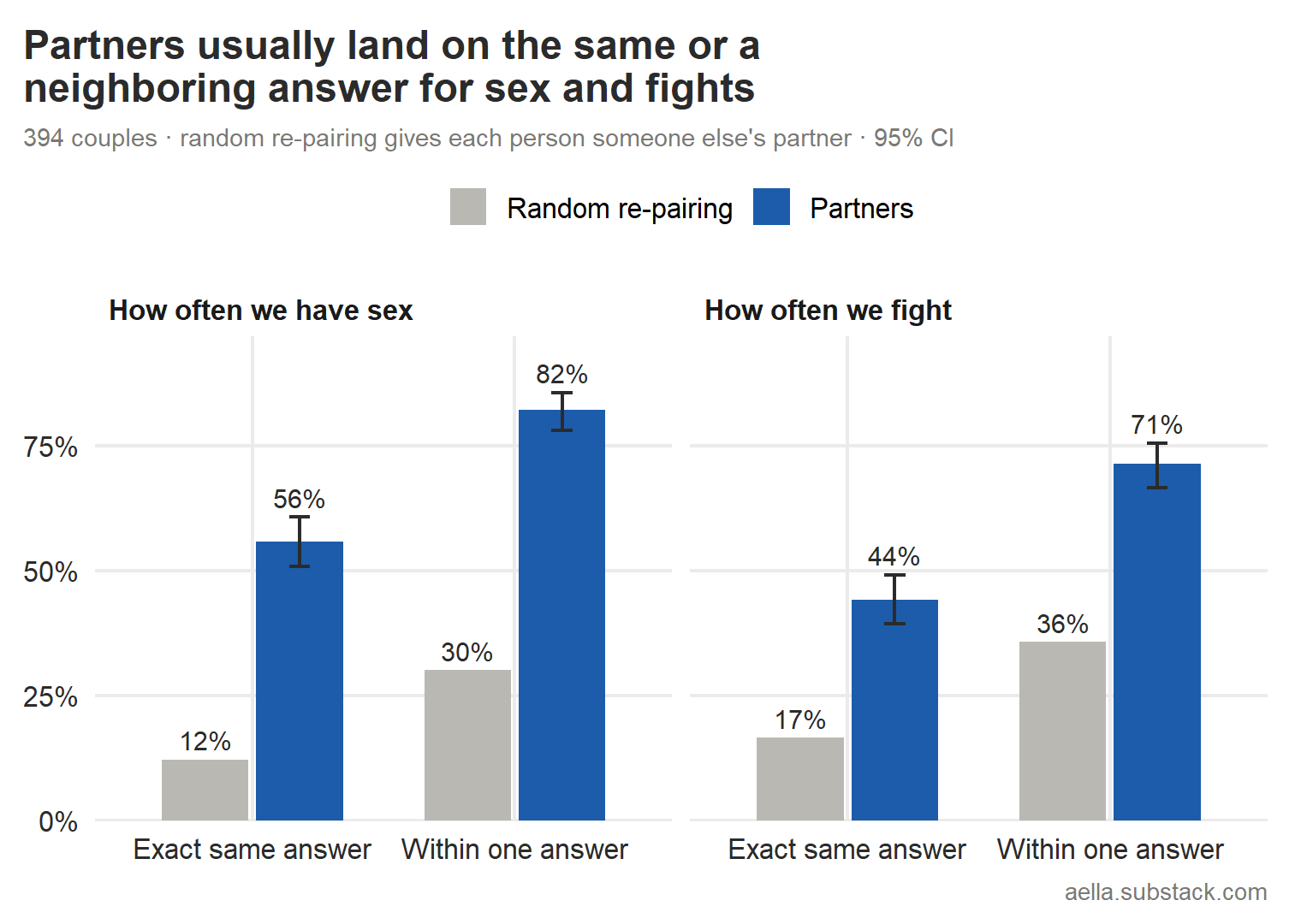
Partners give the identical answer in 56% of couples for sex and 44% for fights, about 4.5 and 2.7 times as often as random re-pairing (12% and 17%). In 82% and 71% they are within one notch, like "once a week" and "2x a week", which two people can honestly see differently. About 1 couple in 5 is further apart than that on sex (18%) and 3 in 10 on fights (29%).
New couples make both easier to match: 56 couples both say they've never had sex and 70 both say they've never fought, most of them together for under a year. Leaving those out, partners give the same answer in 49% of couples for sex (13% for random re-pairing) and 32% for fights (16%), and land within one notch in 79% and 65% (37% and 40%).
As a correlation, partners' answers go together at 0.82 for sex and 0.72 for fights, or 0.73 and 0.59 leaving out those couples (rank correlations, so they don't depend on how the answers are spaced).
When partners disagree about how often they have sex, the man gives the higher number slightly more often (26% of couples vs 21%), but that difference isn't statistically clear. For fights it's close to even (27% vs 29%).
3. All the measures on one scale
For each answer, how well does one partner's answer predict the other's? The figure shows the two frequencies, all seven combined scores, the three best- and five worst-agreed of the 40 single statements, and four questions discussed elsewhere in the report.
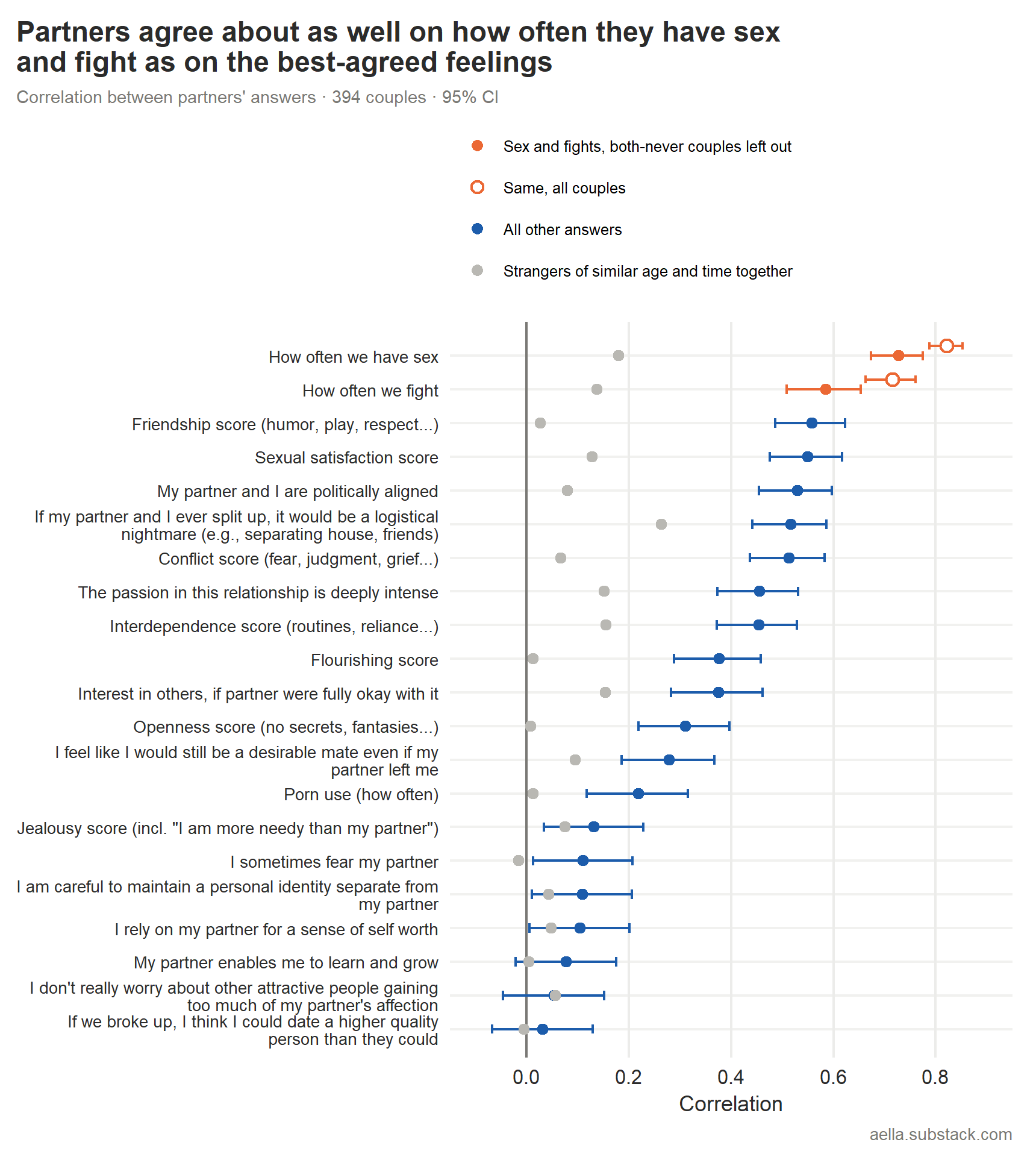
Partners' answers on how often they have sex and fight are at or near the top. Sex (0.73 leaving out couples who both say never) is above every feelings score. Fights (0.59) match the best ones, friendship (0.56) and sexual satisfaction (0.55), and sit above the other combined scores, which run from 0.31 (openness) to 0.51 (conflict). Pairs who started within 10 minutes of each other agree more on sex frequency (section 8). Setting those aside too, sex is 0.65 and fights 0.58, against 0.55 for friendship and 0.58 for sexual satisfaction (rank correlations). Porn use, the one other behavioral frequency, agrees at only 0.22, but it asks about each person's own habits rather than something the two share.
Feelings agree only moderately: apart from the jealousy score, the combined scores correlate 0.31 to 0.56, so partners share roughly 10 to 30% of what varies. Strangers from the other couples in this sample, matched on age and relationship length, show little of it: 0.18 for how often they have sex, 0.14 for fights, near zero for most of the rest, so it isn't just life stage. The exception is "If my partner and I ever split up, it would be a logistical nightmare (e.g., separating house, friends)", which strangers share too (0.26), since it mostly depends on whether you live together and for how long.
Single statements correlate less than the combined scores. Across the 40 single statements, the median correlation between partners is 0.31 and the highest 0.53. On the seven-point statements, partners give exactly the same answer in a median of 38% of couples (26% for unrelated answers) and land within one point 72% of the time (60%). For how often they have sex and fight, the figures are 56% and 44% exactly the same (12% and 17% for unrelated answers) and 82% and 71% within one notch (30% and 36%).
Flourishing correlates 0.38. Nearly everyone scores well (98% are above zero on the −3 to +3 scale), so partners' scores are close either way: 82% of couples are within a point of each other, against 72% for random pairs. People who score below 1.5 have partners who average 1.6; people who score 2.5 or more have partners who average 2.3; a randomly chosen partner would average about 2.0.
At the bottom are mostly statements about one's own inner state or standing. The five lowest of the 40 are "I don't really worry about other attractive people gaining too much of my partner's affection" (0.05), "My partner enables me to learn and grow" (0.08), "I rely on my partner for a sense of self worth" (0.10), "I am careful to maintain a personal identity separate from my partner" (0.11) and "I sometimes fear my partner" (0.11). Lower still is "If we broke up, I think I could date a higher quality person than they could" (0.03), which is relative by construction. These intervals overlap, so they can't be ranked against each other. Low agreement on them isn't the same as disagreement: each partner is describing their own state, and fear is rare. "My partner physically desires me" (0.13) asks each person about the other, so the two answers describe different things.
4. Who's needier, who could do better
Two statements compare the partners directly: "I am more needy than my partner" and "If we broke up, I think I could date a higher quality person than they could". If both partners see it the same way, their answers should mirror each other: if one says yes, the other should say no.
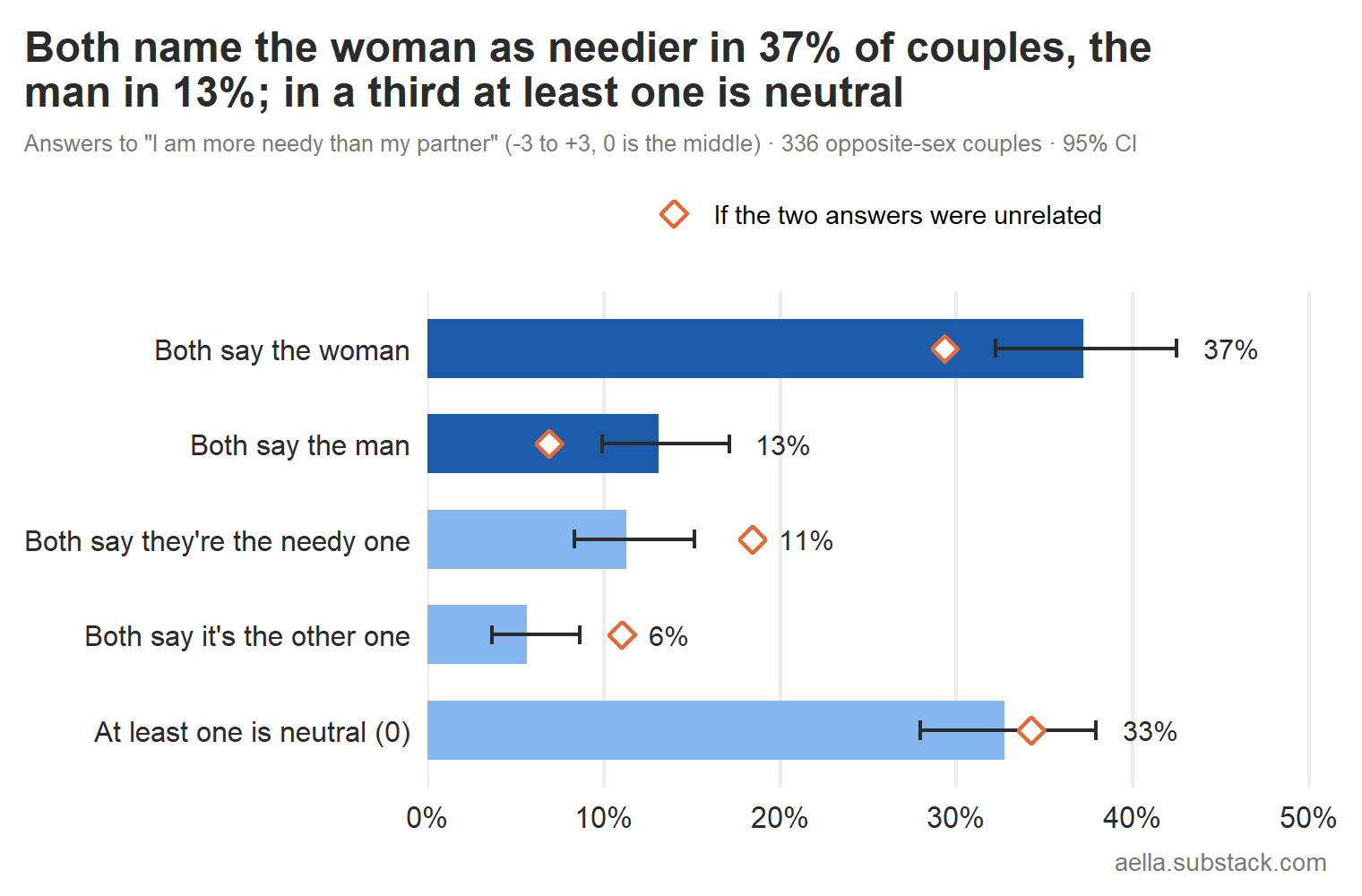
Both partners name the woman as the needier one in 37% of couples and the man in 13%. In 33% at least one answer is 0, the middle of the scale; we read that as not having a clear view, though it could also mean they see no difference. Where one partner says yes and the other no (169 couples), it's the woman who is needier 74% of the time: 60% of women say they're the needier one, against 31% of men. The pattern is real but partial. The two answers correlate −0.40 (a perfect mirror would be −1), and the two partners name the same person in 50% of couples, against 36% if their answers were unrelated. 11% of couples have both partners claiming to be the needy one.
"Could date better" doesn't mirror at all. About a quarter of men (23%) and women (27%) agree that if they broke up, they could date a higher quality person than their partner could. But whether one partner thinks so has nothing to do with what the other thinks (correlation 0.03). Both claim the upper hand in 6% of couples, the same as unrelated answers give. If partners saw their relative options the same way, that number would be near zero. Either people don't know how their partner sees it, or there's no shared answer to know.
5. Do you know what your partner wants?
The survey asks "In a world where your partner was fully aware and deeply okay with it, how much would you be interested in having sexual/romantic experiences with people besides your partner?" The answers are "Not at all", "A little bit", "Somewhat", "A lot" and "Extremely, this is essential". It then asks you to guess your partner's answer: "In a world where you were fully aware and deeply okay with it, how much would your partner be interested in having sexual/romantic experiences with people besides you?" (the fourth answer there is "Very much"). With both partners, the guess can be checked:
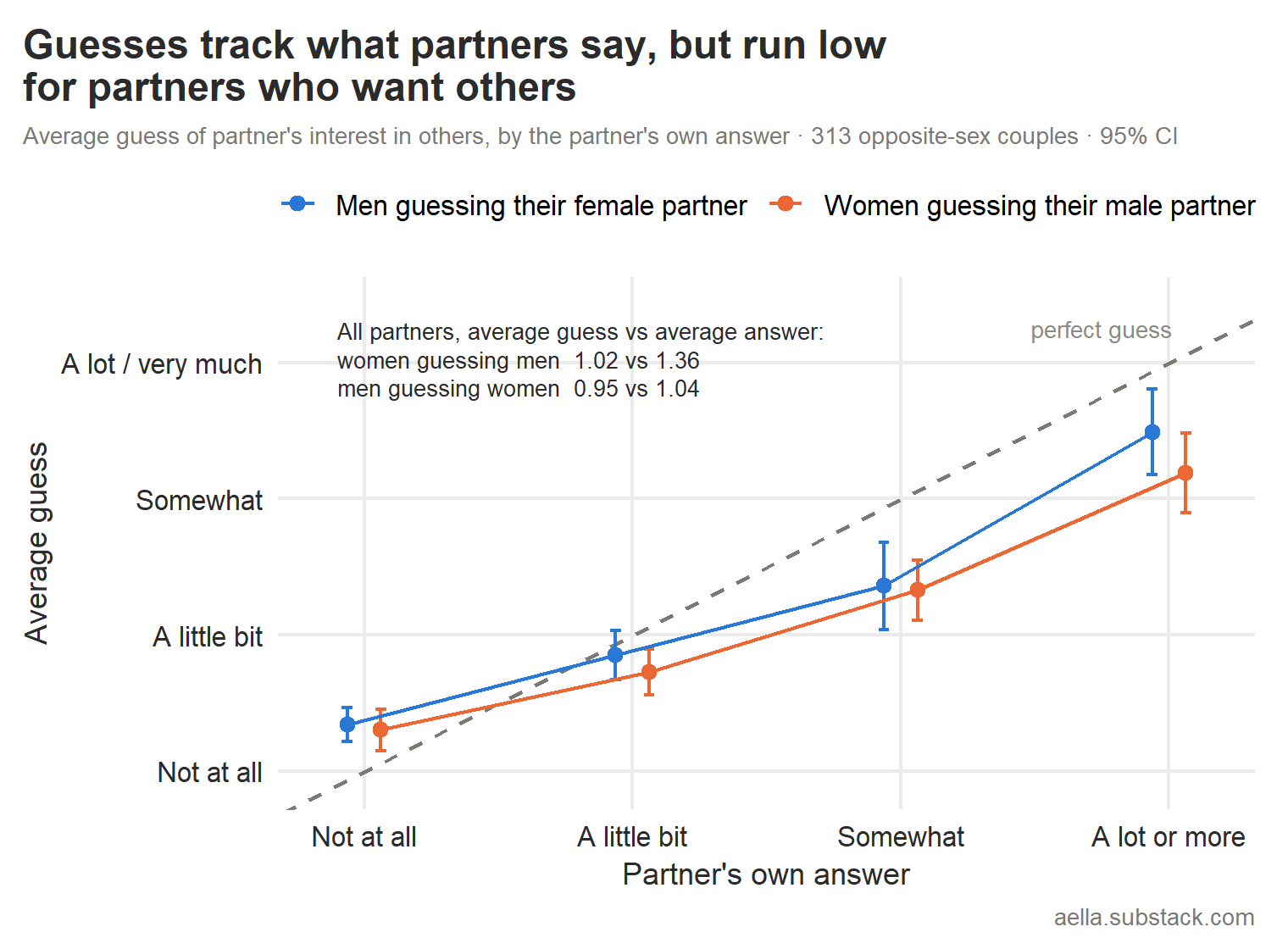
Guesses track the truth reasonably well. The correlation is 0.63 for men's guesses and 0.61 for women's (0.14 and 0.17 for strangers), and about 9 in 10 guesses are within one notch (88% and 87%). Partners who say they'd have no interest are guessed "not at all" 77% of the time by men and 82% by women.
On average, though, guesses run a little low. Over everyone in these couples (712 people, same-sex couples included), guesses fall 0.20 points short of the partner's own answer (95% CI 0.13 to 0.28). Among opposite-sex couples, women guess their male partner's interest at 1.02 on the 0 to 4 scale, while the men's own answers average 1.36, a shortfall of 0.34 (95% CI 0.22 to 0.45). Men guess 0.95 for women's 1.04, a shortfall of 0.10 (−0.01 to 0.21), which isn't clearly different from zero. Among partners with any interest, 54% of women's guesses and 47% of men's are too low, against 11% and 17% too high. A partner who would want others "a lot" or more is guessed at about 2.2 by women and 2.5 by men, against 3.2 for their own answers.
Part of that curve is just what noisy guessing does: guesses get pulled toward the middle, so partners with no interest are guessed a little above zero (0.3) and partners with a lot are guessed lower. That alone wouldn't lower the overall average. Noise at the bottom of the scale pushes averages up (a simulation of noisy guesses gives +0.05 to +0.15), so the low average isn't just noise.
Read the other way, someone who guesses their partner has no interest in others is wrong 38% of the time (33% for men guessing, 44% for women guessing): those partners say at least "a little bit". Someone who guesses "a lot" or more is right that the partner has some interest 93% of the time.
Women's guesses about men fall further short than men's guesses about women: the per-couple difference in shortfall is 0.24 points (0.05 to 0.43). Part of that is that men's own answers run higher (1.36 against 1.04), which leaves more to underestimate: 69% of the men being guessed about have some interest, against 56% of the women. For partners who gave the same answer the difference shrinks to 0.11, about half, which isn't statistically clear.
6. Does worry about being left match what the partner thinks?
38% of women and 32% of men agree with "I sometimes worry that my partner will leave me for someone better". Does the partner's side of the story match?
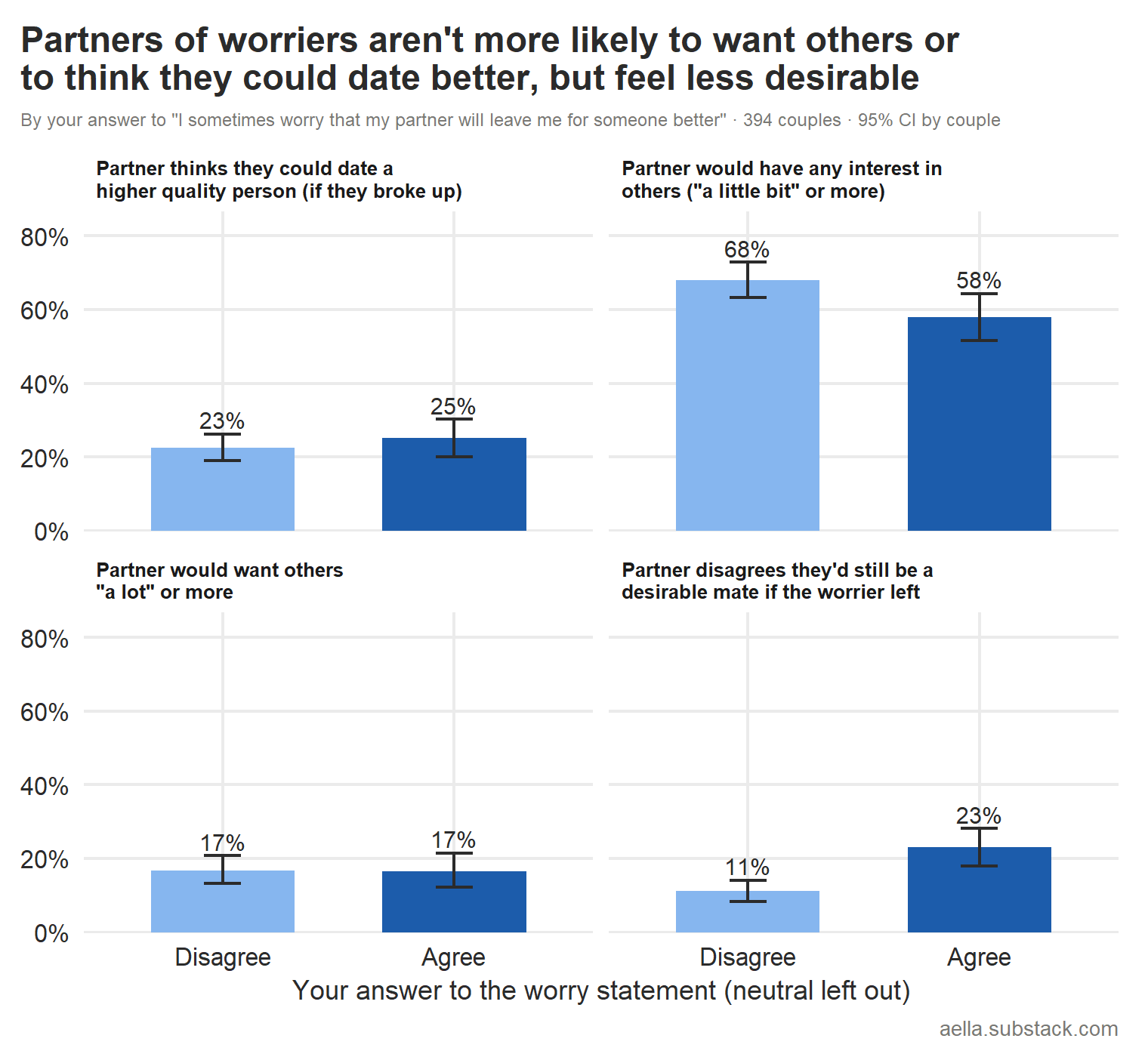
Worry shows no sign that the partner thinks they could date better or wants others more. Partners of worriers are about as likely to agree "If we broke up, I think I could date a higher quality person than they could" (25% vs 23%; a difference of +3 points, 95% CI −3 to +9), and the same holds at stricter cuts: a stronger agreement (2 or 3 on the −3 to +3 scale) is 14% vs 14%, and the strongest (3) 4% vs 5%.
Wanting others depends on the cut. At "a lot" or more, 17% vs 17% (0 points, −6 to +6); at "somewhat" or more, 34% vs 37% (−3 points, −11 to +5); at "extremely, this is essential", 5% vs 4% (+1 point, −2 to +5). At "a little bit" or more, worriers' partners are less likely to have any interest: 58% vs 68% (−10 points, −18 to −2; p about 0.06 after allowing for sex and relationship length). That is the opposite of what the worry would predict. As correlations with the worry statement itself, the links to "could date better" and to interest in others are −0.02 (−0.09 to +0.05) and −0.03 (−0.11 to +0.04).
Two things the worry does go with:
- A partner who feels less desirable. 23% of worriers' partners disagree with "I feel like I would still be a desirable mate even if my partner left me", against 11% of other partners (a difference of +12 points, 6 to 17). The correlation is −0.17 (−0.25 to −0.10), and −0.09 when the worrier's own answer to that statement is held equal. Partners' answers on the worry statement itself correlate 0.22, so insecurity seems to be shared within couples rather than one partner being right about the other.
- A slightly less happy partner. Worriers' partners score a little lower on flourishing (correlation −0.16, −0.23 to −0.09), and −0.12 comparing worriers who are equally happy themselves.
Feeling desired shows a similar pattern. "My partner physically desires me" correlates 0.28 with the partner's own "The passion in this relationship is deeply intense". But most of that is shared mood: comparing people who are equally passionate, satisfied with their sex life and excited by their partner, feeling desired barely predicts the partner's passion (0.05).
Cheating
Among 712 people in these couples, 41 said they had cheated on their partner and 24 said their partner had cheated on them. Of the 24 partners reported as cheaters, 20 admitted it. But about half of the cheating people admitted (21 of 41) was not reported by their partner, perhaps because the partner doesn't know. The numbers are small, so treat them as a rough picture.
7. Men and women in the same couple
Comparing a man and a woman in the same relationship removes some reasons men's and women's answers differ across the survey, such as relationship length and age. Porn use is "about how often do you watch porn or consume erotic content for the purposes of arousal?"
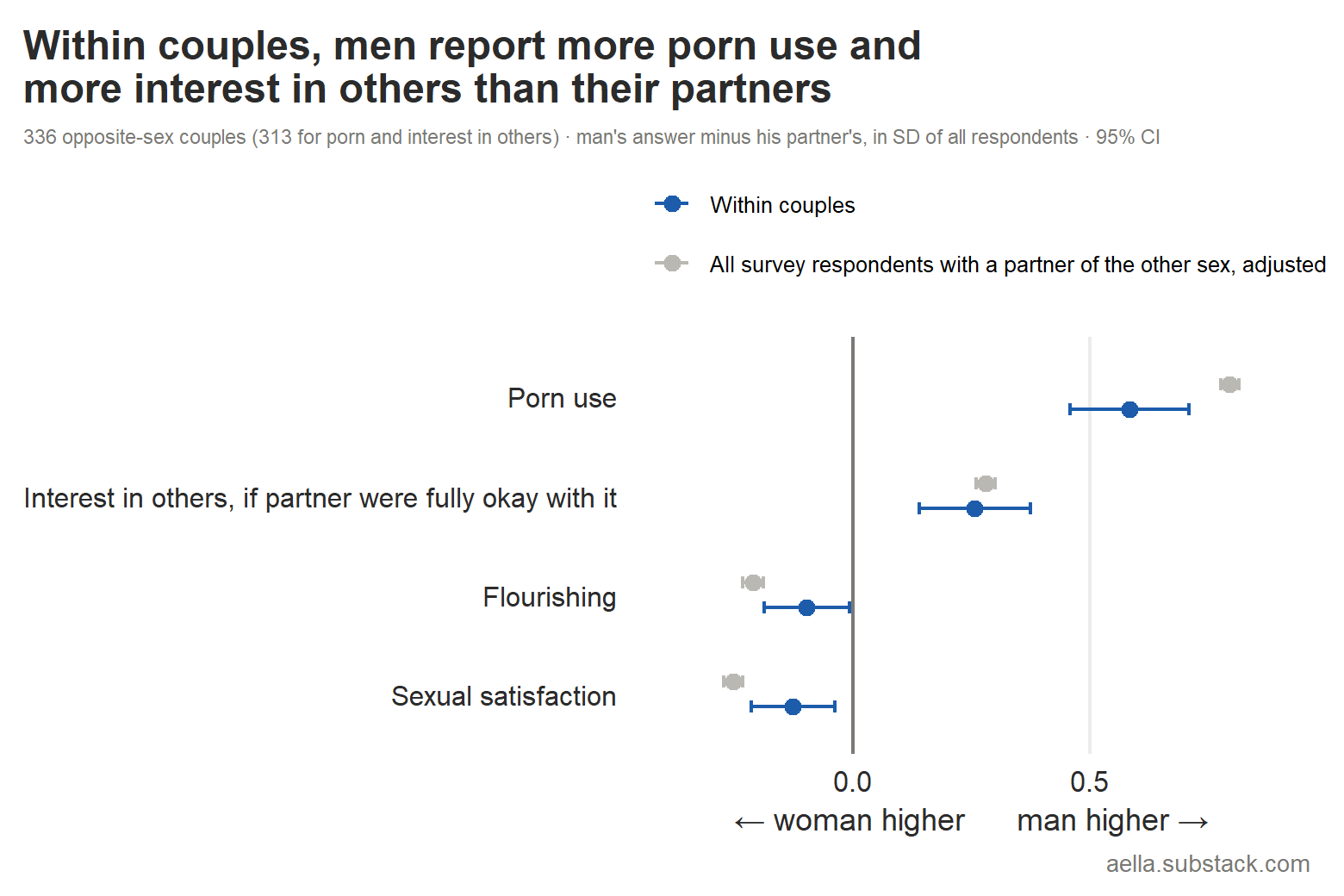
Men report more porn use and more interest in others than their partners do. These are gaps between the two partners, so they don't show which of the two is unusual. In 67% of couples the man reports more porn use and in 20% the woman does; 41% of the men watch porn or erotic content 3-4 times a week or more, against 15% of the women. 21% of men and 15% of women say they'd be interested in others "a lot" or more, with the man giving the higher answer in 41% of couples and the woman in 21%.
Flourishing and sexual satisfaction differ little. On the −3 to +3 scale men average 1.99 and women 2.09 on flourishing, and 1.74 and 1.90 on sexual satisfaction; 90% of both sexes score above 1 on flourishing. The gaps are about a tenth of a standard deviation (−0.10 and −0.13), and the flourishing interval (−0.19 to −0.01) nearly reaches zero, so with four comparisons it could be chance.
Men and women across the survey who have a partner of the other sex differ in the same directions, usually by more: porn use +0.80 standard deviations, interest in others +0.28, flourishing −0.21 and sexual satisfaction −0.25 (grey dots). Inside couples the gaps are about the same for interest in others and smaller for the other three.
8. Could it be something else?
Aren't some of these pairs strangers?
Some probably are, from a few percent up to about 14% (section 1). Strangers would lower the agreement numbers, not raise them.
Do couples who answer within minutes of each other compare notes?
Possibly. The correlation on how often partners have sex is 0.86 for pairs who started the survey within 10 minutes of each other, 0.64 for pairs 10 to 30 minutes apart, 0.65 for 30 minutes to 3 hours, and 0.72 for the confirmed Glosso couples (rank correlations, leaving out couples who both say they've never had sex). Fights, leaving out couples who both say they've never fought, show no such pattern (0.59, 0.61, 0.54; Glosso 0.51), and friendship runs the other way (0.51, 0.51, 0.64; Glosso 0.56). So the sex-frequency figure may run high for the closest pairs. Leaving them out, sex is 0.65 and fights 0.58, level with the best feelings.
Does agreement change over the years, or with how busy the survey was?
Sex-frequency agreement rises over time: 0.60 for pairs from 2023 (133 couples), 0.77 for 2024 (110), 0.80 for 2025 (61) and 0.88 for 2026 (42). Splitting the survey pairs into thirds by how many other people took the survey within three hours (median 5, 13 and 204), sex agreement is 0.75, 0.75 and 0.71, fights 0.55, 0.62 and 0.58, and friendship 0.60, 0.63 and 0.35. Only friendship drops in the busiest third, so busy-time coincidences don't clearly explain the rise, and the data can't say what does. The 48 confirmed Glosso couples are the check that didn't go through the matching rule: sex 0.72 (CI 0.53 to 0.84), fights 0.51 (0.25 to 0.70), friendship 0.56 (0.33 to 0.73) and sexual satisfaction 0.62 (0.36 to 0.79). That is similar to the survey couples, with sex above the feelings and fights a little below them, though 48 couples are too few to settle it.
Isn't it just age or how long they've been together?
Strangers matched on age and relationship length agree little (0.18 on sex frequency, 0.14 on fights; Figure 3). Within the couples, taking the younger partner's age and leaving out couples who both say they've never had sex or never fought (rank correlations), agreement on sex is 0.68 for 18 to 24, 0.72 for 25 to 29 and 0.76 for 30 and over, and on fights 0.56, 0.69 and 0.64. For couples with a partner under 18 it is lower, with wide intervals: sex 0.44 (−0.01 to 0.75, 19 couples) and fights 0.44 (0.10 to 0.69, 30 couples). Younger couples are also in newer relationships, so age and length can't be separated here.
Do the 14 to 17-year-olds look different?
51 couples include someone under 18. They line up less than couples where both are 18 or older on fights (0.44 for the 30 couples left after leaving out those who both say they've never fought, against 0.62) and on several feelings: friendship 0.47 (0.56), sexual satisfaction 0.45 (0.59), flourishing 0.22 (0.38) and interest in others 0.21 (0.37). With 51 couples each of those intervals is about ±0.3 wide, so they overlap. Many of these couples are new: 39 of the 51 include a partner who says they've never had sex, against 30 of the other 343. Leaving all 51 out leaves the findings in place: sex 0.72 and fights 0.61 (never-couples left out), friendship 0.55, 38% of couples where both name the woman as needier and 13% the man, and guesses 0.09 short for men and 0.37 for women.
Methods and limits
Data. Survey couples come from the Your Relationships survey, February 2023 to August 2026. They're limited to pairs where neither partner said their partner watched, started within three hours of each other (within 30 minutes at busy times). Glosso couples are every pair whose relationship surveys link to each other's accounts, using each person's most recent take. Glosso's survey asks the same questions with the same answer codes. Older Glosso takes didn't save some background questions (such as the guess about your partner's interest in others, or age), so a few analyses are almost entirely survey couples. People who said they didn't answer honestly ("No" or "Slightly") are excluded; one Glosso couple was dropped for this. Glosso data was read without account identifiers and only aggregates are shown.
Ages. The survey takes respondents aged 14 and up. Among the 735 people with a known age, 90 are 14 to 17 (10 aged 14, 21 aged 15, 28 aged 16, 31 aged 17) and the oldest is 60. They're included in every analysis. Age is unknown for 53 people, all in Glosso couples.
Matching rule. Survey started within three hours of each other (30 minutes when more than 40 other people started it within three hours either side), same length in months (allowing one month), marital status and living situation, with each person's age and sex equal to the other's description of their partner; unique, two-way matches only.
Statistics. Agreement is the share of couples giving identical answers, or the correlation between partners. The correlation for the two frequency questions is a rank correlation, since their answers are ordered lists; Figure 3 uses ordinary correlations for the rest, and section 8 uses rank correlations throughout (for the combined feeling scores the two differ by at most 0.07). "Random re-pairing" shuffles partners within the sample. "Strangers" in Figure 3 are other couples in this sample: each man is paired with a woman from another couple in the same age and relationship-length band, averaged over 500 reshuffles. Confidence intervals are 95%; analyses that count both partners as separate people (the worry section) use couple-clustered intervals. Many statements were compared, so single-statement differences near zero shouldn't be ranked against each other.
Limits. The correlations are probably a little low because of the coincidental pairs and a little high where partners answered together; the data can't separate the two. The rule for which pairs to keep was set partly by looking at agreement on how often partners have sex, which could flatter that measure; the confirmed Glosso couples, which didn't go through the rule, are the unselected check. Each answer is one person's report, so disagreement can mean different views or different memories. These are couples who chose to take a relationship survey, so they say little about couples in general.
Correction. The first version, live since 11 November, said partners agree on feelings but not on shared events. It compared exact-match rates for events with correlations for feelings; on one scale, shared events agree about as well as the best-agreed feelings. It also said worry about being left tells you nothing about what the partner thinks, when worriers' partners more often feel less desirable.