Poly vs Mono, on GlossoThe same relationship questions, asked again on glosso.ink, and checked against the big sample
The main poly vs mono report uses 50,528 people who took the relationship survey on GuidedTrack. I put the same survey on glosso, and 1,094 people have taken it since March. This page reruns the main comparisons on them and checks each one against the GuidedTrack numbers.
The short version
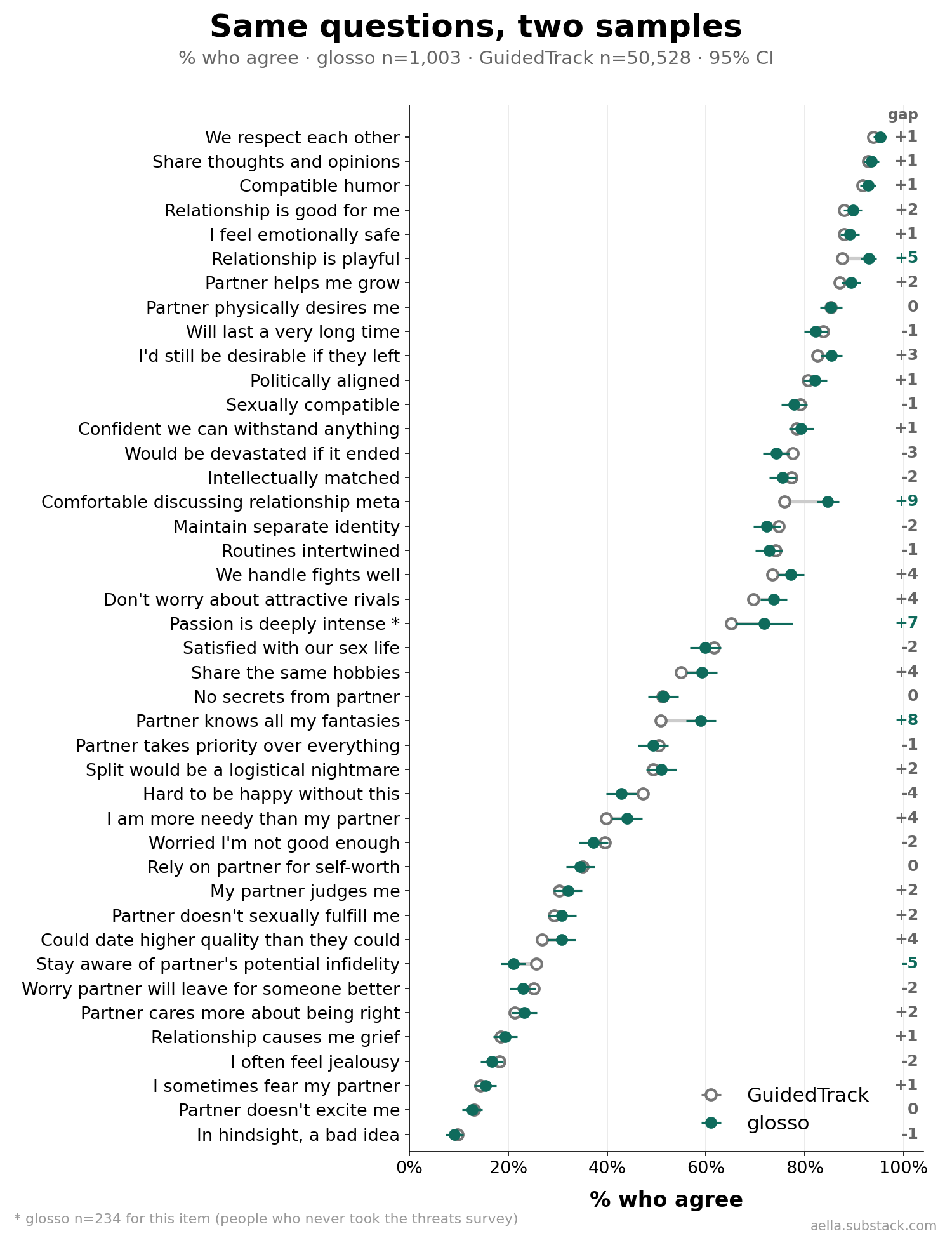
- Glosso people answer the relationship questions almost exactly like the GuidedTrack sample. 38 of the 42 statements are within 5 points.
- But glosso is far more poly. 28% of glosso people who answered a mono/poly question are full poly, vs 3% on GuidedTrack.
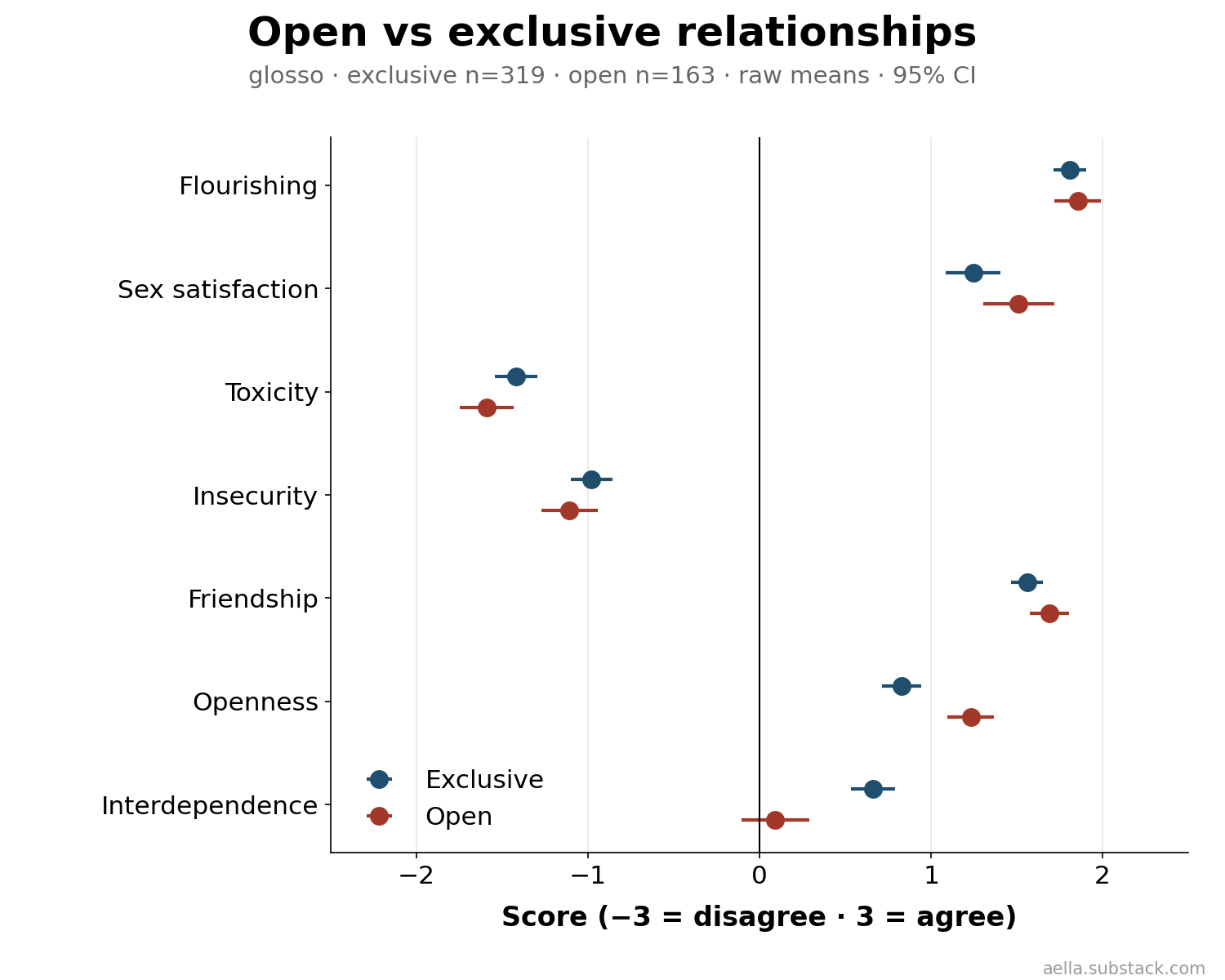
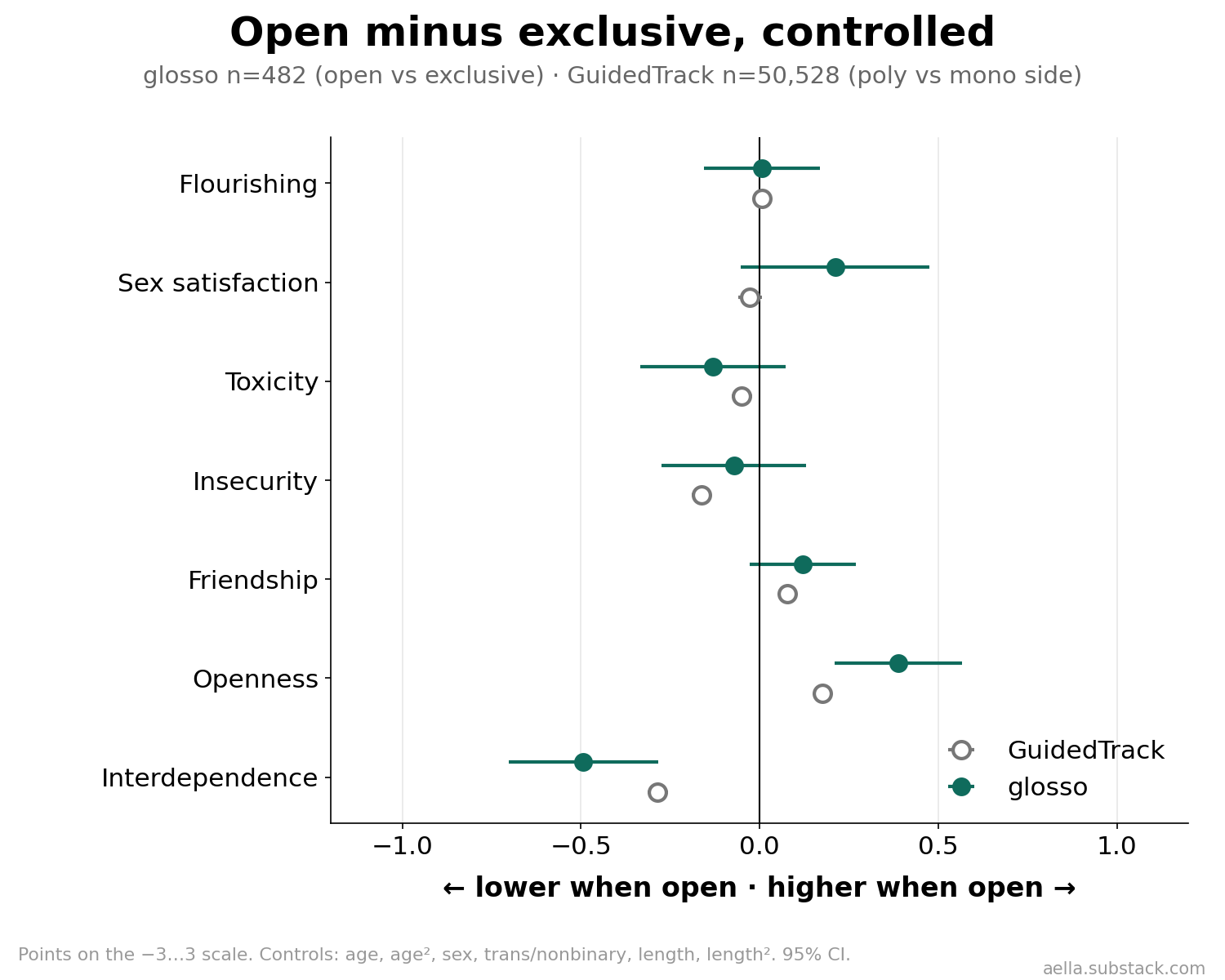
- Open relationships look about as good as exclusive ones. Flourishing is the same in both groups, in both samples.
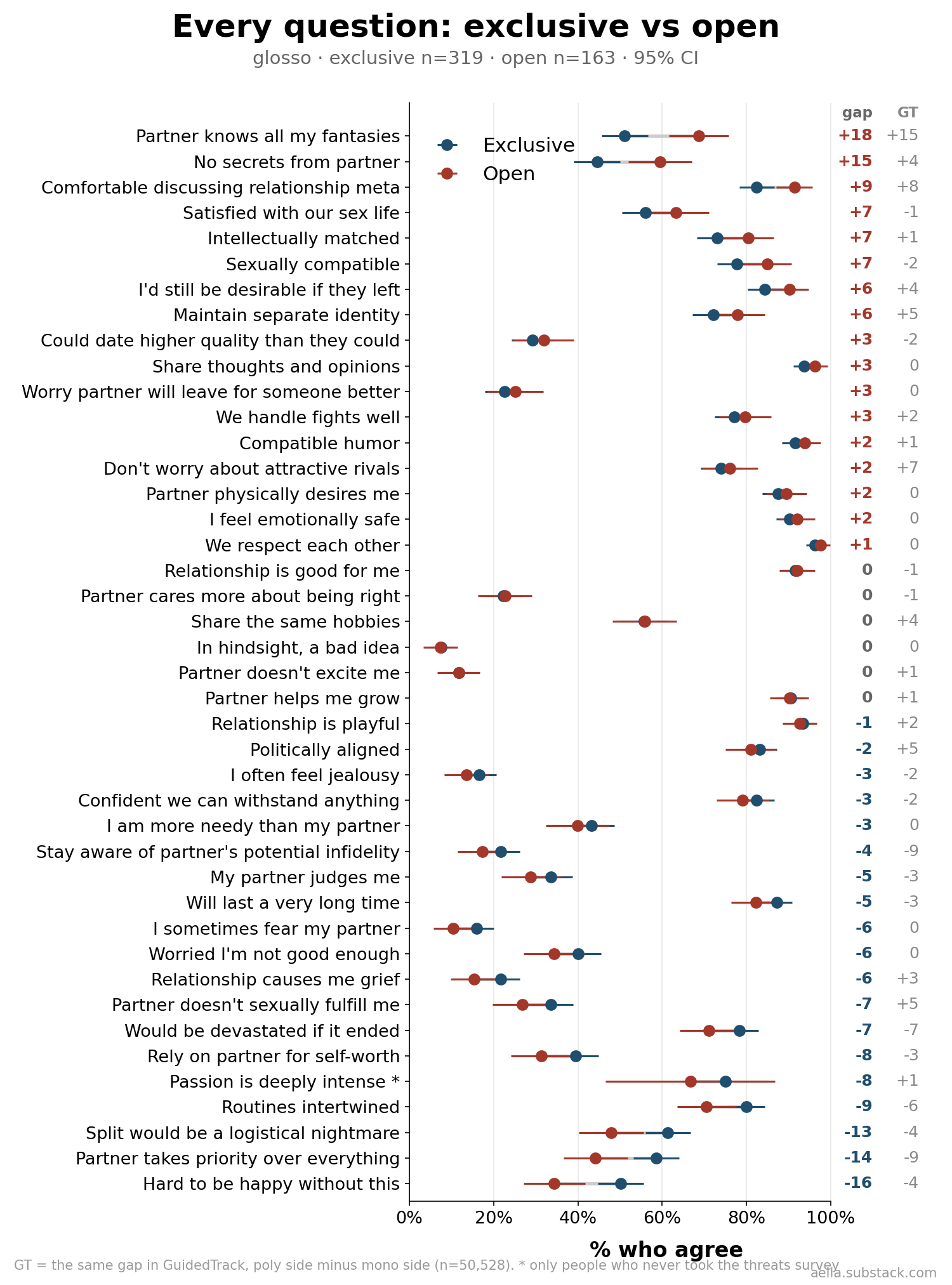
- Two differences from the main report show up here too, and bigger. People in open relationships are more open with their partner and less intertwined with them. 69% say their partner knows all their fantasies, vs 51% of people in exclusive relationships.
- Split by identity, glosso draws almost the same lines as GuidedTrack. Full poly people report the highest flourishing in both.
01Where the data comes from
1,094 people have taken the glosso relationship survey, and 1,003 of them have their answers to the relationship statements saved. Those statements are word-for-word the same as on GuidedTrack: things like "We respect each other" and "I sometimes fear my partner," on a disagree-to-agree scale.
For most people, the survey's own background questions weren't saved, including its mono/poly question. So this page takes mono vs poly from two other glosso questions:
- "Is your sexual relationship currently monogamous/exclusive?" 482 people answered this, which gives the main split: exclusive (319) vs open (163).
- "Are you more monogamous or polyamorous?" (or glosso's shorter version of it). 254 people answered one of these, which gives three groups: mono side (103), leaning poly (79), and full poly (72). The two versions use different scales, so they only line up cleanly at this level. That means I can't separate very mono from slightly mono here.
The two splits agree. Among people who answered both, all 21 full poly people are in open relationships, as are 22 of 36 leaning poly people and 8 of 52 on the mono side.
| glosso | GuidedTrack | |
|---|---|---|
| People | 1,003 | 50,528 |
| Female | 38% | 37% |
| Trans or nonbinary | 16% | 10% |
| Median age | 31 | 29 |
| Median relationship length | 4 years | 4 years |
| Lean poly at all (of those asked) | 59% | 15% |
| Full / very poly (of those asked) | 28% | 3% |
| In an open relationship | 34% | not asked |
02Is it the same crowd?
Before comparing groups, it's worth checking whether glosso people describe their relationships the way GuidedTrack people do. They mostly do.
03Open vs exclusive
The main report groups the statements into seven scores. Here they are for people in exclusive and open relationships.
GuidedTrack doesn't ask whether the relationship is currently exclusive, so the closest match is identity: slightly, mostly, or very poly, vs the three mono options. The next chart puts the two side by side, after controlling for age, sex, being trans or nonbinary, and relationship length.
04By identity
With identity instead of current relationship type, the groups are smaller (254 people), but the comparison with GuidedTrack is closer to apples-to-apples.
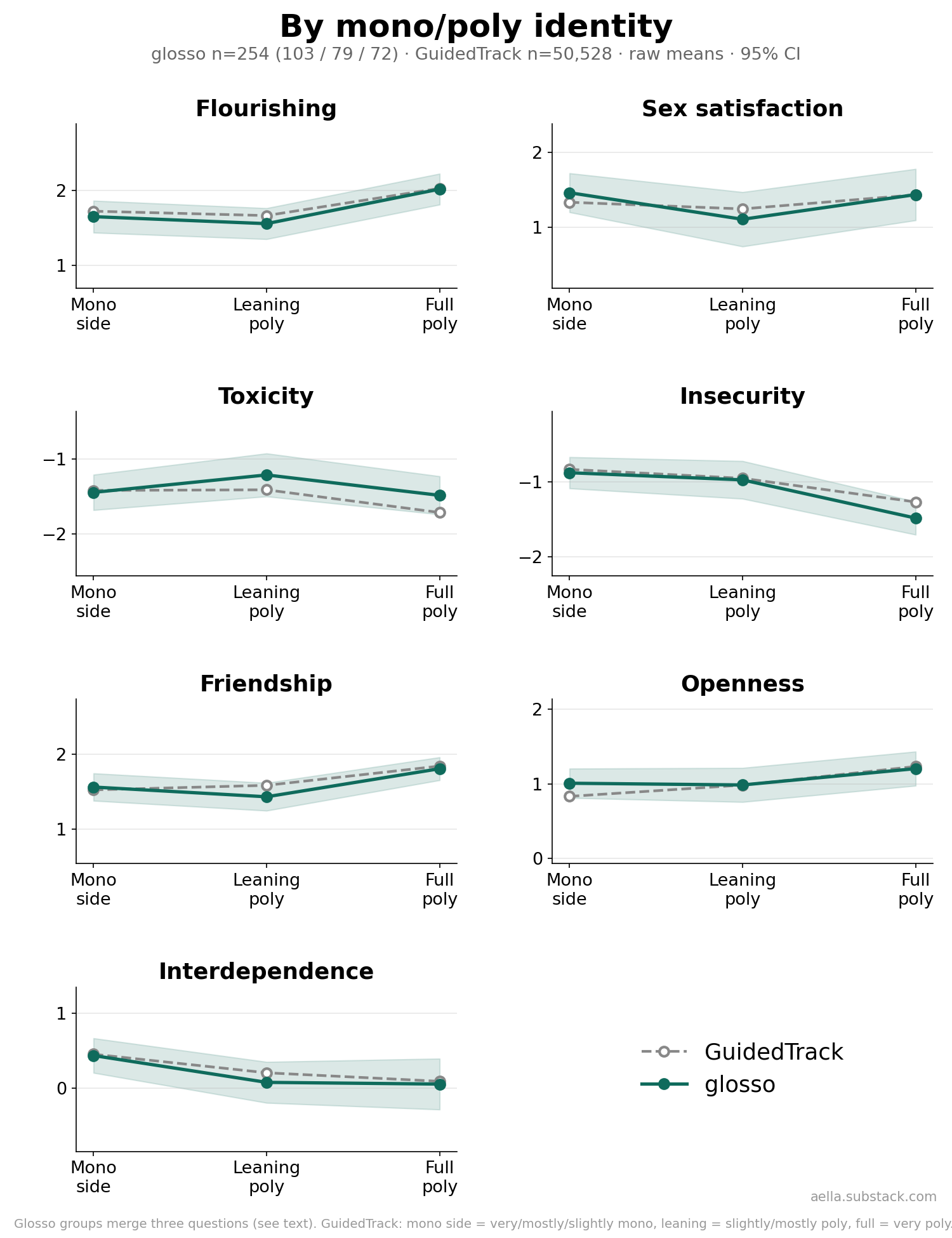
The main report found a dip at "slightly mono," the worst group on almost everything. Glosso can't test that, because its mono side can't be split up. The leaning poly group is a little below the mono side on flourishing in both samples (1.56 vs 1.65 on glosso, 1.67 vs 1.72 on GuidedTrack), so a faint version of the middle-is-worse pattern shows up here too.
05Every question
For every statement, the share who agree in exclusive and open relationships. The grey column on the right is the same gap on GuidedTrack (poly side minus mono side), for a spot-check.
06Sex, fights, and length
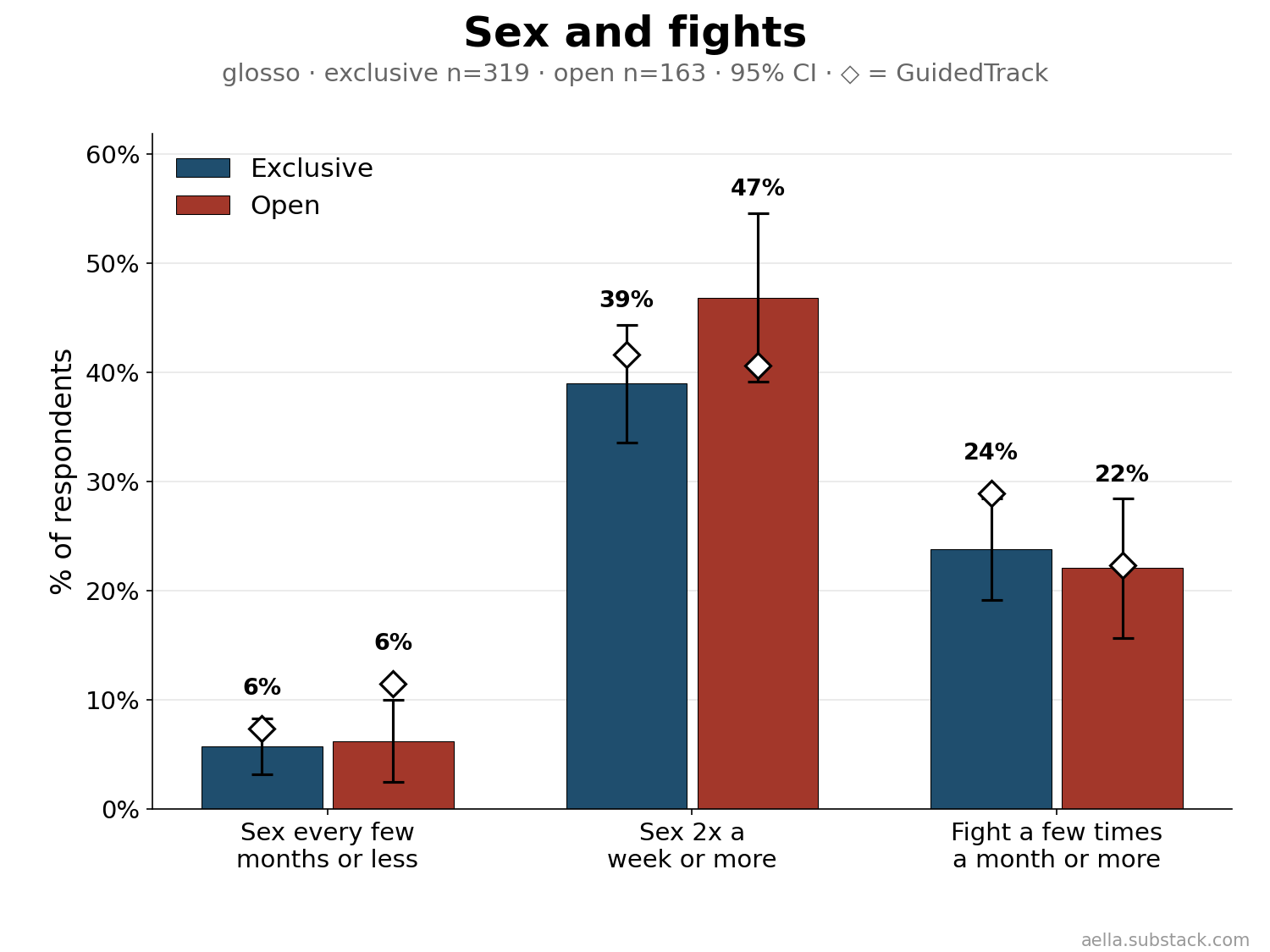
Relationship length: open relationships are shorter. The median is 4 years vs 5 for exclusive, even though the open group is two years older. After adjusting for age and sex, open relationships run about 16 months shorter (95% CI ±13). On GuidedTrack, the same comparison gives 10 months (±2).
07Caveats
- Small groups. 163 people in open relationships and 72 full poly people. Gaps smaller than about 0.2 points on the scores, or 9 points on single statements, are within the noise.
- Mono/poly comes from a different question than the survey itself, sometimes answered at a different time. Someone could have answered "exclusive" about a past relationship.
- Fewer controls than the main report. Marriage, kids, income, religion, and politics weren't saved for most glosso respondents, so the controls here are age, sex, being trans or nonbinary, and relationship length. GuidedTrack comparisons use the same reduced set, so the two are like-for-like.
- "Passion is deeply intense" shares its name with a question in glosso's threats survey and got overwritten for most people. It's only shown for the 234 people who never took that survey, and it's left out of the sex satisfaction score in both samples.
- Who's on glosso. More male (62%) and more trans or nonbinary (16%) than GuidedTrack, and much more poly. Nothing is weighted.
- Snapshot, not cause. Same as the main report: this can't tell whether being open changes a relationship or whether certain relationships open up.