The Rat SpectrumWhat else changes as glosso users score more rationalist? Beliefs, morals, consent, mood, sex, and how other people see them.
The last report found that glosso users who score higher on the "How Rationalist Are You?" quiz are more okay with their partner being with other people. This one starts from the same quiz and sweeps everything else glosso has: the drip questions, every test, the kink quiz, the marriage quiz, rankland ratings, achievements, how people use the site and who they're friends with. 2,750 people have a rationalist score. I kept only questions that at least 300 of them answered. Every comparison is adjusted for sex and age, and for how close each person is to me in glosso's friend graph and whether they live in the Bay Area. Glosso is my site, and the people closest to me skew rationalist, so without that some results would just mean "people near Aella" (section 14).
Glosso users in each tier of the rationalist quiz (N = 2,750). Most charts below merge these into three groups: Normie or less (1,247), Toe-in Rat / Lightrat (841) and True Rat or more (662).
Short version
- Higher scorers are more male, richer, more educated and far more Bay Area. The share who live in the Bay goes from 8% at the bottom tier to 57% at Highrat and above.
- They believe in fewer spooky things. 22% of Normies-or-less think some people can talk to ghosts, against 7% of True Rats-or-more. 61% vs 10% think an assassination attempt on Trump was faked. But 88% of the top group think AI might destroy the world, and 86% want to live forever.
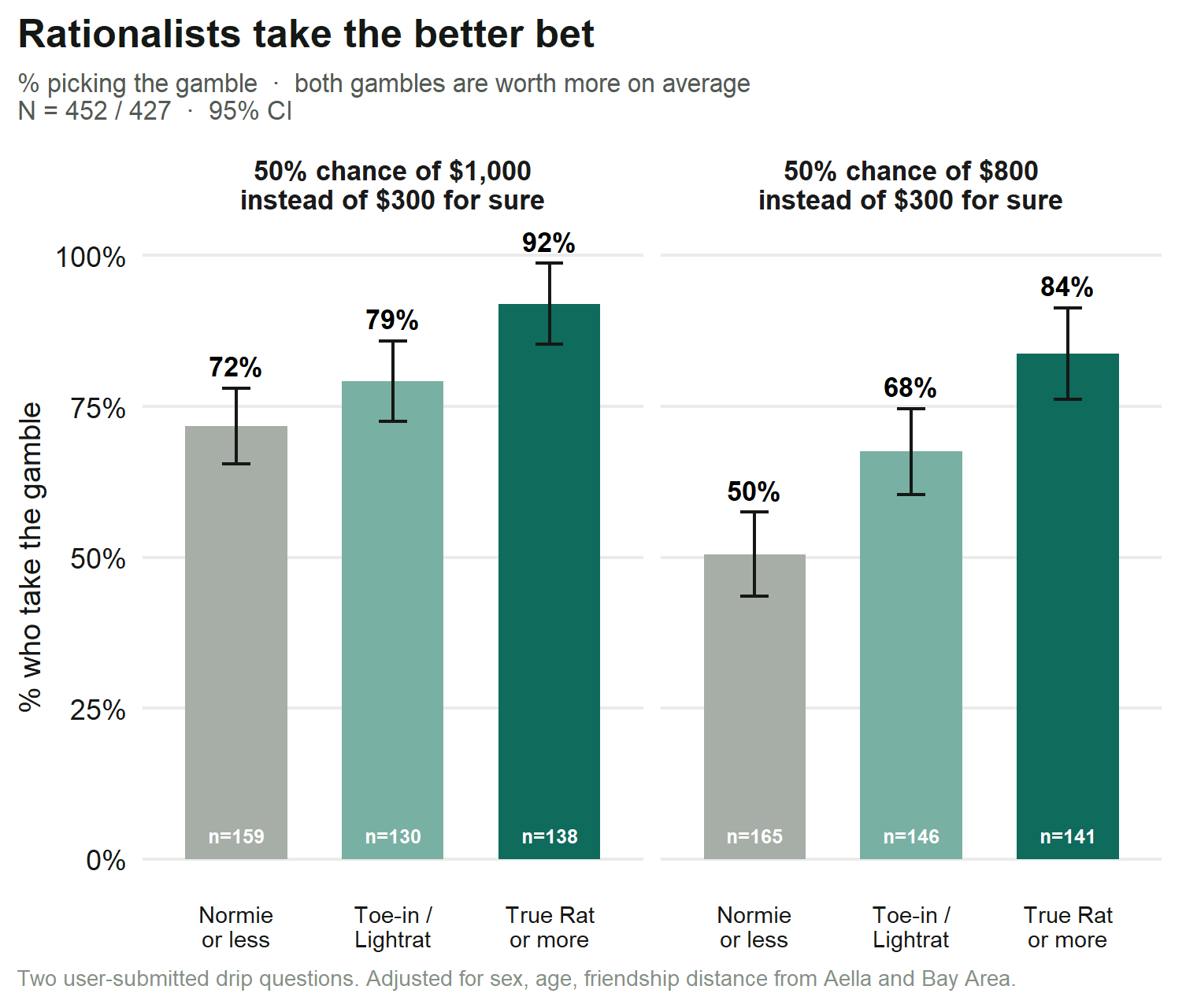
- They take the better bet. Offered a 50% chance of $800 or $300 for sure, 50% of the bottom group gamble, against 84% of the top.
- They score higher on glosso's matrix puzzles. On an IQ-style scale where 100 is the average glosso puzzle-taker, True Rats-or-more average 107 and Normies-or-less 95 (correlation 0.38, 216 people who did 5+ puzzles).
- They hold fewer moral absolutes, but say they're more honest. Fewer think some acts are wrong whatever the consequences (77% → 49%). Far fewer would steal a large sum if they'd never get caught (54% → 29%).
- They draw the rape line further out in grey areas. On the consent test's slider, the biggest gaps are a 26-year-old with an enthusiastic 16-year-old (57 vs 25 out of 100) and a guilt-tripping partner (58 vs 37). Clear-cut scenarios and the deception scenarios show no gap.
- They report much less misery. 72% of the bottom group say they tend to suffer from anxiety, against 49% of the top. This holds after controlling for class and education.
- They find most things in the kink quiz less erotic. Of 132 kink items with a clear difference, 126 go down. The 6 that go up are mostly dark-scenario fantasies like wartime raids and slave auctions. Rape play and CNC don't differ.
- They want unusual families. 50% of True Rats-or-more want to homeschool their kids, against 26% of Normies-or-less. Far fewer want to split housework strictly equally (57% → 30%). More give or plan to give 10% of their income to charity (19% → 44%).
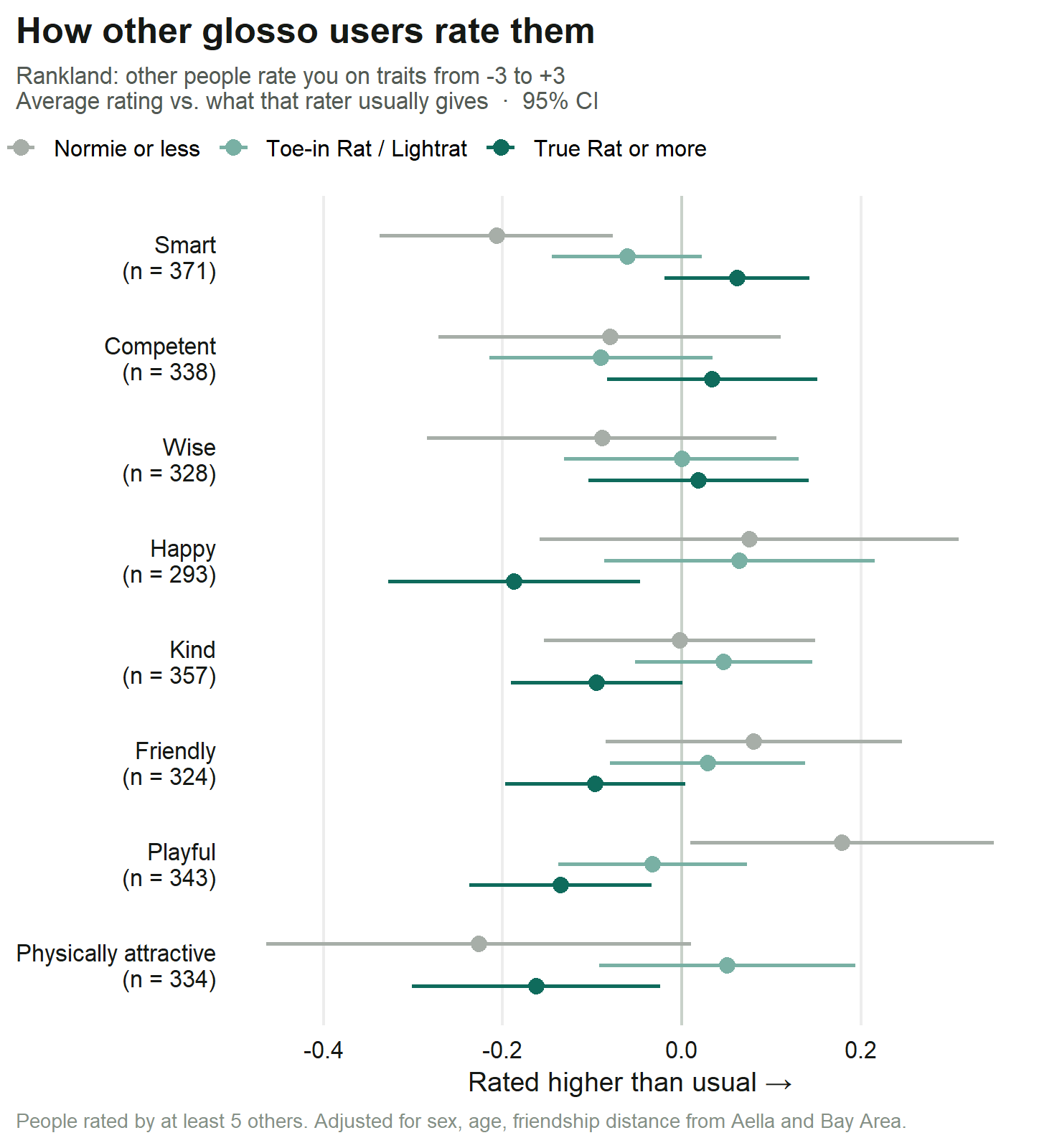
- Other users rate them as smarter and less playful. Rating themselves, they say they're more arrogant and less compassionate. They aren't more active on glosso.
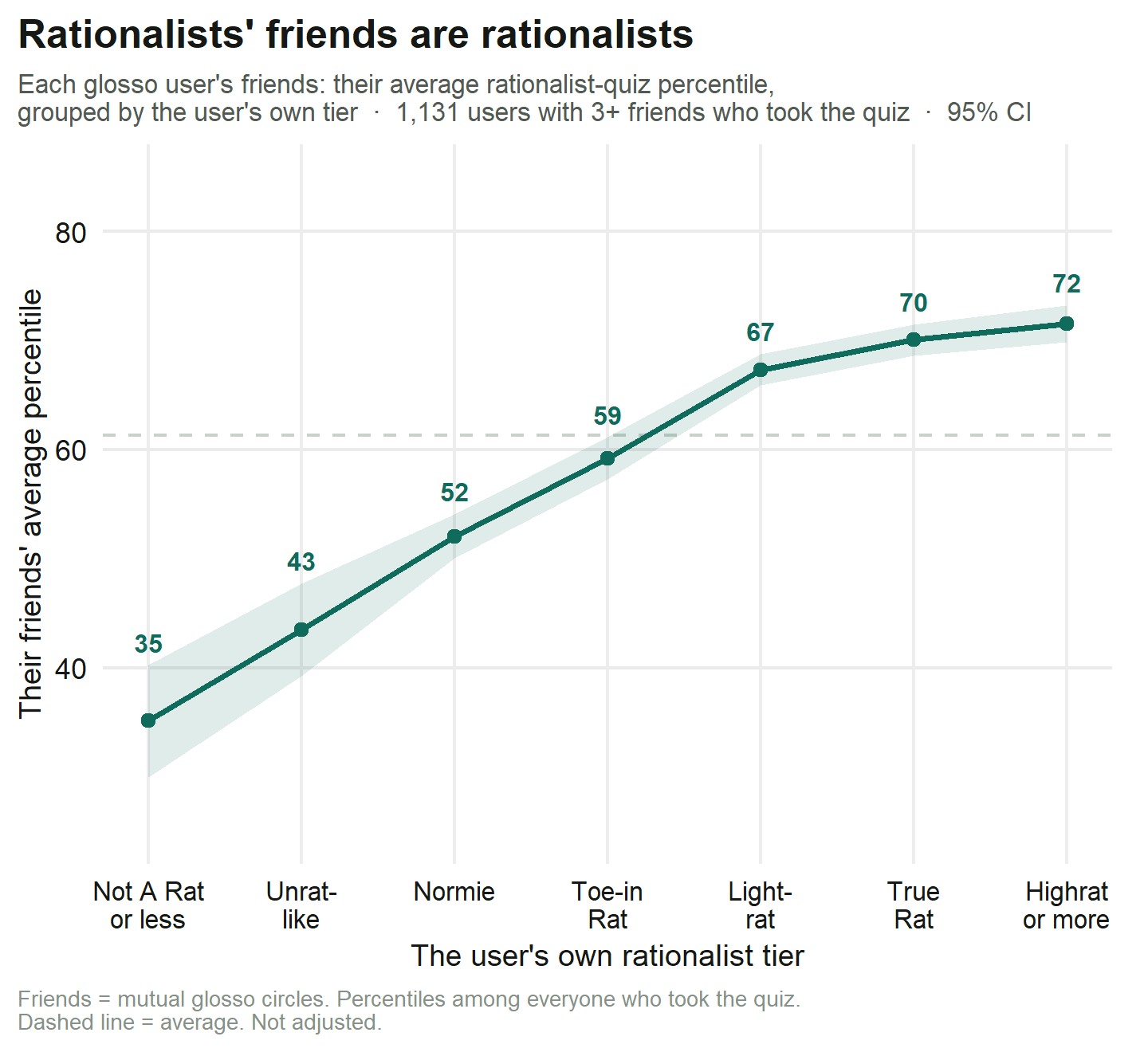
- Rationalists' friends are rationalists. Across 12,798 glosso friendships, the two friends' quiz scores correlate 0.22.
- Almost nothing peaks in the middle. Only 9 of 8,747 items bend that way. Exercise is one: the middle tiers work out the most.
- This isn't just the quiz grading itself. The quiz includes a few opinion questions, so I also scored everyone on only how much they like LessWrong, ACX and five similar outlets. 388 of the 438 differences in the full list still hold.
- I adjust for my own circle. People close to me on glosso skew rationalist and into noncon, so every comparison here controls for friendship distance from me and Bay Area (section 14).
01Who scores high
The rationalist quiz scores agreement with a set of rationalist-culture markers (liking LessWrong and Astral Codex Ten, knowing what "epistemology" means, thinking price gouging during shortages is good) and sorts people into eleven named tiers. The thin ends are merged here.
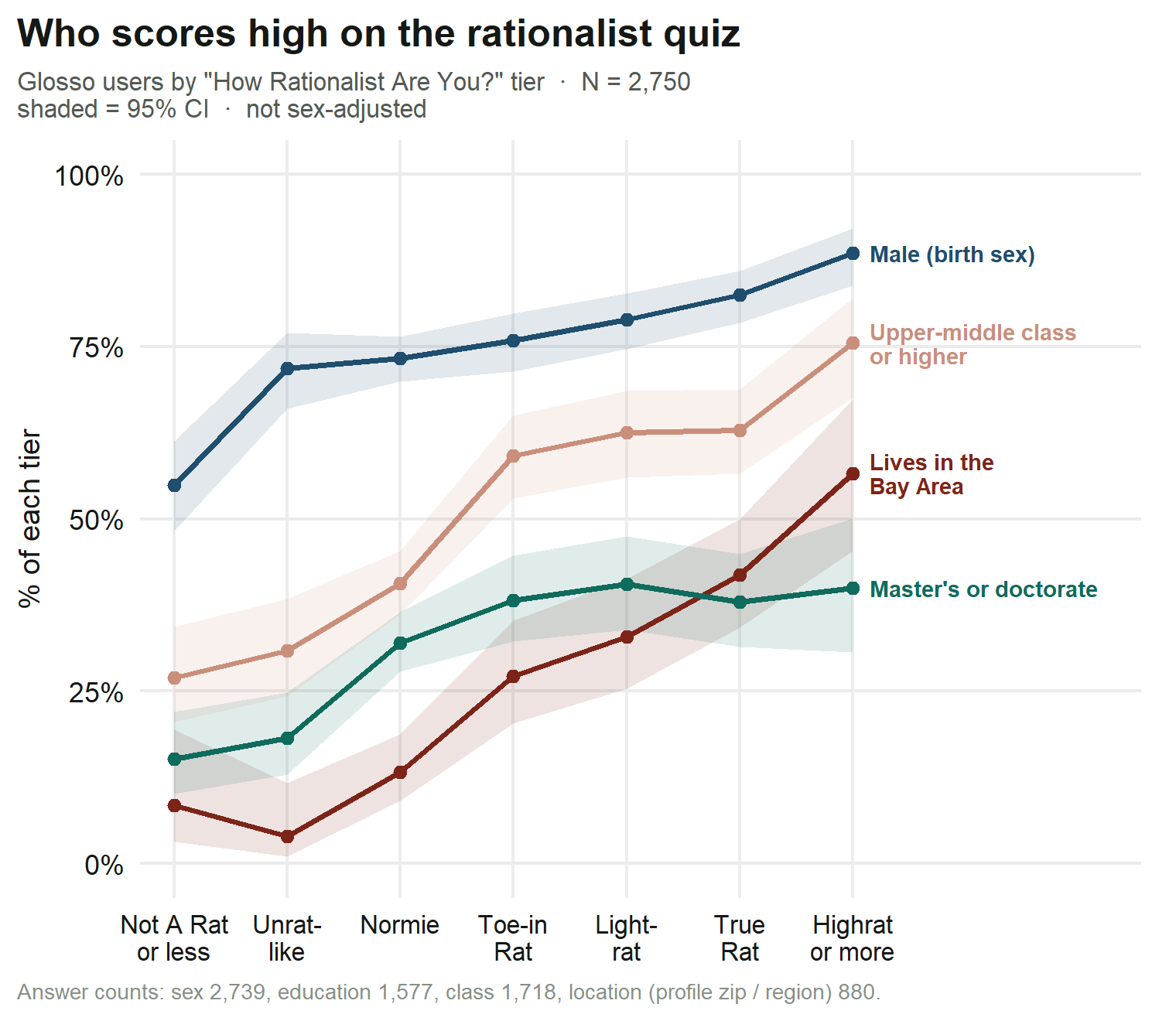
Politically, higher scorers lean economically right (18% of Normies-or-less are right of centre on economics, against 59% of True Rats-or-more) but are just as socially liberal as everyone else (84–87% left of centre in all three groups). They also weigh a little less for their sex and age (r = −0.10, n = 2,250).
This section describes who is in each tier, unadjusted. From here on, every chart compares groups after adjusting for sex, age, friendship distance from me and Bay Area, and every correlation is adjusted for the same things.
02What they believe
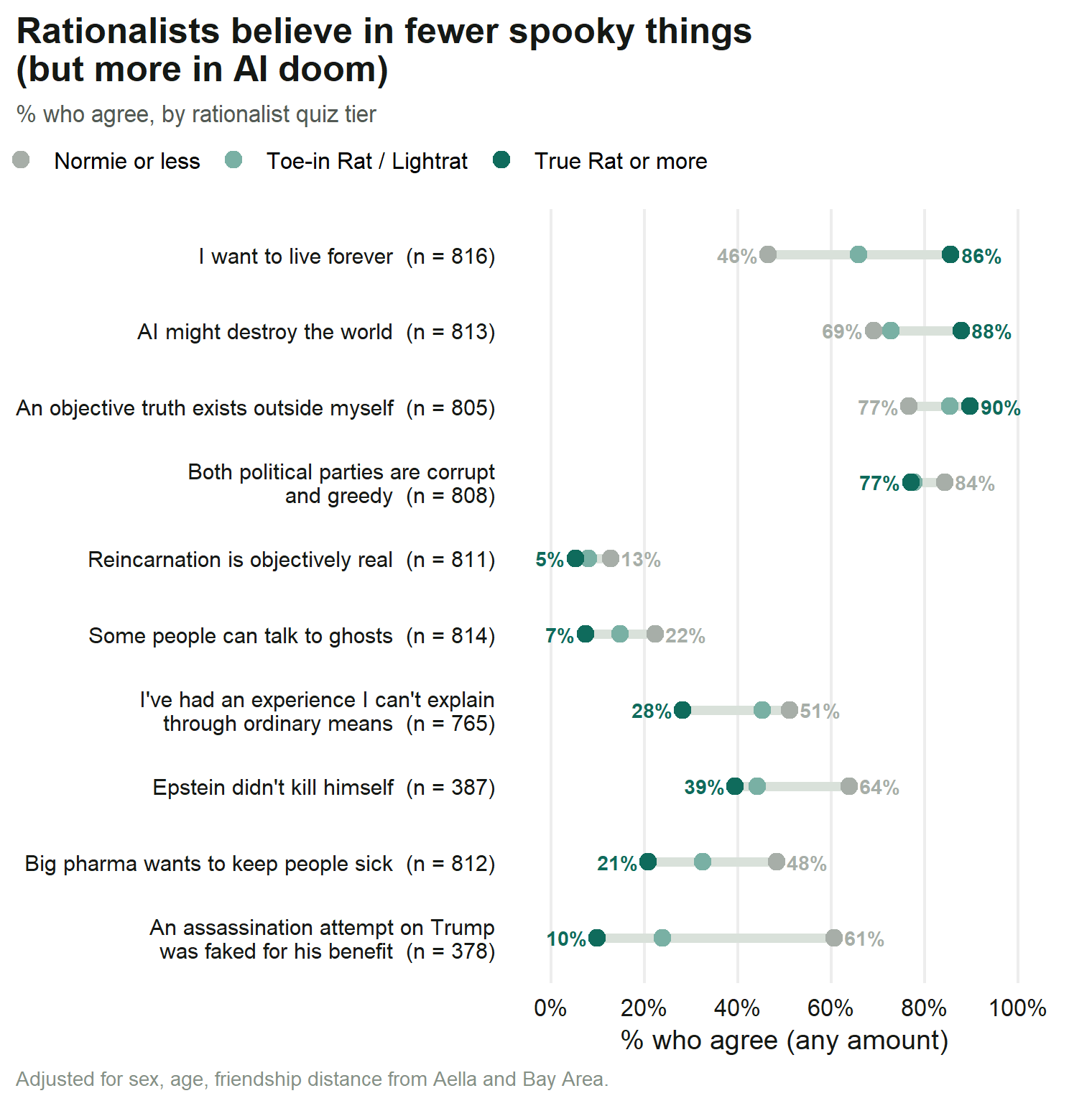
The pattern is skepticism toward the supernatural and toward conspiracy theories, plus more confidence that there is an objective truth. It flips for two things the community is known for: AI risk and life extension. About nine in ten of the top group think AI might destroy the world, and wanting to live forever goes from 46% to 86%.
03How they think: self-reports, a bet, and a puzzle test
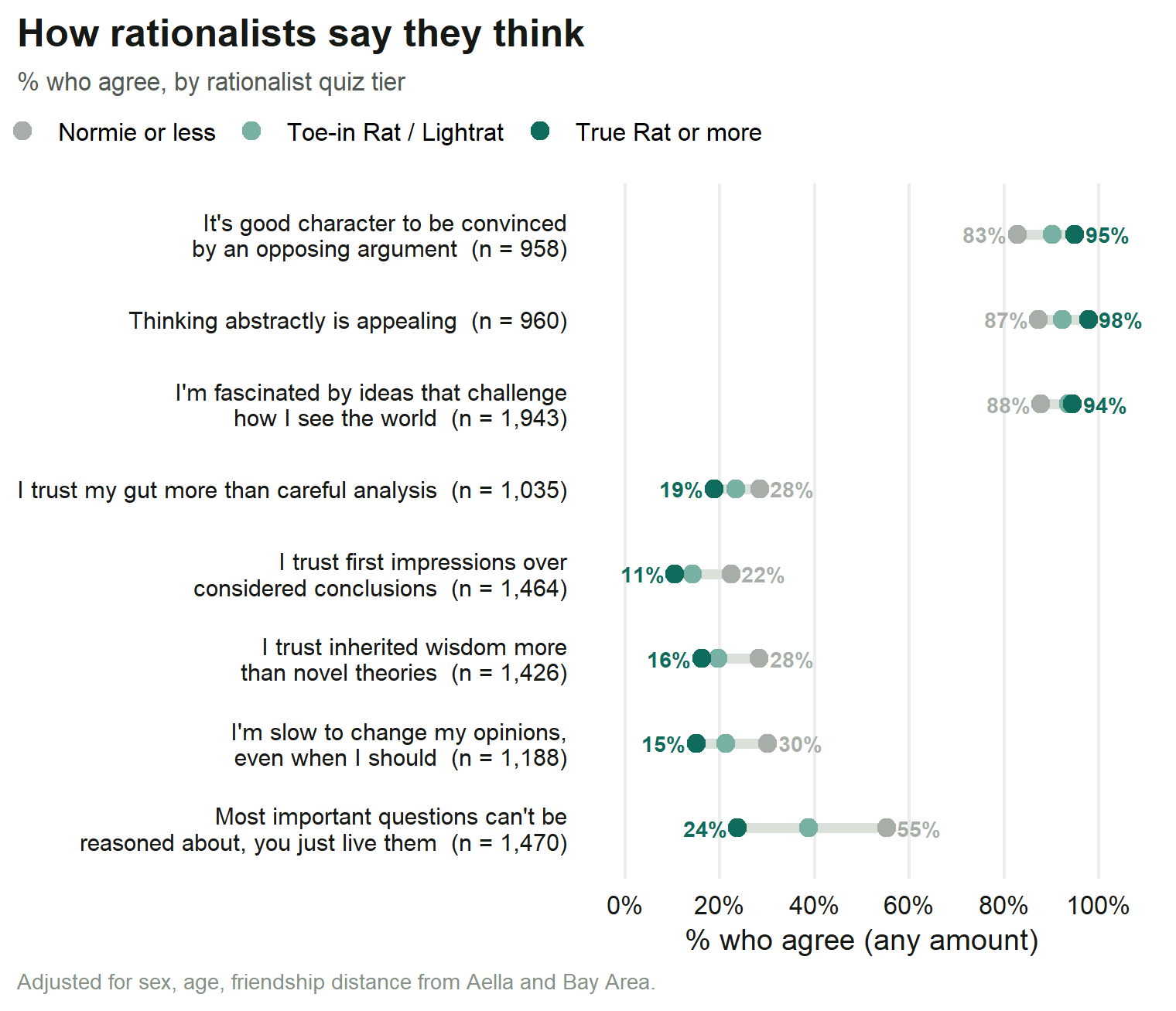
These are self-descriptions, and they line up with how the community describes itself, so they're partly identity. Two user-submitted drip questions get closer to an actual decision:
The puzzle test
Glosso drips Raven's matrices puzzles (Set II of the Advanced Progressive Matrices) into the feed, a few at a time. 1,836 people have answered at least one. Scoring them like an IQ test, with harder puzzles counting for more, gives an IQ-style number where 100 is the average glosso puzzle-taker. That's not 100 for the general population; glosso users are likely well above that. 216 people with a rationalist score have done at least five puzzles (median 13).
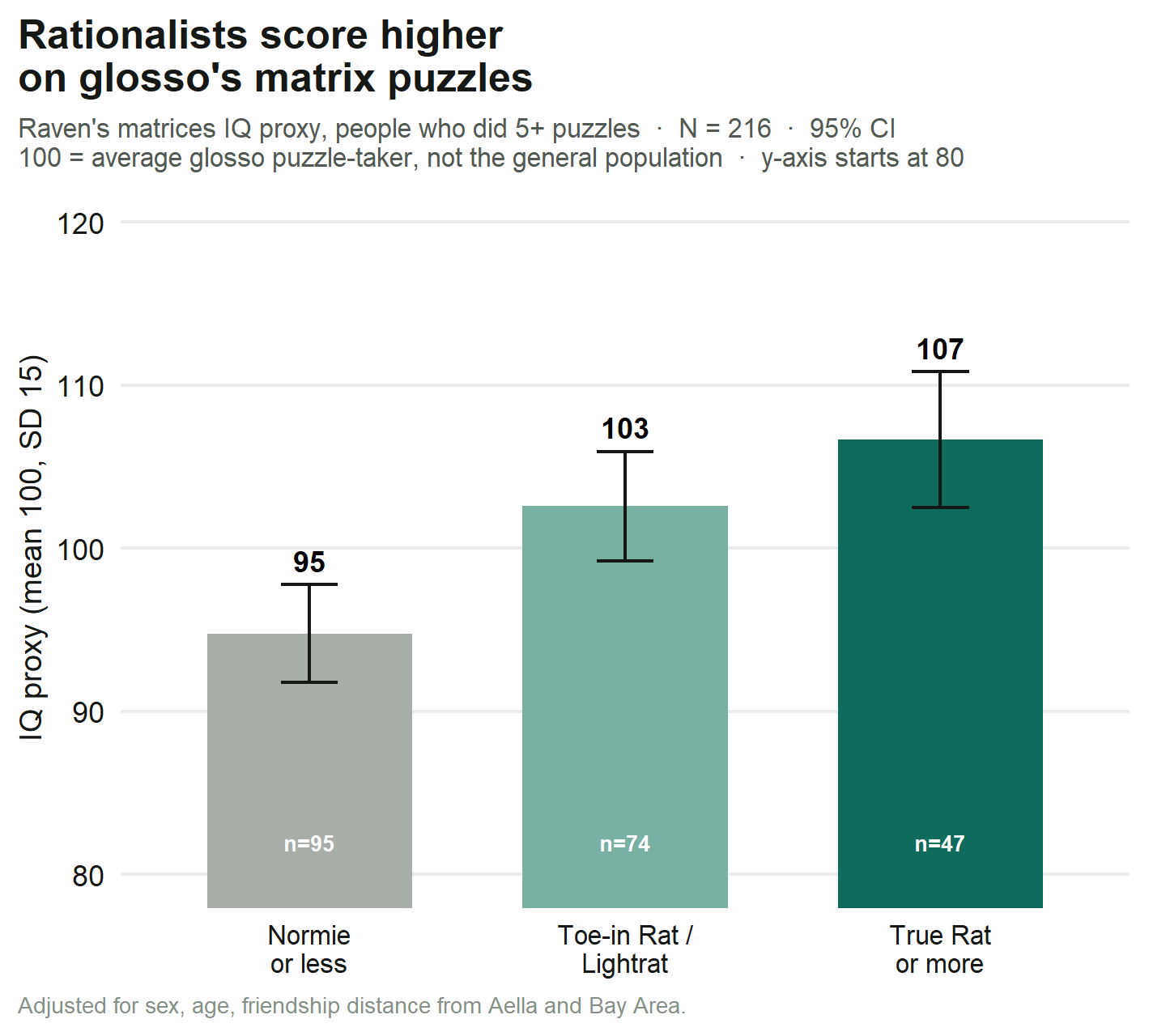
True Rats-or-more average 107 against 95 for Normies-or-less. As a correlation, rationalist score and puzzle score go together at 0.38, one of the larger effects in this report. It's 0.29 on the fandom-only score. It gets stronger as people do more puzzles (0.23 counting everyone who did at least one, 0.38 at five or more, 0.41 at ten or more), which is what you'd expect if the puzzle score is noisy rather than the link being a fluke. It's stronger among men (0.42) than women (0.23, only 53 women).
04Morals
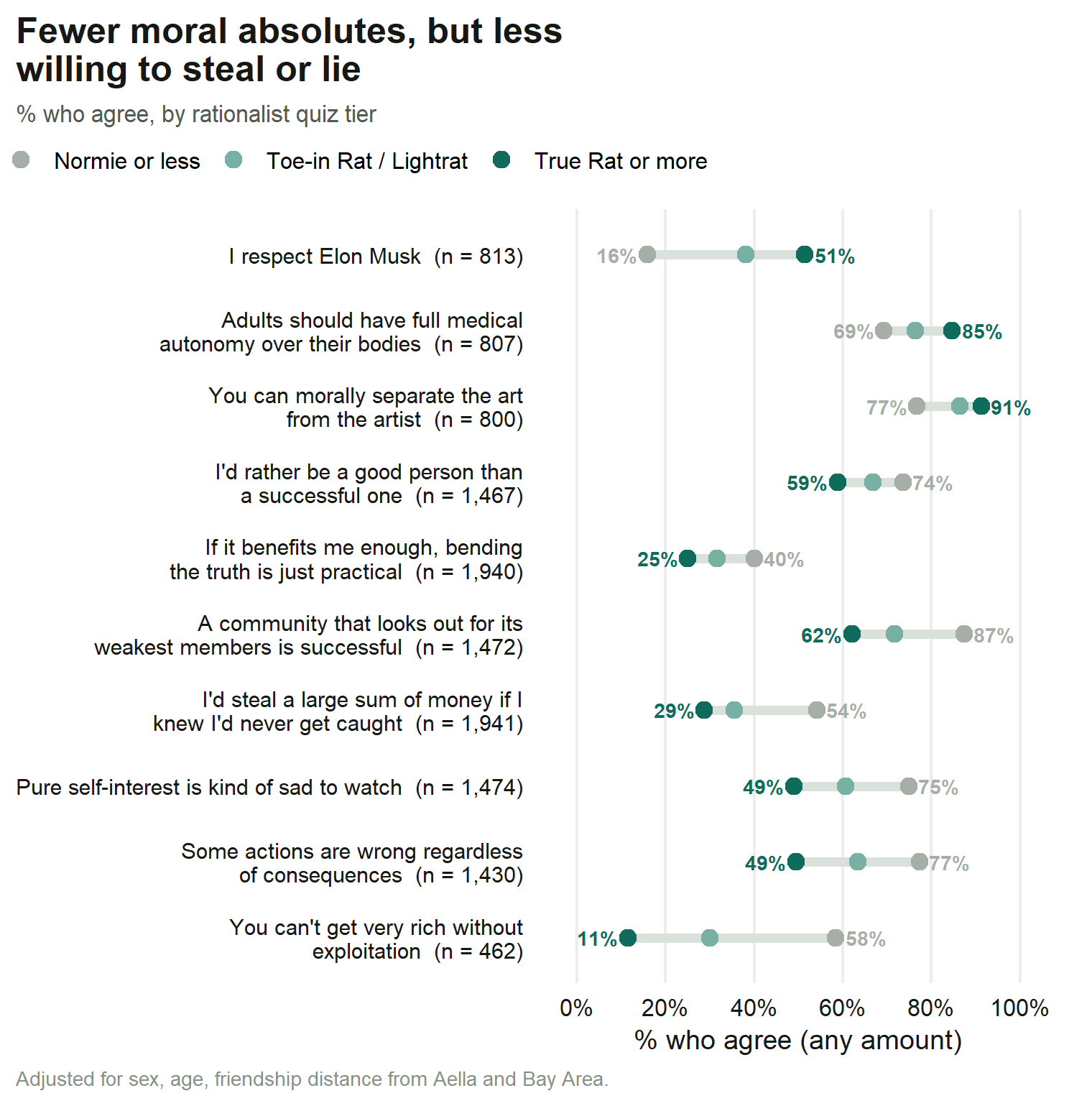
Higher scorers are less deontological ("some actions are wrong regardless of consequences": 77% → 49%), less communitarian, and much more likely to respect Elon Musk (16% → 51%). They are also much less likely to say they'd steal or lie for their own benefit: 54% of Normies-or-less would steal a large sum of money if they knew they'd never get caught, against 29% of True Rats-or-more.
05Consent
Glosso's consent test gives 19 short scenarios and asks people to rate each on a slider from "not rape" (0) to "rape" (100). 1,515 people with a rationalist score took it.
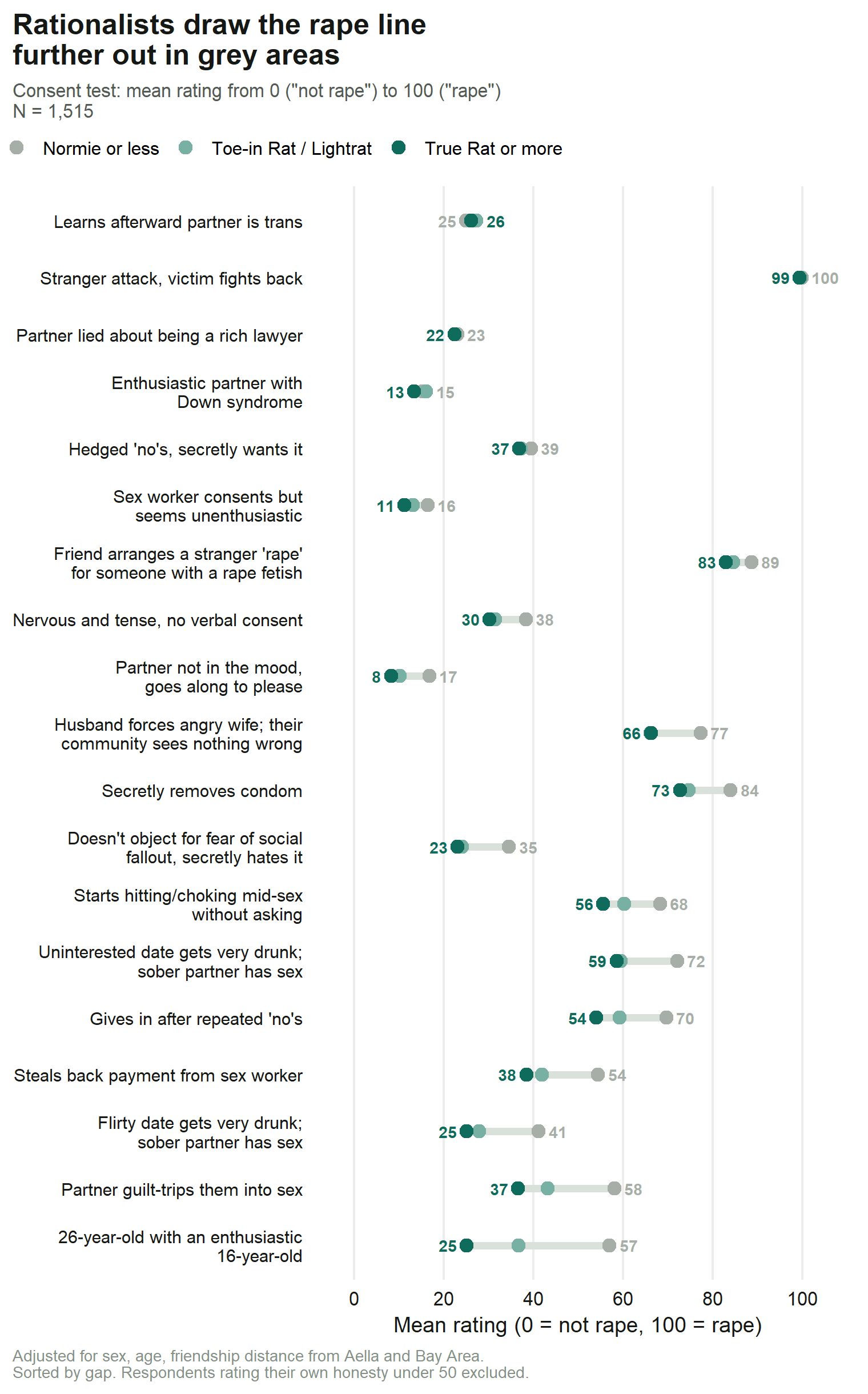
The gaps are in scenarios involving pressure, intoxication and age. A 26-year-old having sex with a 16-year-old who is enthusiastic and often initiates averages 57 in the bottom group and 25 in the top. A partner who guilt-trips the other into sex goes from 58 to 37. A flirty date who gets very drunk and has sex with a sober partner goes from 41 to 25.
One of the quiz's own items is "Consent is overrated by mainstream American culture", so some of this is built in. On the fandom-only score these correlations shrink by about 33% but stay large (section 13). A user-submitted drip question points the same way: 9% of Normies-or-less agree that "rape isn't as big a deal as it's often made out to be," against 22% of True Rats-or-more (n = 307, not sex-weighted).
06Wellbeing and self-regard
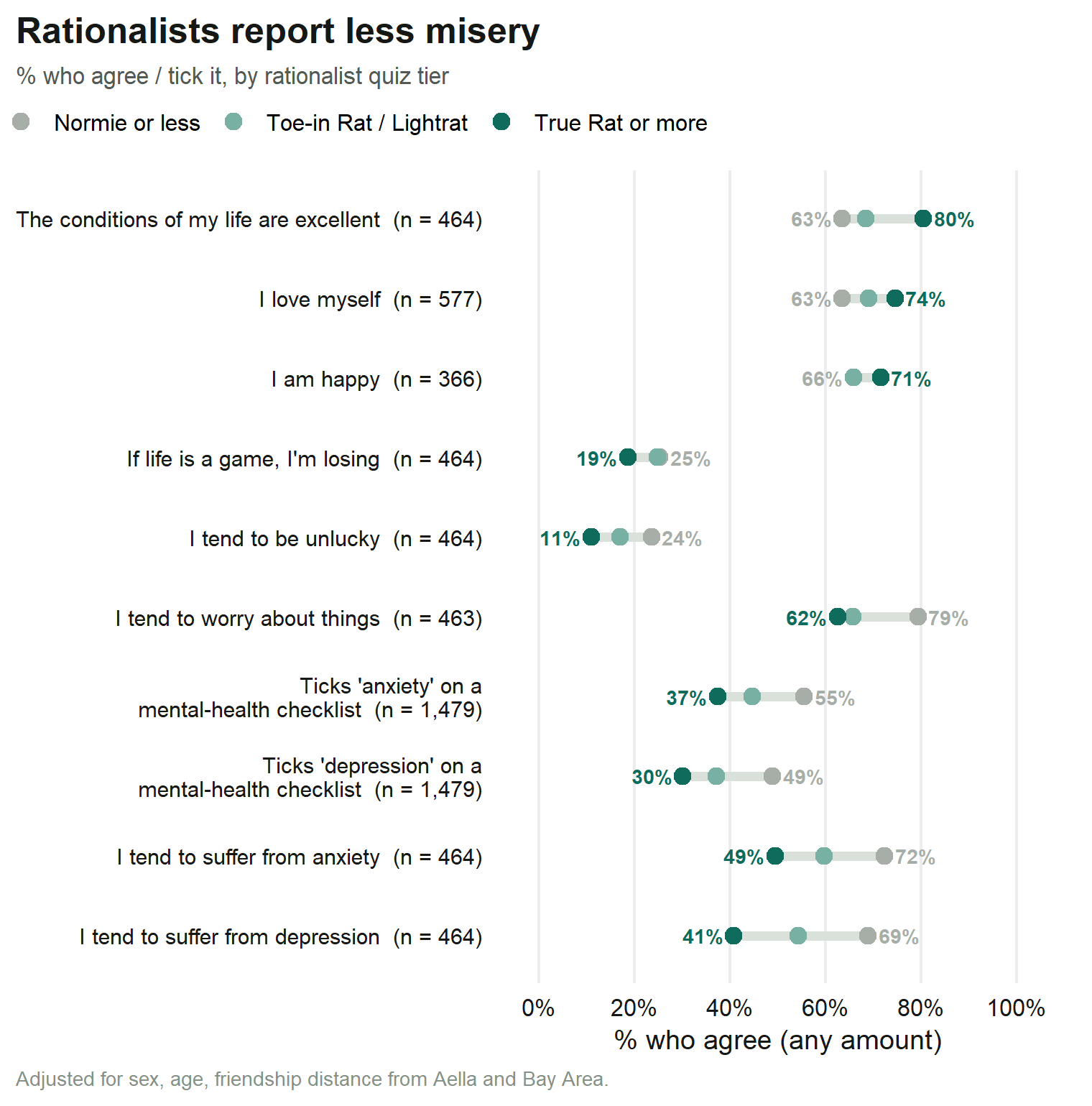
Higher scorers say they're less anxious, less depressed and less worried, and more likely to love themselves and call their lives excellent. Since they're also richer and more educated, I checked whether class and education explain it. They explain a little: the anxiety and depression effects shrink by 8–20% and remain clearly significant.
The self-regard extends to looks. Glosso asks people to compare their face and body to sets of reference photos. Men in higher tiers more often say they're more attractive than the photos: correlations of +0.12 to +0.16 across the five men's sets with the most answers, adjusted for sex, age and closeness to me. The women's sets have fewer answers and show no clear pattern (2 of 6 point the same way; 0 reach significance).
Two tensions. On rankland (section 09), other users rate True Rats-or-more as slightly less happy than average. This is weak: across the whole range the correlation is −0.13 (n = 302), which doesn't survive the correction for testing thousands of things (q = 0.09). The peer ratings aren't noise. In the 266 people who have both, other people's "happy" ratings correlate 0.43 with how happy they rate themselves. So it may be that higher scorers come across as less cheerful rather than being less happy: they rate themselves as more stoic (0.18), and others rate them as less playful (−0.17). And other users don't rate higher scorers as any more physically attractive once groups are adjusted (r = −0.07, n = 346).
07Sex
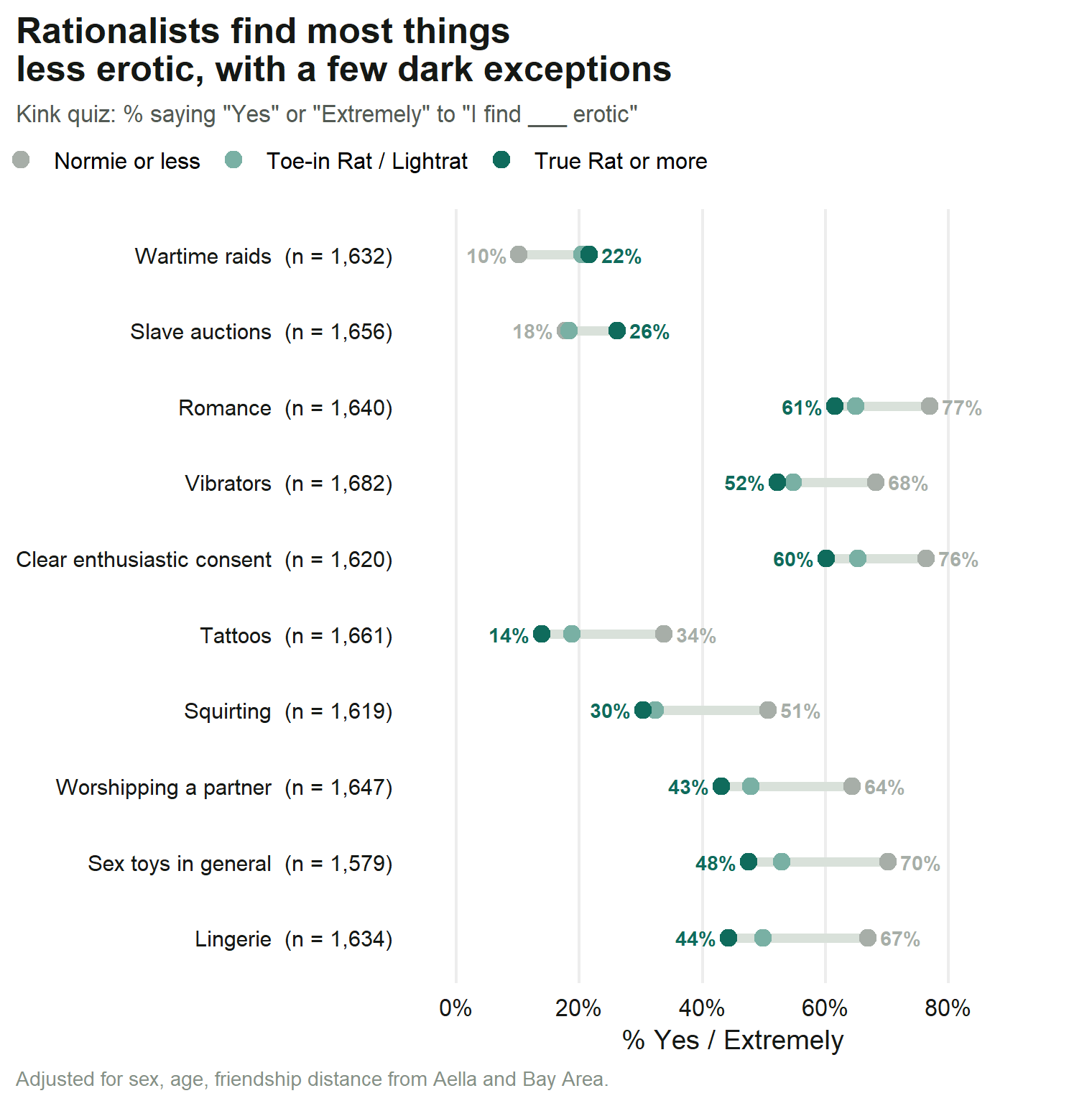
Across 519 kink-quiz items, 79% lean lower among higher scorers. Of the 132 items with a clear difference, 126 are lower. The pattern runs through toys, clothing, body modification, romance and worship, and through the BDSM test: higher scorers are less into affectionate, service-oriented dom styles ("Dom worships sub", "Dom makes sub feel safe"). In the relationship-desires test they're less likely to call passion a must-have.
The 6 items that go up are wartime raids, Nazis, sex trafficking, slave auctions, sexual slavery and smegma (natural buildup under the foreskin). Wartime raids goes from 10% to 22% saying "Yes" or "Extremely", and slave auctions from 18% to 26%. Minor attraction is slightly higher but below this report's bar (r = 0.07). Part of the general drop could be answer style: if higher scorers just pick "Extremely" less often, everything moves down together. That can't explain the items that move up.
Not all "noncon" is the same. The dark-scenario fantasies (wartime raids, slave auctions, sex trafficking, sexual slavery) go up with rationalist score (wartime raids: 0.17). Classic consensual non-consent doesn't: rape play (0.02) and the BDSM test's noncon score (0.05) barely differ. Rape play and CNC are concentrated among people close to me, which is one of the reasons for the adjustment (section 14).
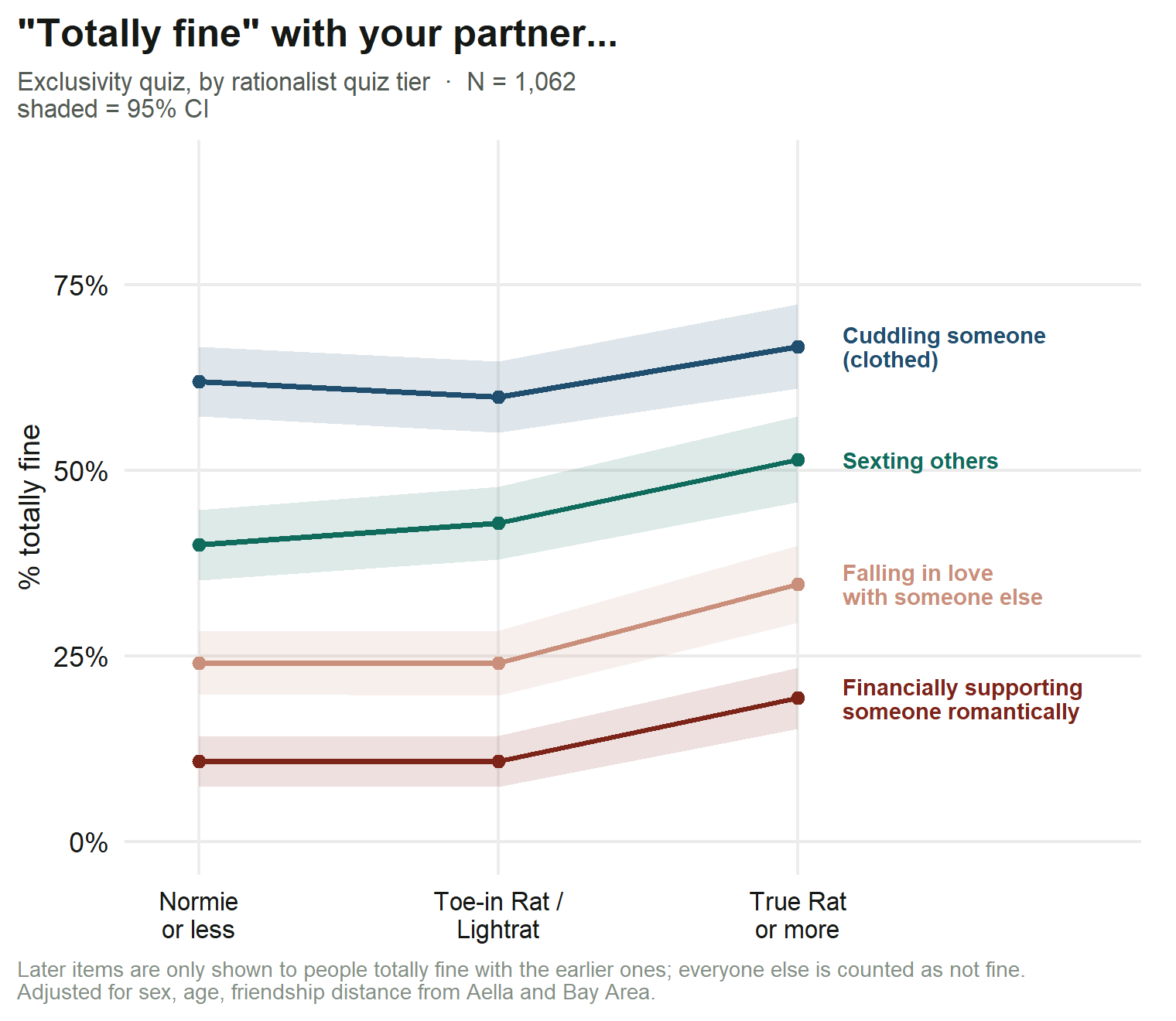
The last report found rationalists more open to non-monogamy. Here, with closeness to me controlled, the difference is small: 44% of Normies-or-less call themselves at least slightly polyamorous, against 52% of True Rats-or-more (r = 0.11), and exclusivity-quiz openness is 0.07. Neither clears this report's bar. Much of the poly difference tracks closeness to me (section 14).
08Marriage and family
Glosso's marriage quiz asks 1,225 of these people about what they want in a marriage, how much each thing matters in a partner, and which of a partner's answers they'd accept.
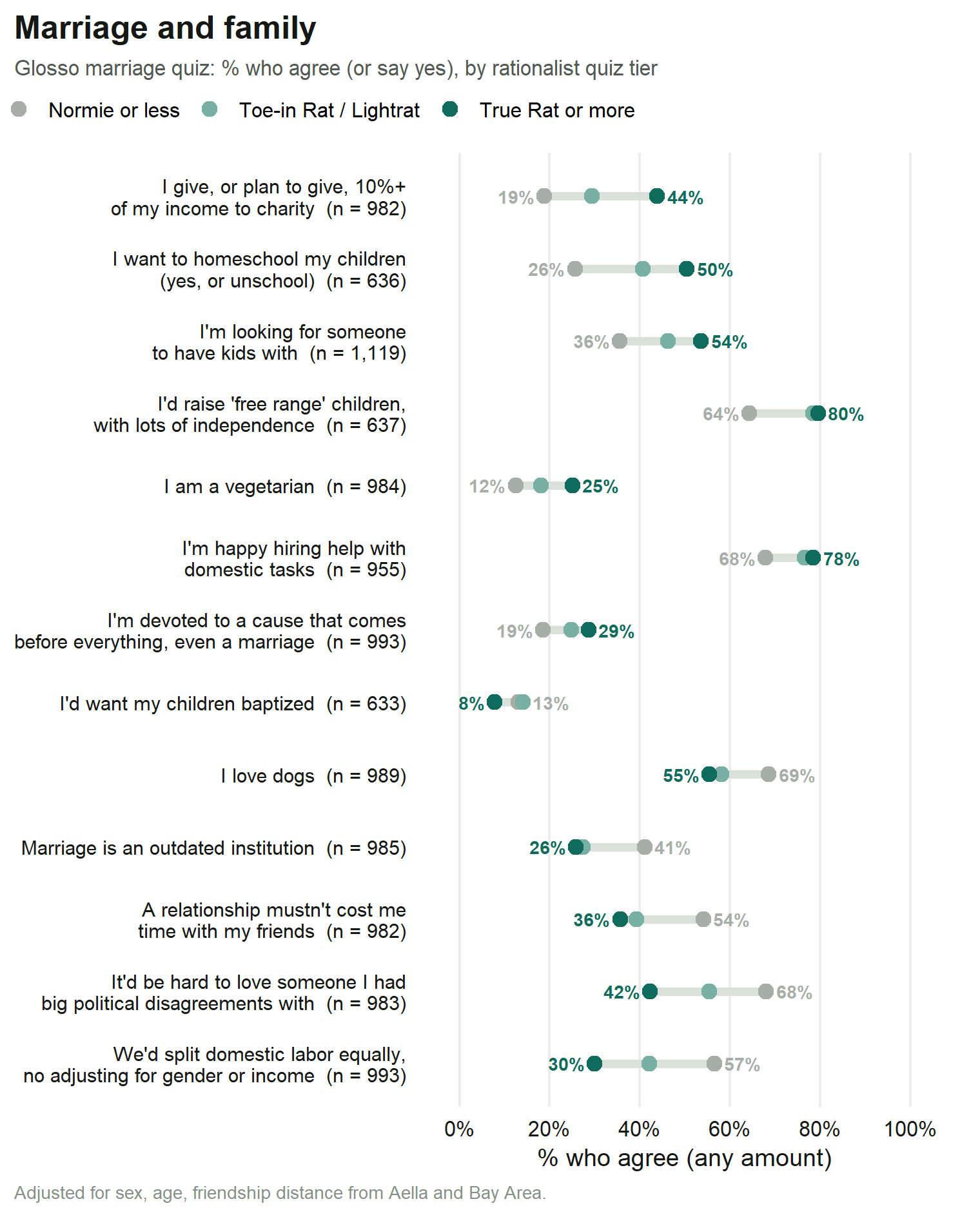
Higher scorers want more unconventional families: homeschooling goes from 26% to 50%, and "free range" parenting from 64% to 80%. They are more likely to be looking for someone to have kids with (36% → 54%). The effective-altruism signature shows up clearly: giving 10% of income to charity goes from 19% to 44%, and vegetarianism from 12% to 25%.
They are less wedded to equality as a rule at home: only 30% of True Rats-or-more want domestic labour split equally with no adjusting for gender or income, against 57% of Normies-or-less. They also care less about matching a partner's politics (68% → 42% say big political disagreements would make it hard to fall in love). Across the whole quiz they accept a wider range of a partner's answers (r = 0.18), so on paper they are less picky.
09On glosso
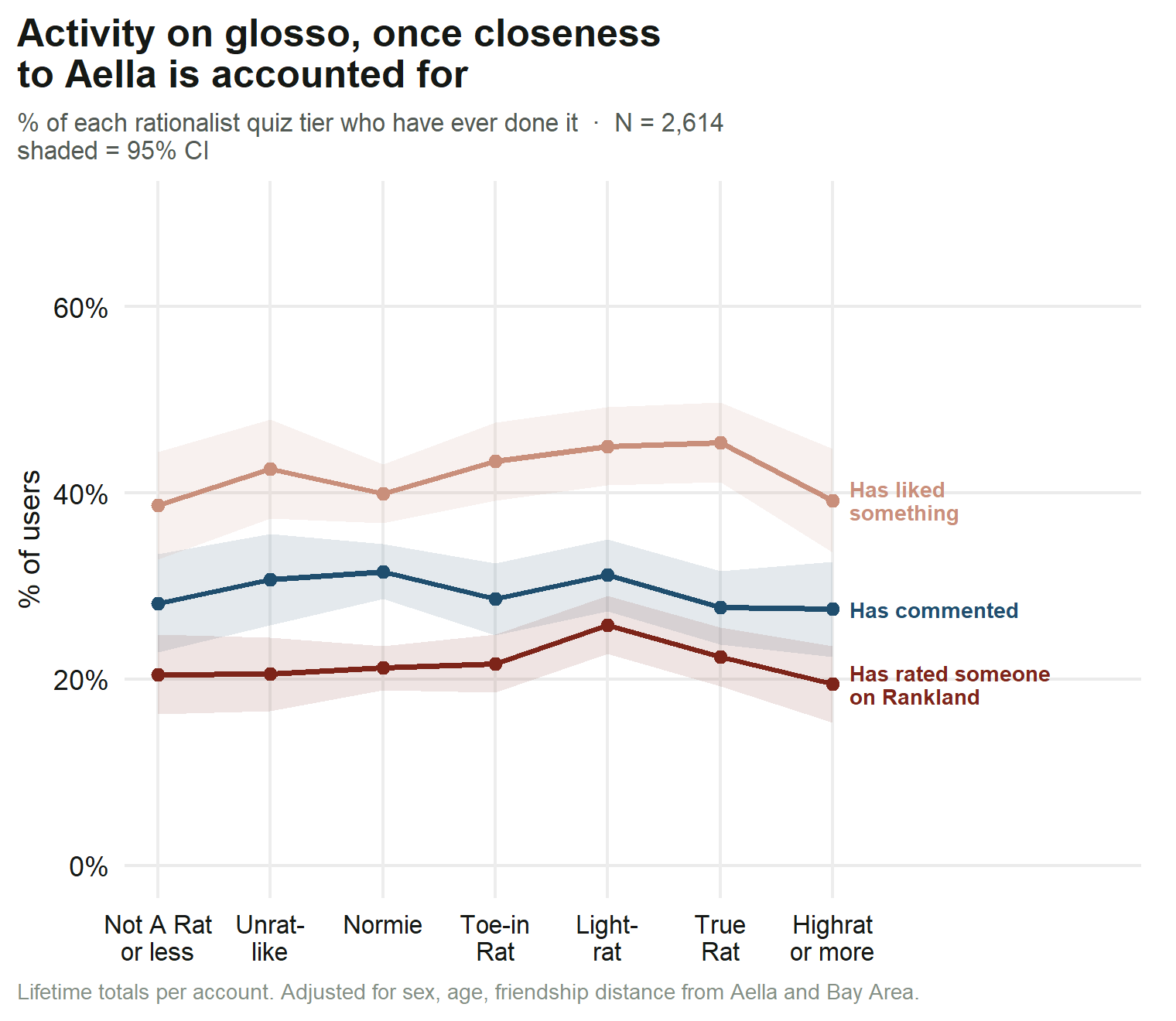
Higher scorers have somewhat more glosso friends (r = 0.10) but aren't more active. Section 10 looks at who their friends are. On rankland, other users rate people on traits from −3 to +3. Here is how the three groups come out, compared with what each rater usually gives:
People can also rate themselves on the same traits (337–496 people per trait):
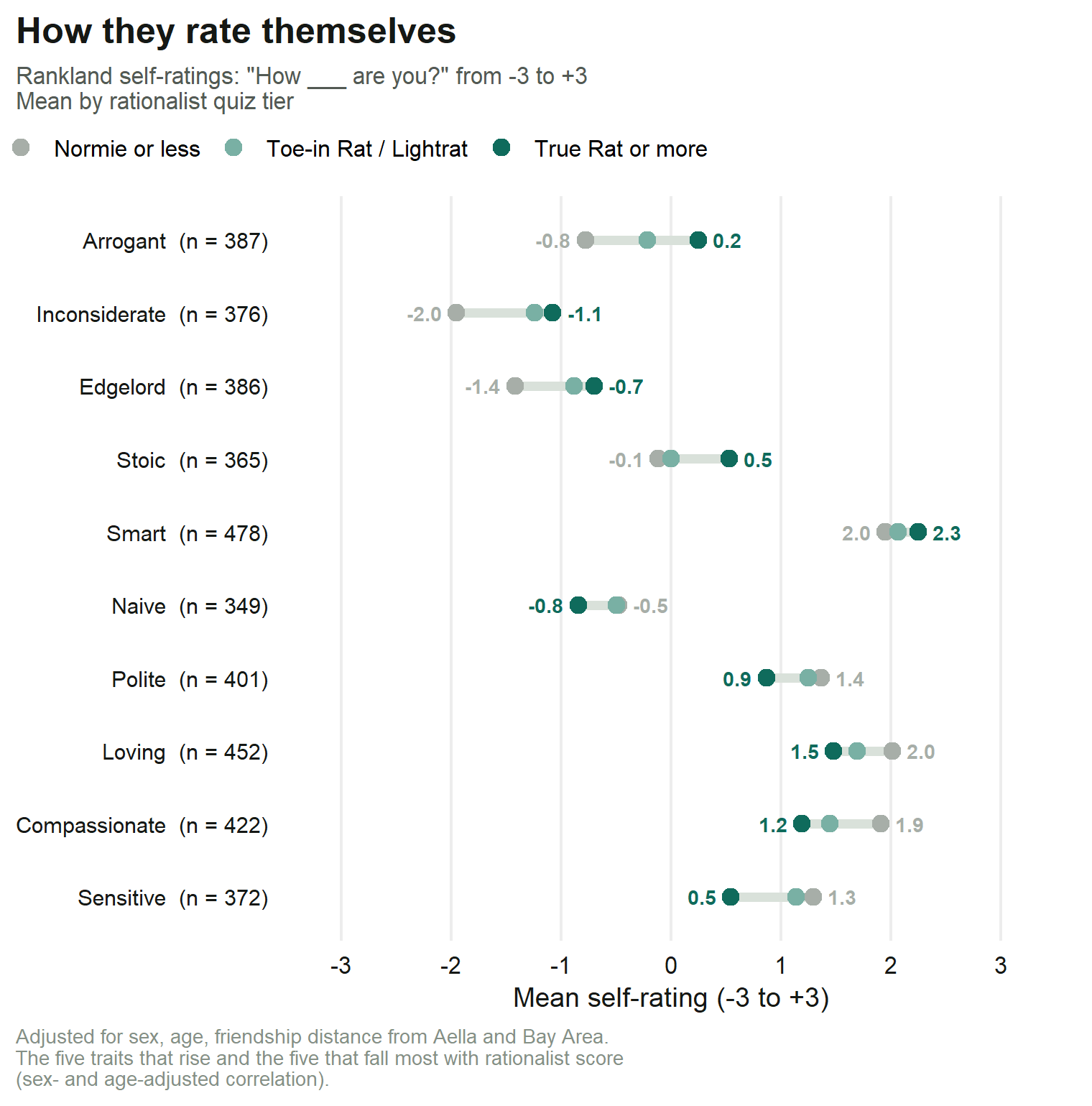
As correlations adjusted for sex, age and closeness to me, higher scorers rate themselves as more arrogant (+0.23), inconsiderate (+0.19), edgelord (+0.18), smart (+0.15) and stoic (+0.18), and less compassionate (−0.23), polite (−0.18), sensitive (−0.20), naive (−0.13) and loving (−0.18). Other users agree about smart; on the warmer traits their ratings lean the same way, more weakly.
10Who they're friends with
Glosso friendships are mutual: you're in each other's circle. Among people who both took the quiz there are 12,798 friend pairs. If friendship ignored rationalist score, the two friends' scores would be uncorrelated (shuffling gives 0 ± 0.02). They correlate 0.22, after adjusting for closeness to me and Bay Area.
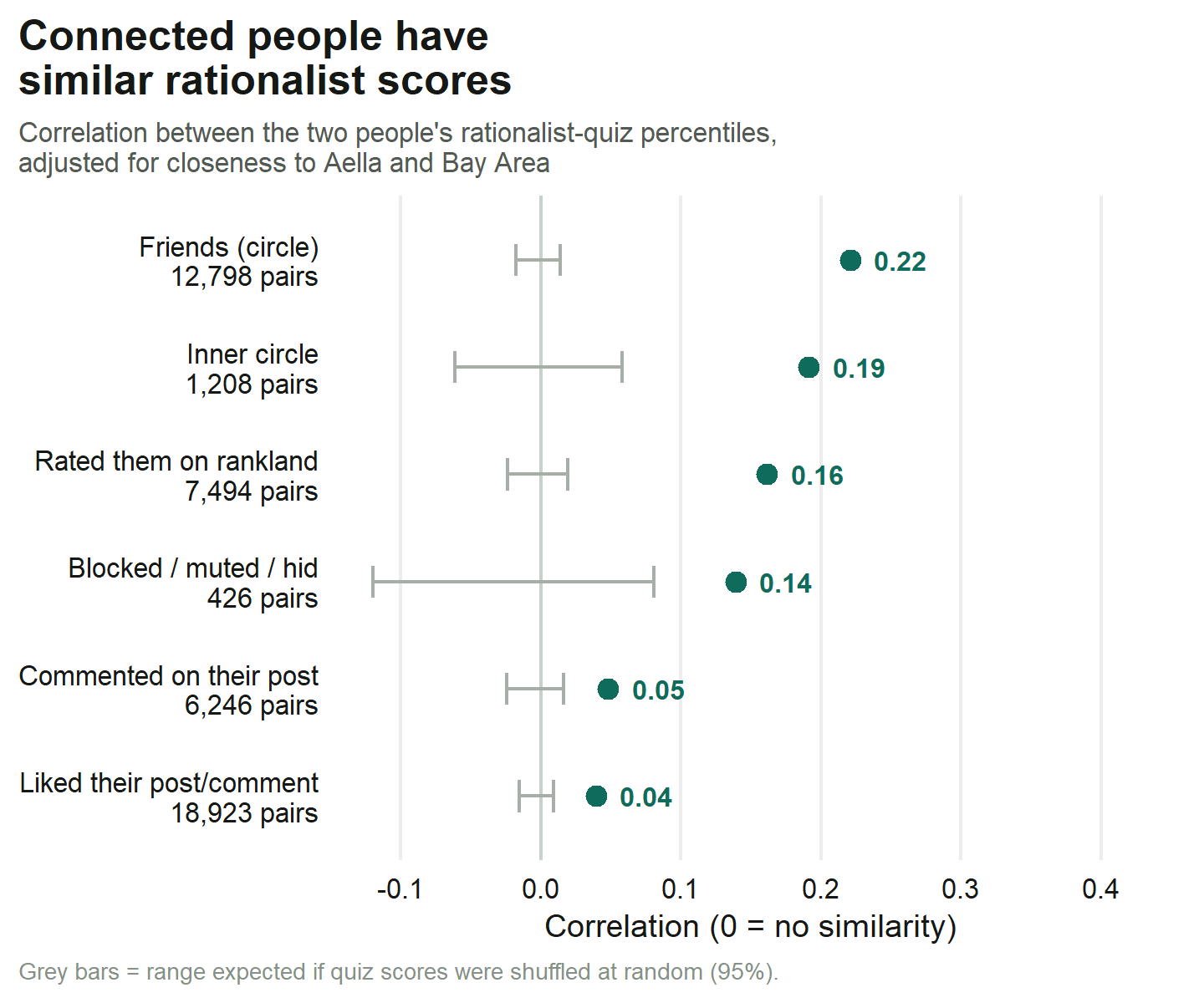
After accounting for closeness to me, friends (0.22), inner circles (0.19) and people who rate each other on rankland (0.16) all have similar scores, while people who merely comment on (0.05) or like (0.04) each other's posts are barely more similar than chance. Blocks and mutes run rat-to-rat as well (0.14, 426 pairs). That suggests part of this is just who you run into: you can only block someone you've come across.
Glosso's friend graph also splits into communities. Among the 8 communities with at least 20 quiz-takers (1,117 people), community membership explains 7.6% of the variation in rationalist score, against at most 1.3% if people were assigned to communities at random.
11The middle of the spectrum
Everything above is a straight-line comparison: does it go up or down as rationalist score rises? A trait could instead peak or dip in the middle tiers and look flat on a straight line. I tested every item for a curve, adjusting for sex, age and closeness to me, and counted an item only if the curve survived the false-discovery correction and its turning point fell in the middle of the range (between the 15th and 85th percentiles).
Only 9 of 8,747 items qualify, and several of those are just answers bunching at the top of a scale. Almost everything about rationalists changes steadily from one end to the other. The clearest real ones:
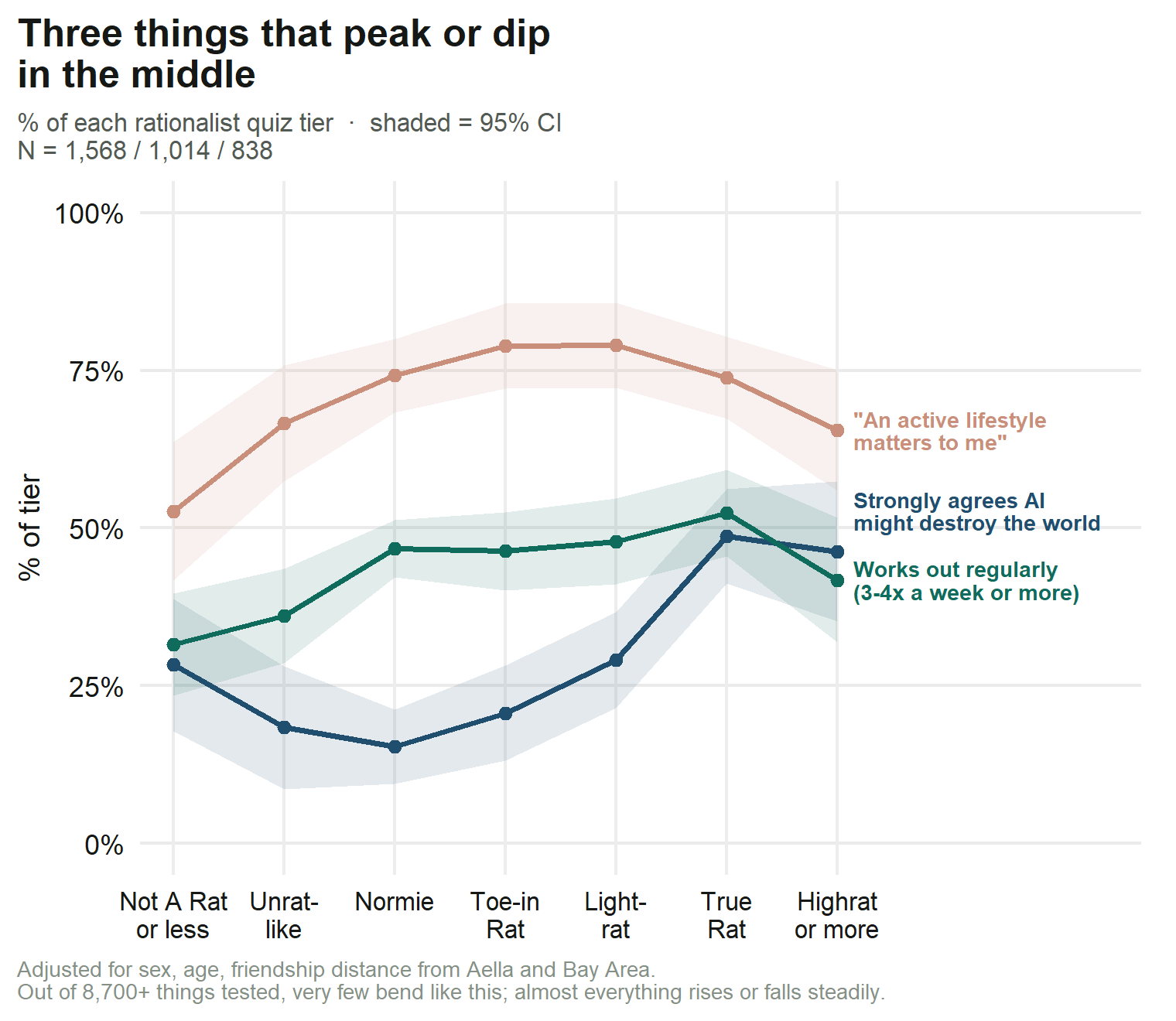
One more thing worth noting: higher scorers say they're quicker to change their minds (section 03), but they actually change their past glosso answers slightly less often (r = −0.10, n = 2,639).
12Grab bag
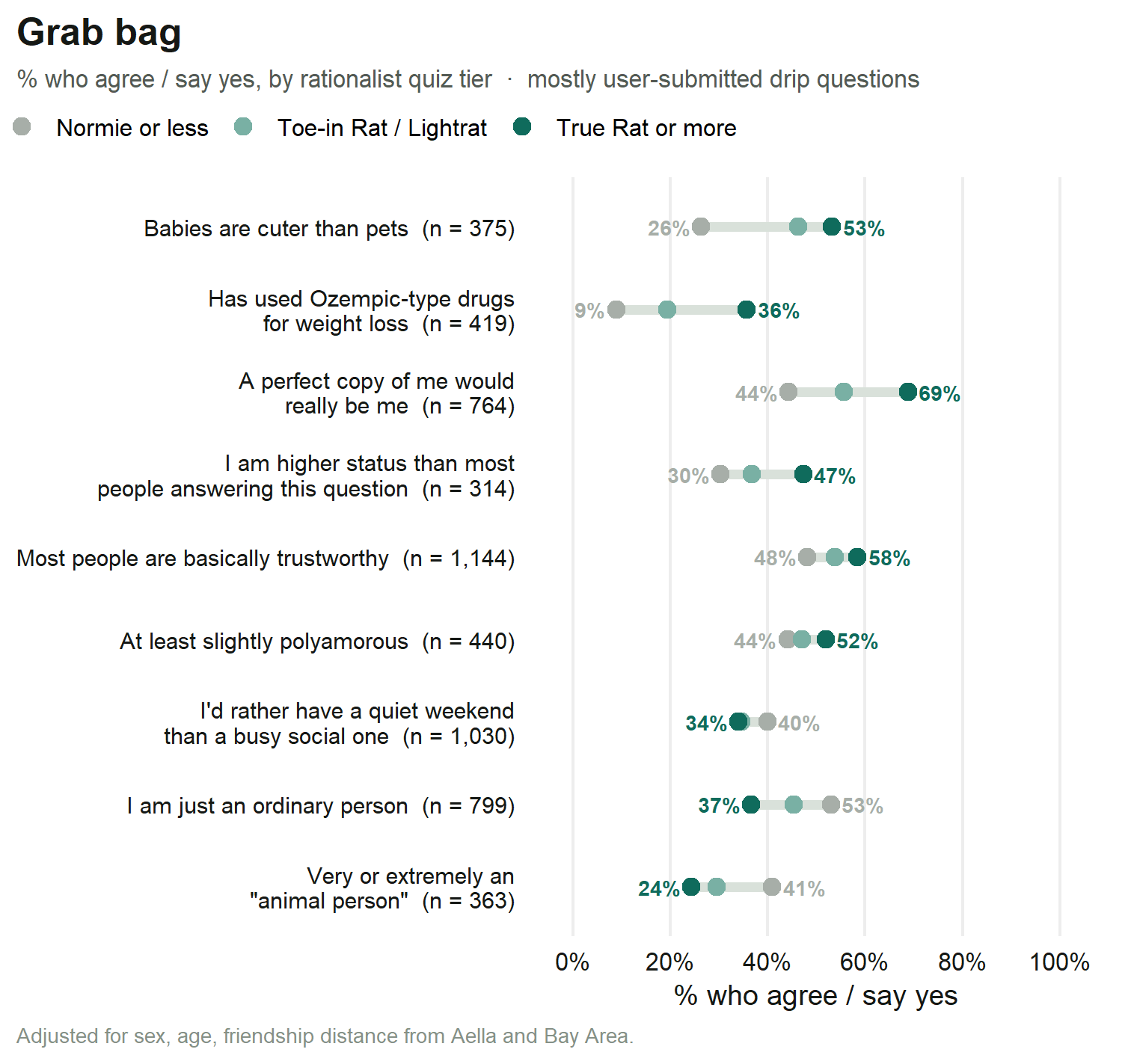
36% of True Rats-or-more say they've used Ozempic-type drugs for weight loss, against 9% of Normies-or-less. 47% of the top group agree they are higher status than most people answering the question. Babies beat pets on cuteness, and 69% say a perfect copy of them would really be them.
13Is the quiz grading itself?
Most of the quiz is community markers: liking LessWrong, Astral Codex Ten, Marginal Revolution, Don't Worry About the Vase, Hacker News, the EA Forum and The Bayesian Conspiracy, plus knowledge items. But some items are opinions: price gouging during shortages is good, insider trading should be allowed, consent is overrated by mainstream culture, the political elite are not a cabal of pedophiles. Any question close to those will correlate with the quiz partly by construction.
To check, I scored everyone on only the seven outlet questions, weighted the way the quiz weights them. This fandom-only score correlates 0.87 with the full quiz score. Then I reran every difference against it.
| Question | Full quiz | Fandom only |
|---|---|---|
| Economically left vs right | −0.42 | −0.23 |
| I respect Elon Musk | 0.44 | 0.28 |
| Consent: 26-year-old with enthusiastic 16-year-old | −0.39 | −0.29 |
| Consent: partner guilt-trips them into sex | −0.33 | −0.21 |
| Trump assassination attempt faked | −0.44 | −0.34 |
| Big pharma wants to keep people sick | −0.32 | −0.28 |
| Some people can talk to ghosts | −0.24 | −0.27 |
| AI might destroy the world | 0.23 | 0.31 |
| I want to live forever | 0.40 | 0.36 |
| I'd steal if I'd never get caught | −0.25 | −0.23 |
| I tend to suffer from anxiety (agree) | −0.27 | −0.15 |
| Puzzle IQ proxy (5+ puzzles) | 0.38 | 0.29 |
| Kink quiz: wartime raids | 0.17 | 0.10 |
| Number of glosso friends | 0.10 | 0.11 |
Rank correlations with rationalist score, adjusted for sex, age, friendship distance from me and Bay Area. On the fandom-only score, economics and consent shrink the most, as you'd expect from the quiz's own items. Almost everything else barely moves. Of the 438 differences in the full list below, 388 still hold on the fandom-only score.
14Why I adjust for closeness to me
Glosso is my site, and I'm a rationalist who's into noncon. If the people around me share both, a rationalist-noncon link could just mean "people close to Aella." The people closest to me on glosso do skew both ways. Distance below is the number of friendship steps from me in glosso's friend graph:
| Distance from me | People | Avg. rationalist percentile | "Yes" to rape play | "Yes" to wartime raids | Bay Area |
|---|---|---|---|---|---|
| My direct friends | 112 | 72nd | 66% | 26% | 79% |
| 2 steps | 569 | 64th | 52% | 18% | 38% |
| 3 steps | 762 | 51st | 51% | 20% | 16% |
| 4+ steps | 247 | 36th | 47% | 12% | 14% |
| Not connected | 1,060 | 43rd | 36% | 11% | 18% |
"Yes" = Yes or Extremely on "I find ___ erotic". Bay Area share is among people whose location is known. Not sex-adjusted, and the closer groups are more male.
So every comparison in this report adjusts for friendship distance from me (direct friend, 2, 3, 4+ steps, or not connected) and Bay Area, on top of sex and age. The adjustment matters for a handful of things. Without it, higher scorers would also look more active on glosso, more polyamorous, and more into rape play and CNC; those differences track closeness to me rather than rationalist score. For nearly everything else it makes little difference: the typical correlation keeps about 88% of its size.
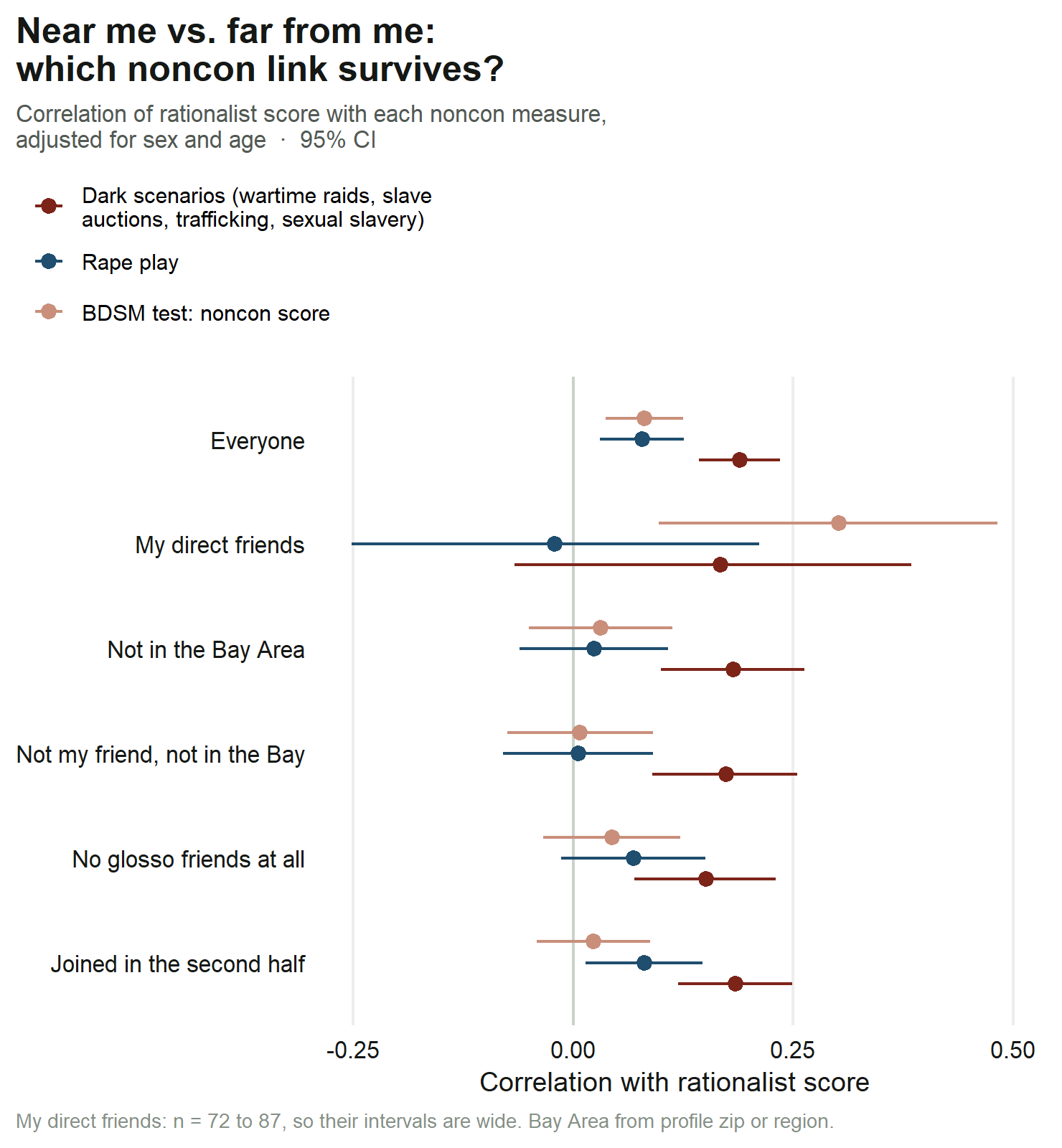
For noncon specifically, the answer splits. The rape play and BDSM-test noncon links look like my circle: the BDSM noncon link is 0.30 among my direct friends and 0.01 among people who are neither my friends nor in the Bay. The dark-scenario fantasies don't: 0.17 in that same far group (540 people), and among people with no glosso friends at all, wartime raids still goes from 7% of Normies-or-less to 16% of True Rats-or-more. Since rationalists are less kinky across the rest of the kink quiz (−0.15), this is a specific tilt, not a general one.
This can't rule out a broader version of the same problem: everyone here found glosso through me somehow, so "rationalists who end up on Aella's site" may differ from rationalists in general. That needs data from somewhere else.
15All 438 differences
Every glosso question or score answered by at least 300 people with a rationalist score, where the difference survives adjustment for sex and age, passes a false-discovery-rate cutoff of 0.001 across all 8,748 things tested, and has a correlation of at least 0.10 either way. The number on the right is that adjusted rank correlation: around 0.1 is small, and 0.3 or more is large for survey data. Green bars to the right mean higher scorers agree more or score higher; the grey line under each question says which end of its scale they lean toward.
"Higher scorers lean toward X" means that as the rationalist score goes up, answers move toward that end of the scale. Orange marks the 50 differences that don't hold up on the fandom-only score, and the 47 that weaken once closeness to me is controlled (section 14). Nothing is left out for being sensitive. The only exclusion is the MTG colour scores, which are partly built from rationalist-quiz items.
16What this doesn't show
- Rationalists in general. This is glosso users who took a quiz on Aella's site. The high tiers are people who like rationalist blogs and use glosso, which is a particular slice of the community.
- Causes. Nothing here says rationalist culture makes people less anxious or more willing to gamble. People who already think that way may be the ones drawn to it.
- Behaviour. Almost everything is self-report. "I'd steal if I'd never get caught" is a statement about yourself, not a measure of honesty.
- Other confounders. Everything is adjusted for sex, age, friendship distance from me and Bay Area. Higher scorers are also richer and more educated. I checked class and education for the headline findings (none shrinks by more than 19%), but the 438-row list isn't adjusted for them.
- Why friends are similar. Friends could become similar, similar people could become friends, or the quiz could have spread through friend groups so that whole circles took it together. The data can't separate these.
- Different people answer different questions. The drip shows each question to whoever happens to get it, so the 300 people behind one question aren't the same 300 behind the next.
17Methods
Data pulled read-only from the glosso database on 7 Oct 2026: every non-banned user with a rationalist-quiz score (N = 2,750). For each user I collected their latest answer to every drip and test question, their stored scores from each test, war ratings, rankland ratings given and received, rankland self-ratings, kink-quiz and marriage-quiz answers, achievements, how often they changed past answers, feedback on drip questions, post views, and activity counts. For the friendship analysis I used every mutual circle, inner circle, like, comment, rankland rating, block, mute and hide between two people who both took the quiz, plus the communities glosso computes from the friend graph. Private messages were not used. Questions that are part of the rationalist quiz were excluded, along with the MTG colour scores, which are partly built from quiz items. The threats test and the relationship test both use the names sex1–sex7 for different questions, so those are kept apart by test.
Coding. Ordered answers were used as numbers, with "don't know" and similar answers dropped. Unordered answers and checklists were split into one yes/no variable per option chosen by at least 40 people. That gave 8,748 variables with at least 300 answers.
Statistics. For each variable: a Spearman correlation with rationalist score after removing sex, age (quadratic), friendship distance from me and Bay Area from the ranks of both. P-values were corrected with Benjamini–Hochberg across all 8,748. The charts compare three groups of tiers using adjusted means: a linear model of the answer on group, sex, age, distance and Bay Area, averaged over everyone with each person assigned to each group in turn, with 95% confidence intervals from the model. The "who scores high" and friends' percentile charts are unadjusted descriptions.
Rankland. Each rating is centered on that rater's average for that trait (raters with at least three ratings on it), then averaged per person. Only people rated by five or more raters on a trait are included.
Fandom-only score. Answers to the seven outlet questions ("I like the forum LessWrong", etc.), counting slight agreement as 1 and strong agreement as 2, weighted by the quiz's own weights (0.28–0.49), for the 2,730 people who answered at least five of them.
Ties. For each kind of connection, every pair of quiz-takers counted once, and the correlation between their rationalist-quiz percentiles computed symmetrically. "After accounting for closeness to me" means each person's percentile is first replaced by its residual from a regression on distance from me and Bay Area. The "random" range comes from shuffling scores among the same people 500 times. Communities are glosso's own friend-graph clusters; "variation explained" is the between-community share of variance, compared against 500 random reassignments.
Closeness to me. Friendship steps from my account in the mutual-circle graph (direct friend, 2, 3, 4+, or not connected), plus Bay Area (yes, no or unknown, from profile zip or region), included as controls throughout.
Puzzle IQ proxy. Raven's Advanced Progressive Matrices Set II items, dripped a few at a time. Answers faster than five seconds are dropped as likely misclicks, and "don't know" counts as wrong. Each puzzle gets a difficulty from how many people solve it; each person gets an ability estimate (Rasch model, expected a posteriori, standard normal prior), rescaled to mean 100 and SD 15 across all glosso users with five or more puzzles.
Curves. For each item, a regression of the item's ranks on rationalist percentile, percentile squared, sex, age (quadratic), distance from me and Bay Area. Curve p-values were corrected with Benjamini–Hochberg across all 8,747 items; an item counts as peaking or dipping in the middle only if the corrected p is below 0.01 and the turning point lies between the 15th and 85th percentiles.
Class and education check. For the headline items, a linear model of the answer on standardized rationalist score, sex, age, distance from me and Bay Area, with and without self-reported current class and education, among people who answered both.