ScorecardBlanchard's claims, checked
Each row is one testable claim from Blanchard's work (or a standard part of the theory added by his collaborators), what the Big Kink Survey shows, and a verdict. Details and caveats for each are below.
| Claim | What the BKS shows | Verdict |
|---|---|---|
| Androphilic trans women mostly lack AGP; nonhomosexual ones have it | AGP is lowest in trans women attracted only to men, and a third of them have none. But another third are very or extremely aroused. | Partly |
| AGP peaks at moderate, not exclusive, attraction to women | In cis men, 39% of bisexual men vs 17% of exclusively straight and 6% of exclusively gay men are very or extremely aroused. | Supported |
| Crossdressing arousal belongs to the nonhomosexual type | 41–52% of trans women find crossdressing erotic at every orientation; androphilic trans women are no lower. | Not supported |
| Bisexual AGP is about being admired by men ("pseudobisexuality") | Interest in being admired rises with attraction to men, but the same pattern continues through gay men. | Partly |
| Androphilic trans women are shorter and lighter | 0.6 inches shorter than other trans women, like gay vs straight men. Not lighter for their height. | Height only |
| Nonhomosexual trans women transition later | 28% of gynephilic vs 15% of androphilic trans women started estrogen at 25 or older. | Supported |
| Older brothers raise the odds of the androphilic type | Older siblings raise the odds of attraction to men, but older sisters count as much as older brothers. | Not supported |
| AGP is one of a family of "erotic target location errors" | AGP has small positive links to arousal at being a child, turning into an animal, and furries. | Supported, small |
| The anatomic kind of AGP drives gender dysphoria | AGP strongly predicts being trans, but through "being admired as a woman." Arousal at one's own female body parts points the other way. | Not supported |
| AGP-type arousal is extremely rare in natal females | 16% of cis women are very or extremely aroused by picturing a male body; about 10% also by their own male body parts. | Not supported |
| AGP arousal fades after transition | Lower with longer estrogen use, mostly the body-part kind. | Consistent |
| Trans men are almost all attracted to women | Only 12% of trans men here are attracted mostly or only to women; their AAP is highest when attracted to men. | Not this population |
| Androphilic trans women were feminine boys | No childhood gender nonconformity item. | Can't test |
1 · The theoryWhat Blanchard proposed
In the 1980s and early 1990s, Ray Blanchard, a psychologist at the Clarke Institute in Toronto, studied several hundred patients assigned male who wanted to live as women. He sorted them by sexual orientation. Patients attracted to men he called "homosexual"; patients attracted to women, to both, or to neither he grouped as "nonhomosexual" (Blanchard 1985, Arch Sex Behav; Blanchard 1989, Arch Sex Behav and J Nerv Ment Dis).
His claim was that these are two different conditions with different causes. The androphilic group were typically feminine from childhood and resembled very feminine gay men. The nonhomosexual groups shared a paraphilia he named autogynephilia: sexual arousal at the thought of oneself as a woman. He argued that autogynephilia, not childhood femininity, was what drove their wish to become women.
Several other predictions follow from the theory or were added by Blanchard and colleagues: about which subgroup is most autogynephilic, height, age at transition, older brothers, other "auto-" interests, natal females, and what happens after hormones. Those are the claims tested below.
The theory is contested. Critics have argued the two types are a continuum rather than distinct (Veale 2014), that AGP is neither always present in gynephilic nor always absent in androphilic trans women (Moser 2010; Nuttbrock et al. 2011), and that the framing is stigmatizing (Serano 2010). This page sets the politics aside and checks the parts that make predictions.
2 · The dataBlanchard's own questions, a million miles from his clinic
The Big Kink Survey asks three questions that are close copies of Blanchard's 1989 scales. People assigned male get:
- "When I picture myself as having a nude female body, I find this:" (his Core Autogynephilia Scale, item 1)
- "When I picture my own nude female breasts, buttocks, legs, or genitals, I find this:" (items 2–5)
- "The thought of someone else admiring me while I am a woman in the nude is:" (his interpersonal fantasy scale, item 9)
Blanchard's items were yes/no ("ever aroused?"). The BKS asks how arousing, on six steps from not to extremely. Here "very or extremely" is used as the cutoff for strong AGP. People assigned female get mirror versions about a male body.
The sample is very different from his: a self-selected online kink survey, mostly young, with 15,534 trans women, 11,208 nonbinary people assigned male, 34,084 trans men and 168,706 cis men who answered these items. His were adults seeking clinical help in Toronto decades ago. Where findings differ, either could be the reason. Most charts here use raw (unweighted) data because they compare trans subgroups, which weighting shrinks to a few hundred effective respondents.
3 · Two typesAndrophilic trans women: less AGP, not no AGP
Androphilic ("homosexual") trans women are not usually autogynephilic; nonhomosexual trans women are.
Blanchard's 1989 data: on his 8-item Core Autogynephilia Scale, 117 androphilic patients averaged 2.17, versus 4.00 to 5.88 for the three nonhomosexual groups. An earlier sample found fetishistic arousal in over 80% of heterosexual but under 10% of homosexual male patients (Blanchard, Clemmensen & Steiner 1987).
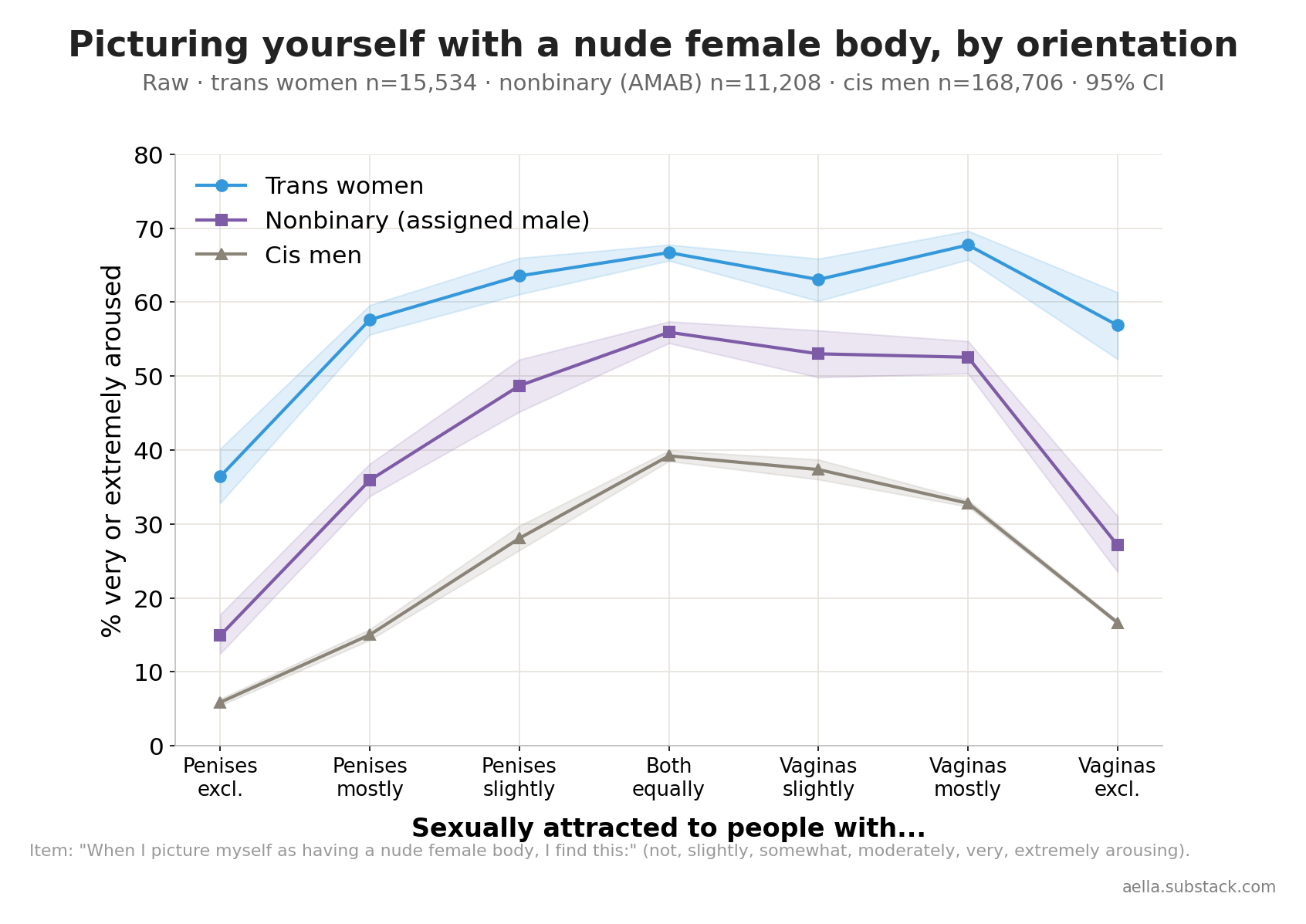
The direction matches Blanchard. Trans women attracted exclusively to men are the least autogynephilic group, and 31% of them say picturing a female body is "not arousing" at all, versus 6–14% of gynephilic trans women. That looks like a real subgroup without AGP.
But it isn't a clean split. Another 36% of exclusively androphilic trans women are very or extremely aroused, and trans women who are "mostly" attracted to men (58%) look like everyone else. The stricter definition (attracted only to penises and preferring masculine-looking partners) gives the same picture: 32–35% strongly aroused, 36% not at all. This matches later work describing the difference as "large but not deterministic" (Nuttbrock et al. 2011) and as a continuum rather than two types (Veale 2014).
4 · Non-trans menThe inverted U, replicated
Among men, autogynephilia is most common at moderate attraction to women, not at the most exclusive.
Blanchard (1992, J Abnorm Psychol) found this in 427 men. A large New York study of trans women did not replicate it; there, fetishism rose in a straight line with attraction to women (Nuttbrock et al. 2011).
In the BKS it shows up clearly, especially in cis men (Fig 1, grey line): 6% of exclusively gay men are very or extremely aroused, rising to 39% of men attracted to both equally, then falling to 17% of exclusively straight men. The same peak holds after controlling general kinkiness and age. Among trans women the curve is flatter, but exclusively gynephilic trans women (57%) are still below those attracted mostly to women (68%).
Blanchard's 1989 trans data also put the bisexual group on top (5.88 vs 5.32 for heterosexual), so this part of the theory holds up well here.
5 · CrossdressingNot a marker of type here
Erotic crossdressing (transvestic fetishism) is part of the nonhomosexual pattern and is rare in androphilic trans women.
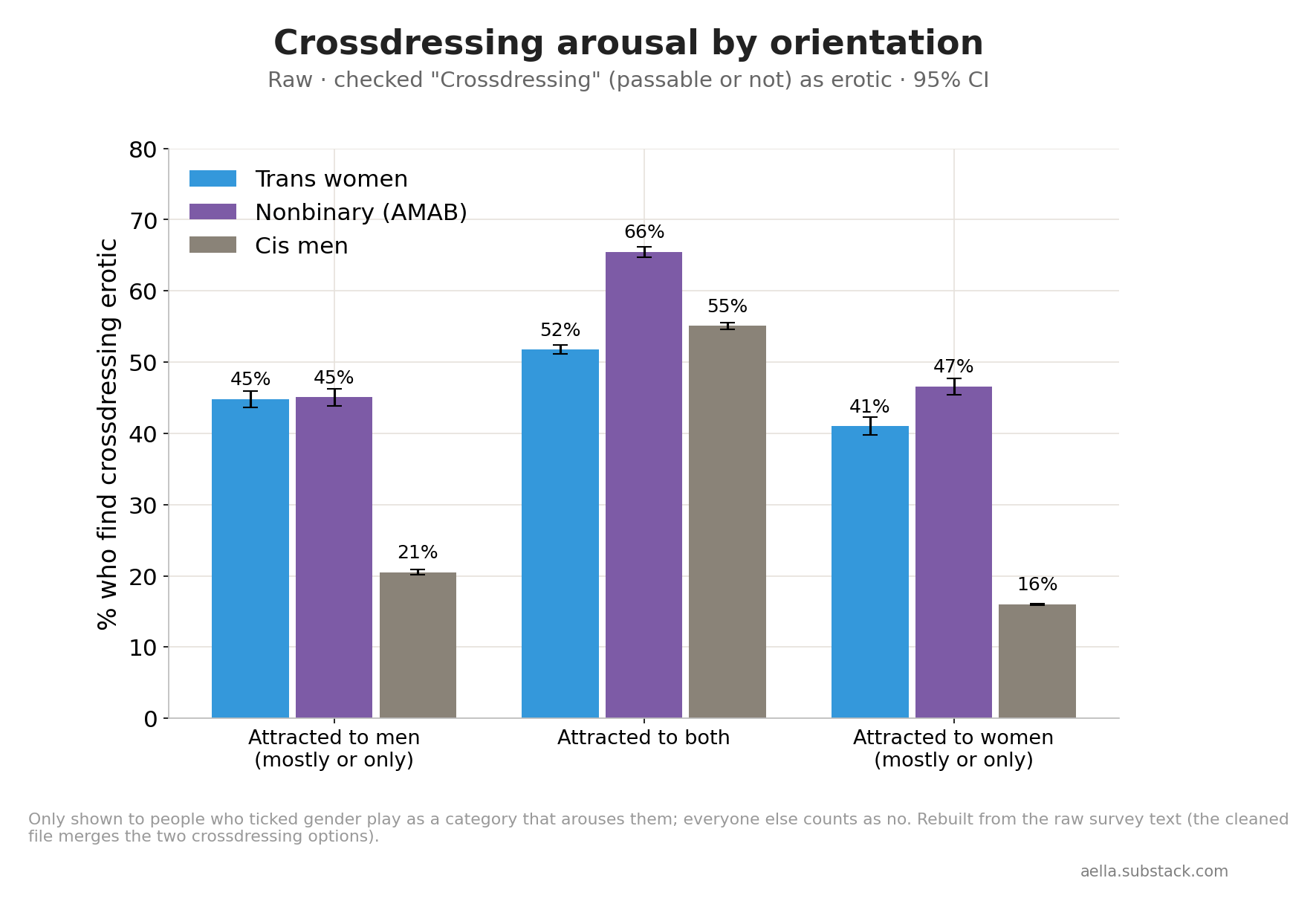
Androphilic trans women are as likely as gynephilic ones to find crossdressing erotic. The difference Blanchard reported (over 80% vs under 10%) isn't there.
Two caveats. The BKS item is current ("which of the following do you find erotic"), not a lifetime history of arousal while cross-dressing, and it was only shown to people who said gender play arouses them. For a trans woman, wearing women's clothes may also simply be how she dresses, which could blur the line between fetish and identity. Nuttbrock et al. (2011) also found large differences by ethnicity and age in reported fetishism, which a clinic sample can confound with type.
6 · PseudobisexualityBeing admired goes with attraction to men, in everyone
"Bisexual" nonhomosexual trans women are drawn to men mainly as validation of themselves as women, through fantasies of being admired as a woman.
Blanchard's 1989 data: on his Autogynephilic Interpersonal Fantasy scale, the bisexual group averaged 3.38, versus about 2 for every other group. He called their interest in men "pseudobisexuality."
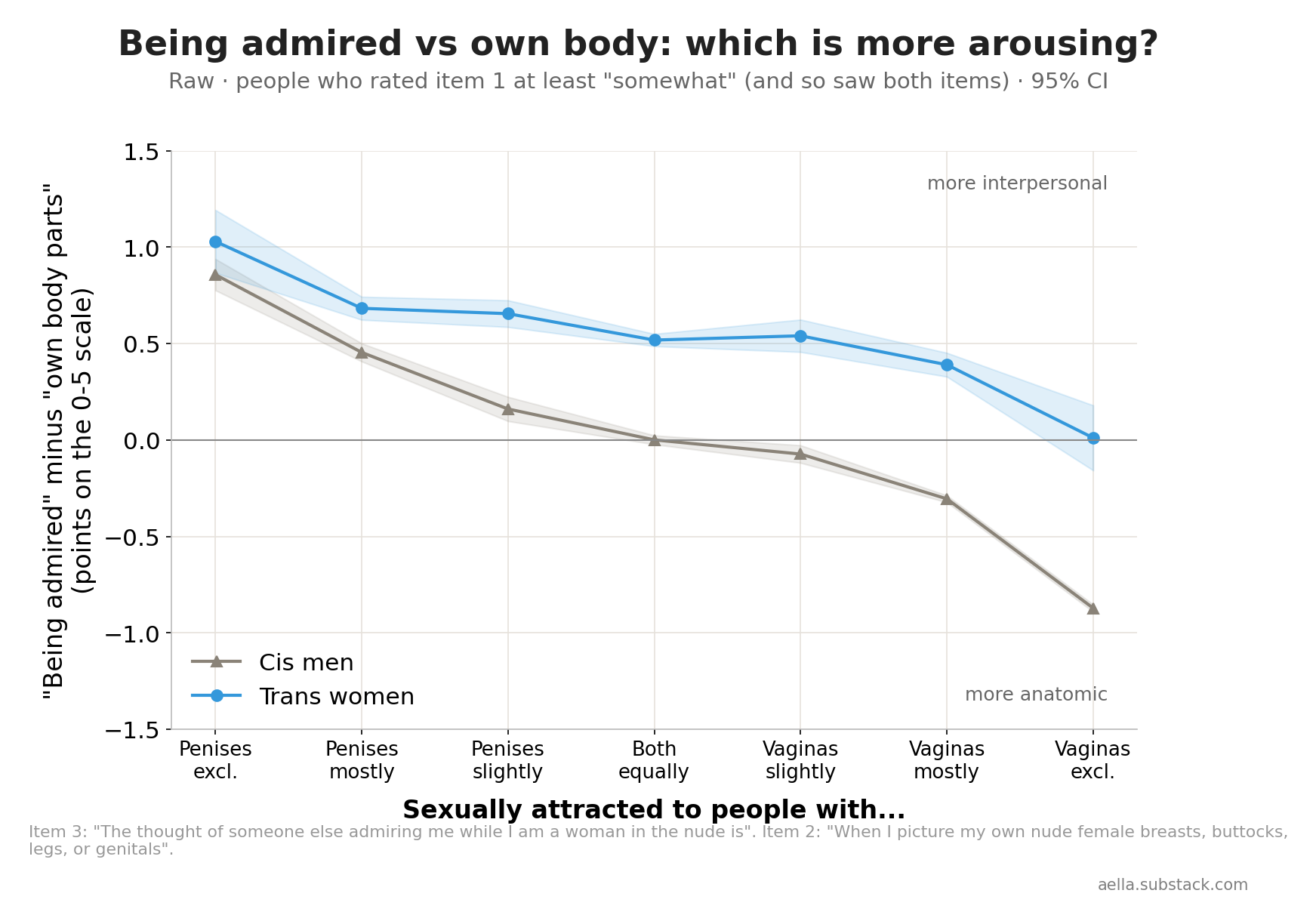
The association is there. Among straight-leaning cis men with AGP, arousal at being admired as a woman predicts substantial attraction to men (odds ×1.8 per standard deviation), while arousal at their own female body parts doesn't (×0.9).
But the pattern doesn't stop at bisexual men. It keeps rising through gay men, who are the most interpersonal of all. The simpler reading is that "someone admiring me" is more appealing to anyone attracted to the kind of person likely to be doing the admiring. The survey can't test whether bisexual AGP men see men as props.
7 · HeightAndrophilic trans women are a little shorter
Androphilic trans women are shorter and lighter than nonhomosexual trans women.
Blanchard, Dickey & Jones (1995) compared 176 androphilic and 246 nonhomosexual patients and found the androphilic group shorter, lighter, and lighter for their height. A Dutch study found no difference (Smith et al. 2005).
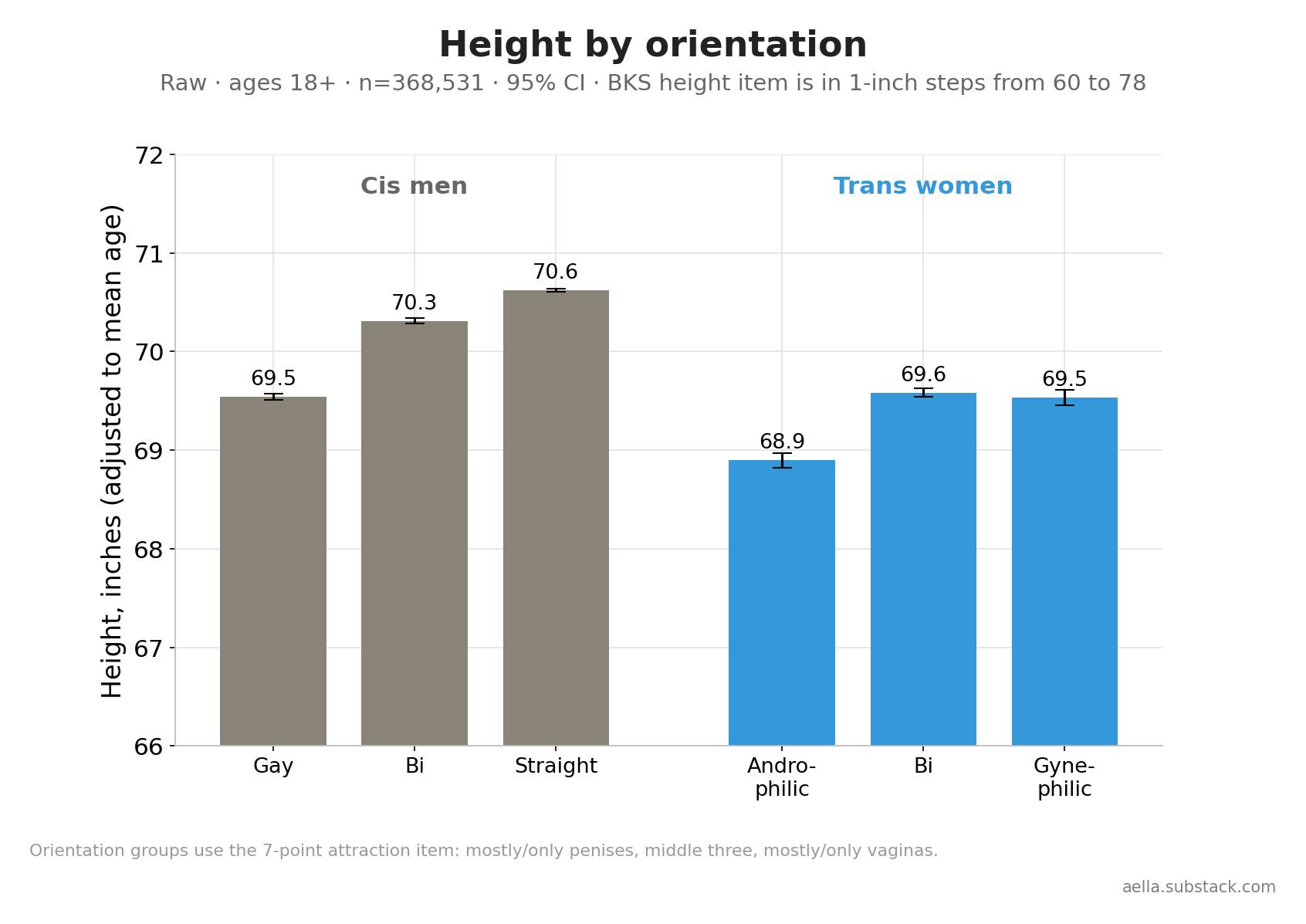
Androphilic trans women are about 0.6 inches shorter than other trans women, roughly half the gap between gay and straight cis men. That fits Blanchard's view that androphilic trans women are related to gay men. They are not lighter for their height, though: after adjusting for height and age, their weight is about the same as gynephilic trans women's. Weight is also affected by estrogen, which makes it a weaker test.
8 · TimingGynephilic trans women start later
Nonhomosexual trans women come to transition later in life than androphilic ones.
Blanchard's patients showed this, and later clinic samples agree (Blanchard et al. 1987; Smith et al. 2005). The BKS has no age-at-transition question, so this uses current age minus years on estrogen.
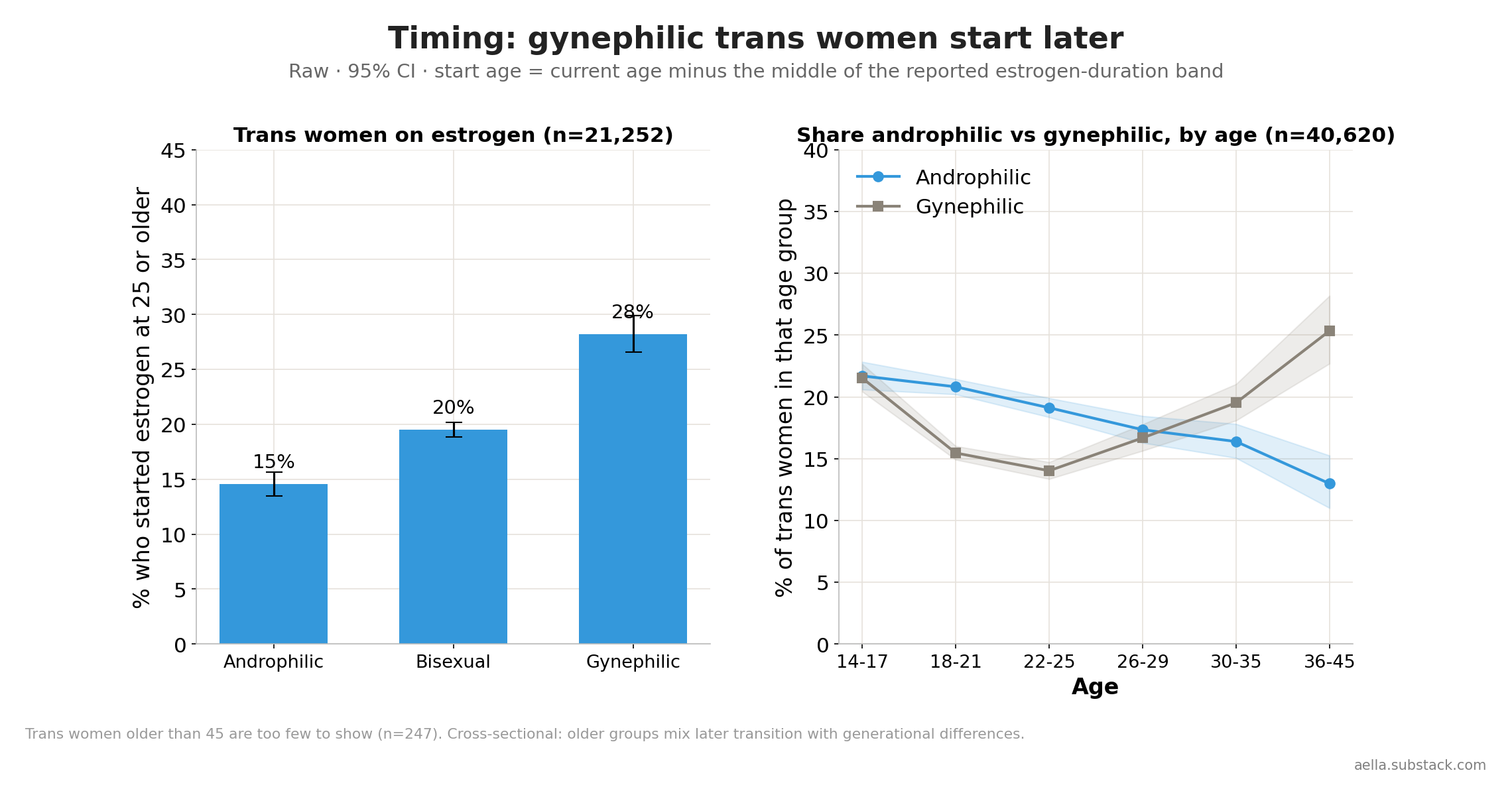
The direction matches. The gap is smaller than in clinic samples, probably because this sample is young (median age 21) and older transitioners are rare in it. The age pattern on the right is cross-sectional, so it mixes later transition with generational change.
9 · Older brothersOlder siblings matter, but not just brothers
Each older brother raises the odds that a male is androphilic, including among trans women (the fraternal birth order effect). Older sisters don't matter.
Blanchard & Sheridan (1992) found later birth order and an excess of brothers in androphilic patients. Green (2000) estimated each older brother raised the odds of the androphilic type by about 40%. The effect has been reported in several countries.
The BKS doesn't ask for a count of older brothers. It asks how many siblings you grew up with, your birth order, and whether your siblings are "mostly male," "mostly female" or "an equal mix." With one or two siblings, those three answers fix exactly how many older brothers and older sisters someone has.
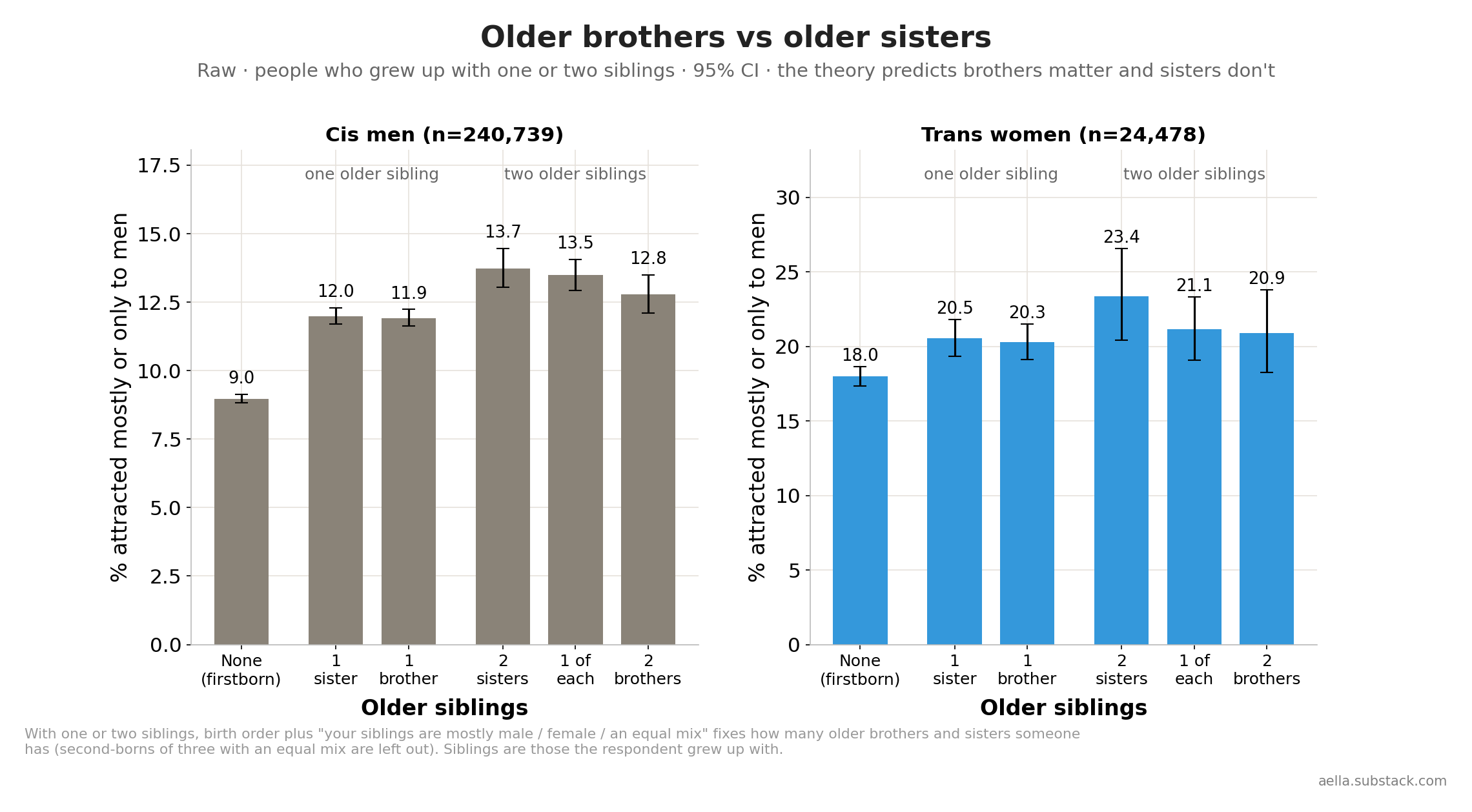
Controlling family size and age, each older brother raises cis men's odds of androphilia by 26% (95% CI 23–29%), and each older sister by 29% (26–33%). For trans women it's 10% and 15%. There is an older-sibling effect, but it isn't specific to brothers, which is the core of the fraternal birth order idea.
This is a strong null for the brother-specific part, with 240,000 cis men. It differs from most published work, and the measure could be the reason: "siblings you grew up with" can include step-siblings and miss biological brothers raised elsewhere, while the proposed mechanism is biological (the mother's immune response to male pregnancies). Mismeasured siblings would dilute a brother effect toward zero, but it wouldn't create an equally strong sister effect.
Is this just later-borns answering everything differently? No. The same model on other items, cis men:
| Outcome | Per older brother | Per older sister |
|---|---|---|
| Attracted mostly or only to men | odds ×1.26 | ×1.29 |
| AGP very or extremely | ×0.98 | ×0.98 |
| Light bondage very or extremely arousing | ×1.00 | ×1.01 |
| Left-handed | ×1.01 | ×1.01 |
| Porn daily or more | ×1.06 | ×1.11 |
| General kinkiness (0–5 scale) | +0.00 | +0.02 |
| Height | −0.04 in | 0.00 in |
Older siblings move attraction to men and leave almost everything else flat. They also don't affect AGP, which fits Blanchard: he never tied birth order to the autogynephilic type. In cis women the orientation effect is much weaker (×1.06 per older brother, ×1.04 per older sister).
10 · Target location errorsA small "auto-" family
Autogynephilia is an "erotic target location error": attraction to women turned toward the self. People prone to it should also be more likely to eroticize becoming other things they're attracted to (Freund & Blanchard 1993).
Later studies found arousal at being a child among men attracted to children (Hsu & Bailey 2017, Psychol Sci), arousal at being an animal among furries (Hsu & Bailey 2019), and positive links between these "internalized" attractions and AGP (Bailey, Hsu & Jang 2025).
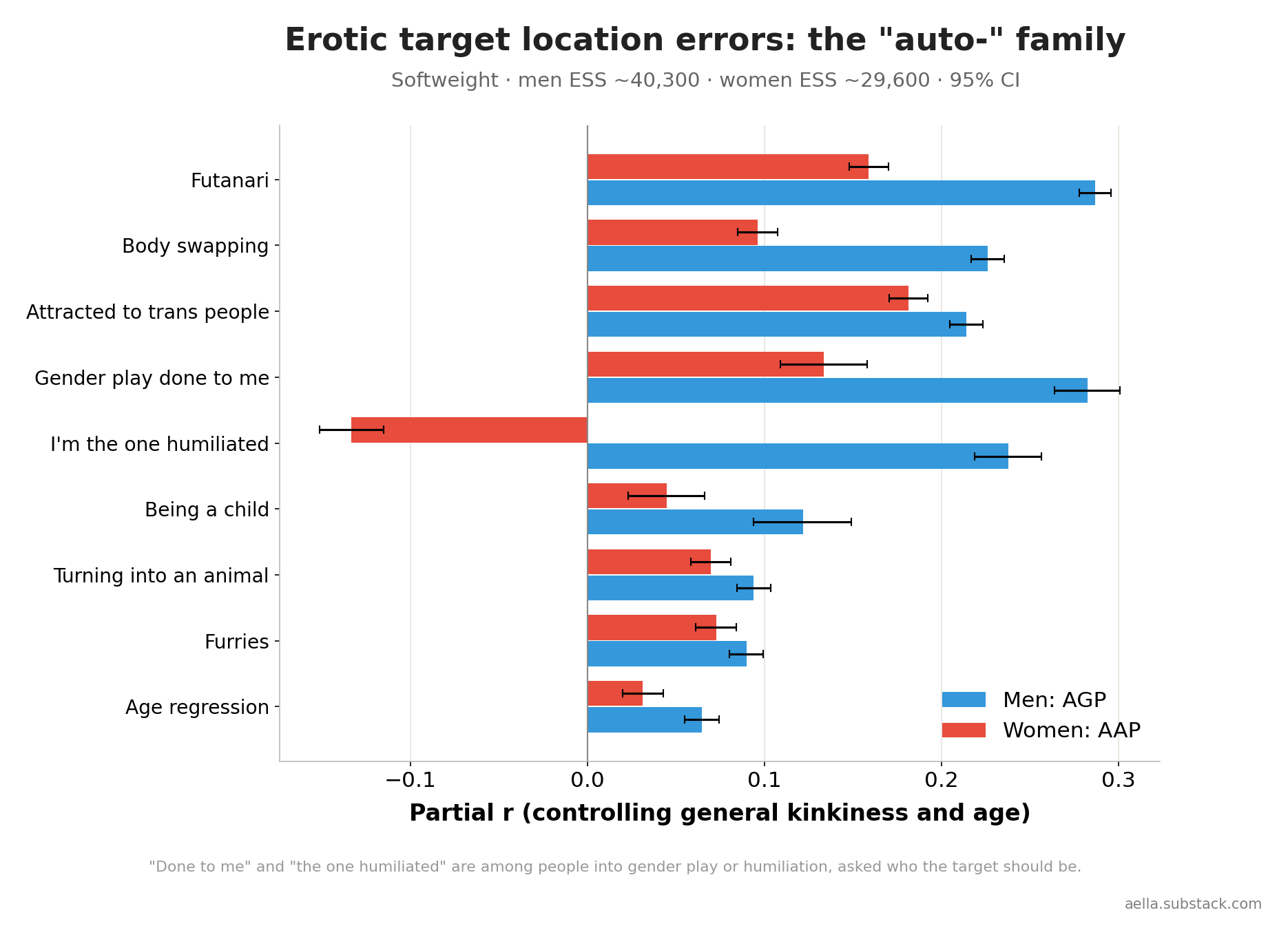
The predicted links are there, and small. The bigger pattern is that AGP men want to be the target of nearly every fetish: gender play, humiliation, bondage. That's consistent with a general tendency to eroticize changes to oneself, which is close to what the target-error idea describes. The checkbox items can't separate "aroused by furries" from "aroused by becoming one," so the "auto-" links are probably understated.
11 · TransitionBeing admired, not body parts, goes with being trans
Autogynephilia drives the wish to be a woman. The anatomic kind (arousal at imagining a nude female body or a vulva) goes with the most gender dysphoria.
Blanchard (1993) found that, among 238 nonhomosexual patients, those most aroused by imagining themselves as nude women were more dysphoric than those aroused by clothes. In 220 patients, arousal at imagining a vulva predicted wanting to be a woman.
The first part holds. Among people assigned male, 4.6% of those who find picturing a female body "not arousing" identify as trans women or nonbinary, rising to 35% of those who find it "extremely" arousing.
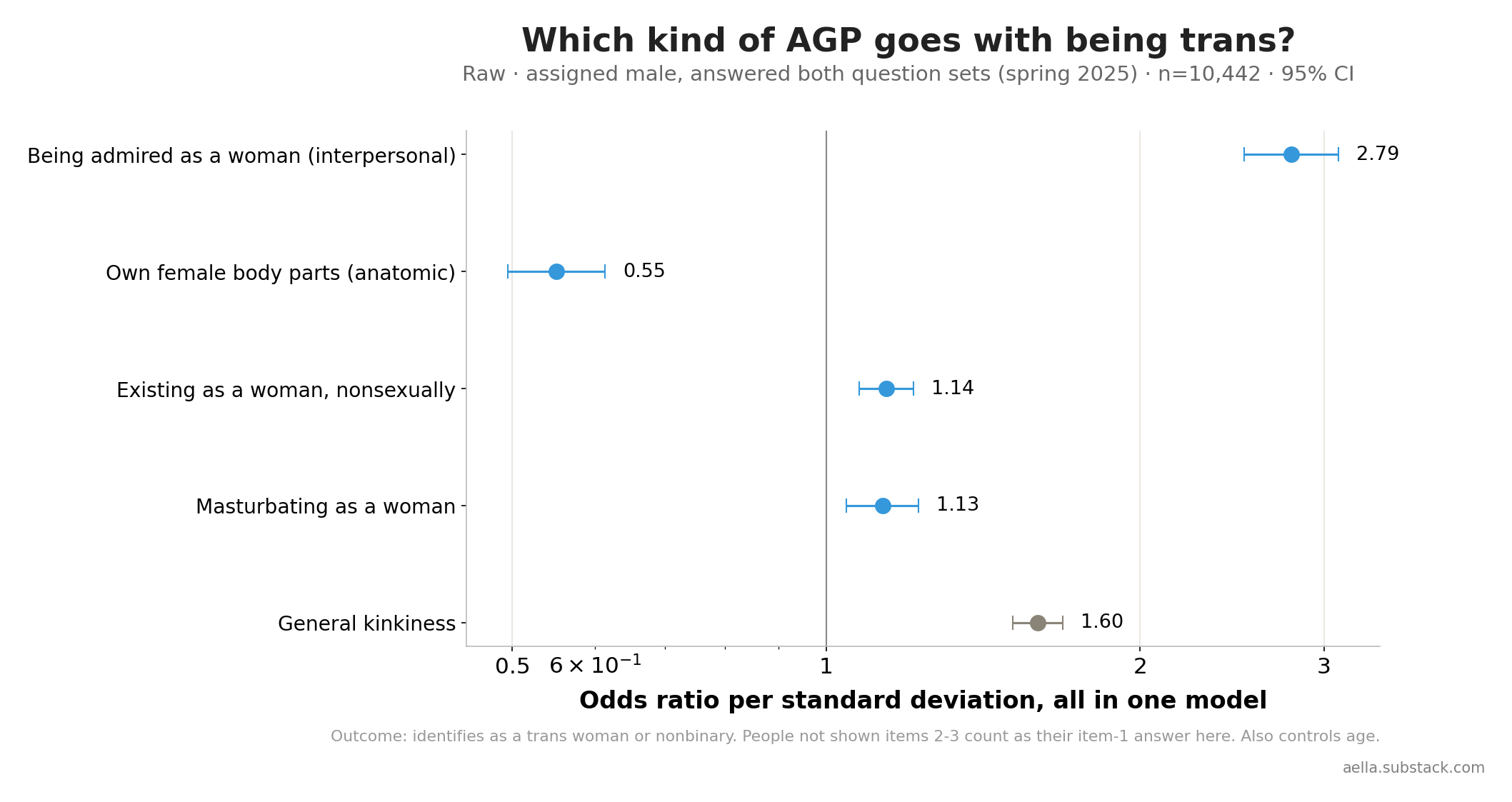
The second part doesn't. The interpersonal item, being admired as a woman, is by far the strongest predictor of trans identity. Holding it fixed, arousal at one's own female body parts goes with being less likely to be trans. In the full sample (100,158 people who saw all three items) the pattern is the same (×2.38 vs ×0.68).
The outcome here is trans identity, not clinical dysphoria, and trans women may read "admiring me while I am a woman" as describing who they already are. Still, the anatomic version looks like the kind cis men tend to have.
12 · WomenCross-sex arousal isn't rare in women here
Autogynephilia-type arousal and nonhomosexual gender dysphoria are extremely rare in natal females (Blanchard 1989).
A related argument is over whether women are "autogynephilic" about their own bodies. Moser (2009) said most women in a small sample were; Bailey & Hsu (2022), using Blanchard's scale, found natal females scored like men without AGP.
Women in the BKS were asked the mirror question about a male body. In the Hardweight data (weighted toward the general population), 16% of cis women are very or extremely aroused by picturing themselves with a nude male body, the same as cis men for a female body. Some of that is women misreading "picture myself with a nude male body" as "with a naked man," so a stricter rule that also requires arousal at one's own male body parts gives about 10% of women versus 15% of men. Either way, it isn't extremely rare. See the AGP report for the misreading check.
The older BKS items speak to the Moser question, because women were also asked about being female.
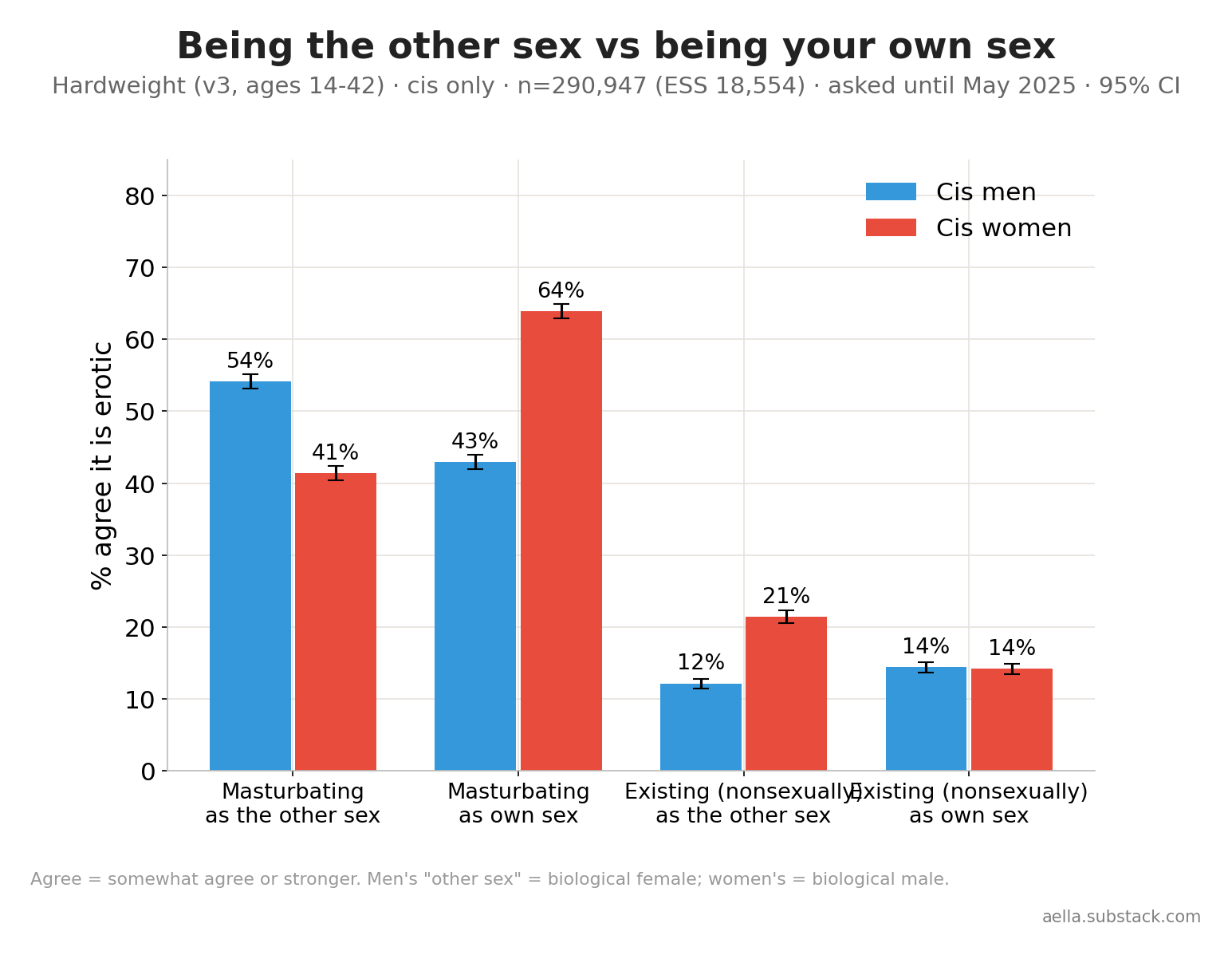
Women find being female in everyday life erotic at the same rate men find being male, so there's no special female "autogynephilia" here, which agrees with Bailey & Hsu. But women's arousal at existing as a man is higher than that baseline, which doesn't fit the idea that cross-sex arousal is a male phenomenon.
13 · HormonesAGP is lower with longer estrogen use
Autogynephilic arousal fades after transition, while the wish to be a woman remains.
In 232 patients of one surgeon, 49% reported hundreds of autogynephilic arousal episodes or more before surgery, versus 3% after (Lawrence 2005). The design was retrospective and self-selected.
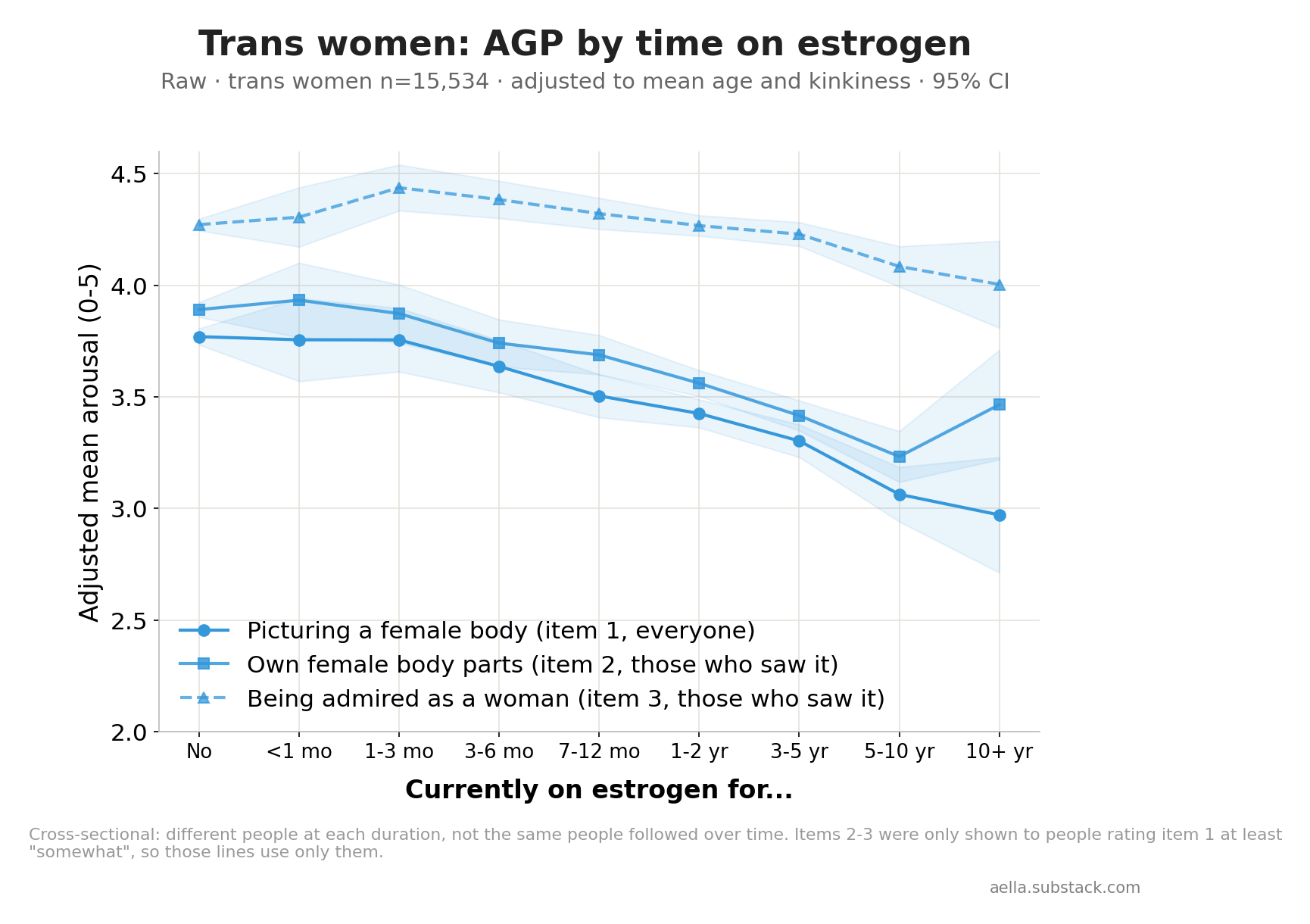
Consistent with the claim, with a twist: what fades is mostly the body-focused kind. Lower libido on estrogen explains only a small part of it. This is cross-sectional, so it compares different people at different stages rather than following the same people.
14 · Trans menA different population from Blanchard's
Trans men are overwhelmingly attracted to women. Blanchard's 1987 clinic had 71 female-attracted trans men and 1 male-attracted.
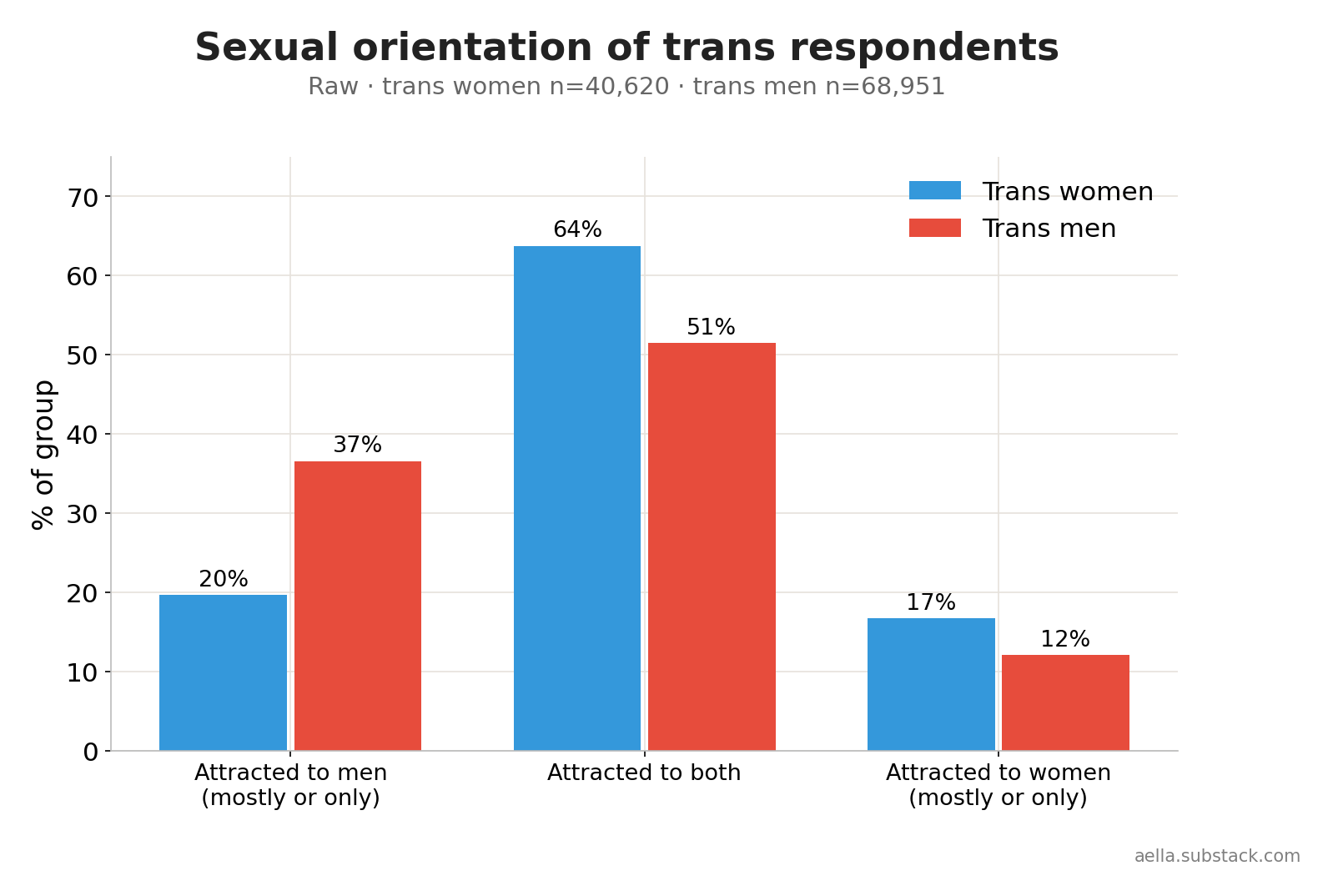
Trans men in this sample look nothing like Blanchard's. Only 12% are attracted mostly or only to women. Blanchard didn't propose an autogynephilia-like type for trans men, but some recent work argues that "autoandrophilia" exists among male-attracted trans men (Illy 2025). In the BKS, trans men's arousal at picturing themselves with a male body is highest among those attracted to men (59% very or extremely) and lowest among those attracted to women (41%). That is the mirror of the trans women pattern, and it fits the idea that cross-sex embodiment arousal follows attraction to the sex one becomes.
15 · Can't testWhat this survey can't answer
- Childhood femininity. The core of Blanchard's androphilic type. The BKS has no childhood gender nonconformity question.
- The asexual ("analloerotic") group. There's no asexual option on the attraction question.
- Which self-image is most arousing (nude, underwear, clothed), and physiologic AGP (menstruation, pregnancy).
- Surgery, and change within the same person over time.
- Whether bisexual AGP men see men as props. That is a claim about motive.
- Clinical populations. These are mostly young people online, not adults seeking treatment.
16 · MethodsData and caveats
- Data: Aella's Big Kink Survey. Raw (unweighted) data for trans subgroups and the sibling analysis; Hardweight v3 (weighted toward the general population, ages 14–42) for women's base rates; Softweight for the correlations in Fig 7.
- Strong AGP: very or extremely arousing on item 1. Items 2 and 3 were only shown to people who rated item 1 at least "somewhat"; charts of those items use only people who saw them.
- Orientation: the 7-step penises-to-vaginas attraction item. Androphilic = mostly or only penises; gynephilic = mostly or only vaginas; bisexual = the middle three.
- Crossdressing: rebuilt from the raw survey text, counting either "passable" or "nonpassing" crossdressing, because the cleaned data file merges the two options.
- Controls: the odds ratios control general kinkiness (mean arousal across 27 fetish categories) and age; the sibling models control family size and age.
- Caveats: a self-selected, very-online kink-survey sample (it spread well beyond Aella's own following), self-report throughout, and everything is cross-sectional. Blanchard studied clinic patients decades ago, so some differences may reflect who comes to a gender clinic rather than whether the theory is right.
Main sources: Blanchard 1985, Arch Sex Behav 14:247; Blanchard, Clemmensen & Steiner 1987, Arch Sex Behav 16:139; Blanchard 1989, J Nerv Ment Dis 177:616 and Arch Sex Behav 18:315; Blanchard 1992, J Abnorm Psychol 101:271; Blanchard & Sheridan 1992, J Nerv Ment Dis 180:40; Blanchard 1993, Arch Sex Behav 22:241 and J Sex Marital Ther 19:301; Freund & Blanchard 1993, Br J Psychiatry 162:558; Blanchard, Dickey & Jones 1995, Arch Sex Behav 24:543; Green 2000, Psychol Med 30:789; Lawrence 2005, Arch Sex Behav 34:147; Smith et al. 2005, Psychiatry Res 137:151; Veale, Clarke & Lomax 2008, Arch Sex Behav 37:586; Moser 2009, J Homosex 56:539; Moser 2010, J Homosex 57:790; Serano 2010, Int J Transgenderism 12:176; Nuttbrock et al. 2011, Arch Sex Behav 40:247; Veale 2014, Arch Sex Behav 43:1177; Hsu & Bailey 2017, Psychol Sci 28:115; Rosenthal, Hsu & Bailey 2017, Arch Sex Behav 46:255; Hsu & Bailey 2019, Arch Sex Behav 48:1349; Bailey & Hsu 2022, Arch Sex Behav 51:3311; Bailey, Hsu & Jang 2025, Arch Sex Behav 54:2805; Illy 2025, Arch Sex Behav 54:3005.