TL;DRShame attaches to what you want, not to watching porn — and it's the taboo themes specifically
Being ashamed of your own arousal is the normal condition — about two-thirds of respondents endorse it, men and women equally (mean +0.75 on a −3..3 scale for both). [Hardweight population estimate (Aug 2026): 53% agree, mean +0.14 — still a majority-adjacent norm, but the population version is lower, and the sex symmetry breaks: men 56%, women 49%. The perfect male/female tie is partly a fact about who takes this survey.] But the shame is not evenly distributed across desires. After controlling for how much porn someone watches, how kinky they are overall, how neurotic/depressed/anxious they are, and their politics, a specific cluster carries the shame: non-consent, humiliation, gender play, incest themes, bestiality, hypno/mental alteration, age play, transformation. And a cluster is shame-free or shame-negative: attraction to appearance, sadomasochism, bondage, toys, sensory play — the normalized, partnered kinks.
Meanwhile shame about porn use itself turns out to be content-blind: no fetish meaningfully predicts it once you account for how often someone watches. Porn-use shame is about the habit (and it's highest among the lightest users), not about what's on the screen. People aren't ashamed of using porn to look at what they want; they're ashamed of wanting it at all.
01Two different shames, two different questions
The survey has two shame items, and they behave completely differently:
- Arousal-shame — "I am ashamed or embarrassed about at least some of what arouses me" (−3 strongly disagree … +3 strongly agree; n≈1,071,000). Asked of everyone.
- Porn-use shame — "Do you feel shame about your pornography/erotica use?" (Not at all / A little / A moderate amount / A large amount, coded 0–3; n≈16,200 porn-watchers; added to the survey May 2026).
For every one of 29 fetish categories, we regress each shame measure on fetish strength (0–5), separately by natal sex, stepping through control sets: (1) porn frequency + age, (2) + overall kinkiness (the person's mean arousal across the other 28 categories — the crucial control, since kinky people report more of everything including shame), (3) + neuroticism, depression, anxiety, and politics, and (4) a recent-cohort model swapping in current religiosity. Betas are standardized: +0.10 ≈ a 1-SD stronger fetish goes with a tenth of a standard deviation more shame.
02The map: taboo themes carry the shame
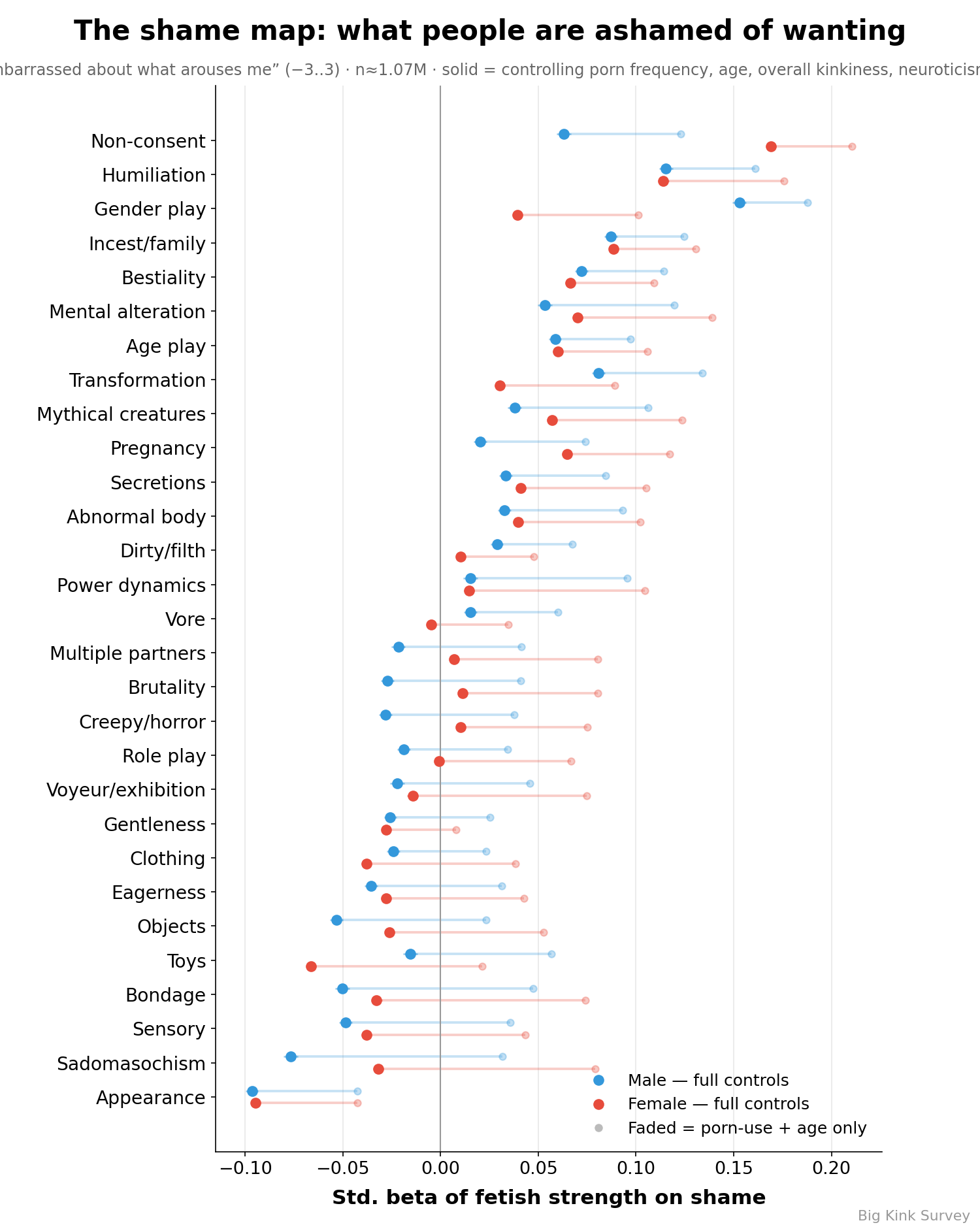
Three bands emerge after full controls (solid dots):
| Band | Fetishes | β (full controls, M/F mean) |
|---|---|---|
| Shame-carrying | Non-consent, humiliation, gender play, incest, bestiality, mental alteration, age play, transformation | +0.06 to +0.12 |
| Neutral | Mythical, pregnancy, secretions, abnormal body, dirty/filth, power dynamics, vore, multiple partners, brutality, creepy/horror, role play, voyeur/exhibition | −0.02 to +0.05 |
| Shame-negative | Gentleness, clothing, eagerness, objects, toys, bondage, sensory, sadomasochism, appearance | −0.03 to −0.10 |
The shame-carrying list is not "the kinky stuff" — sadomasochism and bondage are about as kinky as it gets and sit at the bottom. It's specifically the themes that violate consent, dignity, category, or law in their content. Notice the faded dots: before the kinkiness control, every fetish looks shame-associated, because kinkier people are more ashamed overall. The control splits that into a real content signal.
03Dose-response: the gradient is in the content
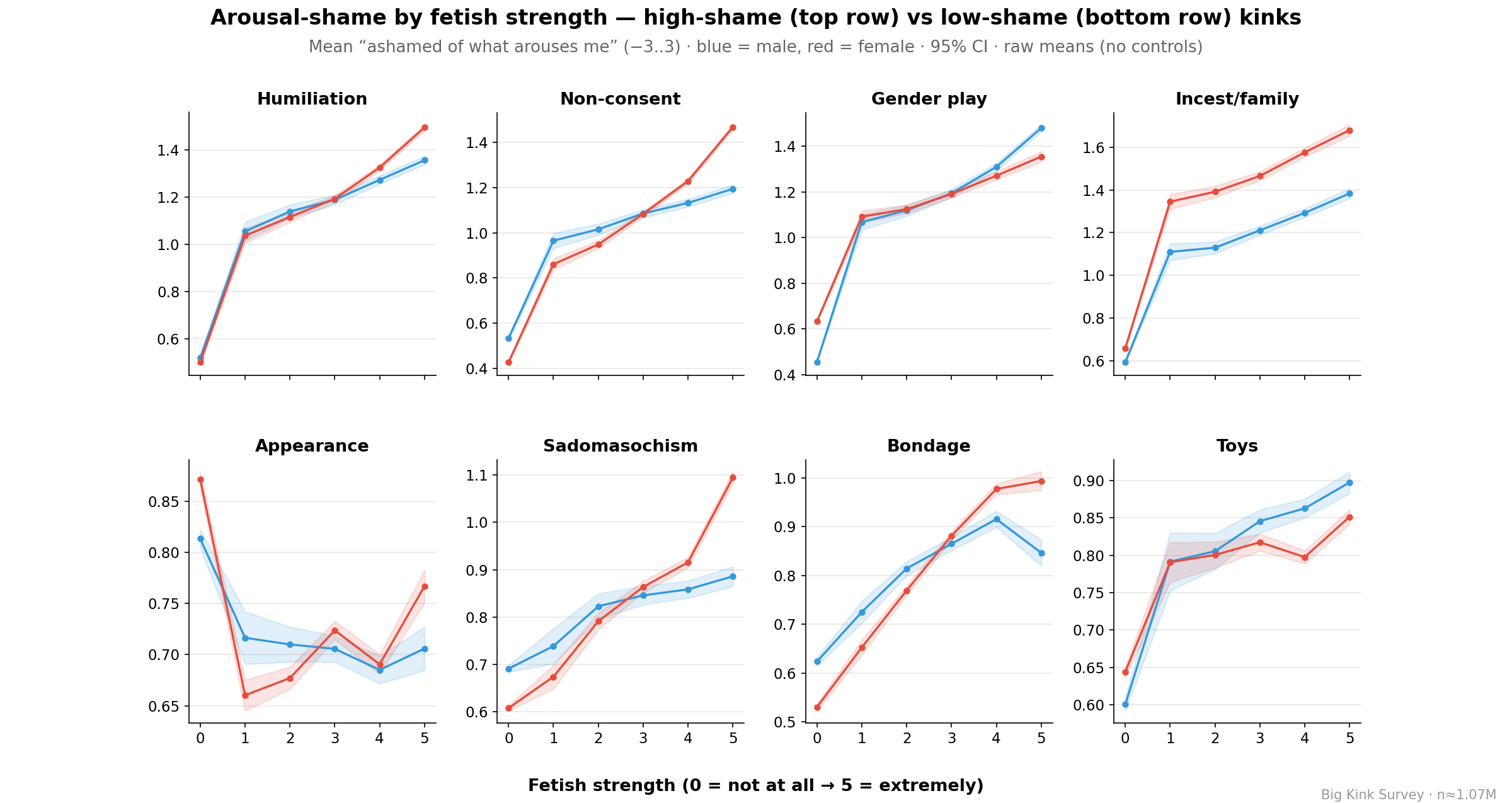
Raw means (no controls): arousal-shame climbs steeply with strength of the taboo kinks (top row — someone "extremely" into humiliation or non-consent averages +1.3 to +1.5 vs +0.5 for those not into it at all), while the bottom-row kinks rise far more shallowly — that shallow rise is the general-kinkiness confound the models remove.
04Porn-use shame: content-blind, and highest among light users
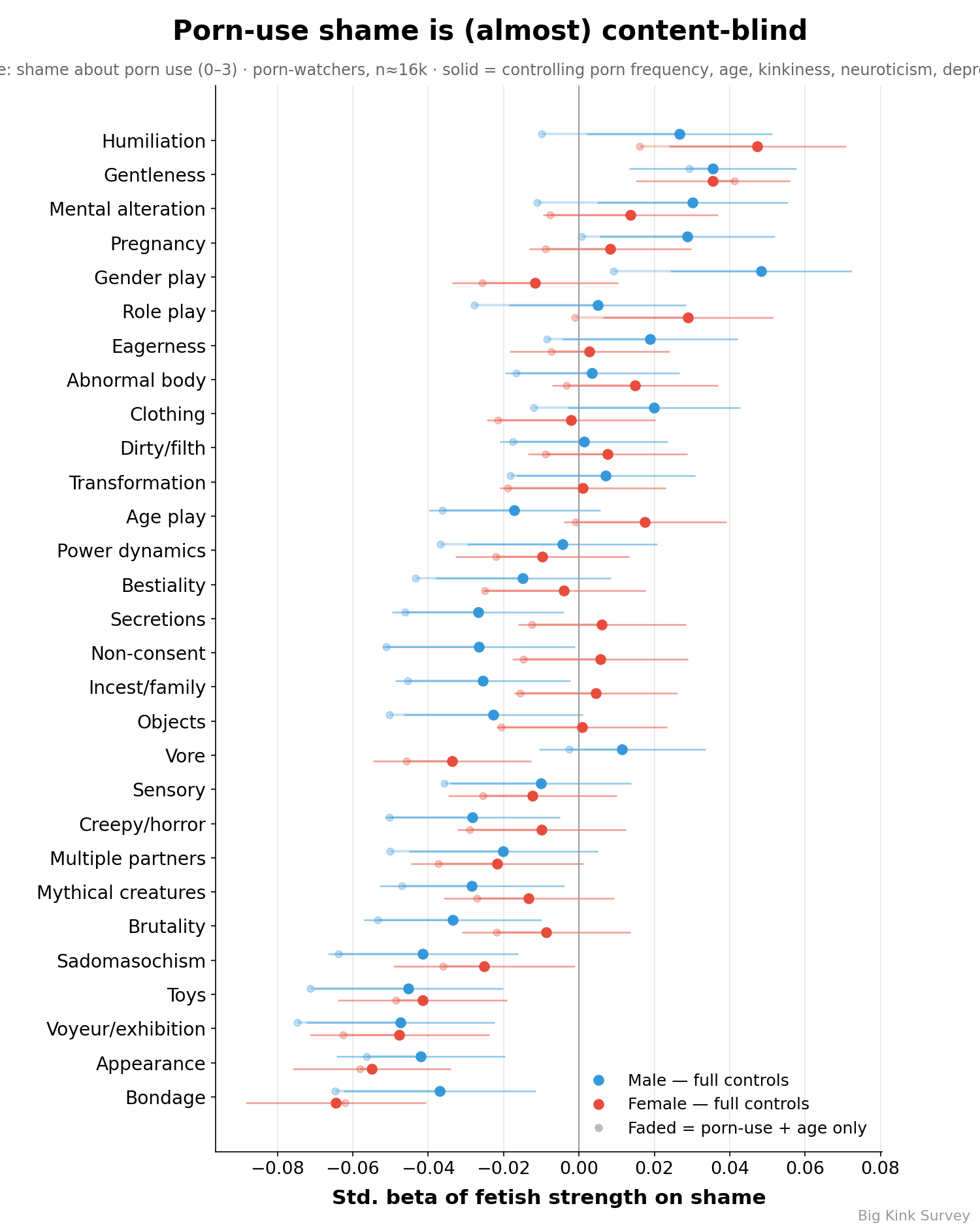
Run the identical analysis with shame-about-porn-use as the outcome and the map goes flat: after the kinkiness control, every fetish lands between −0.05 and +0.05 — nothing survives as a meaningful predictor. What you watch isn't what makes porn use feel shameful.
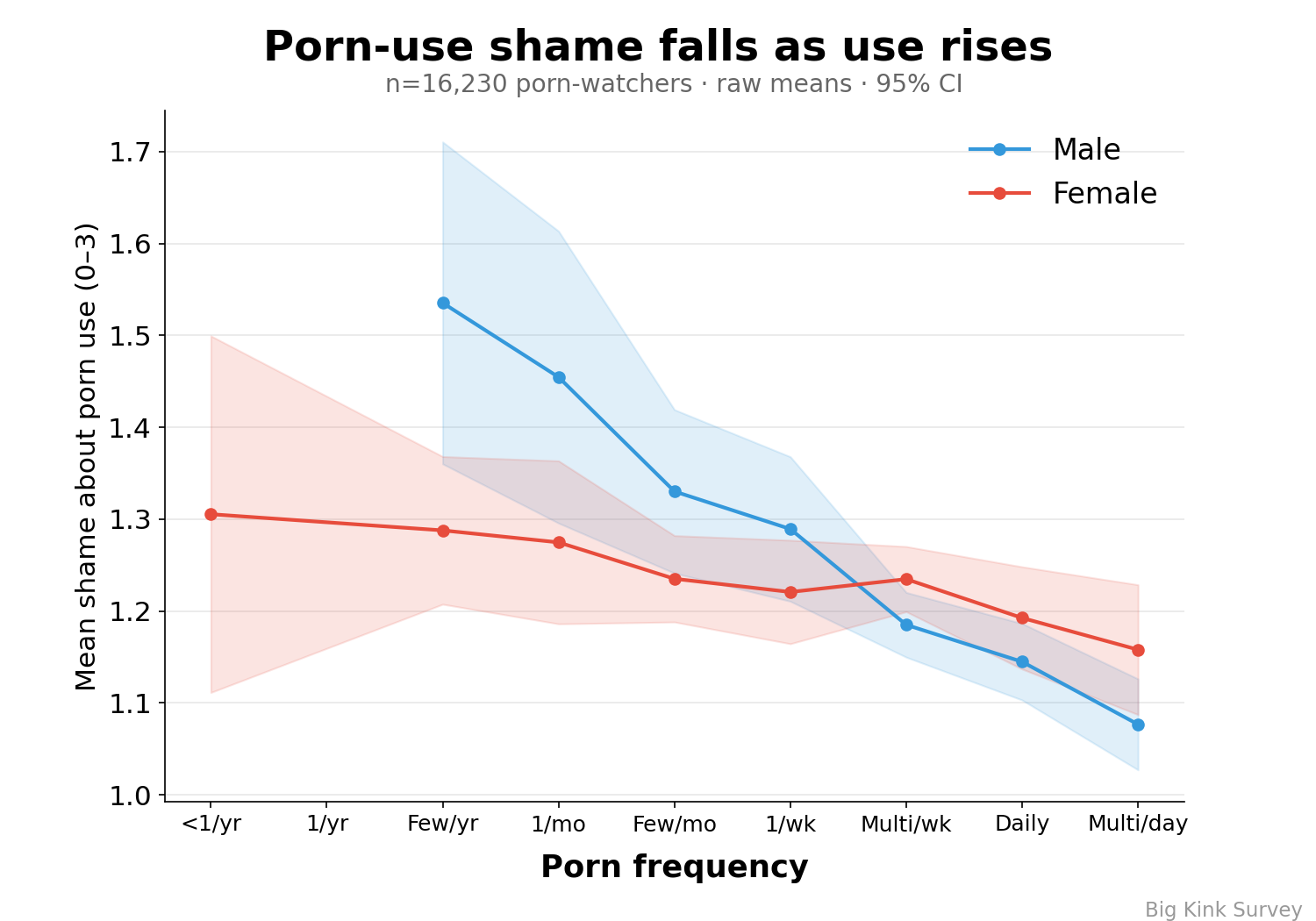
What does predict porn-use shame? Using less porn. Shame falls monotonically from ~1.4 (on 0–3) among people who watch less than yearly to ~1.1 among multiple-times-daily users — consistent with shame suppressing use, shame accompanying attempts to quit, or habituation among heavy users. (Cross-sectional; can't say which.)
05The confounders, one by one
- Degree of porn use — controlled in every model by design (the original question). It matters for porn-use shame, not for the content map.
- General kinkiness — the big one. Without it, all 29 fetishes "predict" shame; with it, the list splits into the bands above. Everything downstream includes it.
- Neuroticism, depression, anxiety — the obvious worry: shame-prone people might both feel more shame and have darker fetishes. Adding all three changes the betas by ≤0.01 essentially everywhere (compare b2→b3 in the data file). The content map is not a temperament artifact.
- Politics — controlled in the main model; no visible effect on the ordering.
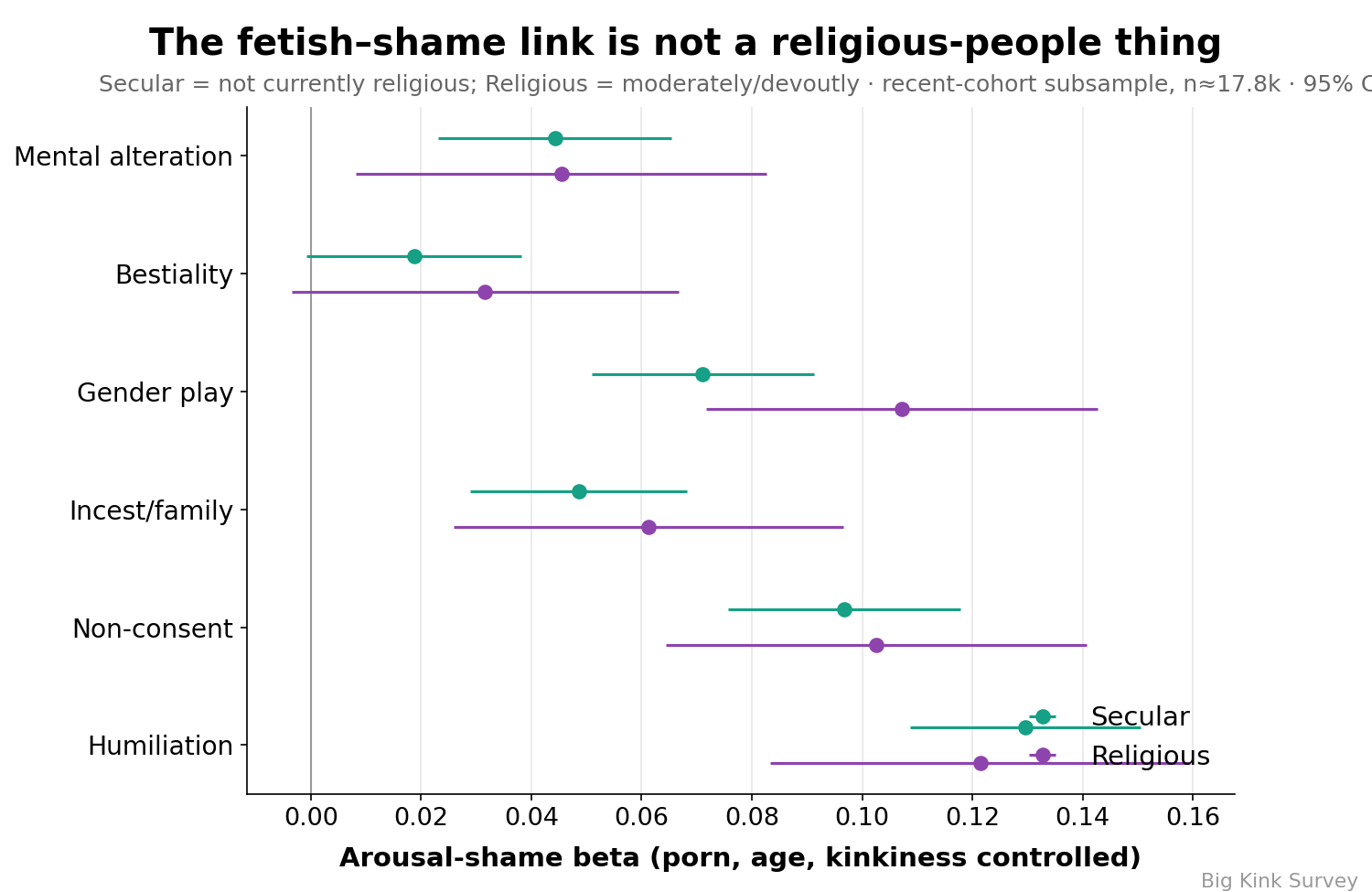
- Religiosity — two tests. First, re-running the full model in the recent cohort with current religiosity as a control: the ordering survives (humiliation +0.12, gender play +0.09, non-consent +0.08). Second, the interaction test — is the fetish→shame link a religious-person phenomenon? No: secular and devout respondents show near-identical betas for the top taboo kinks. Religiosity raises shame's overall level, but the content map is culture-wide.
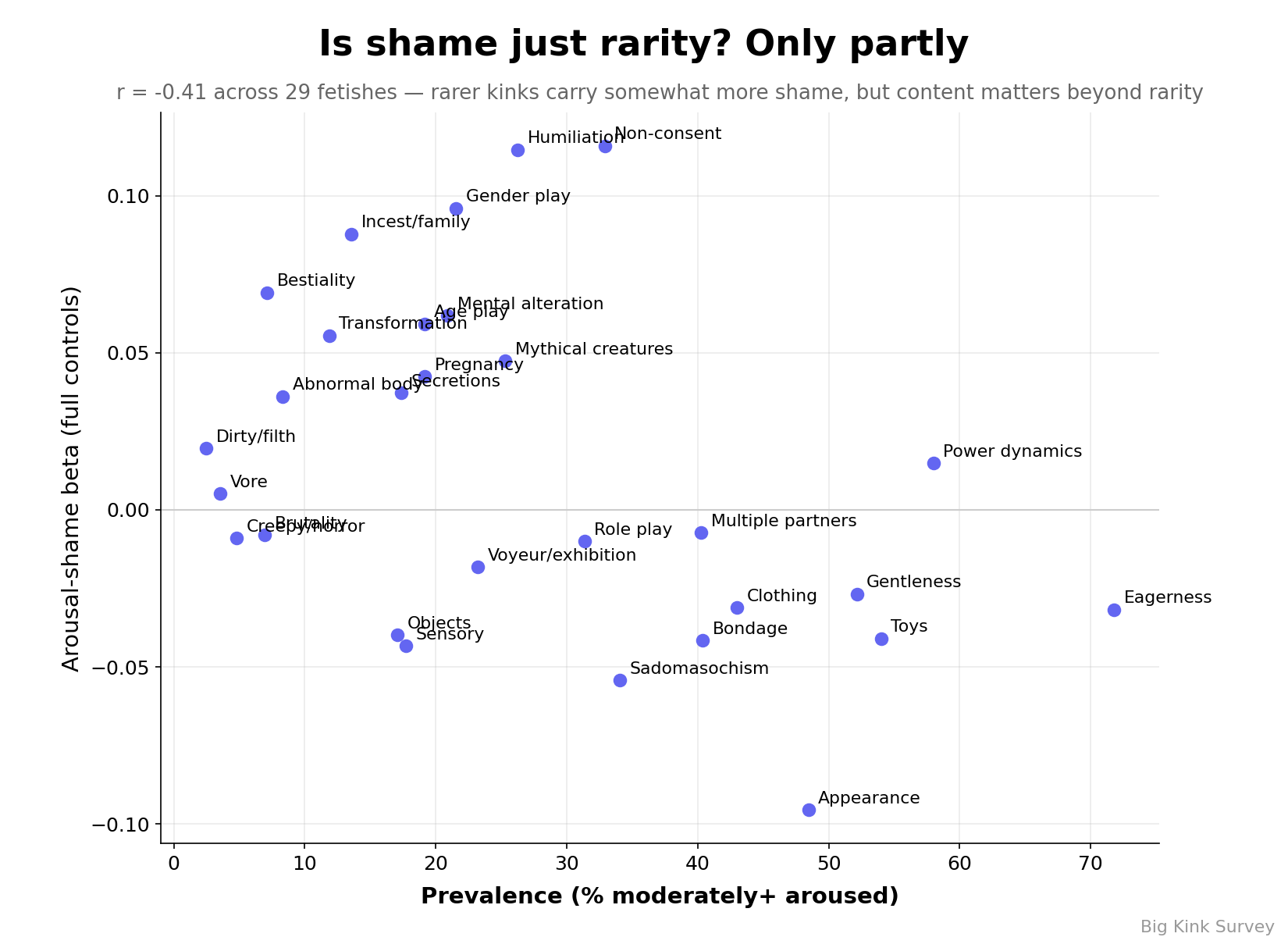
- Rarity — maybe people are just ashamed of unusual desires? Partly: across the 29 categories, rarer kinks do carry more shame (r = −0.41). But content beats rarity at both ends: humiliation and non-consent are among the most common fetishes (26–35% moderately+ in the sample; hardweight pop. est. 15% and 24%) yet top the shame map, while vore and creepy/horror are rare and shame-neutral.
- Sex — all models run separately by sex; see below.
- Not controllable here: causal direction (see verdict), and social-desirability differences in who admits shame.
06By sex: same map, two signature differences
Men and women carry identical amounts of arousal-shame (means 0.745 vs 0.754; 66% agree-plus for both) and broadly the same map. Two divergences stand out in the full-control model:
- Women's shame concentrates on non-consent (β = 0.17 vs men's 0.06) — the most common female-skewed fantasy is also the one women feel worst about.
- Men's shame concentrates on gender play (β = 0.15 vs women's 0.04) — gender-bending arousal is the most shame-loaded male desire, ahead of even incest and bestiality themes for men.
In both cases the sex that has the desire more (or for whom it's more identity-threatening) feels it more — shame tracks the perceived stakes, not the rarity.
07What this means (and what it can't tell you)
Is interest in specific fetishes associated with more shame, beyond porn use? For shame about one's own arousal: yes, strongly patterned, and robust to every confounder we could throw at it — kinkiness, temperament, mental health, politics, religiosity, rarity. The shame-carrying desires are precisely the morally/legally transgressive themes; the physically intense but consent-framed kinks (BDSM cluster) carry none. For shame about porn use: no — that's about quantity, not content.
The arrow could run either way, and plausibly runs both. The obvious reading is content → shame: people feel bad about wanting transgressive things. But the reverse path is real and sexologically respectable: shame and prohibition can eroticize ("forbidden fruit"), so the desires that grow in shame's soil would end up shame-correlated even if shame came first. The flat secular-vs-religious result cuts mildly against a pure social-conditioning story (the map isn't stronger where prohibition is), but this is a cross-section of self-reports — treat the associations as a map of where shame lives, not a causal diagram.
One more reading worth keeping: the most shameful desires are among the most common. A third of respondents are moderately+ into non-consent or humiliation themes, two-thirds of everyone is ashamed of something they want — whatever shame is doing, it is not marking out a deviant minority. [Hardweight population versions: ~a quarter moderately+ into non-consent, half ashamed — softer, but the conclusion stands.]
08Methodology & limitations
- Sample: Big Kink Survey (porn-conference subset build, June 2026 pull), 1,071,338 cleaned respondents 14+; analyses here use adults' full range with age + age² controls. Kink-survey sample: levels don't generalize; comparisons across fetishes are the point.
- Outcomes:
ashamed_arousal(−3..3, n≈1.07M, everyone) andpornshame(0–3, n≈16k porn-watchers, 2026 item). Porn-use-shame models restrict to porn watchers. - Models: OLS, standardized fetish strength (zeros included), per natal sex; controls stepped: porn habit (0–9) + age + age² → + leave-one-out kink breadth → + neuroticism, depression, anxiety, politics → cohort sensitivity with current religiosity. Cohort gotcha handled: the politics items exist only for pre-2026 respondents and the religiosity/porn-shame items only post-2026, so those controls are never combined.
- Religiosity interaction: recent-cohort subsample (n≈17.8k), secular (= not religious) vs moderately/devoutly religious, identical model per group.
- Rarity test: Pearson r between each fetish's prevalence (% moderately+) and its full-control shame beta, across 29 categories.
- Limitations: cross-sectional self-report; "shame" measured by single items; betas are small in absolute terms (max ≈ 0.12 — shame has many sources besides kink content); reverse causality (eroticized shame) and reporting differences not resolvable; the porn-shame item's n is ~16k so its null is tight but its subtle positives (e.g., humiliation +0.04) are at the edge of resolution.