01The data
The survey. Aella's Big Kink Survey is a long, anonymous online questionnaire about sexual interests, with about 1.35 million cleaned responses. This report is about two of its items, each rated Not arousing / Slightly / Somewhat / Moderately / Very / Extremely arousing:
- "I find older children who have not yet reached sexual maturity (e.g., age 8) to be:"
- "I find toddlers or babies to be:"
Both come with the reminder "Experiencing sexual arousal to a fantasy does not mean you would act in a way that harms others in real life." They're only shown to people who first tick the age-related category of kinks as something that arouses them; everyone else counts as "not arousing."
Who counts as having the interest. Anyone who rated either item "somewhat" or higher. Only adults are included (18–42). The survey's teenage respondents are left out.
Two versions of every number.
- Hardweight is the version of the dataset built to correct kink base rates. People who take a kink survey are kinkier than everyone else, so it reweights respondents aged 14–42 from the US, Canada, the UK and Western Europe to match the population on things that go along with kink and have known rates: sex, age, LGBTQ status, politics, ethnicity, BMI, sexual assault, religion, mental health, partner count, marriage and porn use.
- Raw is the unweighted survey: everyone aged 18–42 (1,048,721 people). It describes the people who took the survey, not the population.
TL;DRAbout 1 in 80 men, few women, and more than just "very kinky."
- It's mostly older children. 81% of the men with the interest rate only the "older children (e.g., age 8)" item that high; under 1% rate only the toddlers item.
- The kinks it goes with are taboo ones: age-gap scenarios, incest, age regression, bestiality and caregiver/little play. BDSM goes the other way.
- Half say erotic content about children would lower their own risk of acting on it (49%; 13% say it would raise it).
- Self-reported behavior: 9% of the men who answered (hardweight; raw 12%) say they've had sexual contact with a child, rising to about 15% among those most strongly aroused. 22% say they've had a sexual experience with someone who didn't want it, against 9% of equally kinky men.
02How common is it?
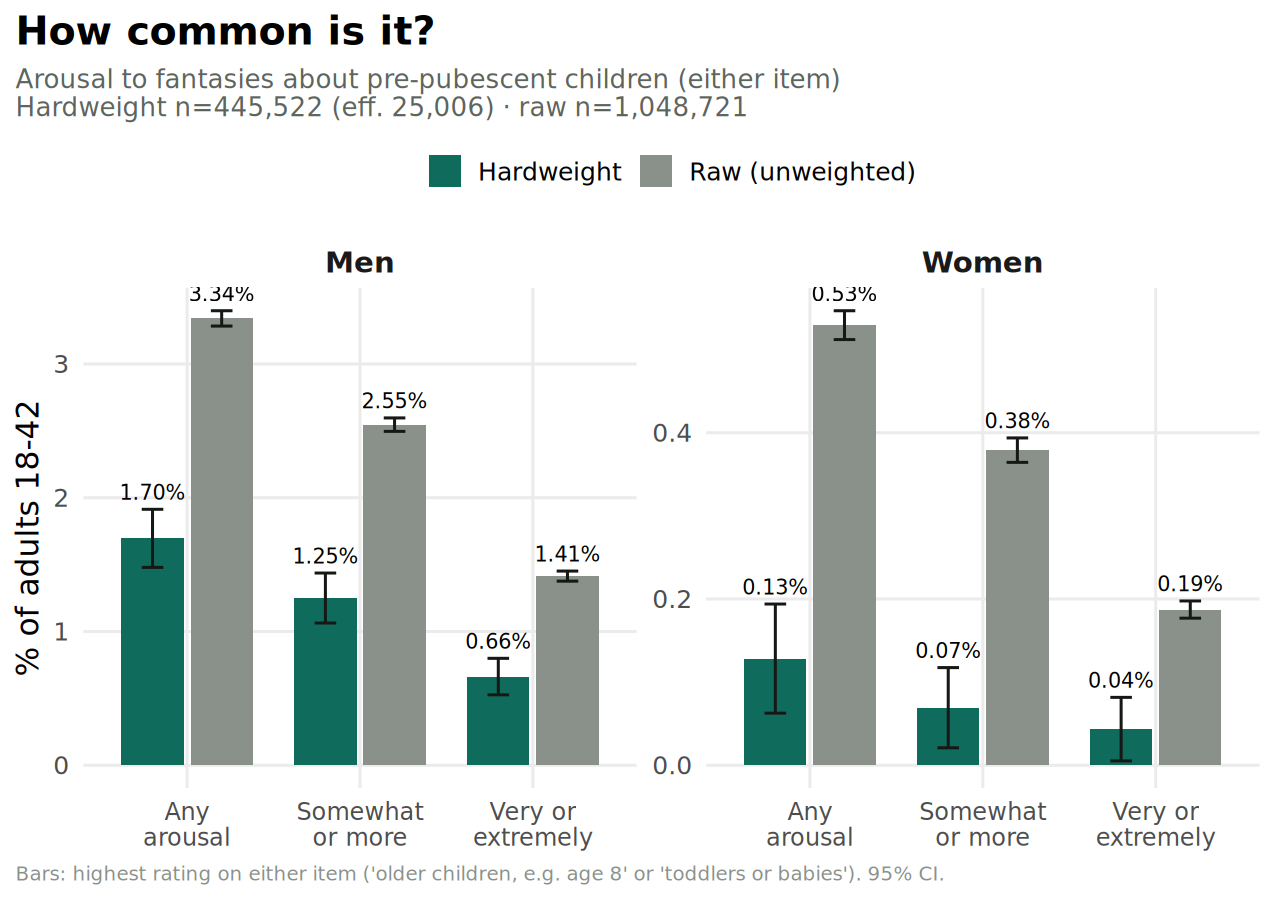
Hardweight roughly halves the men's rate: 1.25% of men aged 18–42 say "somewhat" or more, against 2.5% in the raw survey. 0.66% say "very" or "extremely" (raw 1.41%). Among women it's rare in both views: 0.07% in hardweight and 0.38% raw.
The two items are very different in size. 1.25% of hardweighted men rate older children "somewhat" or higher, but only 0.24% rate toddlers or babies that high, and almost all of those also rate older children that high. Among the men with the interest, 81% rate only the older-children item (raw 73%), 19% rate both (raw 26%), and under 1% rate only toddlers.
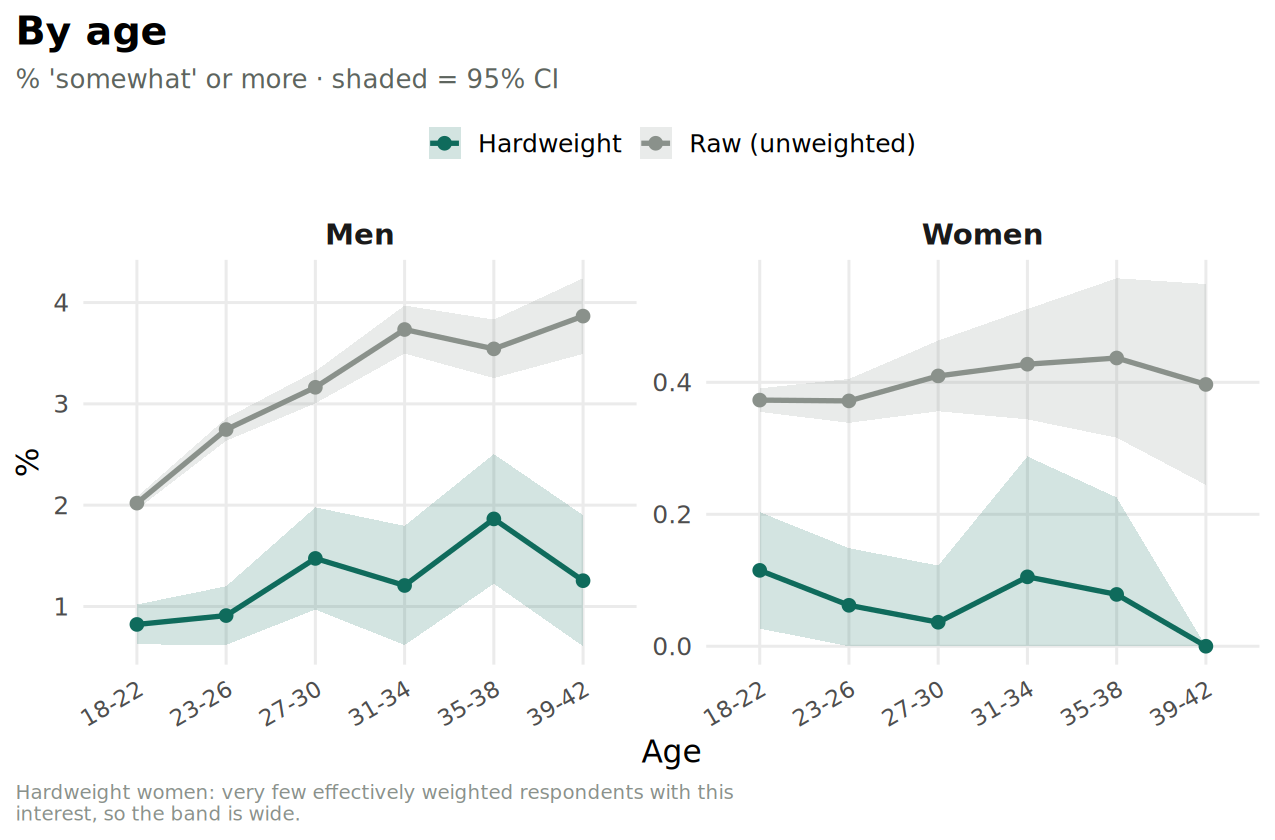
Among men it rises with age in both views: from 0.8% at 18–22 to about 1.2–1.9% in the 30s in hardweight, and from 2.0% to 3.5–3.9% raw. Among women the raw rate is flat at about 0.4% across ages.
Orientation and gender identity. In the raw survey, bisexual men report it most (3.5%), then straight men (2.5%) and gay men (1.9%). By gender identity it follows birth sex: 2.5–3.5% of cis men, trans women and nonbinary people assigned male at birth, against 0.25–1.3% of cis women, trans men and nonbinary people assigned female at birth. Hardweight agrees for straight cis men; for the smaller groups its error bars are too wide to say anything.
03Who are they?
Men with the interest are much kinkier than other men: their average arousal across 53 other kinks is 1.71 on the 0–5 scale, against 1.04 (hardweight), and they rate about 20 of those kinks "moderately" or higher, against 12. So the fair comparison isn't "everyone else." It's other men who are just as kinky and the same age. The chart shows both.
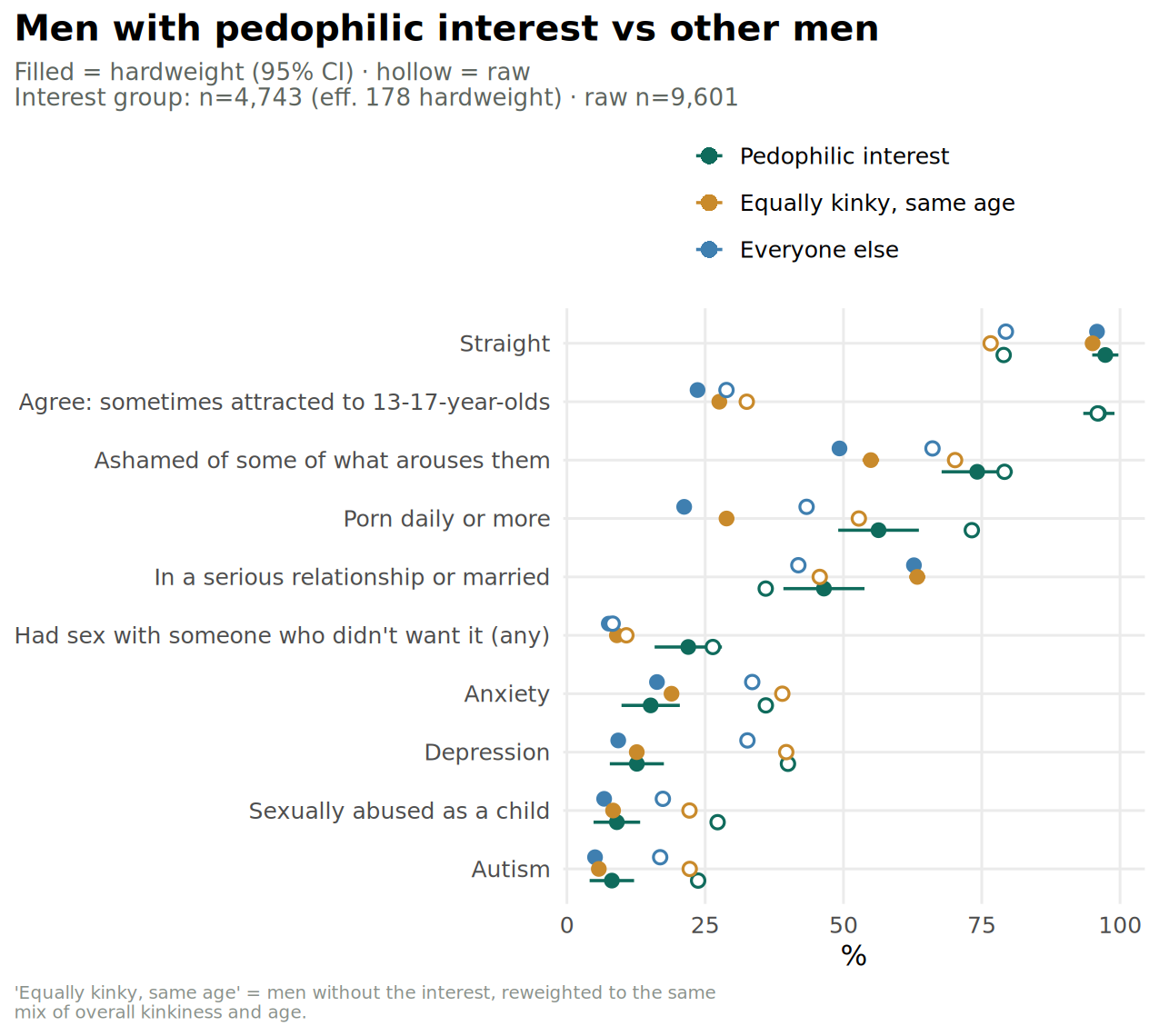
- Things that look different but aren't specific. Depression is higher than in men generally (13% vs 9% in hardweight), but exactly the same as in equally kinky men (13%). Anxiety, autism and childhood sexual abuse follow the same pattern: whatever difference there is from the average man comes from being kinkier, not from this interest.
- Things that stay different. Porn every day: 56%, against 29% of equally kinky men and 21% of everyone else. Ashamed of some of what arouses them: 74% vs 55% vs 49%. In a serious relationship or married: 46% vs 63% vs 63%.
- Attraction to teenagers. 96% agree they "sometimes find people who have clearly reached sexual maturity, but are not yet adults (e.g., ages 13–17)" sexually attractive, against 28% of equally kinky men. That agreement is common among men in general (24%), so it isn't distinctive by itself, but almost everyone with pedophilic interest has it.
- Orientation is no different: 97% of the men with the interest are straight, like other men in hardweight.
04What's specific to it, vs just being kinky?
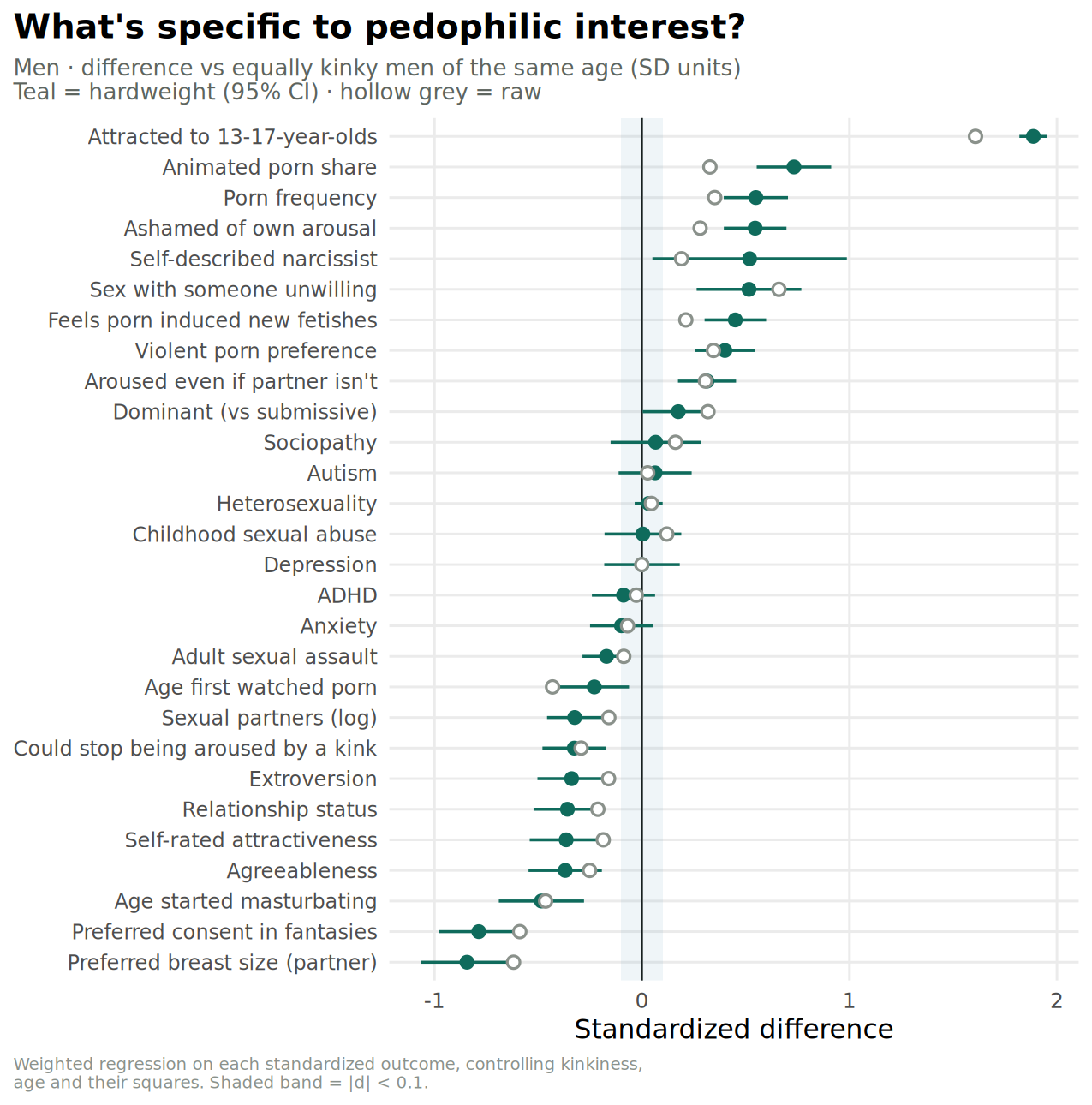
To find what goes with pedophilic interest itself, each trait below is compared with equally kinky men of the same age. The numbers are standardized differences: 0.2 is small, 0.5 is medium and 0.8 is large. Teal dots are hardweight, hollow grey dots raw.
What survives, in both views:
- Fantasies with less consent (−0.79 hardweight, −0.59 raw). Asked "the optimal amount of consent in my preferred erotic scenarios is," they choose less than equally kinky men do. They also more often agree they can get aroused by a partner doing what they like even if the partner isn't aroused (0.31, 0.31), and lean dominant rather than submissive (0.17, 0.32).
- A preference for smaller breasts (−0.84, −0.62) in a partner: a preference for a younger-looking body that carries over to adult partners.
- Porn. More of it (0.55, 0.35), more of it animated (0.73, 0.33), more violent porn (0.40, 0.34), and more often the feeling that porn induced new fetishes in them (0.45, 0.21).
- An earlier start. They began masturbating younger (−0.48, −0.46) and watching porn younger (−0.23, −0.43). In the raw survey, almost every other kink they have also started earlier for them, by about a third of a standard deviation.
- Shame and less control. More shame about their arousal (0.55, 0.28), and they're less likely to say they could stop being aroused by something they're into if they wanted to (−0.33, −0.29).
- Fewer social and romantic ties. Less often partnered (−0.36, −0.21), fewer sexual partners for their kink level (−0.32, −0.16), lower self-rated attractiveness (−0.37, −0.19), lower agreeableness (−0.37, −0.25) and lower extroversion (−0.34, −0.16).
- Self-reported non-consensual sex (0.52, 0.66). 22% say "Have you ever had a sexual experience with someone else who did not want the experience?" applies to them at least mildly, against 9% of equally kinky men and 8% of everyone else (raw 26%, 11% and 8%).
What doesn't: depression, anxiety, ADHD and autism are all within 0.1 of zero once kinkiness is held constant. Childhood sexual abuse is too: zero in hardweight and 0.12 in raw. A history of abuse is more common in this group than in men overall, but no more common than in equally kinky men. Self-reported sociopathy is small and not clear (0.07, 0.16). One self-described trait, "I am a narcissist," comes out high in hardweight (0.52), but it was asked of few people and the raw figure is 0.19, so hold it loosely.
Does any of it scale with how strong the interest is?
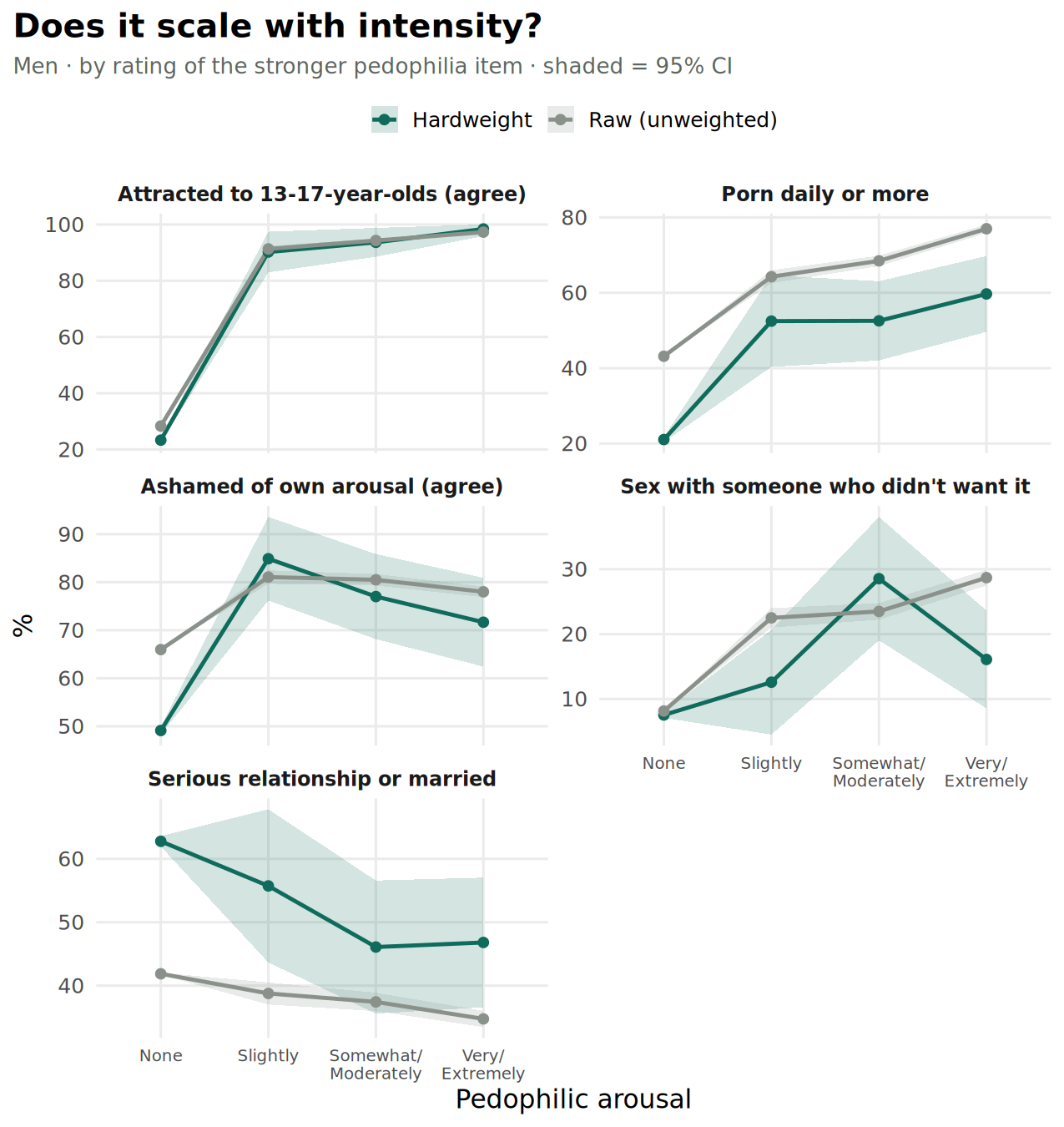
Attraction to 13–17-year-olds is a step: it jumps from about a quarter of men to nine in ten at even "slight" pedophilic arousal. Daily porn use and non-consensual sex climb with intensity: in the raw survey, 8% of men with no pedophilic arousal report a sexual experience with someone who didn't want it, against 22–24% at "slightly" to "moderately" and 29% at "very" or "extremely." Being partnered drifts down. Shame is a step, not a slope.
05The kink signature
Which other kinks go with it, beyond general kinkiness? These are partial correlations, controlling each man's average arousal across the other kinks:
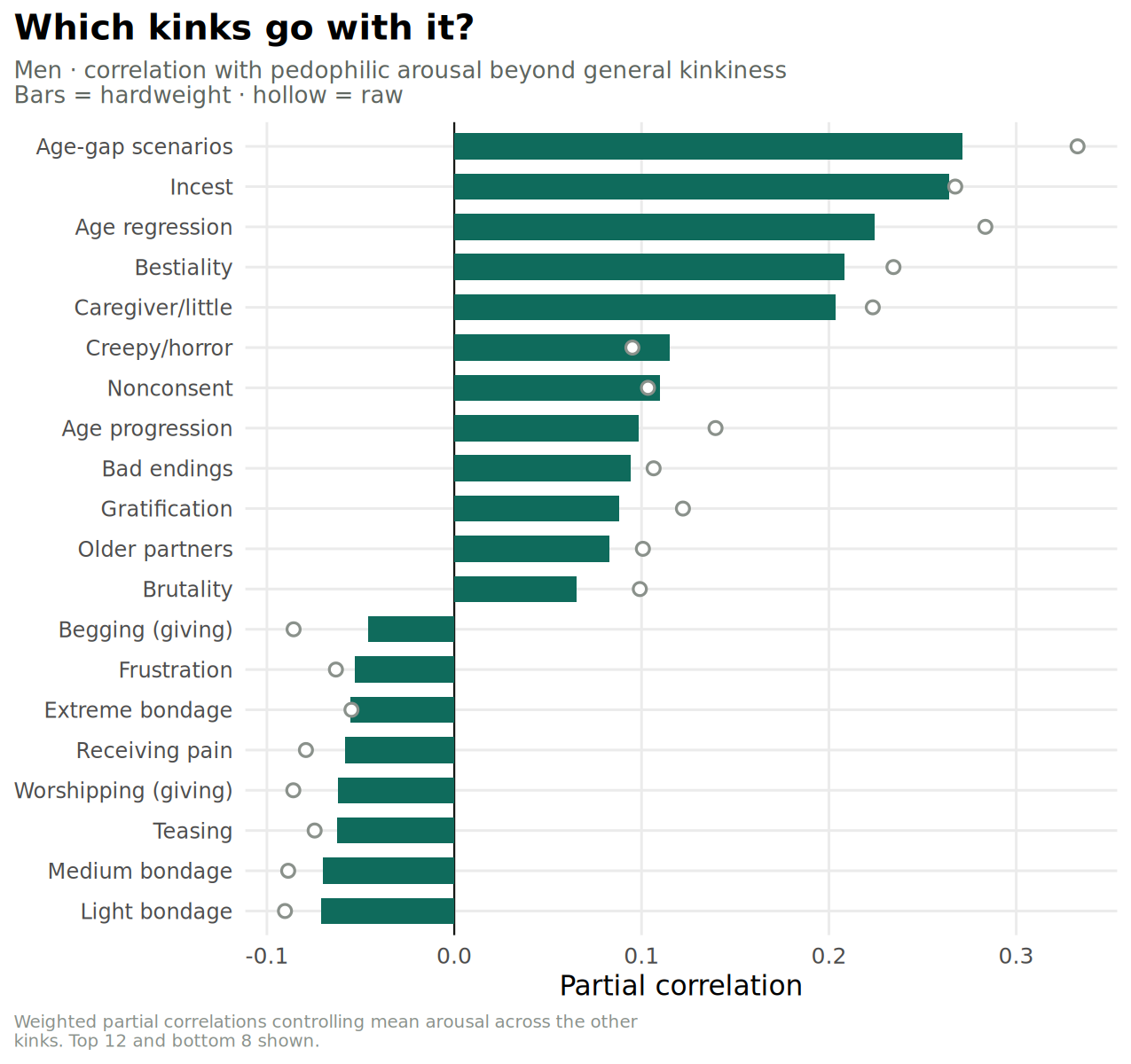
The top of the list is about age and taboo: age-gap scenarios (0.27 hardweight, 0.33 raw), incest (0.26, 0.27), age regression (0.22, 0.28), bestiality (0.21, 0.23) and caregiver/little dynamics (0.20, 0.22), then creepy or horror themes, nonconsent and age progression. At the bottom are the core BDSM kinks: light and medium bondage, teasing, worshipping and receiving pain all correlate slightly negatively once kinkiness is held constant. This is the same taboo cluster the bestiality report found, and it isn't BDSM.
06Fantasy, beliefs and behavior
People who rated either item at all were asked four follow-up questions. Two of them were added later, so only about 60% of the group saw them.
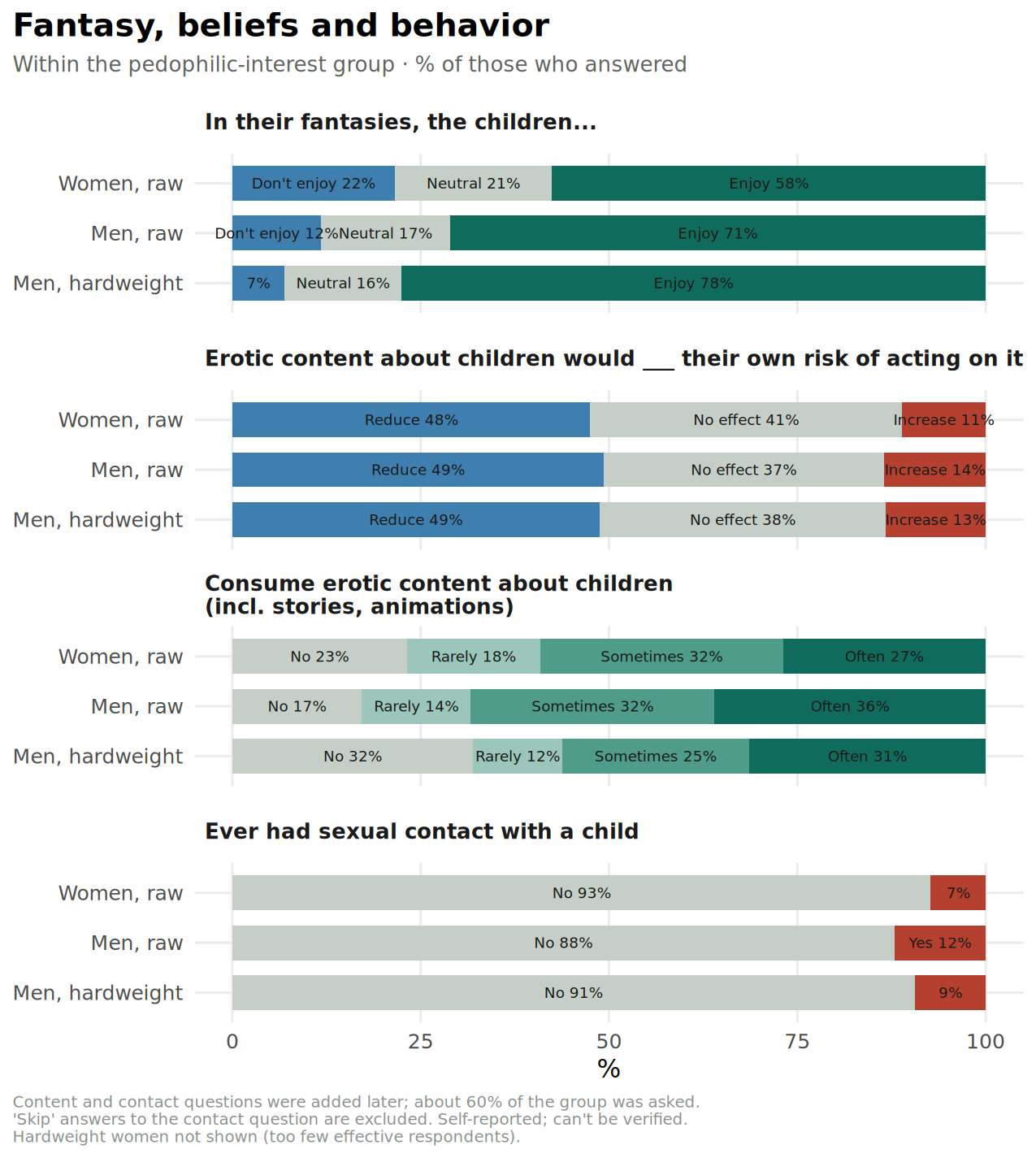
- "In your fantasies involving children, the children typically ___ the experience." 78% of the hardweighted men say the children enjoy it, and 51% say they "totally" enjoy it; 7% say they don't. Women (raw) are more split: 58% enjoy, 22% don't.
- "In general, consuming erotic content about children feels like it would ____ my likelihood of acting on this in real life." About half say it would reduce it (49%), 38% no effect and 13% increase, in both views and both sexes.
- "Do you consume erotic content about prepubescent children? This can include victimless content, such as erotic stories or animations." 68% of hardweighted men say at least rarely and 31% often (raw 83% and 36%). The question includes written and drawn material, so this isn't a rate of viewing abuse imagery.
- "Have you ever had sexual contact with a child?" (with the note "Not including child-on-child sexual experiences – only when you were older"). 9% of the hardweighted men who answered say yes (95% CI 4–15%; raw 12%), mostly "slightly." It's 3% among men rating their arousal "somewhat" or "moderately" and 15% among those at "very" or "extremely" (raw 5% and 17%). Among women (raw) it's 7%.
07Women (raw only)
With an effective sample of 11 in hardweight, women's numbers here come from the raw survey: 2,546 women aged 18–42 with the interest. They describe women who took the survey, not the population.
- Less often straight: 44%, against 57% of equally kinky women and 64% of everyone else.
- More dominant (0.74 vs equally kinky women) and more often report a sexual experience with someone who didn't want it (19%, against 5% of equally kinky women).
- Attraction to 13–17-year-olds: 85%, against 16% of equally kinky women.
- Porn every day: 49%, against 30% of equally kinky women.
- Lower agreeableness (−0.52), more often self-described narcissists (0.51), and more often report sociopathy (0.39).
- Childhood sexual abuse is reported by 54% of these women, against 48% of equally kinky women and 38% of everyone else. Autism is 34%, against 26% and 18%. Both are somewhat higher even after allowing for kinkiness, unlike for men.
- Kink signature: the same taboo cluster, led by incest, age regression, bestiality and age-gap scenarios, a bit weaker than for men.
08Methodology & limitations
Source & measures
Aella's Big Kink Survey (GuidedTrack), about 1.35 million responses after cleaning. The two items are gated behind the age-related kink category; people who didn't tick it are scored "not arousing." The arousal scale is coded 0–5 (Not arousing to Extremely). The group is everyone aged 18–42 rating either item 2 ("somewhat") or higher. Follow-up questions were shown only to people with some arousal. The contact and content questions were added later.
Weighting
Hardweight is the version of the dataset built to correct kink base rates. It covers ages 14–42 in the US, Canada, the UK and Western Europe and rakes to: sex × age × LGBTQ status; sex × politics; LGBTQ × politics; age × politics; age × ethnicity; age × BMI; childhood and adult sexual assault by sex; religious upbringing; self-reported autism, ADHD and depression; lifetime partner count by sex and age; marriage by sex and age; porn-use frequency by sex and age; and current religiosity and anxiety among women in the US. Weights are capped at 30. The 445,522 adults aged 18–42 have an effective sample of about 25,000. The interest group's is about 178 men and 11 women. Raw is the unweighted cleaned survey, all countries, ages 18–42. All confidence intervals are 95% and use the effective sample size of the group shown.
Models
General kinkiness is the average arousal across 53 kink items, from spanking to vore, leaving out all the age-related ones. "Equally kinky, same age" reweights the people without the interest to the same mix of kinkiness (20 bands) and age (6 bands) as the people with it, separately by sex. The standardized differences are weighted regressions of each standardized outcome on group membership with kinkiness, age and their squares as controls, fit separately by sex, with robust standard errors. The kink signature uses weighted partial correlations, controlling a leave-one-out version of the same kinkiness average.
Limitations
- Fantasy, mostly. The two main items measure arousal to imagined scenarios. The few behavior questions are self-reports with no comparison group.
- Hardweight's tiny effective sample for this group. Men's hardweight estimates rest on the equivalent of about 178 people, and women's on about 11. Where hardweight and raw agree, the finding is solid. Where they differ, the raw number describes survey-takers and the hardweight number is noisy.
- Weighting corrects for the known correlates of kink, not unknown ones. On sexual items that can be checked against probability samples, this dataset still runs above them even after weighting. 1.25% for men is the best estimate this data supports, and the true rate could be lower.
- Gating. Someone with this interest who didn't tick the age-related category is counted as not aroused, which pushes rates down.
- Many comparisons. The traits were found by screening a few hundred survey questions. Large effects are far beyond chance, but anything under about 0.15 should be held loosely.
- Cross-sectional and self-reported. Nothing here says what causes what.
Analysis pipeline: R (DuckDB, data.table, ggplot2); scripts and full results tables available on request.