TL;DRIt's common, it's mostly "generic kinkiness" — except the shame.
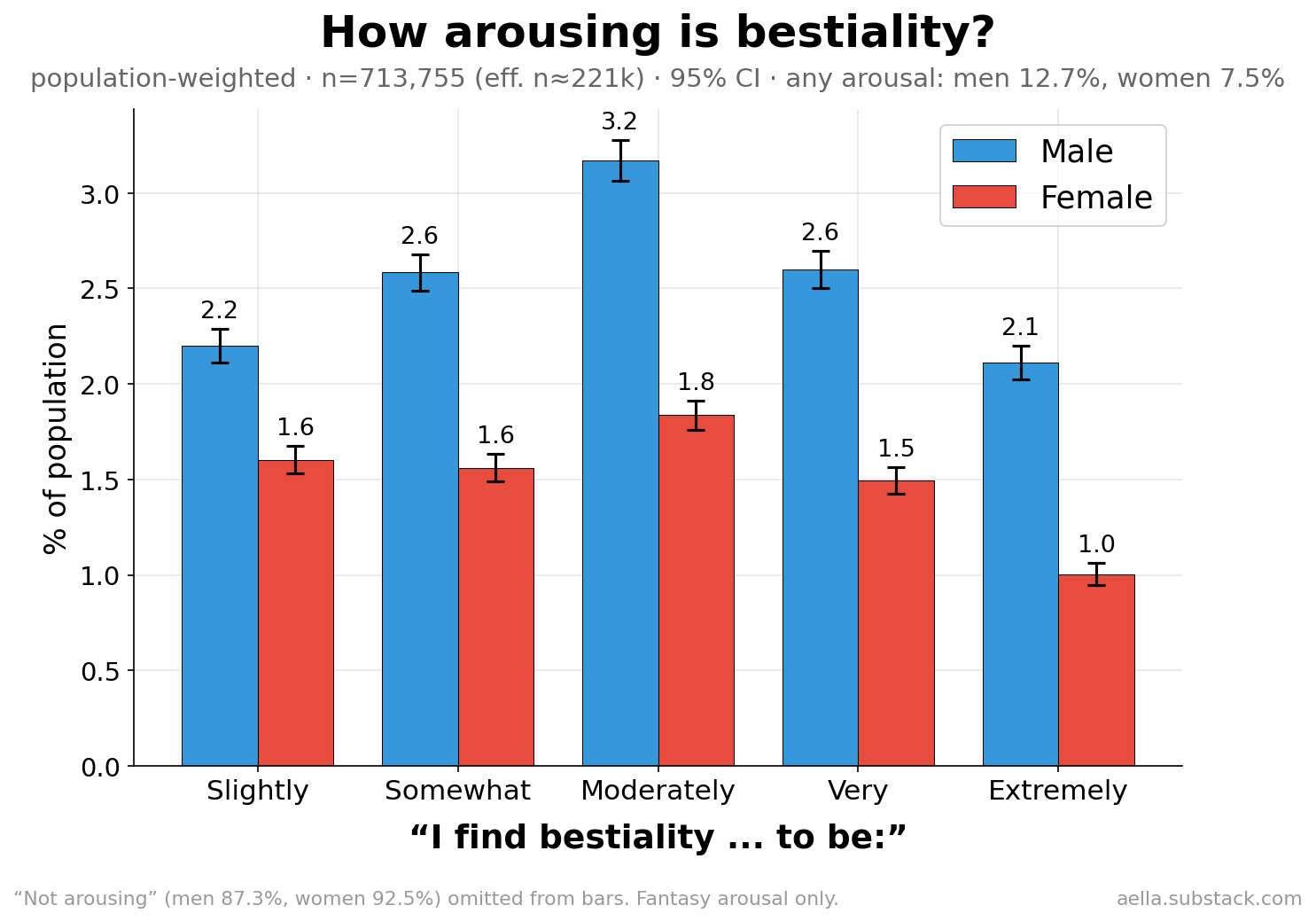
About one person in ten reports some arousal to bestiality — more among men (12.7%) than women (7.5%), and strikingly more among bisexual people. At first glance the interested look different in lots of ways: more depression, more childhood sexual assault, more autism, way more porn. But almost all of that is just what kinky people in general look like. Compare them to equally kinky people and nearly every difference collapses to zero — the trauma and mental-health story is not a bestiality story.
What actually survives the comparison: shame about their own arousal, heavier and earlier porn use, a modest extra dose of autism, male bisexuality — and, oddly, slightly fewer sexual partners than their equally-kinky peers. And their other fantasies aren't random: bestiality residually co-travels with the taboo/creature cluster (incest, mythical creatures, transformation, creepy/horror) while being residually negatively correlated with mainstream BDSM (spanking, bondage, teasing).
01The data
Aella's Big Kink Survey: 1,071,355 cleaned respondents, recruited via viral spread across the internet — the survey traveled far beyond Aella's own following. Respondents rate dozens of sexual interests on a six-point scale — "I find bestiality, or sexual interaction with at least one non-human animals/amphibians/insects/birds/etc, to be: Not arousing / Slightly / Somewhat / Moderately / Very / Extremely." The survey clarifies it means real creatures (not being an animal yourself, and not fantasy creatures — those have their own sections).
Two analysis modes, used deliberately: base rates use population weights (raking to US/Canada/W-Europe demographics on sex, age, cis/trans, BMI, politics, ethnicity; effective n ≈ 220,000, ages 14–33), so "how common" numbers approximate the general population rather than the self-selected survey-taker pool. Correlational results use the full unweighted million, where precision matters more than representativeness.
02How common is it?
Weighted to the population, 10.1% report at least some arousal to bestiality, and 6.1% say "Moderately" or more. [Under the stricter hardweight population weighting: 7.3% any arousal, 4.2% moderately+; men 9.1%, women 5.3%.] It's not a long thin tail, either — the distribution among the interested is fairly flat: about as many people say "Extremely" as say "Slightly."
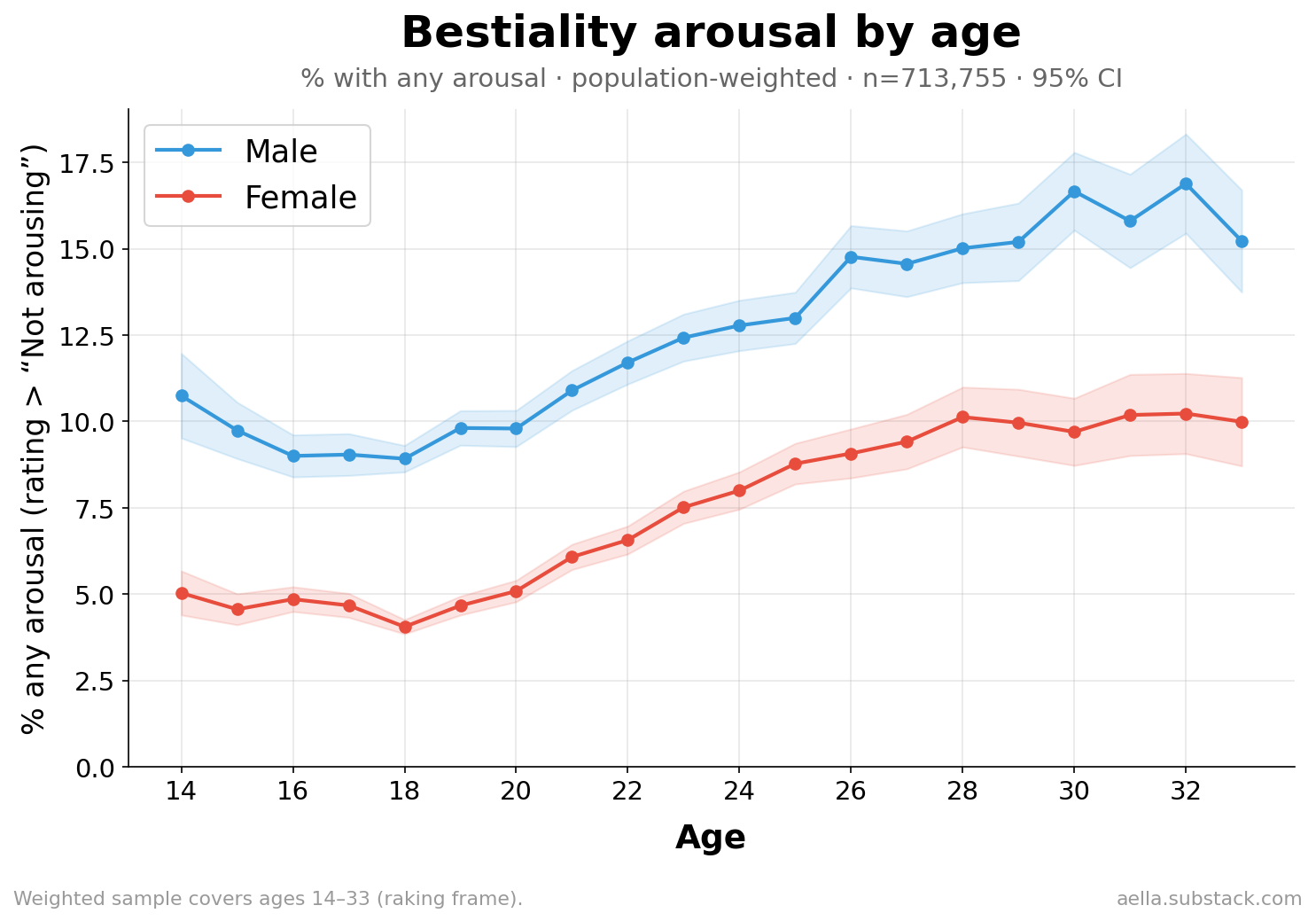
Arousal rises with age — roughly doubling for both sexes between 18 and 30. That could be aging, cohort, or older people being more honest with themselves; the late-onset numbers below suggest some of it is real acquisition in adulthood.
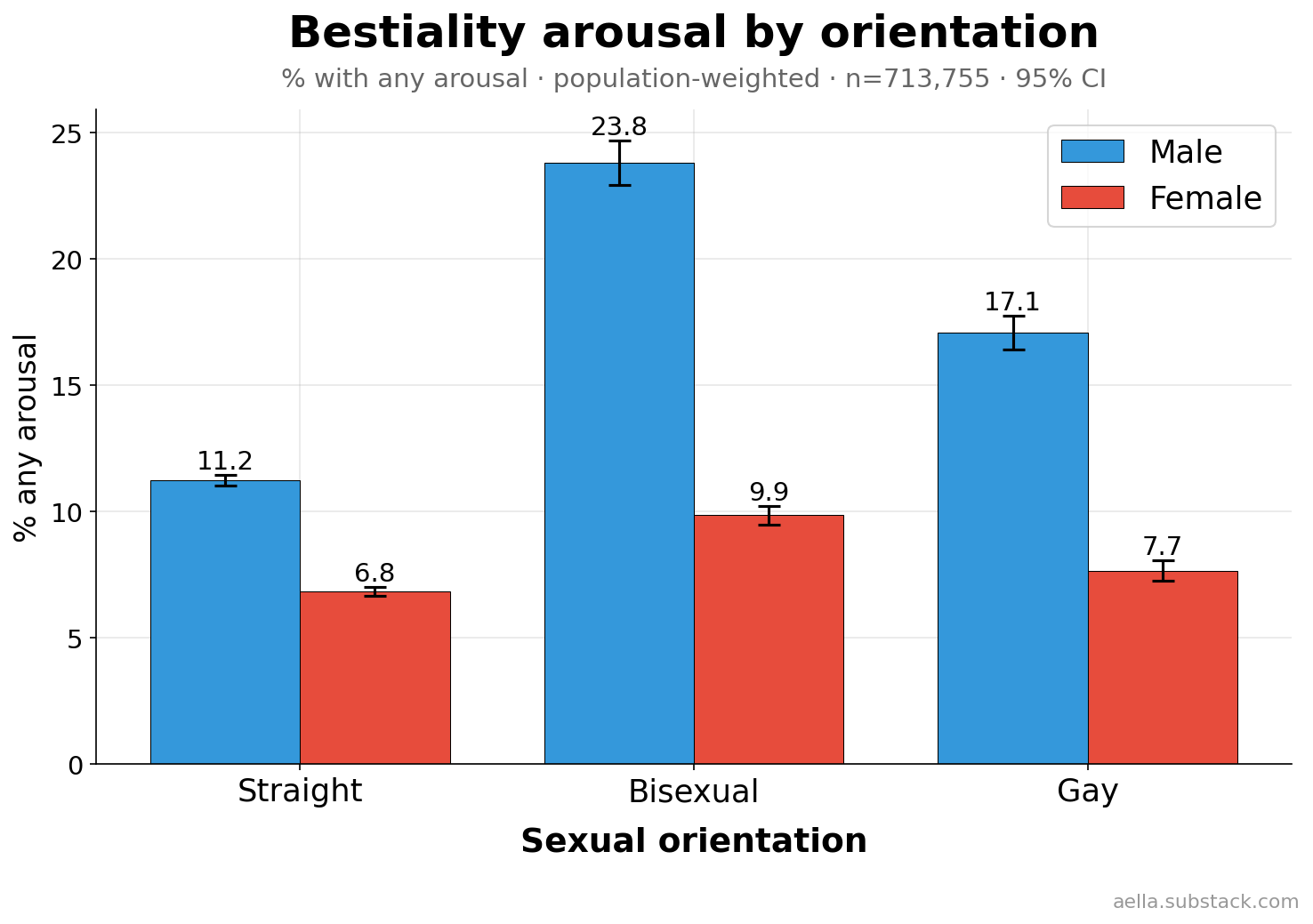
Orientation matters a lot: bisexual men are at 23.8% — more than double straight men (11.2%) — with gay men in between (17.1%). The same ordering holds for women (9.9% bi vs 6.8% straight). A pattern worth remembering for the residual analysis later: even after controlling for kinkiness, lower heterosexuality stays linked to bestiality among men.
03Which animals?
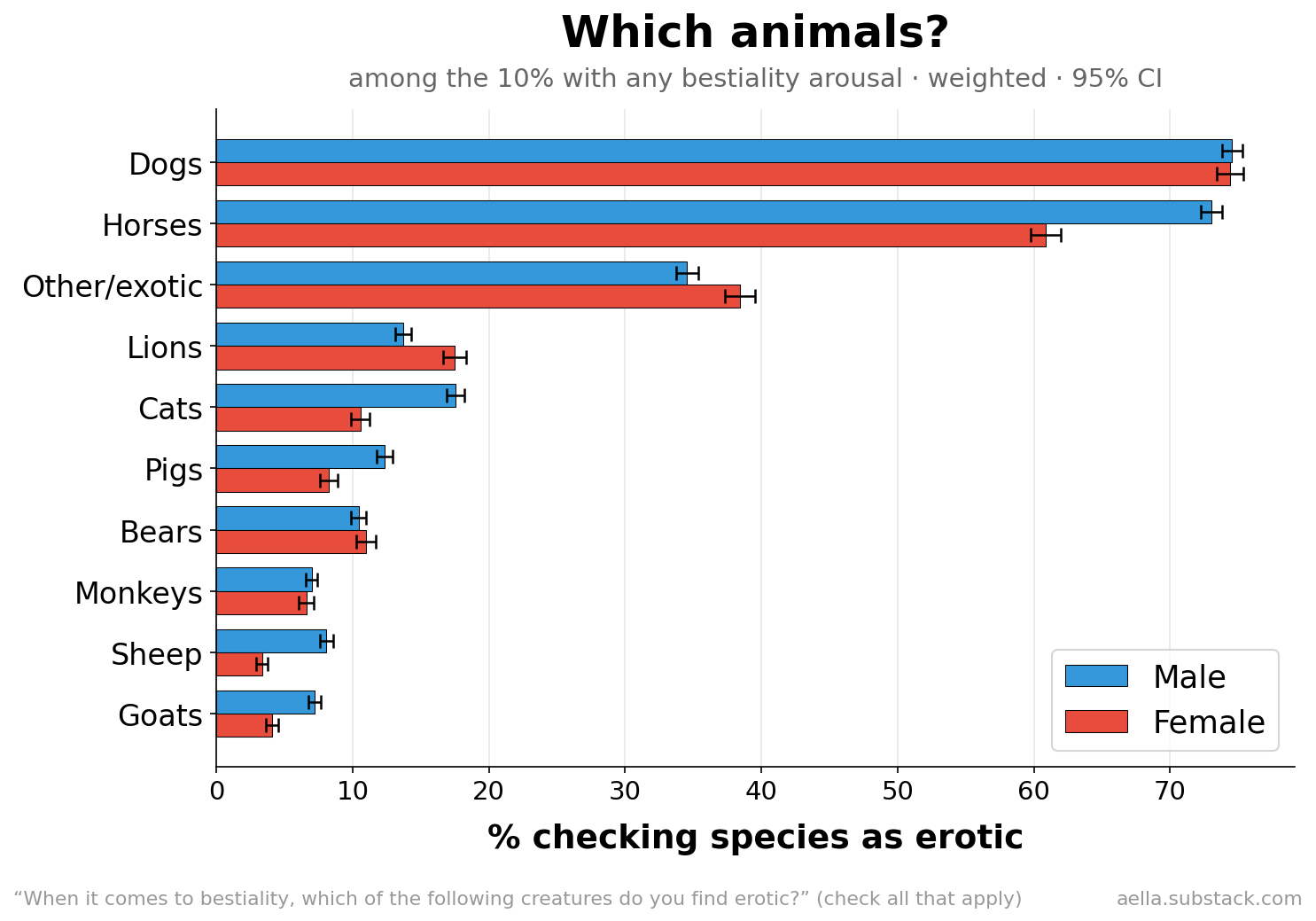
Dogs and horses, overwhelmingly — each endorsed by well over half of the interested. Men and women like dogs equally (≈75%); horses skew male (73% vs 61%); cats, pigs, sheep and goats skew male; lions and the exotic list skew female.
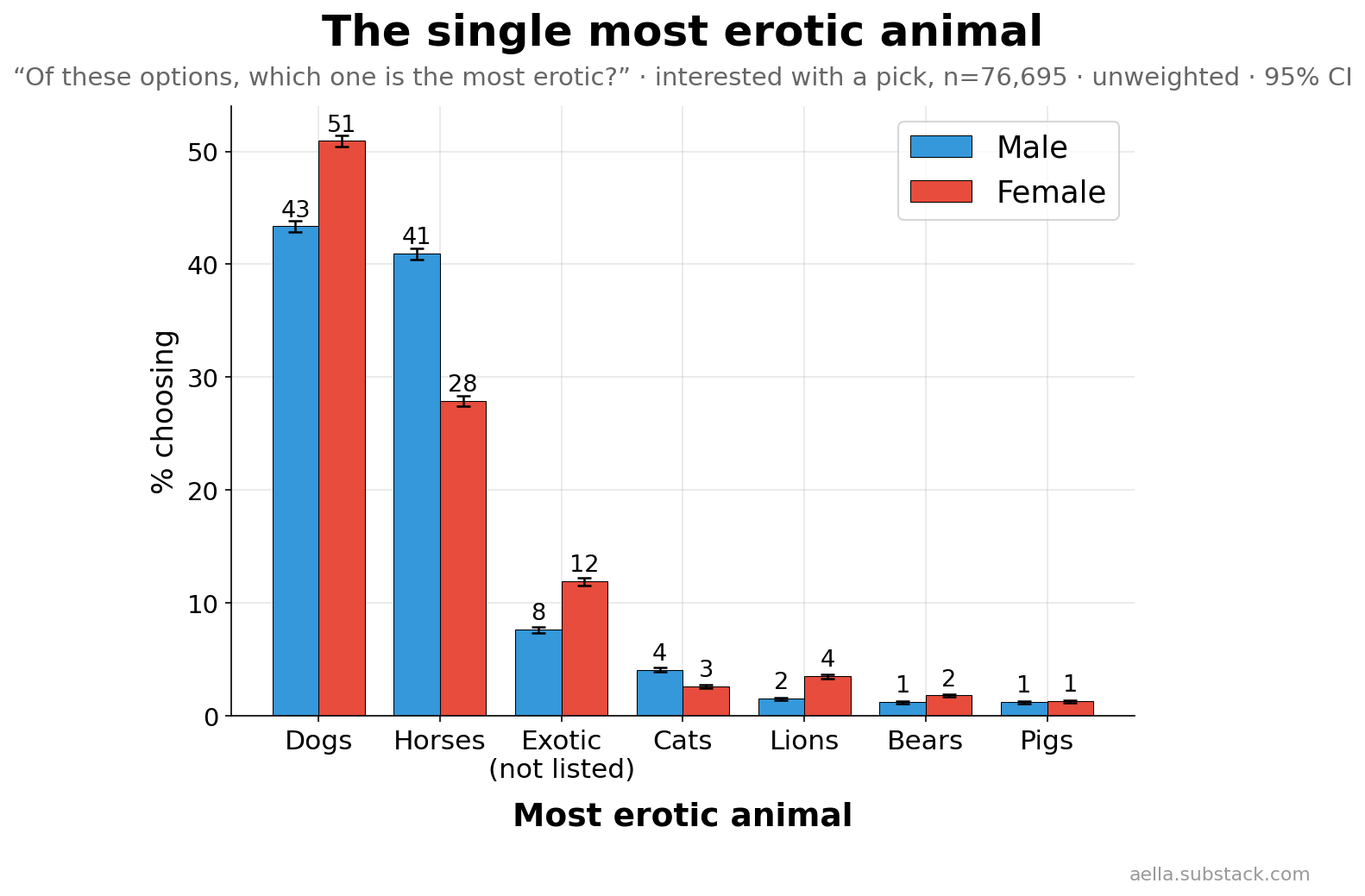
Forced to pick a single favorite, the sex difference sharpens: dogs are women's #1 (51% vs 43% of men), horses are the male pick (41% vs 28%), and women are 50% more likely to name an exotic creature.
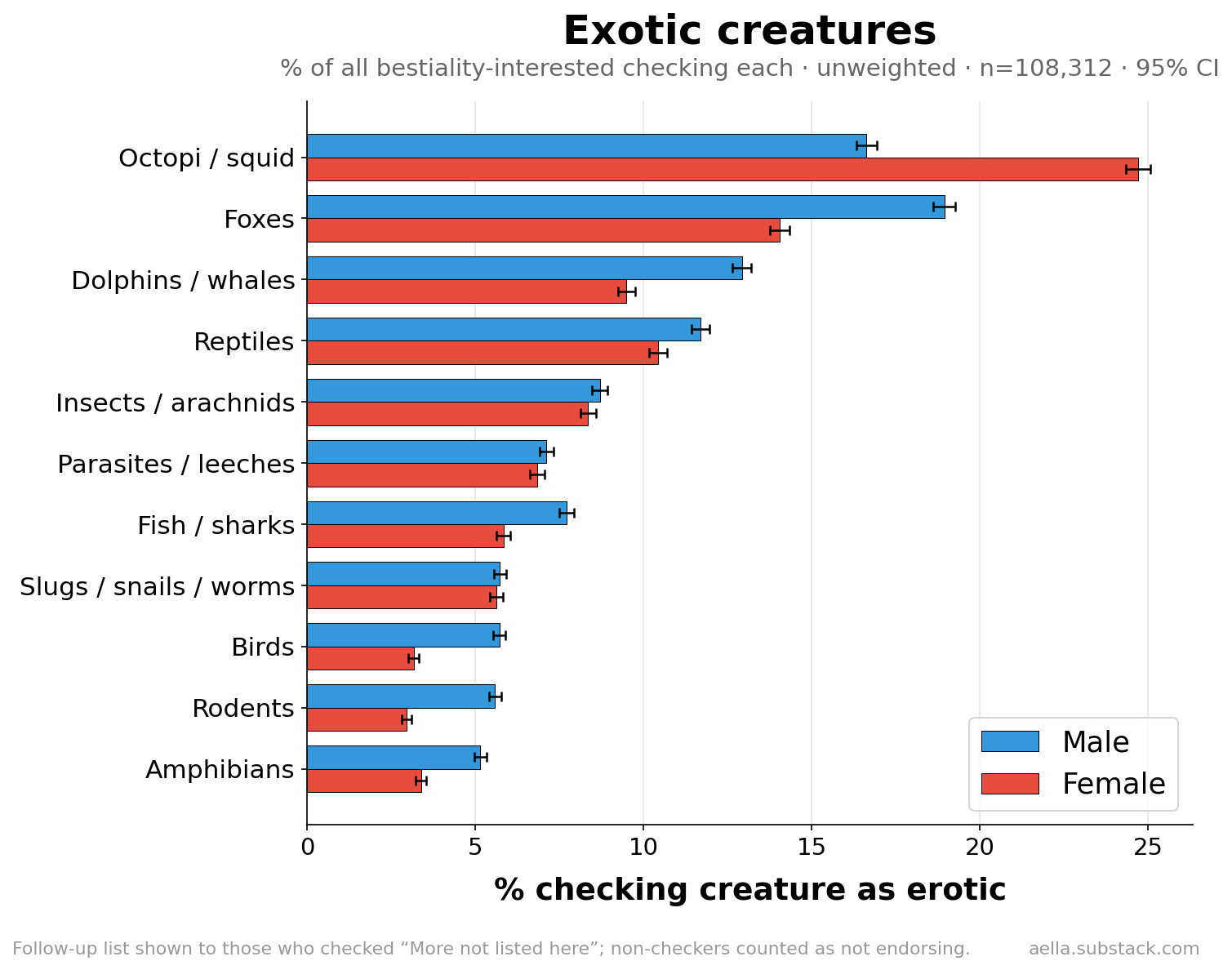
The exotic tail is led by octopi/squid (21% of all interested) — tentacle erotica is a genre for a reason — followed by foxes (17%), dolphins (11%) and reptiles (11%). Insects, parasites and slugs are rare but far from zero.
04Which direction, and since when?
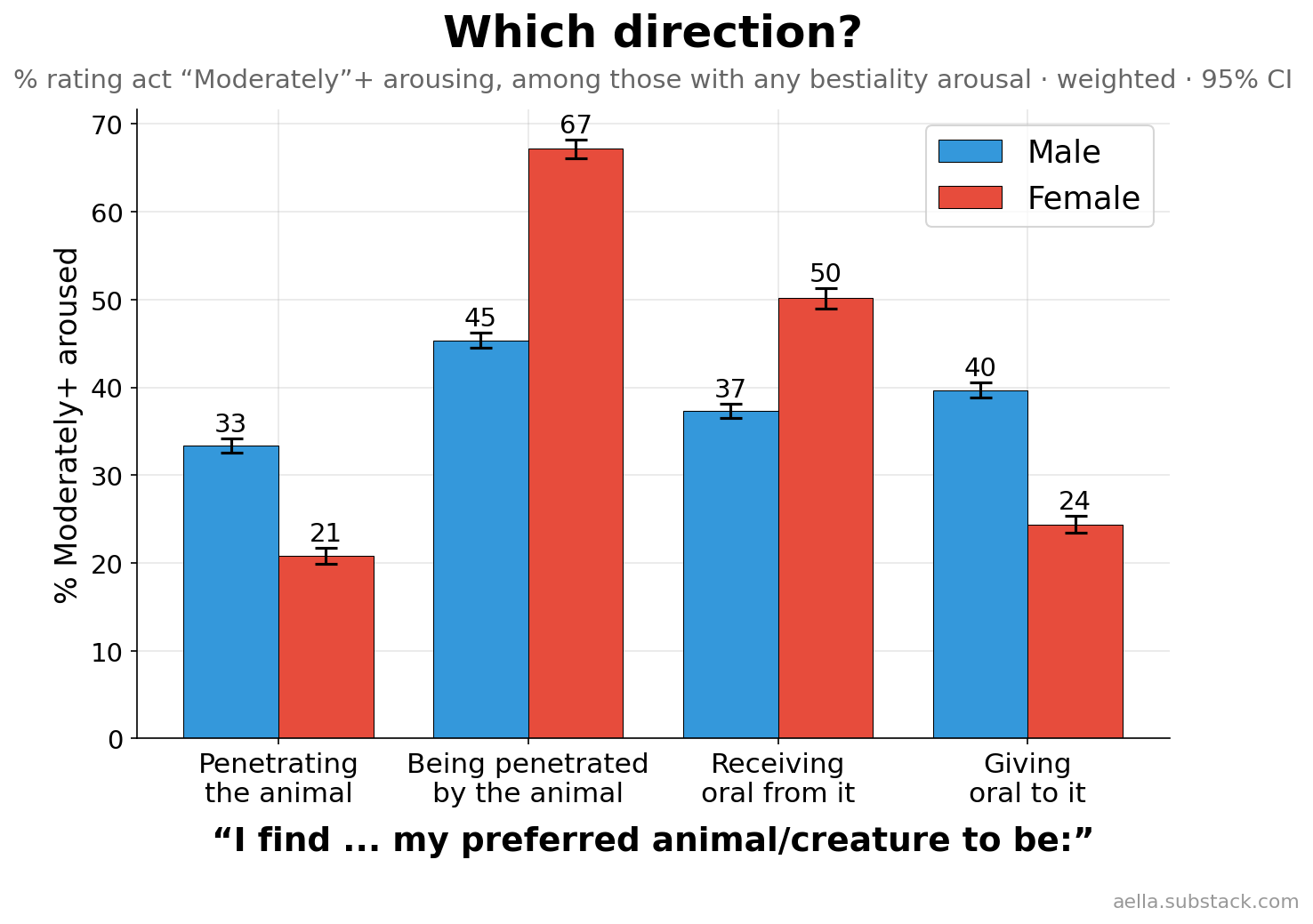
The fantasies are mostly receptive. Among interested women, 67% find being penetrated by their preferred animal moderately+ arousing versus 21% for penetrating it. But men skew receptive too — 45% being-penetrated vs 33% penetrating — and men are also likelier than women to fantasize about giving the animal oral. Whatever bestiality fantasy is doing, "the animal does it to me" is its dominant grammar.
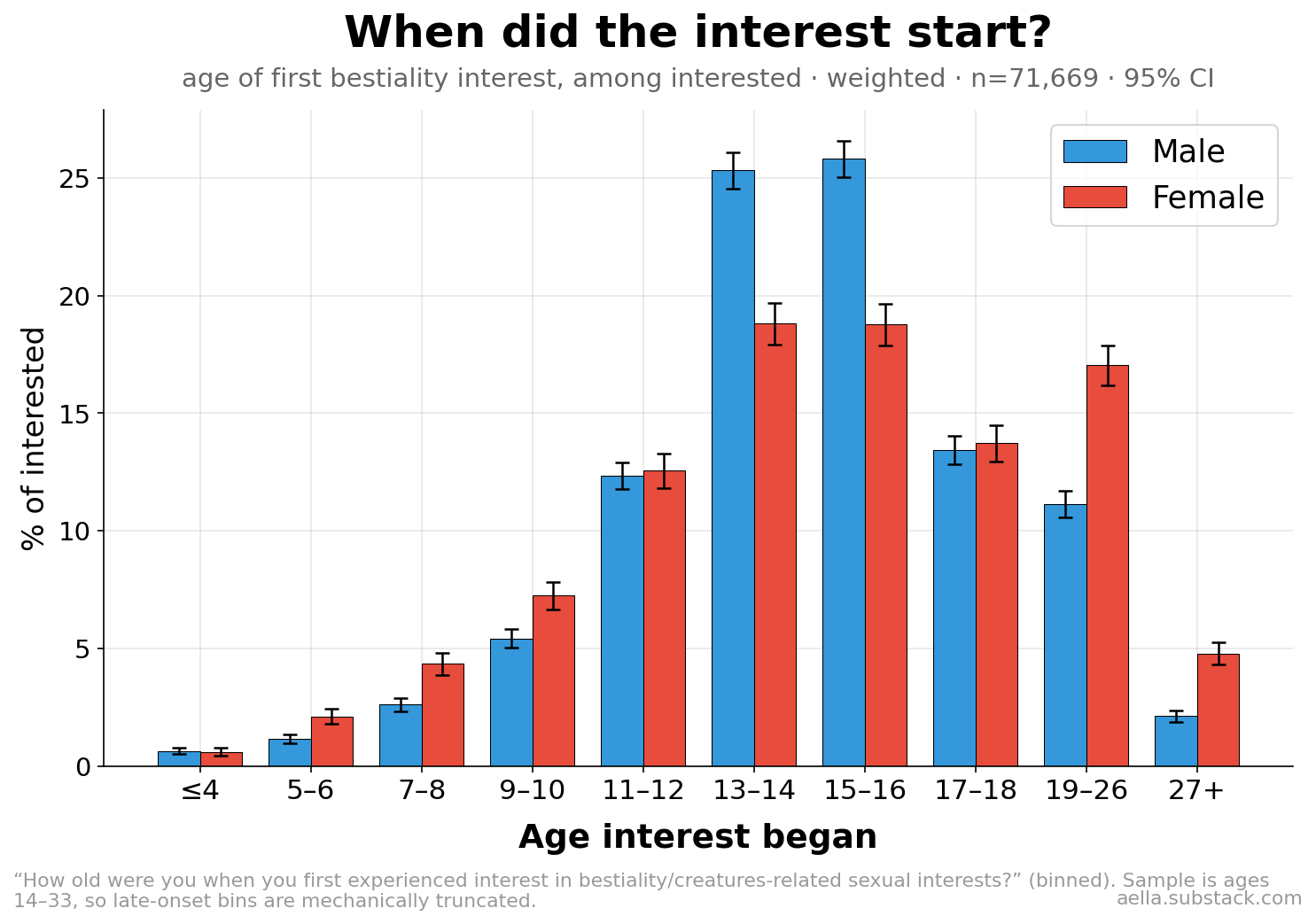
Onset is classic fetish-timing: it peaks at puberty (13–16) for both sexes. But women have a fat late tail — 17% of interested women date the interest to ages 19–26 and nearly 5% to 27+, versus 11% and 2% for men. A meaningful chunk of women acquire this interest in adulthood.
05Who are they? (raw differences)
Switching to the full unweighted sample for precision: 108,312 respondents (10.1%) report some arousal. Raw demographic profile of the interested vs everyone else:
| Bestiality-interested | Everyone else | |
|---|---|---|
| n | 108,312 | 963,043 |
| % female (of this sample) | 47.8% | 63.8% |
| Mean age | 24.2 | 22.4 |
| % straight | 65.2% | 69.9% |
| % bisexual | 22.3% | 17.7% |
| General kinkiness (mean arousal, 59 other kinks, 0–5) | 1.92 | 1.14 |
| Kink breadth (# kinks rated Moderately+) | 24.6 | 14.7 |
In raw comparisons (hollow circles in the chart below) the interested differ on almost everything: they like violent porn much more (d≈0.6), use porn more (d≈0.5), are more ashamed of their arousal (d≈0.4–0.5), have broader interests, more autism (d≈0.3), more depression, more ADHD, more childhood sexual assault, and they're less straight.
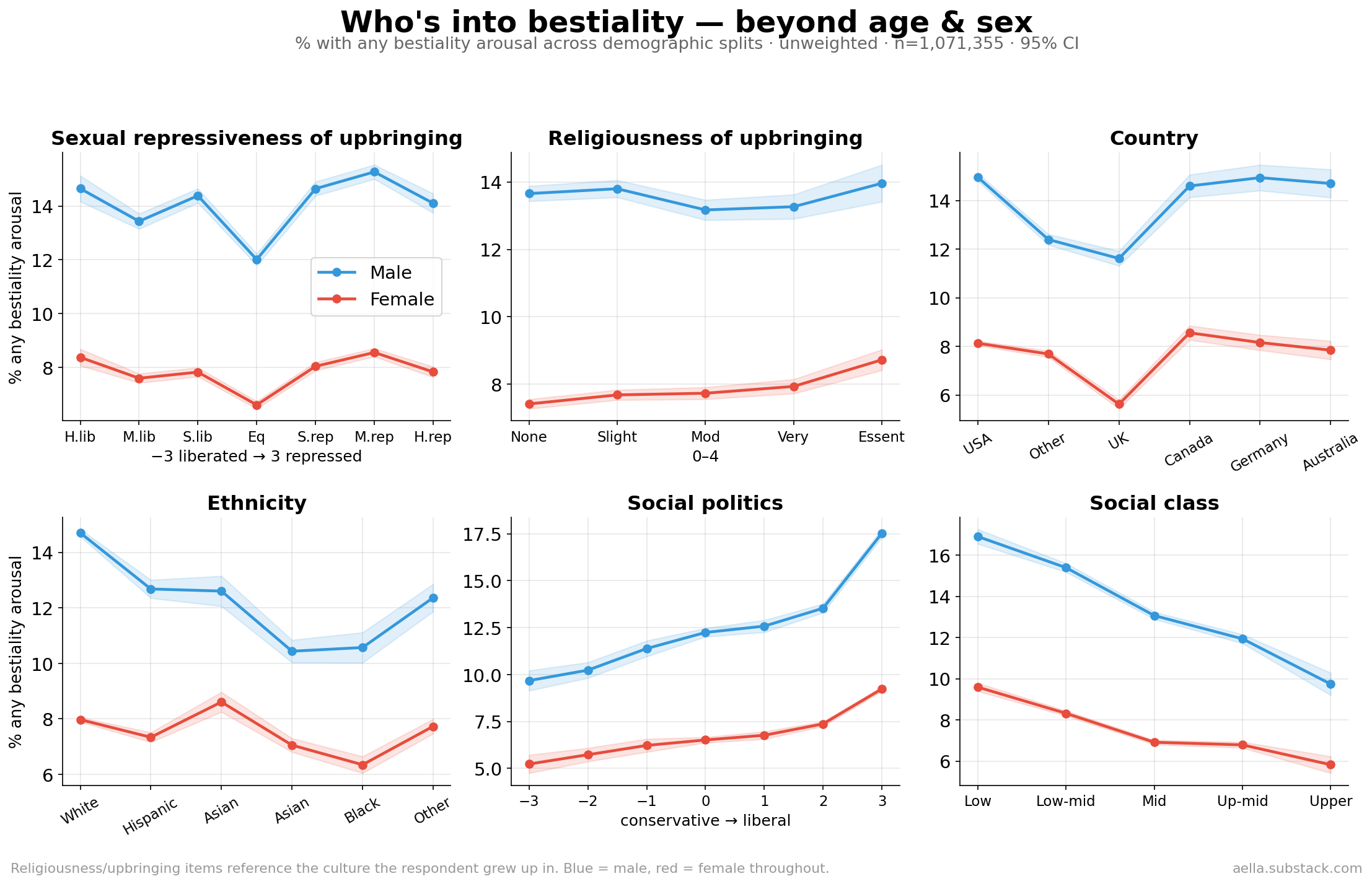
Background matters too — and not always the way you'd guess. Bestiality arousal is highest among the politically liberal and the lower social classes, follows a U-shape by upbringing (both the most sexually repressed and the most liberated childhoods report more than the balanced middle), is slightly higher with a more religious upbringing, and varies by country (lowest in the UK) and ethnicity (highest among White and "other" respondents). The male–female gap holds within every group.
06The key question: what's unique, vs just "being kinky"?
Bestiality-interested people are much kinkier overall (1.91 vs 1.17 on the 0–5 composite). So is any of the above actually about bestiality, or is it just the standard profile of a very kinky person? The solid dots below re-estimate every difference holding general kinkiness (and age) constant — i.e., comparing the interested to equally-kinky people.
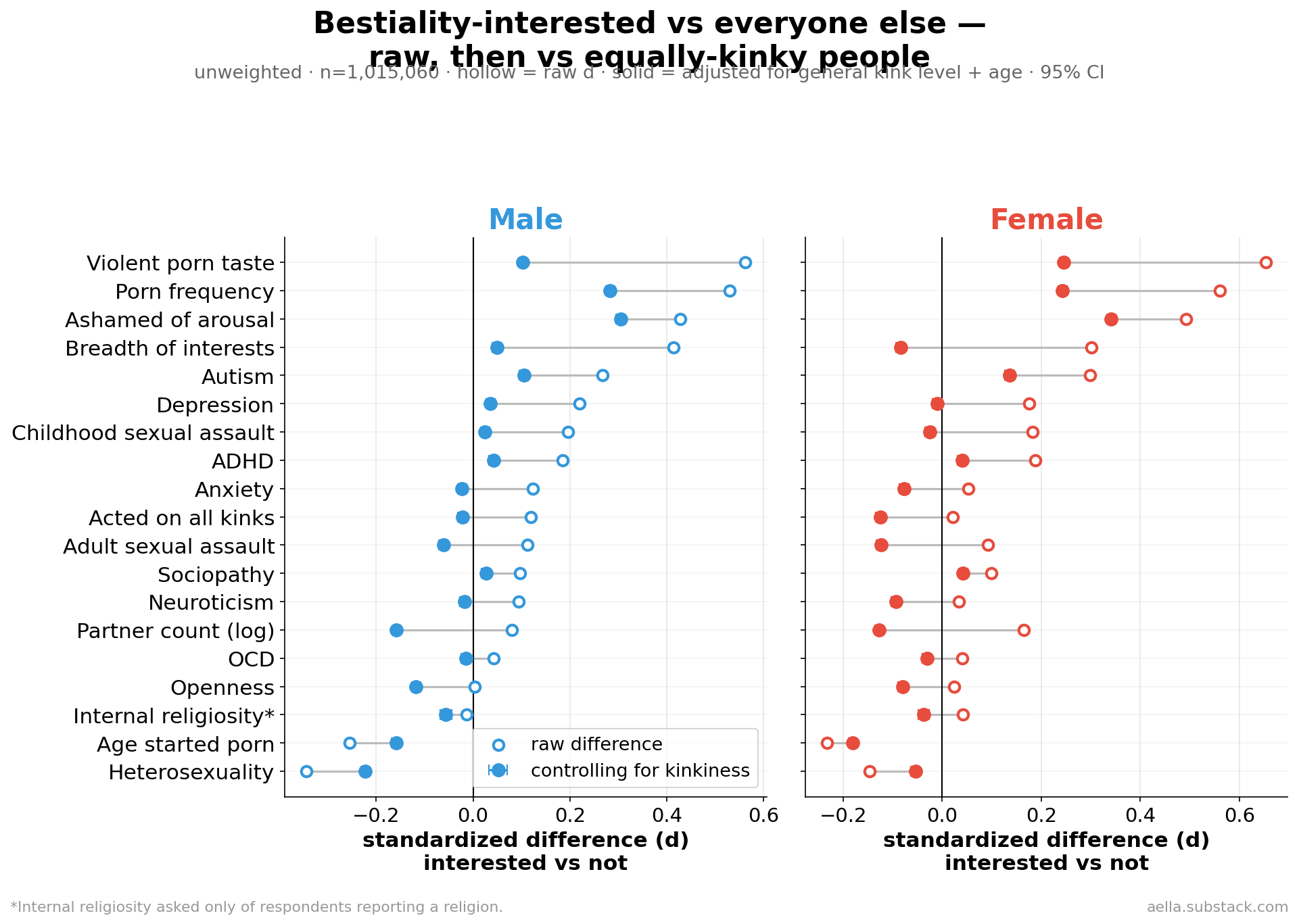
Almost everything collapses. Depression: gone (d≈0.2 → 0.0). Childhood sexual assault: gone (0.2 → 0.0). Anxiety, ADHD, breadth of interests, sociopathy: gone. These are correlates of being kinky at all, not of bestiality specifically. What survives:
- Shame (d≈0.30 men, 0.34 women) — the single most bestiality-specific psychological feature. Even among equally kinky people, the bestiality-interested are far more likely to agree "I am ashamed or embarrassed about at least some of what arouses me."
- Porn: heavier (d≈0.25) and started earlier — and a residual taste for violent porn, stronger in women (d=0.24) than men (d=0.10).
- Autism (d≈0.10–0.13) — shrinks a lot but doesn't vanish.
- Lower heterosexuality in men (d=−0.22) — the bi-men effect is not just kinkiness.
- Fewer partners (d≈−0.12 to −0.15) — the raw difference actually flips sign: for their kink level, bestiality-interested people have somewhat fewer sexual partners, consistent with a more fantasy-weighted, less enacted sexuality.
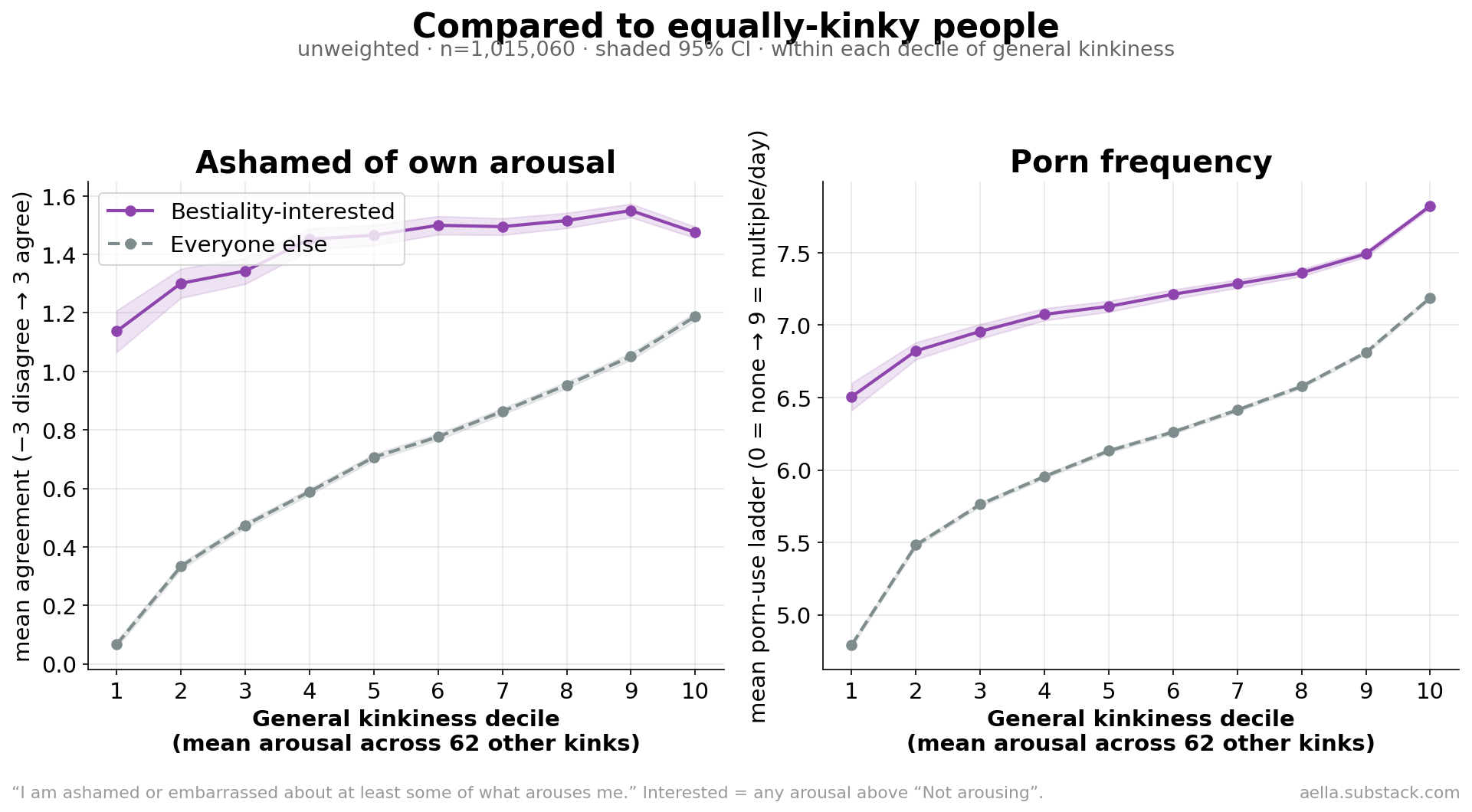
The shame gap holds at every level of kinkiness — it's not driven by some odd corner of the distribution. Porn frequency shows the same persistent gap:
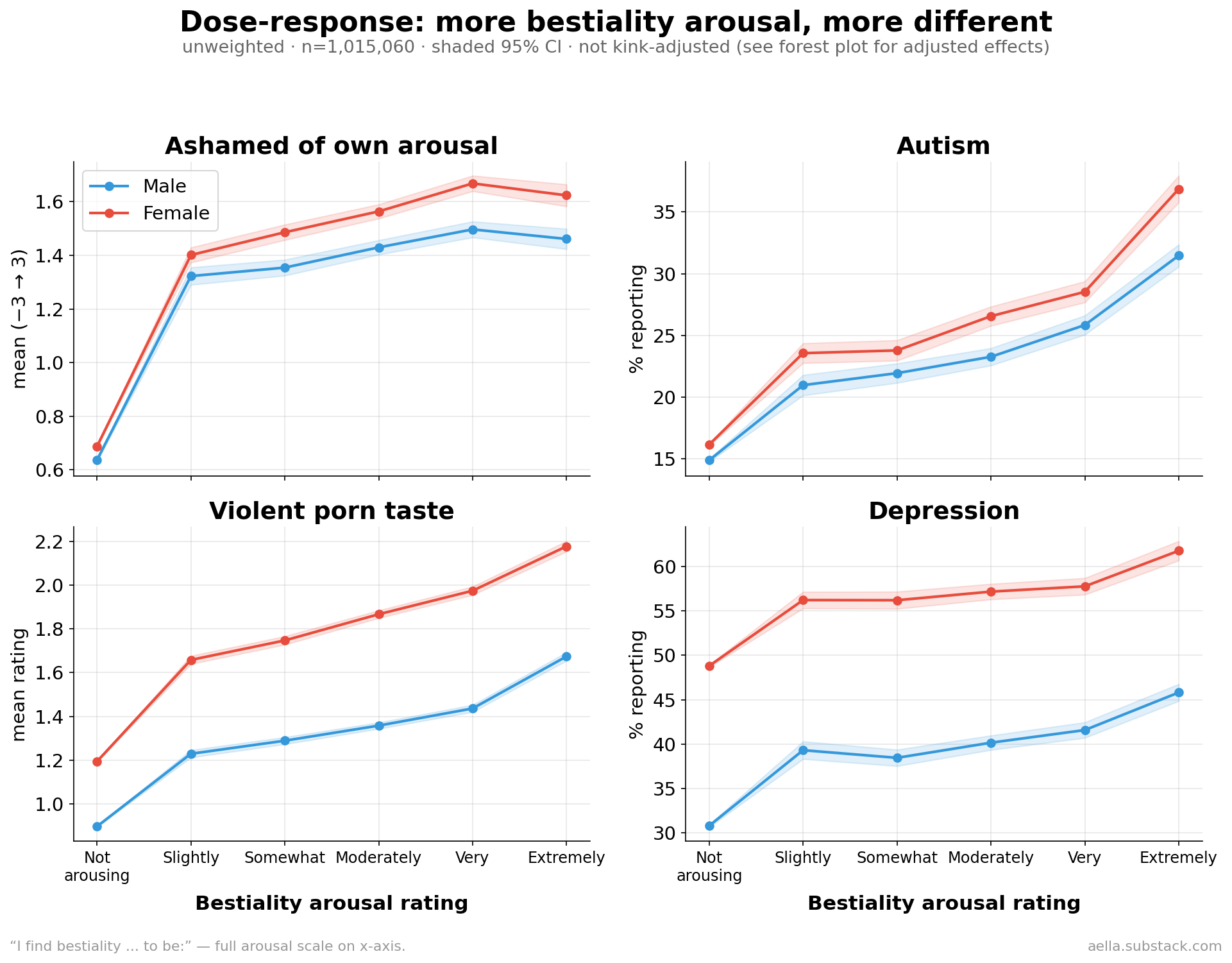
And the differences scale with intensity. Autism climbs from 15–16% among the unaroused to 31% (men) and 36% (women) at "Extremely"; shame jumps the moment there's any interest; violent-porn taste rises monotonically. Depression, by contrast, steps up at "any interest" and then barely moves — the signature of a generic-kinkiness correlate rather than a bestiality-specific one.
07The kink signature: taboo, not BDSM
Which other kinks does bestiality travel with, beyond what general kinkiness predicts? Partial correlations, controlling each person's mean arousal across the other kinks:
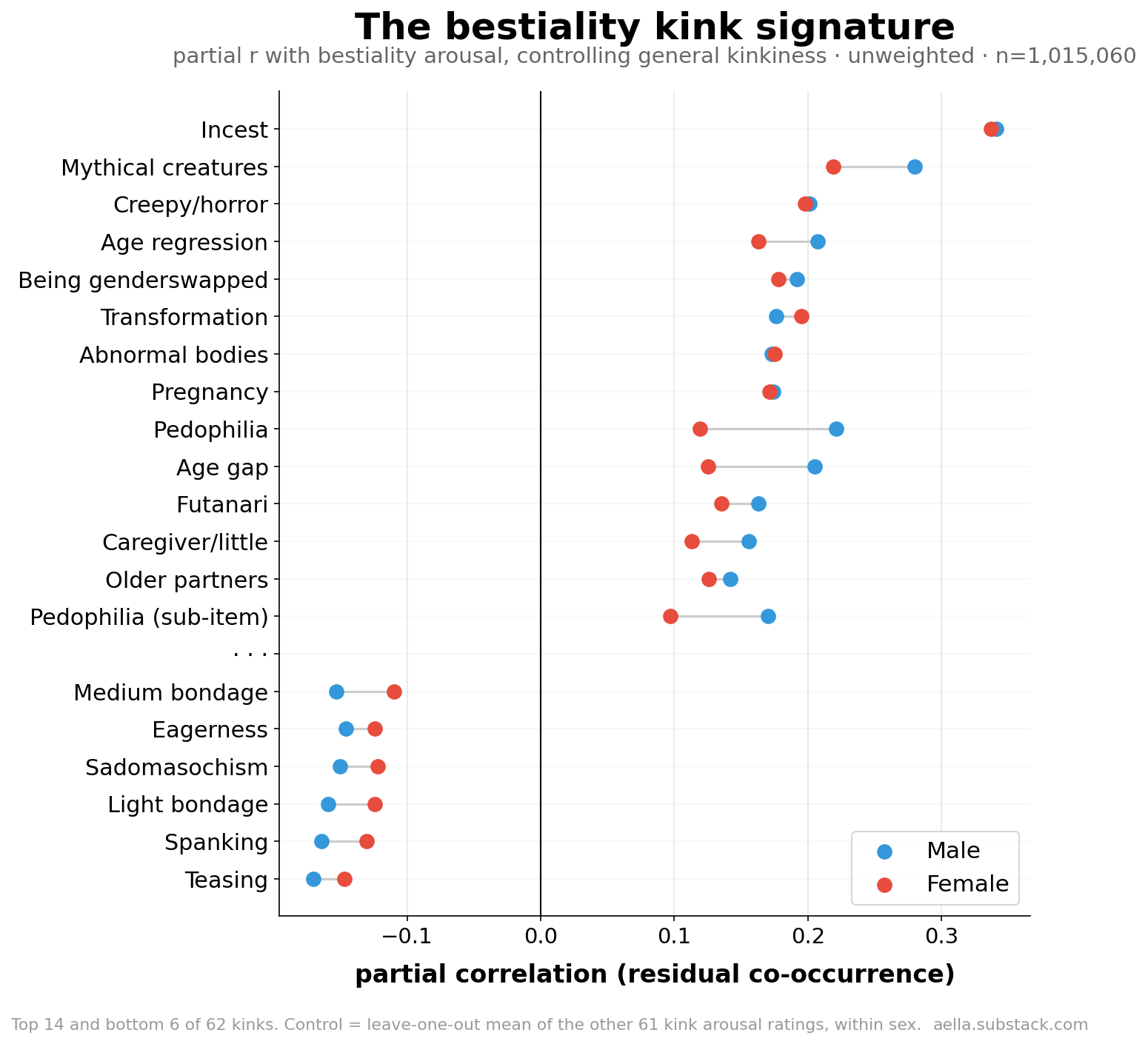
The residual signature is a taboo/creature/transformation cluster: incest is the standout (partial r=0.34 in both sexes), then mythical creatures, creepy/horror, transformation, age regression, genderswap, abnormal bodies, pregnancy — with pedophilia-adjacent items notably higher in men (0.22) than women (0.12). At the bottom, the most mainstream kinks — teasing, spanking, light bondage, sadomasochism — correlate negatively once kinkiness is controlled. Bestiality is not "BDSM but more"; it's a different axis, the one organized around violating category boundaries rather than around power and sensation.
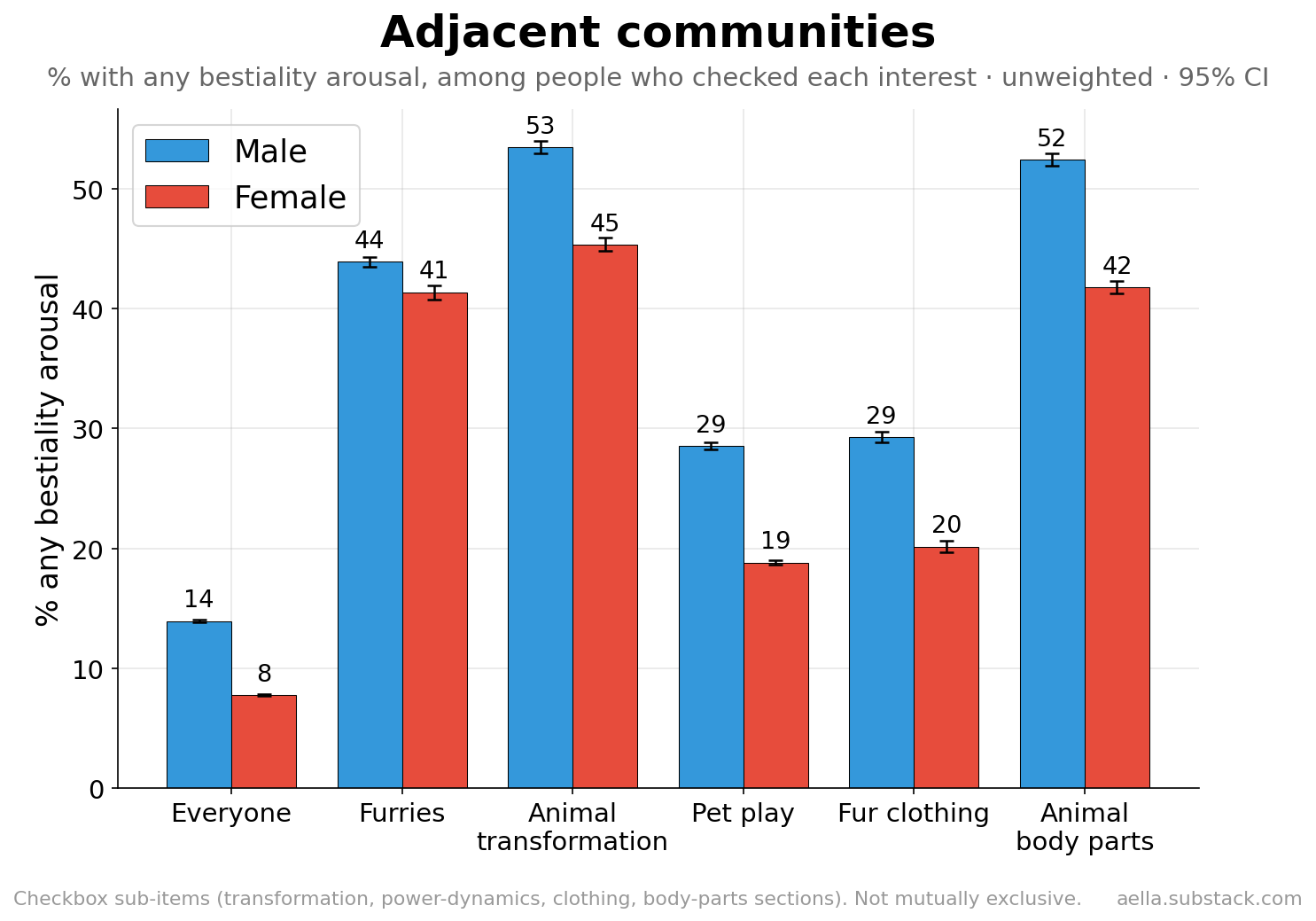
The neighboring communities tell the same story. People who checked furry, animal-transformation, or animal-body-part interests are massively enriched for bestiality arousal (42–54% vs the 8–14% baseline). But the overlap runs mostly one way: only 30% of the bestiality-interested checked furries — they are not simply furries by another name (52% did check pet play, though).
08Species profiles: dog people vs horse people
Grouping the interested by their single most-erotic animal:
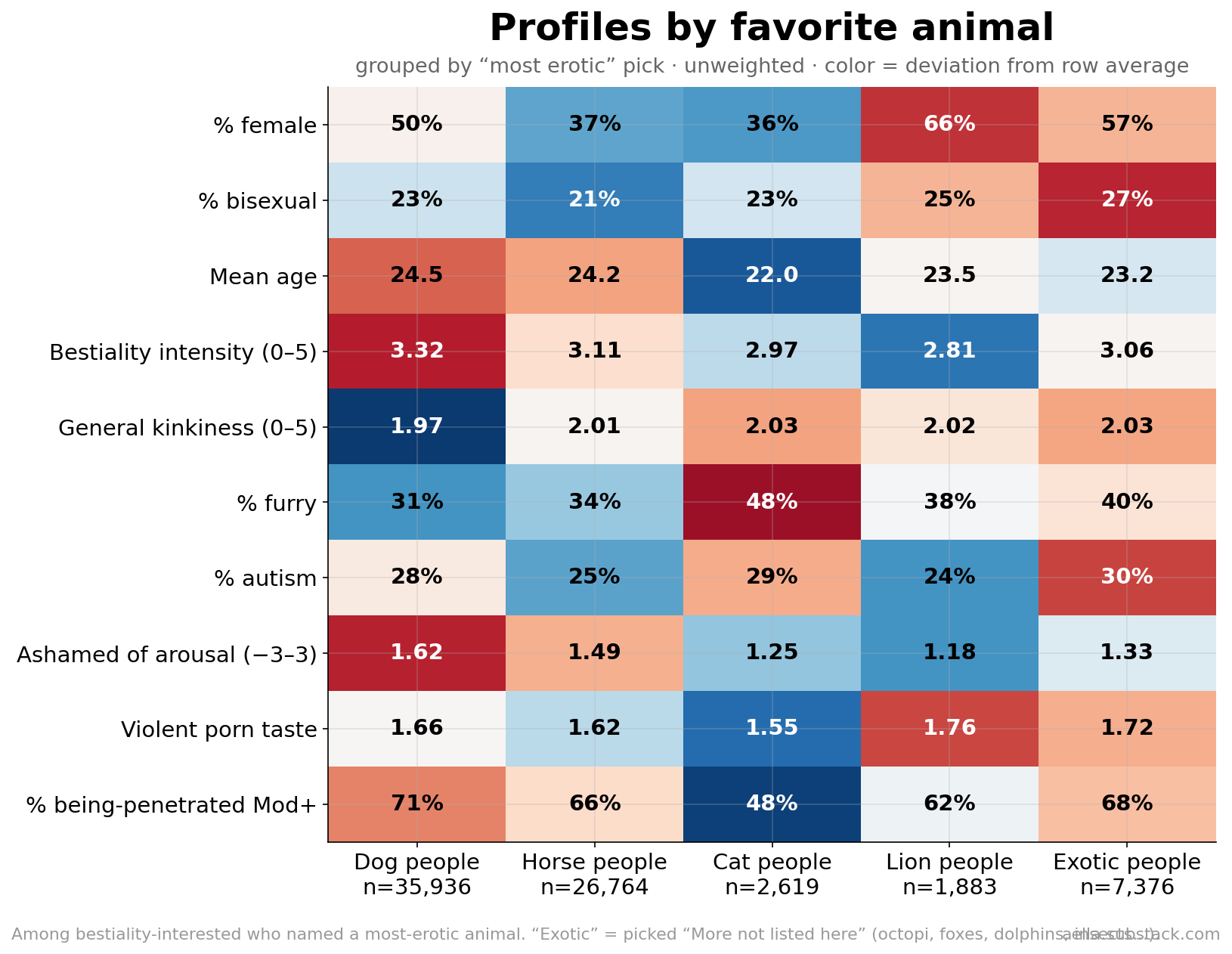
- Dog people (the plurality, 51% female): the most intense bestiality arousal, the most receptive fantasies (71% being-penetrated Mod+), the most shame, yet the least kinky overall — closest to "ordinary person with one very strong weird thing."
- Horse people (63% male): similar but less ashamed, slightly less receptive.
- Cat people (small, male-skewed, youngest): the furriest group (48%) and by far the least receptive — reads more like aesthetic/anthro attraction than the penetration-centered fantasy of dog and horse people.
- Lion people (66% female, 30% bisexual): the "monsterfucker" profile — low shame, high violent-porn taste, big-predator romance.
- Exotic people (58% female): the most bisexual (32%) and highest-autism (30%) group — octopi, foxes, dolphins.
09Methodology & limitations
Source & measures
Aella's Big Kink Survey (GuidedTrack), ~2021–2026, n=1,071,355 after cleaning. The bestiality item is gated: respondents first check whether any "Bestiality/creatures" category arouses them at all; non-checkers are scored "Not arousing." Sub-questions (specific animals, acts) were asked only of those with some arousal, and act-level percentages are reported only within that group. The raw arousal scale is non-linear (Not=0, Slightly=1, Somewhat=2, Moderately=3, Very=5, Extremely=8) and was recoded to ordinal 0–5; means over it are for comparison, not interval-scaled truth.
General kinkiness = mean arousal across the 59 other category-level kink items (everything from spanking to vore); kink-adjusted differences are OLS coefficients on standardized outcomes with kinkiness and age as covariates, fit separately by sex. The kink-signature chart uses partial correlations controlling a leave-one-out version of the same composite. Error bars/bands are 95% CIs; weighted CIs use the raking design's effective n (DEFF ≈ 3.2).
Limitations
- Fantasy, not behavior. Worth repeating: no question asks about actual acts.
- Not a random sample. The unweighted sample is self-selected people willing to take a long kink survey — young, very online, kink-tolerant. Weighting corrects demographics (sex, age 14–33, cis/trans, politics, BMI, ethnicity) for the base-rate section, but can't conjure people who'd never take a kink survey; true population rates are plausibly somewhat lower.
- Cross-sectional. "Autism correlates with bestiality arousal" says nothing about direction or mechanism.
- Kinkiness control is a composite. Controlling for mean arousal across 59 kinks is a strong but imperfect way to define "equally kinky"; residual confounding by unmeasured dimensions of sexuality is possible.
- Gated sub-items. Species and act questions were only shown to the interested; all such percentages are conditional on interest, never population rates.
- Self-report, anonymous, with all the usual caveats — though anonymity is exactly what makes taboo items like this answerable at all.
Analysis pipeline: pandas + numpy; scripts and full results tables available on request.