Who Does Well in Relationships?Personality, childhood, kink and more from glosso.ink, checked against the relationship survey, with every test planned before I looked
1,119 people on glosso have taken the relationship survey. Most of them have also taken other glosso surveys: personality, childhood, BDSM, sex life, what scares you, consent, and more. I wanted to know if any of that predicts having a better relationship, and in particular whether some kinds of people do better at poly and others at monogamy.
The sample is small and there are a lot of possible comparisons, which is a good recipe for finding things that aren't real. So I wrote down every test before pulling the data, corrected for the number of tests, and required each finding to show up again in a held-out half of the sample.
The short version
- No personality type is better suited to poly. Out of 400 tests of "does this trait matter more for mono or poly people," none survived. For flourishing, every personality trait has nearly the same effect in mono and poly people. This sample can rule out big differences, but not small ones.
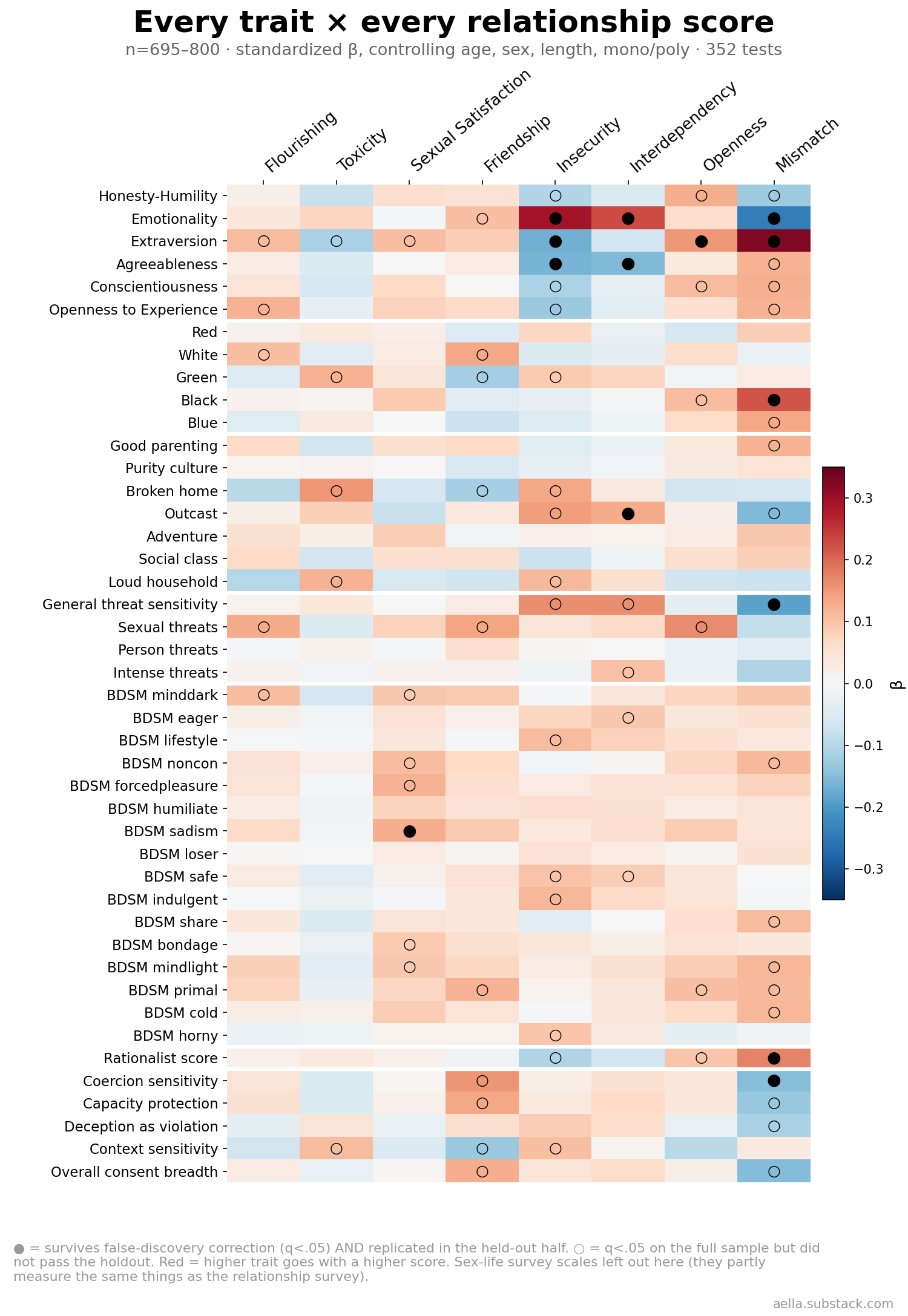
- Personality barely predicts how good someone's relationship is. Nothing reliably predicts flourishing except scales from the sex-life and relationship-desires surveys, which partly ask the same questions. Extraversion and openness to experience come closest, with small effects that didn't hold up in the held-out half.
- Personality does predict how people feel inside their relationship. People high in emotionality are much more likely to feel insecure: 33% vs 4% among women, 17% vs 5% among men. Extraverted and agreeable people feel less insecure. Extraverts are much more likely to think they're the better catch, about 85% vs 56% in both women and men.
- Kinkier people are more likely to be poly. CNC, sadism, primal and several other BDSM scales all go with being on the poly side. People high on the "Green" colour (nature, tradition, acceptance) are less likely to be poly.
- Poly people are less insecure and less intertwined with their partner. That holds up. The data also suggests poly people flourish more, but that part only appears in people whose poly answer was estimated, so I don't trust it.
01How I avoided fooling myself
With 1,119 people and about 50 traits, there are hundreds of ways to slice the data. Run enough comparisons and some will look significant by luck. Here is what I did about that:
- Wrote the plan first. Every outcome, trait, control and test was fixed in a plan file before any relationship data was pulled. Everything in this report comes from that plan, and every test is in the downloadable tables, including the ones that found nothing.
- Corrected for the number of tests. Each question's tests were corrected together (Benjamini–Hochberg false discovery rate). A finding needs q < .05 after correction. Raw p-values are never the headline.
- Held out half the sample. People were randomly split in two. Anything that looked promising in the first half had to show up again, same direction and p < .05, in the second half before I call it a finding.
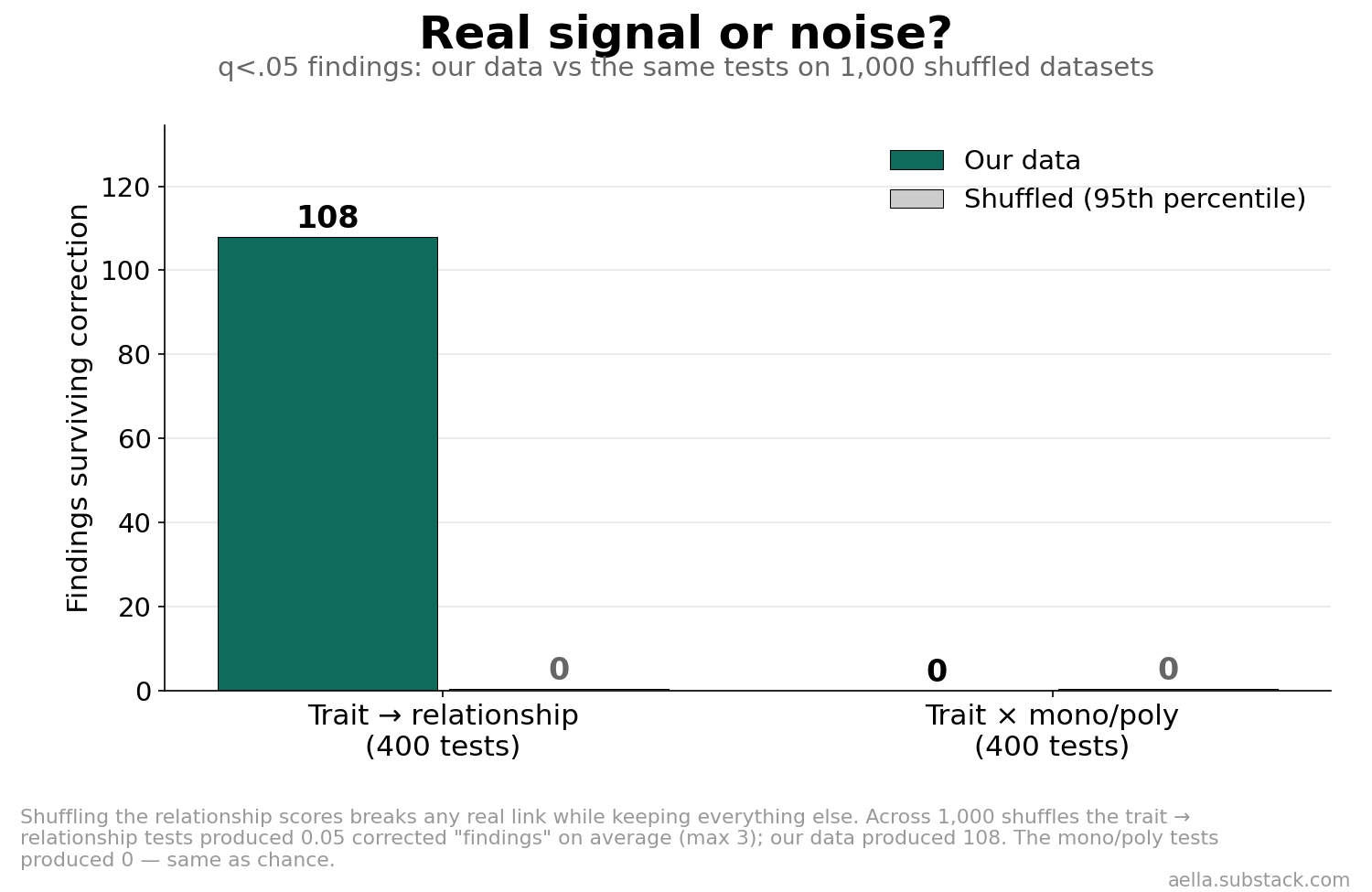
- Checked against chance. I shuffled the relationship scores 1,000 times, which destroys any real link, and ran all the tests again each time. If the method were producing false positives, the shuffled data would produce "findings" too.
- Checked the survivors. Every headline result was rerun separately for men and women, and the poly results separately for people who answered the poly question themselves vs. people whose answer was estimated.
Every control in every model: age, age², biological sex, and how long the relationship has lasted.
02Is any personality better at poly?
This was the main question. For each trait, I asked whether it predicts relationship scores differently for people on the mono side (0–2 on the mono/poly question) vs the poly side (3–5). That's 50 traits × 8 relationship scores = 400 tests.
None survived correction. The shuffled datasets produced the same number: zero. For flourishing in particular, here is how each personality trait relates to it in each group:
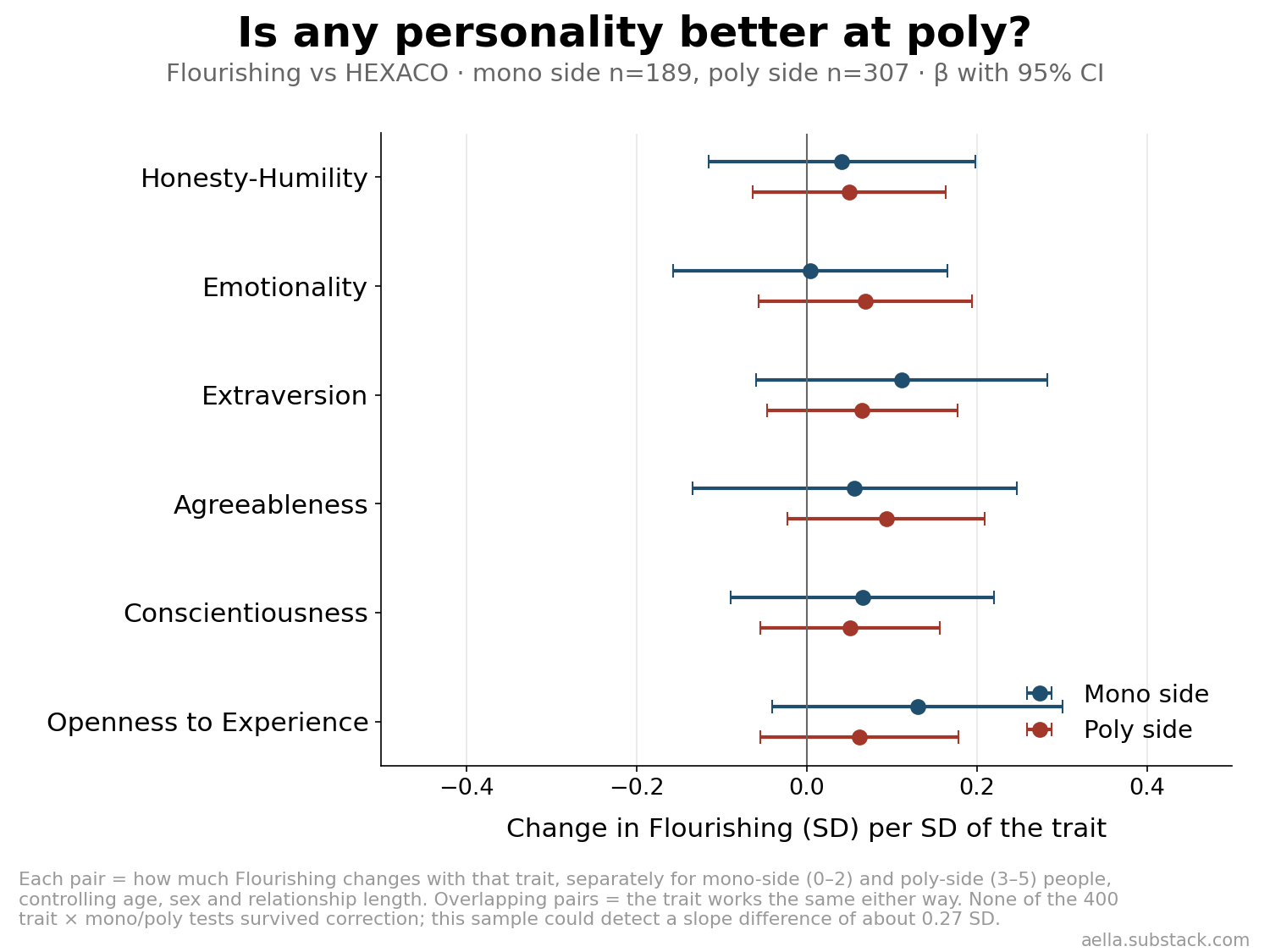
The simple version: extraverts flourish a bit more than introverts, and that's about equally true in both groups.

What "nothing found" means here: this sample could detect a difference of about 0.27 standard deviations in how much a trait matters for mono vs poly people. So there's no large personality-by-poly effect. There could still be small ones that a bigger sample would catch. The closest call was childhood: a good-parenting score predicted flourishing for mono people (+0.34 SD) and not for poly people (+0.01). It was nowhere near surviving correction (q = .90), so I'd treat it as a thing to check later, not a finding.
03What predicts a better relationship?
Ignoring mono/poly, does anything predict relationship scores? Yes, lots of things, but mostly about how the relationship feels, and very little about whether it's good.
Flourishing was the main outcome: "This relationship is good for me", "I think this relationship will last for a very long time", "My partner enables me to learn and grow", and similar. The only things that reliably predict it come from the sex-life survey, which partly measures the same thing (below). Among actual traits, the strongest were openness to experience (+0.12 SD per SD) and extraversion (+0.11). Both passed correction on the full sample but didn't hold up in the held-out half.
The sex-life survey mostly restates the relationship survey
The sex-life survey's "Wanting" scale strongly predicts lower sexual satisfaction (−0.60 SD), lower flourishing (−0.29) and more toxicity (+0.31). "Disengaged" does much the same. But "Wanting" is built from items like "I'm satisfied with my sex life" (reversed) and "There's ways my sex life could be better", so it's largely the same question asked twice. I count these as real but uninteresting. I noticed this after seeing the results; the plan listed the sex-life survey as an ordinary predictor. All 14 of its replicated results are in the downloads.
The same goes for the Relationship Desires survey ("what do you want from a relationship"), which I'd already marked in the plan as too close to the outcome. Wanting quality predicts flourishing (+0.25), which is about what you'd expect.
04Insecurity and feeling like the catch
These were the clearest personality results. All of them passed correction, replicated in the held-out half, and held for men and women separately. The charts below split by sex because women score much higher on emotionality (average percentile 59 vs 38 for men), so a pooled chart would partly show a sex difference.

"Mismatch" in the relationship survey is mostly "If we broke up, I think I could date a higher quality person than they could" and "I feel like I would still be a desirable mate even if my partner left me." A high score means you think you're the better catch.

Two other replicated results: agreeable people are less intertwined with their partner (−0.15 SD), and people who felt like outcasts as kids are more intertwined (+0.13). Among the BDSM scales, the only replicated result was sadism with higher sexual satisfaction (+0.13).
05Who's poly
A different question: which traits go with being on the poly side at all? 50 tests, 8 replicated.
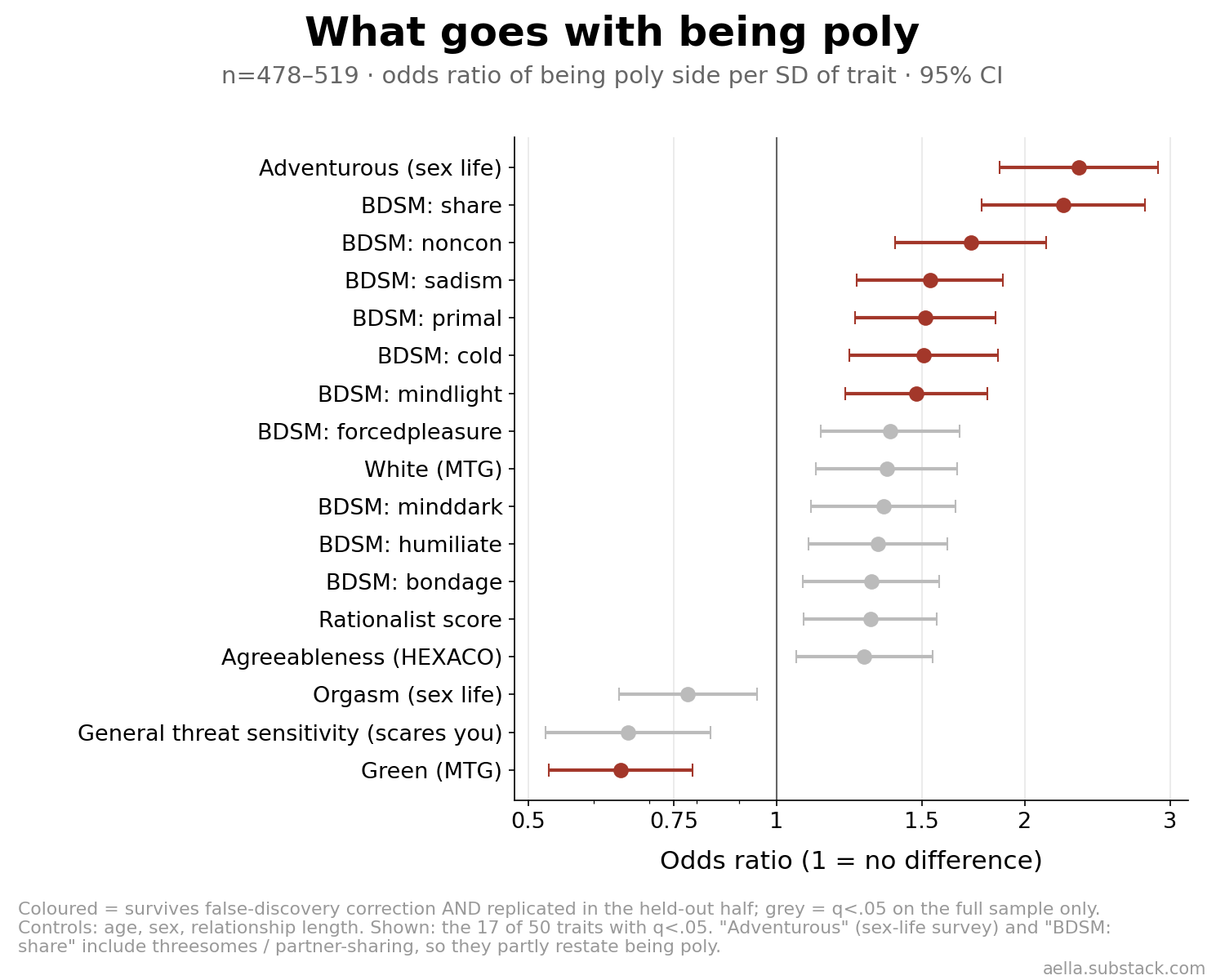

Personality (HEXACO) barely predicts being poly. Agreeableness came closest (odds ratio 1.28 per SD) and didn't replicate.
06Mono vs poly: how relationships differ
Controlling for age, sex and relationship length, poly-side people score lower on Insecurity (−0.27 SD) and lower on Interdependency (−0.32 SD). Both hold for people who answered the poly question themselves and for people whose answer was estimated.
Poly-side people also score higher on Flourishing, Friendship and Openness, but only among the estimated group. Among people who answered for themselves, those differences are near zero. This matches the earlier glosso poly report, which found flourishing about equal in open and exclusive relationships.
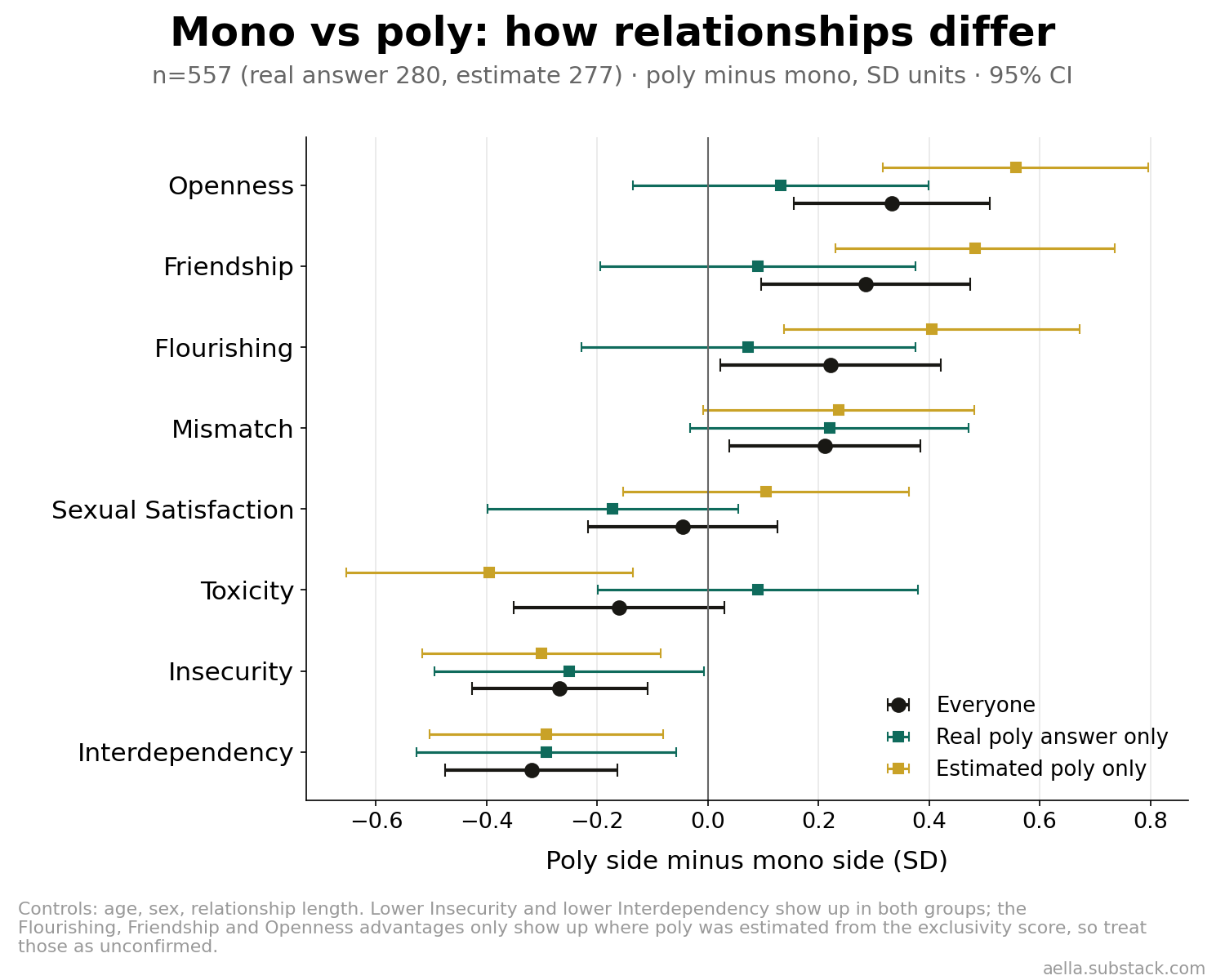
Why some poly values are estimated: between April and October 2026 a bug on glosso stopped the relationship survey from saving its demographic questions, including the poly question. For 300 people in that window I estimated poly from their score on the glosso exclusivity quiz. The estimate gets the mono/poly side right about 82% of the time. It's good enough to use as a control and for "who's poly," but it can carry its own link to relationship quality, which is likely what's happening above.
07Caveats
- Glosso is not a normal sample. It's a very online, very kinky, very poly crowd: 58% of people with a poly answer are on the poly side. These results describe glosso users.
- Everything is self-report from the same person. Someone who answers personality questions anxiously may also answer relationship questions anxiously. That inflates links between "emotionality" and "insecurity" in particular.
- One point in time. These are correlations between people. They don't show that becoming more extraverted would make you feel more secure, or that kink makes people poly.
- Missing data. About half the sample has no poly value. 92 people are missing relationship length and drop out of the models. Each trait has its own sample (695–800 people) depending on who took that survey.
- Power. The mono/poly comparisons have 189–307 people per group. They can find big differences and miss small ones.
08Methods and data
| Question | Tests | q<.05 | Replicated | Shuffled data (avg) |
|---|---|---|---|---|
| Trait → relationship score | 400 | 108 | 28 | 0.05 |
| Trait × mono/poly → relationship score | 400 | 0 | 0 | 0.03 |
| Trait → being poly side | 50 | 17 | 8 | — |
| Mono vs poly → relationship score | 8 | 6 | — | — |
- Outcomes: the 8 relationship-survey scores (average of 6 items each, −3 to 3), standardized. Flourishing was the pre-planned primary outcome.
- Traits: HEXACO personality (6), MTG colour wheel (5), childhood (7), what scares you (4), sex life (6), BDSM (16), rationalist score (1), consent (5). Relationship Desires (6) reported separately. Each standardized.
- Models: OLS with robust (HC3) standard errors, controlling age, age², biological sex and log relationship length. The trait → relationship models also control mono/poly side, with "unknown" as its own category so nobody is dropped. Being poly side: logistic regression.
- Sex: biological sex is a control in every model, and every headline result was also rerun separately for women and men. Percentage charts are split by sex, or sex-adjusted where the cells would be too small. Thirds of each trait use the same cut-offs for both sexes.
- Mono/poly: real answer to the mono/poly question if present, otherwise the exclusivity-based estimate. Mono side = 0–2, poly side = 3–5.
- Holdout: random 50/50 split. Discovery half: anything at q < .10. Held-out half: same sign and p < .05.
- Sample: everyone with a relationship-survey result on glosso as of October 21, 2026 (n=1,119). Unweighted. Ages outside 18–80 set to missing.
Full results, every test including the nulls: trait → relationship · trait × mono/poly · trait → poly · mono vs poly · robustness checks · relationship desires. These are summary statistics only; no individual answers are published.